
Volume: 11 Issue: 01 | Jan 2024 www.irjet.net
Volume: 11 Issue: 01 | Jan 2024 www.irjet.net
ARATI C1 , PRAVEEN. B M1,* , PAVITHRA B N1,2, SUDHAKAR3
1 Department of Chemistry, Srinivas University, Institute of Engineering & Technology, Mukka, Srinivas Nagar, Mangaluru, Karnataka, India.
2 School of Engineering, Department of Chemistry, Presidency University, Itgulpura, Bengaluru, Karnataka, India.
3 Department of Chemistry, Raja Rajeswari College of Engineering, Ramohalli Cross, Kumbalagodu, Bengaluru, Karnataka, India. ***
Introduction
The global concern of water pollution caused by various contaminants originating from wastewater, agriculture, municipalities,andindustriesiswellknown.Thesepollutants,foundinunbalancedconcentrations,poseseriousthreatsto humanhealthandaquaticlife.
Industrial waste is being discharged into the environment at an increasing rate due to the development of the chemical industry. It is projected that this waste will have a deleterious effect on human immunity and reproduction, leading to neurological and behavioral disorders in people. Since there is currently no cure or therapy for many diseases, like diabetes,itiscrucialtomanagethedisease'ssymptoms.Bloodglucosemonitoringisthoughttobeacrucialtoolforboth early disease detection and management of its side effects. Furthermore, blood glucose monitoring might be highly beneficialforthetreatmentofpatients.Asa result,developingnewsensorshasemergedasa crucialarea ofresearchfor the detection of substances at trace amounts. Researchers worldwide are actively exploring measures and detection methodsforthesepollutantsanddetectingbiologicalmolecules.
Researchershavebeenworkingontheuseofnanostructuresthatcansensethesepollutantsandbiomoleculesaccurately andspecifically.Toaddressthesechallenges,researchersareexploringinnovativenanomaterials,suchasmetaloxides,and dopedmetaloxides.
Compared to other conventional methods, electrochemical detection techniques have advantages One of the industries with the quickest growth is electrochemical sensors. Amperometric sensors generate an electroactive species by the oxidationorreductionofmeasuringthevoltagedifferentialbetweenanelectrodeandareference.
Cyclicvoltammetry(CV)isanelectrochemicalmethodusedinthestudyofredoxprocesses,andelectrontransferchemical reactions.Studyingchemicalreactionstriggeredbyelectrontransfer,suchascatalysis,isaidedbyit.
CVgivestheanalysisofcurrent(i)asafunctionofappliedpotential(V)
Theappliedpotentialmeasurestheconcentrationsofredoxspeciesattheelectrodesurface.TheButler-VolmerorNernst equationsexplaintherateofreaction.
E=E0-RT/nFln[CR0/CO0].......Nernstequation
CR(0,t)e(1-α)nf/RT(E-E0)-CO(0,t)e–αnF/RT(E-E0)]=nfAk0*i...TheButler-Volmerformula.
The Nernst equation helps to understand the system's behavior during cyclic voltammetry experiments. The system’s respond depends on changesin concentration or electrodepotential. The "duck" shapeis a resultof the processesatthe electrodeinterface.
The stability of the analyte is predicted by the Chemical reversibility of reduction and reoxidation. Electrochemical reversibilityreferstofastelectrontransferkineticsbetweentheelectrodeandanalyte,followingtheNernstequation.
Peak-to-peakseparation(ΔEp)isusedtoassessreversibility,withavalueof57mVat25°Cindicatingreversibleelectron transfer.
Nanomaterials, characterized by their nanoscale dimensions, offer unique physicochemical properties that make them highlyattractivefora wide rangeofapplicationsacross variousfields. Theadvantageous propertiesof nanomaterialsare primarily attributed to their large surface-to-volume ratios and quantum effects, enabling improved and tailored
Volume: 11 Issue: 01 | Jan 2024 www.irjet.net p-ISSN:2395-0072
properties.Nanomaterialsareutilizedinthedevelopmentofhighlysensitiveandselectivechemicalsensorsfor detecting gases,pollutantslikeheavymetalsandalsobiomolecules.
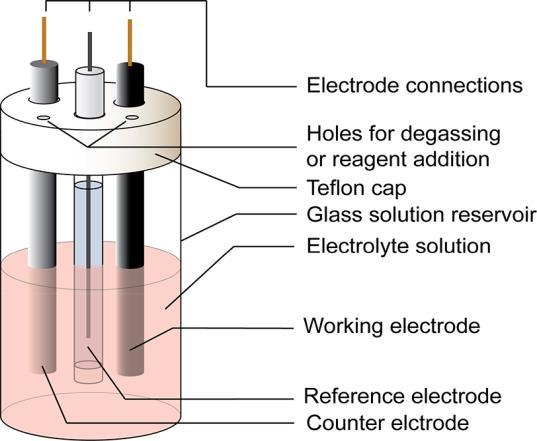
2. Electrochemical cell used for cyclic voltammetry experiments.
Key components and their roles:
1. Working Electrode
This is the location of the relevant electrochemical reaction. Usually, it is composed of the subject matter being studied. Theworkingelectrodeiscentraltotheexperiment,anditscharacteristicsarecrucialfordatacollection.
2. Counter Electrode:
Thecounterelectrodeisessentialtocompletetheelectricalcircuit
It doesn't participate in the electrochemical reaction but facilitates the flow of electrons. Typically, it is made of an inert materiallikeplatinum.Tomaintainaconstantpotential,thesurfaceareaofthecounterelectrodeneedstobesignificantly greaterthanthatoftheworkingelectrode.
3. Reference Electrode:
The reference electrode is crucial for measuring and maintaining a stable and known electrochemical potential. It is usuallya reversibleelectrodewitha well-defined redox potential,suchasa silver/silver chlorideelectrode. To guarantee theaccuracyoftherecordeddata,thepotentialoftheworkingelectrodeismonitoredinrelationtothereferenceelectrode.
4. Electrolyte:
The electrolyte is the medium through which ions are transported between the working and counter electrodes. It's typicallyasolutioncontainingthespeciesofinterest.Thechoiceofelectrolytecanhaveasignificantimpactonthereaction kineticsandthebehavioroftheelectrochemicalcell.
5. Cell Body/Container:
Theelectrochemicalcelliscontainedwithinavesselorcellbody,whichisusuallymadeofchemicallyinertmaterialssuch asglassorplastic.Itseparatestheworkingandcounterelectrodesandholdstheelectrolyte.Thedesignofthecellbodyis crucialtopreventcontaminationandmaintainacontrolledenvironment.
In this review we are discussing the investigation of sensing ability of various nanoparticles towards different heavy metals,rareearthmetalsandbiomolecules.
3. Methodology:
The nanoparticles to be used as a sensor is made as working electrode in the construction of electrochemical cell. This prepared working electrode; reference electrode and counter electrode are connected to the CV instrument and cyclic voltammogramsarestudiesfortheapplicationsofNPsasasensor.
Inmostoftheresearchworkingelectrodeispreparedasfollows:
Toformthecarbonpasteelectrode(CPE),thegeneratedsampleNPs,siliconoil,andgraphitepowderwereground(hand mixed)inamassratioof15:15:70forabouthalfanhour.Themixerwasthenputinsideamicrotiptube.Theexteriorofthe cavitytubewaspolisheduntilitwaslevelwithapieceofweighingpaper.
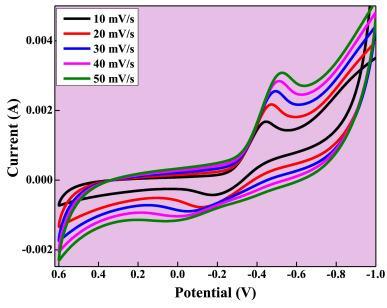
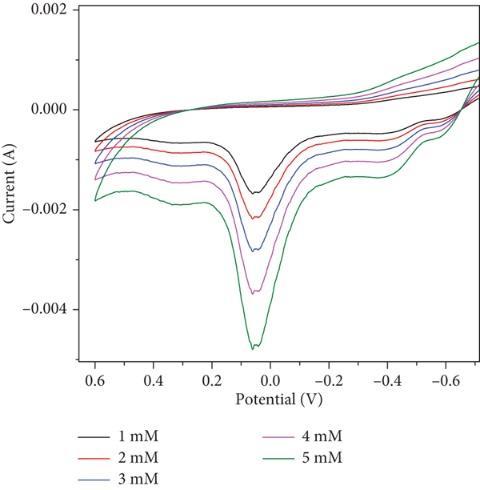
H.V. Harinia et al: Synthesizednanomaterial,Cu2ZnAl2O4(CZA),sensingabilityinvestigationwasconductedinasolution containing1NKCl.ThesynthesizedCZAnanomaterialexhibitedexceptionalredoxreactionproperties
The synthesized CZA nanomaterial exhibited remarkable sensitivity and selectivity in the detection of lead and tin ions. This underscores its potential as a highly efficient sensor for heavy metal detection, which is crucial in environmental monitoringandindustrialapplication.
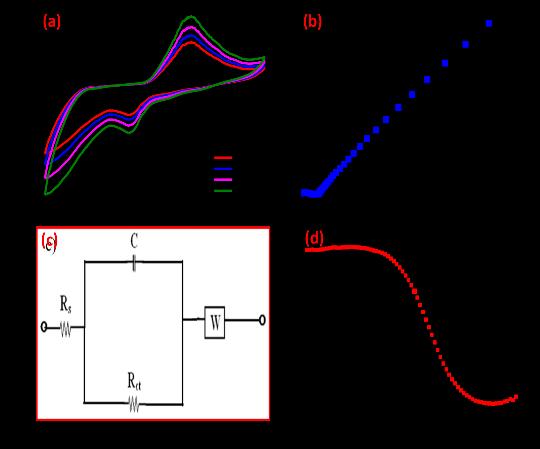
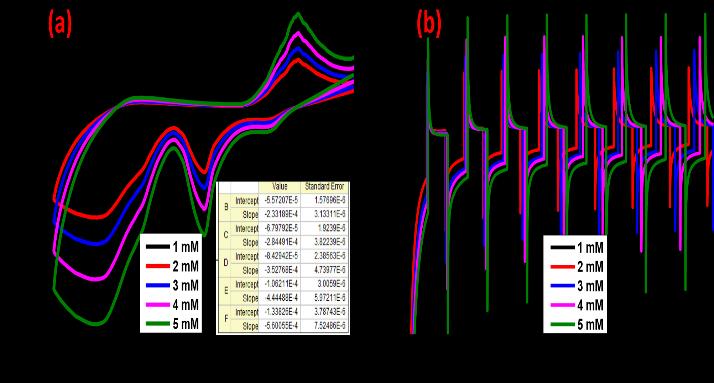
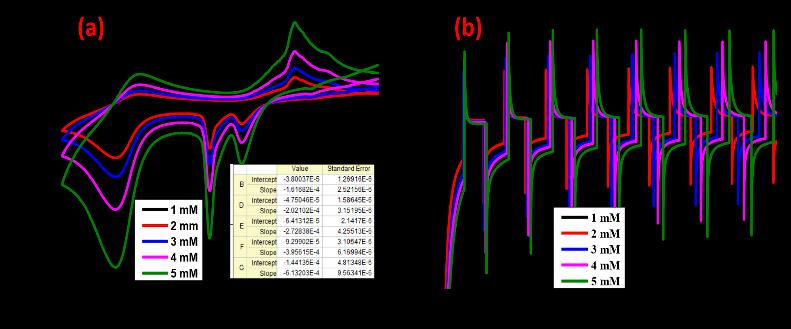
Cu2ZnAl2O4 (CZA) nanoparticles showed ability to detect lead and tin ions at concentrations of 1 mM (millimolar). The study reveals a rapid reaction time of 3 seconds for the electrode material. applications where rapid monitoring is required.
ImprovedleadandtinmetalionsensingpotentialwasdemonstratedbytheCZA-modifiedelectrode.Thisindicatesthatthe CZAnanostructureenhancesthesensitivityandselectivityoftheelectrodetowardsthetargetmetalions.
A. Naveen Kumar et al:
Synthesized La10Si6O27:RE3+ (RE = Eu, Sm, Dy, Tb) nanophosphors (LNPs) and investigated its application in electrochemical sensing, for paracetamol. The rare earth ions (Eu3+, Sm3+, Dy3+, and Tb3+) were doped into LNPs at a concentration of 5 mol%. The dopants enhanced the electrochemical sensing characteristics, making the LNPs more promisingforsensorapplications.ThemodifiedLNPelectrodesweresuccessfulinsensingparacetamolinanacidicmedia. For medicines with a 1 mM concentration, a 3 second response time suggests the possibility of sensitive and swift detection.
La10Si6O27:Eu3+ (5mol%) (211) 0.274
La10Si6O27:Sm3+ (5mol%) (211) 0.275
La10Si6O27:Dy3+ (5mol%) (211) 0.280
La10Si6O27:Tb3+ (5mol%) (211) 0.273
An efficient and widely used antipyretic and analgesic is paracetamol. It is commonly used as an over-the-counter medicationtotreatanumberofillnesses,suchasheadaches,pain,fever,arthritis,andcolds.
Detection and monitoring Paracetamol are crucial for preventing and diagnosing overdose situations, ensuring that individualstakethemedicationwithinrecommendedlimits.
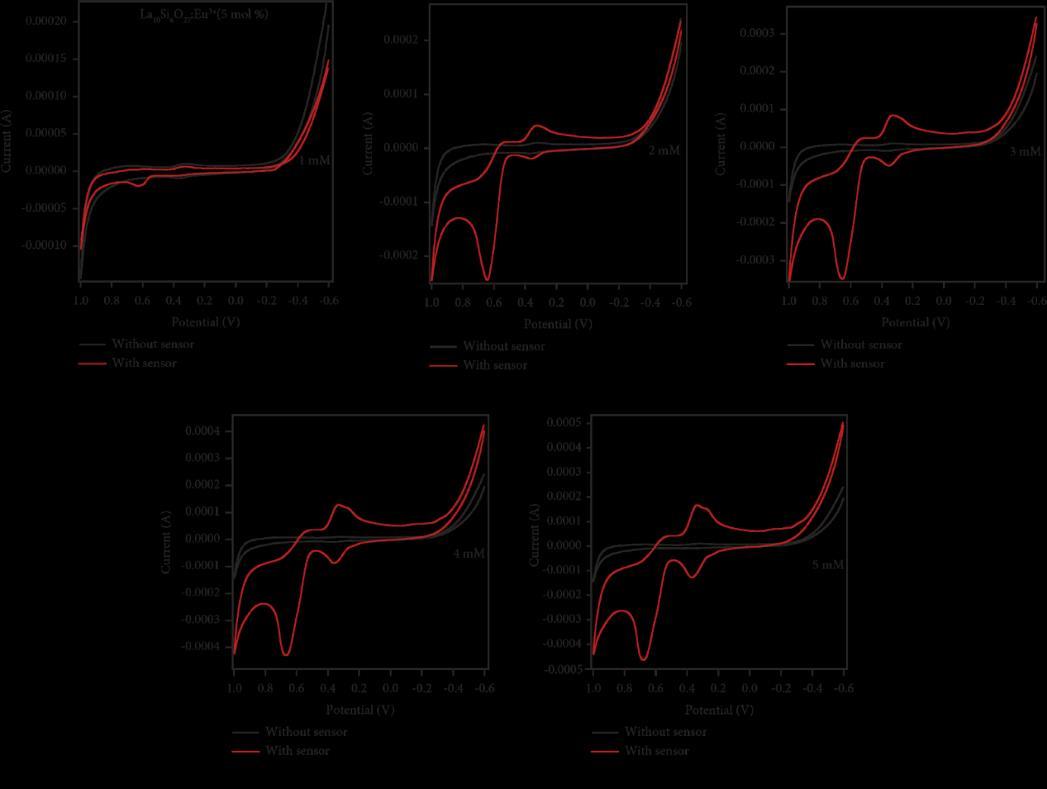
Thestudyholdssignificanceinprovidingasimple, rapid,andportablemethodfor detectingandmonitoringparacetamol levels.
The application of electrochemical sensors, particularly voltammetry, adds to the existing arsenal of techniques for drug quantification.
Samplenames Oxidationpeakpotential(V) Reductionpeakpotential(V)
Produced lanthanum oxide (La2O3) nanoparticles utilizing Tridax (T-La2O3) and Centella asiatica (C-La2O3) leaf powders usingagreencombustionmethod.TheelectrochemicalbehavioroftheLa2O3 nanoparticleswasstudied,toinvestigatethe sensingabilityforparacetamolusingCVtechniques.ResultsshowedexcellentsensingabilityofthesynthesizedNPs.
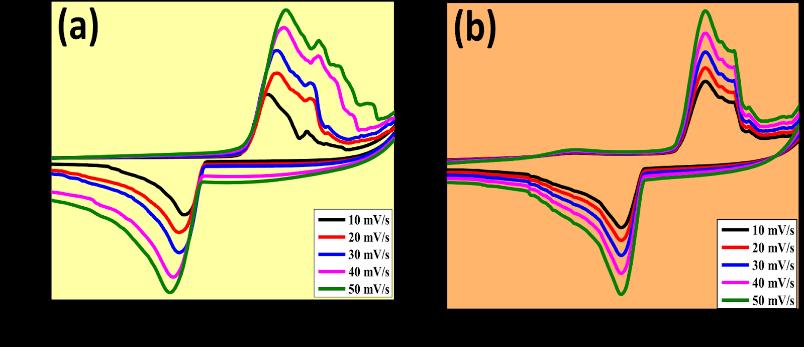
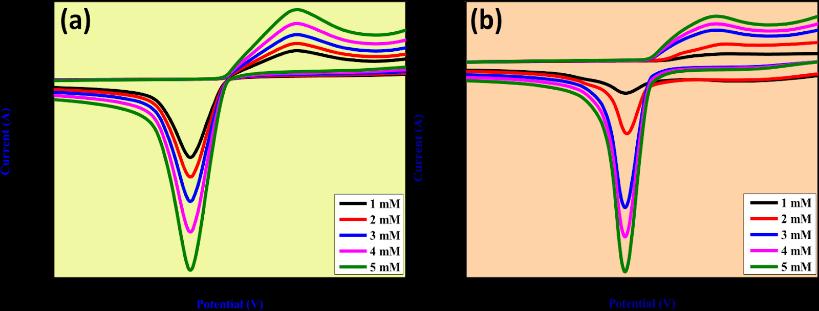
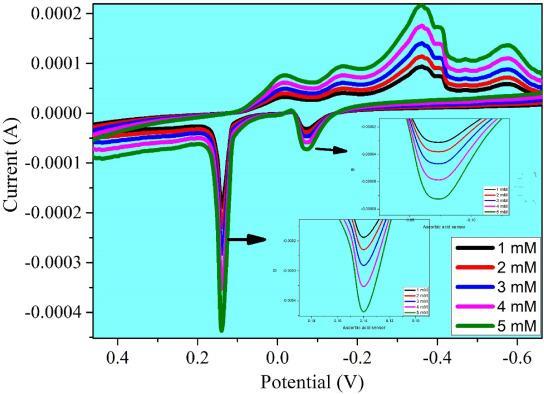
Examined sensing applications for the detection of hazardous elements like lead as well as the production and characterisation of molybdenum oxide nanoparticles (MoO3 NPs) utilizing a green combustion process with powdered Centellaasiaticaplant.
The capability is tested in basic medium. The electrode, composed of MoO3 (Molybdenum trioxide), shows shift in both oxidationandreductioncurvesinthepresenceoflead,indicatingitssuitabilityforleadsensing.Theoxidationpeakshifts towardsapositivepotential,resultsina peakvalueof0.14Vthatincreaseswithhigherleadconcentrations
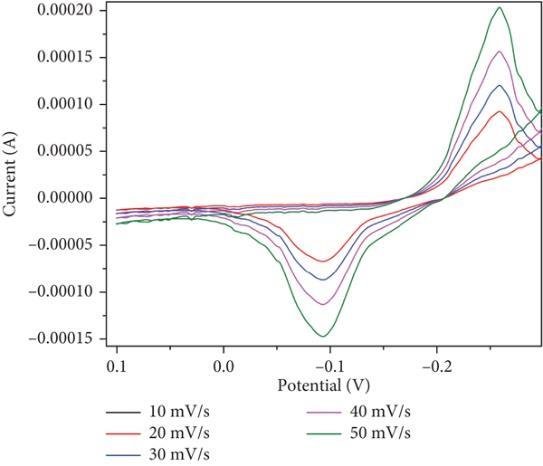
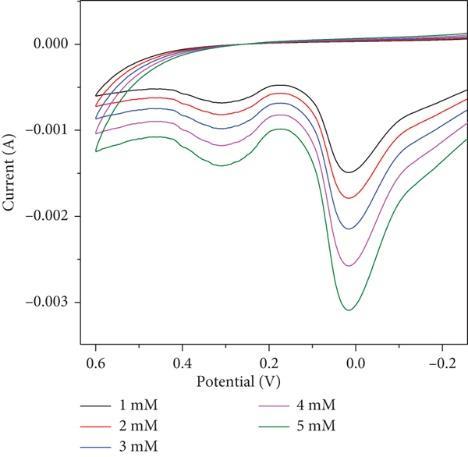
Synthesizedusinga straightforwardandinexpensive probesonicationtechniqueto produce bismuthoxide nanoparticles (Bi2O3 NPs).Thesynthesizednanoparticlesshowedhighsensingabilityforascorbicacidandlead,suggestingitspotential application in electrochemical sensing of biomolecules. CV studies done on the Bi2O3 electrode in 0.1 N HCl, revealing a specificcapacitancevalueof25.5.
5. Conclusion:
The cyclic voltammetry (CV) technique is particularly valuable in nanoparticle sensor studies due to its effectiveness in providing real-time results. This method offers enhanced reliability, addressing the scientific challenge of accurately sensingspecificmetalsorbiomoleculesinthepresenceofcomplexmixtures.
References:
1] Elgrishi, N., Rountree, K. J., McCarthy, B. D., Rountree, E. S., Eisenhart, T. T., & Dempsey, J. L. (2018). A practical beginner’sguidetocyclicvoltammetry. Journalofchemicaleducation, 95(2),197-206. https://pubs.acs.org/doi/10.1021/acs.jchemed.7b00361
2]Harini,H. V., Nagaswarupa,H.P., Bekele, E.T.,Murthy, H.A., & Ravikumar,C.R.(2023).Novel synthesisof Cu2ZnAl2O4 nanostructures for photocatalytic and electrochemical sensor applications. Sensors International, 4, 100225. https://doi.org/10.1016/j.sintl.2022.100225
3]Kumar,A.N.,Jnaneshwara,D.M.,Ravikumar,C.R.,Murthy, H.C.,Prashantha,S.C.,Kumar,M.R.,&Ajay,K.M. (2022).A ComparativeCyclicVoltametricStudyonRare Earth(Eu,Sm,Dy,andTb)IonsDopedLa 10Si 6O27Nanophosphors for SensorApplication. AdvancesinMaterialsScienceandEngineering, 2022
https://doi.org/10.1155/2022/7429133
4] Rashmi, B. N., Harlapur, S. F., Gurushantha, K., Ravikumar, C. R., Kumar, M. A., Santosh, M. S., ... & Murthy, H. A. (2022). Facile green synthesis of lanthanum oxide nanoparticles using Centella asiatica and Tridax plants: photocatalytic, electrochemical sensor and antimicrobial studies. Applied Surface Science Advances, 7, 100210. https://doi.org/10.1016/j.apsadv.2022.100210
5] Mamatha, K. M., Ravikumar, C. R., Murthy, H. A., Kumar, V. D., Kumar, A. N., & Jahagirdar, A. A. (2022). Facile green synthesis of Molybdenum oxide nanoparticles using Centella Asiatica plant: Its photocatalytic and electrochemical lead sensorapplications. SensorsInternational, 3,100153.
https://doi.org/10.1016/j.sintl.2021.100153
6]Kusuma,K.B.,Manju,M., Ravikumar,C.R.,Dileepkumar,V.G., Kumar,A.N., Santosh,M.S.,... &Gurushantha,K.(2022). Probe sonicated synthesis of bismuth oxide (Bi2O3): photocatalytic application and electrochemical sensing of ascorbic acidandlead. JournalofNanomaterials, 2022,1-13.
https://doi.org/10.1155/2022/3256611