
FAULT DETECTION IN FIVE BUS SYSTEM USING MATLAB & SIMULINK (DISCRETE WAVELET TRANSFORM METHOD)
Suraj Kumar Padhan1, Lokesh Jaiswal2, Pranjal Prajapati3 and Ganesh Ram Ratnakar4
1 Department of Electrical and Electronics Engineering, Chouksey Engineering College, Bilaspur, Chhattisgarh, India
2Department of Electrical and Electronics Engineering, Chouksey Engineering College, Bilaspur, Chhattisgarh,, India
3Department of Electrical and Electronics Engineering, Chouksey Engineering College, Bilaspur, Chhattisgarh,, India
4Assistant Professor, Department of Electrical and Electronics Engineering, Chouksey Engineering College, Bilaspur, Chhattisgarh,, India ***
Abstract - The transmission line is a critical component of the power system, but it is vulnerable to faults due to its exposure to harsh environmental conditions. These faults, such as open circuit and short circuit, directly affect the quality of the electric power supplied. Therefore, it is essential to promptly detect and fix any faults to ensure the reliable operation of the power system. Fault diagnostics are crucial for maintaining the stability of a multi-bus system within the power system. This research focuses on a five-bus system and presents twelve different types of faults with varying durations in transmission lines at different locations. To determine the specific fault type, the receiving end current signals of the line undergo Discrete Wavelet Transform (DWT). The resulting wavelet coefficients are then used in the fault identification process. The simulation and extraction of wavelet coefficients are carried out accordingly.
Keywords: Line fault, Discrete Wavelet Transforms (DWT), Wavelet coefficient, five bus system, MATLAB.
1. Introduction
Ensuring that energy is clean, affordable, and reliable is crucialinthefightagainstpovertyandclimatechange.With theincreasingintegrationofrenewableenergybyvarious agencies,GridAutomationisbecominganinevitabletaskin smartgrids.Transmissionlinefaults,whethersymmetrical orunsymmetrical,occurfrequentlyduetovariousadverse factors such as environmental imbalances, overloads, and lack of maintenance [1]. Detecting these faults in a timely mannerisessentialformaintainingareliablepowersystem withminimalinterruptions.Inrecentyears,severaldecision algorithmshavebeenproposedforlocatingfaultsinmultiterminalsystems[2–4].Thispaperfocusesonusingwavelet transform[5–7],specificallythedb8wavelet,toextractfault features from line currents in transmission lines. By analyzingthesefeatures,thetypeoffaultcanbeidentified [9].
2. System Under Study
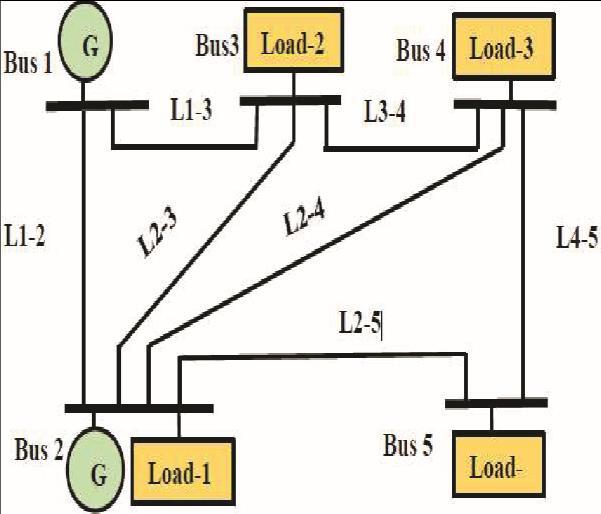
TheprovidedFigure1illustratesthesingleLineDiagram of a five bus system that is being analyzed. This system consists of two sources and four loads, all interconnected
throughatransmissionlinenetworkcomprisingsevenlines [8]. Detailed specifications for the transmission lines, sources,andloadscanbefoundinTables1and2.
ItisworthnotingthatBusnumber2isconnectedtoboth ageneratorandaload.Additionally,Bus1,referredtoasthe Generator Bus, serves as the Slack Bus, responsible for maintaininga balancebetweenactiveandreactivepower. Forthepurposeofthisstudy,aTypical5Busconfiguration hasbeen adoptedasthe basesystemforanalysis.Table1 presentstheTransmissionLinespecificationsforaT-section Model.Afittingreferencevalueof100MVA,denotedasSb, and a base kV of 230 kV, denoted as Vb, are utilized. The specifications include the values for Positive and Zero SequenceResistance,aswellasInductance.
International Research Journal of Engineering and Technology (IRJET) e-ISSN: 2395-0056 Volume: 11 Issue: 01 | Jan 2024 www.irjet.net p-ISSN: 2395-0072 © 2024, IRJET | Impact Factor value: 8.226 | ISO 9001:2008 Certified Journal | Page386
-
Figure 1:- Fivebussystemunderstudy.
Bus Length of Trans. Line km Positive Seq.R (Ω/km) Zero Seq.R (Ω/km) Positive Seq.L (H/km) Zero Seq.L (H/km) Positive Seq. C(F/km) Zero Seq.C (F/km) 1–2 46 0.23 0.66 0.0017 0.0052 6.3×10 9 1.89× 10 8
Table 1 :- Transmissionlinespecifications
TheTransmissionLinemodelincorporatesthecalculation and application of capacitance. The length of the Transmission Line is determined by considering the resistanceandreactancevalues[8].InMATLAB/Simulink, the Load Flow Bus Block should be connected to the Bus where the voltage and angle measurements are required. Table 2 provides information on the Load Flow requirements for the Source and Load Bus. The Real and ReactivePowervaluesforallfiveBusesareobtainedfrom theGeneratorandLoadBlock,asindicatedinTable2.
3. Simulation Of Five Bus System
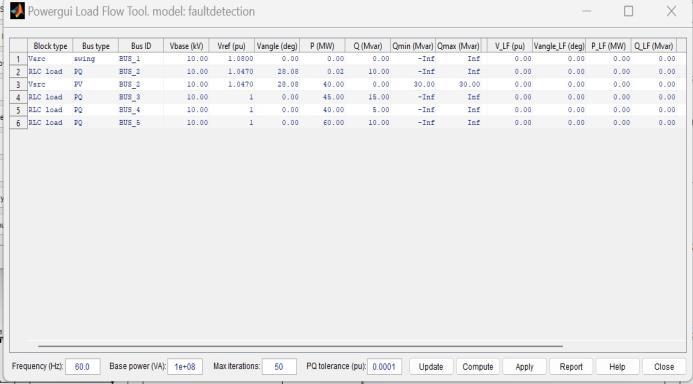
TheMATLAB/Simulinkenvironmentwasutilizedtodevelop theFiveBusmodelofthepowersystem,withthespecified parameters.Aloadflowstudywasconductedundernormal operating conditions. The Load Flow Studies Block in MATLAB/SimulinkwasemployedtoobtaintheLoadFlow results after performing the simulation. These results are presentedinTable3,whichdemonstratesthatthesystemis functioning flawlessly under steady state conditions.
Additionally,Figure2illustratesapiesectionmodelofthe5 bussystemthatwasusedforthesimulation.Thecontinuous blockwasemployedforsimulationindiscretetime.A100 kVAsystemconsistingofFiveBuseswasconsideredforthe simulation,withthesystemspecificationsprovidedinTables 2and3.
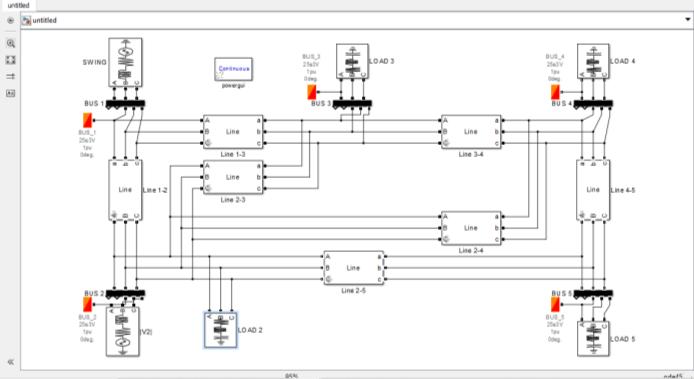
The MATLAB software is utilized to design and simulate the system. By employing the 3-phase Fault Generator Block, a three phase Fault is introduced to the system, and the resulting signals are captured at the receivingendforalltwelveFaultconditions.TheSimulation timethatistakenintoaccountis0.1s.
4. Interpretation From The Simulation Results
The analysis for detecting three-phase faults is currently beingconductedusingtheMATLAB/SimulinkTool.Inorder to effectively capture the features of fault signals, the WaveletTransformDb8Level6hasbeenchosenforFault Detection. If the fault involves the ground, the sum of detailedcoefficientsinthethreephaseswillnotbeequalto zero.However,ifthereisnofault,thesumwillbeequalto zero.Underfaultyconditions,thesumofdetailedcoefficients in the three phases is found to be different from that of healthyconditions.Eventhoughthewaveletcoefficientsdo notdeviatesignificantlywhenthefaultdurationisreduced, theyarestillsufficienttodistinguishbetweenhealthyand
International Research Journal of Engineering and Technology (IRJET) e-ISSN: 2395-0056 Volume: 11 Issue: 01 | Jan 2024 www.irjet.net p-ISSN: 2395-0072 © 2024, IRJET | Impact Factor value: 8.226 | ISO 9001:2008 Certified Journal | Page387 1–3 86 0.47 1.45 0.0038 0.0115 2.87× 10 9 8.62× 10 9 2–3 68 0.46 1.40 0.0037 0.0112 2.97× 10 9 8.91× 10 9 2–4 68 0.46 1.40 0.0037 0.0112 2.97× 10 9 8.91× 10 9 2–5 46 0.45 1.34 0.0035 0.0105 3.15× 10 9 9.45× 10 9 3–4 18 0.27 0.813 0.0021 0.0064 5.14× 10 9 1.54× 10 9 4–5 86 0.47 1.455 0.0038 0.0115 2.87× 10 9 8.62× 10 9
Table 2
Bus PG(W) QG(VAR) Q-Max (VAR) Q-Min (VAR) PL(W) QL(VAR) 1 0 0 500× 106 500× 106 0 0 2 40× 106 0 300× 106 300× 106 20× 106 10×106 3 0 0 0 0 45× 106 15×106 4 0 0 0 0 40× 106 5×10⁶ 5 0 0 0 0 60× 106 10×106
Sourceandloadspecifications
Figure 2 :- Simulatedfivebusessystem.
Table 3 :- Loadflowresultsoffivebussystem
faulty conditions. The use of Db8 at level 6 yields good results in identifying faults regardless of their location, duration,orvaryingloadconditions.
5. Conclusion
The research paper focuses on utilizing a DWT based approachtodetectandclassifyfaultsintransmissionlines withinafive-bussystem.ByemployingtheDiscreteWavelet Transform(DWT)method,faultscanbeaccuratelylocated. Themethodinvolvesanalyzingthetransientchangeinthe power system's current using the Daubechies 8 wavelet transform. The detailed coefficients extracted from this analysis are then utilized to identify faults in different phases, considering varying load conditions and fault locations. The obtained results demonstrate that the db8 mother wavelet yields a mean error of −0.34%. Given the satisfactoryaccuracyoftheproposedmethodfordifferent faulttypes,itcanbefurtherexpandedtolargerbussystems. Consequently,aFaultdetectionandclassificationalgorithm canbedevelopedbasedonthediscretewavelettransform, whichhasproventobesuccessfulinhandlingvaryingfault locations,durations,andloadconditions
6. References
1) BadriRamandD.N.Vishwakarma,“PowerSystem Protection and Switchgear”, Tata McGraw Hill PublicationCompanyLimited,NewDelhi,2005.
2) D.Chanda,N.K.KishoreandA.K.Sinha,“Application of wavelet multiresolution analysis for identification and classification of faults on transmission lines”, Electric Power Systems Research,Vol.73,pp.323–333,2005.
3) MazenAbdel-Salam,AdelAhmedandWaelAhmed, “Wavelet Based Analysis for Transmission Line Fault Location”, Innovative Systems Design and Engineering,Vol.4,No.14,2013.
4) P.ChiradejaandC.Pothisarn,“Identificationofthe Fault Location for Three-Terminal Transmission Lines using Discrete Wavelet Transforms”, T&D Asia2009.
5) H.Fernando,MagnagoandAliAbur,“FaultLocation UsingWavelets”, TransactionsonPowerDelivery, pp.1475–1480,October1998.
6) Daubechies, “The wavelet transform, timefrequency localization and signal analysis”, TransactionsofInformationTheory,pp.961–1005, September1990.
7) C.H.KimandR.Aggarwal,“Wavelettransformsin powersystems:Part1.Generalintroductiontothe wavelet transforms”, Power Engineering Journal, pp.81–87,April2000.
8) AnjaliAtulBhandakkarandDr.LiniMathew,“RealTime-Simulation of -5-Bus Network on OPALRTOP4510 Simulator”, 3rd International Conference onCommunicationSystems(ICCS),2017.
9) Maliye Sri Pranav, Kanipakam Vishal, Chigurupati Karthik,JakkamsettiTarunandDr.D.Kavitha,Dr.V. Vanitha,“FaultDetectionandClassificationinThree PhaseTransmissionlinesusingSignalProcessing”, ThirdInternationalconferenceonRecentTrendsin ElectronicsandCommunicationTechnology,2018.
International Research Journal of Engineering and Technology (IRJET) e-ISSN: 2395-0056 Volume: 11 Issue: 01 | Jan 2024 www.irjet.net p-ISSN: 2395-0072 © 2024, IRJET | Impact Factor value: 8.226 | ISO 9001:2008 Certified Journal | Page388
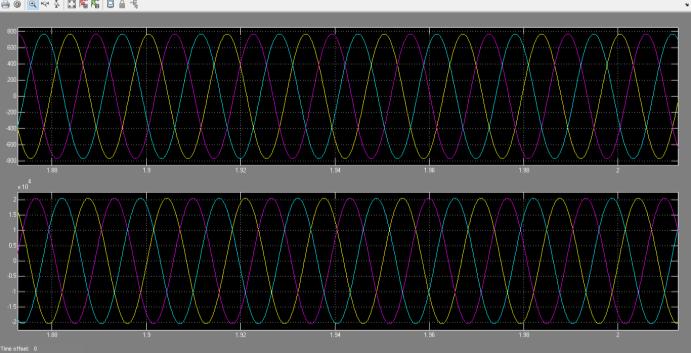
Figure 3:- Receivingendvoltageandcurrentinline connectedbetweenbuses2and5underhealthycondition.
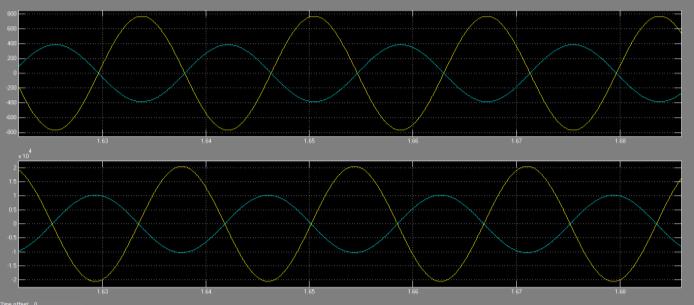
Figure 4:- Receivingendvoltageandcurrentinline connectedbetweenbuses2and5underfaultycondition.