
Usability of input methods within mobile devices: A comparative study between Voice-to-text
vs soft keyboard
Rudraksh GuptaBCA, Department of Computer Science and Engineering, Guru Nanak Dev University, Amritsar
Abstract - This study, rooted in Human-Computer Interaction (HCI), meticulously compares mobile input methods Voice-to-text and Soft Keyboard. The research was conducted by Guru Nanak Dev University student and scrutinizestheiradvantages andlimitationsthrougha 2×2 within-subjects design with 10 participants. Contrary to expectations within the HCI framework, Soft Keyboard consistently outperforms Voice-to-text in input speed, indoorsandoutdoors.Thischallengesassumptionsandcalls for future HCI research to embrace a comprehensive evaluation framework, considering factors like user preferences and accuracy, ensuring mobile interfaces align seamlesslywithuserneeds
Key Words: Voice-to-text,SoftKeyboard,Usability
1.INTRODUCTION
In our rapidly changing, technology-driven world, the devices we use daily have a large impact on how we interact with the digital world. Human-Computer Interaction (HCI) looks to study this essential connection while focusing on enhancing the user experience. Within HCI, the choice of input method is a crucial decision, greatly affecting how users engage with systems. This researchdelvesintotwodistinctinput methods:voice-totext andstandard keyboard input,aiming toshedlight on theirrelativeadvantagesanddisadvantages.
Recentyearshaveseenimpressiveadvancementsinvoice recognitiontechnology.Theseimprovementshavecreated anewerawhereuserscanspeaktotheirdevices,reducing the need for typical keyboard input. The evolution of this technology is groundbreaking as it completely transforms thewaywecommunicatewithdigitaldevices.
The appeal of voice-to-text input lies in its speed and accessibilityforuserswithimpairments.Userscantalk to their devices and see their words appear as text rather than typing each word out using their fingers. This technology has made voice-to-text input a very intriguing alternativetotraditionalkeyboardinput.
However, beneath these advantages, voice-to-text input also produces its own set of challenges. Users often have concerns about its accuracy and overall usability. There are questions surrounding potential trade-offs between
thespeedofvoice-to-textandtheprecisionoftypingona keyboard.
This research seeks to explore HCI by analyzing the comparativeadvantagesanddisadvantagesoftwodistinct input methods – voice-to-text and standard keyboard input. Through an in-depth investigation, this study aims to provide insights into the optimal input method for differentscenarios,thuscontributingtothedesignofuser interfaces.
RELATED WORK
1.1 A Comparison of Speech and Typed Input
The research conducted by Carnegie Mellon, titled "A ComparisonofSpeechandTypedInput,"(Hauptmann, 1990) provides a thorough exploration of the dynamics between voice and keyboard input within thecontextofdigitentrytasks.Theprimaryaimofthe study is to conduct a detailed comparison between these two input modalities, shedding light on their respectiveadvantagesandlimitations.
In terms of experimental setup, the research encompassed two experiments: one involving the presentationofdigitstringsonascreenandtheother requiring subjects to read from a paper (Hauptmann, 1990). Three distinct data entry modes were considered voice only, voice with keyboard correction, and keyboard only. Each experiment involved subjects entering three lists of 66-digit strings, facilitating a comprehensive examination of variousinputconditions(Hauptmann,1990).
Crucially, the study's findings regarding input duration time highlight the efficiency of speech input. The average difference between pronouncing a digit string and typing one was reported to be less than 2 seconds in both experiments (Hauptmann, 2022). Real-time response and accurate speech recognition emerged as pivotal factors influencing speech as a preferablecommunicationmode(Hauptmann,1990).
Regarding accuracy, the research revealed high typing accuracy for both paper and on-screen presentations. However, recognition word accuracy
International Research Journal of Engineering and Technology (IRJET) e-ISSN: 2395-0056 Volume: 11 Issue: 01 | Jan 2024 www.irjet.net p-ISSN: 2395-0072 © 2024, IRJET | Impact Factor value: 8.226 | ISO 9001:2008 Certified Journal | Page379
***
was notably higher for on-screen presentations compared to paper presentations, emphasizing the influenceofpresentationmodeontheeffectivenessof theinputmodality(Hauptmann,1990).
The key findings and solutions proposed by the research suggest that the advantages of each input modality are contingent upon factors such as string lengthandsystemresponsecharacteristics.Thestudy positsthatformorecomplextasksrequiringagreater numberofkeystrokespersyllable,speechinputcould demonstrate superiority (Hauptmann, 1990). Furthermore, in tasks demanding visual monitoring, speech emerges as a preferable input channel, alleviating the cognitive load associated with dividing attention between the keyboard, screen, and paper (Hauptmann,1990).
Concerningourresearchonvoice-to-textinputversus standardkeyboardinput,theinsightsgained fromthe Carnegie Mellon study provide valuable context. The emphasis on real-time response, accuracy, and the impact of visual effort aligns with the core challenges in developing effective voice-to-text interfaces. By leveraging the findings of this related work, we can draw parallels and distinctions, enriching our understandingofthedynamicsatplayandguidingthe designandevaluationofvoice-to-textsystems.
1.2 Comparing Voice Chat and Text Chat in a communication Tool for Interactive Television
Interactive Television (iTV) involves the use of voice chat and text chat communication modes (Geerts, 2006). This Noteworthy research focused on the pros andcons of thesecommunicationmechanisms during TV watching. This paper has been of great help as it offeredsomeinsightsintohowcommunicationmodes interact with their audiences while watching television.
OnecriticalaspectofITVissupportingthesocialuses of television. Communication has been aided during andafterTV watchinghaswidely beenaccepted.This includes the possibility of communicating with relatives, friends, or neighbors. Such systems enable users,locatedindifferentspacesthroughvoicechator textchat.
The use of CMC has been widespread in instant messaging applications, voice communication, and other areas (Geerts, 2006). Indeed, this mode of communication is being employed in various scenarios such as work, school, and leisure. A lot of these settings involve multitasking to examine the
convenienceanddistractednessofvoicedinstructions versustextcommands.
According to Wikipedia, backchannel communication refers to an online discussion happening simultaneously with live verbal commentary (Geerts, 2006). Previous studies have examined the use of backchannels in academic conferences; however, this one applies the “backchannel” concept for watching TV.Themethodthatisusedtocarryoutthisresearch isquitenewbutitservesasabasisforunderstanding howtheproblemofabackchannel(voicechatortext) workswhenwatchingTVorprimarymaterial.
Fascinating results were derived from a comparative studythatcenteredaroundvoicechatandtextchatin interactive television. It was seen that voice chat was morenaturalanddirect,hence,easiertopayattention tothetelevisionprogram.However,youngpeopleand experienced computer-based communicative users preferred instead to text chat (Geerts, 2006). These insights are important in helping to appreciate how user-friendly these communication channels are and theextenttheycanshapeviewers’experience.
Summarily, this previous research brings into perspective the practical utility, preferences of users, as well as possible distractions that may result from the integration of voice chat with text chats when using it together with television viewing. Using this fundamental perception, this study explores the comparativeanalysisofvoiceandtextcommunication withindifferentcontexts.
1.3 A Comparison of Text and Voice Modalities to Improve Response Quality in Course Evaluations
Conversational evaluation tools in educational research offer great potential to improve data quality and end-user experience. This study will discuss two separate modalities (text-based vs voice-based) for evaluating courses, building on prior works in the area(Theimo,NaimandMatthias2022).
Previous studies have shown how conversational interactive surveys can be employed for educational purposes (Theimo, Naim and Matthias 2022). The results demonstrate that these tools are developed to foster dialogic interactions in which the results are more qualitative and deeper than others. This aligns withthisresearchstudythatconsidersauser-centred methodology for adaptive conversational interface development for educational purposes. Moreover, the other study has revealed positive effects on customer experience especially social presence and interactive enjoyability(Theimo,NaimandMatthias2022).
International Research Journal of Engineering and Technology (IRJET) e-ISSN: 2395-0056 Volume: 11 Issue: 01 | Jan 2024 www.irjet.net p-ISSN: 2395-0072 © 2024, IRJET | Impact Factor value: 8.226 | ISO 9001:2008 Certified Journal | Page380
It is becoming increasingly interesting whether textcenteredorvoice-centeredmodalitiesareappropriate within conversational interfaces. Detailed and informative response is a sure way of improving response quality when using text-based conversational tools. However, voice-based interactive learning systems are still in their infancy and have their own advantages. It is a useful point in this study’s course evaluations with which it can compare these two modes, noting their advantages. Researchonthemeasurementofresponsequalityhas been a common area of study in the literature, focusing on lexical, syntactical, and semantic responses.Consistentwiththis strategy,thisresearch acknowledges that high-level measures are required to thoroughly appraise response quality, emphasizing attributes such as specificity and pertinence in determining response (Theimo, Naim and Matthias 2022).
For years, researchers have been concerned with improving users’ experience in educational settings, including course evaluations. Studies conducted before, show that conversational interface affects self dis-closingandinteractionalenjoymentandperceived social presence. These trends reflect the findings that show how conversational tools can lift up the user experienceforeducationalpurposes.
Research areas for future development are equally numerousandexciting.Voicededucation,contextsfor conversational interface and applying voice analytics for survey enrichment. Hence, researchers should explorehowculturalandcontextualmattersaffectthe efficiency of conversational instruments across educationalsurroundings
1.4 A Comparison of Text and Voice Modalities to Improve Response Quality in Course Evaluations Transcription
Transcription In the domain of text entry tasks, Carnegie Mellon's research paper titled "A Comparison of Speech and Typed Input" (Margaret, Géry and Daniel 2020) emerges as a seminal work, delivering an exhaustive exploration of the interplay betweenvoiceandkeyboardinput,specificallywithin the context of digit entry tasks. The primary aim of thisstudyis tometiculouslycomparethesetwoinput modalities, shedding light on the associated advantagesandlimitations(Margaret,GéryandDaniel 2020).
Thestudyconductedtwoexperiments,onepresenting digit strings on a screen and the other requiring subjects to read from a paper. Three distinct data
entry modes were considered: voice only, voice with keyboardcorrection,andkeyboardonly.Significantly, each experiment comprised subjects entering three lists of 66-digit strings, ensuring a comprehensive examination of various input conditions (Margaret, GéryandDaniel2020).
A critical revelation of the research lies in the significantdifferenceininputdurationtimesbetween speech and traditional typing. Speech input demonstrated faster input durations compared to traditional typing, with an average difference of less than 2 seconds in both experiments (Margaret, Géry and Daniel 2020). Real-time response and accurate speech recognition were identified as pivotal factors favoringspeechasapreferablecommunicationmode.
Concerning accuracy, the study unveiled high typing accuracy for both paper and on-screen presentations. However, recognition word accuracy was notably higher for on-screen presentations than paper presentations, emphasizing the influence of presentation mode on the effectiveness of the input modality(Margaret,GéryandDaniel2020).
The research's key findings posit that the advantages of each input modality hinge upon factors like string length and system response characteristics. It suggests that formorecomplextasksrequiringagreaternumberof keystrokes per syllable, speech input could exhibit superiority (Margaret, Géry and Daniel 2020). Furthermore, in tasks demanding visual monitoring, speech emerges as a preferable input channel, alleviating the cognitive load associated with dividing attention between the keyboard, screen, and paper (Margaret,GéryandDaniel2020).
This related work bears significant relevance to this study’s exploration of voice-to-text input versus standard keyboard input. The emphasis on real-time response, accuracy, and the impact of visual effort alignswiththecorechallengesindevelopingeffective voice-to-text interfaces (Margaret, Géry and Daniel 2020).
By leveraging the findings of this related work, parallelsanddistinctionscanbedrawn,enhancingthe understanding of the dynamics in the comparison between voice and keyboard input. The detailed comparison of input duration times provides a quantitative benchmark for the exploration of similar aspects in the context of voice-to-text interfaces. Additionally, the proposed solutions in the related research form a foundation for addressing challenges in this study’s investigation, guiding the design and
International Research Journal of Engineering and Technology (IRJET) e-ISSN: 2395-0056 Volume: 11 Issue: 01 | Jan 2024 www.irjet.net p-ISSN: 2395-0072 © 2024, IRJET | Impact Factor value: 8.226 | ISO 9001:2008 Certified Journal | Page381
evaluation of voice-to-text systems for optimal user experienceandefficiency.
2. METHOD
Forthe purpose ofcomparingtheinputsof bothvoice-totext and typing through a soft keyboard, experimental research was conducted. The experiment consisted of a number of people and each participant tested both variables, the voice-to-text and typing using a soft keyboard. Recording each result, a comparison of performanceandusabilitywasmade.
2.1 Hypothesis
Thehypothesesoftheuserstudyissplitinto2categories, theperformancehypothesesandtheusabilityhypotheses.
Fortheperformancehypotheses:
● H0:Nocleardifferenceintermsofinputspeed betweenthetwomethods.(α=0.05)
● Ha:Therewillbeasignificantdifferencein input speedbetweenthetwomethods.
Asfortheusabilityhypotheses:
● H0 : Using either input method will have no difference withrespecttoerrorsmade.(α=0.05)
● Ha : Using either input method will have a significantdifferenceinrespecttoerrorsmade.
Giventhatthenatureofthisuserstudyisquantitativeand repetitive, a paired sample T-test and a F-test was employed to observe any significant differences in the means. This test was appropriate since the same participantstestedbothinputmethods.
2.2 Participants
Number of Participants: The study involved a total of 10 participants,splitintotwogroups.
Populationfromwhichtheyweredrawn:
Participants were drawn from a diverse population of smartphone users spanning various genders, ages (1670s), educational backgrounds, and technology experience. This inclusive approach included high school students, Baby Boomers, and millennials, with representation from males, females, and non-binary individuals. In terms of prior experience with technology, participants exhibited varying levels, from older individuals with limited exposure to technology to universitystudentswithanabundanceofexperience.
A diverse group of 10 participants were selected for the study using a combination of recruitment methods tailored to each group. These methods included convenience sampling, giving information on university
bulletin boards, corporate channels, social media, community centers, support groups, and online communities.
2.3 Apparatus
For the experiment’s apparatus, a standard smartphone can be used to conduct both the voice-to-text and manual typing features. Since most voice assistants are similar to one another there wouldn’t be a significant difference in performance when using various devices. However, for consistency's sake, throughout the research, this experiment was conducted using an Apple 13 Pro Max. The built-in voice assistant (Siri) was used to conduct the voice-to-text section of the experiment and the iMessage appwasusedforthetypingsectionoftheexperiment.

This experiment is easily reproducible, as the voice assistantfeatureaswell asa defaultmessagingappexists inallsmartphones.
2.4 Procedure
Participants were greeted and given an overview of the study's objectives. Informed consent was obtained, and participants were assured of the confidentiality of their data. Participants were divided into two equal groups to ensure balanced representation. The order of the trials wascounterbalancedtoeliminateanyordereffects.
Participants were introduced to the Apple 13 Pro Max smartphone and the iMessage app. Basic instructions on how to use the voice-to-text feature (Siri) and the soft keyboard were provided. Participants were given a clear description of the experiment task. They were informed that the task involves sending a specific phrase through the iMessage app, either using voice-to-text or manual typing. Participants were informed about the two environmental conditions: sitting indoors and walking in public.Theywereinstructedonhowtotransitionbetween theseconditions.
Participants were allowed a brief practice phase of 5 minutes to familiarize themselves with the voice-to-text feature and the soft keyboard. For the main experiment phase, participants were divided into two equal groups. The experiment was performed in 2 environments i.e., sitting insideandwalking ina publicsetting.Forgroup1, For each trial, they received the specific phrase: "The
International Research Journal of Engineering and Technology (IRJET) e-ISSN: 2395-0056 Volume: 11 Issue: 01 | Jan 2024 www.irjet.net p-ISSN: 2395-0072 © 2024, IRJET | Impact Factor value: 8.226 | ISO 9001:2008 Certified Journal | Page382
Figure1.ScreenshotofApple’sSiriVoiceAssistantonthebottomcenter
brownfoxjumpsoverthelazydog".Theywereinstructed to send the phrase via. iMessage using the voice-to-text feature (as input 1) while they were sitting indoors first, and then by soft keyboard (as input 2). Afterwards, they were instructed to send the same phrase while walking outdoors in public using the voice assistant first, then throughthesoftkeyboard.
Forgroup2,Foreachtrial,they receivedthesamephrase "The brown fox jumps over the lazy dog". They were instructedtosendthegivenphrasevia.iMessageusingthe soft keyboard (as input1) first while walking outside. Then, they were instructed to use the voice input method (as input 2) next. Afterwards, the participants were taken inside, where they sent the same phrase using a soft keyboard first while sitting, then used the voice-to-text featuretosendthephrasewhileremainingseated.
Each participant's time to complete the task and the numberoferrorsmadewererecordedforeverytrial.The experiment took approximately 10-20 minutes for each participant, including the practice phase and the main experimentphase


2.5 Design
Theuserstudyapplieda2×2within-subjectsdesign.The participants were each tested using the smartphone’s voice-to-textfeatureorthesoftkeyboard.Withintheuser study, each participant was also asked to utilize the input methods in two varying environment conditions. Each inputmethodwastestedwhilesittingindoorsandwalking in public. Each trial was timed to compare the overall performance results of the two input methods. The independentvariablesinthisstudyconsistof:
● Inputmethod:Voice-to-textorsoftkeyboard
● Environment conditions: The participants were eithersittingindoorsorwalkingoutsideinpublic.
Thedependentvariablesinthisstudyconsistof:
● Time:Theamountoftimeittakestheparticipant to complete the task using the voice assistant or the onscreenkeyboard.
● Accuracy: The number of errors the voice assistantortheparticipantmaymakeduringthetests.
The participants were divided into two equal groups and the order of the trials will be counterbalanced to reduce the effects of earlier trials on later trials. Each of the 10 participants were told to send the given phrase through the messaging app using both voice-to-text and the onscreen keyboard. Each input method was tested while sitting or walking. Therefore, the total number of trials was 10 participants × 2 input methods × 2 participant/surroundingconditions=40totaltrials
3. RESULTS
Afterconductingandcollectingtheresultingdatafromthe user study, the data was then averaged as a mean for performance and usability separately with further separation considering the environmental settings for the trials.
As for performance, the means of the data collected were organized into charts to better visualize the comparison. Overall,whencalculatingthevariancesoftheinputspeeds usingANOVA(F-test),theF-valueresultedtobe5.55with aP-valueof0.003.GiventhattheP-value<0.05,thereisa strong indication of a significant difference in the input speedssotheperformancenullhypothesiswasrejected

were performing their trials while sitting indoors. The average
speed in words per minute (wpm) for voice-to-text input was 22.45, while for soft keyboard was 33.43. The soft keyboard proved to be 39% faster for participants
International Research Journal of Engineering and Technology (IRJET) e-ISSN: 2395-0056 Volume: 11 Issue: 01 | Jan 2024 www.irjet.net p-ISSN: 2395-0072 © 2024, IRJET | Impact Factor value: 8.226 | ISO 9001:2008 Certified Journal | Page383
Figure2.Aparticipantperformsthetext-to-speechtaskfeature forinput[1]
Figure3.Aparticipantusingthesoftkeyboardasaninputmethod[2]
Figure4.ChartdepictingtheAverageinputspeed(wpm)forVoice-totextvsKeyboardwhileparticipantswereinside.
Figure 4, illustrates the average input speeds for the two input methods compared when the participants
input
compared to voice input when the percentage difference was calculated. The difference was statistically significant where(T-statistic=-3.787,p<.05)
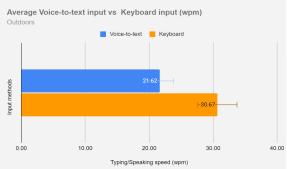
When the participants were using the two input methods while walking outdoors in public, the mean for the input speed resulted in 21.62 wpm for voice-to-text. On the other hand, the mean for soft keyboard was 30.67 wpm. The percentage difference between the two means is calculated to be 35%. The difference was statistically significant(T-statistic=-2.21,p<.05).
The soft keyboard was faster than the voice-to-text input method in terms of input speed for both environmental scenarios.Anotherfindingtomentionforinputspeedwas thatforbothinputmethods respectively,participantshad an overall faster input speed when they were experimentingindoorsratherthanoutdoors.
With regards to usability, Using the ANOVA (F-test), the variance of the number of errors was calculated. The resultswere,F-valueat2.38andaP-valueat0.0856.This suggestedthatthereisnotasignificantdifferenceandnot enoughevidencetorejecttheusabilitynullhypothesisata 0.05significancelevel.

Figure 6 shows the average number of errors for both voice-to-text and keyboard inputs while sitting indoors. Voice-to-text had an average of 0.2 errors while the keyboard input had an average of 0.1 errors. The T-test indicated there is no clear evidence of a significant difference between the two input methods (T-statistic = 0.59,p>0.05).
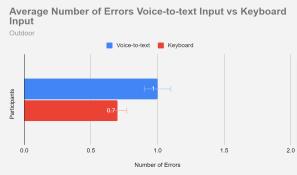
Figure 7 depicts the average number of errors when participants moved outside. Voice-to-text had an average of 1 error while typing with the keyboard had an average of 0.7 errors. Again, the T-test indicated there is no clear evidenceofasignificantdifferencebetweenthetwoinput methods(T-statistic=0.81,p>0.05).
4. DISCUSSION
Theresultsoftheuserstudyprovidevaluableinsightsinto the performance and usability of voice-to-text and soft keyboard input methods in different environmental settings. The findings are presented separately for performanceandusabilityaspects.
In terms of input speed, the soft keyboard consistently outperformed the voice-to-text input method in both indoor and outdoor scenarios. Participants exhibited a 39% and 35% faster input speed with the soft keyboard compared to voice-to-text when inside and outside, respectively.Thestatistical significanceofthedifferences, as indicated by T-statistics, further supports the conclusionthatthesoftkeyboardissignificantlyfasterfor inputspeedinbothsettings.
It is noteworthy that participants demonstrated a generally faster input speed when experimenting indoors rather than outdoors, irrespective of the input method. Thisobservationsuggeststhatenvironmentalfactorsplay a role in influencing input speed, with indoor settings potentially providing a more conducive environment for efficientinput.
International Research Journal of Engineering and Technology (IRJET) e-ISSN: 2395-0056 Volume: 11 Issue: 01 | Jan 2024 www.irjet.net p-ISSN: 2395-0072 © 2024, IRJET | Impact Factor value: 8.226 | ISO 9001:2008 Certified Journal | Page384
Figure5.ChartdepictingtheAverageinputspeed(wpm)forVoice-totextvsKeyboardwhileparticipantswereoutside.
Figure6.ChartdepictingtheAveragenumberoferrorsforVoice-to-text vsKeyboardwhileparticipantswereinside.
Figure7.ChartdepictingtheAveragenumberoferrorsforVoice-to-text vsKeyboardwhileparticipantswereoutside.
The rejection of the performance null hypothesis emphasizes the importance of considering input speed as a critical factor when comparing voice-to-text and soft keyboardtechnologies.Thepracticalimplicationsofthese findings may influence the design and selection of input methods in various applications, particularly those requiringrapiddataentry.
Contrary to the performance results, the usability aspect, as measured by the average number of errors, did not show a significant difference between voice-to-text and soft keyboard input methods. The T-tests indicated no clear evidence of a difference in error rates between the two methods, both indoors and outdoors. This suggests that, at least in terms of error rates, users can expect a comparableexperiencewitheitherinputmethod.
The absence of a significant difference in error rates may indicate that users can achieve similar levels of accuracy withvoice-to-textandsoftkeyboardinputs.Thisfindingis essential for applications where accuracy is a critical factor, as it suggests that users can adapt to either input methodwithoutcompromisingonerrorrates.
While the study provides valuable insights, it is essential to acknowledge certain limitations. The study focused on input speed and error rates but did not explore other aspects of user experience, such as user preference, comfort, or fatigue. Future research could delve deeper into these factors to provide a more comprehensive understanding of the overall user experience with voiceto-textandsoftkeyboardtechnologies.
In summary, the results of this user study contribute valuable insights into the performance and usability of voice-to-text and soft keyboard input methods. The findings highlight the importance of considering specific use cases and environmental factors when choosing betweenthesetwoinputmethods,providingafoundation for future research and design considerations in humancomputerinteraction.
5. CONCLUSION
In conclusion, this study marks a significant advancement in our understanding of mobile input methods within the realm of Human-Computer Interaction. The unexpected andconsistentsuperiorityoftheSoftKeyboardintermsof input speed prompts a paradigm shift, challenging prevailing assumptions about the perceived efficiency of Voice-to-text.Thisnewfoundinsight,criticalinthecontext of HCI, catalyzes future research endeavours. The call is forHCIstudiestobroadentheirscopebeyondinputspeed and delve into a myriad of factors, encompassing user preferences, accuracy, and fatigue. By adopting this comprehensiveapproach,futureHCIresearchcannotonly refine the design of mobile interfaces but also provide
actionable insights that enhance overall usability and satisfactionforusersnavigatingthedynamiclandscape of mobiledevices.
6. REFERENCES
1. A participant perform text to speech task feature forinput. https://www.wired.com/images_blogs/gadgetlab /2013/03/130318_siri_0078.jpg
2. A participant using soft keyboard as a input method.(n.d.)
https://heresthethingblog.com/wpcontent/uploads/2012/11/7-essential-iPhonetyping-tips.jpg
3. Margaret Foley, Géry Casiez, Daniel Vogel. Comparing Smartphone Speech Recognition and Touchscreen Typing for Composition and Transcription. CHI 2020 - ACM Conference on Human Factors in Computing Systems, Apr 2020, Honolulu, United States. pp.1-11, ff10.1145/3313831.3376861ff.ffhal02919659f
4. Hauptmann, A. G., & Rudnicky, A. I. (1990). A Comparison of Speech and Typed Input. Proceedings oftheICASSP, 45-48.Retrieved from https://aclanthology.org/H90-1045.pdf
5. Geerts, D. (2006, October). Comparing voice chat and text chat in a communication tool for interactive television. In Proceedings of the 4th Nordic conference on Human-computer interaction:changingroles(pp.461-464).
6. Wambsganss, T., Zierau, N., Söllner, M., Käser, T., Koedinger, K. R., & Leimeister, J. M. (2022). Designing Conversational Evaluation Tools: A Comparison of Text and Voice Modalities to Improve Response Quality in Course Evaluations. Proceedings of the ACM on Human-Computer Interaction,6(CSCW2),1-27.
International Research Journal of Engineering and Technology (IRJET) e-ISSN: 2395-0056 Volume: 11 Issue: 01 | Jan 2024 www.irjet.net p-ISSN: 2395-0072 © 2024, IRJET | Impact Factor value: 8.226 | ISO 9001:2008 Certified Journal | Page385