
A review of the study of the fundamental natural time period of the AAC block infill wall under seismic conditions
Mohit Rathod1 , Kishan Jayswal 2 , Aakash Suthar3
1M. Tech Student, L.J. University, Ahmedabad.
2Kishan Jayswal, Assistant Professor, Civil Engineering Department, L.J. University, Ahmedabad, Gujarat, India.
3Aakash Suthar, Assistant Professor, Civil Engineering Department, L.J. University, Ahmedabad, Gujarat, India
Abstract - Nowadays, the growth of construction work is increasing rapidly compared to the last decade. And increase the usage of the AAC block as infill material in the infill wall for the high-rise building. traditionally, because masonry is a non-structural element, its impact on the building under seismic load has often been ignored, but some studies have found that infill wall panels affect the structure under seismic load. In an earthquake. In the research paper research about the various parameters that were studied were base shear, story displacement, story drifts, frequency, and time period.
Key Words: AAC blocks, Fundamental period, bare frame, infill wall, infill with opening, RC frame, MRF frame, seismic analysis
1. INTRODUCTION
Incontemporaryarchitectureandconstructionpractices,the role of infill walls has evolved beyond mere structural support to become a critical component influencing the overallperformance,sustainability,andenergyefficiencyof buildings. As the global construction industry seeks innovative solutions to address the challenges of environmental impactand energyconsumption,thereis a growing interest in exploring alternative materials and technologiesforinfillwallsystems.
Traditionally relegated to the spaces between structural elements, infill walls are now recognized as integral contributorstoabuilding'soverallstructuralstabilityand energy efficiency. The choice of materials and design considerations for infill walls can significantly impact a structure's load-bearing capacity, thermal insulation, and environmentalsustainability.Inthiscontext,theinfusionof ion-based materials presents a novel approach, drawing inspirationfromtheuniquepropertiesofionstopotentially enhanceboththestructuralandthermalattributesofinfill walls.
Theintegrationofionsinconstructionmaterialshasgained attention for its potential to influence various material properties, including strength, thermal conductivity, and environmentalsustainability.Byharnessingtheprinciplesof ioninteraction,thisresearchseekstoexplorethefeasibility andbenefitsofincorporatingion-infusedmaterialsininfill
walls,aimingtocontributevaluableinsightstotheevolving landscapeofsustainableconstructionpractices.
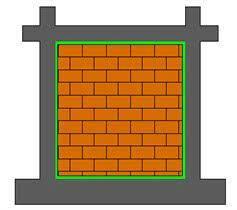
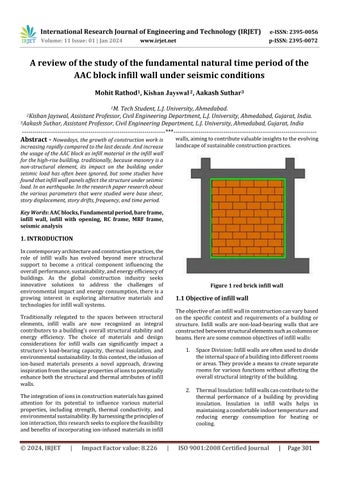
1.1 Objective of infill wall
Theobjectiveofaninfillwallinconstructioncanvarybased on the specific context and requirements of a building or structure. Infill walls are non-load-bearing walls that are constructedbetweenstructuralelementssuchascolumnsor beams.Herearesomecommonobjectivesofinfillwalls:
1. SpaceDivision:Infillwallsareoftenusedtodivide theinternalspaceofabuildingintodifferentrooms orareas.Theyprovideameanstocreateseparate rooms for various functions without affecting the overallstructuralintegrityofthebuilding.
2. ThermalInsulation:Infillwallscancontributetothe thermal performance of a building by providing insulation. Insulation in infill walls helps in maintainingacomfortableindoortemperatureand reducing energy consumption for heating or cooling.
3. SoundInsulation:Infillwallscanactasbarriersto sound transmission, helping to minimize noise transfer between different parts of a building or between adjacent buildings. This is particularly important in residential and commercial constructions.
4. Fire Resistance: Infill walls may be designed to enhance the fire resistance of a building. The materialsusedintheconstructionofthesewallscan be chosen for their fire-retardant properties, helpingtocontainthespreadoffire.
2. LITERATURE REVIEW
[1] Jalaeefar,A.,&Zargar,A.(2020,December).Effectof infillwallsonbehaviorofreinforcedconcretespecial moment frames under seismic sequences. In Structures (Vol.28,pp.766-773).Elsevier
Inthisresearchpaperstudy,thebehavioroftheRCframe undertheinfluenceofmainshockandaftershockinacertain time period was calculated. For this purpose, firstly the numerical procedure in opensees was used, and then 3 specialRCframeswith4,8and12layerswereexamined.In thiscase,modelswithinfill walls,withoutinfill walls,and withopeningswithinfillwallsweremodeled.Later,research andcurrentstudieswereconductedtoexaminetheresponse patterns of the structure to examine the impact of the earthquakeontheresponsestructure,especiallylater.
Forthenumericalmodelingprocess,thefirstmodeperiods ofthe4,8,and12storyframesareanalyzedbythesoftware ETABS and Opensees. From the result time period is the mostmatch.HencetheverificationisO.K.
Aftertheverification,threetypesoftheRCmomentframe includingfourbaysand4,8,and12stories,aretakeninto account. The buildings are designed in compliance with seismic provisions of ACI318 and ASCE/SE17. After the analysisresultsareobtainedfromthenonlineartimehistory analyses.(Pushoveranalysis,displacementductilitydemand, rotationalductilitydemand,andenergydissipation)
Theresultsofthepushoveranalysisshowthatthe additionoftheinfillwallsincreasesthestiffnessand strength,andalsoreducesthedurationofthefirst vibrationmode.
Thepresenceofinfillwallsreducestheductilityof the structure. in addition, a comparison of the ductility (displacement and rotational) of the structure with walls with and without opening showsthattheductilityishigherwhenopeningsare provided since the smaller ones are all the tight model
Asthenumberoffloorsincreasestheductilityand rotationalductilitydecrease
[2] Bârnaure, M., Ghiţă, A. M., & Stoica, D. N. (2016). Influence of the infill panels masonry type on the seismic behaviour of reinforced concrete frame structures.In The 1940 Vrancea Earthquake. Issues, Insights and Lessons Learnt: Proceedings of the Symposium Commemorating75YearsfromNovember 10, 1940VranceaEarthquake (pp.319-331).Springer InternationalPublishing.
The research paper compares the behavior of Bare frame and masonry infilled frame and the influence of masonry types is assessed. They compare the base shear and story displacement and stiffness of the following types of Bare frame,andinfluencesofmasonrytypesofinfilled
1. BareFrame
2. FullinfillSolidBricks
3. Fullinfillperforatedbricks
4. FullinfillAACblocks
5. Softstorysolidbricks
6. Softperforatedbricks
7. SoftAACbricks
AnalysisoftheframeisusingtheETABSsoftware.Forthe analysis consider the following data. G+3 frame structure, 2,3,4typeofthebayframes.
ThefirstConfigurationcorrespondstotheBareframe,andin thesecondConfiguration,theinfillisconsideredusingapinjoineddiagonalframe.Forthethirdconfiguration,fullinfill is taken into account for the upper stories while at the groundfloorlevel,onlythebareframeisconsidered.
Theinfillisalsomodeledasanequivalentdiagonalstrut;the height of the diagonal is defined as 0.1D; where D is the length of the diagonal and they are used P100-1/2013 seismicdesigncodeforthefollowingforces;1.Slidingshear alonghorizontaljoints,diagonaltension,andcrushinginthe cornersthatareincontactwiththeframe.
Asaresult,Consideringthelowstrengthandstiffnessvalues (likeACCblocks)doesnothaveasignificantimpactonthe behaviorofthestructure.
Consideringthehighstrengthandstiffnessvalues(likesolid andperforatedbricks)doesnothaveasignificantimpacton thebehaviorofthestructure.
[3] Kose, M. M. (2009). Parameters affecting the fundamental period of RC buildings with infill walls. Engineering Structures, 31(1),93-102
Thisstudyisaboutthebasicparametersliketheheightof thestructure,numberofbays,no.ofstories,storyheight,etc. affectingthefundamentalperiodofRCbuildingofinfillwall.
The following article states that the research plots three types of different buildings identical to 1. Bare frame, 2. Withoutanopenfirstfloor,3.Withanopenfirstfloorand also different parameters like percentage of shear wall; percentageofinfillwalletc.,Analysisofthestructureisusing the SAP2000 and ETABS software, for the following parameters;columnsizeis450x450mm,4No.ofbays.
Fortheestimation,thefundamentalperiodofthemoment resistingframehasbeengivenbythe

1. UniformBuildingcode: ; where.,h=heightof thebuildinginfeet,Ct=0.03

2. FEMA450: ;where.,hnistheheightinfeet,Cr =0.016,x=0.9

3. Eurocode 8: ; where H = height of the buildinginmeter
4. NationalBuildingcodeofCanada:0.1N;whereNis thenumberoffloorsabovetheexteriorbase
Andcomparetheresultoftheabovecodestotheproposed equations.,
TheProposedequationsofthefundamentalperiodare
.0156B+0.0039F-0.1656S0.0232I
A comparison of the proposed multiple linear regression model with UBC, Eurocode 8, FEMA 450 and NBC is presentedinthechart 1

conclusions,buildingheightistheprimaryparameterthat affects the fundamental period of the structure. The percentageoftheshearwallisthesecondmostimportant parameter that affects the fundamental period of the structure.Thepercentageoftheinfillwallandthenumberof thebayhavethesameeffectonthefundamentalperiodof thestructure.
[4] Fasil Mohi ud din (2017). Behaviour of Infill Wall under Seismic Loading in RC Framed Structure, InternationalJournalofEngineeringandTechnical Research7(7):65-70
Thisstudyisbasedonthecomparativestudyofframesin the same plane but with different stiffness and strength configurations. Fundamental period, frequency, displacement, story drift, and base shear are the different parametersstudiedinthatresearchpaper.Fortheresearch three types of the model were selected. First is the with shearwallmodel,secondisthewithoutshearwallmodel, andthirdiswithinfillwallmodel(bricksusedasmasonry infill materials). Analysis of the model is using structural engineering software CSI ETABS software. and follow the earthquake resistance code (IS 1893(part-1) : 2016). And usedtheResponsespectrumAnalysismethodfortheseismic analysis.
Asaresult,theDecreaseintheperiod,withashearwallis 42.06 % when compared with without a shear wall. With infillwall84.33%whencomparedtowithoutshearwall.An increase in frequency, with a shear wall is 42.04% when comparedwithwithoutashearwall.Withinfillwall82.39% whencomparedtowithoutshearwall.
[5] Patel, P., & Shah, D. (2021). Comparative Study of Brick Infill Wall and Autoclaved Aerated Concrete (AAC)BlocksUsingResponseSpectrumAnalysis
Intheresearchpaper,researchaboutthecomparisonofAAC block and Clay bricks. These are more suitable for constructionasinfillmaterialsalsoknowwhicharegreen andsuitableforconventionalbrickssuchasAACblockscan performbetterornotunderseismicconditions.Inthisstudy theG+6storyRCbuildingisanalyzedbyusingtheresponse spectrumanalysismethodandinfillwallsaremodelledand analyzedbyequivalentdiagonal strutmethodusingEtabs software.
For the research, prepared the six models which are mentionedinthegiventable.,
CASE1
BRICK INFILL
Model1
Brickinfillwithoutstruts
Model2 Brick infill with 230mm wall struts
Model3 Brick infill with 230mm and 115mmwallstruts
AACINFILL
Model5 Brick infill with 230mm wall struts
Model6 Brick infill with 230mm and 115mmwallstruts
the research paper compares the story displacement, the story drifts, the bending moment, and the axial and shear force.
Asaresult,allthemodelssatisfiedtheconditionofthestory displacement and story drifts as per clause 7.11.1.1 of IS 1893-2016(part1)maximumstorydriftinabuildingshould notexceed0.004timesthestoryheight.
When The stiffness of the building is increasing, story displacementandstorydriftaredecreasinginthecaseofthe strut model. When the analysis of the building using the diagonal strut method shows a lesser bending moment, lesser shear force, and lesser axial force compared to the bare frame model with the same frame sections under similar seismic conditions Also, we can say that the AAC blockisagreensubstituteforconventionalclaybrickdueto thefollowingreasons.1.Withoutconsideringinfillstruts→ 25.67%concrete,16.89%reinforcement,and18.94%cost canbeconservedbyadoptingAAC. 2.Considering230mm infillstruts→10.68%concrete,9.78%reinforcement,and 9.99% cost can be conserved by adopting AAC. 3. Considering 230mm+115/100mm infill struts → 10.68% concrete, 6.91% reinforcement and 7.78% cost can be conservedbyadoptingAAC.
3. Objective of review
Tofindwhichtimeperiodformulaistakenfortheinfill(AAC block) of the RC and MRF building. As per earthquake resistancecode(IS1893:2016part1).
TocheckwhetherthebehavioroftheBareframeandwith infillwall(AACblockasinfillmaterials)isthesameornot.
To study the behavior of drift pattern of different percentagesofopeningwall
Tofindthebaseshearofdifferentmodel
TocheckthebehaviorofRCandMRFframewithAACblock infillbymodelinginfillasdiagonalstrut.
4. CONCLUSIONS
In summary, the reviewed literature emphasizes the positiveimpactofinfillwallsonthestiffnessandstrengthof reinforcedconcreteframesunderseismicloads.Thestudies revealnuances,suchastheinfluenceofopeningsonductility and variations in structural response based on masonry types. Building parameters, like height and shear wall
percentage, are identified as key factors affecting fundamental periods. Comparative analyses suggest economic and environmental considerations in choosing infill materials. Overall, the findings provide valuable insightsforseismicdesignandretrofitting,highlightingthe need for a comprehensive understanding of various parametersinstructuralbehavior.
REFERENCES
[1] Jalaeefar, A., & Zargar, A. (2020, December). Effect of infill walls on behavior of reinforced concrete special moment frames under seismic sequences. In Structures (Vol.28,pp.766-773).Elsevier
[2] Bârnaure, M., Ghiţă, A. M., & Stoica, D. N. (2016). Influence of the infill panels masonry type on the seismic behaviour of reinforced concrete frame structures. In The 1940 Vrancea Earthquake. Issues, Insights and Lessons Learnt: Proceedings of the Symposium Commemorating75YearsfromNovember10, 1940 Vrancea Earthquake (pp. 319-331). Springer InternationalPublishing..
[3] Kose, M. M. (2009). Parameters affecting the fundamental period of RC buildings with infill walls. Engineering Structures, 31(1),93-102
[4] FasilMohiuddin(2017).BehaviourofInfillWallunder SeismicLoadinginRCFramedStructure,International JournalofEngineeringandTechnicalResearch7(7):6570
[5] Patel,P.,&Shah,D.(2021).ComparativeStudyofBrick Infill Wall and Autoclaved Aerated Concrete (AAC) BlocksUsingResponseSpectrumAnalysis