
The new trend to Project Management: Lean construction. A methodology to
mitigate waste and risk within the project.
Georgios Xanthakis
PhD, Aegean University, Chios, Greece - GeorgeX consultants (Director),PMP,MICE,MAPM,EUR-ING
Abstract - Lean is a business philosophy, not just a tool set or method for improvement. This business philosophy was derived from Toyota experiences and from its Toyota ProductionSystem(TPS).Itfocussesisonreducingwasteinall business processes, reducing cost and lead-time as well as an increasing the quality.
This paper explores the principles of Lean Philosophy as applied to project management processes. This will be an introduction to the advantages of applying Lean tools and techniques to Projects. It is time for the world of projects to reap the same kind of benefits that Lean has achieved for manufacturing, -maximizingthevalueandminimizingwaste. Proper use ofLeantechniques resulted incutting waste inthe projects, producing greater customer satisfaction and improved profit margin. The goal of this paper is to provide participants with an understanding of how using Lean principles can help ensure project success. The objective is to explore how Lean principles can be applied to project management and to determine the conditions within can be successfully implemented.
Key Words: Lean Management, Construction, Project Management
1.INTRODUCTION
1.1 Lean Philosophy and Construction Industry
Its common at Construction Industry [1] projects have significant delays and budget overruns. Lean construction methodologyisefficientineliminatingthetypesofwasteina construction project such as defects, overproduction of goods, inventory, motion, transportation, waiting, over processing and not out utilizing talent. Over processing includesoverengineering,applysimilardocument,duplicate forms and getting double supply estimation. Any step in a process that is not adding any value the project can be considered as overprocessing. Not utilizing talent includes bad quality training assigning wrong people to significant roles,noteffectiveadmintasks,poorwaysofcommunication, poormanagement,lackofeffectiveteamworkandingeneral issuescauses inefficient management of human resources. Eliminatingaboveissuesgetawaytherelevantwasteleading tomoreandefficientproductivity.
A lack of trust [2] within the construction sector has created systems of checks, double-checks and over
specification to cover legal ramifications both real and perceived, problems thatLeanconstruction seeks to solve. EvidencefromthreeLCI-fundedresearchsourcesshowthat projectsthatimplementLeanbuildingtoolsandtechniques havemuchbetteroutcomesacrossavarietyofbenchmarks. Lean methods of maximizing stakeholder value while reducingwastebyemphasizingcollaborationbetweenteams on a project. The goal of Lean construction is to increase productivity, profits, and innovation in the industry. Lean Construction is a project deliveryprocess that uses Lean methods of maximizing stakeholder value while reducing waste by emphasizing collaboration between teams on a project. The goal of Lean construction is to increase productivity, profits, and innovation in the industry, while minimizing waste. It focuses on increasing workflow efficiencyandmaximizingprofitwithoutexertingmoreeffort orrequiringadditionalresources.
LeanconstructionusestheprinciplessuchasValue,Value Stream, Flow, Pull and Perfection and applies them to constructionindustrytoeliminatewaste[10] Leanphilosophy applied to construction focus on waste elimination, improvingquality,creatingapullsystemwithcontinuesflow withoutbottlenecksthatmeetthecustomer'srequirements, involveemployeesateachlevel,suppliers,andclientwithin the project process, investing inbuilding in quality and continuous improvement. Activities taking place in construction can be divided into following two categories: conversion activities that lead tangible outcome and flows activitieswhichfastensuchconversionactivitieswithinthe delivery.Researchhasdiscoveredthatsignificantwastelies inthatflowprocesses [3]
1.2 Methodology
Byitsnature,thispaperisanintegrativeliteraturereview. This is a form of research that reviews, critiques, and synthesizes representative literature on a topic in an integratedwaysuchthatnewframeworksandperspectives onthetopicaregenerated [4].Integrativeliteraturereviews can be structured using a set of competing models and information.Nodataweregeneratedoranalysedduringthe study. At the first part of this paper the lean concept and their principles is presented while follows the connection among lean philosophy and construction projects and the implementation of Lean principle to them. The paper highlightsthebarrierstothisandtheconnectionbetween
International Research Journal of Engineering and Technology (IRJET) e-ISSN: 2395-0056 Volume: 11 Issue: 01 | Jan 2024 www.irjet.net p-ISSN: 2395-0072 © 2024, IRJET | Impact Factor value: 8.226 | ISO 9001:2008 Certified Journal | Page293
***
leanconstruction andsustainability.Thepaperiscomplete withconclusionandrecommendations.
2. LEAN APPROACH
2.1 Lean History
Followingthe1973energycrisis,Toyota [5] wastheonly Japanesefirmresistingbyworkingefficientlyandeffectively. Thecompanymanagedtoovercomethiscrisisbydeployinga cultureofempowerment.Toyotaemployeeswereembarked inacontinuousimprovementjourneyandwereworkingto drive inefficiencies out of work processes. Results are reduction of manufacturing lead-time and costs as well as improvingqualityandcustomersatisfaction.
This is a study of the automobile industry [6] that introducedthisbusinessphilosophyleanproductionforthe first time to the western world. The Toyota success story base waste elimination has since kept all industries enthusiast about the lean approach. It was also a breakthroughstepfrommassproductiontoleanproduction, from a pushsystemtoa pull system.“Lean manufacturing useslessofeverythingcomparedwithmassproduction-half thehumaneffortinthefactory,halfthemanufacturingfloor space,halftheinvestmentintools,halftheengineeringhours todevelopa newproductinhalfthetime.Also,itrequires keepingfarlessthanhalftheneededinventoryonsiteand resultsinfewerdefects.” [6]
Overtheyears,WomackandJonesrefinedtheirstrategy and published in 1996 Lean Thinking: Banish Waste and Create Wealth in Your Corporation. [7] Theyproposedinthis bookasetofmanagementprinciples,tools,andbestpractices designed to highlight and reduce waste in work processes andincreaseefficiency.Theaimwastohelporganizationsget theoperationalexcellence.TobeLeanmeanstoprovidewhat isneeded,whenitisneeded,withtheminimumnumberof materials, equipment, labour, and space. The bookLean Thinking, presented in 1996, proposed the following core principles:
Thefirstleanprincipleistospecifyvalueintheeyesofthe customer. Value of a product or service is defined as “a capability provided to a customer at the right time at an appropriateprice,asdefinedineachcasebythecustomer.”[7] Valueisstatedinthecustomer'sword.Thechallengehereis tofocusonwhatthecustomeriswillingtopay.
Thenextprinciplewastoidentifythevaluestreamofeach product. The value stream includes “all the actions, both values added, and non-value added, currently required to bring a product from raw material to the arms of the customerorthroughthedesignflowfromconcepttolaunch.”
[8] Firstthingis neededtocreateavaluestreammapthat shows the processbeingtreatedand thatatthenext step was analyzedforwasteandvaluecreation,andafuture-state mapiscreated,whichrepresentshowtheprocesscouldand
shouldoperate,generatingthenanimprovementplan,which will enable todesign the transformation fromthecurrent state to the next/ improved state. Rother & Shook [9] in theirLearningtoSeehavedevelopedapowerfultechniqueto mapvaluestreamwhichfacilitatetheidentificationofwastes andallowprocessimprovement.
The third step was to make value flow by eliminating waste. Once the value is defined and the value stream is identified,thefollowingstepistocreatecontinuousflowby eliminating backflows, scrap, rework, and interruptions. Withintheanalysisofvaluestreams,workprocesseswillbe categorizedintooneofthreefollowingtypes:
Value-AddedWork(worksareessentialchangesto product/service)maximizingthiscategoryprovide customervalue(Form,Fit,Function).
Value-Enabling Work: the category that has potential for elimination in the future (with identified improvements) but can't be eliminated immediately.
Non-Value-AddedWorkbeeliminatedquicklyandis notdependentonimprovementofotherareas.This istheworknobodyneeds,anditispurewaste.
Thelasttwostepsarelettingthecustomerpulltheflow andthecontinuousimprovement. Thechallengehere isto avoiddeliveringvaluebeforethecustomerrequestitandno morethantheagreedinitialscope.Thecustomerpullingthe flow providing a Kanban system that allows the implementationofajust-in-timeapproach. Thefinalstepis pursuingperfectionthatwouldleadthetransformationtoa leanculturecreatinganendlessprocessimprovement.
2.2 Lean Mindset in Construction Industry
LeanconstructionusestoolslikeA3thinking,Choosingby AdvantageandValueStreamMappinghelpsdecision-making ItproposesmindmapslikePoka-yoketopreventerrorsand eliminatedefectsand5smethodologytoachieveareduction andeliminationofthe wastes.Leanconstructionmakeuse ofJustintimeprinciplesconsideringtherightquantity,atthe right place and time and visualize the process using the Kanban,controllingtheprocessofproductionandhighlight potentialbottlenecks.
LastPlannerhelpsinmakingtrustworthyscheduleand work plan for any project rather than conventional forecastingthatmayleadtoprojectdelays.Finally,itpresents Integrated project delivery (IPD), a delivery model for constructionprojectsusingasinglecontractfordesignand construction with a shared risk/reward approach that integratesteams,structures,andbusiness [1].Abovetools, mindsets, and philosophies are presented in the following paragraphs and their contribution to the outcome of Lean Constructionishighlighted.
International Research Journal of Engineering and Technology (IRJET) e-ISSN: 2395-0056 Volume: 11 Issue: 01 | Jan 2024 www.irjet.net p-ISSN: 2395-0072 © 2024, IRJET | Impact Factor value: 8.226 | ISO 9001:2008 Certified Journal | Page294
2.3 Implementing Lean Principles in Construction
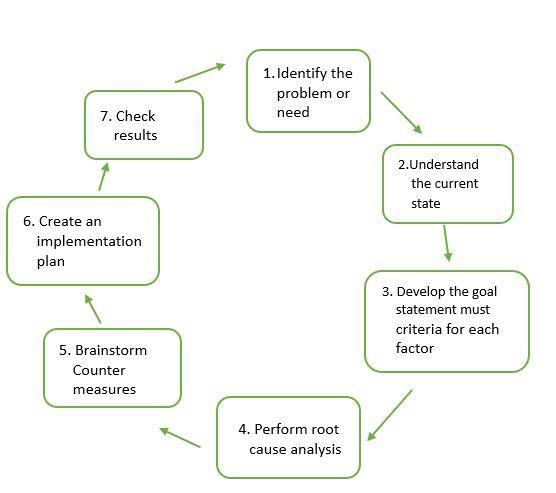
A3thinkingisacollaborativemanagementprocessand improvementmethod.Thespecificmethodologycanbeused forproblemsolving,decisionmaking,planning,orreporting ofaspecificissue.Theflexibilityoftheconceptmakesiteasy tobeusedwithinmanyissues.Itcanbedevelopedusinga pencilandpaperorcommonlyusedprograms(Excel,Word, PowerPoint).Image1.1showsthestepshouldbefollowedto preparinganA3Report.Brainstorming,Affinitydiagramsand
Multivoting are tools that encourage teams to investigate their creativity and add methods for decision making
Brainstorming produces many ideas of solution in a short timestimulatingthecreatingthinkingprocessandmakesure that all group member’s ideas are considered. Affinity diagrams organize facts, opinions, and issues into natural groups to help in diagnosing complex situations and exploringissues.Theyhelpidentifycentralthemesinasetof ideas,organisinginformationwell,breakingthroughbeyond traditional thinking. Multivoting is a quick technique for identifyingprioritiesandnarrowingdowntheoptionfroma list ofideas.This tool assume thatyou havea list of ideas, eliminates duplicates and combines related ideas before continuing [1]
AValueStreamMap(VSM)isatoolthathelpsvisuallysee andunderstandagivenprocessrather.Thisisvitalbecause understanding the specific process can be identified any waste within the processAVSM enables people tosee the flowof(BusinessValue-CustomerValue-Added)aswellas thepercentagesofeachintheprocess.Byunderstandingthe process, team can easier design a solution that develops functionalityandimprovingtheoutcome.Applicationofthe methodology create improvements in the process by eliminatingerrors,requiredtimes,andthenon-valueadding
activities,increasingoverallperformanceoftheprocess.It helpscommunicateinsideandoutsidetheorganisation.
SIPOC is a simple diagram for identifying the basic elementsofaprocess(boundaries,inputs,processes,teams, outputs). Creating a SIPOC [1] and top down or swing-lane flowchartsasappropriatetoidentifyscope,keymetrics,and basic process steps. The first step is the determination of individualproducts,services,orfamilyofproducts,following fromthedrawingoftheprocessflaw.Thenextstepsarethe addingofmaterialflow,informationflow,andthecollection oftheprocessdataandtheconnectionofthistoBoxesonthe chart.Thelasttwostepstocompletethemaparetheaddition ofprocessandleadtimedatatothechartandtheverification ofthemap.
ChoosingByAdvantage(CBA)isoftenusedwhenmultiple variablesneedtobeconsideredtodecide. Thistoolcanbe usedformakingdecisionwhenthereisnumberofalternative choices available, but the team can’t determine the best outcome.Fig.2showsthestepshouldbefollowedtoapply CBA.

Fig -2:StepstoapplyCBA
Poka-yoke [11] means "error proofing”. It is a mistake proofingmethodappliedtopreventanyerrorsordefects.It can be implemented in design and construction phase to preventreworkandwastageofmaterial.Forexample,inthe designphase,iftheplanofthebuildingismadeclearlywith different color codes for the similar components but with differentspecificationitwouldhelpinbetterunderstanding andpreventrework.
5 S helps [12] to the reduce and eliminate of the wastes within a process It develops people's participation, collaboration,teamwork,andatthesametimereducescosts, variabilityanduncertaintyandithelpstothedevelopofLean mindsetwithinthecompany,basedintfollowingsteps:
International Research Journal of Engineering and Technology (IRJET) e-ISSN: 2395-0056 Volume: 11 Issue: 01 | Jan 2024 www.irjet.net p-ISSN: 2395-0072 © 2024, IRJET | Impact Factor value: 8.226 | ISO 9001:2008 Certified Journal | Page295
Fig -1:StepstoapplyA3thinking
Sorting - Clarify the necessary issues from the unnecessary
Simplifying -Placeeverythingwhichisnecessaryina designatedplaceandhighlightitsoitcaneasilybe found.
Sweeping - Clear cleaning up the work areadeliberatelycollectallpartsandmaterialsthatare outofplaceandleaveeachtoitsassignedplace.
Standardizing - Create - standardwaystokeep the work areas organized, clean and in order, and standardwaystosucceedthe5Sapproach.
Self-Discipline - Followingthe5S'sagreementsand ensureitismaintainedinaproperway.
JIT (Just in time) philosophy [13] proposes having the required quantity of goods, at the right place and time. Organize buffers mean piles of stuff: Materials, tools, equipment, manpower. It’s a method to eliminate physical buffers. Kanban methodologyhighlights“asignaltoreplace or refill." Kanban is a communication tool used to tell workers to deliver more material or to refill material containerstoaspecifiedlevel.Itisavisualtoolformonitora process. Kanban uses the pull method which secures that everythingisundercontrolandproduced,inrightquantityat therighttime.Itensuresthateverythingisaccordingtothe schedule.OneofinitialconditionssettingupaKanbansystem istoleveltheprocess,whichleadstolimitinventoryofeach activitywithinit.(Patel&Solanki,2020) [14]
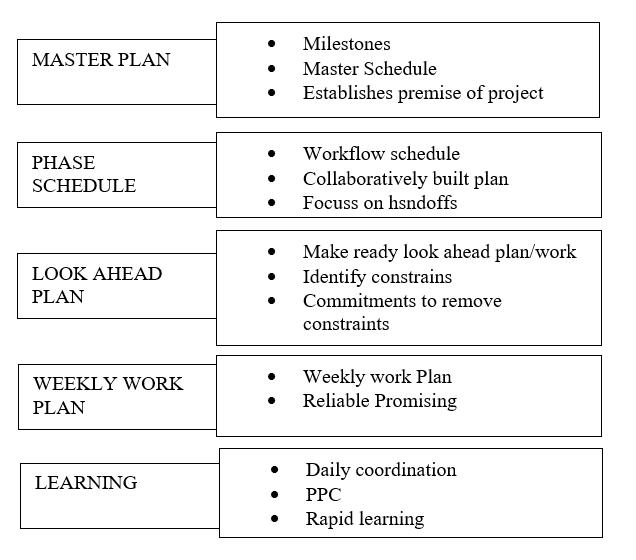
Last Planner helpsinmakingtrustworthyscheduleand work plan for any project rather than conventional forecasting that may lead to project delays [15]. The "last planner"referstothepeopleresponsibleformakingthefinal assignment. TheLastPlannerplanningcycle(showninfigure 3)comprises:
“themasterschedule”coveringthewholeproject,
the detailed “phase schedule” emerging from collaborativeplanning,
the“look-aheadplan”withconstraintsanalysisand
the“weeklyworkplan”withmeasuredpercentplan complete.
Front end planning begins with the master schedule whichinitiatesstrategicplanning,identifiesmajormilestone. (PlannerPSW,2007)[15].Production/Serviceplanningbegins with the magnification of detailed activities on the phase scheduleintothelookaheadplan.Thelookaheadplan[17]isa listofactivitiesthatneedtobeworkedonovertheupcoming sixweeks.Theplanisupdatedweeklywhereconstraintsthat threaten reliable workflow are studied. Identifying
responsibilities and making assignments ready follows by analyzing resource management information. The Weekly WorkPlan [18] isthemostdetailedplaninthesystem.
Integrated project delivery (IPD) isadeliverymethodfor deliveringconstructionprojectsusinga singlecontractfor design and construction, assigning responsibility between staff, and presenting an operating system based on lean principles, and introducing collaborative culture. IPD is a projectdeliveryapproachthatintegratespeople,practices, andbusiness. [16]
IntegratedProjectDelivery(IPD)isanimportantpillarof theLeanConstruction.Theconstructionindustryhasseena sharpdeclineinproductivityandprojectoutcomessincethe late 1960s. A for this decline is that a lot of projects were deliveredlateandover-budget.TheaimofIPDistocreatea bettersystemofcollaborationandcommunicationbetween the parties involved in a project, from the owner to the designertotheconstructionteam,anytradesandsuppliers involved.Thisapproachcontrastswiththetraditionaldesignbid-build project delivery approach in which the owner/developeroftheprojecthasseparatecontractswith eachpartyandactsasaconnectionbetweenforthedesign andbuildteams.Byaligningthevariouspartiesinvolvedin the project and ensuring they stay in continuous communication throughout, IPD its ensured increased efficiency and is eliminated wastein projects. The term “waste” is referred to both literal material waste and intangiblewastesuchaswaittimes,poorlyassignedhuman resources, and overproduction. If any issue is highlighted duringthedesignstage,itwillbeeasiertoremovethewaste oftimeandassociatedcostsinfixingthatkindofaproblem andincreaseyourproject’sefficiencyinyourefforttodeliver itontime.TheIPDmethodisoftenconsummatedthrougha
International Research Journal of Engineering and Technology (IRJET) e-ISSN: 2395-0056 Volume: 11 Issue: 01 | Jan 2024 www.irjet.net p-ISSN: 2395-0072 © 2024, IRJET | Impact Factor value: 8.226 | ISO 9001:2008 Certified Journal | Page296
Fig -3:LastPlanner
singlephysicalcontractbetweentheinvolvedpartiesofthe constructionproject.Thecontractoutlinesexpectationsfor eachgroupandclearlystatesthesharedgoalsfortheproject.
BelowitsexploredstepstoadoptIPDaccordingtheLCI (LeanConstructionInstitute)[19]:
Firststep is the definition the project owner’sbusiness caseandgoalsandthedetermineofthebudgetandworkto eliminateunknownsandvariablesasmuchaspossible.The fewerunknowncostsarefaced,thebetterequippedyouwill betohandleanycurveballsthrownattheteam.Thesecond step is the successful Building of the team using the best valueselectionprocesstocontractkeystakeholderspriorto or during concept design to validate targets and unify the team,ensuringtheteamisonboardwithusinganIPDmodel andispreparedtotakethenecessarystepstoimplementit.
The next step is to secureongoing trainingand coachingfortheteamtoincreaseadoptionofLeanmethods. AmajorfacetoftheIPDmethodisawillingnesstoinnovate andtolettheexpertiseoftheteammembersshineproviding spaceforthosepeopletoemergeasleadersinyourproject. Thefourthstepisprovidingcontractsshouldsupportagood teamcultureandadoptionofLeanmethods.Arisingtidelifts all boats, so encourage all members and teams within the project to be unafraid to seek help and toconstantly communicate.Alastproposalforanyleanprojectistolook forhelpandtrainingandeducationresources.
IPD might not be the right method for every project. Projectsizeandprojectstatusarefactorstoconsiderwhen utilizingIPD.Similarly,ateamwithfewerresourcesmaynot havetheabilitytoeducatethosewhohavenotbuiltusingIPD inthepast.Thefollowingaresomeimportantrequirements for a successful IPD implementation: an owner willing to remain engaged and collaborative, trust for all parties, complete buy-in from all involved in, desire to innovate, value-driven mentality, resources continuously educated teammembersonIPDprocesses[15]
2.4 Lean Applications in Construction Projects
Recent research and discussion have been carried out usingleanconstructionapplicationsinmany(developedand developing)countriesallovertheworldsuchasNigeriaby AdamuandHamid[20],EcuadorbyFialloandRevelo[21],Chile by Alarcon etal. [22]and Malaysia by Marhani etal. [23] .In addition,attemptshavebeenmadetoapplyleanprinciples and techniques to all project management processes, including the project delivery system, production control, workscheduling,design,supplychain,projectcontrols,and overallconstructionprojectmanagement.
Ballard et al. [24] presented an overview of the entire intervention, which confirms the applicability of lean conceptsandtechniquestothemanagementoffabrication processes. Also, they illustrated the benefits achievable in
improved management of demand, reduced cycle time, greaterproductivity,heightenedworkforceinvolvement,and increased revenue and profitability. The results achieved illustratethepowerofleanconceptsandtechniquesandtheir applicability to the operations of fabricators supplying engineered-to-orderproductstoconstructionprojects.Tsao etal. [25] illustratedhowleanthinkingandworkstructuring helpedtoimprovethedesignandinstallationofmetaldoor framesforaprisonconstructionproject.
Koskela et al. [26] examined a fast-track office building projectandshowedhowthebuildingprocesscouldbemade leanerandspeedier.Inthefieldofsimulationandsoftware, Marzouk et al. [27] used computer simulation as a tool for assessing the impact of applying lean principles to design processes in construction consultancy firms to aid in decision-making at early stages of construction projects. Sacksetal. [28] havebeenspecifiedapullflowconstruction managementsoftwaresystem,andasetoffunctionalmockups of a proposed system that has been implemented and evaluated.Alinaitwe [29] providedagraphicalaidtoenable decision-makers to concentrate their efforts to overcome barriersbyinvestigatingtheinfluenceofmanybarrierson thesuccessofleanconstructioninitiatives.
2.5 Risk Management and Risk Response Schedule
Riskmanagementcanbedefined“astheprocessoftaking calculatedrisks,reducesthelikelihoodthatalosswilloccur andminimizesthescaleofthelossshoulditoccur”.Themain objectiveofriskmanagementprocessistoreducetherisk effectontheprojectobjectivesandthusimprovedecisionmaking.Itincludesboththeimpendingofpotentialproblems andtheearlydiscoveryofproblemswhentheyoccur [30].
TheProjectManagementBodyofKnowledgedefinedthe riskmanagementplanningastheprocessofdecidinghowto approach and plan the risk management activities for a project [31]. Itisimportanttoplanfortheriskmanagement processes that follow to ensure that the level, type, and visibilityofriskmanagementarecommensuratewithboth theriskandimportanceoftheproject.Thesignificanceofthe riskmanagementtaskvarieswiththesizeoftheproject,and itsimportance.
Schwalbe [32] presented risk management as a set of principles,wherebytheprojectmanagercontinuallyassesses risks and their consequences and takes appropriate preventiveactions.Riskmanagementisacriticalfactorfor successfulprojectmanagement,asprojectstendtobemore complexandcompetitionincreasinglytougher.
There is a direct relationship between effective risk managementandprojectsuccesssincerisksareassessedby their potential effect on the objectives of the project. Contractorshavetraditionallyusedhighmarkupstocover risk,butastheirmarginshavebecomesmaller,thisapproach isnolongereffective.Inaddition,theconstructionindustry
International Research Journal of Engineering and Technology (IRJET) e-ISSN: 2395-0056 Volume: 11 Issue: 01 | Jan 2024 www.irjet.net p-ISSN: 2395-0072 © 2024, IRJET | Impact Factor value: 8.226 | ISO 9001:2008 Certified Journal | Page297
has witnessed significant changes particularly in procurementmethodswithclientsallocatinggreaterrisksto contractors. The risk response planning phase exists to develop responses to identified risks that are appropriate, achievable,andaffordable.Ownersarealsoallocatedtoeach riskresponse,toberesponsibleforitsimplementationand formonitoringitseffectiveness.Riskresponsesareusually groupedaccordingtotheirintendedeffectontheriskbeing treated.Itiscommontousethefollowingfourriskstrategies [33]
Avoid (seekingtoeliminatetheuncertaintybymakingit impossible for the risk to occur), Transfer (identifying another person better able to manage the risk), Mitigate (reducing the size of the risk), or Accept: recognizing that residualrisksmustbetaken.
2.5 Lean Manufacturing and Sustainability
Leanconstruction(LC)promisesoutstandingresultsin managing the construction process and achieving the project’sgoalsbyeliminatingwaste.Leanconstructionand Sustainable construction policies are two separate and independent strategies, where Lean’s process goal is to improve economic standards, while sustainability aims to improve the environmental objectives. However, through enormous research and industry practices, it is found recentlythatthetwopracticesareinterdependentandshares theexactbasicsofwasteelimination[33].Componentsrelated toSCcanbeintegratedintotheconceptofLCtoenhanceand preserve the natural resources, economic growth, and environment without compromising the future. This is possiblebecausetheintegrationofconceptswillenhancethe performance and the impact of building construction by realizing hidden cost reductions towards the environment [35] .Theglobalconstructionindustrywillsignificantlybenefit from adopting both Sustainable and Lean Construction concepts.
Table -1: ThelinksbetweenLeanconstructionand sustainability(adaptedfromShepherdConstruction) Lean waste Description Manifestation of waste Three pillars Transpo rt
Communicationfailurein between processes, multiple & complex sources
Double handling Material unavailability Environment Inventory
Excessive information, inadequateconfiguration management, complex retrievalsystem,workin progress
Excess materials
Insufficient materials Motion
Searchingforinformation, required manual intervention, lack of direct access, no collocation
Overproductio n
O verprocessing
Signoffs,toomanydetails, unnecessaryinformation, redundant activities, over-dissemination, pushing rather than pullinginformation
Scope creep, overtime unplanned, excessive approvals, resources overloaded, excessive reviews, hand-offs, producing intermediate deliverables, too many iterations, unnecessary data conversions, excessiveverification
Overspecificati on coordination problems
Personal frustration
Efficiency of output delivery
Increased accidents
Low productivity Economic
Rework,poorestimation, conversion errors, inaccurate information, inappropriate design verification, unclear acceptancecriteria
Defective materials/wor k
Social Defects
2.6 Barriers in Implementation Lean Principle in Construction
Youssef Larteb et al., (2015) [35] identified that success factorsofleanimplementation,Thestudyhighlightsfactors such as: strong management's leadership, engagement, commitment,providingtimeandresourcesforimprovement projects,andorganisingemployee'sdevelopmentprogram.
Managers and supervisors should motivate, supervise, andtraintheiremployees.Theymustencouragethemand activelyparticipate withtheminthe processofimproving projectsformanagersandproductionsupervisors,quality should go ahead in productivity and efficiency. Managers andproductionsupervisorsactivelycommunicateeffectively andledtheirstaff.
NordinNoranietal.,(2010)[37]identifiedthemainreason for failure of implementation of Lean manufacturing is difficulties in managing the change process during the transformation within the organisation. Lack of adequate leanunderstandingandfinancialissuesfollow
3. CONCLUSIONS
SummingupadoptingtheLeanconstructionmindsetwill provideanintegratedroadmaptomanagetheconstruction and preconstruction phase of any new buildings. Lean construction will help in better decision-making, in preventingerrorsanddefectandachievingareductionand eliminationofthe wastes.TakingadvantageofJustintime mind-setconsideringtherightquantityofgoods,attheright place the right time and visualizing the process using the Kanban,thecontroloftheprocesswillbeachieved,andthe
International Research Journal of Engineering and Technology (IRJET) e-ISSN: 2395-0056 Volume: 11 Issue: 01 | Jan 2024 www.irjet.net p-ISSN: 2395-0072 © 2024, IRJET | Impact Factor value: 8.226 | ISO 9001:2008 Certified Journal | Page298
potentialbottleneckswillbeavoided.LastPlannerwillhelp in making trustworthy schedule and work plan for the projectratherthanconventionalforecastingthatmayleadto projectdelays.
Finally,itproposesIntegrated projectdelivery(IPD),a deliverymodelfordeliveringconstructionprojectsusinga singlecontractfordesignandconstruction.Themainfactor ofleanimplementationandsuccessfuloutcomearethetop management support. Considering Lean construction as changetotraditionalwayofactingintheindustryrequires thesupportoftheLeaders. Managersandsupervisorsmust motivate, supervise, and rain the staff in the new way of thinkingandacting.
REFERENCES
[1] Hammadhu R, 2023. Guide to Lean Construction-Easy way to become Lean with case studies. Printed by Amazon.
[2] Moujib, A.,2007. Lean Project Management. Paper presented at PMI® Global Congress 2007. EMEA, Budapest, Hungary. Newtown Square, Project ManagementInstitute
[3] Womack,J.P.,& Jones,DT,2003 Lean thinking.New York Simonand Schuster
[4] Torraco, R. J. 2005. Writing integrative literature reviews: Guidelines and examples.HumanRes.Dev.Rev. 4 (3): 356–367. Available at: https://doi.org/10 .1177/1534484305278283
[5] T.Ohno,TheToyotaProductionSystem:BeyondLarge ScaleProduction,ProductivityPress,Cambridge,1998
[6] Womack,J.P.,& Jones,DT,1990 Lean thinking.New York Simonand Schuster
[7] Womack,J.P.,& Jones,DT,1996 Lean thinking. Lean Thinking: Banish Waste and Create Wealth in Your Corporation. Simonand Schuster
[8] Morgan, James,2002. High Performance Product Development: A Systems Approach to a Lean Product Development Process, Doctoral thesis in Industrial and Operations Engineering,UniversityofMichigan.
[9] Shook,J.,Rother,M.,1999 Learning to See. Value Stream Mapping to add value and Eliminate Muda, Brookline, MA:TheLeanEnterpriseInstitute.
[10] Picchi,F.A.,Granja,A.D.,2004."Constructionsites:using lean principles to seek broader implementations". Paper presented at 11th annual conference of the internationalgroupforleanconstruction Blacksburg, Virginia
[11] Zhang A., 2014. Quality improvement through PokaYoke:From engineeringdesigntoinformationsystem design. International Journal of Six Sigma and CompetitiveAdvantage8(2)p.147-155
[12] Singh A., 2015. Review of 5S methodology and its contributionstowardsmanufacturingperformance.Int.J. ProcessManagementandBenchmarking,Vol.5,No.4, 2015.p.408-417
[13] HybelL.,2018. The Just in Time concept in construction. Online [Accessed 30 June 2023] http://wiki.doingprojects.org/index.php/The Just_In_Time_concept_in_construction
[14] Patel V. & Solanki J., 2020. Just in time concept used in construction Project. International Research, Journal of engineeringandtechnology(IRJET).Volume07Issue06. June2020
[15] Thelast Planner Production System Workbook,2007. ImprovingReliabilityinPlanningandWorkflow.Version 20.LeanConstructionInstitute.
[16] IPDA, 2020. An integrated project delivery-An action guideforleaders
[17] G.Ballard,Thelastplanner,In:SpringConferenceofthe NorthernCalifornia,Construction,1994.
[18] G. Ballard, G. Howell, Stabilizing workflow, in: Proceedings of the 2nd Annual Conference of the International Group for Lean Construction, IGLC-2, Santiago,Chile,1994.
[19] (Lean Construction Institute) LCI. Available at: https:/leanconstruction.org/
[20] S. Adamu, R. Hamid, Lean construction techniques implementationinNigeriaconstructionindustry,Can.J. Environ.,Constr.Civ.Eng.3(2012)186–193.
[21] C.M. Fiallo, P.V.H. Revelo, Applying the last planner controlsystemtoaconstructionproject:acasestudyin Quito, Ecuador, in: Proceedings of the 10th Annual Conference of the International Group for Lean Construction,IGLC-10,Gramado,Brazil,2002.
[22] F.L. Alarco´ n, S. Diethelmand, O. Rojo, Collaborative implementation of lean planning systems in Chilean construction companies, in: Proceedings of the 10th AnnualConferenceoftheInternationalGroupforLean Construction,IGLC-10,Gramado,Brazil,2002.
[23] M.A.Marhani,A.Jaapar,N.A.A.Bari,Leanconstruction: towardsenhancingsustainableconstructioninMalaysia, J.Procedia–SocialBehavior.Sci.68(2012)87–98.
International Research Journal of Engineering and Technology (IRJET) e-ISSN: 2395-0056 Volume: 11 Issue: 01 | Jan 2024 www.irjet.net p-ISSN: 2395-0072 © 2024, IRJET | Impact Factor value: 8.226 | ISO 9001:2008 Certified Journal | Page299
[24] G.Ballard,N.Harper,T.Zabelle,Anapplicationoflean conceptsandtechniquestoprecastconcretefabrication, in: Proceedings of the 10th Annual Conference of the International Group for Lean Construction, IGLC-10, Gramado,Brazil,2002.
[25] C.Y.Tsao,I.D.Tommelein,E.Swanlund,G.A.Howell,Case study for work structuring: installation of metal door frames,in:Proceedingofthe8thAnnualConferenceof theInternationalGroupforLeanConstruction,Brighton, UK,2000.
[26] L.Koskela,P.Lahdenpera¨,V.Tanhuanpa¨a¨,Sounding the potential of lean construction: a case study, in: Proceedings of the 4th Annual Conference of the InternationalGroupforLeanConstruction.Birmingham, UK,1996.
[27] M. Marzouk, I. Bakry, M. El-Said, Application of lean principles to design processes in construction consultancyfirms,Int.J.Constr.SupplyChainManage.1 (2011)43–55.
[28] R.Sacks,M.Radosavljevic,R.Barak,Requirementsfor buildinginformationmodellingbasedleanproduction management systems for construction, J. Automat. Constr.19(2010)641–655.
[29] H.M.Alinaitwe,Prioritisingleanconstructionbarriersin Uganda’sconstructionindustry,J.Constr.Dev.Countries 14(2009)15–30.
[30] C.Churchill,D.Coster,MicrofinanceRiskManagement Handbook,EmilyPickrellandCalvinMiller,2001.
[31] PMBOK, A Guide to the Project Management Body of Knowledge, fourth ed., Project Management Institute, Inc.,Pennsylvania,USA,2008.
[32] K. Schwalbe, Information Technology Project Management,CourseTechnology,CambridgeUSA,2000.
[33] D. Hillson, Extending the risk process to manage opportunities, Int. J. Project Manage. 20 (2002) 235–240.
[34] Khalfan, M.M.A., Anumba, C.J. & Carrillo, P.M., 2001. Development of a readiness assessment model for concurrent engineering in construction. Benchmarking: An International Journal,8(3),pp.223–239.
[35] Meng,X.,2012.Theeffectofrelationshipmanagementon project performance in construction. International Journal of Project Management, 30(2),188–198.
[36] YoussefLetal.,2015.NationalCultureImpactonLean Leadership and Lean Manufacturing Maturity. IJRET: International Journal of Research in Engineering and Technology.p542-550
[37] Nordin Norani et al., 2010. Analysis Of Lean Management Implementation in Construction sector. IJRET:InternationalJournalofResearchinEngineering andTechnology,p100-109
International Research Journal of Engineering and Technology (IRJET) e-ISSN: 2395-0056 Volume: 11 Issue: 01 | Jan 2024 www.irjet.net p-ISSN: 2395-0072 © 2024, IRJET | Impact Factor value: 8.226 | ISO 9001:2008 Certified Journal | Page300