
International Research Journal of Engineering and Technology (IRJET) e-ISSN: 2395-0056
Volume: 11 Issue: 01 | Jan 2024 www.irjet.net p-ISSN: 2395-0072

International Research Journal of Engineering and Technology (IRJET) e-ISSN: 2395-0056
Volume: 11 Issue: 01 | Jan 2024 www.irjet.net p-ISSN: 2395-0072
Ketan Meshram1
1Department of Electronics and Telecommunication, Vishwakarma Institute of Information Technology, Pune- 411048, India
Abstract - ThispaperexploresLiteOS, anopen-source Linuxbased lightweight operating system designed for low-power devices. Covering LiteOS's version, purpose, historical development, architecture, and design principles, it emphasizes key features like memory management with minimal overhead and efficient handling of processes and multithreadingforenhancedsystemefficiency.Thediscussion extends to LiteOS's user interface, file system a rchitecture, process management, and synchronization mechanisms. Additionally, LiteOS's interaction with hardware devices, security features, performance evaluation, and optimization techniquesarehighlighted.Real-worldcasestudiesshowcase successfuldeployments, addressingchallenges, whileinsights into updates and future trends like edge computing and AI support conclude the exploration.
Key Words: Operating System, Architecture and Design, Memory Management, Security Features, Case Studies.
LiteOS,aninnovative[5]open-sourcelightweightoperating systembasedonLinux,reshapestheoperationalparadigm for low-power devices. Its versatility spans a spectrum of applications,fromwearablesandsmarthomestoconnected vehiclesandmicrocontrollers,positioningitselfasarobust solutionfordiverseIoTscenarios.Notablycompatiblewith GoogleAndroidOSandseamlesslyinteroperablewiththirdpartydevices,LiteOSismeticulouslydesignedtoofferIoT developers a Unix-like environment. Developed with a dedicated focus on IoT requirements, LiteOS introduces programming paradigms that feel [5]familiar, featuring a hierarchical file system implemented using LiteC programming language and a Unix-like shell. The latest iteration, LiteOS [Version 10], [10]originating from the University of Illinois at Urbana-Champaign, is tailored specificallyforWirelessSensorNetwork(WSN)applications. ItboastsatraditionalUnix-likeenvironment,completewith a hierarchical file system, a wireless shell interface, and a kernel that supports dynamic loading, native execution of multithreaded applications, and online debugging. One of LiteOS'sstandoutfeaturesliesinitsadeptnessatfacilitating software updates, ensuring sustained longevity and relevance.Theseparationofthekernelanduserapplications through a suite of system calls streamlines the updating process, showcasing LiteOS's adaptability in the dynamic technologicallandscape.
LiteShelltakescenterstageasaUnix-likeshellresidingon the base station or PC. Designed with user interaction in mind, LiteShell empowers developers with a familiar command-lineinterface.Thissubsystemhandlesaspectrum of shell commands, ranging from file and process managementtodebuggingfunctionalities.Notably,LiteShell's operationsunfold[5]withuserintervention,executinglocal processingontheuser'scommand.Theintricaciesofthese commandsare then wirelessly transmittedto the targeted IoTnode.ThisinteractionparadigmensuresthatLiteShell's capabilitiesalignseamlesslywithuserexpectations.
The file system, LiteFS, represents the second pillar of LiteOS'sarchitecture.Ittransformssensornodesintofiles, mountingtheentiresensornetworkasadirectory.LiteFS's organizational prowessisevidentasit [5]lists all one-hop sensor nodes in a file, embracing a structure akin to traditionalUnixdirectoryhierarchies.Thisdesignnotonly provides a user-friendly interface on the base station but also facilitates legitimate command usage. LiteFS, with its hierarchical approach, stands as a testament to LiteOS's commitmenttoenhancinguserexperienceinnavigatingthe intricaciesofsensornetworks.
AtthecoreofLiteOS'sarchitectureliesthekernel,residing on the IoT node. The kernel embraces a multitasking paradigm, supporting concurrency multithreading for efficient task execution. It boasts dynamic loading capabilities, enabling developers to load and unload applications on the fly. Priority-based and round-robin scheduling mechanisms empower LiteOS with flexibility, allowing[5]developerstoregistereventhandlersthrough callback functions. The kernel becomes the heartbeat of LiteOS,orchestratingtheseamlessexecutionofapplications inthedynamicIoTlandscape.(Fig-1)
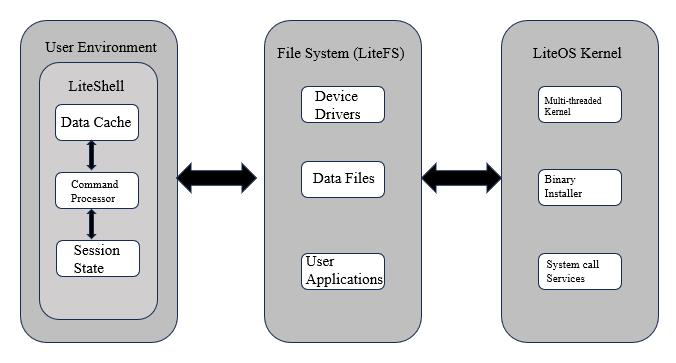
LiteOSexhibitsadynamicsystem,enablingflexibleresource allocationatrun-time,idealforthedynamicdemandsofIoT environments. Its modular system architecture supports efficient application compilation into individual modules, enhancing adaptability, especially during frequent modifications. Networking support is facilitated through Unix-like shell commands, contributing to a familiar communication paradigm for developers. Proficiency in event-basedprogrammingensuresLiteOSefficientlyhandles scenarios demanding high responsiveness with minimal overhead.Withamulti-threadedkernel,LiteOSalignswith traditionalthread-likeprogrammingstyles,promotinguserfriendliness and efficient parallel processing. Embracing wireless reprogramming through dynamic linking and loading enhances the efficiency of code updates. LiteOS implements hierarchical file organization and a wireless shell interface, simplifying file operations and enhancing userexperiencewithinIoTsystems.
LiteOS,aselucidatedinitspublicationatIPSNin2008and detailedonitswebsitewww.liteos.net,presentsadynamic system architecture distinguished by its modular composition. Operating under a file-assisted networking paradigm,LiteOSisequippedwithevent-basedfunctionality facilitatedthroughcallbackfunctions.Despitelackingarealtime guarantee, LiteOS supports programming in LiteC++, offering multi-threading capabilities and wireless reprogramming. The file system is organized in a hierarchical Unix-like structure. Notably, LiteOS is compatiblewithavarietyofplatforms,includingMicaZ,IRIS, and AVR MCU. Its adaptability and modularity make it a promising choice for diverse applications in the realm of embeddedsystemsandwirelesssensornetworks.
LiteOS excels in adaptability and resource optimization through its dynamic system, allowing real-time resource allocation. This dynamic approach ensures the efficient utilizationofresources,adaptingtotheevolvingneedsofthe IoTenvironment.Thesystem'sadaptabilityisakeyfactorin maintainingoptimalperformanceandresponsiveness.
The modular system architecture of LiteOS streamlines efficient system modifications, especially in scenarios requiringfrequentupdatesornetworkreprogramming.This modularity enables the system to accommodate changes seamlessly, contributing to its flexibility and efficiency in evolvingIoTlandscapes.
Usability and familiarity are paramount in LiteOS, particularlyevidentinitsnetworkingsupportthroughUnixlikeshellcommands.Thisfeatureenhancescommunication within the IoT network, making the system more userfriendly and accessible for developers. The emphasis on a familiar environment contributes to a smoother user experience.
LiteOS's proficiency in event-based programming ensures efficient event handling, a crucial aspect for the responsivenessofthesystem.Thiscapabilityisparticularly valuable in IoT applications where quick responses to changing conditions are essential. LiteOS's adept event handlingenhancesitsoverallfunctionalityandreliability.
The multi-threaded kernel of LiteOS enables parallel processing, supporting concurrent execution and aligning with traditional programming styles. This design choice enhances user-friendliness and contributes to the overall functionality of the system by allowing efficient parallel processing.
LiteOSstandsoutinsupportingseamlesswirelessupdates throughdynamiclinkingandloading mechanisms.Thisfeatureensuresthatcodeupdatescanbe executedseamlessly,reducingdisseminationoverheadand enabling quick, modular updates. LiteOS's approach to wireless reprogramming contributes to the system's efficiencyinadaptingtochangingrequirements.
LiteOS simplifies file operations through hierarchical file organization and a wireless shell interface. This Unix-like command interaction not only streamlines file operations but also enhances the user experience within the IoT environment. The user-friendly design contributes to the overall functionality and efficiency of the file system in LiteOS.
LiteOSpresentsaversatileuserinterfaceprimarilybasedon acommand-lineinterface(CLI)paradigm.Theuserinteracts with LiteOS through LiteShell, [5]a Unix-like shell that providessupportforvariousshellcommands,includingfile management,processmanagement,anddebugging.LiteShell resides on a base station or a personal computer (PC), leveraging the abundant resources of these devices for executingmorecomplexcommands.
TheLiteShellinterfacerequiresuserintervention,ensuring thatcommandsareexecutedonlywhenexplicitlyinitiated. This approach aligns with LiteOS's design philosophy of providing control to the user, with some local processing occurring on the base station or PC before wirelessly transmittingcommandstotheintendedIoTnodes.
LiteOS's hierarchical file system, represented in LiteFS, enhances the user experience by offering a directory structuresimilartotraditionalUnixsystems.Usersonthe base station can navigate and interact with this directory structure using familiar commands, providing a seamless experience for those accustomed to Unix-like file organization.
The IoT node's response, subsequent to executing a command,istransmittedbacktotheuseranddisplayedfor review. In cases where a mote fails to [5]carry out commands,anerrorcodeisreturned,ensuringtransparency inthecommandexecutionprocess.
LiteOSstrategicallymanagesresourceutilizationandcontrol through its command-line interface, exemplifying its commitment to efficient operation on IoT devices. The reliance on a command-line interface empowers users to explicitly initiate commands, aligning with LiteOS's overarching goal of serving as a lightweight, resourceefficientoperatingsystem.Thisdesignchoiceisparticularly advantageousforIoTapplications,whereoptimalresource usageisparamount.Furthermore,LiteOSenhancestheuser experience by incorporating Unix-like shell commands, fosteringasenseoffamiliarityfordeveloperswell-versedin Unixsystems.Thisintentionaldesignprinciplecontributes to a smoother learning curve and facilitates a seamless transitionfordevelopers.
ApivotalaspectofLiteOS'sdesignistheclearseparationof [5]userspaceandapplicationprocessesachievedthrougha set of system calls. This design choice not only enhances security but also establishes a distinct boundary between userinteractionsandtheunderlyingsystemprocesses.The implementation of security mechanisms, including authenticationbetweenthebasestationandmountedmotes, reinforces LiteOS's commitment to ensuring secure communicationswithintheIoTnetwork.Theincorporation oflow-costauthenticationmechanismsfurtheratteststothe thoughtfulsecuritydesignembeddedwithinLiteOS.
LiteOS's wireless-centric design is evident in its extensive supportfortechnologiessuchasLTEandmeshnetworking. Thisdeliberateemphasisonwirelesscapabilitiespositions LiteOSasarobustchoiceforIoTapplicationsthatdemand seamlessandreliablewirelesscommunication.Additionally, LiteOS prioritizes ultra-low-power consumption, aligning with the energy-efficient requirements of resourceconstraineddevices.TheabilitytopowerdeviceslikeMicaZ
motes for extended periods underscores LiteOS's commitmenttoenergyefficiency,acrucialconsiderationin theIoTlandscape.
TheversatilityofLiteOSisshowcasedthroughitssupport forvariousplatforms,includingMicaZ,IRISnodes,Windows XP,WindowsVista,andLinux.Thisbroadplatformsupport reflects LiteOS's adaptability and commitment to compatibility across diverse environments. By embracing multiple platforms, LiteOS extends its reach, catering to a broader user base and promoting ease of integration. In essence,LiteOS'sdesignprinciples,rangingfromresource efficiency and security measures to wireless support and platform versatility, collectively contribute to its effectiveness as an operating system tailored for the dynamiclandscapeofIoTdevelopment.
LiteOSexcelsindynamicmemorymanagement,employing efficientstrategiestohandleprocesses,virtualmemory,and supportmultitaskingenvironments.Theoperatingsystem's approach to dynamic memory allocation is evident [5]throughsystemcalls,notablythe`malloc()`and`free()` functions,whichplayapivotalroleinmeetingthevarying memory requirements of processes. Remarkably, LiteOS achieves almost zero overhead in this allocation process, ensuringthatthecrucialtaskofmanagingmemoryimposes minimal processing burden, a crucial aspect for resourceconstrainedenvironments.Intermsofmemoryprotection, LiteOSadoptsameticulousapproachbyallocatingdedicated memory to individual threads, preventing unauthorized access or modification of memory spaces. This not only enhances stability but also ensures a secure and isolated executionenvironmentforeachthread.LiteOS'ssupportfor concurrency and multithreading further underscores its dynamicmemorymanagementprowess.Thesystemallows multiple threads to execute concurrently, each with its allocated memory space, promoting efficient parallel executionwithoutinterference.LiteOSembracesaprocessbased memory allocation model, dedicating resources to threads based on specific requirements, contributing to effective isolation and optimized resource utilization. The operating system's multitasking capabilities extend to memory scheduling and prioritization, with both prioritybasedandround-robinschedulingmechanismsinplace.This ensures that higher-priority tasks receive precedence in memory allocation, aligning with LiteOS's commitment to multitaskingefficiency.Designedforreal-timeapplications, LiteOS prioritizes low-latency scenarios, although lacking built-innetworkingprotocolsforreal-timeuse.Thesystem's memory management strategies are tailored to minimize delays,ensuringtimely execution oftaskscrucial for realtimeconsiderations.LiteOSemploysstandardsystemcalls formemoryoperations,with`malloc()`allocatingmemory using a pointer and `free () ` releasing allocated memory space. This adherence to established memory allocation
practices provides a familiar and reliable programming interface for developers working within the LiteOS environment.
LiteOSfeaturesarobusthierarchicalfilesystemthatserves as a cornerstone for organizing and facilitating file interactionswithintheoperatingsystem.Thearchitecture revolvesaroundthreeinterconnectedsubsystems:LiteShell, LiteFS, and the kernel. LiteShell provides a Unix-like shell interface for executing commands, LiteFS functions as the filesystem,organizingsensornodeshierarchically,andthe kernel, residing on IoT nodes, executes file-related operations. Organizing files in a familiar hierarchical structureandmountingthesensornetworkasadirectory, LiteOS ensures a user-friendly interface. While it doesn't explicitlyspecifyfileformats,LiteOSfocusesonenablingfile communications through traditional Unix-like shell commands. Supported by LiteShell, users can seamlessly performreading,writing,anddirectorymanipulations.The transmission of commands from LiteShell to IoT nodes, coupledwithevent-drivenhandlingandsupportforsecure file access mechanisms, reflects LiteOS's multitasking capabilities.Theintegrationofauthenticationmechanisms further enhances security, and the event-driven model, powered by callback functions, ensures efficient file operationhandling.LiteOS'semphasisona[5]hierarchical file system interface, complemented by a wireless shell interface,underscoresitsuser-friendlydesignandmakesit anaptchoiceforIoTdevelopment,facilitatingefficientand secure file-based interactions across diverse computing environments.
LiteOS implements a sophisticated process management system,orchestratingthecreation,scheduling,andexecution of processes within its operating environment. Processes, operatingasseparatethreads,aregeneratedinresponseto bothsystemresourceavailabilityandusercommands.The dynamicnatureofLiteOSallowsforreal-timeallocationof resources, optimizing the execution of processes to align withthedynamicdemandsoftheIoTlandscape.Intermsof scheduling,LiteOSadoptsadualmechanism,employingboth priority-basedandround-robinscheduling.Priority-based scheduling ensures tasks are executed based on assigned priority levels, providing precedence to higher-priority tasks. Simultaneously, round-robin scheduling offers equitableresourceaccess,preventingmonopolizationbyany singletask.
LiteOS'ssupportforconcurrencyandmultithreadingallows multiplethreadstoexecuteconcurrentlywithinaprocess, each operating within its allocated memory space. This promotes parallel execution withoutinterference, and the multitaskingkerneloptimallymanagesresourcestofacilitate effective multitasking. Designed with real-time
considerations in mind, LiteOS optimizes its process managementsystemforlow-latencyscenarios.Whilelacking [5]built-innetworkingprotocolsforreal-timeapplications, LiteOS minimizes delays, ensuring the timely execution of criticaltasks.
Furthermore, LiteOS incorporates robust mechanisms for process synchronization and communication. Synchronization is achieved through primitives like semaphores or mutexes, preventing interference between processes.Inter-processcommunication(IPC)mechanisms facilitate information exchange, enhancing the overall efficiency of LiteOS. Embracing an event-driven model for process handling, LiteOS [5]allows developers to register event handlers through callback functions, enhancing responsiveness.
LiteOSexhibitsarobustdevicemanagementsystem,crucial forseamlessinteractionwithdiversehardwarecomponents in IoT environments. Utilizing device drivers as intermediaries, LiteOS ensures effective communication between the operating system and hardware devices, enhancingadaptabilitythroughitsmodulararchitecture.The management of input/output operations is streamlined, providing applications with a user-friendly interface for efficientdataexchangewithperipherals.LiteOSemploysa sophisticated interrupt handling mechanism, responding promptly to asynchronous events triggered by peripheral devices,contributingtothesystem'sreal-timecapabilities. Peripheraldevicemanagementisstandardizedthroughan interface that abstracts device-specific complexities, promotingportabilityandeasingapplicationdevelopment. ThedynamicadaptabilityofLiteOSenablestheintegrationof new device drivers or updates without substantial modificationstothecoreoperatingsystem.Notably,LiteOS prioritizesenergy-efficientdeviceinteractions,minimizing unnecessary activities during idle periods, thereby optimizingresourceutilization.Insummary,LiteOS'sdevice management strategies, encompassing drivers, I/O operations,interrupthandling,andperipheralmanagement, collectivelycontributetoitsefficiency,responsiveness,and adaptability,positioningitasacompellingchoicefordiverse IoTapplications.
LiteOS places a paramount emphasis on ensuring the securityoftheInternetofThings(IoT)ecosystemthrougha comprehensive suite of features and mechanisms. The operatingsystemimplementsarobustuserauthentication system,employingstrongprotocolstoverifytheidentityof users interacting with the system. Access control mechanisms are intricately woven into LiteOS, carefully regulatinguserpermissionstothwartunauthorizedaccess andbolstersystemsecurity.Encryptiontakescenterstagein LiteOS'ssecuritystrategy,safeguardingsensitivedataduring
transmissionandstoragethroughtheapplicationofrobust encryption algorithms. Network security measures, including secure communication protocols like TLS and DTLS, fortify LiteOS against cyber threats, ensuring the confidentiality and integrity of transmitted data. LiteOS further enhances security through a secure boot process, meticulously verifying the authenticity and integrity of bootloaderandkernelcomponentsduringsystemstartup. The implementation of secure system calls and regular securityupdatesaddslayersofprotectionagainstpotential exploits, while device authentication and authorization mechanismssecureinteractionsamongconnecteddevices. In essence, LiteOS's multifaceted security framework establishes a resilient defense, ensuring the integrity, confidentiality, and secure operation of IoT devices in an ever-evolvingdigitallandscape.
LiteOS exhibits commendable performance across varied conditions,makingitarobustchoiceforInternetofThings (IoT)environments.Theoperatingsystem'sdynamicsystem architecturefacilitatesoptimalresourceutilization,allowing it to adapt to changing conditions in real-time. LiteOS efficientlymanagesprocessesandthreads,leveragingboth priority-basedandround-robinschedulingmechanismsto ensurefairaccesstoresourcesandpreventmonopolization by any single task. The support for concurrency and multithreadingcontributestoefficientparallelprocessing, enhancingtheoverallperformanceofthesystem.
LiteOS excels in low-latency scenarios, aligning with its design for real-time applications. While it does not inherentlyhavebuilt-innetworkingprotocolsforreal-time applications, LiteOS's process and memory management strategiesareoptimizedtominimizedelays,ensuringtimely executionofcriticaltasks.Theoperatingsystem'sfilesystem architecture, featuring hierarchical organization and a wireless shell interface, simplifies file operations, contributingtoasmootheruserexperienceandenhancing overallsystemperformance.
To further optimize performance, LiteOS may leverage specific tools and techniques. The modular architecture allows for targeted enhancements without requiring a complete system overhaul. LiteOS developers can employ optimizationtechniquesduringthecompilationandlinking processes,tailoringthesystemtospecificIoTapplications. Additionally, LiteOS may provide debugging and profiling tools to identify and address performance bottlenecks, ensuringtheefficientoperationofIoTdevices.
LiteOS2.0,thelatestiterationofLiteOS,hasfoundsuccessful deploymentinvariousreal-worldscenarios,showcasingits adaptability and integration capabilities. One notable platform it operates on is the MicaZ, serving as the target
board, and the MIB510/MIB520, functioning as programmingboards.Thiscompatibilitywidensthescopeof LiteOSapplicationsinIoTdevelopment.
A significant enhancement in LiteOS 2.0 is its close integrationwithAVRStudio5.0.Thisintegrationintroduces several advantages, including an integrated development environment(IDE)forediting,debuggingfeatures,andbuiltin Joint Test Action Group (JTAG) support. These improvementsstreamlinethedevelopmentanddebugging processes, contributing to a more efficient workflow for developers.
Despitetheseadvancements,acompatibilityissuebetween LiteOS2.0andtheIRISmotewasidentified.However,the LiteOS development team has demonstrated a proactive approach by addressing this challenge in the upcoming version2.1.Thiscommitmenttocontinuousimprovement and addressing compatibility issues ensures that LiteOS remainsareliableandevolvingoperatingsystem.
Inreal-world use cases,LiteOS2.0hasproven valuable in IoTapplications,particularlyinscenarioswhereresourceconstrained devices require efficient and lightweight operating systems. The integration with AVR Studio simplifies the development cycle, making LiteOS an attractive choice for developers working with MicaZ and relatedplatforms.
ThesecasestudieshighlightLiteOS'ssuccessfuldeployment in diverse environments, showcasing its versatility and practicalityintherapidlyevolvingfieldofIoT.Theproactive resolution of compatibility challenges further underlines LiteOS'scommitmenttoprovidingarobustoperatingsystem forabroadrangeofIoTapplications.
LiteOShasundergoneseveralupdates,withnotableversions being:
LiteOS 5.1 (June 2020): This release introduced support for Bluetooth low energy (BLE), a new security framework, and improved overall performance.
LiteOS 5.2 (October 2020): The update included support for the RISC-V architecture, addressing variousbugs,andimplementingimprovementsto enhancetheoperatingsystem'sfunctionality.
LiteOS 6.0 (April 2021): This version brought support for the Arm Cortex-M55 processor, introduced a new memory management system, andfocusedonoptimizingperformance.
LiteOS 6.1 (October 2021): The release featured support for the RISC-V RV32GC processor, along
with bug fixes and additional improvements to enhance the operating system's stability and efficiency.
LiteOS is expected to align with several key trends and futuredevelopmentsintheoperatingsystemlandscape:
Edge Computing: LiteOS is poised to leverage the trend of edge computing, emphasizing the processingofdataatthenetwork'sedge,cateringto the requirements of distributed and latencysensitiveapplications.
Artificial Intelligence (AI LiteOS is well-suited to supportAI-powereddevices,reflectingthebroader industry shift towards incorporating artificial intelligenceintovariousapplicationsandservices.
Security remains a paramount focus for LiteOS developers, and future updates are likely to introduce enhanced security features to address evolvingthreatsandvulnerabilities.
Performance Optimization: Ongoing efforts to improveLiteOSperformancewillpersist,ensuring that it remains an attractive option for resourceconstraineddevicesinIoTenvironments.
LiteOSemergesasadistinctiveandrobustoperatingsystem tailored specifically for the Internet of Things (IoT) ecosystem.ThecasestudydelvesintoLiteOS'skeyfeatures, including its dynamic and modular system architecture, supportfornetworkingthroughUnix-likecommands,eventdrivenprogramming,multi-threadingcapabilities,wireless reprogramming,andahierarchicalfilesystemwithauserfriendly interface. LiteOS's memory management system, processhandling,devicemanagement,securityfeatures,and recent updates, such as versions 5.1, 5.2, 6.0, and 6.1, highlightitsadaptabilityandcontinuousevolution.
LiteOS'simpactliesinitsefficiencyinresourceutilization, adaptabilitytochangingIoTenvironments,anduser-centric design, exemplified by its Unix-like shell commands and wirelessshellinterface.Theoperatingsystem'sabilitytorun on various platforms, support different devices, and integratewithpopulartoolslikeAVRStudiocontributesto its widespread adoption. LiteOS's support for real-time applications, low-power consumption, and extensive wireless capabilities positions it as a preferred choice for diverseIoTapplications.
Looking forward, LiteOS is well-positioned to embrace emerging trends such as edge computing and artificial intelligence, while maintaining a strong focus on security
and performance optimization. Its open-source nature fosters collaboration and customization, aligning with the industry trend towards accessible and collaborative development.LiteOS'ssignificanceextendsbeyondbeingan operatingsystem;itisafacilitatorofinnovationintheIoT domain,enablingdeveloperstocreateefficientandsecure solutionsforaconnectedworld.
[1]C.Gu,Y.Tao,andQ.Chen,“BriefIndustryPaper:LiteOS: Managing Sleep for Low-energy IoT. IoT Devices,” 2021. https://doi.org/10.1109/rtas52030.2021.00054
[2] Q. Cao, T. Abdelzaher, J. Stankovic, et al., “The LiteOS operating system: towards Unix-like abstractions for wireless sensor networks,” Proc. Int. Conf. Information ProcessinginSensorNetworks(IPSN),USA,April2008.
[3] Huawei LiteOS: A heavyweight in IoT connectivityHuawei Publications. (n.d.). Huawei. https://www.huawei.com/fr/huaweitech/publication/84/li te-os-smart-iot
[4] M. O. Farooq and T. Kunz, “Operating Systems for WirelesssensorNetworks:Asurvey,”Sensors,vol.11,no.6, pp. 5900–5930, 2011. https://doi.org/10.3390/s110605900
[5] M. H. Qutqut, A. Al‐Sakran, F. Almasalha, and H. S. Hassanein,“ComprehensivesurveyoftheIoTopen‐source OSs,”IETWirelessSensorSystems,vol.8,no.6,pp.323–339, 2018.https://doi.org/10.1049/iet-wss.2018.5033
[7] V. Vanitha, V. Palanisamy, N. L. Johnson, and G. Aravindhbabu, “LiteOS based Extended Service Oriented Architecture for WirelessSensorNetworks,”International Journal of Computer and Electrical Engineering, pp. 432–436,2010.https://doi.org/10.7763/ijcee.2010.v2.173
[8] W. Dong, C. Chen, X. Li, Y. Liu, J. Bu, and K. Zheng, “SenSpireOS:apredictable,flexible,andefficientoperating systemforwirelesssensornetworks,”IEEETransactionson Computers, vol. 60, no. 12, pp. 1788–1801, 2011. https://doi.org/10.1109/tc.2011.58
[9] Wikipedia contributors. (2023, August 9). LiteOS. Wikipedia.https://en.wikipedia.org/wiki/LiteOS
[10] W. Dong, C. Chen, X. Liu, Y. Liu, J. Bu, and K. Zheng, “SenSpireOS:APredictable,Flexible,andEfficientOperating SystemforWirelessSensorNetworks,”IEEETrans.Comput., vol. 60, no. 12, pp. 1788–1801, Dec. 2011, doi: 10.1109/TC.2011.58