
International Research Journal of Engineering and Technology (IRJET) e-ISSN: 2395-0056
Volume: 11 Issue: 01 | Jan 2024 www.irjet.net p-ISSN: 2395-0072
International Research Journal of Engineering and Technology (IRJET) e-ISSN: 2395-0056
Volume: 11 Issue: 01 | Jan 2024 www.irjet.net p-ISSN: 2395-0072
1 Assistant Professor & HOD, Department of Electronics and Communication Engineering, Anjuman Institute of Technology and Management, Bhatkal, Karnataka, India.
2 Professor & HOD, Department of Electronics and Communication Engineering, Institute of Engineering and Technology, Srinivas University. Mangalore, India
3 Professor & HOD, Department of Electrical Engineering, Bharat-Ratna Indira Gandhi College of Engineering, Solapur, India ***
ABSTRACT
The grid integration of small-scale photovoltaic systems involves connecting the distributed energy resources to the electricity grid. To design an improved secondary distribution network for enhanced power quality in the integrated grid of small-scale photovoltaic systems, it is imperative to address various technical challenges. Hence, this review paper presents a comprehensive overview of the recent developments in various power quality improvement methods for power quality enhancement in grid integration, focusing on PI-Based Reactive Power Control Systems, Flicker Logistic Control Methods, Automated Filtering Mechanisms, Shunt Active Power Filter modules, Integrated Optimization-based AI Technique and Grid Synchronization Techniques. The review explores the benefits and drawbacks of each technique, providing an in-depth understanding of their respective contributions to improving power quality. Also, it provides a comparative analysis to demonstrate the effectiveness of various techniques for enhancing power quality The review systematically evaluates how each method addresses challenges such as voltage fluctuations, harmonics, and flicker, thereby contributing to a more stable and reliable power supply. The review also highlights the future research directions and challenges in implementing various techniques for enhancing power quality in grid integration of small-scale photovoltaic systems and provides some suggestions for further improvements to be done in the future for better power quality in grid integration of small-scale photovoltaic system
Keywords: Logistic Control Methods, Reactive Power Control, Grid Synchronization, small-scale photovoltaic system, Shunt Active Power Filter
Becauseofthedepletionoffossilfuelsandtheneedtoreducetheirnegativeimpactontheenvironment,theuseof renewableenergyisconstantlyevolvingtoday.Photovoltaicenergygenerationisbecomingmorepopularinboth urban and rural areas due to its low cost, low noise, and easy availability. Microgrids are commonly used to distribute electrical energy in rural communities [1]. There are two types of microgrids: standalone and gridconnected.Thesolarpowerplantisdisconnectedfromthegridinstandalonephotovoltaicmicrogrids.Inthiscase, theplantisdesignedforalowvoltagedistributionnetworkandissubjecttovoltageimbalanceasloadimbalance increases, which can be dangerous for some equipment such as 3-phase motors [2]. Furthermore, due to bad weather conditions, a standalone PV system cannot supply load at night and at times during the day; thus, an energy storage system is typicallyused to stabilize the level of produced energy [3]. Whenpowerconverters are used, harmonics are introduced into the system. In contrast, the increased use of sensitive electronic circuits in industries and households, as well as privatization and rivalry in electric energy systems, pose power quality improvementasoneofthekeyproblemsintheelectricalindustry.Harmonicscausesourcevoltagedistortionand additionlossduetounwantedcurrentflowinginthesource.Itmayalsoleadtothemalfunctioningofrelays,mains, and other control units. As a result, it is necessary to reduce the harmonics. There are numerous techniques for reducingtheeffectofharmonics[4,5].OneofthesemethodsistouseSAPF,whichgeneratesaharmoniccurrentof
equalmagnitudeandpolaritytotheharmoniccurrentproducedinthesystem,cancelingtheharmoniccurrentin thesystem.Becauseitcontainspowerelectronicdevices,ithasafastresponsetimeandflexibilityinoperation. Shunt Active Power Filter (SAPF) is capable of compensating harmonics, and current distortion, and injecting power generated by unconventional resources [6]. The SAPF is a load-related voltage source inverter (VSI). For various load conditions, the Shunt Active Power Filter can keep the current balanced and sinusoidal after remuneration.PowerswitchingdevicesareusedtoconvertDCtoACpower.Asaresult,theoutputwaveformsare composed of distinctvalues, yieldingoutputthat ismore oscillatoryrather than filtered. Whenandhowlongthe power values can become active, the capacity to deliver close sine waveforms around the key recurrence is directed by the tyrannical regulation technique. Additionally, Static Volt-Ampere Reactive Compensators (SVC) play a role in controlling system voltages, enhancing transient stability, and increasing grid capacity [7, 8]. The integrationofPVcellsinvolvesthechallengeofefficientlyconvertingelectromagneticwavesintoelectricity.
TheMPPTtechniqueemployedinthe PVsystemplaysacrucialroleinmaximizingtheutilizationofthePVarray output power and efficiently tracking the Maximum Power Point (MPP) from the PV array input. Detecting the voltage or current MPP automatically poses a significant challenge in MPPT techniques [9]. This challenge is furthercompoundedbytheimpactofchangesinoutputvoltageonMPPToutputcharacteristics[10].Despitethe advantages of MPPT techniques, existing inverter levels exhibit some inaccuracy due to the additional functionalitiesrequired.Thisinaccuracyisparticularlyrelevantwhenconsideringthetimerequiredtopredictthe Global Maximum Power Point (GMPP), which is directly proportional to the number of PV arrays and the complexityofthesystemdesign[11]
To address power qualityissues, Distributed Flexible AC Transmission System (DFACTS) devices with control algorithms are deployed at the point of common coupling (PCC). DSTATCOM and UPQC, for example, adjust voltage,impedances,andpowertoimprovesystemdynamics.Devicesareclassifiedasseries,shunt,series-series, orshunt-series[12,13].Traditionalcontrolalgorithmsbasedonsynchronousreferenceframetheory(SRFT)and instantaneousreactivepowertheory(IRPT)havedrawbackssuchasslowresponseandpoorstability.Overcoming these, AI-based algorithms based on deep learning and machine learning provide precise PQ issue mitigation via datamodeling.However,thesemodelsfacechallengessuchasalackofcreativityandincreasedsystemcosts. The leastmeansquare(LMS)andleastmeanfourth(LMF)adaptivecontrolalgorithmsaddressintermittencyinsolar PV generation by improving dynamic responses, adaptivity, computational efficiency, and enhanced dynamic responses in grid-connected solar PV systems [13-15] Many researchers have introduced various techniques for powerqualityenhancementingridintegrationofsmall-scalephotovoltaicsystemsbutthedirectionsofanalyzing theapproacheshaveveryrarelybeensummarized.Themaincontributionofthereviewpaperistostudyenhanced powerqualitywhichisgivenbelow:
Toreducethevoltagefluctuations,harmonics,andflickerinpowerqualityenhancementingridintegration ofsmall-scalephotovoltaicsystems,variouspowerqualityimprovementmethodsarereviewedwiththeir significanceandlimitations.
Various power quality improvement methods such as PI-Based Reactive Power Control Systems, Flicker Logistic Control Methods, Automated Filtering Mechanism, Shunt Active Power Filter modules, Grid Synchronization Techniques, and Integrated Optimization-based AI Techniques are used to enhance the powerquality,andthesetechniquesareanalyzedwiththeirsignificanceandlimitations
Thecontentofthepaperisorganizedasfollows:Section2presentstheliteraturesurveyofvariousapproachesfor load frequency control in an interconnected power system, section 3 provides comparative analysis; Section 4 discussestheresult,section5concludesthepaper,andfinally,section6providesthefutureperspective.
In this section, the review has been provided by discussing various technologies for power quality in grid integration of small-scale photovoltaic systems. Also, the significance and limitations of these techniques are described.ThedirectionsforpowerqualitytechniquesareshowninFigure1.
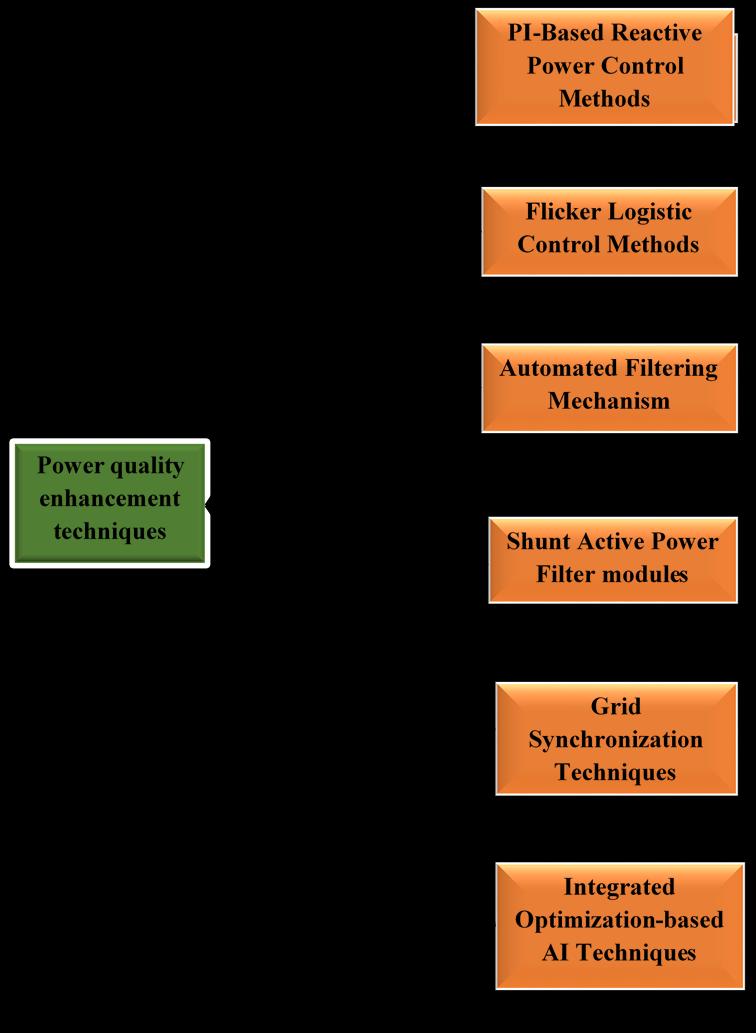
Thisreviewhasbeenmadeinsixdifferentphasesofpowerqualityenhancementingridintegrationofsmall-scale photovoltaic systems namely, PI-Based Reactive Power Control System, Flicker Logistic Control Methods, Automated Filtering Mechanism, Shunt Active Power Filter module, Grid Synchronization Techniques, and IntegratedOptimization-basedAITechniques.
In this review of power quality enhancement using various PI-Based Reactive Power Control Systems in grid integrationofsmall-scalephotovoltaicsystems,ManyPI-basedreactivePowerControlsareusedinpowerquality enhancement such as optimal fractional order PID controller, Fuzzy PID controller, Fuzzy adaptive PI controller, Multi-stage fuzzy-based flexible controller, and Distributed power flow controller. However, there were some limitations, such as the computational burden and testingis a challenge for real-time applications, as well as the
limitedadaptabilitytoawiderangeofscenarios.Therefore,controllersmustbedevelopedtoproperlyenhancethe powerqualityingridintegrationofsmall-scalephotovoltaicsystems[16-25].
Table 1: ReviewonPI-BasedReactivePowerControlSysteminGridIntegration
Ref no
[16]
[17]
[18]
Techniques/method
Optimalfractionalorder PIDcontroller
Fuzzy-PIandfuzzy-PID
FuzzyadaptivePI controller
[19]
[20]
Multi-stagefuzzy-based flexiblecontroller
Distributedpowerflow controller
[21] FuzzyLogicController
[22]
[23]
Fuzzylogic-based modifiedreal-reactive powercontrol
Doublesecondordergeneralized integratorphase-locked loop
[24]
[25]
HighlyReducedFuzzy LogicController
CascadedH-bridge inverter
Significance
Reducesettlingtimeand overshoot
Reducedvoltage fluctuation,andreduced overshooting.
Solvepowerquality problemsandmitigate voltagesags,voltage swells,andloadharmonic.
Achievedvoltage stabilizationandensured thelowestharmonic distortion.
Mitigatethepowerquality issuesandcurrent harmonics.
Ensuredvoltagerecovery, increasedaccuracy,and negligiblevoltagedip
Limitinggridovercurrent byreducingactivepower flow
PIcontroller'sgainto obtainafastresponseand improvethesystem's powerquality.
Thissimplifiesthe implementationprocess andalsoresultsin significanttimeandcost savings.
Improvethesystem's powerquality,flexibility, andefficiencyofthe photovoltaicsystem.
Limitations
Thecontroller’sabilityis affectedbytheerrorsinthe probabilisticmodels.
Fuzzycontrollershavea computationalburdeninrealtimeapplications.
Environmentalconditions affectthecontroller's robustness.
Fuzzycontrollershavea computationalburdeninrealtimeapplications.
Thecontrollerneedstobe adopted.
Environmentalconditions affectthecontroller's robustnessandtestingisa challengeforreal-time applications
Riskofchangesinthe operatingenvironment.
Thecontrollersarerequired tobeadaptable.
Adaptabilitytoawiderange ofscenariosislimited.
Unwantedoscillationhappens inrapidchanges.
Table 1 gives the power quality enhancement using various PI-Based Reactive Power Control Systems in grid integrationofsmall-scalephotovoltaicsystems.Fromthetable,itisobservedthatthepowerqualityenhancement in an in-grid integration of a small-scale photovoltaic system is reviewed and the advantages as well as the
disadvantagesofusingvariousPI-BasedReactivePowerControlsarealsoreviewed.ManyPI-basedreactivePower Controls are used in power quality enhancement such as optimal fractional order PID controller, Fuzzy PID controller, Fuzzy adaptive PI controller, Multi-stage fuzzy-based flexible controller, and Distributed power flow controller.However,thereweresomelimitations,suchasthecomputationalburdenandtestingisachallengefor real-timeapplications,aswellasthelimitedadaptabilitytoawiderangeofscenarios.Therefore,controllersmust bedevelopedtoproperlyenhancethepowerqualityingridintegrationofsmall-scalephotovoltaicsystems.
Thisreviewgivesthevariousflickerlogisticcontrolmethodsusingpowerqualityenhancementingridintegration of small-scale photovoltaic systems. it is observed that the logistic control methods are reviewed and the advantages as well as the disadvantages of the various secure data transmission in network security are also reviewed. Many logistic control methods such as Unified Power Quality Conditioner, Dynamic voltage restorer, Static Var compensator, Static synchronous compensator, and Distribution static compensator were analyzed. However,alltheseapproacheshavesomelimitationssuchasreactivepowerimbalancescausedbysolarpower's fluctuatingnature,powerconsumptionincreasesandthecostofbatteriesandassociatedpowerelectronicsmake this approach too costly.Hence, there is a needforlogisticcontrolmethods to improvethe power qualityingrid integrationofsmall-scalephotovoltaicsystems[26-35].
Ref no Techniques/method Significance Limitations
[26]
Distributionstatic compensator
[27] Staticcompensator integrationin distributionnetworks
[28] StaticVarcompensator
Achievingunitypower factorandkeepingthe powerqualitystable.
Reduceactiveandreactive powerdemandandreliance
Provideswell-enhanced voltagestability,the smallestvoltagedeviation, andactivepowerloss
Adaptingthesystemto differentscalesand configurationsnecessitates additionalconsiderations
Cost-effectiveandpower consumptionincreases.
Reactivepowerimbalances arecausedbysolarpower's fluctuatingnature.
[29] Dynamicvoltagerestorer
[30] Dynamicvoltagerestorer
[31] Staticsynchronous compensator
[32]
[33]
UnifiedPowerQuality Conditioner
QuasiZ-sourceinverterbasedUPQC
Supplypowertosensitive loads
Mitigationofvoltagesags, improvingtheoverall powerquality.
Improvingvoltage regulation,improvingthe performanceandreliability ofthesesystems
Integratingpowerquality improvementandclean energygeneration.
Reducingcurrentand voltageinstabilities,and
Thecostofbatteriesand associatedpower electronicsmakethis approachtoocostly.
Thecombinationofvarious technologiesmakesthe systemmorecomplex.
Introduceadditionalsystem disturbancesintheformof currentunbalancedand harmonicinjections.
Localloadsexperiencesome disruptionduringtheswitch.
Scalabilityacrossdifferent scalesofsolarPV
[34]
[35]
Transformerless dynamicvoltagerestorer
Integrateddistribution staticsynchronous compensator
harmoniccontent. installationsposesa challenge.
Theconverter achievedhighvoltagegain throughitssoft-switching capability.
Voltagefluctuationwas negligible.
Thisaffectstheconsistent performanceoftheDVR system.
Reactivepowerimbalances arecausedbysolarpower's fluctuatingnature.
Table 2 gives the various flickerlogisticcontrolmethods usingpowerqualityenhancementingrid integrationof small-scalephotovoltaicsystems.Fromthetable,itisobservedthatthelogisticcontrolmethodsarereviewedand the advantages as well asthe disadvantages of thevarioussecure data transmissioninnetworksecurityare also reviewed. Many logistic control methods such as Unified Power Quality Conditioner, Dynamic voltage restorer, Static Var compensator, Static synchronous compensator, and Distribution static compensator were analyzed. However,alltheseapproacheshavesomelimitationssuchas reactivepowerimbalancescausedbysolarpower's fluctuatingnature,powerconsumptionincreasesandthecostofbatteriesandassociatedpowerelectronicsmake this approach too costly.Hence, there is a need forlogisticcontrolmethods to improvethe power qualityingrid integrationofsmall-scalephotovoltaicsystems.
2.3 Review on automated filtering mechanism in grid integration
Thereviewgivesthevariousautomatedfilteringmechanismsusingpowerqualityenhancementingridintegration ofsmall-scalephotovoltaicsystems.Itisobservedthatthepowerqualityenhancementingridintegrationofsmallscale photovoltaic systems using various automated filters is reviewed and the advantages as well as the disadvantagesofthevariousarealsoprovided.Variousautomatedfilteringmechanismsareusedforpowerquality enhancementin grid integration of small-scale photovoltaic systems such as LCL filter, Shunt hybridactive filter, Hybrid series active power filter, Fractional order notch filter-based control, LC passive filters Recursive Digital Filter, Hybrid harmonic filter. However, some limitations include its inability to adapt to dynamic real-world conditions,variationsinfrequencyandvoltagethatcausegridinstability,andvoltagespikesthatoccuracrossthe filtercomponents.Toeffectivelyimprovethepowerqualityingridintegrationofsmall-scalephotovoltaicsystems, thefilters'performancemustbeimproved[35-45].
Table 3: Reviewonautomatedfilteringmechanismingridintegration
Ref no Techniques/method Significance Limitations
[36] LCLfilter
[37]
[38]
[39]
Shunthybridactive filter
Hybridseriesactive powerfilter
Fractionalorder notchfilter-based control
Filtersoutharmonicsand increasespowerquality.
PVsystemstoimprove performanceunderdifferent operatingconditions.
Tominimizetheusageof energyfromtheutilitygrid.
Designedcontrolsystem handledharmonicdistortion ingridcurrent,reactive powerdemandoftheload, andunbalancedloadcurrents.
Voltagespikesoccuracross thefiltercomponents
Solarirradiationcaused fluctuationsinthegenerated power.
Variationsinfrequencyand voltagecausegridinstability.
Filtersexhibitovershootand ringingbehaviorinsudden changes.
[40] LCpassivefilters
[41]
[42]
RecursiveDigital Filter
Shuntactivepower filter
[43] Hybridshuntactive powerfilter
[44]
Hybridharmonic filter
[45] LCfilters
Thegridsystemsignificantly reducedtheinverteroutput current.
Improvingpowerqualityand ensuringpowertransfer betweentheutilitygridand connectedloads.
ProvideasmoothDC-link voltageandreducetotal harmonicdistortion.
Improvepowerqualityby compensatingharmonicsand regulatingreactivepower.
Optimizedthesizeand numberofpassivefilters,and hysteresisbandwidth.
Enhancingdynamicstability andpowerqualityunderany conditions.
Distortionsofvoltageand currentwaveform,decreased systemefficiency,and increasedlossesinthe system.
Performancereducesdueto theslowresponseofvariable insolationconditions.
Inefficientfordynamicload changes,andhigh computationalburden.
Whenrenewableenergy generationislowandload demandsarehigh,thisharms thepowersupply's dependabilityandstability.
Powerqualityneedstobe improvedbyusingdifferent hybridfiltertopologies.
Lackofadaptabilityto dynamicreal-world conditions.
Table3givesthevariousautomatedfilteringmechanismsusingpowerqualityenhancementingridintegrationof small-scale photovoltaic systems. It is observed that the power qualityenhancement in grid integration of smallscale photovoltaic systems using various automated filters is reviewed and the advantages as well as the disadvantagesofthevariousarealsoprovided.Variousautomatedfilteringmechanismsareusedforpowerquality enhancementin grid integration of small-scale photovoltaic systems such as LCL filter, Shunt hybridactive filter, Hybrid series active power filter, Fractional order notch filter-based control, LC passive filters Recursive Digital Filter, Hybrid harmonic filter. However, some limitations include its inability to adapt to dynamic real-world conditions,variationsinfrequencyandvoltagethatcausegridinstability,andvoltagespikesthatoccuracrossthe filtercomponents.Toeffectivelyimprovethepowerqualityingridintegrationofsmall-scalephotovoltaicsystems, thefilters'performancemustbeimproved.
Thereviewgivesthevariousshuntactivepowerfiltermodulesforpowerqualityingridintegrationofsmall-scale photovoltaic systems, it is observed that the detection of power quality in grid integration are reviewed and the advantages as well as thedisadvantagesof the various shuntactive power filtermodule arealso reviewed. Many shunt active power filter modules such as Hybrid active power filter, Shunt Active Power Filter, switched power filtercompensator,andThree-phasehalf-bridgeinterleavedbuckshuntactivepowerfilterarepresentedtoreduce settling time and total harmony distortion and improve power quality in grid integration of small-scale photovoltaic systems. However, all these approaches have some limitations such as low reactive power levels leading to voltage instability, and the ability to address voltage fluctuations is limited. Hence, there is a need to developashuntactivepowerfiltermoduletoeffectivelyimprovethepowerquality[46-55].
Ref no Techniques/method Significance Limitations
[46]
Shuntactivepowerfilter basedonaPLL
[47]
Three-phasehalf-bridge interleavedbuckshunt activepowerfilter
[48]
[49]
[50]
[51]
[52]
[53]
[54]
SolarPV-integrated universalactivepower filter
SAPFmitigationsuppressed non-sinusoidalharmonic currentandincreased activepower.
Achieveahighdegreeof compensationforcurrent harmonicsandreactive power
Theproposedsystem combinestheadvantagesof cleanenergygeneration withimprovedpower quality.
Lowreactivepowerlevels leadtovoltageinstability.
Lowreactivepowerlevels leadtovoltageinstability
Voltageandfrequency fluctuationsarecaused.
[55]
Shuntactivepowerfilter
SRFtheory-basedShunt activepowerfilter
ShuntActivePower Filter
Theproposedcontroller reducedtheharmonics.
Reducedsettlingtimeand totalharmonydistortion.
LMEprovidedasignificant steady-stateresponseand powerquality improvement.
Grid-tiedShuntActive PowerFilter Estimatestheharmonic current.
Hybridactivepower filter
Aswitchedpowerfilter compensatoranda switchedactivepower filter
Single-phaseactive powerfilter
Hysteresiscurrentcontrol eliminatesharmonic.
Eliminatetheharmonic amplitudeofthecurrent andvoltageandcontroller error.
Ensurehighgridcurrent qualityandminimize switchingfrequency.
Processingpowerand memoryofdigitalsignal processorsarelimited, affectingthecontroller's efficiencyandperformance.
Affectedthesystem'srealtimeperformance.
Thecomputational complexityofthesystem hasanimpactonitsrealtimeperformance.
Affectedthesystem'srealtimeperformance.
Theirabilitytoaddress voltagefluctuationsis limited.
Voltageandfrequency fluctuationsarecaused.
Implementingamodified PUCconverterrequiresthe useofadditional components.
Table 4 gives the various shunt active power filter modules for power quality in grid integration of small-scale photovoltaic systems. From the table, it is observed that the detection of power quality in grid integration are reviewedandtheadvantagesaswellasthedisadvantagesofthevariousshuntactivepowerfiltermodulearealso reviewed. Many shunt active power filter modules such as Hybrid active power filter, Shunt Active Power Filter, switched power filter compensator, and Three-phase half-bridge interleaved buck shunt active power filter are presented to reduce settling time and total harmony distortion and improve power quality in grid integration of
small-scalephotovoltaicsystems.However,alltheseapproacheshavesomelimitationssuchaslowreactivepower levelsleadingtovoltageinstability,andtheabilitytoaddressvoltagefluctuationsislimited Hence,thereisaneed todevelopashuntactivepowerfiltermoduletoeffectivelyimprovethepowerquality.
The review gives the power quality improvement using grid synchronization techniques in grid integration of small-scale photovoltaic systems, it is observed that the power quality improvementin grid integration of smallscale photovoltaic systems is reviewed and the advantages as well as the disadvantages of using various grid synchronization techniques are also reviewed. Many synchronization techniques are used in power quality improvementsuchasPhaseLockedLoop,DQcurrentcontroltheory,Mixedthirdandfourth-ordercomplexfilter, Vector-basedsynchronization,Adaptivefeed-forwardPLL,andlightweightinertialPLL.However,thereweresome limitationssuchasPLLsexhibitingtransientresponsesduringsuddengridchanges,lackofrobustnessresultingin instability and it requires rapid and accurate synchronization. Therefore, synchronization techniques must be developedtoproperlyimprovethepowerqualityiningridintegrationofsmall-scalephotovoltaicsystems[56-65]
Ref no Techniques/method Significance Limitations
[56]
[57]
AdaptivefeedforwardPLL
Vector-based synchronization
[58] IteratedExtended KalmanFiltering
Increasedthestabilityregion, reducedtheeffectofvoltage variation,andprovidedhigh harmonicattenuation.
Thebatterychargesand dischargestomanageexcess anddeficientpower.
Achievingunitypowerfactor, reducingmeansquareerror, andincreasingconvergence speed
Practicalimplementationof adaptivealgorithmsis difficult,andlackstability.
Systemstabilityrequires rapidandaccurate synchronization
TheaccuracyofKF predictionisnotverygood
[59]
Mixedthirdand fourth-ordercomplex filter
[60] Phase-lockedloop
[61] PhaseLockedLoop
[62] ImprovedPLL
[63] PLLsynchronization
Reducedcomputationtime, addressedthepoorpower qualityissue, eliminatedharmonics,and reducedburdenandnoise rejection.
Improvepowerquality,and reduceharmonics.less distortedpoweroutput
Totalharmonicdistortionwas reducedandimproved synchronizationaccuracy
Providedagreatdynamic response
Lackofrobustnessresults ininstability.
Voltageandfrequency fluctuationsarecaused.
PLLsexhibittransient responsesduringsudden gridchanges.
Suddenchangesingrid voltagequality impaircurrentextraction accuracy.
Improvepowerqualityand highharmonicattenuation. Communication delaysimpact synchronizationaccuracy
[64]
[65]
Providesthedesiredinertial responseanddampingcapacity, resultinginthelowest frequencydropatthesystem.
Computationalburdenreduced, andsteady-stateperformance wasimproved.
IPLLencounterschallenges indynamicgridconditions.
Mismatchesinfrequency haveanimpactonthe reliabilityofpowercontrol andtracking.
Table 5 gives the power quality improvement using grid synchronization techniques in grid integration of smallscalephotovoltaicsystems.Fromthetable,itisobservedthatthepowerqualityimprovementingridintegrationof small-scalephotovoltaicsystemsisreviewedandtheadvantagesaswellasthedisadvantagesofusingvariousgrid synchronization techniques are also reviewed. Many synchronization techniques are used in power quality improvementsuchasPhaseLockedLoop,DQcurrentcontroltheory,Mixedthirdandfourth-ordercomplexfilter, Vector-basedsynchronization,Adaptivefeed-forwardPLL,andlightweightinertialPLL.However,thereweresome limitationssuchasPLLsexhibitingtransientresponsesduringsuddengridchanges,lackofrobustnessresultingin instability and it requires rapid and accurate synchronization. Therefore, synchronization techniques must be developedtoproperlyimprovethepowerqualityiningridintegrationofsmall-scalephotovoltaicsystems.
ThereviewgivesthepowerqualityenhancementusingvariousIntegratedOptimization-BasedAItechniques,itis observedthatthepowerqualityenhancementinagridintegrationofasmall-scalephotovoltaicsystemisreviewed andtheadvantagesaswellasthedisadvantagesofthevariousarealsoreviewed.VariousIntegratedOptimizationBased AI techniques such as Tunable Q-factor wavelet transform and an Artificial neural network, Grey wolfoptimized Artificial neural network, Decision-tree-based fuzzy logic controller, Multi-Feature-attention-LSTM, Statistical feature-based Deep neural network, Deep-learning classifier based on LSTM, Adaboost algorithm, and convolutional neural network are used for power quality enhancement in an interconnected power system. However, all these approaches have some limitations such as effective decision-making is needed, the reliable detection of islanding is difficult in dynamic response, real-time use is computationally complex and thresholdsetting is difficult. Hence, there is a need to develop Optimization-Based AI techniques for effectively controlling thepowerqualityenhancementingridintegrationofasmall-scalephotovoltaicsystem[66-75].
Ref no
Techniques/method Significance Limitations [66]
MPPT-basedAI controllers
AIcontrollerslack robustnessinthefaceof rapidlychangingoperating conditions. [67]
TunableQ-factor wavelettransformand anArtificialneural network
Improvedpowerqualityfor thegrid-connectedPV system.
Highlyaccurateislanding conditionandinsensitiveto externalgriddisturbances.
Changesinenvironmental conditions,loadvariations, andotherfactorsthat affectphotovoltaicsystem performance.
[68]
GreywolfoptimizedArtificial neuralnetwork
[69]
[70]
[71]
Decision-tree-based fuzzylogiccontroller
ContinuousWavelet Transformsand convolutionalneural network
Multi-Feature-attentionLSTM
[72]
[73]
Statisticalfeature-based Deepneuralnetwork
Deep-learningclassifier basedonLSTM
[74] Adaboostalgorithm
Moreaccurateand dependableislanding detection,andimproving efficiency,reliability,and sustainability.
Effectiveislanding detection,improved transientresponse,and reducedsettlingtime.
Improvesthemodel's robustnesstofrequency andamplitudevariations.
Higheraccuracyreduces noiseinterference,ensures safeoperation,andshorter detectiontime
Performedwellundernoisy conditionsanddetected islandingconditions accurately.
Detectingislanding effectivelyandusing lessdetectiontime
Effectivelyreducingthe complexityoftheisland classificationandaccurate detection.
Difficulttoensurereliable andpreciseislanding detectionundervarious conditions.
Totalharmonicdistortion exceedsthelimits.
Real-timeisextremely computationalandposes difficultiesforexecutionin controlsystems.
Theissueoftheactive methodaffectsthe microgridpowerquality.
Effectivedecision-makingis required.
Carefulhyperparameter selectionisrequired.
Thereisadifficultyin threshold-setting.
[75]
convolutionalneural network
Processlargeamountsof imageryrapidlywhilealso ensuringthepower system'ssafety.
Carefulhyperparameter selectionisrequired.
ThetablegivesthepowerqualityenhancementusingvariousIntegratedOptimization-BasedAItechniques.From the table, it is observed that the power quality enhancement in a grid integration of a small-scale photovoltaic system is reviewed and the advantages as well as the disadvantages of the various are also reviewed. Various Integrated Optimization-Based AItechniques suchas Tunable Q-factor wavelettransform andanArtificial neural network,Greywolf-optimizedArtificialneuralnetwork,Decision-tree-basedfuzzylogiccontroller,Multi-Featureattention-LSTM,Statisticalfeature-basedDeepneuralnetwork,Deep-learningclassifierbasedonLSTM,Adaboost algorithm,andconvolutionalneuralnetworkareusedforpowerqualityenhancementinaninterconnectedpower system. However, all these approaches have some limitations such as effective decision-making is needed, the reliable detection of islanding is difficult in dynamic response, real-time use is computationally complex and threshold-setting is difficult. Hence, there is a need to develop Optimization-Based AI techniques for effectively controllingthepowerqualityenhancementingridintegrationofasmall-scalephotovoltaicsystem
small-
Thecomparisonanalysisofvariousapproachesforpowerqualityimprovementisdiscussedinthissection.
Figure 2 depicts the comparison overshoot and steady-state error of various PI-Based Reactive Power Controls such as the PI [17], PID [17], Fuzzy-PI [17], and Fuzzy-PID [17]. From the comparison, the PI, PID, Fuzzy-PI, and Fuzzy-PIDcontrollersachieveanovershootof4.6,4.1,3.2%,and2.1%respectively.Thesteady-stateerrorPI,PID, Fuzzy-PI,andFuzzy-PIDcontrollersare0.9%,0.7%,0.6%,and0.2% ComparedwithalltheexistingmodelsFuzzyPIDachieveslesssteady-stateerrorandovershoot.
Figure 3shows the comparisonof the totalharmonic detection of variousautomated filters such as passive filter [44], active filter [44], and hybrid filter [44] which have a frequency deviation value of 1.2%, 4%, and 1.25% respectively.Comparedwithalltheexistingtechniqueshybridfiltershavealowtotalharmonicdetectionvalueof 1.2%.
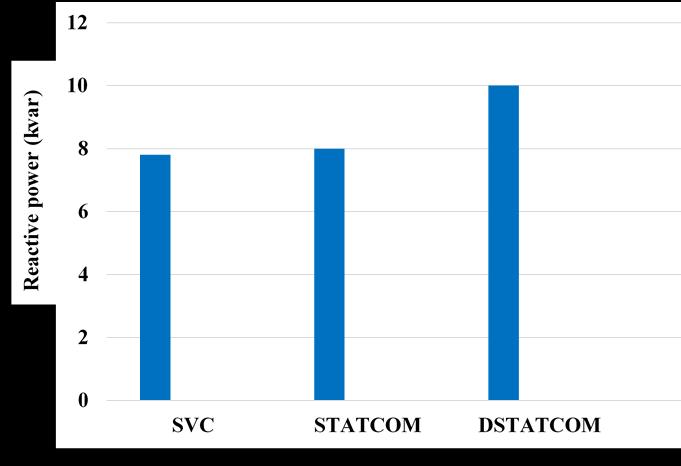
Figure 4 illustrates the comparison of the reactive power of various flicker logistic control methods such as SVC [26],STATCOM[27],andDSTATCOM[28] TheexistingtechniquessuchasSVC,STATCOM,andDSTATCOMhavea reactivepowervalueof7.8,8,and10kvarrespectively.DSTATCOMhasahighreactivepowervalueof10kvarand SVChasalowsettlingtimevalueof7.8kvar.
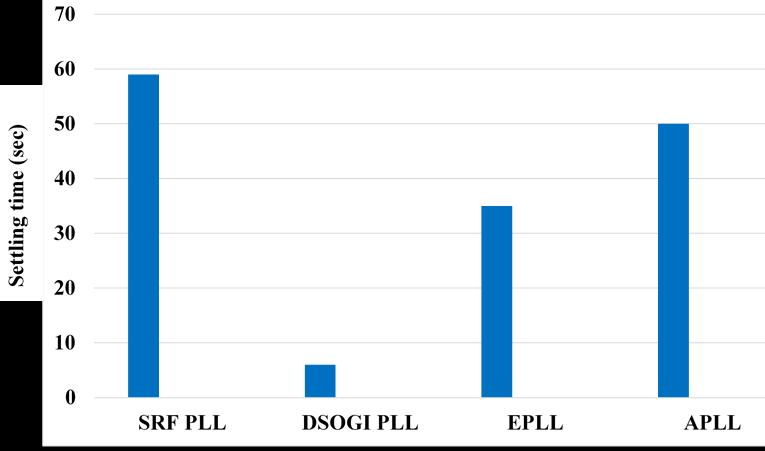
Figure5showsthecomparisonofsettling
variousexistinggridsynchronizationtechniquessuchasSRF PLL [56], DSOGI PLL [23], EPLL [61], and APLL [56]. The existing techniques such as SRF PLL, DSOGI PLL, EPLL, and APLL have a settling time value of 58 sec, 6 sec, 30 sec, and 52 sec respectively. SRF PLL has a high settling timevalueof58andDSOGIPLLhasalowsettlingtimevalueof6sec.
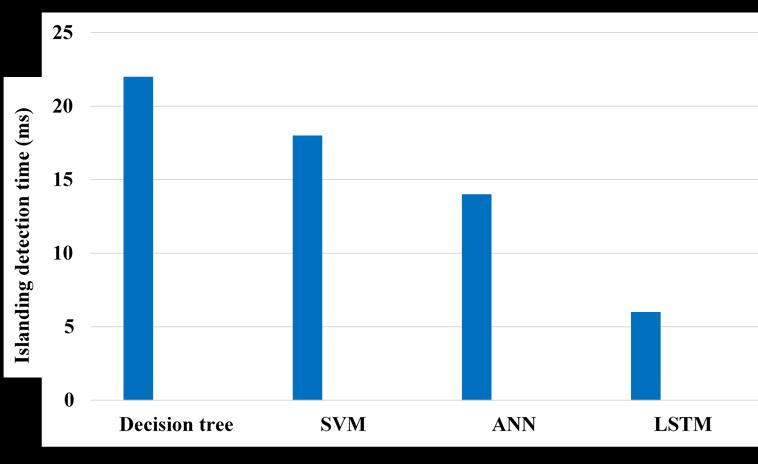
Figure6demonstratesthecomparisonofIslandingdetectiontimewithvariousIntegratedOptimization-BasedAI techniquessuchasdecisiontree[73],SVM[73],ANN[73],andLSTM[73]attaininganIslandingdetectiontimeof 22ms, 18ms, 14ms, and 6ms respectively. Compared with all the existing techniques LSTM has a less Islanding detectiontimeof6ms.
Overall, the comparison analysis of various power quality improvement techniques for power quality enhancementingridintegrationofasmall-scalephotovoltaicsystemispresented Here,theovershootandsteadystate error are comparedwith some methods such as PI, PID, Fuzzy-PI, and Fuzzy-PID controllers, in this FuzzyPID achieves less steady-state error and overshoot. LSTM has a less Islanding detection time compared with a decisiontree, SVM, andANN.Settlingtime is compared with various grid synchronizationtechniques,inthis SRF PLL, achieves a high settling time. Compared with various automated filters, Hybrid filters attain a low total harmonicdetection.DSTATCOMachievesahighreactivepower.However,someerrorsoccurredwhilenavigating complicated harmonics in grid integration of a small-scale photovoltaic system. Hence these techniques require further improvement to perform efficient power quality enhancement without harmonics, less settling time, overshoot,andsteady-stateerroranddetectiontime.
The various techniques for power quality enhancement in grid integration of a small-scale photovoltaic system havebeenanalyzedinvariousdirectionssuchasPI-BasedReactivePowerControlSystems,FlickerLogisticControl Methods, Automated FilteringMechanisms,ShuntActive Power Filter modules, Integrated Optimization-based AI TechniqueandGridSynchronizationTechniques.Theanalyzedsummaryisgivenasfollows:
PI-Based Reactive Power Control Systems optimal fractional order PID controller, Fuzzy PID controller, Fuzzy adaptive PI controller, Multi-stage fuzzy-based flexible controller, and Distributed power flow controller were found to be helpful and effective in power quality enhancement, mitigating voltage sags, voltage swells and ensured the lowest harmonic distortion However, these approaches were found with some limitations such as the Fuzzy controller’s computational burden and testingbeing a challenge for real-timeapplications,unwantedoscillationhappeninginrapidchangesalsolimitedadaptabilitytoawide rangeofscenarios.
The flickerlogisticcontrol methods such asUnified Power QualityConditioner, Dynamic voltage restorer, Static Var compensator, Static synchronous compensator, and Distribution static compensator helped reduce current and voltage instabilities and harmonic content of grid integration of small-scale photovoltaic systems. However, some drawbacks such as power consumption increases and the cost of batteriesandassociatedpowerelectronicsmakethisapproachtoocostly.
The automated filters such as an LCL filter, Shunt hybrid active filter, Hybrid series active power filter, Fractionalordernotchfilter-basedcontrol,LCpassivefiltersRecursiveDigitalFilter,andHybridharmonic filter helped to reduce the total harmonic distortion and improve the power quality in grid integrated small-scalephotovoltaicsystems.However,drawbackssuchasitsinabilitytoadapttodynamicreal-world conditions,poorstability,andvoltagespikesthatoccuracrossthefiltercomponents.
ThevariousshuntactivepowerfiltermodulessuchasHybridactivepowerfilter,ShuntActivePowerFilter, switched power filter compensator, and Three-phase half-bridge interleaved buck shunt active power filters were studied to help improve power quality, reduce settling time, and effectively provide better accuracy. However, some drawbacks such as low reactive power levels lead to voltage instability and the abilitytoaddressvoltagefluctuationsislimited.
The grid synchronization techniques such as Phase Locked Loop, DQ current control theory, Mixed third andfourth-ordercomplexfilter,Vector-basedsynchronization,Adaptivefeed-forwardPLL,andlightweight inertial PLLwerestudiedto helpimprovequalityto effectivelyincrease theperformance. However,these approaches have some drawbacks, PLLs exhibit transient responses during sudden grid changes, lack of robustnessresultsininstability,anditrequiresrapidandaccuratesynchronization.
Various Integrated Optimization-Based AI techniques such as Tunable Q-factor wavelet transform and an Artificial neural network, Grey wolf-optimized Artificial neural network, Decision-tree-based fuzzy logic controller, Multi-Feature-attention-LSTM, Statistical feature-based Deep neural network, Deep-learning classifierbasedonLSTM,Adaboostalgorithm,andconvolutionalneuralnetworkwerefoundtobeefficient andreliableoperationsofthemodernpowernetwork.However,thesestrategieshadsomelimitationssuch asinreal-worldscenarioscomplexity,effectivedecision-makingisneededandreliabledetectionisdifficult fordynamicoperation.
5. Conclusion
This review paper presented a comprehensive overview of the recent developments in various techniques for powerqualityenhancement,includingPI-BasedReactivePowerControlSystems,FlickerLogisticControlMethods, AutomatedFilteringMechanisms,ShuntActivePowerFiltermodules,IntegratedOptimization-basedAITechnique and Grid Synchronization Techniques. The review highlighted that power quality improvement methods can significantly improve the performance of power quality enhancement in in grid integration of a small-scale photovoltaicsystem.Overall,thisreviewpaperprovidesvaluableinsightsinto therecentdevelopmentsinpower qualityimprovementmethodsforpowerqualityenhancement.Acomparisonoftheperformanceofvariouspower quality improvement methods in terms of harmonics, less settling time, overshoot, and steady-state error and detection time for power quality enhancement in grid integration of a small-scale photovoltaic system has been provided. The paper concludes that the integration of power quality improvement methods can enhance the performance of power quality and ensure the stability and reliability of grid integration of a small-scale photovoltaic system. The future research directions include addressing the challenges in implementing power qualityimprovementmethodsandexploringnewtechniquestofurtherimprovetheperformanceofpowerquality enhancementingridintegrationofasmall-scalephotovoltaicsystem.
[1] Li, D., Wang, T., Pan, W., Ding, X. and Gong, J., 2021. A comprehensive review of improving power quality usingactivepowerfilters.ElectricPowerSystemsResearch,199,p.107389.
International Research Journal of Engineering and Technology (IRJET) e-ISSN: 2395-0056
Volume: 11 Issue: 01 | Jan 2024 www.irjet.net
p-ISSN: 2395-0072
[2] Swapna, V. and Gayatri, M.T.L., 2021, December. Power quality issues of grid integration of distributed generation: A review. In 2021 International Conference on Computational Performance Evaluation (ComPE)(pp.142-147).IEEE.
[3] Chawda,G.S.,Shaik,A.G.,Mahela,O.P.,Padmanaban,S.andHolm-Nielsen,J.B.,2020.Comprehensivereview of distributed FACTS control algorithms for power quality enhancement in utility grid with renewable energypenetration. IEEE Access, 8,pp.107614-107634.
[4] Bajaj,M.andSingh,A.K.,2020.GridintegratedrenewableDGsystems:Areviewofpowerqualitychallenges andstate‐of‐the‐artmitigationtechniques.InternationalJournalofEnergyResearch,44(1),pp.26-69.
[5] Goud,B.S.andRao,B.L.,2021.Powerqualityenhancementingrid-connectedPV/wind/batteryusingUPQC: atomsearchoptimization.JournalofElectricalEngineering&Technology,16,pp.821-835.
[6] Khandelwal, A. and Neema, P., 2019, January. State of art for power quality issues in PV grid connected system.In2019InternationalConferenceonNascentTechnologiesinEngineering(ICNTE)(pp.1-4).IEEE.
[7] Sahoo, B., Alhaider, M.M. and Rout, P.K., 2023. Power quality and stability improvement of microgrid throughshuntactivefiltercontrolapplication:Anoverview.RenewableEnergyFocus.
[8] Das, S.R., Ray, P.K., Sahoo, A.K., Ramasubbareddy, S., Babu, T.S., Kumar, N.M., Elavarasan, R.M. and MihetPopa, L., 2021. A comprehensive survey on different control strategies and applications of active power filtersforpowerqualityimprovement.Energies,14(15),p.4589.
[9] Yap, K.Y., Sarimuthu, C.R. and Lim, J.M.Y., 2020. Artificial intelligence based MPPT techniques for solar powersystem:Areview.JournalofModernPowerSystemsandCleanEnergy,8(6),pp.1043-1059.
[10] Shafiullah, M., Ahmed, S.D. and Al-Sulaiman, F.A., 2022. Grid integration challenges and solution strategiesforsolarpvsystems:Areview.IEEEAccess,10,pp.52233-52257.
[11] Tavakoli, A., Saha, S., Arif, M.T., Haque, M.E., Mendis, N. and Oo, A.M., 2020. Impacts of grid integrationofsolarPVandelectricvehicleongridstability,powerqualityandenergyeconomics:Areview. IETEnergySystemsIntegration,2(3),pp.243-260.
[12] Rajesh,P.,Shajin,F.H.,Rajani,B.andSharma,D.,2022.Anoptimalhybridcontrolschemetoachieve powerqualityenhancementinmicrogridconnectedsystem.InternationalJournalofNumericalModelling: ElectronicNetworks,DevicesandFields,35(6),p.e3019.
[13] Jumani, T.A., Mustafa, M.W., Alghamdi, A.S., Rasid, M.M., Alamgir, A. and Awan, A.B., 2020. Swarm intelligence-based optimization techniques for dynamic response and power quality enhancement of AC microgrids:Acomprehensivereview.IEEEAccess,8,pp.75986-76001.
[14] Chaitanya,B.K.,Yadav,A.,Pazoki,M.andAbdelaziz,A.Y.,2021.Acomprehensivereviewofislanding detectionmethods. Uncertainties in Modern Power Systems,pp.211-256.
[15] Gupta,N.,Dogra,R.,Garg,R.andKumar,P.,2022.Reviewofislandingdetectionschemesforutility interactivesolarphotovoltaicsystems. International Journal of Green Energy, 19(3),pp.242-253.
[16] Shahsavari,H.andNateghi,A.,2019.OptimaldesignofprobabilisticallyrobustPIλDμcontrollerto improve small signal stability of PV integrated power system. Journal of the Franklin Institute, 356(13), pp.7183-7209.
[17] Nafeh,A.A.,Heikal,A.,El-Sehiemy,R.A.andSalem,W.A.,2022.Intelligentfuzzy-basedcontrollersfor voltage stability enhancement of AC-DC micro-grid with D-STATCOM. Alexandria Engineering Journal, 61(3),pp.2260-2293.
[18] Yang,D.,Ma,Z.,Gao,X.,Ma,Z.andCui,E.,2019.Controlstrategyofintergratedphotovoltaic-UPQC SystemforDC-Busvoltagestabilityandvoltagesagscompensation.Energies,12(20),p.4009.
[19] Attia, A.F., Sharaf, A. and El Sehiemy, R., 2021. Multi-stage fuzzy based flexible controller for effectivevoltagestabilizationinpowersystems.ISAtransactions.
[20] Naidu,R.P.K.andMeikandasivam,S.,2020.Powerqualityenhancementinagrid-connectedhybrid systemwithcoordinatedPQtheory&fractionalorderPIDcontrollerinDPFC. Sustainable Energy, Grids and Networks, 21,p.100317.
2395-0056 Volume: 11 Issue: 01 | Jan 2024 www.irjet.net
2395-0072
[21] Hazari, M.R., Jahan, E., Mannan, M.A. and Das, N., 2021. Transient stability enhancement of a gridconnectedlarge-scalePVsystemusingfuzzylogiccontroller. Electronics, 10(19),p.2437.
[22] Roselyn,J.P.,Chandran,C.P.,Nithya,C.,Devaraj,D.,Venkatesan,R.,Gopal,V.andMadhura,S.,2020. Design and implementation of fuzzy logic based modified real-reactive power control of inverter for low voltage ride through enhancement in grid connected solar PV system. Control Engineering Practice, 101, p.104494.
[23] Nkambule, M.S., Hasan, A.N., Ali, A. and Shongwe, T., 2022. A Novel Control Strategy in GridIntegratedPhotovoltaicSystemforPowerQualityEnhancement. Energies, 15(15),p.5645.
[24] Farah, L., Hussain, A., Kerrouche, A., Ieracitano, C., Ahmad, J. and Mahmud, M., 2020. A highlyefficientfuzzy-basedcontrollerwithhighreductioninputsandmembershipfunctionsforagrid-connected photovoltaicsystem.IEEEAccess,8,pp.163225-163237.
[25] Ahmed,M.S.,Mahmood,D.Y.andNuman,A.H.,2022.Powerqualityimprovementofgrid-connected photovoltaic systems using PI-fuzzy controller. International Journal of Applied Power Engineering (IJAPE), 11(2),pp.120-33.
[26] Kumar,A.andKumar,P.,2021.Powerqualityimprovementforgrid-connectedPVsystembasedon distribution static compensator with fuzzy logic controller and UVT/ADALINE-based least mean square controller. Journal of Modern Power Systems and Clean Energy, 9(6),pp.1289-1299.
[27] Boghdady, T.A. and Mohamed, Y.A., 2023. Reactive power compensation using STATCOM in a PV gridconnectedsystemwithamodifiedMPPTmethod.AinShamsEngineeringJournal,14(8),p.102060.
[28] Berwa, M.G. and Moses, P.M., 2021, August. Design of static Var compensator (SVC) for improving powersupplyofsolarenergyconnectedtothegrid.In2021IEEEPES/IASPowerAfrica(pp.1-5).IEEE.
[29] Molla, E.M. and Kuo, C.C., 2020. Voltage quality enhancement of grid-integrated pv system using battery-baseddynamicvoltagerestorer. Energies, 13(21),p.5742.
[30] Molla,E.M.andKuo,C.C.,2020.VoltagesagenhancementofgridconnectedhybridPV-windpower systemusingbatteryandSMESbaseddynamicvoltagerestorer. IEEE Access, 8,pp.130003-130013.
[31] Jamil, E., Hameed, S. and Jamil, B., 2019. Power quality improvement of distribution system with photovoltaic and permanent magnet synchronous generator based renewable energy farm using static synchronouscompensator. Sustainable energy technologies and assessments, 35,pp.98-116.
[32] Devassy, S. and Singh, B., 2020. Performance analysis of solar PV array and battery integrated unifiedpowerqualityconditionerformicrogridsystems. IEEE Transactions on Industrial Electronics, 68(5), pp.4027-4035.
[33] Muthuvel, K. andVijayakumar, M., 2020. Solar PVsustained quasi Z-sourcenetwork-based unified powerqualityconditionerforenhancementofpowerquality. Energies, 13(10),p.2657.
[34] Paramasivam, S.K., Ramu, S.K., Mani, S., Muthusamy, S., Sundararajan, S.C.M., Panchal, H. and Sadasivuni,K.K., 2022.Solar photovoltaic-baseddynamic voltage restorer with DC-DC boostconverterfor mitigating power quality issues in single phase grid. Energy Sources, Part A: Recovery, Utilization, and EnvironmentalEffects,44(1),pp.91-115.
[35] Lam, D.H.C., Wong, J., Lim, Y.S. and Thiam, H.S., 2019, June. Research on the efficacy of integrated fuel cell and distribution static synchronous compensators in improving power quality on distribution networks with photovoltaic systems. In IOP Conference Series: Earth and Environmental Science (Vol. 268, No.1,p.012090).IOPPublishing.
[36] Raj, R.D.A., Aditya, T. and Shinde, M.R., 2020, February. Power quality enhancement of gridconnectedsolarphotovoltaicsystemusingLCLfilter.In 2020 International Conference on Power Electronics & IoT Applications in Renewable Energy and its Control (PARC) (pp.334-339).IEEE.
[37] RanjanDas,S.,Mishra,A.K.,Ray,P.K.,Mohanty,A.,Mishra,D.K.,Li,L.,Hossain,M.J.andMallick,R.K., 2020. Advanced wavelet transform based shunt hybrid active filter in PV integrated power distribution systemforpowerqualityenhancement. IET Energy Systems Integration, 2(4),pp.331-343.
International Research Journal of Engineering and Technology (IRJET) e-ISSN: 2395-0056
Volume: 11 Issue: 01 | Jan 2024 www.irjet.net
p-ISSN: 2395-0072
[38] Cholamuthu, P., Irusappan, B., Paramasivam, S.K., Ramu, S.K., Muthusamy, S., Panchal, H., Nuvvula, R.S.,Kumar,P.P.andKhan,B.,2022.AGrid-ConnectedSolarPV/WindTurbineBasedHybridEnergySystem Using ANFIS Controller for Hybrid Series Active Power Filter to Improve the Power Quality. International Transactions on Electrical Energy Systems, 2022.
[39] Badoni,M.,Singh,A.,Pandey,S.andSingh,B.,2021.Fractional-ordernotchfilterforgrid-connected solar PV system with power quality improvement. IEEE Transactions on Industrial Electronics, 69(1), pp.429-439.
[40] Adak, S., 2021. Harmonics mitigation of stand-alone photovoltaic system using LC passive filter. Journal of Electrical Engineering & Technology, 16(5),pp.2389-2396.
[41] Shukl,P.andSingh,B.,2020.Recursivedigitalfilterbasedcontrolforpowerqualityimprovementof gridtiedsolarPVsystem.IEEETransactionsonIndustryApplications,56(4),pp.3412-3421.
[42] Ravinder, K. and Bansal, H.O., 2019. Investigations on shunt active power filter in a PV-wind-FC based hybrid renewable energy system to improve power quality using hardware-in-the-loop testing platform. Electric Power Systems Research, 177,p.105957.
[43] Das, S.R., Ray, P.K., Sahoo, A.K., Ramasubbareddy, S., Babu, T.S., Kumar, N.M., Haes Alhelou, H. and Siano,P.,2020.Performanceofhybridfilterinamicrogridintegratedpowersystemnetworkusingwavelet techniques. Applied Sciences, 10(19),p.6792.
[44] Assi, A. and Tafreshi, S.M.M., 2019, June. Design of the hybrid harmonic filter to improve power quality of the grid connected hybrid renewable energy system. In 2019 Iranian Conference on Renewable Energy & Distributed Generation (ICREDG) (pp.1-6).IEEE.
[45] Roy, T.K., Mahmud, M.A., Islam, S.N., Rajasekar, N., Muttaqi, K.M. and Oo, A.M., 2020, January. Nonlinearbacksteppingcontrollerdesignforgrid-connectedphotovoltaicsystemswithoutputlcfiltersto improve dynamic stability and power quality. In 2020 IEEE International Conference on Power Electronics, Smart Grid and Renewable Energy (PESGRE2020) (pp.1-5).IEEE.
[46] Agrawal, S., Vaishnav, S.K. and Somani, R.K., 2020, February. Active power filter for harmonic mitigation of power quality issues in grid integrated photovoltaic generation system. In 2020 7th InternationalConferenceonSignalProcessingandIntegratedNetworks(SPIN)(pp.317-321).IEEE.
[47] Echalih, S., Abouloifa, A., Lachkar, I., El Aroudi, A., Hekss, Z., Giri, F. and Al-Numay, M.S., 2022. A cascadedcontrollerforagrid-tiedphotovoltaicsystemwiththree-phasehalf-bridgeinterleavedbuckshunt active power filter: hybrid control strategy and fuzzy logic approach. IEEE Journal on Emerging and SelectedTopicsinCircuitsandSystems,12(1),pp.320-330.
[48] Golla,M.,Chandrasekaran, K.andSimon,S.P., 2021. PVintegrateduniversal active powerfilter for power quality enhancement and effective power management. Energy for Sustainable Development, 61, pp.104-117.
[49] Fanjip,R.C.,Naoussi,S.R.D.,Kom,C.H.,Nanfak,A.andNgaleu,G.M.,2021.Fuzzyslidingmodecontrol of a shunt active power filter for harmonic reduction in grid-connected photovoltaic systems. Journal of ElectricalEngineering,Electronics,ControlandComputerScience,8(1),pp.43-54.
[50] Prasad,D.,Kumar,N.andSharma,R.,2023,August.SRFtheory-basedshuntactivepowerfilterfor power quality improvement in grid-interfaced solar photovoltaic system. In Journal of Physics: Conference Series (Vol.2570,No.1,p.012024).IOPPublishing.
[51] Suresh, P. and Vijayakumar, G., 2020. Shunt active power filter with solar photovoltaic system for long-termharmonicmitigation.JournalofCircuits,SystemsandComputers,29(05),p.2050081.
[52] Prince,S.K.,Panda,K.P.,Patowary,M.andPanda,G.,2019,September.FPAtunedextendedKalman filter for power quality enhancement in PV integrated shunt active power filter. In 2019 international conferenceoncomputing,powerandcommunicationtechnologies(GUCON)(pp.257-262).IEEE.
[53] Smadi,A.A.,Lei,H.andJohnson,B.K.,2019,October.Distributionsystemharmonicmitigationusing apvsystemwithhybridactivefilterfeatures.In 2019 North American Power Symposium (NAPS) (pp.1-6). IEEE.
2395-0072
[54] Khosravi, N., Abdolmohammadi, H.R., Bagheri, S. and Miveh, M.R., 2021. A novel control approach forharmoniccompensationusingswitchedpowerfiltercompensatorsinmicro‐grids. IET Renewable Power Generation, 15(16),pp.3989-4005.
[55] Sahli,A.,Krim,F.,Laib,A.andTalbi,B.,2019.Energymanagementandpowerqualityenhancement in grid‐tied single‐phase PV system using modified PUC converter. IET Renewable Power Generation, 13(14),pp.2512-2521.
[56] Kathiresan, A.C., PandiaRajan, J., Sivaprakash, A., Sudhakar Babu, T. and Islam, M.R., 2020. An adaptivefeed-forwardphaselockedloopforgridsynchronizationofrenewableenergysystemsunderwide frequencydeviations.Sustainability,12(17),p.7048.
[57] Beniwal, N., Hussain, I. and Singh, B., 2019. Vector-based synchronization method for grid integrationofsolarPV-batterysystem.IEEETransactionsonIndustrialInformatics,15(9),pp.4923-4933.
[58] Swain,S.andSubudhi,B.,2019.IteratedextendedKalmanfilter‐basedgridsynchronisationcontrol ofaPVsystem. IET Energy Systems Integration, 1(4),pp.219-228.
[59] Yadav, V., Verma, A. and Singh, B., 2020, October. MTFOCF Based Control for Grid Connected PV System and Seamless Grid Synchronization. In 2020 IEEE 5th International Conference on Computing Communication and Automation (ICCCA) (pp.269-274).IEEE.
[60] Saxena,H.,Singh,A.andRai,J.N.,2019.DesignandanalysisofdifferentPLLsasloadcompensation techniquesin1-∅grid-tiedPVsystem.InternationalJournalofElectronics,106(11),pp.1632-1659.
[61] Kumar, S., Varghese, A.J., Roy, R. and Bhattacharya, D., 2024. Phase Locked Loop-based Synchronization of Solar PV System with Single-Phase Grid for Integrated Load Supply. International JournalofIntelligentSystemsandApplicationsinEngineering,12(4s),pp.545-551.
[62] Pal, K.,Kumar, S.,Singh,B. andKandpal,T.C., 2020. Improvedphase‐locked loop‐basedcontrolfor grid‐integratedPVsystem. IET Renewable Power Generation, 14(5),pp.705-712.
[63] Mulembo, Kalunga D., Ali Almaktoof, Mohamed K. Elmezughi, Abdurazag M. Khalat, and Shaheen Solwa. "Performance Analysis of a Phase-Locked-Loop-based Synchronization Technique for Grid Connected-Photovoltaic Systems." In 2022 IEEE 2nd International Maghreb Meeting of the Conference on Sciences and Techniques of Automatic Control and Computer Engineering (MI-STA),pp.772-779.IEEE,2022.
[64] Tarraso,A.,Candela,J.I.,Rocabert,J.,Miletic,Z.andLuna,A.,2023.GridFormingControlforPower ConvertersBasedonanInertialPhaseLockedLoop(IPLL). IEEE access.
[65] Ahmad, S., Mekhilef, S. and Mokhlis, H., 2021. An improved power control strategy for grid‐connected hybrid microgrid without park transformation and phase‐locked loop system. International Transactions on Electrical Energy Systems, 31(7),p.e12922.
[66] Mahendravarman, I., Elankurisil, S.A., Venkateshkumar, M., Ragavendiran, A. and Chin, N., 2020. Artificialintelligentcontroller-basedpowerqualityimprovementformicrogridintegrationofphotovoltaic systemusingnewcascademultilevelinverter.SoftComputing,24,pp.18909-18926.
[67] Kumar,S.A.,Subathra,M.S.P.,Kumar,N.M.,Malvoni,M.,Sairamya,N.J.,George,S.T.,Suviseshamuthu, E.S. and Chopra, S.S., 2020. A novel islanding detection technique for a resilient photovoltaic-based distributed power generation system using a tunable-q wavelet transform and an artificial neural network. Energies, 13(16),p.4238.
[68] Admasie, S., Bukhari,S.B.A., Gush,T., Haider, R. and Kim,C.H., 2020.Intelligentislandingdetection of multi-distributed generation using artificial neural network based on intrinsic mode function feature. JournalofModernPowerSystemsandCleanEnergy,8(3),pp.511-520.
[69] Venkata Pavan Kumar, Y., Naga Venkata Bramareswara Rao, S. and Kannan, R., 2023. Islanding DetectioninGrid-ConnectedUrbanCommunityMulti-MicrogridClustersUsingDecision-Tree-BasedFuzzy LogicControllerforImprovedTransientResponse.UrbanScience,7(3),p.72.
[70] Reddy,C.R.,Reddy,K.H.,Goud,B.S.andPakkiraiah,B.,2021,January.ADeeplearningapproachfor Islanding Detection of Integrated DG with CWT and CNN. In 2021 International Conference on Sustainable Energy and Future Electric Transportation (SEFET) (pp.1-7).IEEE.
2395-0072
[71] Xia, Y., Yu, F., Xiong, X., Huang, Q. and Zhou, Q., 2022. A novel microgrid islanding detection algorithmbasedonamulti-featureimprovedLSTM. Energies, 15(8),p.2810.
[72] Hussain, A., Mirza, S. and Kim, C.H., 2023. Islanding detection and classification of non-islanding disturbance in multi-distributed generation power system using deep neural networks. Electric Power Systems Research, 224,p.109807.
[73] Abdelsalam, A.A., Salem, A.A., Oda, E.S. andEldesouky, A.A., 2020. Islandingdetection of microgrid incorporating inverter based DGs using long short-term memory network. IEEE Access, 8, pp.106471106486.
[74] Zhi,N.,An,Y.,Zhao,Y.andQiu,J.,2023.IntelligentIslanddetectionmethodofDCmicrogridbased onAdaboostalgorithm.EnergyReports,9,pp.970-982.
[75] Adenugba, F.T., Orovwode, H.E. and Ademola, O.F., 2022, March. An image classification based approachforislandingdetectioninasustainabledistributedgenerationsystemusingconvolutionalneural network. In IOP Conference Series: Earth and Environmental Science (Vol. 993, No. 1, p. 012021). IOP Publishing.