
Treatment of Distillery Wastewater By Electro-Flotation
Ritesh Chouhan1 , Vikas Vishwakarma2
1Ritesh Chouhan, Mtech Student, IPS Academy, Indore, Madhya Pradesh
2Mr. Vikas Vishwakarma, Professor, Dept. of Chemical Engineering, IPS Academy, Indore, M.P.
Abstract – Distillery Wastewater (DWW) has been effluent aspect leading many diseases in human. It requires treatment and minimization. For this, the efficient method named electro-flotation would represent the categorical representation of the information. The primary objective is to study the characteristics of wastewater through which COD, SS and pH level has been influenced. It has somehow focused on the five parameters i.e., BOD, COD, color and suspended solids and pH. Based on the DWW quality component, it has been found that Light brown color at pH 5.6 and SS to be minimum and COD and BOD ratio is 1:2 presents the removal of wastes in the water as per CPCB Board.
Key Words: Electrocoagulation, Distillery wastewater, Electroflotation
1.INTRODUCTION
Water has been a limited source which is generally affected to shortage of facilities. It hampers the homeandcommercialusagelevelifthereisinefficiencyin it.Thiscanbeprofoundthatnumerouscontaminantshave been hazardous and leading to negligence in the environment and unavoidable trash affecting the human health. With the rising cost of water treatment, the new regulations are set to mitigate the adopted programs within the environment. It proposes new and innovative techniques for optimization of the water bodies. This can also help in setting out the treatment of water which containsorganicandinorganiccompoundsbycoagulation and flotation. The colloidal and destabilized substances are remarkably managed through promising technique which has been included in the current study i.e., Electroflotation.
Electrofloation has been a separating method whichhaselectricallygeneratedatinybubbleofhydrogen and oxygen. It requires the pollutant free measures to coagulate the process. It usually separates the wastes present in the water with the help of D.C. supply. It can somehow form a layers which generates flakes that usuallydrivenintheliquidbody.
1.1 Review of Literature
Juarez et al (2014) provide electroflotation as the processofpHdependentandmaximizingtheeffectiveness through current density around 200 or more. While on
other hand, the electro-coagulation and reverse osmosis method have rejected the effluent treatment of distillery with use of Al-Al and Fe-Fe electrodes. It has been segmented that 98% of COD removal and efficiency rates were obtained through electrolysis time of 3 h using Al-Al electrode.
Yi-Ming Kuo et al (2008) have provided the treatment of simulated laundry wastewater through flotation technique. It has removed waste coagulants to around 63%. Henceforth, it has set out the ultrasound to the cell which has addressed on pH approach for neutrality in all experimental running. It has added on optimal results to energy concentration of less than 2500 ppm. It has also addressedonthepositiveeffectonremovalofefficiency.
Jiang et al (2020) have worked on the electrolytic reactorswhereseparationinflotationtankandcoagulants being positively drawing on the hydrogen gas bubbles generation withthecathodesurfaces and Al dissolutionin aqueousspeciesatpH6.5areattained.Ithasspecifiedthat drinking water treatment has been low and added on currentdensityof10-20A/m2 .
Belkacemi et al (2000) has reportedly might wet oxidation to add on timothy grass-based alcohol distillery wastewaterandsharpenonorganiccarbonandwentdown andcatalystdeactivatedbycarbonaceousdepositiononthe catalyst inhibition to managed on the kinetic models with non-catalyticprocesswithinreactioninhibition.
Kyaz et al (2016) has gravity separation process originatedformineralprocessingandaddingthedissolved air-flotation or electroflotation. It has applied on the biologicalwastes,heavymetalsandwatersamongtheions and magnesite and pyrite. Cd (II) and Cr (VI) and it presents electric field gradients and fine gas bubbles with the certain design aspects. It has also contributed on the by-productsandwastematerialsinclusioninwater.
2. EXPERIMENTAL METHOD
The Wastewater of distillery industry, used in this study was taken a local distillery. This wastewater used for treatmenthasaninitialCOD=35650.Theentirechemicals usedinthestudywereanalyticalreagent/grade(AR).The stainlesssteelareusedaselectrodematerial.Thesesheets were procured from the local suppliers. A flat-bottomed flaskmadeofacrylicglasswasusedasareactor.
International Research Journal of Engineering and Technology (IRJET) e-ISSN: 2395-0056 Volume: 11 Issue: 01 | Jan 2024 www.irjet.net p-ISSN: 2395-0072 © 2024, IRJET | Impact Factor value: 8.226 | ISO 9001:2008 Certified Journal | Page235
***
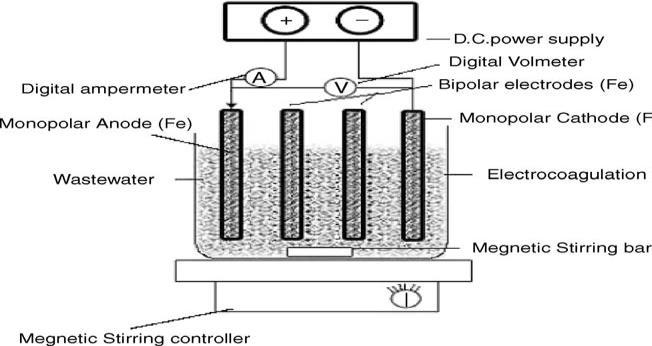
BatchexperimentswereconductedfortreatmentofDWW by EF. 1.4 dm3 DE was taken in 1.5 dm3 EF reactor. Four plate configurations at varying current intensities (1, 2 ,3 and4)andvoltageintherangeof0-30Vwereusedduring experiments. All test runs were performed at the temperature22-270Cfor60min.SincepHhastremendous effect on EC, the experiments were first performed at different initial pH. When the optimized pH evaluated, treatments were performed at different intensities. To determine the COD, the samples were analyzed at regular timeintervalof1hr.
3. RESULT AND DISCUSSION
The influence of pH on the wastewater has somehow strongly presented that treatment at pH 4, 6, 8 have not presentedthedesiredresults.
COD
TDS 46245 3456
TSS 36000 3659
TS

Fig-2:pH5.6andvaluesofcurrentdensityanditseffect
It raises the bubbles rates which causes the flux to move upward and enhance the pollutants degradation in the water. It has also helpful in generating the relevant tendency to reduce the waste in water using SS-304 electrodeatCOD=8913mg/dm3 andpH=5.6.
4. CONCLUSIONS
With the current process of electroflotation, it has been withdrawnthatpH5.Providesthebestcharacteristic and removal ratio of the waste organics and inorganics from thewater.Italsoreducesthecolortendencyfromdark to light with COD of 75.6%. It has certainly presented that 85% of the reduction was achieved. It has somehow represented that the discharge of wastewater was achieved and method was helpful in treatment of it at feasibleduration.
REFERENCES
7887
It has been analyzed that the efficient and theoretical amount of the supplied information would set out the current density rate at 0.05 A/m2. It has certainly formed thebubbleswhichwouldhelpinsweepingthecoagulation andflotationmechanisms.
A.K.Golder,A.N.Samanta,S.Ray,Sep.Purif.Technol.2007, 53,33-41.
Belkacemi,K.;Larachi,F.;Hamoudi,S.;Sayari,A.,Catalytic wet oxidation of high strength alcohol-distillery liquors.Appl.Catal.A:General,2000,199,199-209.
C.F. Albert, Advanced Inorganic Chemistry: A ComprehensiveText,2nded.,JohnWiley&Sons,New York1996.
C.Thakur, V.C.Srivastava, I.D.Mall, Chem. Eng. J.2009,148,496-505.
D. Kornack and P. Rakic, “Cell Proliferation without .K. Chaudhari,I.M.Mishra,S.Chand, Ind.Eng.Chem.Res. 2005,44,5518-5525.
Degradation of Pulp and Paper Mill Wastewater. Part 2. Characterization and Analysis of Sludge, Ind. Eng. Chem.Res.2006b,45(16),5766-5774.
International Research Journal of Engineering and Technology (IRJET) e-ISSN: 2395-0056 Volume: 11 Issue: 01 | Jan 2024 www.irjet.net p-ISSN: 2395-0072 © 2024, IRJET | Impact Factor value: 8.226 | ISO 9001:2008 Certified Journal | Page236
FIG.-1.Schematicdiagramofelectro-flotationprocess
Parameters Effluent EF-afteroptimumconditions
35650 8913
94525
TotalHardness 9000 1100 pH 3.5 5.6 Color Dark Brown LightBrown
Table-1:Typicalcompositionafterandbeforetreatment ofwastewater
E.S. Z. El- Ashtoukhy, N.K. Amin, O. Abedlwahab, Chem. Eng.J.2009,146,205-210.
Erick Butler , Yung-Tse Hung , Ruth Yu-Li Yeh and Mohammed Suleiman Al Ahmad “Electro-coagulation in Wastewater Treatment” 2011. 27. Mahesh, S.; Prasad,B.;Mall,I.D.;Mishra,I.M.Electrochemical
F.Esmadi,J.Simm,ColloidsSurf.,A1995,104,265-270.
F.I. Anto- Ponselvan, M. Kumar, J.R. Malviya, V.C. Srivastava, I.D. Mall, Water Air Soil Pollut.2009, 199(1),371-379.
Gritzner G, and Kreysa G. Nomenclature, Symbols and Definitions in Electrochemical Engineering. IUPAC. PureandAppliedChemistry,1993,65(5),1009-1020.
Indian Standard specifications for drinking water IS: 10500.
It Col. Mantha Nagaraj, Dr. Arvind kumar; Distillery wastewatertreatmentanddisposal,2010.
Journal of environment chemical Engineering, volume1, Issue3,September2013,pages440-447.
Journal of Hazardous Materials, Volume 244-245, 15 January 2013, Pages 478-488 Huangzhao Wei, XiamiaoYan,XianruLi,SongboHe,ChenglinSun.
K. Belkacemi , F. Larachi, S. Hamoudi, A. Sayari, Appl. Catal.,2000,199,199-209.
Kyzas GZ, Matis KA. Electroflotation process: A review. JournalofMolecularLiquids.2016Aug1;220:657-64.
M.Kumar, F. Infant, A. Ponselvan, J.R.Malviya, V.C. Srivastava, I.D. Mall, J.Hazard, Mater.2009,165,345352.
R.Ahlawat,V.C.Srivastava,I.D.Mall,S.Sinha,CLEAN:Soil AirWater2008,36(10-11),863-869.
R.Font,AICheJ.1990,36,3-12.
R.Sridhara,v. Sivakumar, V.P Immaneual, J.P.Marsn, J. Hazard.Mater.2011,186,1495-1502.
S. Mahesh, B. Prasad, I.D. Mall, I.M. Mishra, Ind. Eng.Chem.Res.2006,45,2830-2839.
International Research Journal of Engineering and Technology (IRJET) e-ISSN: 2395-0056 Volume: 11 Issue: 01 | Jan 2024 www.irjet.net p-ISSN: 2395-0072 © 2024, IRJET | Impact Factor value: 8.226 | ISO 9001:2008 Certified Journal | Page237