

A Review on Seismic Analysis of Irregular Plan of Diagrid Structure on Sloping Ground
Sujal Panchal1, Kishan Jayswal2 ,
1M. Tech Student, L.J. University, Ahmedabad, India.
2Kishan Jayswal, Assistance Professor, Civil Engineering Department, L.J. University, Ahmedabad, India.
Abstract - Moderntallbuildingsoftenusediagridsystems duetotheirpotentialforbotharchitecturalaestheticsand structuralefficiency.Diagridsystemsaremorestructurally efficientthanothersystemssuchasbracedsystems.Whena structurecanwithstand bothgravityandlateral load,it is considered stable. Therefore, it is important to design it usingstructuralsoftwaresuchasE-tabs,StaadPro,etc.,to verifycertainstructuralconditionsandimplementationsas per IS standards. The review report takes into account factorssuchasdeadload,liveload,floorfinish load,wind load,andseismicloadastheactingloads.
Key Words: Dia-Grid Structure, Structural Design, Seismic Load, E-tabs, Staad pro.
1. INTRODUCTION
Thecurrenttrendshowsthatthepopulationisgrowing rapidly, resulting in limited space for new constructionsinthecity.Toaccommodatethisgrowth, tall buildings are necessary. The diagrid system is a cost-effectivesolutionthatcanefficientlyresistlateral forcesandsupportgravitationalloads.Whendesigning tallstructures,itiscrucialtoconsiderthelateralloads that can be caused by wind and earthquakes. An inclined column positioned at the periphery of the structuremakesthediagridsystemabetteroptionfor resistinglateralloads.Incontrast,diagonalbracesina conventional system can create wall-like structures withwidelyspacedcolumns.
People living in areas with no flat land are forced to buildtheirhomesonhillyterrain.Eventhoughbuilding on hills comes with advantages like great views, natural ventilation, natural drainage, and additional spacefromlowerfloorlevels,rapidurbanizationhas ledtoanincreaseinthepopulationofhillyregions.As a result, the construction of high-rise buildings has becomenecessary.However,designingstructureson sloping ground is quite different from designing structuresonlevellandduetothechangesinmassand stiffnessofthebuildingasitrisesandspreads.

The term "diagrid" is a combination of diagonal and grid, used to describe a structural system that uses triangulation to achieve coherence. This system consists of single-thickness members that are joined together at the floor edge beams. The loads, such as weightdensityandsidewaysforce,areacceptedand distributedinahighlydistributedmannerbymultiple membersanddirectionsthroughoutitsconfiguration, resultingintriangulatedmemberevolution.

Thecharacteristicsofabuilding,suchasitsmassand stiffness, change as it rises and spreads. Therefore,
International Research Journal of Engineering and Technology (IRJET) e-ISSN: 2395-0056 Volume: 11 Issue: 01 | Jan 2024 www.irjet.net p-ISSN: 2395-0072 © 2024, IRJET | Impact Factor value: 8.226 | ISO 9001:2008 Certified Journal | Page231
***
Figure 1: I-Lab Corporate Office, Hyderabad, India
Figure 2: Diagrid Structure
designing a structure on sloping ground can be significantly different from designing one on level ground.Foranyhigh-risebuildingonaslopingorflat surface, a unique structural system is required. As a building gets taller, the system that can withstand lateral loads becomes more important than the one that can withstand gravitational stresses. The most commonly used sideways load resisting systems includeshearwalls,rigidframes,wallframes,outrigger systems,bracedtubesystems,andtubularsystems.In recentyears,thediagridstructuralsystemhasgained popularity.
1.2 Objective
Toinvestigatetheseismicloadingofadiagrid structure with plan irregularity on sloping ground.
To determine the optimum angle for various irregular geometry of diagrid structures on differentslopinggroundangles.
Analyse the performance of the Diagrid structure with various parameters such as storydrift,storydisplacement,andbaseshear.
To investigate the differences in structural response caused by earthquake motions in variousIndianseismiczones.
Theprimarygoalofdesigninganearthquakeresistant structure is to ensure that the structure has enough ductility to withstand lateralloads.
To analyse diagrid structure using E-tabs software.
2. Literature Review
[1] Saurabh Babhulkar, Kuldeep R Dabhekar, S.S. Sanghal,IshaP.Khedikar, “ComparativeStudyofSeismic Behavior of Diagrid Structure with Conventional Structure” IOP Conference Series: Materials Science and Engineering (2021)
Thisreportpresentsananalysisanddesignofa24mx24m buildingwithatotalplanareaof576m².Thebuildinghas15 stories, each witha height of 3.2 m. The report focuseson threetypesofstructures:diagridswithtwomodules,diagrids withfourmodules,anddiagridswithsixmodules.Thetwostorymodulehasacorner-to-cornerangleof50.19°,thefourstorymodulehasanangleof67.38°,andthesix-storymodule
hasanangleof74.475°.Toconducttheanalysis,theresponse spectrummethodwasusedwithStaadProsoftware.
According to the peak storey graph, the conventional structurehasasignificantlylowerpeakstoreyshearthanthe diagridstructure,4-modulediagridstructure,and6-module diagridstructure.Theconventionalstructureshavealower baseshearvaluethanthediagridstructures,whichhavea higher base shear value. The diagrid structure is more efficient than other structures because it requires less concreteandsteel,dependingontheconditions.

[2] Chittaranjan Nayak, Snehal Walke, and Suraj Kokare “Optimal Structural Design of Diagrid Structure for Tall Structure” ICRRM 2019 – System Reliability, Quality Control,Safety, Maintenance and Management, pp. 263–271, (2020)
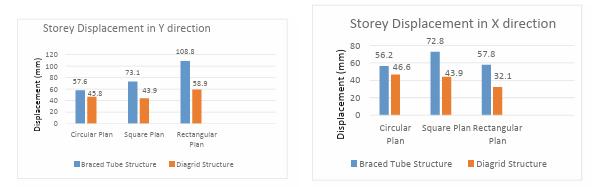
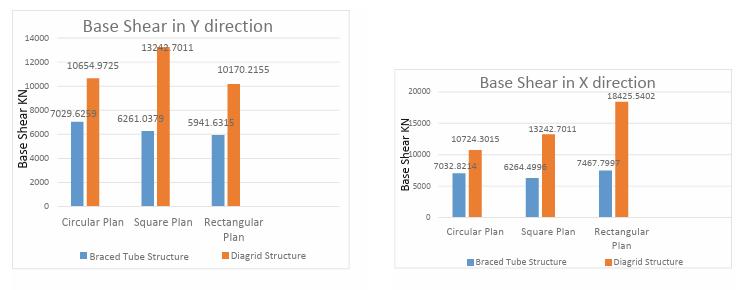
Thepaperdiscussesthemodelofbracedtubestructuresand diagrid structures with circular, square, and rectangular plans. The rectangular plan measures 54 m x 24 m, the squareplanmeasures36mx36m,andthecircularplanhas adiameterof40.62m.Thestoryheightofeachstructureis 60 m, with a height of 3.0 m for each story. The paper comparestheearthquakeandwindanalysisresultsofboth braced tubes and diagrid structures. Using Etabs software calculatesthestorydisplacement,storydrift,andbaseshear.
Accordingtotheanalysis,diagridstructuresexhibitlessstory displacement and storey drift than braced tube structures duringearthquakes.However,thebaseshearofthediagrid structureishigherthanthatofthebracedtubestructure.In wind analysis, diagrid structures also show less storey displacementandstoreydriftthanbracedtubestructures.In the case of braced tube structures, circular plans perform betterthansquareorrectangularplans.Conversely,square plansperformbetterthancircularorrectangularplansfor diagridstructures.Intermsofstoreydisplacementandstorey drift values, diagrid structures have the lowest values, whereasthebaseshearvaluesarethehighestascomparedto bracedtubestructures.Therefore,itcanbeconcludedthat diagridstructuresperformbetterthanbracedtubstructures.
International Research Journal of Engineering and Technology (IRJET) e-ISSN: 2395-0056 Volume: 11 Issue: 01 | Jan 2024 www.irjet.net p-ISSN: 2395-0072 © 2024, IRJET | Impact Factor value: 8.226 | ISO 9001:2008 Certified Journal | Page232
Figure 2.1 (a): Base Shear[1]
[3] Merry James and Neeraja Nair “Seismic Performance Analysis of Vertically Irregular Structure with Diagrid” National Conference on Structural Engineering and Construction Management (2019)
The36-storytallbuildinghasaplandimensionof36mx36 m, according to this paper Eachstorey hasa height of 3.6 meters. All the structural members of the building are designedusingIS800-2007code.Fromthe18thfloortothe top,thebuildinghasasymmetricalsetbacksbyremovingthe corners.Theangleof the diagridiscalculatedfordifferent module heights of 2-story, 4-story, 6-story, and 18-story basedontheheightandspacingofthediagrid.Theangleofa 2-story diagrid is 50.2 degrees, a 4-story diagrid is 67.5 degrees, a 6-story diagrid is 74.5degrees,andan 18-story diagridis84.4degrees.Theseismicanalysisofallmodelsis performedusingEtbassoftwarewiththehelpoftimehistory analysis.
Accordingtoatimehistoryanalysisofasymmetricmodel,a diagridstructurewithanangleof67.22°outperformsother anglesintermsofmaximumdisplacementanddrift.Forthis particulardiagrid,themaximumdisplacementandstorydrift are lower compared to other angles. As the diagrid angle increases, the base shear and structural weight decrease progressively.However,thestructuralweighthasonlybeen slightly reduced since all models have the same member sizes.

Table 2.3 (a): Analysis Result[3]
[4] Chetan S.Patta, Prof. Smt. Varsha Gokak “Analysis of diagrid structure with irregularity” International Research Journal ofEngineeringand Technology (2018)
Inthispaper,theauthorsanalyzethediagridstructurewith plan irregularity for seismic loading. Three models are considered:squareplan,C-typeplan,andL-typeplanlayout. All plans have a G+16 story structure. The structures are modelledinETABSsoftware,witheachstoryheightat3.6m. The study compares parameters such as base shear, time period,storeydrift,andquantityofmaterialconsumed.
Based on the results, it has been observed that the L-type diagrid structure is more efficient in terms of base shear, storeydisplacement,storeystiffness,andstoreydrift.Onthe otherhand,theC-typediagridstructureismoreefficientin terms of top-storey shear. Additionally, the C-type diagrid structure consumed less material than the L-type diagrid structure. Overall, the performance of the L-type diagrid structureismoreefficient.
[5] Mangesh Vhanmane and Maheshkumar Bhanuse “Study of Behavior of High-Rise Buildings with Diagrid Systems” SPRINGER Nature Singapore Pte Ltd. (2021)
Thisworkanalyzesthebehaviourofdiagridstructureswith 30,60and80floors,takingintoaccountlateralforcescaused by windloadsandearthquakes,following theIndiancode. The diagrid structures are modelled and analyzed using ETABS software. Response spectrum analysis is used for earthquakeloads.Thepaperexaminesfourdifferentcases with diagonal angles of 56.18°, 66.2°, 71.33° and 75.4° for eachdiagridstructure,with4,6,8,and10-storeymodules respectively. The results are evaluated in terms of storey shear,storeydisplacement,andstoreydrift.
Accordingtotheresults,thestoreydisplacementanddrifts are less in G+40 and G+60 storey buildings with a storey module of 6, and in G+80 storey buildings with a storey moduleof8.Therefore,module6withadiagridangleof66.2° issuitableforG+40andG+60storeybuildings,andmodule8 with a diagrid angle of 71.33° is suitable for g+80 storey buildings.Additionally,theresultssuggestthatthediagrid anglerangingbetween65°and72°isbestsuitedforheights rangingbetween120and240meters.
International Research Journal of Engineering and Technology (IRJET) e-ISSN: 2395-0056 Volume: 11 Issue: 01 | Jan 2024 www.irjet.net p-ISSN: 2395-0072 © 2024, IRJET | Impact Factor value: 8.226 | ISO 9001:2008 Certified Journal | Page233
Figure 2.2 (a): Storey Displacement[2]
Figure 2.2 (b): Base Shear[2]
[6] Shylaja N, Ashwini RMand Babu ER“SeismicAnalysis of Diagrid Structure on Sloping Ground” IOP Conference Series: Materials Science and Engineering (2019)
This paper describesthe designandanalysis ofa 12-story diagrid structure and a conventional building on sloping ground,witha plandimensionof24mx24manda storey heightof3.5m.Allstructuralmembersweredesignedusing IS:800-2007andthemodelingandanalysiswerecarriedout in ETABS software. Additionally, a 48-story structure was modelled with varying ground slopes and diagrid angles. Responsespectrumanalysiswasusedfordynamicanalysisof modelsbyvaryingthediagridangleto53.47°,60.94°,69.67°, 74.47°,and79.5°.
Thediagridbuildingdisplayslesslateraldisplacementand storey drift when compared to a conventional building on sloped ground. Additionally, the storey stiffness and base shearofdiagridishigherthanthatofaconventionalbuilding. Theseismicweightofdiagridstructureissignificantlyless than that of a conventional building. This is due to the lightweight materials that are used for the diagrid, which provideahighlevelofstrength.Fora15°slopeoftheground, theoptimumangleofdiagridis60.94°,andfora25°slopeof theground,theoptimumangleis69.67°.Diagridbuildings haveamorepleasingappearancecomparedtoconventional buildings.
3. CONCLUSIONS
Theliteraturereviewabovecomparesthediagridstructure modelsandbraced framemodelswitha traditional frame model.Ittakesintoaccountstructuralirregularitiesandalso alterstheH/Bratioanddiagridangle.Studiesareconducted usingresponsespectrumanalysisandtimehistoryanalysis withtheaidofETABSandSTAADProsoftware.Basedonthe research,itisdeterminedthat:
The diagrid structural model has more stiffness than the simple model as the top displacement is lessinit.
Verticalirregularitiesindiagridstructuresresultin less top-story displacement, making the diagrid structuremorestablethere.
The diagrid angle should vary according to the model'sheight.
Adiagridsystemisabettersolutionforlateralload, flexibility and economy in terms of material consumption
Anidealdiagridangleforheightsrangingfrom120 to 240 m is between 61° to 72°. However, the diagrid construction with a 67.22° angle is better thanotheranglesregardingmaximumdisplacement anddrift.
On sloping ground, the diagrid structure is more efficient than the conventional structure, and the optimumdiagridangleisbetween60-75°.
REFERENCES
[1] SaurabhBabhulkar,KuldeepRDabhekar,S.S.Sanghal, Isha P. Khedikar, “Comparative Study of Seismic Behavior of Diagrid Structure with Conventional Structure” IOP Conf. Series: Materials Science and Engineering 1197 (2021) 012049 doi:10.1088/1757899X/1197/1/012049
[2] Chittaranjan Nayak, Snehal Walke, and Suraj Kokare “OptimalStructuralDesignofDiagridStructureforTall Structure”SpringerNatureSingaporePteLtd.2020V.K. Gunjan et al. (Eds.): ICRRM 2019– System Reliability, QualityControl,Safety,MaintenanceandManagement, pp.263–271,2020.https://doi.org/10.1007/978-98113-8507-0_39
[3] Merry James and Neeraja Nair “Seismic Performance AnalysisofVerticallyIrregularStructurewithDiagrid” SpringerNatureSwitzerlandAG2020K.Dasguptaetal. (eds.),ProceedingsofSECON’19,LectureNotesinCivil Engineering 46, https://doi.org/10.1007/978-3-03026365-2_55
[4] Chetan S.Patta, Prof. Smt. Varsha Gokak “Analysis of diagrid structure with irregularity” International ResearchJournalofEngineeringandTechnology(IRJET) Volume:05Issue:08 Aug2018
[5] MangeshVhanmaneandMaheshkumarBhanuse“Study of Behavior of High-Rise Buildings with Diagrid Systems”SpringerNatureSingaporePteLtd.2021M.C. Narasimhanetal.(eds.),TrendsinCivilEngineeringand Challenges for Sustainability, Lecture Notes in Civil Engineering99,https://doi.org/10.1007/978-981-156828-2_19
[6] ShylajaN,AshwiniRMandBabuER“SeismicAnalysis of Diagrid Structure on Sloping Ground” IOP Conf. Series:MaterialsScienceandEngineering1255(2022) 012008doi:10.1088/1757-899X/1255/1/012008
International Research Journal of Engineering and Technology (IRJET) e-ISSN: 2395-0056 Volume: 11 Issue: 01 | Jan 2024 www.irjet.net p-ISSN: 2395-0072 © 2024, IRJET | Impact Factor value: 8.226 | ISO 9001:2008 Certified Journal | Page234