
Holistic Approach For Lightweight Automotive Exhaust System Design
Hiren Sonaiya1 , Shashwat Yadu2 , Swapnil Shelke3
1Hiren Sonaiya, Project Manager, Tata Technologies, ERC, Chassis, Tata Motors
2Shashwat Yadu, Sr. Technical lead, Tata Technologies, ERC, Chassis, Tata Motors
3Swapnil Shelke, Team lead, Tata Technologies, ERC, Chassis, Tata Motors
Abstract - The automotive industry is continually evolving to meet increasingly stringent regulatory standards and consumer demands for improved efficiency and performance. As a result, there is a growing emphasis on developing lightweight exhaust systems that contribute to enhanced fuel economy, reduced emissions, and optimized vehicle dynamics. This abstract presents an overview of the latest trends and advancements in the designof lightweight automotiveexhaust systems.
Key Words: Automotive, Exhaust System, Light weight, VAVE.
1. INTRODUCTION
The automotive industry has undergone a transformative shiftinrecentyears,drivenbyaconfluenceoffactorssuchas tightening emission regulations, increasing consumer demandforfuelefficiency,andadvancementsinmaterials and manufacturing technologies. As a result, automotive engineersanddesignersarefacingtheintricatechallengeof developing innovative solutions that not only meet these demandingrequirements butalsoenhanceoverall vehicle performanceanddrivingexperience.
Value Engineering (VE) is a sequential and disciplined approachtoevaluatetheworthorusefulnessofaproduct for the intended customer or consumers. It targets on desired functions of Product, process, service and system therebymaintainingperformance,aesthetics,optimumlifecycle cost, quality reliability, and safety intact. It is used when the process is applied to new product development while The Value Analysis (VA) is used when the value process is applied to existing products [1]. The Value Engineeringhastwodimensionsworthandcost.InIndian automotive industries Value Engineering approach is not fully utilized. It’s most effective approach available to identifyandeliminateunnecessarycosts.Itsapplicationto product design and development, specifications and practicesislesswellknown,itseffectivenessintheseareas have been proven [2]. VE is a creative thinking which is applicableforexploringbestalternativewaysforcarrying outthevariousfactionsattheoptimizedcost.Aproductor service is generally considered to have good value if that productorserviceshasappropriateperformanceandcost.
Valueisthemostcosteffectivewaytoreliablyaccomplisha function that will meet the user’s needs, desires and expectations[3].Itshouldbekeptinmindthatincreasingthe value of the product/services doesn’t necessarily mean increasingthecostoftheproduct.Valuecanbeincreasedby increasing the benefits/worth and reducing the resources etc.Valueengineeringistargetedtoidentifyandcapturethe lowpercentageofthefactorsinanyproductthataffectsthe greatestpercentageofthecost.Valueengineeringdoesnot takeanydecisionswhetherthisproposalisokornot,itjust Provoke/triestogetpeopletothinkthattherearedifferent/ equivalent ways to perform the work. It attempts to minimize the design life cycle time. It’s an exercise or technique which anybody can apply in a proper defined design format under the guidance of VE specialist. During World War II many industries were faced problem of materialshortage,duringsuchcriticalsituationeffortswere madebyindustrypeopletousedifferenttechniquesinorder toretainthefunctionoftheproductbyeitherprovidingthe substitutetotheexistingmaterialorchangingtheproduct design keeping the product performance same/improved. Further,during1947basedupondifferentapproachesstep by step system was developed and named as” Value Analysis”.In1959theSocietyofAmericanValueEngineers (SAVE)wasincorporatedinWashington,D.C.forconnecting thepractitionersandenablingthegrowthoftheprofession. In1977TheIndianValueEngineeringSocietywasformed. During this period different small growing American industries have adopted VE techniques to improve their productperformance,profitmarginsandalsoforenhancing theirmarketcompetitiveposition.
Wecanreducetheproductcostbylocalizationofimported parts,resourcingfromadifferentsupplier,designchanges. value analysis, supplier negotiations, supply chain cost review,benchmarking,competitiveevaluation,alternate Manufacturingprocess&re-evaluatecustomerneeds.
M/s Tata Technologies suggest approach to achieve light weightexhaustsystemandconsiderationtobetakenwhile designexhaustsystem.
2. Exhaust System
ExhaustsystemdesignisanArt,whichcomprisesofmany child parts. Exhaust System require balancing of back pressure, weight and cost targets. The requirements for
International Research Journal of Engineering and Technology (IRJET) e-ISSN: 2395-0056 Volume: 11 Issue: 01 | Jan 2024 www.irjet.net p-ISSN: 2395-0072 © 2024, IRJET | Impact Factor value: 8.226 | ISO 9001:2008 Certified Journal | Page205
***
quality,productivity,andcost efficiencyareatlevel where optimizationofthedesignandmanufacturingofaproduct mustoccurintheearlieststagesofconception.Thetimeand cost spentin trial and erroranalysis inthe design process needstobeminimizedforanindustrytoremaincompetitive inourcurrentglobalmarket.
The purpose of any Exhaust System (ES) is to reduce the enginenoise,dischargingtheexhaustgasinasafemanner, minimizingthepowertrain/exhaustvibrationtransferredto therestofvehicleandcarrytheemissionsfromaproperly tunedcombustionengine.Butweneedkeepinmind,thatfor packaging reasons this system should be compact, and for thisprincipalreasonwehaveseveralproblemstodesignthis systemcomplexityadequatefunctionandlowcost.
2.1. Balancing of the targets
Back pressure and NVH are the one of the critical parameterwhichdecidetheweightoftheexhaustsystem. This is further cascade to volume distribution and pipe diametersize.
ForlightweightES,weneedtorunbelowCAEanalysisto arrivelightweightexhaustsystem–

2.2. Vibration analysis
Exhaustsystemreceivesvibrationfromtheengineandthen transfersvibrationtothebodystructurethroughhangers.It
is important to understand exhaust system dynamic
characteristicsinordertoreducethevibrationcomingfrom theengineandtoreducevibrationtransferringtothebody.
2.3. Modal Analysis
Exhaust system modes are critical for exhaust dynamic analysis.Anormal modesanalysisshouldbeperformedto makesurethatthefrequenciesoftheexhaustsystemdoes notlineupwiththefrequenciesofthepowerplantandbody. Also the same analysis is helpful to determine the nodal pointsontheexhaustsystem.Thesenodalpointscanbeused as the locations where hanger rods can be attached to the exhaust system. This will minimize vibrational energy transferredtothebody.
Rubberhangerstiffnessandno.ofrodhangerisalsooneof theavenueforlightweightexhaustsystem.Lessertherod hanger,lesserthenoiseinincab,lesserwillbecostofexhaust system.
2.4. NVH CAE Simulation
Following 3 criterions are used in the development of exhaustsystemfornoise
A.AcousticTransmissionLoss
B.AcousticInsertionLoss
C.ExhaustOrificenoise
Balancingthepremufflerandpostmufflervolumeisthe oneofthekeycontributortomeettheexhaustorificenoise alongwithpipediameterplacemajorroleinmeetingflow noise.
Enginecalibrationisalsothekeyparametertomeetthe noiserequirements,withchangeincalibrationnoisequality andperformancegetschanged.
2.5. Exhaust Back-Pressure Simulation using CFD
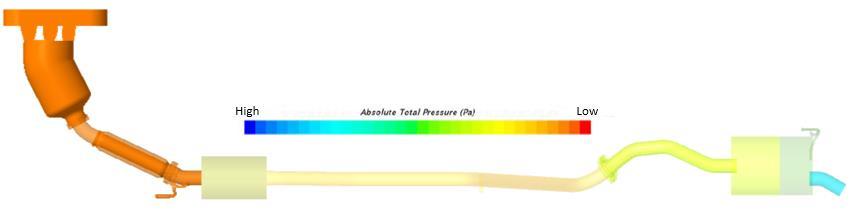
ComputationalFluidDynamics(CFD)simulationisrequired toevaluateflowperformance(intermsofsystempressure dropandbackpressureprediction)ofdifferentconceptsof Exhaust connection elbow and exhaust systems. CFD simulations are performed using appropriate commercial CFD software. CFD analysis is done at rated operating conditionoftheengine.
Pipediameterandmufflerexpansionisthekeyparameterto meetbackpressurerequirement.
International Research Journal of Engineering and Technology (IRJET) e-ISSN: 2395-0056 Volume: 11 Issue: 01 | Jan 2024 www.irjet.net p-ISSN: 2395-0072 © 2024, IRJET | Impact Factor value: 8.226 | ISO 9001:2008 Certified Journal | Page206
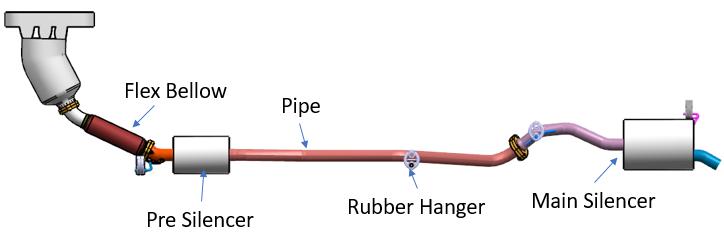
Fig -1:ExhaustSystemLayout
Fig. 2 Balancingofthetargets
3. Material Selection
Durable exhaust system design, development and manufacturingismandatedforthevehicletobecompetitive andcomparative.Materialselectionfortheexhaustsystem playsavitalroleduetotheincreasedwarrantyrequirements and regulatory compliances. Physical, chemical and mechanical characteristics of the materials used for conventionalandspecialapplicationsarecompared.Exhaust systemmaterialsshouldpossesshightemperatureoxidation resistance,thermo-mechanicalvibrationresistance,external salt corrosion resistance and internal acid/base corrosion resistances.Internalcomponentssuchasinnercones,baffle plates, retainer rings, perforated pipes and external componentssuchashangerrod,outershell,heatshield,end capsoutercones,flextube,manifoldetc.shouldbeableto withstandhighthermalimpactandvibrationscausedbyroad load,thermalloadandengineload.
ES weight can be balance using high grade material with lesserweightthickness.
Pipematerial,weneedtodecidebasedonB10life(saltspray test and corrosion requirements) and considering the warrantytargets.
4. Manufacturing Process
All the above stages combined with the packaging of the engineevolvethedesignoftheprototypemufflerandthose; canbetakenupformanufacturing.Followingaresomeofthe importantmanufacturingconsiderationssummarizedbased onexperience:
There should not be any leakage of gas from one chambertoanother.
Weldingprocess.
Acoustic performance on manufacturing of the perforatedtube.
Tubematerial
Mufflermanufacturingprocess
Flangetypeandmanufacturingprocess.
5. Benchmarking
Thefirststepinanydesignanddevelopmentactivityistoset a target by doing benchmarking exercise of same kind of models.Thesamewillbeapplicableforthesilencerhere,to
set a target in terms of transmission loss of same engine powermodelsofcompetitorbenchmarkingvehicles.Based on the provided engine input data and bench mark study targetforbackpressureandnoiserangearedecided.
6. New Technologies
Newemergingtechnologiesareexhaustvalveresonatorfree pipe(RFP),exhaustvalve,Helmholtzresonatorsamecanalso beexploredconsideringthecosttargets.
7. Through VE techniques
Strong performance of cost planning in the Product Development Process (PDP) - Although the company possessesanimageofdevelopingexpensiveproducts,with strongfocusonquality,costplanningisincreasinglypresent asanactiveparameteroftheproject.ThePDPhasthreeclear objectives:time,qualityandcost.
Development through multifunctional teams. The basisofthemultifunctionalteamsinvolvespeople fromtheEngineering,PurchaseandVEdepartments. Thisallowsanexchangeofknowledgetomakecost reductionproposalsinordertoachievethegoalsof target-cost. Strong coordination and cooperation amongpeoplefromalldepartmentsofthecompany allowthemaintenanceofagoodactivityflow.
ImportantfunctionofFinance.Thefinancialfunction is essential to manage target-costing. It acts to supplyinformationthatguidestheactivitiesofcost planning for the entire company, measuring and monitoringtheactivitiestoachievethecompany’s strategicobjectives.
Integration of cost planning with the company’s globalstrategy.Itispossibletoimprovetheoriginal design by developing studies with local suppliers, changing materials or production processes and simplifyingthedesignforlocalneeds.
Use of tools and techniques that support VE. As described previously, VE is not applied in a systematic way to the cost reduction process to achieve the target-cost. However, it was observed thatmanyofthecostreductiontechniquesusedby thecompany,e.g.,ReverseEngineering,Designfor manufacturing and assembly (DFMA), Quality function deployment (QFD), modularity, part standardization,supportthemethodologyofVEand targetcosting.
8. CONCLUSIONS
Inthiscurrentstudyweexploredifferentavenuestoachieve thelightweightexhaustsystem.Theevolutionoflightweight exhaust system design represents a dynamic and transformative journey that intersects cutting-edge materials science, advanced manufacturing techniques,
International Research Journal of Engineering and Technology (IRJET) e-ISSN: 2395-0056 Volume: 11 Issue: 01 | Jan 2024 www.irjet.net p-ISSN: 2395-0072 © 2024, IRJET | Impact Factor value: 8.226 | ISO 9001:2008 Certified Journal | Page207
Fig -3:ExhaustBack-PressureSimulationusingCFD
REFERENCES
[1] Gerhardt, D. J., & Rand, P. I. (2006). Managing value engineeringinnewproductdevelopment.ValueWorld, 29(2),26.
[2] Mostafaeipour, A. (2016). A Novel Innovative Design Improvement using Value Engineering Technique: a Case Study. Journal of Optimization in Industrial Engineering,9(19),25-36
[3] M Khan, K. A., & Houston, G. D. (2000). Design optimization using Life Cycle Cost Analysis for low operating costs. BOMBARDIER AEROSPACE DOWNSVIEW(ONTARIO).
BIOGRAPHIES



Hiren Sonaiya, Project Manager, Tata Technologies, ERC, Chassis, TataMotors
EmailId:hs925008.ttl@tatamotors.com
ShashwatYadu,Sr Technicallead, Tata Technologies, ERC, Chassis, TataMotors
EmailId:sy922715.ttl@tatamotors.com
Swapnil Shelke, Team lead, Tata Technologies, ERC, Chassis, Tata Motors
EmailId:sshelke.ttl@tatamotors.com
International Research Journal of Engineering and Technology (IRJET) e-ISSN: 2395-0056 Volume: 11 Issue: 01 | Jan 2024 www.irjet.net p-ISSN: 2395-0072 © 2024, IRJET | Impact Factor value: 8.226 | ISO 9001:2008 Certified Journal | Page208 computational simulations, and a holistic approach to VE techniques.