

BATCHING METHODS AND THEIR INFLUENCE ON PROPERTIES OF CONCRETE –
A LIMITED STUDY
Shodolapo Oluyemi Franklin1, a, Philip N. Kaboro2
1Senior Lecturer, Department of Construction Engineering, Gaborone University College, Mmopane, Botswana.
2Formerly, Department of Civil Engineering, University of Botswana, Gaborone, Botswana.
aCorresponding Author – Email: soafranklin@gmail.com ***
Abstract - The effect of mass and volume batching on the fresh and hardened properties of concrete was investigated using a single mix proportion and water-cement or w/c ratios of 0.5, 0.55 and 0.65. Volume batching was carried out by means of a constructed gauge box, while mass batching was effected via a well calibrated mass scale. All concrete samples were manufactured using OPC 42.5N CEM Type 1 cement and the specimens were cured in water for 7, 14 and 28 days as required. It was found that the workability increased with w/c ratios for both methods of batching, although it was somewhat higher for mass proportioning than for volume batching. In addition, higher compressive strengths were obtained for concrete specimens proportioned by mass, for all w/c ratios. In most cases the coefficients of variation of the compressive strength test results for the concrete batched by mass were markedly lower than their equivalent counterparts produced by volume proportioning. It was concluded that these findings were in broad agreement with the results of previous research in the literature.
Key Words: Batching method, mix proportion, watercementratio,curingage,concrete,workability,compressive strength.
1. INTRODUCTION
Concrete is universally regarded as a composite material comprisedofamixtureofcoarse/finegranularmaterialsor aggregates, cement, water and admixture all combined in certainproportionswhichmaybevarieddependingonthe desirednatureandcharacteristicsofthefreshandhardened concrete. The property of the fresh concrete of primary interest here is the workability, defined as the amount of mechanical work or energy needed to produce complete compactionoftheconcretewithoutsegregation(Mindesset al. [1]). In a qualitative sense, the term describes the ease with which the concrete can be mixed, placed, compacted and finished (Kong and Evans [2]). With regards to the hardened concrete, the major mechanical property of concern is the compressive strength, although in several circumstances the main focus may be on the flexural and tensilestrengthsofthehardenedconcrete.
The manufacture of concrete involves several steps namelybatching,mixing,transporting,placing,compaction, curing and finishing in that order (Shetty and Jain [3]).
Batchingofaggregatesandcement,thefirststage,isdefined astheprocessofmeasuringandintroducingintothemixer theingredientsofthebatch(MehtaandMonteiro[4]).There aregenerallytwomethodsavailableinthisregard,namely proportioning by mass or volume batching. According to Kellerman[5],Mindessetal.[1]andMehtaandMonteiro[4], batching by mass is generally accepted as the preferred meansofproportioning.Sincewaterandliquidadmixtures alone can be measured accurately by volume, it is not surprisingthatthequantificationofsolidslikecementand aggregates on a volume basis may result in gross errors (Mindessetal.[1]). Inaddition,iffluctuationsorchangesin aggregate moisture contents take place, proportioning by masseasilyfacilitatesconvenientandrapidadjustmentsof quantitiesofaggregateandwater.AccordingtoMindesset al. [1], environmental and practical concerns frequently make it advantageous to retain some wash water in the mixerwhichmustbetakenintoaccountduringthebatching operation; this necessitates material quantities to be measured to a high degree of accuracy and is best accomplishedbymassproportioning.Withwell-maintained and properly functioning equipment, mass batching can resultinahighdegreeofuniformityofsuccessivebatchesof concrete(Kellerman[5]).
In respect of batching by volume, Kellerman [5] has statedthatpossiblesourcesoferrorsareduetothebulking ofsandrangingfrom15%to30%forcoarseandfinesands respectively,thecompactionofaggregatesandthepacking characteristics of the aggregate. Regarding the latter, rounderandmoregradedaggregatesareliabletopackmore closely than poorly shaped and single sized aggregates. Majorerrorsalsooccurwithvolumebatchingofcementon accountofchangesintheloosebulkdensityasthecement becomes aerated when discharged. Consequently for the foregoingreasonsitisgenerallyrecommendedthatvolume batching be confined to non-structural works such as foundations for houses, and relatively unimportant construction not requiring usage of mass batching equipment(Kellerman[5]).
Despite the above observations and misgivings, the general tendency in many West African and particularly Nigerianconstructionsitesistoadoptvolumebatchingfor the majority of concrete works, on the grounds of ease, simplicity and construction speed (Orumu [6]). This has beenthecaseforbothstructuralandnon-structuralconcrete
International Research Journal of Engineering and Technology (IRJET) e-ISSN: 2395-0056 Volume: 11 Issue: 01 | Jan 2024 www.irjet.net p-ISSN: 2395-0072 © 2024, IRJET | Impact Factor value: 8.226 | ISO 9001:2008 Certified Journal | Page159
constructionswhichareinaccordancewithBS8500-1:2002 [7].Admittedlytheproblemhereiscompoundedbythefact that a given project may specify nominal mix proportions and maximum coarse aggregate sizes to be employed, but the method of batching whether by mass or volume proportioninginordertoachieveaspecifiedcharacteristic strength is seldom stated. Furthermore on-site practices involve a visual assessment of the workability of the concreteaswaterisaddedandconsequently,compressive strengths attained may be substantially lower than the specifiedcharacteristicstrengthandmaydifferfrombatch to batch of the concrete produced particularly where the consistencyisnotmonitored(Olusolaetal.[8]).
2. LITERATURE REVIEW
Areviewoftheliteratureonthevariationsthatoccurinthe properties of concrete when batching is carried out by volumeasopposedtomassrevealssurprisinglyadearthof results. Goldbeck and Gray [9] in their pioneering studies emphasizedthenecessityofestablishingthemixproportions with the materials to be used on site. In contrast to the generalpracticeofstipulatinganunconfirmedmixratiofora specified characteristic strength, they suggested that appropriate mix proportions should be arrived at after preliminarysitetests.
Olusola et al. [8] investigated the influence of batching methods on the compressive strength and workability of concreteusingfivemixproportionsof1:1:2,1:1.5:3,1:2:4, 1:3:6and1:4:8,andwatercementratiosvaryingfrom0.35to 0.95.Inallcasesbatchingbymassgaverisetohigherslumps than volume proportioning, the percentage differences rangingfrom4%to30%,withmostresultsintherange4%10%.Withregardstothecompressivestrength,forordinary structural mix ratio of 1:2:4 normally used for structural workinWestAfrica,concretebatchedbyvolumeresultedin 28thdaycompressivestrengthswhichwereabout14%lower than concrete produced by mass proportioning. They concludedthatcompressivestrengthsproducedbyvolume batchingonconstructionsitesmightnotattainthedesigned targetstrengths.
Orumu[6]developedamodifiedvolumebatchingmethod basedonthecompleteremovalofentrainedairoccurringin thetraditionalvolumeproportioningapproach.Hefoundthat forarichstructuralmixratioof1:1.5:3,concretebatchedby themodifiedvolumemethodhad65%and22%compressive strength increase over concrete batched by the traditional volumeapproachfor7and28daysrespectively.Additionally the modified volume batching method resulted in a more rapid strength development than that of the traditional volume proportioning. However he concluded that an increaseof20.9%incementvolume,adecreaseof24.6%in fine aggregate volume and an increase of 1.1% in coarse aggregatevolumewasrequiredincontrasttothetraditional volumeproportioningmethod.Forthepurposeofthepresent studyhowever,amodifiedvolumebatchingapproachhasnot beenadopted.
Inviewofthescarcityofresultsfoundintheliteratureas enunciatedearlier,theemphasisinthecurrentinvestigation is on a comparison of the mass and volume batching methodswithrespecttotheirinfluenceonthepropertiesof thefreshandhardenedconcretealongthelinesadoptedby Olusola et al. [8]. However locally sourced materials in Botswana have been utilized for the present research in order to provide additional test results and thereby supplementtheexistingdatarelatingtobatchingmethods.
3. EXPERIMENTAL PROGRAMME
In this section a description is given of the different materialsemployedinthecurrentstudyandhow the mix proportionswerearrivedat.Theprocedureforcastingofthe concretespecimensaswellasthemethodsemployedforthe tests subsequently carried out on the fresh and hardened concreteareoutlined.
3.1 Materials, Mix proportions and Casting
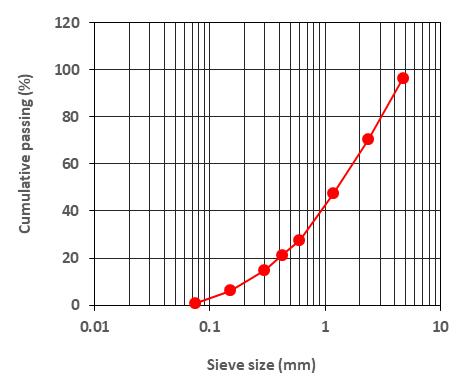
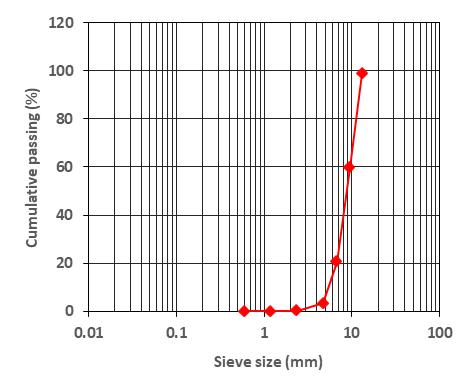
OrdinaryPortlandcementofspecification42.5NCEM1 andmanufacturedbyPPCLtd.wasutilizedforthestudy.This cement is suitable for the production of all reinforced concreteworkandmortarsrequiringhighinitialstrength.It has ready application in a great variety of reinforced and prestressedconstruction.Thecementhasaninitialsetting time≥60minutesandfinalsettingtimeofapproximately110 minutes,witha7daycompressivestrengthof29MPaand28 daycompressivestrengthof42.5MPa.Thecoarseaggregate utilizedwas13.2mmmaximumsizesilicastone,whilethe fineaggregateemployedwas4.75mmmaximumsizecrusher sand. The loose bulk densities of the fine and coarse aggregates were approximately 1,600 kg/m3 and 1,440 kg/m3respectively.TheaggregatesweresourcedfromKgale QuarriesinGaborone.Theparticlesizedistributionsforthe fine and coarse aggregates are shown in Figures 1 and 2 respectively.
International Research Journal of Engineering and Technology (IRJET) e-ISSN: 2395-0056 Volume: 11 Issue: 01 | Jan 2024 www.irjet.net p-ISSN: 2395-0072 © 2024, IRJET | Impact Factor value: 8.226 | ISO 9001:2008 Certified Journal | Page160
Fig. 1: Particlesizedistributionforfineaggregate
TheCementandConcreteInstitutemethodofmixdesign derivedfromACIStandard211.1-91asdescribedbyAddis andGoodman[10]wasadoptedtodeterminethequantities ofthedifferentmaterialsneeded.Theselectedcharacteristic strengthwas 42.5MPaat28days.Parameterssuchasthe compactedbulkdensityandrelativedensityforthecement, crushersandandsilicastoneweretakenfromthesuppliers guidelinesinordertoobtainreasonableestimatesofmaterial characteristics for the mix design. Three water-cement or w/c ratios of 0.5, 0.55and 0.65 were adopted. Trial mixes werecarriedouttoarriveatthemixproportionsshownin Table1.
cubes, in order to assess the compressive strength at any giventime.Themouldsforallcastspecimenswerevibrated bymeansofavibratingtableandsubsequentlycoveredwith wet hessian or translucent plastic sheet for 24 hours. The cubes were then de-moulded and placed in a constant temperature curing bath for a total of 7, 14 or 28 days as deemednecessary,priortotesting.
3.2 Testing Procedures
Thetestingofthehardenedconcretecubeswascarried outat7,14or28daysaftercuringforeachcubeirrespective of the batching method employed. A well-maintained compressiontestmachineshowninFigure4wasutilizedfor thispurpose.Loadingwasappliedataconstantrateupuntil failureinaccordancewiththeSouthAfricanstandardSANS 5863: 2006 [11]. Any unusual behaviour of the test specimens during crushing was noted and analysed subsequently. As mentioned earlier, the compressive strengthatanygivenoccasionwastakenastheaverageof sixtestresults.
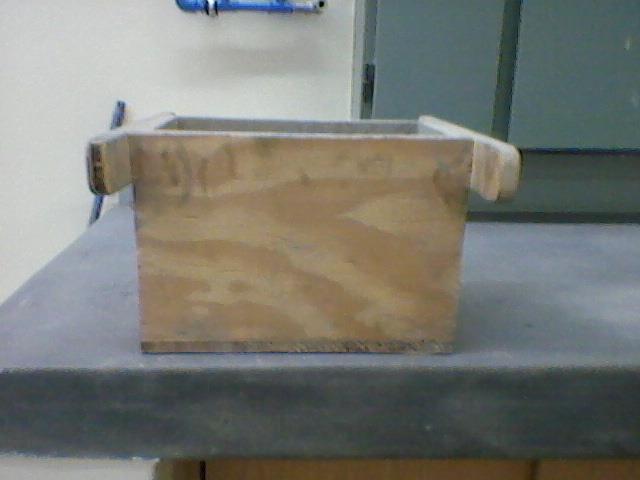
Whenbatchingbymass,theconstituentsoftheconcrete were weighed separately using a well calibrated scale balance. Specifications generally require that materials be measured in individual batches within the percentages of accuracy of 1% for cement, 2% for aggregates and 1% for water. For the case of volume proportioning, a specially constructed gauge box shown in Figure 3 of internal dimensions350mmx200mmx250mmwasemployedto measurethevolumesofthedifferentconstituents.Priorto castingofthecubes,slumptestswerecarriedoutforallthe differentconcretemixes.
Atotalofonehundredandeight(108)concretecubesof 150mmsizeswerecastforthecompressivestrengthtests. Due to uncertainties at this stage regarding the variations that would occur particularly in respect of volume proportioning, it was decided to utilize the results of six cubes rather than the widely adopted or standard three

International Research Journal of Engineering and Technology (IRJET) e-ISSN: 2395-0056 Volume: 11 Issue: 01 | Jan 2024 www.irjet.net p-ISSN: 2395-0072 © 2024, IRJET | Impact Factor value: 8.226 | ISO 9001:2008 Certified Journal | Page161
Fig. 2: Particlesizedistributionforcoarseaggregate
Water Cement Silica stone Crusher sand w/cratio 168.6 337.2 1,011 842.9 0.50 185.5 337.2 1,011 842.9 0.55 219.2 337.2 1,011 842.9 0.65
Table 1: Mixproportions(inkg.)for1m3 offreshconcrete
Fig. 3: Constructedgaugeboxforvolumebatching
Fig. 4: Compressiontestset-up
4. RESULTS AND DISCUSSION
Inthissectionthedetailedresultsoftheslumptestsonthe freshconcrete,compressivestrengthtestsonthehardened cubesandtheobservedvariationsinthecubestrengthswith respect to the batching methods used are presented. An attempt is also made to correlate the results of the study withpreviousfindingspresentedintheliterature.
4.1 Effect of batching method and w/c on slump
The comparison of slumps for concrete batched by volume in contrast to mass proportioning is presented in Table 2. The results demonstrate that slumps forconcrete batched by mass were generally higher than those for materials proportioned by volume for all water-cement ratios,probablyduetothegreaterconsistencyinmeasuring materials by mass as opposed to volume. There were no changesinslumpforconcretebatchedbyvolumeforallw/c ratiosintherange0.5to0.55.Howevertherewasashear slumpforaw/cratioof0.65,indicatingthatthemixwastoo wet. The flow test would have been more appropriate to measure the workability of such mix. In comparison, for concreteproportionedbymass,slumpsof8mmand20mm wereobtainedforw/cratiosof0.55and0.65respectively, althoughtheseresultsindicatethatthemixeswererelatively dry.Itshouldbeborneinmindherehoweverthattherange andnumberoftestsconductedwerelimitedascomparedto thoseofOlusolaetal.[8].
Slump Slumpclass*
*S1(≥10≤40)accordingtoBSEN206-1:2000[12]
4.2 Effect of batching method on cube strength
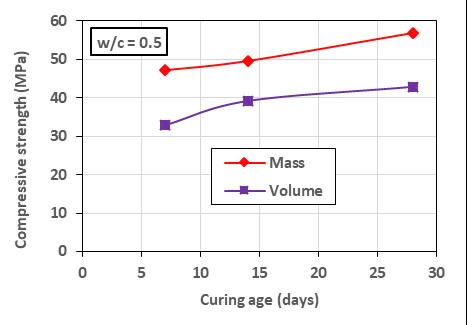
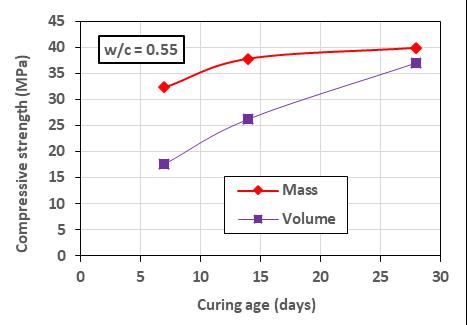
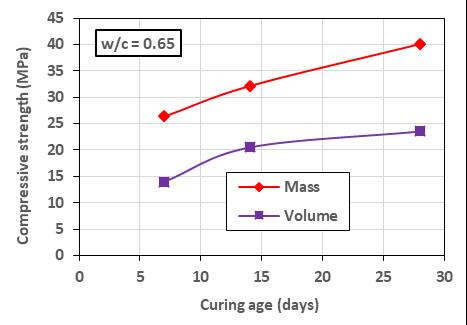
Figures5(a) to(c) showtheresultsofthecompressive cubestrengthsforthedifferentmethodsofbatchingandw/c ratios.Itisapparentthatthereisanincreaseincompressive strengthwithincreaseintestingage.Inadditionthereisa decreaseincompressivestrengthwithincreaseinw/cratio. Thesetrendsarenotsurprisingandarewelldocumentedin theliterature.Inallcaseshighercompressivestrengthswere obtainedforconcretebatchedbymassasopposedtovolume. Forexampleforaw/cratioof0.5,the28th daycompressive strength for concrete proportioned by mass was 32.6% highercomparedtothatproportionedbyvolume.Withaw/c ratioof0.55,thedifferenceincompressivestrengthwas7.8% whichwasquitemodest.Howeverforaw/cratioof0.65,the strength difference peaked at 70.6%. Such trend of compressivestrengthinrelationtothebatchingmethodwas
also found by Olusola et al. [8] although their margins of differenceswerenotaspronouncedcomparedtothepresent study.Neverthelesstheresultsofbothinvestigationssupport theviewthatthereisahighprobabilitythatmostconcrete producedonconstructionsitesinWestAfricancountriesin generalmightnotmeetthedesignedtargetstrengths. (a)
International Research Journal of Engineering and Technology (IRJET) e-ISSN: 2395-0056 Volume: 11 Issue: 01 | Jan 2024 www.irjet.net p-ISSN: 2395-0072 © 2024, IRJET | Impact Factor value: 8.226 | ISO 9001:2008 Certified Journal | Page162
ratio
Volume Mass Volume Mass
0 0 – –0.55 0 8 – –
20
S1
Table 2: Variationofslump(inmm.)withbatchingmethod
w/c
0.50
0.65 Shearslump
–
(c)
(b)
Fig. 5: Variationofcompressivestrengthwithagefor variousw/cratios
4.3 Variation in compressive cube strengths
Withregardstotheissueofvariationinthecompressive strengthresults,inmostcasesthecoefficientofvariationfor cubesbatchedbyvolumewassignificantlyhigherthanfor specimens proportioned by mass regardless of the age of testingorthew/cratio.Forexample,forthe14th and28th daycompressivestrengthswithaw/cratioof0.5,volume batching produced variations of 11.6% and 12.1% respectively. The corresponding values for mass proportioningwere6.3%and4.5%respectively.Withaw/c ratio of 0.65, volume batching resulted in a coefficient of variationforthe14th and28th daycompressivestrengthsof 6.1%and23.8%respectively.Thecorrespondingvaluesfor mass proportioning were 4.1% and 4.5% in that order. Theseresultsdemonstratethatitisprudentassuggestedin the literature (see Kellerman [5] for example) to restrict concretingbatchedbyvolumetominorandnon-structural works, or construction requiring very little or minimum supervision.
5. CONCLUSIONS
Theworkcarriedoutinthepresentstudywasexecutedin ordertodeterminetheinfluenceofthemethodofbatchingon the properties of concrete in both the fresh and hardened states.Theparticularcharacteristicsofinteresthereinwere the workability of the fresh concrete as assessed by the slump, and the compressive strength of the hardened concrete.Asinglemixproportionwasused,howeverthree water-cement ratios of 0.5, 0.55 and 0.65 were employed. Based on the investigations carried out, the following conclusionshavebeendrawn.
(1) Slumps for concrete batched by mass were generally higherthanthoseforconcreteproportionedbyvolume for all water-cement ratios utilized. However the concretes produced by volume batching were consideredtoberatherwet,whilethosemanufactured bymassproportioningwereadjudgedtoberelatively dryforthelimitednumberoftestsconducted.
(2) The compressive strengths for concrete produced by mass batching were higher than those for concrete manufactured by volume proportioning at all ages of testingandforallw/cratios,Withreferencetothe28th daystrengththemarginofdifferencewas32.6%fora w/cratioof0.5and70.6%foraw/cratioof0.65.
(3) Thereisahighlikelihoodthatconcretesproportioned byvolumeonconstructionsites,asprevalentinseveral WestAfricancountries,mightnotmeettheirdesigned targetstrengths.
(4) Inrespectofthecompressivestrengthofconcrete,the coefficientofvariationforcubesbatchedbyvolumewas significantly higher than that for specimens proportionedbymassregardlessoftheageoftestingor
the w/c ratio. This lends credence to the widely held convictiontorestrictconcretingbatchedbyvolumeto minor and non-structural works in the construction industry.
(5) Themajorfindingsfromtheinvestigationsconductedin the current study are in broad agreement with the resultsofpreviousresearchfoundintheliterature.
ACKNOWLEDGEMENT
Theworkcontainedinthepresentstudywascarriedoutin the Civil Engineering Department of the University of Botswana, Gaborone, under the leadership of the first investigator. The authors would wish to thank Professor Goitseone Malumbela of the Botswana International UniversityofScienceandTechnologyforhisusefuladvice and suggestions during the course of the research. In additiontheassistanceofthetechnicalstaffoftheMaterials and Structures laboratories of the Civil Engineering Departmentareherebyacknowledged.
REFERENCES
[1] S. Mindess, J.F. Young and D. Darwin “Concrete”, 2nd Edition, Prentice Hall/Pearson Education Inc., New Jersey,USA,2003,657pp.
[2] F.K.KongandR.H.Evans,“ReinforcedandPrestressed Concrete”, 3rd Edition e-book, CRC Press, London, U. Kingdom,2017,528pp.
[3] M.S.ShettyandA.K.Jain,“ConcreteTechnology–Theory andPractice”,8th RevisedEdition,S.ChandandCo.Ltd., NewDelhi,India,2019,664pp.
[4] P.K. Mehta and P.J.M Monteiro, “Concrete: Microstructure,PropertiesandMaterials”,3rdEditionebook,McGraw-Hill,NewYork,USA,2006,684pp.
[5] J.Kellerman,“ManufactureandHandlingofConcrete”, In:Fulton’sConcreteTechnology,9th Edition,G.Owens (Ed.), Cement and Concrete Institute, Midrand, South Africa,2009.
[6] S.T. Orumu, “Modified Volume Batching Method of Concrete”, Journal of Civil Engineering, Vol. 11, No. 1, 2016, pp. 1-9.
[7] British Standards Institution, “Concrete –ComplementaryBritishStandardtoBSEN206-1–Part 1:MethodofSpecifyingandGuidancefortheSpecifier, BS8500-1:2002” ,BSI,London,U.Kingdom,2003.
[8] K.O.Olusola,A.J.Babafemi,A.A.Umoh,andB.J.Olawuyi, “EffectofBatchingMethodsontheFreshandHardened Properties of Concrete”, International Journal of
International Research Journal of Engineering and Technology (IRJET) e-ISSN: 2395-0056 Volume: 11 Issue: 01 | Jan 2024 www.irjet.net p-ISSN: 2395-0072 © 2024, IRJET | Impact Factor value: 8.226 | ISO 9001:2008 Certified Journal | Page163
ResearchandReviewsinAppliedSciences,ARPAPress, Vol.13,Issue3,2012,pp.773-779.
[9] A.T.GoldbeckandJ.E.Gray,“AMethodofProportioning Concrete for Strength, Workability and Durability”, National Crushed Stone Association, Engineering BulletinNo.11,1968,37pp.
[10] B. Addis and J. Goodman, “Concrete Mix Design”, In: Fulton’s Concrete Technology, 9th Edition, G. Owens (Ed.), Cement and Concrete Institute, Midrand, South Africa,2009.
[11] South African Bureau of Standards, “Concrete Tests –Compressive Strength of Hardened Concrete, SANS 5863:2006”,SABSDivision,Groenkloof,Pretoria,South Africa,2002.
[12] British Standards Institution, “Concrete – Part 1: Specification,Performance,ProductionandConformity, BSEN206-1:2000”,BSI,London,U.Kingdom,2003.
International Research Journal of Engineering and Technology (IRJET) e-ISSN: 2395-0056 Volume: 11 Issue: 01 | Jan 2024 www.irjet.net p-ISSN: 2395-0072 © 2024, IRJET | Impact Factor value: 8.226 | ISO 9001:2008 Certified Journal | Page164