
International Research Journal of Engineering and Technology (IRJET) e-ISSN: 2395-0056
Volume: 11 Issue: 12 | Dec 2024 www.irjet.net p-ISSN: 2395-0072

International Research Journal of Engineering and Technology (IRJET) e-ISSN: 2395-0056
Volume: 11 Issue: 12 | Dec 2024 www.irjet.net p-ISSN: 2395-0072
Mohammad Afaque1, Rizwan Ahmad Khan2, Surendra Roy3, Mohd Raish Ansari4
1Department of Civil Engineering, Babu Banarasi Das University, Lucknow, India,
2Department of Civil Engineering, Faculty of Engineering & Technology, AMU Aligarh, India,
3Department of Civil Engineering, Babu Banarasi Das University, Lucknow, India,
4Department of Civil Engineering, Jahangirabad Institute of Technology, Barabanki, India,
Abstract - The construction industry is increasingly pressured to implement sustainable practices and lessen its environmentalfootprint. A crucialelement ofthis initiative is re-evaluating the use of industrial waste materials, such as copperslag,steelslag,andironslag,assubstitutesfornatural aggregatesinconcreteproduction.Thiscomprehensivereview paper delves into the intricate realm of sustainable concrete development,wheretheincorporationofsubstantialvolumes ofindustrialwastematerialshasemergedasaprominentand environmentally-conscious solution. Within this context, the paper meticulously explores the properties of sustainable concrete, with a specific emphasis on employing waste materials to substitute for either fine or coarse natural aggregates. It delves deeply into the essential characteristics of these waste materials, rigorously assessing their appropriateness for concrete applications and their environmental impact.
Furthermore, the paper conducts a thorough performance evaluation of such sustainable concrete, scrutinizing aspects like compressive strength, flexural strength, durability, and resistance to various environmental factors. By considering the environmental benefits and performing a life cycle assessment, this review paper elucidates the overarching advantages of sustainable concrete development that incorporates a high content of industrial waste materials. In conclusion, this review consolidates findings from extensive literature, emphasizing the crucial role industrial waste materials can play in promoting sustainable concrete and reducingtheconstructionindustry'senvironmentalfootprint. Itservesasaninvaluable resource forresearchers,engineers, and practitioners dedicated to advancing and implementing sustainable construction practices.
Key Words: Sustainable Concrete, Industrial Waste, High IndustrialWaste,construstionindustry,flexuralStrength.
The construction sector is under increasing pressure to adoptsustainablepracticesandminimizeitsenvironmental impact. A crucial aspect of this endeavour involves reconsideringtheutilizationofindustrialby-products,such as copper slag, steel slag, and iron slag, as substitutes for
natural aggregates in concrete production. This extensive reviewpaperdelvesintotheintricatedomainofsustainable concrete development, highlighting the prominent role of incorporatingsignificantamountsofindustrialby-products asanenvironmentally-conscioussolution.
The paper meticulously examines the properties of sustainableconcrete,focusingspecificallyontheuseofwaste materials to replace fine or coarse natural aggregates. It thoroughlyassessestheessentialcharacteristicsofthesebyproducts,evaluatingtheirsuitabilityforconcreteapplications andtheirenvironmentalimplications.Additionally,thepaper conducts a comprehensive performance analysis of such sustainable concrete, scrutinizing factors such as compressive strength, flexural strength, durability, and resistancetovariousenvironmentalstressors.
Byanalysingtheenvironmentalbenefitsandconductinga life cycle assessment, this review paper elucidates the overarchingadvantagesofsustainableconcretedevelopment incorporatingahighproportionofindustrialby-products.In conclusion, this review compiles insights from various sources,highlightingthecrucialroletheseby-productscan play in promoting sustainable concrete practices and reducingtheconstructionindustry'senvironmentalfootprint. Itactsasavaluableresourceforresearchers,engineers,and professionals dedicated to supporting and implementing sustainableconstructionmethodologies.
In steel production, the generation of solid waste and carbondioxideemissionsissubstantial,witharound1tonof solid waste and 1.85 tons of carbon dioxide emitted per metric ton of steel produced (Association, 2021). In 2020, globalcrudesteelproductionreached1.878billiontons,with theUnitedStatescontributing72.7milliontons,makingitthe fourth-largest producer worldwide (Association, 2021). Similarly,ferronickelproductionsignificantlycontributesto carbondioxideemissions,producingapproximately12tons ofcarbondioxidepertonofferronickel(Maetal.,2019).
Thecementindustryisanothermajoremitterofcarbon dioxide, contributing approximately 7-8% of total global emissions (Andrew, 2018). Carbon dioxide emissions in cement production arise from fossil fuel combustion and
International Research Journal of Engineering and Technology (IRJET) e-ISSN: 2395-0056
Volume: 11 Issue: 12 | Dec 2024 www.irjet.net p-ISSN: 2395-0072
limestone calcination, with each kilogram of limestone producing 0.44 kilograms of carbon dioxide during the calcinationprocess(Worrelletal.,2001).
Totackletheseenvironmentalchallenges,researchersare investigating various strategies aimed at reducing carbon dioxide emissions and repurposing industrial waste materials.Utilizingmaterialssuchassteelslag,ferronickel slag,andcopperslaginconstructionapplicationspresentsa promisingapproachtodecreasecementusageandmitigate emissions. However, it's crucial to consider both the environmental impact and microstructure of these waste materials to ensure their suitability for construction applications.
Byexploringthepotentialofutilizingthesewastematerials in construction, this review paper aims to contribute to efforts to reduce industrial emissions and promote sustainableconstructionpractices.
Steelslagsaretypicallyproducedthroughthreeprimary methods ofsteel production: Basic OxygenFurnace(BOF), ElectricArcFurnace(EAF),andLadleFurnace(LD)(Yildirim andPrezzi,2011).IntheBOFandEAFprocesses,steelslags aregeneratedduringtheinitialstagesofsteelmaking,while theLDprocessproducessteelslagsduringthefinalrefining stage(Riegeretal.,2021).
In the BOF process, steel scraps are melted in a basic oxygen furnace, where high-pressure oxygen is injectedto reducethecarboncontentandrefinethesteel(Yildirimand Prezzi,2011).Similarly,intheEAFprocess,electricarcsheat recycled steel scrap to produce molten steel. In both processes,theresultingmoltensteelisseparatedfromthe steelslag,whichisthencooledtoformbasicoxygenfurnace slag.
Similarly,intheEAFprocess,steelscrapsaremeltedusing graphiteelectrodes,andrefiningoperationsinvolvetheuse of ferroalloys (Lehmann and Nadif, 2011). Calcium oxide (CaO) is added to the furnace, and oxygen is injected to oxidize impurities, resulting in the formation of slags that float on the liquid metal (Yildirim and Prezzi, 2011). The molten steel is subsequently extracted, and the steel slags undergoprocessingaccordingtoestablishedstandards.
Ferronickelslagisaby-productofferronickelsmeltingin electric furnaces, where calcine is melted at high temperatures(Diazetal.,1988).Duringthesmeltingprocess,
abottomlayerofmoltenferronickelforms,toppedbyalayer of ferronickel slag, along with off-gases containing carbon dioxide and nitrogen (Moats and Davenport, 2014). Ferronickelisprimarilyusedintheproductionofstainless steelandhigh-temperaturesteel,withslaggeneratedinthe finalrefiningphaseofthemetallurgicaloperation(Crundwell etal.,2011).
Stainless steel slag has potential applications in constructionmaterials,suchasenhancingcompressiveand flexural strength when used as a partial replacement for conventionalaggregates(Rosalesetal.,2017).However,itis essential to consider the environmental and economic impactsofincorporatingstainlesssteelslagintoconstruction materials(DiMariaetal.,2018;Salmanetal.,2016).
Copper production involves ore refining through pyrometallurgicalorhydrometallurgicalprocesses,resulting inthegenerationofcopperslagsandtailings(ICMM,2019; EPA, 1990). In the pyrometallurgical process, copper-rich frothisformedduringflotation,andanyremainingmaterials aredrainedandstockpiledaswastetailings.Subsequently, copper matte is smelted, producing sulfuric acid and slag. Some sites conduct further processing to reclaim residual copper or iron, leading to the formation of copper slag tailings(Phirietal.,2022).
Inahydrometallurgicalmethod,theoreisleachedwith dilutedsulfuricacidtoproduceacoppersulphatesolution, whichisfurtherprocessedtoobtainpurecopper(EPA,1990; SinclairandThompson,2015).Thetailingsgeneratedinboth processes contain various chemical constituents and are subject to regulatory oversight to manage their environmentalandhealthimpacts(CacciuttoloandAtencio, 2022;Pehoiuetal.,2019).
Thestructureandpropertiesofcopperslagdependonthe coolingprocess.Rapidcoolingresultsinaglassystatethatis suitableforpozzolanicproperties,whileslowcoolingleads toacrystallinestate(Phirietal.,2021;Potyszetal.,2016). Copperslagdiffersfromsteelandironslagduetoitshigher ironoxideconcentration.
Inorganicbindersencompassmaterialssuchascement andindustrialby-products,includingsteelslag,ferronickel slag, copper slag, and tailings. Their suitability is often assessed based on their reactivity. Steel slag primarily comprises CaO, while ferronickel slag and copper slag are rich in SiO₂. Steel slag shares chemical similarities with Portlandcement,whereasferronickelslagandcopper slag typicallyexhibitpozzolanicproperties.
International Research Journal of Engineering and Technology (IRJET) e-ISSN: 2395-0056
Volume: 11 Issue: 12 | Dec 2024 www.irjet.net p-ISSN: 2395-0072
Table-1: ChemicalcomponentsofBOF,EAF,andLF steelslags.
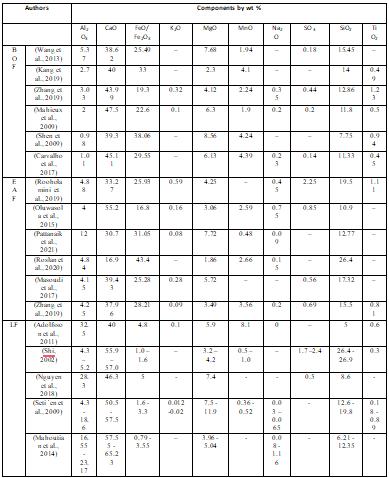
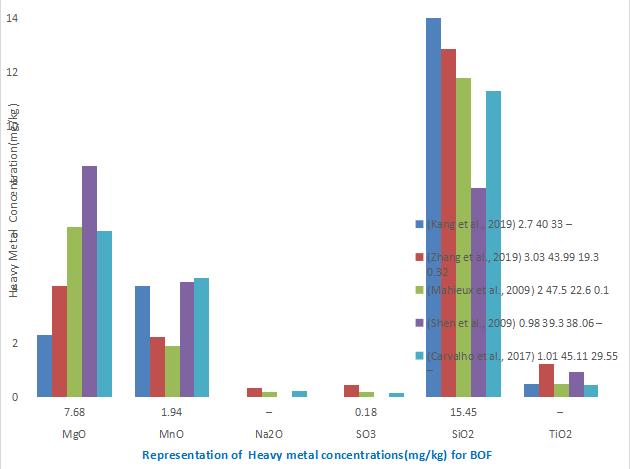
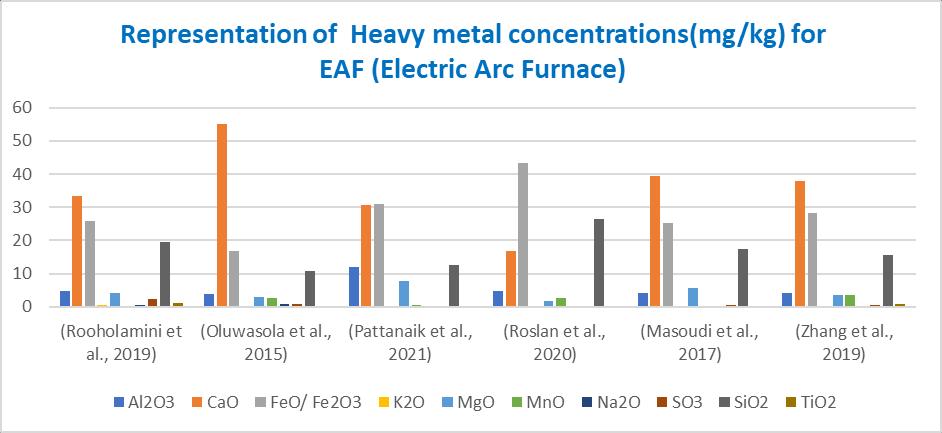
Table 1 provides an overview of the chemical compositions of BOF, EAF, and LF slags, while Fig. 2(a) presentsaBarChartillustratingthechemicalcompositions of steel slag. These slags typically exhibit high levels of calcium oxide and silicon dioxide, although variations in chemical composition arise depending on the production method.Comparingtheheavymetalconcentrationsacross BOF,EAF,andLF,weobservedistinctdifferences.TheBOF slag shows higher concentrations of chromium and lead comparedtoEAFandLFslags.Incontrast,theEAFslaghasa relativelylowerconcentrationofthesemetals,butitshows highercoppercontent.TheLFslag,whilegenerallylowerin metal concentrations, also contributes to the overall understanding of the variation in slag composition from differentfurnacetypes.Thesevariationshighlighttheneed fortailoredapproachesinhandlingandutilizingeachtypeof slagtomitigateenvironmentalimpactseffectively.
BarChart:Ferronickelslag.
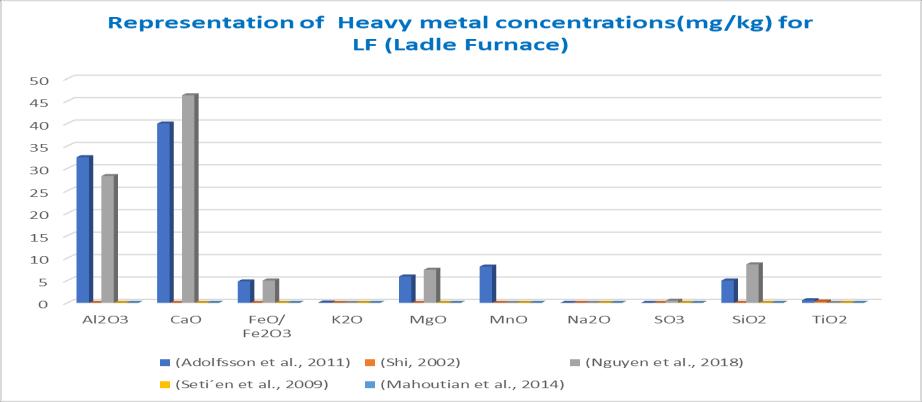
Figure-3: BarChart:Copperslag.
ThechemicalmakeupofEAFslagscanvaryduetotheuse of steel scraps as raw materials, which impacts the composition of the resulting slags. LF slags, on the other hand,typicallycontainloweramountsofironoxide(usually lessthanorequalto5%)comparedtoBOFandEAFslags, whilemaintainingrelativelyhighlevelsofcalciumoxideand silicondioxide.
International Research Journal of Engineering and Technology (IRJET) e-ISSN: 2395-0056
Volume: 11 Issue: 12 | Dec 2024 www.irjet.net p-ISSN: 2395-0072
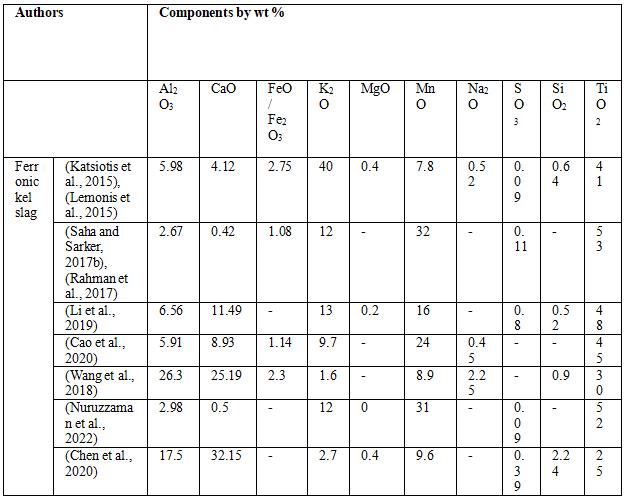
Table-2: Chemicalcomponentsofferronickelslag.
Additionally, slags derived from stainless steel byproductstendtohavelowerironoxidebut
Higher Silicon Dioxide content compared to those from carbonsteel(Adegoloyeetal.,2016).
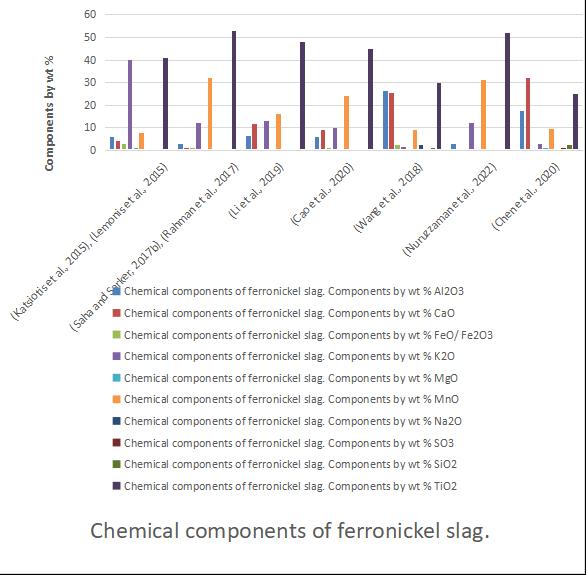
Figure-4: Chemicalcomponentsofferronickelslag.
Table 2 outlines the compositions of ferronickel slags, accompanied by a Bar Chart illustrating their chemical compositions in Fig. 2(b). Ferronickel slag primarily comprisesiron,magnesium,andsilicon,withsiliconbeingthe most abundant among these components. Due to its high silicon dioxide content and low calcium oxide content, ferronickel slag exhibits pozzolanic characteristics rather thanhydraulicones.
Thismakesitsuitableforuseasaclinkerreplacementin blendedcement,withitspozzolanicactivitycontributingto
theformationofsecondarycalciumsilicatehydrate(C-S-H) gel, thereby enhancing late-age strength development. Incorporatingferronickelslagassupplementarycementitious material can reduce the Ca/Si ratio of the C-S-H gel and enhancethepolymerizationofthesilicatechains(Huanget al., 2017). Occasionally, ferronickel slag may contain high levelsofmagnesium,suchasforsteriteandferroan,whichdo not affect the expansion of the mix (Rahman et al., 2017). According to Australian Standard 3582.2, the maximum allowable content of MgO in supplementary cementitious materialsshouldbelessthan15%(Standard,2016).
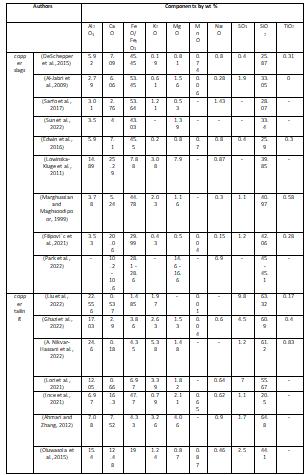
Copper slag exhibits high iron content and low calcium content, as evidenced by various studies (Al-Jabri et al., 2009; De Schepper et al., 2015; Edwin et al., 2016; MarghussianandMaghsoodipoor,1999;Sarfoetal.,2017; Sun et al., 2022). As shown in Table 3 and the ternary diagramsdepictingthechemicalcompositionsofcopperslag in Fig. 2(c), crystalline silica (SiO₂) constitutes the main componentbyweight,rangingfrom40%to75%.
Table-3: Chemicalcomponentsofcopperslagsandcopper tailing.
International Research Journal of Engineering and Technology (IRJET) e-ISSN: 2395-0056
Volume: 11 Issue: 12 | Dec 2024 www.irjet.net p-ISSN: 2395-0072
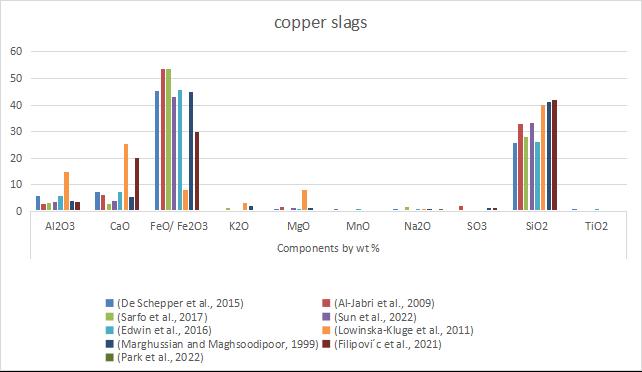
Figure-5: CopperSlags.
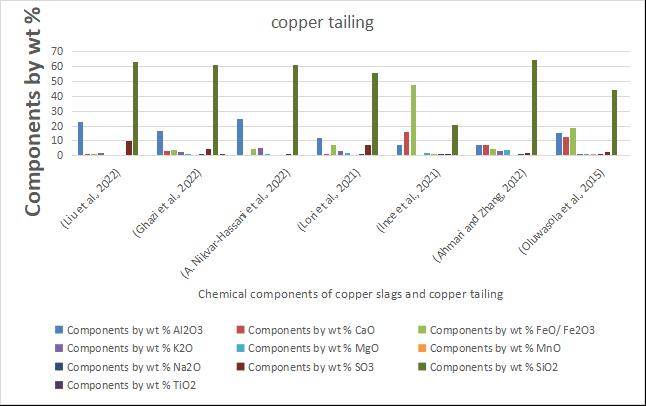
Figure-6: Coppertailing.
SecondarycomponentssuchasAl₂O₃andCaOtypically account for 10% to 20% of the weight, while metal oxide contentrangesfrom0%to20%.Sulphatesandalkalimetals likelithiumandsodiumarepresentinpercentagesranging from0%to5%.Theprimaryhealthconcernassociatedwith thesematerialsarisesfromtraceelements,includingcopper, arsenic,thorium,uranium,lead,andcadmium,eachgenerally presentinamountslessthan1%(EPA,2023b).However,due tothescaleofwaste,thesetoxicelementscanaccumulateto hazardouslevels.Thesignificantpresenceofcrystallinesilica andheavymetalsincreasestheriskofcancerafterprolonged exposureandinhalationofdust(HorwellandBaxter,2006).
4.MICROSTRUCTURE AND PERFORMANCE ANALYSIS
In materials science, understanding the structure of materials is crucial for assessing their performance, particularly for potential use in construction materials. Therefore, analyzing the microstructure of a material is essential. Researchers often utilize scanning electron microscopy(SEM)toexaminethematerial'smicrostructure (Aljerf, 2015). Furthermore, the distribution of porosity is evaluatedusingmercuryintrusionporosimetry(MIP).
All slags intended for use in cement production must comply with the specifications outlined in ASTM C989 (C989/C989M-18a, 2018). This standard establishes the
criteria necessary to meet minimum requirements for concreteormortarcontainingslag.Thesespecificationsare applicablewhenutilizingPortlandcement.Accordingtothe standard,slagcementmusthavesulphideandsulphurlevels below 2.5%, with particle sizes such that less than 20%is retainedona45-micronsieve.Additionally,itmandatesan air content of less than 12% and requires a Slag Activity Indexof95%at28days.
TheSlagCementAssociation(SCA)maintainsadatabaseof slag cement producers and provides various case studies, includingonefocusingontheSouthernBeltway,alimitedaccessroadinCanonsburg,PA,USA.Thisprojectcovereda nineteen-milestretchwithabudgetof$180million.Themix designutilizeda 40%slagcement replacementrateand a water-cementratioof0.42.Thismixturedesignachieveda 28-day compressive strength of 6700 psi (Association, 2022).
Whenobservingthemicrostructureofunagedsteelslagat theSEMlevel,itisnotedthatthesurfaceappearsroughwith numerous pores, some of which are filled with crystalline material (Li et al., 2022). This observation aligns with findingsfrommercuryintrusionporosimetry(MIP),which indicate that mortar-slag mixes exhibit a higher pore distributioncomparedtomortarwithoutslagafter28days (Hadj-sadoketal.,2011).Moreover,asmortarsageduring curing,theporedistributiontendstodecrease,althoughthe decrease is notsignificant. This increased porosityinsteel slagallowsittoabsorbmorebinderandwaterwhenusedas pavementmaterial(J.Liuetal.,2020;Renetal.,2021).
The presence of pores in steel slag results in a higher waterabsorptionrate,rangingfrom0.9%to2.5%,compared tobasaltandgranite,whichabsorbonly0.4%to0.7%and 0.5%to1.1%,respectively(KumarandVarma,2021).This increasedwaterabsorptionisattributedtothelargersurface areaofsteelslagcomparedtosmootheraggregatesofsimilar volume.Whilethislargersurfaceareacanenhancethebond betweenbinderandaggregate,itmayhaveadverseeffectson thestrengthandrigidityoftheresultingconcrete.
However, the crystalline nature of steel slag makes it stable and inert in concrete, which makes it a suitable replacementfornaturalfineaggregate.Studieshaveshown that incorporating steel slag as a replacement for natural sand can improve the compressive strength of mortar samplesdueto denseparticlepackingandhigherintrinsic hardness(Rashadetal.,2016;Tiwarietal.,2016).Steelslag typicallysharesasimilarorhigherspecificgravityasnatural sand, and its increased porosity results in higher water absorption as the proportion of steel slag in the mix increases.
Ingeneral,substitutingcoarseaggregatewithcoarsesteel slag enhances various mechanical properties such as
International Research Journal of Engineering and Technology (IRJET) e-ISSN: 2395-0056
Volume: 11 Issue: 12 | Dec 2024 www.irjet.net p-ISSN: 2395-0072
compressive strength, tensile strength, durability in chloride-exposedenvironments,andtheelasticmodulusofa mix (Faleschini et al., 2015). Utilizing steel slag as an aggregate leads to higher compressive strength, tensile strength,andmodulusofelasticitycomparedtoaggregates likecalcareous,dolomitic,andquartzitelimestone(Beshret al., 2003). Research has demonstrated that incorporating 50% or more steel slag aggregate, instead of natural aggregates, improves concrete durability and physical properties (Maslehuddin et al., 2003). Further studies support these findings, indicating that replacing 75% of natural aggregate with steel slag aggregate enhances the mechanical properties of the mix, with optimal strength achieved at a blend of 70% steel slag and 30% natural aggregate,balancingstrengthandcost-effectively(Asietal., 2007;Behiry,2013).
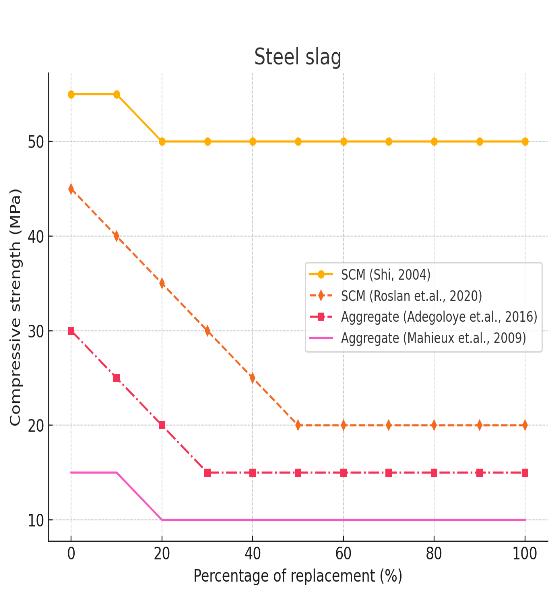
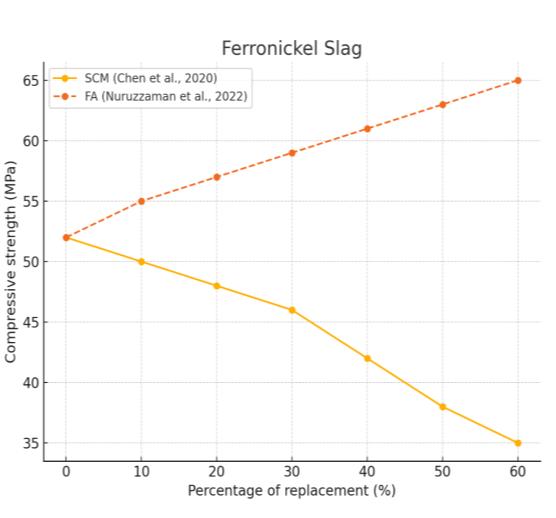
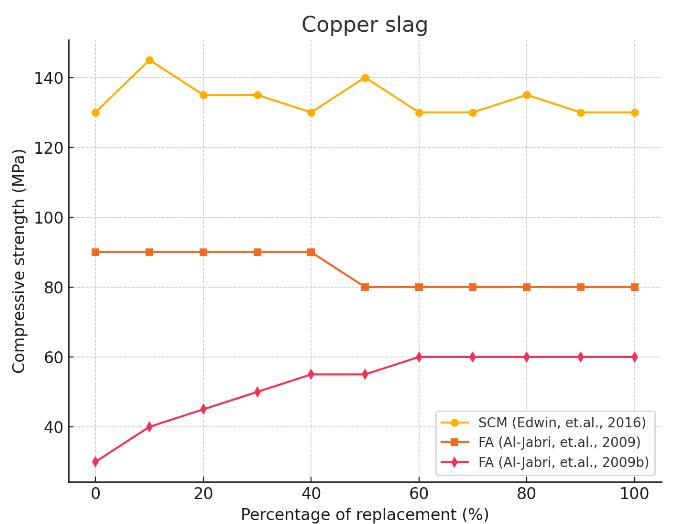
Figure-9: Copper
Compressivestrengthofmaterialsreplacedby:Fig7,Steel slag;Fig8FerronickelSlag;Fig9Copperslag.
Inmagnesiumphosphatecementapplications,theaddition of 5% and 10 % of steel slag by weight can increase compressivestrengthafteragingfor3to60days(Ruanet al., 2022). Additionally, mechanical characteristics and durabilityimprovewithincreasingquantitiesofsteelslagin flexiblepavementapplications(Behiry,2013).Studiesalso indicate that pavements incorporating steel slag exhibit outstanding performance in terms of skid resistance, moisturedamage,rutting,andfatigue(Kumarand Varma, 2021). Figure 3(a) illustrates the compressive strength of concreteat28dayswithaspecificwater-binderratiowhen steel slag is included as supplementary cementitious materialandaggregate.
Researchfindingsontheadvantagesofcarbonationcuring varywidely(Dongxueetal.,1997;Kangetal.,2020).Some studies indicate that with a constant water-binder ratio, increasing the proportion of steel slag results in higher permeabilitytochlorideions,reducedcompressivestrength, andnotablydiminishedcarbonation resistanceat28days (Dongxueetal.,1997;Wangetal.,2013).Conversely,other studies suggest that the carbonation process benefits constructionmaterialsincorporatingsteelslagbyenhancing low cementitious activity, reducing heavy metal leaching, and mitigating volume instability caused by expansive compoundssuchasCaO/MgO(Songetal.,2021;Wangetal., 2023).
Accelerated carbonation may offer environmental advantages; research indicates that 1 kg of steel slag can absorb0.25kgofCO₂(Huijgenetal.,2005).
AccordingtoTable1,bothBasicOxygenFurnace(BOF)and ElectricArcFurnace(EAF)steelslagsoftenexhibithighFeO content. This high FeO content, combined with the highly
International Research Journal of Engineering and Technology (IRJET) e-ISSN: 2395-0056
Volume: 11 Issue: 12 | Dec 2024 www.irjet.net p-ISSN: 2395-0072
crystallinenatureoftheslag,enhancesitsstabilitybutcan lead to chemical inactivity during the hydration process (Muhmood et al., 2009). Consequently, steel slags are commonlyusedasaggregateafteractivation.Toincreasethe reactivityofsteelslag,itcanbeutilizedasasupplementary cementitious material by undergoing a grinding process. Grinding the slag increases its specific surface area by creating surface defects and transforming its crystalline structure into an amorphous one. An example of ground steel slag retaining an amorphous nature is Ground GranulatedBlastFurnaceSlag(GGBFS).
Researchsuggeststhatthesteelslagcontentinamixshould notexceed50%of thetotal dryweight(J.Liuetal.,2020; Qasrawietal.,2009).However,it's importanttonotethat the high porosity of steel slag may result in low freezing resistance of the mix (Manso et al., 2006). Additionally, studieshaveshownthatincorporatingElectricArcFurnace (EAF)slaginmortarcandiminishitsstrengthbyreducing thebondqualitybetweenthecementpasteandaggregates. Thisreductionisattributedtothehighironoxidecontent andcrystallinityoftheslag,whichinducechemicalinactivity duringthehydrationprocess(Rooholaminietal.,2019).
Ferronickelslagperformssimilarlytonaturalaggregatesin high-strengthconcrete.Replacing50%oftheaggregatewith ferronickelslagenhancescompressivestrengthandmodulus of elasticity, increasing from 28 to 32 GPa. A 27% replacementalsoboostssulphateresistancebyupto22%. However,a 50%replacementreducesabrasionresistance and strength against chloride ion attack, although it still outperformsconcretewithoutferronickelslag.
Fig8illustratesthe28-daycompressivestrengthofconcrete with a specific water-binder ratio and ferronickel slag as supplementary cementitious material and fine aggregate. Table4comparesthe7-daycompressivestrengthofmortar containingferronickelslagwiththatcontainingElectricArc Furnace(EAF)slag.
Table-4: Comparisonofcompressivestrengthofconcrete withferronickelslagandelectric-arcfurnaceslag.
Comparison of compressive strength of concrete with ferronickel slag and electric-arc furnace slag.
Aggregates
Ferronickel slag mortar tends to exhibit higher compressive strength thanEAF slag mortar. Incorporating 50% ferronickel slag content into mortar improves compressive strength at 7 days and all curing ages, while 50%EAFslaginmortarcanlowercompressivestrengthat7 days(SahaandSarker,2017a;Rooholaminietal.,2019).
Inself-compactingconcrete,higherlevelsofferronickel slag (30% to 50%) increase compressive strength (Nuruzzaman et al., 2022) and improve chloride and corrosionresistance(Chenetal.,2020).Additionally,copper slagsenhanceworkabilityinhigh-performanceconcreteas theirproportionincreases(Al-Jabrietal.,2009;Edwinetal., 2016).
Ferronickel slag can replace natural fine aggregate partiallyduetoitslargerparticlesizecomparedtonatural sand.Itsamorphoussilicacontentmakesitreactive,leading to significant volume expansion when it reacts with free alkali in cement (Saha and Sarker, 2016). This expansion issuecanbemanagedbyusingsupplementarycementitious materialssuchasflyashtoreplaceaportionofthecement (Sahaetal.,2018).
Ferronickelslagisidealformortarduetoitsdenseparticle packing and lower fineness modulus. However, its higher ironoxidecontentpresentschallengesingrindingittoan optimal particle size for maximizing strength, which can increasecosts duetorequiringlargergrinding equipment (SahaandSarker,2016).Additionally,significantmagnesium oxidecontentmaydelaycompletehydration,extendingthe curingperiodtoseveralyears.
IrjetTemplatesampleparagraph.Defineabbreviationsand acronymsthefirsttimetheyareusedinthetext,evenafter theyhavebeendefinedintheabstract.Abbreviationssuchas IEEE,SI,MKS,CGS,sc,dc,andrmsdonothavetobedefined. Donotuseabbreviationsinthetitleorheadsunlesstheyare unavoidable.
Whenincorporatingindustrialby-productssuchassteel slags, it's critical to assess their environmental impact, especially regarding potential heavy metal content. These slags can leach heavy metals when exposed to rainwater, posing risks of soil and groundwater contamination in constructionapplications(Aljerf,2018a).
TheToxicityCharacteristicLeachingProcedure(TCLP), established by the US EPA, is widely used to assess heavy metalleachingfrommaterials(EPA,2009).Beforeadopting by-productsforlong-termuse,conductingtestslikeTCLPis crucial.Insteelslagasphaltconcretemixes,theTCLPtestis employedtodetectthepresenceofeightheavymetals.
International Research Journal of Engineering and Technology (IRJET) e-ISSN: 2395-0056
Volume: 11 Issue: 12 | Dec 2024 www.irjet.net p-ISSN: 2395-0072
(Hasitaetal.,2021).Additionally,testsareperformedto assessdifferentsteelslagsproducedviablastfurnaces(BF), basicoxygenfurnaces(BOF),andelectricarcfurnaces(EAF) (Proctoretal.,2000).Summaryfindingsfromvariousstudies arepresentedinTable5.
Based on the established criteria, heavy metals in pavement mixed with steel slag are below EPA limits, suggestingtheyaresuitableforuseinpublicareas.TheTCLP methodwithanaceticacidsolution(pH4)wasusedforthe leachingtest(Proctoretal.,2000).However,EPAstandards recommendfurthertestingatdifferentpHlevels(3,5.5,and 7–8)forcomprehensiveassessment(EPA,2009).
Theprimaryissuewiththechemicalmakeupofrawsteel slag is the risk of heavy metal leaching into groundwater. Once dissolved, these metals can spread through water pathways, posing a contamination risk to the local environment if not controlled. The TCLP test is typically employedtoassessthisrisk.Additionally,airpollutionmay occurduringboththeproductionandutilizationofslag.
According toan EPA report,the water-cooling process during slag production releases between 34 and 52 mg of particulatesperliterofquenchwaterused(Annamrajuetal., 1984).Regulationsbystateenvironmentalagenciesaddress concerns about off-gassing of hydrogen sulfide and sulfur dioxide.Usingsteelslaginsteadofgravelondirtroadsraises dust exposure concerns due to heavy traffic and wind, potentiallydispersingthemateriallocally(Kaceretal.,2023).
It'ssimilartosteelslagsusedinconstruction,ferronickel slagsmayalsoriskcontaminatingsoilandgroundwaterdue totheirheavymetalcontent,potentiallyleadingtoleaching (Xi et al., 2018). Raw ferronickel slag contains higher chromium levels compared to Portland cement, and chromiumcanleachunderhighlyalkalineconditions(Kimet al.,2019).
Researchfindingsindicatethatsubstitutingferronickel slagwith5%,10%,and30%replacementsdoesnotleadto leaching of chromium or other heavy metals (Kim et al., 2019). The study used Toxicity Characteristic Leaching Procedure (TCLP) tests recommended by the US EPA to assessconcentrationsofCr6+,Pb,Cu,As,Cd,andHg.
Anotherstudyfoundthatheavymetalconcentrationsin concretespecimensusingferronickelslagasareplacement for fine aggregates consistently remained below allowable limitssetbytheUSEPAandUKEnvironmentAgency(Saha and Sarker, 2017b). The study conducted leaching tests following the NEN 7345 standard from the Netherlands StandardizationInstitute.
Concretespecimensweremade,curedfor28days,andthen immersedinpurifiedwaterforanadditional64days,with
dissolvedheavymetalsmeasuredattheendoftheprocess (Katsiotisetal.,2015).Thesetestsconfirmtheenvironmental safetyofusingferronickelslaginconstruction.
SahaandSarker(2017b)reportedinTables5and6that leached heavy metal concentrations were well below hazardous waste and drinking water limits, indicating minimalleaching.
However, Katsiotis et al. (2015) found higher levels of chromiumandleadintheirspecimens,exceedingdrinking waterstandards,indicatingtheneedforcarefulconsideration beforeapplyingthesematerials.It'simportanttonotethat heavy metal content can vary based on the manufacturing process.
AspertheUSEPAandUKEnvironmentAgencystandards, ferronickelslagcanbeusedifitstaysbelowspecifiedlimits. Anothertest,replacing20%offerronickelslagandusingthe NEN7375monolithicleachingmethod,showedheavymetal concentrations below regulatory thresholds(Salman etal., 2016).
Therefore, ferronickel slag remains viable within hazardous limits. Overall, its use as a binder or aggregate demonstratesminimalheavymetalleachingandnegligible environmentalimpact(Sahaetal.,2018).
Tailingpondsposeasignificantriskofhazardouswasteto the environment, primarily through soil leaching and, occasionally,structuralfailuresinthecontainmentdamsif noteffectivelymanaged(Komljenovicetal.,2020).Research has observed elevatedlevels of heavy metals in farmlands near copper tailing ponds (Xiao et al., 2022). Health risks associatedwiththesemetalscanbeassessedusingguidelines such as the Technical Guidelines for Risk Assessment of Contaminated Sites and US EPA guidelines (EPA, 1990). These assessments provide indices indicating both carcinogenicandnon-carcinogenichazardsinthetestedsoil samples(Tengetal.,2015).
Theextensivesurfaceareaofloosetailingwastepromotes leaching of hazardous materials by solvents (Pehoiu et al., 2019).Tomitigatethis,tailingsarestoredinlargeopen-air ponds lined with impermeable barriers, preventing interaction with underlying soil and contaminated water. Keepingthewastesubmergedunderwaterhelpspreventthe dispersionofcontaminateddustbywind.Minesoftenusea seriesofpondsarrangedalongslopestofacilitatedownhill water flow (Cacciuttolo and Atencio, 2022). Operators managewaterlevelsbyadjustingfluidflowbetweenpondsto prevent overflow or dam breaches that could lead to surroundingareasbeingfloodedwithminingwaste.
Unlike tailings, copper slag is economically viable as a blastingaggregateorinconcreteproductionasapozzolanic
International Research Journal of Engineering and Technology (IRJET) e-ISSN: 2395-0056
Volume: 11 Issue: 12 | Dec 2024 www.irjet.net p-ISSN: 2395-0072
material (Phirietal.,2021).However,itposeshealthrisks such as long-term exposure to dust inhalation and the leachingofheavymetalsintotheenvironment(Mugfordet al.,2017).
RegulatorybodiessuchastheUnitedStatesOccupational Safety and Health Administration (OSHA) offer tables of personal exposure limits to guide manufacturers in maintainingsafelevelsofchemicalcomponentspresentin slag (Administration, 2021). Customizing these limits is crucial due to variations in slag's chemical composition acrossdifferentsites.
Leaching or weathering of copper slag and tailings can release toxic metals into the local environment around miningoperations,posingsignificantpollutionrisks(Punia, 2021). These risks escalate when stockpiles are exposed without proper pollution mitigation measures. To meet increasingmetaldemands,thereisagrowingtrendtoextract usable metals from slag materials for use as additives in concrete(Marinetal.,2022;Phirietal.,2022).
Using copper slags and tailings in concrete shows potential for sequestering harmful metals, as the cement matrixcancontainanyleachedmetalswithinthecomposite (AhmariandZhang,2012;Ghazietal.,2022;GoraiandJana, 2003;Inceetal.,2021;Wangetal.,2020).
Leachingtestsforcopperslagandcoppertailingswere carried out following the US EPA's Toxicity Characteristic LeachingProcedure(TCLP),detailedinTable5.Whileheavy metal levels in copper slag remained below US EPA thresholds (EPA, 2009), leaching from copper tailings exceededthesesafelimits.
The small particle size of copper tailings allows for increaseddustgenerationandprovidesalargesurfacearea formetalstoleachoutwhenexposedtowater.Storinglarge quantitiesofcoppertailingsposessignificantandlong-term environmentalrisks,aswellashighercosts.
This study provides a comprehensive review of steel slag, ferronickelslag,copperslag,andcoppertailings,examining their chemical composition, performance, and environmental aspects. These materials demonstrate potential as partial substitutes for cement and fine aggregatesinconcrete,enhancingmechanicalstrengthwhile effectivelytrappingheavymetalswithinthecomposite.
Reactivityiscrucialforutilizingwastematerialseffectively. Ferronickelslag,copperslag,andcoppertailingshavehigh SiO2content,facilitatingapozzolanicreactionwithcement to form a secondary calcium silicate hydrate. Steel slag, dominated by CaO, closely resembles Portland cement in composition.Allfourwastematerialsexaminedcanreplace
cement, though those with high crystallinity may require grindingtotransitionintoanamorphousphase.
Additionally,theseinertwastematerialscansubstitutefor both fine and coarse aggregates. Incorporating them at specified levels has been found to enhance mechanical strengthanddurabilityinconcreteapplications.
Construction materials containing various types of steel slags (BF, BOF, and EAF), ferronickel slag, or copper slag havebeenfoundenvironmentallysafeinleachingtests,with leached toxic elements below US EPA limits. However, leaching from copper tailings has exceeded safe limits, emphasizingtheneedforcarefulmaterialmanagement.
Tomitigateenvironmentalandhealthimpacts,tailingsare storedinlargeopen-airponds.Studyingthedegradationof these wastes can identify suitable legacy storage sites for material extraction. Many mining or refining wastes are highly toxic and pose storage challenges without clear economic uses. Hence, research should prioritize characterizing and utilizing these wastes to reduce their environmentalandeconomicburdens.
Future research could focus on how weathering and degradation affect the pozzolanic activity of slag and mill tails stored long-term. Additionally, conducting a comprehensive life cycle assessment (LCA) to compare greenhouse gas emissions from the four waste products studied would provide valuable insights into their environmental impact and support informed decisionmakingontheirutilization.
[1] Adegoloye, G., Beaucour, A.L., Ortola, S., Noumowe, A., 2016. Mineralogical composition of EAF slag and stabilizedAODslagaggregatesanddimensionalstability of slag aggregate concretes. Construction and Build. Mater. 115, 171–178. https://doi.org/10.1016/j.conbuildmat.2016.04.036.
[2] Administration, O.S.H., 2021. Permissible exposure limitshttps://www.osha.gov/annotated-pels/table-z-2 Adolfsson,D.,Robinson,R.,Engstro¨m,F.,Bjo¨rkman,B., 2011. Influence of mineralogy on the hydraulic properties of ladle slag. Cement and Concrete Res. 41 (8), 865–871. https://doi.org/10.1016/j.cemconres.2011.04.003.
[3] Ahmari,S.,Zhang, L.,2012. Productionofeco-friendly bricks from copper mine tailings through geopolymerization.ConstructionandBuild.Mater.29, 323–331. https:// doi.org/10.1016/j.conbuildmat.2011.10.048.
[4] Aljerf,L.,2015.Effectofthermal-curedhydrauliccement admixtures on the mechanical properties of concrete.
International Research Journal of Engineering and Technology (IRJET) e-ISSN: 2395-0056
Volume: 11 Issue: 12 | Dec 2024 www.irjet.net p-ISSN: 2395-0072
Interceram-Int. Ceramic Rev. 64, 346–356. https://doi.org/10.1007/BF03401142.
[5] Aljerf,L.,2016.Reductionofgasemissionresultingfrom thermal ceramic manufacturing processes through developmentofindustrialconditions.Sci.J.KingFaisal Univ.17(1),1–10.
[6] Aljerf, L., 2018a. Advanced highly polluted rainwater treatmentprocess.J.UrbanandEnviron.Eng.12(1).
[7] Aljerf,L.,2018b.Dataofthematicanalysisoffarmer ׳s use behavior of recycled industrial wastewater. Data Brief 21, 240–250. https://doi.org/10.1016/j. dib.2018.09.125.
[8] Andrew,R.M.,2018.GlobalCO2emissionsfromcement production. Earth Syst. Sci.Data 10 (1), 195–217. https://doi.org/10.5194/essd-10-195-2018.
[9] Association, W.S., .2021. 2021 world steel in figures. https://worldsteel.org/wp-content/ uploads/2021World-Steel-in-Figures.pdf.
[10] Behiry, A.E.A.E.M., 2013. Evaluation of steel slag and crushed limestone mixtures as subbase material in flexible pavement. Ain Shams Eng. J. 4 (1), 43–53. https://doi.org/10.1016/j.asej.2012.07.006.
[11] Beshr,H.,Almusallam,A.,Maslehuddin,M.,2003.Effect ofcoarseaggregatequalityonthemechanicalproperties ofhighstrengthconcrete.ConstructionandBuild.Mater. 17 (2), 97–103. https://doi.org/10.1016/S09500618(02)00097-1.
[12] Cacciuttolo, C., Atencio, E., 2022. Past, Present, and future of copper mine tailings governance in Chile (1905–2022): a review in one of the leading mining countriesintheworld.Int.J.Environ.Res.PublicHealth 19 (20), 13060. https://doi.org/10.3390/ijerph192013060.
[13] Chen, Y., Ji, T., Yang, Z., Zhan, W., Zhang, Y., 2020. Sustainable use of ferronickel slag in cementitious composites and the effect on chloride penetration resistance.
[14] Crundwell,F.,Moats,M.,Ramachandran,V.,Robinson,T., Davenport,W.G.,2011.ExtractiveMetallurgyofNickel, CobaltandPlatinumGroupMetals.Elsevier.
[15] .DeSchepper,M.,Verl´e,P.,VanDriessche,I.,DeBelie,N., 2015.Use ofsecondaryslagsincompletelyrecyclable concrete. J. Mater. Civil Eng. 27 (5), 04014177 https://doi. org/10.1061/(ASCE)MT.19435533.0001133.
[17] Diaz, C., Landolt, C., Vahed, A., Warner, A., Taylor, J., 1988.Areviewofnickelpyrometallurgicaloperations. JOM 40 (9), 28–33. https://doi.org/10.1007/ BF03258548.
[18] Dongxue,L.,Xinhua,F.,Xuequan,W.,Mingshu,T.,1997. Durability study of steel slag cement. Cement and Concrete Res. 27 (7), 983–987. https://doi.org/10.1016/S0008-8846(97)00084-7.
[19] Edwin,R.S.,DeSchepper,M.,Gruyaert,E.,DeBelie,N., 2016.Effect ofsecondary copperslagascementitious materialinultra-high-performancemortar.Construction and Build. Mater. 119, 31–44. https://doi.org/10.1016/j.conbuildmat.2016.05.007.
[20] EPA,U.,1990.Reporttocongressonspecialwastesfrom mineral processing: summary and findings methods. https://www.epa.gov/sites/default/files/2015-05/docu ments/10001aze.pdf.
[21] EPA, U., 2009. Hazardous waste characteristics https://www.epa.gov/sites/default/ files/201601/documents/hw-char.pdf.
[22] EPA, U., 2019. National primary drinking water regulations. https://www.epa.gov/site s/default/files/201606/documents/npwdr_complete_table.pdf.
[23] Faleschini, F., Fern´andez-Ruíz, M.A., Zanini, M.A., Brunelli,K.,Pellegrino,C.,Hern´andez-Montes,E.,2015. Highperformanceconcretewithelectricarcfurnaceslag as aggregate: mechanical and durability properties. ConstructionandBuild.
[24] Ghazi, A.B., Jamshidi-Zanjani, A., Nejati, H., 2022. Utilization of copper mine tailings as a partial substitute for cement in concrete construction. ConstructionandBuild.
[25] Mater. 317, 125921 https://doi.org/10.1016/j.conbuildmat.2021.125921.
[26] Gorai,B.,Jana,R.,2003.Characteristicsandutilisationof copperslag
[27] Hadj-sadok,A.,Kenai,S.,Courard,L.,Darimont,A.,2011. Microstructureanddurabilityofmortarsmodifiedwith medium active blast furnace slag. Construction and Build.
[28] Mater. 25 (2), 1018–1025. https://doi.org/10.1016/j.conbuildmat.2010.06.077.
[16] DiMaria,A.,Salman,M.,Dubois,M.,VanAcker,K.,2018. Life cycle assessment to evaluate the environmental performance of new construction material from stainless steel slag. Int. J. Life Cycle Assess 23, 2091–2109.https://doi.org/10.1007/s11367-018-1440-1.
2024, IRJET | Impact Factor value: 8.315 | ISO 9001:2008
International Research Journal of Engineering and Technology (IRJET) e-ISSN: 2395-0056
Volume: 11 Issue: 12 | Dec 2024 www.irjet.net p-ISSN: 2395-0072
Hasita, S., Hoy, M., Suddeepong, A., Horpibulsuk, S., Yeanyong,C.,Arulrajah,A.,
[29] Huijgen,W.J.,Witkamp,G.J.,Comans,R.N.,2005.Mineral CO2 sequestration by steel slag carbonation. Environ. Sci. Technol. 39 (24), 9676–9682. https://doi.org/ 10.1021/es050795f.
[30] ICMM., 2019. Tailings reduction roadmap. https://www.icmm.com/en-gb/guidan ce/innovation/2022/tailings-reduction-roadmap.Ince, C., Derogar, S., Gurkaya, K., Ball,R.J., 2021. Properties, durability and cost efficiency of cement and hydrated lime mortars reusing copper mine tailings of LefkeXeros in Cyprus. Construction and Build. Mater. 268, 121070 https://doi.org/ 10.1016/j.conbuildmat.2020.121070.
[31] Katsiotis,N.,Tsakiridis,P.,Velissariou,D.,Katsiotis,M., Alhassan, S., Beazi, M., 2015. Utilization of ferronickel slagasadditiveinPortlandcement:ahydrationleaching study. Waste and Biomass Valorization 6, 177–189. https://doi.org/10.1007/s12649-015-9346-7.
[32] Komljenovic, D., Stojanovic, L., Malbasic, V., Lukic, A., 2020. A resilience-based approach in managing the closureandabandonmentoflargeminetailingponds. Int.
[33] Kumar, H., Varma, S., 2021. A review on utilization of steel slag in hot mix asphalt. Int. J. Pavement Res. Technol.14,232–242.https://doi.org/10.1007/s42947020-0025-0.
[34] Lehmann,J.,Nadif,M.,2011.Interactionsbetweenmetal and slag melts: steel desulfurization. Rev. Mineral. Geochem. 73 (1), 493–511. https://doi.org/10.2138/ rmg.2011.73.15.
[35] Li,B.,Huo,B.,Cao,R.,Wang,S.,Zhang,Y.,2019.Sulfate resistance of steam cured ferronickel slag blended cementmortar.CementandConcreteCompos.96,204–211. https://doi.org/10.1016/j.cemconcomp.2018.12.001.
[36] Li, C., Sun, H., Li, L., 2010. A review: the comparison betweenalkali-activatedslag(SiCa)andmetakaolin(Si Al) cements. Cement and Concrete Res. 40 (9), 1341–1349.
https://doi.org/10.1016/j.cemconres.2010.03.020.
[37] Li,Q.,Li,B.,Li,X.,He,Z.,Zhang,P.,2022.Microstructure ofpretreatedsteelslaganditsinfluenceonmechanical properties of cement stabilized mixture. Construction and Build. Mater. 317, 125799 https://doi.org/10.1016/j.conbuildmat.2021.125799.
[38] Liu,J.,Yu,B.,Wang,Q.,2020a.Applicationofsteelslagin cement treated aggregate base course. J. Clean. Prod.
269, 121733 https://doi.org/10.1016/j. jclepro.2020.121733.
[39] Liu,J.,Zhou,R.,Yu,J.,Guo,L.,Li,X.,Xiao,C.,Hou,H.,Chi, R.,Feng,G.,2022.
[40] Ma, X., Yang, D., Zhai, Y., Shen, X., Zhang, R., Hong, J., 2019.Cost-combinedlifecycleassessmentofferronickel production. Int. J. Life Cycle Assess. 24, 1840–1850. https://doi.org/10.1007/s11367-019-01600-2.
[41] Manso, J.M., Polanco, J.A., Losan˜ez, M., Gonza´lez, J.J., 2006. Durability of concrete made with EAF slag as aggregate.CementandConcreteCompos.28(6),528–534. https://doi.org/10.1016/j.cemconcomp.2006.02.008.
[42] Maslehuddin,M.,Sharif,A.M.,Shameem,M.,Ibrahim,M., Barry,M.,2003.Comparisonofpropertiesofsteelslag and crushed limestone aggregate concretes. Construction and Build. Mater. 17 (2), 105–112. https://doi.org/10.1016/S0950-0618(02)00095-8.
[43] Proctor,D.,Fehling,K.,Shay,E.,Wittenborn,J.,Green,J., Avent,C.,Bigham,R.,Connolly,M.,Lee,B.,Shepker,T., 2000. Physical and chemical characteristics of blast furnace,basicoxygenfurnace,andelectricarcfurnace steelindustryslags.Environ.Sci.Technol.34(8),1576–1582.https://doi.org/10.1021/es9906002.
[44] Punia, A., 2021. Role of temperature, wind, and precipitation in heavy metal contamination at copper mines:areview.Environ.Sci.Pollut.Res.28(4),4056–4072.https://doi.org/10.1007/s11356-020-11580-8.
[45] Rashad, A.M., Sadek, D.M., Hassan, H.A., 2016. An investigationonblast-furnacestagasfineaggregatein alkali-activated slag mortars subjected to elevated temperatures. J. Clean. Prod. 112, 1086–1096. https://doi.org/10.1016/j.jclepro.2015.07.127.
[46] Rieger, J., Colla, V., Matino, I., Branca, T.A., Stubbe, G., Panizza, A., Brondi, C., Falsafi, M., Hage, J., Wang, X., 2021. Residue valorization in the iron and steel industries:sustainablesolutionsforacleanerandmore competitive future Europe. Metals 11 (8), 1202. https://doi.org/10.3390/met11081202.
[47] Rooholamini,H.,Sedghi,R.,Ghobadipour,B.,Adresi,M., 2019. Effect of electric arc furnace steel slag on the mechanicalandfracturepropertiesofroller-compacted concrete. Construction and Build. Mater. 211, 88–98. https://doi.org/10.1016/j.conbuildmat.2019.03.223.
[48] Rosales, J., Cabrera, M., Agrela, F., 2017. Effect of stainlesssteelslagwasteasareplacementforcementin mortars.Mechanicalandstatisticalstudy.Construction and Build. Mater. 142, 444–458. https://doi.org/10.1016/j.conbuildmat.2017.03.082.
International Research Journal of Engineering and Technology (IRJET) e-ISSN: 2395-0056
Volume: 11 Issue: 12 | Dec 2024 www.irjet.net p-ISSN: 2395-0072
[49] Roslan,N.H.,Ismail,M.,Khalid,N.H.A.,Muhammad,B., 2020. Properties of concrete containing electric arc furnace steel slag and steel sludge. J. Build. Eng. 28, 101060https://doi.org/10.1016/j.jobe.2019.101060.
[50] Ruan,W.,Ma,Y.,Liao,J.,Ma,T.,Zhu,Y.,Zhou,A.,2022. Effects of steel slag on the microstructure and mechanicalpropertiesofmagnesiumphosphatecement. J. Build. Eng. 49, 104120 https://doi.org/10.1016/j.jobe.2022.104120
[51] Teng, Y., Li, J., Wu, J., Lu, S., Wang, Y., Chen, H., 2015. Environmental distribution and associated human health risk due to trace elements and organic compoundsinsoilin
[52] Worrell,E.,Price,L.,Martin,N.,Hendriks,C.,Meida,L.O., 2001.Carbondioxideemissionsfromtheglobalcement industry. Annual Rev.EnergyandtheEnviron.26(1), 303–329. https://doi.org/10.1146/annurev.energy.26.1.303.
[53] Yildirim,I.Z.,Prezzi,M.,2011.Chemical,mineralogical, and morphological properties of steel slag. Adv. Civil Eng.2011https://doi.org/10.1155/2011/463638.
[54] Al-Jabri,K.S.,Hisada,M.,Al-Oraimi,S.K.,&Al-Saidy,A. H. (2009). Copper slag as sand replacement for high performance concrete. Cement and concrete composites, 31(7),483-488.
[55] Huang,Y.,Wang,Q.,&Shi,M.(2017).Characteristicsand reactivityofferronickelslagpowder. Construction and Building Materials, 156,773-789.
[56] Kang,S.H.,Kwon,Y.H.,&Moon,J.(2020).Controlling thehydrationandcarbonationinlime-basedmaterials: Advantage of slow carbonation in CO2 curable construction materials. Construction and Building Materials, 249,118749.
[57] Wang,Y.S.,Ishak,S.,Zhang,G.Z.,&Wang,X.Y.(2024). Carbonation curing behavior and performance improvementofrecycledcoralwasteconcrete. Journal of Building Engineering, 90,109473.
[58] Song, B., Shi, C., Hu, X., Ouyang, K., Ding, Y., & Ke, G. (2021). Effect of early CO2 curing on the chloride transport and binding behaviors of fly ash-blended Portland cement. Construction and Building Materials, 288,123113.
[59] Muhmood, L., Vitta, S., & Venkateswaran, D. (2009). Cementitious and pozzolanic behavior of electric arc furnacesteelslags. CementandConcreteResearch, 39(2), 102-109.
[60] Kim, H., Lee, C. H., & Ann, K. Y. (2019). Feasibility of ferronickel slag powder for cementitious binder in
concretemix. Construction and Building Materials, 207, 693-705.
[61] Saha, A. K., & Sarker, P. K. (2017). Sustainable use of ferronickelslagfineaggregateandflyashinstructural concrete: Mechanical properties and leaching study. Journal of cleaner production, 162,438-448.
[62] Rooholamini,H.,Sedghi,R.,Ghobadipour,B.,&Adresi,M. (2019). Effect of electric arc furnace steel slag on the mechanicalandfracturepropertiesofroller-compacted concrete. Construction and building materials, 211,8898.
[63] Saha,A.K.,Khan,M.N.N.,&Sarker,P.K.(2018).Value added utilization of by-product electric furnace ferronickel slag as construction materials: A review. Resources, Conservation and Recycling, 134,1024.
[64] Komljenović, M., Tanasijević, G., Džunuzović, N., & Provis,J.L.(2020).Immobilizationofcesiumwithalkaliactivated blast furnace slag. Journal of hazardous materials, 388,121765.
[65] Oluwasola,E.A.,Hainin,M.R.,&Aziz,M.M.A.(2015). Evaluationofasphaltmixturesincorporatingelectricarc furnace steel slag and copper mine tailings for road construction. Transportation Geotechnics, 2,47-55.
[66] Nikvar-Hassani, A., Hodges, R., & Zhang, L. (2022). Production of green bricks from low-reactive copper mine tailings: Durability and environmental aspects. ConstructionandBuildingMaterials, 337,1275.