
International Research Journal of Engineering and Technology (IRJET) e-ISSN: 2395-0056
Volume: 11 Issue: 12 | Dec 2024 www.irjet.net p-ISSN: 2395-0072

International Research Journal of Engineering and Technology (IRJET) e-ISSN: 2395-0056
Volume: 11 Issue: 12 | Dec 2024 www.irjet.net p-ISSN: 2395-0072
Shreyas H B1 , Siddesh T S2 , Udaya A S3 , Sooraj Kumar N R4
1234Bachelor of Engineering, Information Science and Engineering, Bapuji Institute of Engineering and Technology, Davangere, affiliated to VTU Belagavi, Karnataka, India.
Abstract-Technologyhascompletelytransformedevery elementoflifeinthemoderndigitalage,includingeducation. Enterpriseresourceplanning(ERP)systemsarebeingused more frequently byhigher education institutions tohandle theiradministrativeandacademictasks.Thisstudyaimsto assess how well college ERP systems contribute to higher education institutions' increased productivity and effectiveness.Thestudyemploysamixed-methodsapproach and includes interviews with important stakeholders in addition to a survey ofstudents, teachers, and staff. The study's findings demonstrate that college ERP systems significantly increase the efficacy and efficiency of higher education institutions. Improvements are made in several areas as a result of the implementation of ERP systems, includingstudent enrollment,coursescheduling,academic record-keeping,andfinancialadministration.Thestudyalso shows that using ERP systems enhances stakeholder engagement and communication, which enhances overall institutional performance and decision-making. The study does, however, also point out a number of difficulties that organizationshaveinutilizinganddeployingERPsystems. These difficulties include technical difficulties, a lack of education, opposition to change, and worries about data security.Accordingtothereport,collegesshoulddeployERP systems thoroughly, particularly by offering sufficient trainingandassistance,respondingquicklytotechnological problems,andmaintainingdatasecurity.Overall,thestudy comestotheconclusionthatcollegeERPsystemsareauseful tool for overseeing academic and administrative tasks in higher education establishments. However, a number of factors,suchasgoodimplementation,enoughtraining,and resolvingtechnicalandsecurityissues,affecthoweffective theyare.
Key Words: College ERP System, Higher Education Institutions, Efficiency, Effectiveness, Implementation, Challenges.
Technologyhascompletelytransformedeverypartofour livesinthecurrentdigitalera,andeducationisnoexception. Enterprise resource planning (ERP) systems are being adoptedbymoreandmorehighereducationinstitutionsto manage and streamline their administrative and academic tasks. From student enrollment and course scheduling to academicrecord-keepingandfinancialadministration,these
sophisticated systems provide a thorough and integrated approachtomanagingmanyelementsofcollegeoperations. Bycentralizingdataandautomatingprocesses,ERPsystems give colleges a powerful tool to streamline operations, increaseefficiency,andmakeinformeddecisionsbasedon accurate and real-time information. Additionally, ERP systems facilitate better communication and collaboration amongstakeholders,includingadministrators,and faculty. This study's goal is to evaluate how college ERP systems affect the efficiency and productivity of higher education institutions.Weintendtogeta thoroughunderstandingof theadvantagesandchallengesconnectedwiththeadoption andutilizationofERPsystemsinthecollegecontextbyusing a mixed-methods approach thatcombines interviews with keystakeholdersandasurveyofstudents,teachers,andstaff. The results of this study, which focused primarily on ERP systemsinhighereducationinstitutions,willaddtothebody ofknowledgealreadyavailableontheuseoftechnologyin education. We will also look at how ERP systems affect communication, decision-making, and stakeholder engagement. This study will also provide light on the difficultiescollegesexperienceinimplementingandutilizing ERP systems. The challenges that institutions may face include technical issues, opposition to change, a lack of knowledge,andworriesaboutdatasecurity.Wecanprovide suggestions and tactics for effective ERP adoption by addressingtheseissues,suchaspropertrainingandsupport, quicktechnicalassistance,andstrongdatasecuritymeasures.
Highereducationisjustoneofseveralsectors,including other ones, where enterprise resource planning (ERP) solutions are becoming more and more common. Higher education institutions use ERP systems to streamline operations,enhanceoverallinstitutional performance,and enhance administrative and academic procedures. The followingreviewoftheliteratureoffersanoverviewofthe studies on college ERP systems with an emphasis on the advantagesanddifficultiesoftheiradoptionanduse.
1. Numerous studies have shown how college ERP systems can improve institutional performance and productivity.
International Research Journal of Engineering and Technology (IRJET) e-ISSN: 2395-0056
Volume: 11 Issue: 12 | Dec 2024 www.irjet.net p-ISSN: 2395-0072
2. Inhighereducationinstitutions,theuseofERPsystems improved efficiency in student enrollment, course scheduling,andacademicrecord-keeping,leadingtobetter student outcomes and higher teacher satisfaction, accordingtoastudybyBandyopadhyayandGupta(2017).
3. Additionally, ERP systems improved interaction and cooperation amongst all parties, including employees, instructors,andstudents.
4. AlqarniandAlotaibi(2020)lookedattheeffectofERP systems on financial management in higher education institutionsinadifferentstudy.
5. The study discovered that ERP systems enhanced financialreporting,budgeting,andforecasting, resultingin better financial outcomes for the institution and more informedfinancialdecision-making.
1. Despite the advantages of college ERP systems, their deploymentandusemaypresentanumberofdifficulties.
2. The adoption of ERP systems by higher education institutionswashamperedbytechnicalissues,reluctance tochange,andalackofknowledge,accordingtoastudyby Dasetal.(2019).
3. The study emphasized the significance of providing stakeholders with sufficient training and assistance to guaranteetheeffectiveintegrationanduseofERPsystems ininstitutions.
4. Furthermore, while adopting ERP systems, higher educationinstitutionsmayfacedifficultiesduetoworries aboutdatasecurityandprivacy.
5. institutionsandemphasizedthesignificanceofputting strong data security measures in place and making sure that compliance with relevant rules and standards is maintained.
Overall,theresearchindicatesthatcollegeERPsystems provide higher education institutions with numerous advantages, from greater stakeholder engagement and communication to improved administrative and academic procedures.However,issuesincludingtechnicaldifficulties, reluctancetochange,alack ofknowledge,andworriesabout data security could appear throughout their adoption and utilization.Toaddresstheseissues,itisnecessarytodevelop strong data security measures, ensure compliance with pertinentlawsandstandards,andprovidestakeholderswith propertrainingandassistance.
WhileERPsystemsforcollegeshavemanyadvantages, they also have drawbacks that could reduce their overall performance.Wewilltalkaboutafewofthedrawbacksof collegeERPsystemsthathavebeennotedintheliteraturein thispart.
1. HighImplementationandMaintenanceExpenses:One of the biggest drawbacks of college ERP systems is the highexpensesassociated withtheirimplementationand upkeep.Highereducationinstitutions,especially smaller oneswithfewerresources,mayincursignificantcostsfor purchasing,implementing,andmaintaininganERPsystem. Due of this, it could be difficult for some institutions to demonstratetheROIofputtinganERPsysteminplace.
2. Limited Customization: College ERP systems are created to satisfy the requirements of different higher educationinstitutions.However,someinstitutionsmight haveparticularneeds thatspecializedERPsolution.
3. Resistance to Change: When implementing ERP systems, higher education institutions frequently run againstresistancetochange.Theadoptionanduseofthe system may be slow due to stakeholders' resistance to changesintheirworkingpractices,notablyamongfaculty members and staff. This may reduce the ERP system's efficiencyandlimittheadvantagesitcanprovide.
4. ComplexIntegration:ERPsystemsmustbeintegrated withanumberofothersystemsthatarealreadyinplace, suchasstudentinformationsystems,learningmanagement systems,andfinancesystems. Theintegrationprocesscan be difficult, demanding a lot of time and money, and sometimesleadingtocompatibilityproblems.
5. DataSecurityandPrivacyIssues:CollegeERPsystems gatherandretainprivatedata,suchasstudentinformation, financial data, and employee records. Data security and privacy are raised as a result, especially in light of the growing threat of cyberattacks. To protect sensitive informationandadheretoapplicablelawsandstandards, institutionsmustestablishstrongdatasecurityprocedures.
There are a number of suggested remedies that have surfacedintheliteratureasaresponsetotheshortcomings ofcollegeERPsystems.Thechallengesandshortcomingsof conventionalERPsystemsareintendedtobeaddressedby thesesuggestedsystems,whichalsoaimtoprovidehigher education institutions with more specialized and efficient solutions. We will talk about a few of the ERP systems for collegesinthispart.
1. ERP systems that are cloud-based: These systems provide higher education institutions with a more
International Research Journal of Engineering and Technology (IRJET) e-ISSN: 2395-0056
Volume: 11 Issue: 12 | Dec 2024 www.irjet.net p-ISSN: 2395-0072
affordable and adaptable option. These systems don't requirepriceyhardwareorinfrastructurebecausetheyare hostedondistantserversandaccessedonline.Cloud-based ERPsolutionsareagoodoptionforinstitutionsofallsizes sincetheyprovidemorecustomizationandscalingoptions.
2. Modular ERP: Institutions can deploy particular modules depending on their individual needs using modularERPsystems.Withadditionalcustomizationand flexibility, this method enables institutions to select the modules that best suit their unique requirements. This strategy also enables organizations to progressively expandtheuseoftheirERPsystem,loweringtheexpense andcomplexityofdeployment.
3. Open-source ERP: Open-source ERP systems are collaborative,community-driven,andcost-freesoftware. Thecodeofthesesystemscanbemodifiedbyinstitutions to suit their unique requirements. Since the code is available for public review and inspection, open-source ERPsystemsalsoprovidemoretransparencyandsecurity.
4. Mobile ERP: Open-source ERP systems are collaborative,community-driven,andcost-freesoftware. Thecodeofthesesystemscanbemodifiedbyinstitutions to suit their unique requirements. Since the code is available for public review and inspection, open-source ERPsystemsalsoprovidemoretransparencyandsecurity.
5. Blockchain-based ERP: ERP solutions built on blockchain technology provide increased security and transparencybyutilizingblockchaintechnologystore.
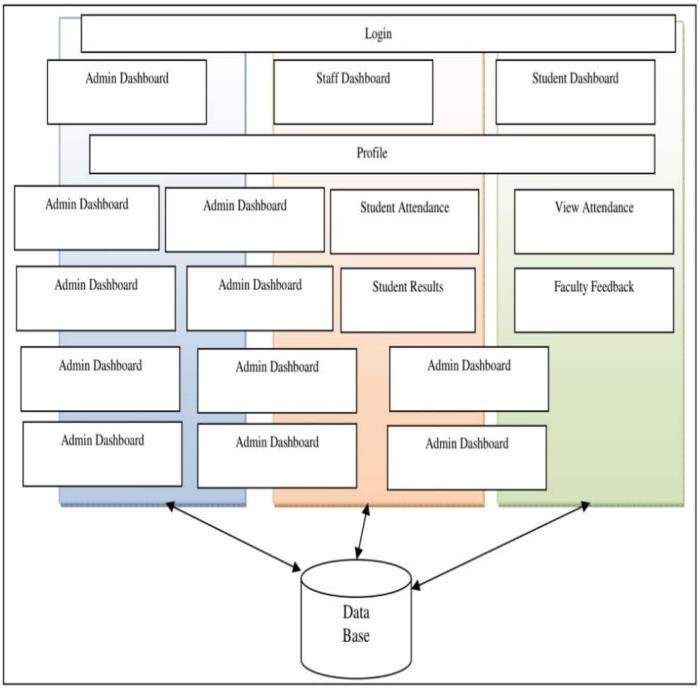
V.SYSTEM OVERVIEW
Onthisproject,variousDesignconceptsandprocedures wereused.Thesoftwareisbrokenupintodistinctmodules
that are each functionally separate and use information concealment, following ideas like separation of concerns. The program is organized into three modules: administrators,teachers,andstudents.We'llexamineeach moduleinfurtherdetail.
Every student is a part of a class with a semester and section. Each class is allocated a department and a set of courses.Asaresult,allmembersofthatclassmusttakethese courses.Aspecialusernameandpasswordareprovidedto thepupilstologin.Theywillallhavedifferentperspectives. Theseviewpointsaredescribedbelow.
i) StudentInformation:Onlythestudent'sownpersonal dataisvisibletootherstudents.Thisincludestheircontact information, such as name, phone number, and address. Additionally, users may check the courses they are registeredforaswellastheattendanceandgradesforeach one.
ii) Attendanceinformation:Eachcourse'sattendancewill be shown. This covers the number of classes that were attendedaswellastheattendancerate.Iftheattendance rate falls under a predetermined cutoff, let's say 75%, it will be marked in red; otherwise, it will be in green. For each course, there will also be a day-by-day attendance viewthatdisplaysthetimeandstatus.Acalendarwillbe usedtopresentthis.
iii)Marks information: For each course, there will be 5 events and 1 semester-ending test. The ERP system will offerthegradesforeachofthese.
iv)Notificationsandevents:Everystudentmustcomplete thissection.Notificationsareannouncementsmadebythe administrator, such as test schedules and holiday declarations. Here, the specifics of the occurrences are listed.
Eachteacherispartofadepartmentandisgivenclasses thatcorrespondtoaparticularcourse.Teacherswillalsobe provided with a username and password. Below are descriptionsofthevariousperspectivesforteachers.
i) Information: The information about the courses and classes they are assigned to will be available to the teachers. Thecredits and thesyllabus planaredetails of hecourses.Thedepartment, semester,section,andalist of the students enrolled in each class are among the informationabouttheclass.Informationonstudentsinthe same class as the teacher will also be available to the teacher.
ii) Attendance: The attendance of each student may be added to and modified by the teacher. They will be
International Research Journal of Engineering and Technology (IRJET) e-ISSN: 2395-0056
Volume: 11 Issue: 12 | Dec 2024 www.irjet.net p-ISSN: 2395-0072
providedwithalistofthepupilsineachclasssotheymay inputtheattendancefortheentireclasson adailybasis. Next to each student's name, there will be two radio buttons: one for present and the other for absent. Additionally,takingadditionalclasseswillbeapossibility. Bothindividuallyandfortheentireclass,teachershavethe abilitytochangeanystudent'sattendance.
iii)Mark: For each course they are assigned, the teacher can input the scores for the 5 events and 1 SEE. In case there are any adjustments, they can also edit the marks. Reportslikeastudent'sreportcardwithalloftheirgrades andCGPAonitcanbeprepared.
3.Administrator
All of the data in the various database tables will be accessible to the administrator. They will have list-style accesstoeverytable.Theywill beallowedtoaddandedit entries in any table. The admin view will have a modular interfacethankstothedesign,whichwillmakeiteasierto querythetables.Foreffectivedataaccess,searchandfilter featureswillbemadeavailabletothem.
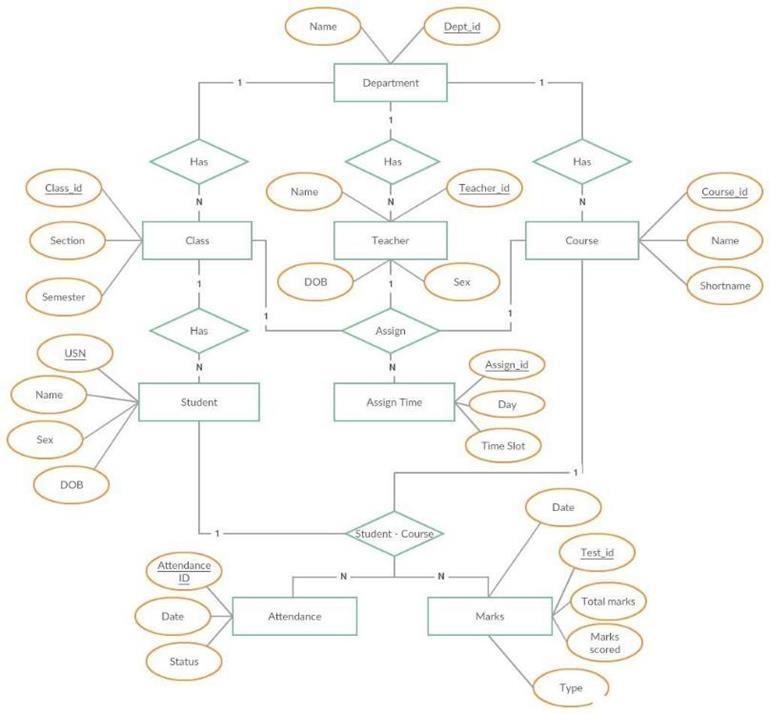
5.Architectural design
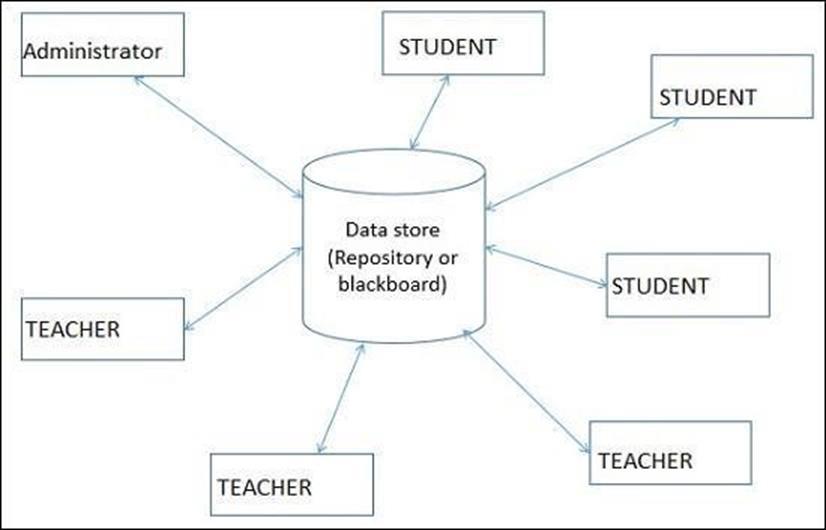
ThearchitecturaldesignisnecessaryfortheERPsoftware inordertorepresentthesoftware'sdesign.Here,wespecifya setofhardwareandsoftwareelementsandtheirinterfacesto createthefoundationforthissoftware'sdevelopment.There are numerous system components that work together to
make a system. The collection of connectors will support componentcooperation,coordination,andcommunication. Thecomputer-basedsystemiscreatedfortheERPsoftware. Itdemonstratesanarchitecturethatisdata-centric.
i) Architectural style: All student and faculty data is maintained in a database and updated, added, deleted, or amended in the college ERP software. As a result, it demonstratesadata-centricarchitecturalstyle.Thecommon datarepositoryisthepointofcommunicationforthevarious componentsinthisarchitecture.Thecomponentsarelargely independentandhaveaccesstoacommondatastructure.
Thecomponentsare:
AcollegeERPsystemcanhaveamajorandwide-ranging impact on many different aspects of the institution's operations. One or more of the outcomes of a successful deploymentcouldbeasfollows:
1. Increased efficiency: By streamlining administrative and academic procedures, college ERP systems can save timeandmoneyspentonactivitieslikeenrollment,course scheduling,grading,andfinancialadministration.Thismay boostproductivityandefficiency,enablingemployeesand professorstoconcentrateonhigher-valuetasks.
2. Improveddataaccuracyandaccessibility:ERPsystems forcollegesofferacentralizeddatabase foracademicand administrative data, which can enhance information accuracyandaccessibility.Asaresult,decision-makingmay bemademorequicklyandinstitutionalperformancemay bebetterunderstood.
3. Enhancedstakeholderengagementandcommunication: Collegestakeholders,includingacademics,staff,students, andadministrators,maycommunicateandworktogether moreeasilywiththehelpofERPsystems.Asaresult,the institution may experience increased involvement and pleasureaswellasastrongerfeelingofcommunity.
International Research Journal of Engineering and Technology (IRJET) e-ISSN: 2395-0056
Volume: 11 Issue: 12 | Dec 2024 www.irjet.net p-ISSN: 2395-0072
A good college ERP system installation can have transformative effects overall by enhancing institutional performance, stakeholder engagement, and student outcomes. It's crucial to remember that the system's performancedependsonanumberofvariables,includingits implementation's effectiveness, the amount of training provided,andcontinuoussupportandmaintenance.
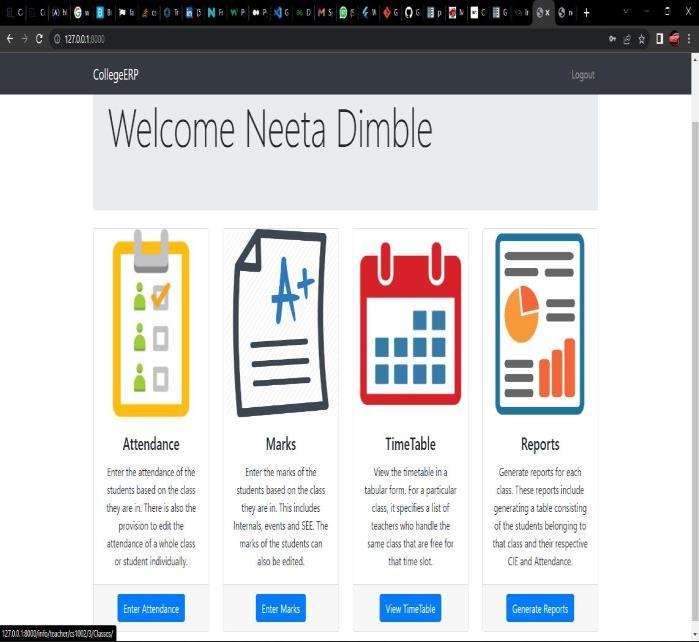
Figure 4: ResultofTeachersHomePage
1. Centralized data management: For academic and administrative data, a college ERP system offers a centralized database, increasing data accuracy and accessibility. As a result, decision-making may be made morequicklyandinstitutionalperformancemaybebetter understood.
2. Enhancedcommunicationandcollaboration:Acollege ERPsystemcanhelpstakeholdersincludingfaculty,staff, students, and administrators communicate and work together. As a result, the institution may experience increasedinvolvementandpleasureaswellasastronger feelingofcommunity.
3. Improved financial management: An ERP system for collegescanhelpwithimprovedfinancialmanagementby allowing organizations to keep track of expenditures, controlspending,andenhancefinancialreporting.Better financialresultsandamoredurableinstitutionmayresult fromthis.
Better student outcomes: By offering resources for monitoringacademicachievement,identifyingareaswhere students may need further support, and enhancing communicationbetweenstudentsandstaff,acollegeERP
4. systemcansupportbetterstudentoutcomes.
5. Datasecurity:Byofferingcentralizedcontroloverdata access and lowering the likelihood of data breaches and unauthorized access, an ERP system for colleges may enhancedatasecurity.
1. Expensive System: The fact that Enterprise Resource Planning(ERP)systemscan bevery expensive isone of theirkeydrawbacks.Costsforotherrequirementssuchas computerhardware,upgradednetworkinfrastructure,and securitysoftwaremaybeinadditiontothosefortheactual softwareandimplementation.
2. TrainingInefficiency:Themostimportantfactorsina manufacturingoperationareexpertise,experience,labor, and resource utilization at its best. Without these components, it is challenging to manage your business effectivelyandsmoothly,whichiswhycomprehensiveERP trainingisessentialtomakethesystemfunctionproperly.
3. DegreeofCustomization:ERPsystems'flexibilitytobe tailoredtoyourcompany'sdemandsisanotherdrawback. Thelevelofcustomizationofferedcanvaryandtypically dependsonthesoftwarebrandselectedassomesystems providemorecustomizationchoicesthanothers.
4. High Implementation Times: For any business, implementinganewoperatingsystemcanbedifficult.The entiredeployment and training process couldtakemore thanayear,dependingonhowcomplicatedthebusiness activitiesare.
5. Inter-connectivity of Departments: A firm may experiencedisadvantagesdespitetheinterconnectedness ofitsnumeroussectionsappearingtobeapositive.
Intoday'sworld,collegemanagementisquicklybecoming a crucial aspect of education. With the aid of the College AutomationSystem,wecanquicklycompileallthenecessary data for management. The handwritten data is now computerizedviathecollege'senterpriseresourceplanning system. It is not necessary for different people to handle differentportionsoncetheinformationhasbeenenteredinto the systemorcomputer.Tokeeptrackofallthereportsand documents,justonepersonisrequired.Additionally,security canbeprovidedinaccordancewithuserneeds.
The current system makes it challenging to get informationfromfiles,andthereisnoquickorsimplewayto maintain staff and student records. Also lacking in automationisthecurrentsystem.OurSystemisdesignedto
International Research Journal of Engineering and Technology (IRJET) e-ISSN: 2395-0056
Volume: 11 Issue: 12 | Dec 2024 www.irjet.net p-ISSN: 2395-0072
lighten the workload and significantly increase staff productivity.
The project's name, College ERP System, refers to a systemthathandlesproblemsspecifictoagiveninstitution. Thefacultyandstudentsbothbenefitgreatlyfromtheeaseof access to information. Based on their profiles andposition inside the system, the college ERP gives users pertinent information. This project was created with the day-to-day issuesthatacollegesystemfacesinmind.
Thus,thebasic issuewiththeadministrator'sabilityto maintain and manage their work is resolved. Prior to this, followingthescheduleandkeepingtrackofthedailytasks wasalittlechallenging.However,bycreatingthisweb-based application, the administrator can have pleasure in the activity while easily completing it and while also saving significanttime.Theusercanaccessthereportsonaregular basiswhenevertheyneedthem,savingtimeandeliminating the need for manual calculations. The efficient use of the labor, proper sharing of it, and the provision of reliable outcomes.Thestoragespacewillmaketheoperator'stask easier. As a result, the system created will benefit the administratorbymakingtheirjobeasier.Thissystemoffers automated admissions, eliminating the need for manual processing.Thisworkiselectronic.Remotemonitoring and control are both possible. It requires less labor overall. It consistentlydeliverscorrectfacts...
Information accumulated throughout the years can be preservedandretrievedatanytime.Theinformationkeptin therepositoryaidsmanagementinmakingwisedecisions andproducingreliableresults.Thestoragespacewillmake theoperator'staskeasier.Thecollegemanagementsystem's features and modules have all been effectively integrated intothisprojectinaccordancewiththespecifications.
[1] Research on Internal Control of Financial Accounting Information System Based on ERP System.HuiLiu,2020GyusooKimandSeulgiLee, “2014 Payment Research”, Bank of Korea, Vol. 2015,No.1,Jan.2015.
[2] Enhancing ERP component detection by estimating ERP latency variability using hidden processmodel.MinjuKim,
[3] Abdullah A. Al-Ghofail and Majed A. Al-Mashari: ERP System Adoption Traditional ERP Systems vs. Cloud-BasedERP
[4] Xia Hu and Min Zhou: The Three-dimensional Teaching Mode of ERP Course in Colleges and Universities2011
[5] PengZhengandWeiZhou:CompetitiveAdvantage intheERPSystem’sValue-Chain2011
[6] ElmasriandNavathe:FundamentalsofDatabase Systems,7thEdition,PearsonEducation.
[7] Hwang,D.,&Min,S.(2019).Asystematicreviewof ERP systems research. Sustainability, 11(21), 5975.
[8] Ragab,N.A.,&Arisha,A.(2016).Areviewofthe critical success factors of ERP implementation. ComputersinIndustry,83,121-139.
[9] Simkin, L., & Ramirez, R. (2019). Implementing enterprise resource planning systems: Best practices in project and change management. Routledge.
Umble, E. J., Haft, R. R., & Umble, M. M. (2003). Enterprise resourceplanning:Implementationproceduresandcritical successfactors.EuropeanJournalofOperationalResearch, 146(2),241