
International Research Journal of Engineering and Technology (IRJET) e-ISSN: 2395-0056
Volume: 11 Issue: 12 | Dec 2024 www.irjet.net p-ISSN: 2395-0072

International Research Journal of Engineering and Technology (IRJET) e-ISSN: 2395-0056
Volume: 11 Issue: 12 | Dec 2024 www.irjet.net p-ISSN: 2395-0072
Sachu Joshna1 , Ravva Harshitha2 , Addagunta Avinash3, Dr. Digavinti Sreenivasulu4
1B-Tech 4th year, Dept. of CSE(DS), Institute of Aeronautical Engineering
2 B-Tech 4th year, Dept. of CSE(DS), Institute of Aeronautical Engineering
3 B-Tech 4th year, Dept. of CSE(DS), Institute of Aeronautical Engineering
4Associate Professor, Dept. of CSE(DS), Institute of Aeronautical Engineering, Telangana, India ***
Abstract - AnAssuranceof humanwellbeingandbearingof ecologicalapproachrelybasicallyuponairqualityprediction. Changes in air quality are hard to predict for most standard single-model frameworks. This paper provides areas of strength for a framework that makes use of cutting-edge machine learning techniques. From a close viewpoint, we investigatevariousmodelssuchasSupportVectorRegression (SVR),DeepBeliefNetwork withBack-Propagation(DBN-BP), and Genetic Algorithm-Enhanced Extreme Learning Machine (GA-KELM). In addition, we suggest integrating a deep learningarchitecture knownasbidirectionallongshort-term memory (BiLSTM) to further improve prediction accuracy even more. After extensive evaluation and testing, we demonstratethatBiLSTMexhibitslowerMeanSquaredError (MSE) and Root Mean Square Error (RMSE) values, outperforming existing models. Additionally, we enhance BiLSTM's display by using GA-KELM, hence significantly enhancing itspredictivecapabilities.Inadditiontoproviding. Asidefromgivingbetterprecisioninair qualityprediction,the recommended hybrid model assists with directing general wellbeing efforts and contamination control arrangements through informed choices. This study underscores the need of researching imaginative ways to deal with handle earnest ecological issues and the conceivable outcomes of ML in further developing air quality control.
Key Words: genetic algorithms, time series, machine learning, extreme learning machines, and air quality forecasts.
Ascendingasasignificantoverallissueinthetwenty-first 100 years, air pollution is exasperated by quick industrializationandurbanization[1].Decliningairquality influencesgeneralwellbeingaswellastheclimate[2].Liet al’ s. concentrates on feature the wellbeing dangers associatedwithopenairactualpracticewithinthesightof encompassingaircontamination,particularlyinregionslike Chinathatarequickseeingmodernadvancement[3].Asin numerous different countries, China estimates air quality utilizingrulescharacterizedintheChineseSurroundingAir QualityNorms.
Thesepollutantshaveplainlyunfortunateresultsforhuman wellbeing[5 Long-termexposuretoair pollutantssuchas PM2.5andemissionsfrommovingvehicleshasbeenlinked
toahigherchanceofdevelopinglungcancer,heartdisease, and other illnesses. According to estimates from the InternationalEnergyAgency,airpollutionresultsinalmost 6.5millionprematuredeathsannually.[6].Subsequently,the advancement of effective frameworks for air quality expectationturnsouttobeincreasinglymoresignificantas ecologicalinsurancedrivesrelyuponthis[7].Predictionof airqualityforthemostpartreliesupon dataaccumulated fromcheckingstationsspreadallthroughsignificanturban communities[8].Theselocalesguideestimatemodelsand deal savvy investigation of contamination levels. [9] ML calculations have become more powerful devices for assessingsuchinformation.Inanycase,therearechallenges like the shortage of careful datasets and the trouble demonstratingnumerousforeignsubstancessimultaneously [10].
Newinvestigationshavetakenaganderatnumerouswaysof meetingthesechallenges.Utilizinginformationfromsixair impurities [11]. Conventional neural network calculations do, nonetheless, oftentimes go against issues like languid learning, aversion to neighborhood minima, and troublesometrainingstrategies[12].
Inviewofthelengthyconverselatticehypothesisandwitha singlehiddenlayerFNN,Huangetal.introducedELMwayto deal with beat these limitations [13]. As for boundary determination,preparingtime,andpredictionaccuracythe ELM calculation has shown preferred execution in AQI predictionoverconventionalneuralnetworks[14].TheELM calculation’sdependenceonarbitrarily pickedboundaries for buried layer hubs presents hardships to prediction accuracyregardlessofwhetheritsproficiency
Inthisregard,thegoalofthisworkistoimproveuponthe currentmodelsforpredictingairqualitybyproposinganew strategy combining with the benefits of ML computations furtherdevelopedboundaryaugmentationtechniques.We presentexplicitlyacrossovermodelconsolidatingtheGAKELM architecture withthe BiLSTMengineering.Utilizing theprescientpowersofBiLSTMandhereditarycalculation improvement of model boundaries, this blend looks to expandtheaccuracyandversatilityofairqualityprojections [16].
This work presents another hybrid model that settles the requirements of current strategies, thusly supporting the
International Research Journal of Engineering and Technology (IRJET) e-ISSN: 2395-0056
Volume: 11 Issue: 12 | Dec 2024 www.irjet.net p-ISSN: 2395-0072
constant endeavorsto further develop airquality forecast methods.ConsolidatingBiLSTMwithGA-KELMwillassistus withgivingmoreexactandreliableconjectures,alongthese lines supporting wise decision-production for general wellbeingtheexecutivesandnaturalsecurity.
Globally, air pollution has become a serious threat to the environmentandpublichealthconcernrequiringintensive examination to distinguish its sources, results, and moderatingprocedures.WithaneyeontheutilizationofML approachesforairqualityprediction,weassesssignificant exploration on air pollution monitoring, forecasting, and controlinthiswritingstudy.
Accentuatingtheneedofhandlingairqualityissuesatthe territoriallevel,Lietal.(2019)underlinedaircontamination asanoverallconcernrequiringneighborhoodarrangements [1].Fromthisvantagepoint,restrictedairqualityobserving andgaugeframeworksbecomesignificantlymoresignificant indirectingcenteredmeasures.Toevaluatetheeffectofair contamination the board approaches in China, Han et al. (2018) introduced a Bayesian LSTM model, consequently featuring the worth of modern factual techniques for information examination of air quality [2]. Their examinationunderlineshowwellLSTMmodelsmightgauge whatstrategychangeswillmeanforairqualityoutcomes.
Baietal.(2018)examinedmanydisplayingproceduresand information sources applied in air quality prediction [3] along with a synopsis of air contamination gauges. Their researchhighlightshowdifficultitistopredictairquality andhowimportantitistohaveafewsourcesofinformation. includingmeteorologicalinformation,satelliteperceptions, and ground-level checking information. Utilizing inertial sensorinformationofairpenmanship,DingandXue(2019) recommended a DL technique for essayist ID, thusly demonstrating the versatility of DL strategies in sensor informationexaminationforsomepurposes[4].
Exploring the change of outside air proportion in cooling frameworks for arriving at wanted inside air quality and greatestenergyreservefunds,Chengetal.(2019)[5]found Their examination underscores the need of boosting ventilationmethodstosafeguardimproveindoorairquality anduselessenergy.AnLSTMmodelbasedonperiodseries was developed by Chaudhary et al. (2018) to forecast air pollution foci in notable Indian metropolitan areas, demonstrating the value of Their work contributes to the growing body of research on information-driven methods forpredictingairquality
In view of publicly supported and cloud-based air quality markers,Chenetal.(2018)proposedametropolitanmedical care big data system featuring the potential outcomes of publiclysupportinginformationforcheckingmetropolitan air quality [7]. Their examination underlines how new
innovationcouldassistwithexpandingthedegreeofgeneral wellbeingcheckingandairqualitycontrol.JoiningCNNsand LSTMnetworks[8],theirexaminationsshowthathybridDL calculationscatchmultifacetedspatiotemporalexamplesin airqualitydataactually.
The writing auditcallsattention to by andlarge the rising interestinutilizingMLstrategiesfortheboard,forecasting, and air quality monitoring. To expand the accuracy and reliabilityofairqualityfigures,researchhastakenagander at a different range of strategies having LSTM models, DL structures, hybrid ML designs. These improvements could assist with directing proof-based medicines intended to minimize the damaging effects of air pollution on the environmentandpublichealth.
The study coordinates GA & ELM to further develop air qualityforecasting,explicitlyPM2.5levels.GAwillupgrade theELMmodel'ssecrethubsandlayerstofurtherimprove learning and prediction. GA’s [14] ability to look for ideal arrangementsinsidea given huntregionpermitstheELM modeltoadaptivelymodifyitsengineeringtomorereadily reflect air quality information's convoluted linkages. MSE and RMSE will be utilized to analyze adequacy versus exemplary methodologies like Support Vector Machines (SVM)[16].
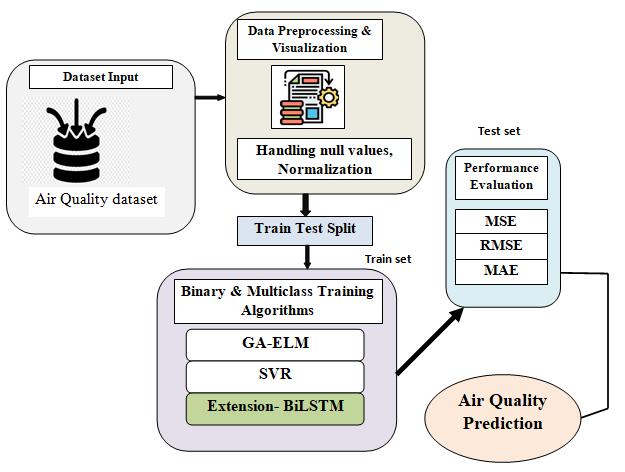
Fig -1:Proposed
Thereareseveralmaincomponentstothesuggesteddesign foranairqualityforecastingsystem.Itstartsbyenteringa dataset on air quality including geographic information, meteorological data, and pollution concentrations. While visualizationhelpstodiscoverdatatrends,dataprocessing techniques include normalizing, feature engineering, and handling missing values ready the data for modeling.
International Research Journal of Engineering and Technology (IRJET) e-ISSN: 2395-0056
Volume: 11 Issue: 12 | Dec 2024 www.irjet.net p-ISSN: 2395-0072
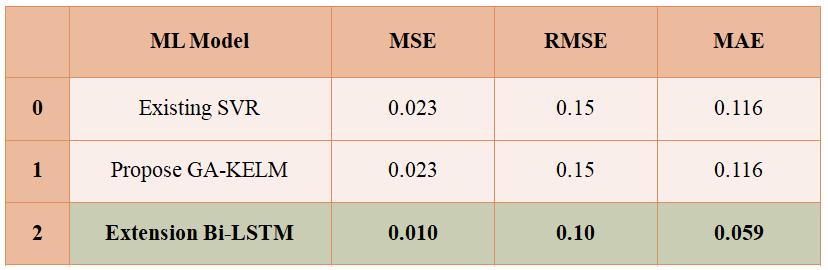
Trainingandtestingsetsseparatethedatasetsoastoassess thegeneralizingpowerofthemodel.Usingalgorithmssuch GA-ELM [14], SVR, and BiLSTM, trends between input characteristicsandairqualityresultsarefound.Prediction accuracy is measured by means of MSE, RMSE, and MAE, thereby evaluating performance. By means of pragmatic insights, the system projects pollution concentrations and AQIvalues,thereforesupportingpublichealthinitiatives.
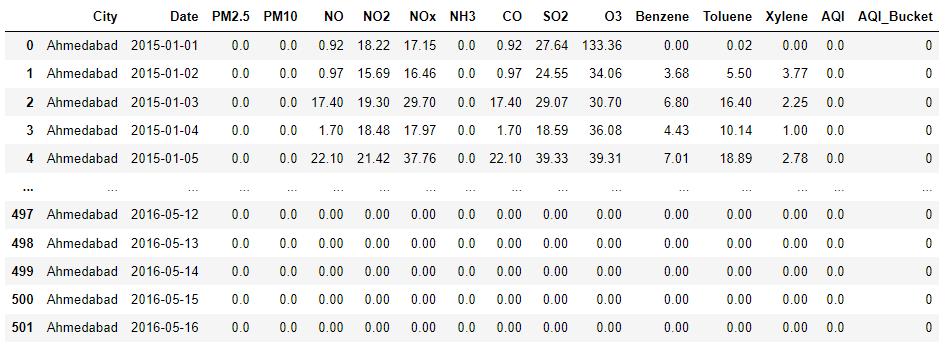
Fig -2:Dataset
Estimates of a few toxins and particulate matter with a widthoflessthan10millimeters(PM10)areincludedinthe airqualitydataset.Toxinfixations,relatedtimestamps,and geographic areas are completely remembered for every perception.Meteorologicaldatamaylikewisebegiven,for example,temperature,mugginess,windspeed,andgaseous tension. Research on the impacts of contamination on the climateandgeneralwellbeingismademorestraightforward by this dataset, which considers the examination and investigationofchangesinairqualityoverthelongrunand indifferentgeologicalregions.
Preparing datasets for model training depends on data processing leveraging Pandas and Keras Data Frames Pandaseffectivelymanagesmissingvaluesbyimputingor deletingthem,thereforeguaranteeingdatasetintegrityand lowering bias. Usually between 0 and 1, normalizing numericalfeaturestoacommonscalehelpstoavoidbigger featurescontrollingthemodeltrainingprocess.Toreduce dimensionalityandimprovecomputingspeed,unnecessary columns are deleted. Keras Data Frames provide effective data preparation for neural network designs by elegantly interacting with deep learning frameworks. They also preservedataintegritybyhandlingmissingvaluesjustlike Pandasdoes.KerasDataFramesmaximizeresourceuseand minimize overfitting by normalizing numerical characteristicsand eliminatinguselesscolumns,therefore guaranteeing improved model convergence and performance.
Seaborn and Matplotlib data visualization improves knowledgeofairqualitystatistics.Whilescatterplotsshow
relationshipsbetweenpollutantsandmeteorologicaldata, histograms emphasize patterns and outliers in pollution concentrations.Showcasingseasonalandlong-termtrends, linegraphsdemonstratepollutionlevelsovertime.Analysis ofairqualitydynamicsandtheassistanceofthecreationof efficientpredictionmodelsdependonthesevisuals.
Viableairqualitypredictionmodelsneedfeatureselection. We use relationship examination, include importance positioning, and PCA to diminish dimensionality. By recognizing connections amongst foreign substances and meteorological variables, relationship investigation helps pick significant attributes. Positioned include importance approacheslikeRandomForestfavorpersuasivehighlights forprediction.PCAadditionallyfindsidlefactorsthatmake sense of most information variety, bringing down dimensionality while keeping key data. Include determination further develops air quality forecast model executionandcomputationalproficiencybypickingthemost enlighteningattributes.
Toevaluatetheperformanceofthemodelitisnecessaryto divide the air quality dataset into training and testing subsets.Typically,an80/20or70/30randomsplitisusedto ensureenoughinformationtosupporttestingandtraining. The instruction set trains the predictive model, and the testing set evaluates the model's execution. This split assessesthemodel'sadaptabilitytofreshdata,facilitating thecreationofcredibleairqualityforecastsandanobjective performanceevaluation.
Genetic Algorithm (GA)isusedbyGeneticAlgorithmwith Extreme Learning Machine (GA-ELM). for parameter optimizationtoimproveExtremeLearningMachine(ELM). GA develops solutions to improve the predictive ability of ELM through fitness-based selection, breeding, and mutation. ELM is effective for demanding environmental data such as air quality forecasting by using in order to computeoutputweightsandmapinputfeaturesintoahighdimensionalspace,arandomactivationfunctionisused.
Support Vector Regressor (SVR) generates a regression model by using a hyperplane that maximizes the distance between data points, thereby reducing the error function. SVR can record complex interactions between inputs and outputs, making it very effective in predicting nonlinear trends in air quality data. SVR faithfully reflects complex interactionsbyoptimizingparameterssuchaskerneltype andregularization,improvingtheoverallforecastquality.
BiLSTM: Byanalyzingtimetheextendedbidirectionallong short-termmemory(BiLSTM),whengivenseriesdatainboth
International Research Journal of Engineering and Technology (IRJET) e-ISSN: 2395-0056
Volume: 11 Issue: 12 | Dec 2024 www.irjet.net p-ISSN: 2395-0072
forwardandbackwarddirections,generates:Itisespecially helpfulforcomprehendinghowairqualitydatachangesover timeasbidirectionalprocessingallowsittocapturebothpast andfutureenvironments.Sincelong-termdependenciesand trendsarewellhandledbyBiLSTM,italsoallowsformore accuratepredictionofairqualitychangesovertime.
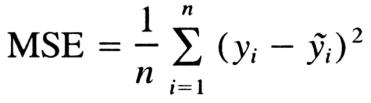
Mean squared error (MSE): MSEinstatisticschecksfactual model error. It assesses the normal and noticed values' typical squared distinction. The MSE equivalent 0 when a model is sans mistake. It is worth ascents as model error rises.Furthermore,alludedtoasthestandarddeviationof themean(MSD).

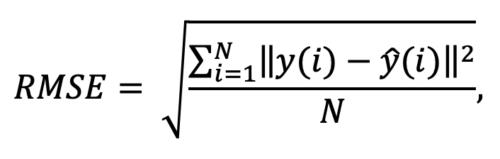
Root Mean Square Error (RMSE):Thismeasureassesses thestandarddeviationbetweenthegenuineinformationand the extended upsides of a measurable model. It is, numerically,theresiduals'standarddeviation.Residualsare theinformationpointdistancefromtheregressionline.

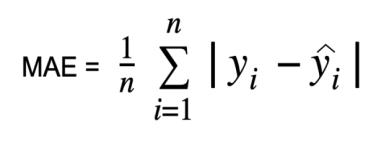
Mean Absolute Error (MAE): The inaccuracy in your estimationsisthelevelofmisstep.Itisthevarietybetween the"true"andrecordedvalues.


International Research Journal of Engineering and Technology (IRJET) e-ISSN: 2395-0056
Volume: 11 Issue: 12 | Dec 2024 www.irjet.net p-ISSN: 2395-0072

Fig -8:RegistrationPage

Fig -9:LoginPage

Fig -10:UploadInputData
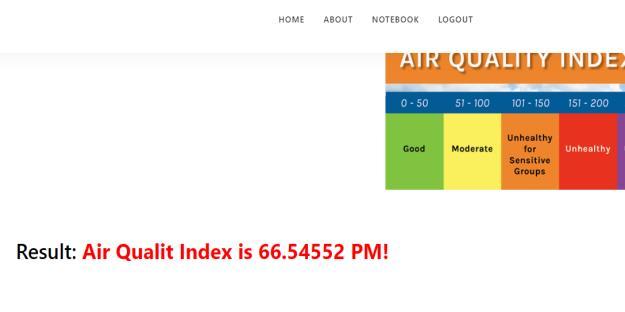
Fig -11:FinalOutcome
Insummary,theintegrationofthe"GeneticAlgorithmwith ExtremeLearningMachine"(GA-KELM)andtheextensionof the"BidirectionalLongShort-TermMemory"(BiLSTM)[14] addressvitalimprovementsinairqualityprediction,giving expanded accuracy and further developing natural administrationnavigation.Thetask'simpactisadditionally expandedbysendingtheBiLSTMmodelinsideaninstinctive Flaskframework,whichgivesgeneralsocietyandscientists thesamevaluableadmittancetoairqualityforecasts.This notjustempowersindividualstogowithdecisionsthatare bestfortheirwellbeingandprosperity,howeveritlikewise makes it simpler to make a deterrent move against the harming influence that the environment is affected by air pollution.
Therearenumerousforthcominginnovativeworkpotential opendoors.Furtherturnofeventsandenhancementofthe BiLSTMandGA-KELMmodelsshouldfocusonanticipated accuracy and versatility. Incorporation of constant informationstreamsandmoreenhancedcomponentsmight work on model capacities. Beyond air quality prediction, applying these models to environment demonstrating or ecological effect evaluations might give critical bits of knowledge. At long last, making air quality forecast advancements,forexample,portableapplicationsandonline stages, more open and usable will assist with tackling ecologicalissues.Highlevelcomputationaltechniquesand their utilization to reduce natural issues and increment worldwidepersonalsatisfactionarewhat'sinstore.
[1] X.Li,L.Jin,andH.Kan,‘‘Airpollution:Aglobalproblem needslocalfixes,’’Nature,vol.570,no.7762,pp.437–439,Jun.2019.
[2] Y. Han, J. C. K. Lam, and V. O. K. Li, ‘‘A Bayesian LSTM model to evaluate the effects of air pollution control regulationsinChina,’’inProc.IEEEBigDataWorkshop (BigData),Dec.2018,pp.4465–4468.
[3] L.Bai,J.Wang,X.Ma,andH.Lu,‘‘Airpollutionforecasts: Anoverview,’’Int.J.Environ.Res.PublicHealth,vol.15, no.4,p.780,2018.
[4] Y.DingandY.Xue,‘‘Adeeplearningapproachtowriter identification using inertial sensor data of airhandwriting,’’IEICETrans.Inf.Syst.,vol.E102-D,no.10, pp.2059–2063,2019.
[5] S.-Q. Dotse, M. I. Petra, L. Dagar, and L. C. De Silva, ‘‘Applicationofcomputationalintelligencetechniquesto forecastdailyPM10exceedancesinBruneiDarussalam,’’ Atmos.Pollut.Res.,vol.9,no.2,pp.358–368,Mar.2018.
International Research Journal of Engineering and Technology (IRJET) e-ISSN: 2395-0056
Volume: 11 Issue: 12 | Dec 2024 www.irjet.net p-ISSN: 2395-0072
[6] M. Jia, A. Komeily, Y. Wang, and R. S. Srinivasan, ‘‘Adopting Internet of Things for the development of smartbuildings:Areviewofenablingtechnologiesand applications,’’ Automat. Construct., vol. 101, pp. 111–126,May2019.
[7] S.Abirami,P.Chitra,R.Madhumitha,andS.R.Kesavan, ‘‘Hybridspatio-temporaldeeplearningframeworkfor particulatematter(PM2.5)concentrationforecasting,’’ inProc.Int.Conf.Innov.TrendsInf.Technol.(ICITIIT), Feb.2020,pp.1–6.
[8] Y.Cheng,S.Zhang,C.Huan,M.O.Oladokun,andZ.Lin, ‘‘Optimization on fresh outdoor air ratio of air conditioningsystemwithstratumventilationforboth targetedindoorairqualityandmaximalenergysaving,’’ BuildingEnviron.,vol.147,pp.11–22,Jan.2019.
[9] A.C.CosmaandR.Simha,‘‘Machinelearningmethodfor real-timenon-invasivepredictionofindividualthermal preferenceintransientconditions,’’BuildingEnviron., vol.148,pp.372–383,Jan.2019.
[10] M. Bhowmik, K. Deb, A. Debnath, and B. Saha, ‘‘Mixed phase Fe2O3/Mn3O4 magnetic nanocomposite for enhanced adsorption of methyl orange dye: Neural network modelingandresponsesurfacemethodology optimization,’’Appl.OrganometallicChem.,vol.32,no.3, p.e4186,Mar.2018.
[11] V. Chaudhary, A. Deshbhratar, V. Kumar, and D. Paul, ‘‘Time series based LSTM model to predict air pollutant’sconcentrationforprominentcitiesinIndia,’’ in Proc. Int. Workshop Utility-Driven Mining (UDM), Aug.2018,pp.1–9.
[12] M.Chen,J.Yang,L.Hu,M.S.Hossain,andG.Muhammad, ‘‘Urban healthcare big data system based on crowdsourcedandcloud-basedairqualityindicators,’’ IEEE Commun. Mag., vol. 56, no. 11, pp. 14–20, Nov. 2018.
[13] R.Chen,X.Wang,W.Zhang,X.Zhu,A.Li,andC.Yang,‘‘A hybrid CNN-LSTM model for typhoon formation forecasting,’’GeoInformatica,vol.23,no.3,pp.375–396, Jul.2019.
[14] S. Du, T. Li, Y. Yang, and S. Horng, ‘‘Deep air quality forecasting using hybrid deep learning framework,’’ IEEETrans.Knowl.DataEng.,vol.33,no.6,pp.2412–2424,Jun.2021.
[15] R.Feng,H.-J.Zheng,H.Gao,A.-R.Zhang,C.Huang,J.-X. Zhang,K.Luo,andJ.-R.Fan,‘‘Recurrentneuralnetwork andrandomforestforanalysisandaccurateforecastof atmospheric pollutants: A case study in Hangzhou, China,’’ J. Cleaner Prod., vol. 231, pp. 1005–1015, Sep. 2019.
[16] B. S. Freeman, G. Taylor, B. Gharabaghi, and J. Thé, ‘‘Forecasting air quality time series using deep learning,’’J.AirWasteManage.Assoc.,vol.68,no.8,pp. 866–886,Aug.2018.
[17] S. Mahajan, H.-M. Liu, T.-C. Tsai, and L.-J. Chen, ‘‘Improving the accuracy and efficiency of PM2.5 forecast service using cluster-based hybrid neural networkmodel,’’IEEEAccess,vol.6,pp.19193–19204, 2018.
[18] J. Jin, J. Gubbi, S. Marusic, and M. Palaniswami, ‘‘An informationframeworkforcreatingasmartcitythrough InternetofThings,’’IEEEInternetThingsJ.,vol.1,no.2, pp.112–121,Apr.2014.
[19] A. Grover, A. Kapoor, and E. Horvitz, ‘‘A deep hybrid model for weather forecasting,’’ in Proc. 21st ACM SIGKDD Int. Conf. Knowl. DiscoveryData Mining, Aug. 2015,p.379–386.
[20] A. Agarwal and M. Sahu, ‘‘Forecasting PM2.5 concentrationsusingstatisticalmodelingforBengaluru and Delhi regions,’’ Environ. Monit. Assessment, vol. 195,p.502,Mar.2023.
[21] D.J.Lary,T.Lary,andB.Sattler,‘‘Usingmachinelearning to estimate global PM2.5 for environmental health studies,’’Environ.HealthInsights,vol.9,no.1,pp.41–52,2015.
[22] Y.Zheng,X.Yi,M.Li,R.Li,Z.Shan,E.Chang,andT.Li, ‘‘Forecastingfine-grainedairqualitybasedonbigdata,’’ inProc.21thACMSIGKDDInt.Conf.Knowl.Discovery DataMining,NewYork,NY,USA,Aug.2015,pp.2267–2276.
[23] Y. Zheng, L. Capra, O. Wolfson, and H. Yang, ‘‘Urban computing:Concepts,methodologies,andapplications,’’ ACMTrans.Intell.Syst.Technol.,vol.5,no.3,p.38,Sep. 2014.
[24] T. S. Rajput and N. Sharma, ‘‘Multivariate regression analysis of air quality index for Hyderabad city: Forecastingmodelwithhourlyfrequency,’’Int.J.Appl. Res.,vol.3,no.8,pp.443–447,2017.
[25] Z. Kang and Z. Qu, ‘‘Application of BP neural network optimizedbygeneticsimulatedannealingalgorithmto predictionofairqualityindexinLanzhou,’’inProc.IEEE Comput. Intell. Appl. (ICCIA), Sep. 2017, pp. 155–160, doi:10.1109/CIAPP.2017.8167199.
[26] B. Liu, S. Yan, J. Li, G. Qu, Y. Li, J. Lang, and R. Gu, ‘‘A sequence-tosequenceairqualitypredictorbasedonthe n-step recurrent prediction,’’ IEEE Access, vol. 7, pp. 43331–43345,2019.
International Research Journal of Engineering and Technology (IRJET) e-ISSN: 2395-0056
Volume: 11 Issue: 12 | Dec 2024 www.irjet.net p-ISSN: 2395-0072
[27] K. Elbaz, I. Hoteit, W. M. Shaban, and S.-L. Shen, ‘‘Spatiotemporalairqualityforecastingandhealthrisk assessment over smart city of NEOM,’’ Chemosphere, vol.313,Feb.2022,Art.no.137636.
[28] P. C. Campbell, Y. Tang, P. Lee, B. Baker, D. Tong, R. Saylor, A. Stein, J. Huang, H.-C. Huang, E. Strobach, J. McQueen,L.Pan,I.Stajner,J.Sims,J.Tirado-Delgado,Y. Jung,F.Yang,T.L.Spero,andR.C.Gilliam,‘‘Development and evaluation of an advanced national air quality forecastingcapabilityusing theNOAAGlobalForecast Systemversion16,’’Geosci.ModelDevelop.,vol.15,no. 8,pp.3281–3313,Apr.2022.
[29] X.-B.Jin,Z.-Y.Wang,W.-T.Gong,J.-L.Kong,Y.-T.Bai,T.-L. Su, H.-J. Ma, and P. Chakrabarti, ‘‘Variational Bayesian networkwithinformationinterpretabilityfilteringfor air quality forecasting,’’ Mathematics, vol. 11, no. 4, p. 837,Feb.2023.
[30] J.Li,W.Shi,andD.Yang,‘‘Colordifferenceclassification ofdyedfabricsviaakernel extremelearningmachine based on an improved grasshopper optimization algorithm,’’ColorRes.Appl.,vol.46,no.2,pp.388–401, Apr.2021.