

Design and Different Sections of a Waste Water Treatment Plant
Shah Azhar Ullah Khan3GN17CV073
Visvesvaraya Technological University (VTU)
Public university in Belgaum, Karnataka
ABSTRACT:
Water treatment plants are crucial in guaranteeing theavailabilityofsafeanddrinkablewater,whichis an essential requirement for maintaining life and promoting societal progress. This study paper explores the complex terrain of water treatment plants, analyzing their architecture, operating strategies, and incorporation of cutting-edge technologies. The main emphasis is on improving efficiency, sustainability, and quality control inside thesefacilities.
This paper conducts a thorough examination of currentliteratureandcasestudiestoemphasizethe difficulties encountered by conventional water treatment technologies and investigates modern solutions and progressions. This study investigates the implementation of state-of-the-art technologies, including membrane filtration, sophisticated oxidation processes, and smart monitoring systems, to enhance the effectiveness of treatment, reduce the environmental footprint, and maximize the use ofresources.
The purpose of this study is to contribute to the development of strategies for water treatment plants, promoting sustainable practices that consider ecological sensitivity, operational efficiency,andsocietal needs.Thisarticleprovidesa thoroughand extensive source of information for policymakers, engineers,environmentalists, and stakeholders who are working towards the development of water treatment technology and the establishment of a sustainable water future for futuregenerations.
Keywords: Water Treatment Plants, Architecture, Environment, Technology
INTRODUCTION:
Wastewatertreatmentfacilitiesareessential for water purification, eliminating contaminants likewaste,grease,oils,anddebris.Theprocesses include settling to separate particles and biodegradation to decompose organic materials, ensuring the released water meets environmentalsafetystandards.
Preliminarytreatment:encompassestheremoval of large solids (such as bottles, fabric, and plastics) from water utilizing bar racks and screens.
Primary treatment involves physio-chemical processes to settle and precipitate suspended solids, reducing the biochemical oxygen demand of organic solids. This treatment neutralizes water, eliminates volatile contaminants, and removesgreasesandoils.
Secondary treatment comprises biological processes that diminish the organic matter in wastewater. This includes aerobic processes, degrading organic material with oxygen, and anaerobic processes, oxidizing organic matter withoutoxygen,followedbysecondarysettling.
REQUIREMENT
150MLD=15x10^7lit=15x10^4
cu-mPopulation=694444Averagedaily
Demand=83333333lit
MaximumDailydemand=149999999≈150 millionlit/day
Discharge=1.73cu-m/sec
International Research Journal of Engineering and Technology (IRJET) e-ISSN: 2395-0056 Volume: 11 Issue: 01 | Jan 2024 www.irjet.net p-ISSN: 2395-0072
--------------------------------------------------------*** --------------------------------------------------------© 2024, IRJET | Impact Factor value: 8.226 | ISO 9001:2008 Certified Journal | Page 151
SCREENING
Screening stands as the initial unit operation in wastewater treatment plants (WWTPs), designed to eliminate objects like rags, paper, plastics, and metals. This prevents damage and clogging of downstream equipment, piping, and appurtenances. Some advanced WWTPs utilize both coarse screens and fine screens. Figure 1 illustratesatypicalbarscreen,whichisaformof coarse screen. The screening process in wastewater treatment refers to the method of removinglargesolidobjectsanddebrisfromthe wastewater before it undergoes further treatment.
Water screening is an essential aspect of both municipal and industrial wastewater treatment plants since it effectively captures and retains particles present in the wastewater. At the beginning of the water treatment process, it is imperative to eliminate these solid substances astheymighthindertheoverallefficiencyofthe system, cause harm to valuable and essential water treatment machinery, or contaminate the water, resulting in significant disruptions to the entireecosystemofaregion.
Coarse Screen:
Coarse screens remove large solids, rags, and debris Coarse screens remove large solids, rags, anddebris
Fromwastewater,andtypicallyhaveopeningsof 20mmorLarger. Typesofcoarsescreens Includemechanicallyandmanuallycleanedbar
Fine Screen:
Fine screens are typically used to remove material That May Create operation and maintenance Problems in downstream
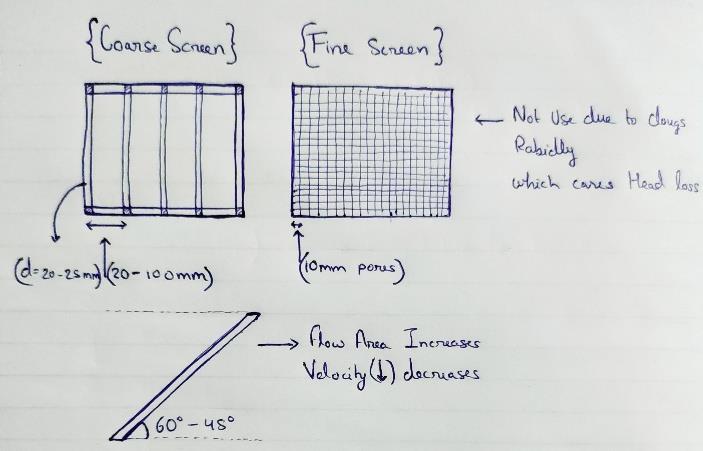
Processes, particularly in systems that lack primary treatment. Typical opening size for finescreensare6mmto10mm That may create operation and maintenance problems and even if requires it is allowed to place very fine screen with openings of 0.2 to 1.5mm
Level of filtration in the process of treating Design taken= Course Screen of 2×2 crosssectionArea
Diameterofbars=25mm=0.025m
Distance of bars from Centre to Centre= 60mm=0.06m
Areaofscreen=4m^2
(Length=2m,width=2m)Angleofscreen=50°


COAGULATION & FLOCCULATION
Coagulation and flocculation are essential processes used in the treatment of wastewater. Coagulation involves the addition of chemicals to destabilize and aggregate suspended particles, while flocculationpromotestheformationoflarger particlescalledflocs.
International Research Journal of Engineering and Technology (IRJET) e-ISSN: 2395-0056 Volume: 11 Issue: 01 | Jan 2024 www.irjet.net p-ISSN: 2395-0072
© 2024, IRJET | Impact Factor value: 8.226 | ISO 9001:2008 Certified Journal | Page152
Theseprocessesaidintheremovalofimpurities and contaminants from wastewater, making it cleanerandsaferfordisposalorreuse.
Both groundwater and surface water contain dissolvedandsuspendedparticles.Coagulationand flocculation are employed to segregate the suspended solids from the water. The characteristicsofsuspendedparticles,suchastheir source,charge,particlesize,shape,anddensity,can vary. These parameters impact the appropriate implementation of coagulation and flocculation. Waterborne particulates possess a detrimental electrical charge, and due to their same surface charge,theyexhibitmutualrepulsionuponcontact. If adequate coagulation and flocculation methods are not employed, suspended solids will persist in thewaterwithoutaggregatingandsettling.
COAGULATION TANK
The process of coagulation and flocculation occurs in sequential stages, facilitating the collision of particles and the subsequent formation of flocs. Sedimentation occurs subsequently. Failure to completethecoagulationstagewillresultinafailed flocculation step, and failure to complete the flocculation step will result in an unsuccessful sedimentationstep.
Coagulation is the initial stage of chemical wastewater treatment. The majority of us acquired knowledge about coagulation during our anatomy class. Hematopoiesis occurs when our blood undergoesoxygenation, leadingto the formationof a scab or a blood clot. This also applies to the processoftreatingwastewater.
Coagulationtreatmentemploysabenignsubstance, such alum, to induce a positive charge in all particles, resulting in their aggregation and facilitating filtration. Coagulation is highly efficient in eliminating chemical phosphorus from water. However,coagulationwater treatmentis not a new orinnovativetechnology.Excessivemixingdoesnot impact coagulation, whereas insufficient mixing results in an incomplete completion of this stage. The contact period in the rapid-mix chamber generallyrangesfrom1to3minutes.


International Research Journal of Engineering and Technology (IRJET) e-ISSN: 2395-0056 Volume: 11 Issue: 01 | Jan 2024 www.irjet.net p-ISSN: 2395-0072
© 2024, IRJET | Impact Factor value: 8.226 | ISO 9001:2008 Certified Journal | Page153


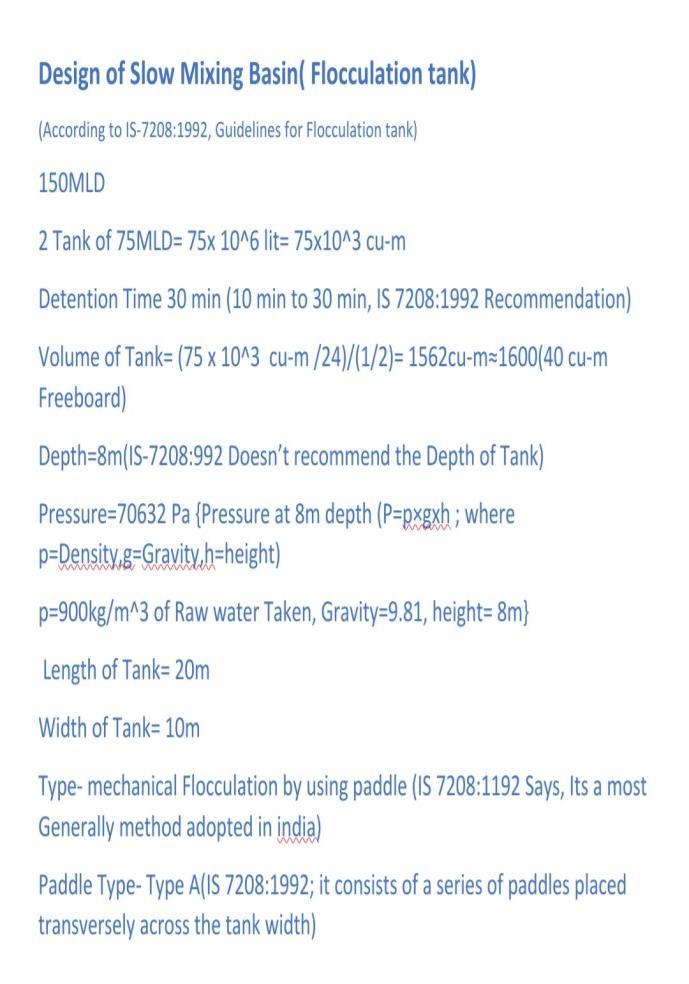
FLOCCULATION TANK
Flocculation and coagulation operate together in the process of wastewater treatment. Following the process of coagulation, which causes the waste particles to clump together, flocculating agents are employed in wastewater treatment to eliminate these clumps. Flocculants are polymers that induce the aggregation and precipitation of destabilized particle clusters, effectively eliminatingthemfromthefilteredwater.They can have varying degrees of weight, ranging from lightweight to medium weight, or high weight. The weight employed is contingent uponthenatureoftheparticle.
Thedesignintervalsforflocculationrangefrom 15 to 20 minutes up to an hour or longer. It is crucial to closely monitor the mixing velocity andmixenergy.Whenthesizeofflocrises,the velocity and energy of mixing are usually decreasedinordertoavoidtheflocfrombeing torn apart or sheared. Once flocs are disintegrated, it becomes challenging to reassemblethemtotheiridealdimensionsand durability. The operator's level of control in flocculation is greatly influenced by the equipment'stypeanddesign.
International Research Journal of Engineering and Technology (IRJET) e-ISSN: 2395-0056 Volume: 11 Issue: 01 | Jan 2024 www.irjet.net p-ISSN: 2395-0072
© 2024, IRJET | Impact Factor value: 8.226 | ISO 9001:2008 Certified Journal | Page154


SEDIMENTATION TANK
A sedimentation tank, also known as a settlingtankor clarifier,is anintegral part of a contemporary water supply or wastewater treatment system. A sedimentation tank facilitates the separationofsuspendedparticlesinwater or wastewater by allowing them to settle down while the liquid passes through the tank at a slow pace, resulting in a certain degree of filtration. Sludge, a layer of accumulated solids, accumulates at the bottom of the tank and is subsequently removed. Prior to sedimentation in drinking-water treatment, coagulants are introduced into the water to facilitate the settling process, which is subsequently followedby filtrationandothertreatment procedures.
International Research Journal of Engineering and Technology (IRJET) e-ISSN: 2395-0056 Volume: 11 Issue: 01 | Jan 2024 www.irjet.net p-ISSN: 2395-0072
© 2024, IRJET | Impact Factor value: 8.226 | ISO 9001:2008 Certified Journal | Page155

In order to enhance the effectiveness of purification, it is necessary to supplement primary sedimentation with a secondary treatment method such as a trickling filter oractivatedsludgeincontemporarysewage treatmentprocesses.Priortosedimentation, thetypicalprocedureinvolvestheuseofbar screens and grit chambers to remove large objectsandcoarsesolids.
Depthofthetankis4mthenthe12.5x10^3 cu-m/4= 3125 Providing Extra Depth for sludgestoragesays(use0.5in4m)sofor4m depthitis
0.5mextraDepth
TotalDepth=4.5atthestartingEnd, And4.5+(125/50)=7matd/sEnd(byusing a slop; 1 in 50) {i e 1 in 40 to 1 in 60 acceptable} and Using Free Board of 0.8 m (because for every 5 to 6 m depth 0.5 Free BoardRecommended)fromthewaterlevel
Sedimentation Tank Design Calculation
1. Rectangular Tanks: Rectangular tanks possess a planar shape with numerous baffle walls. The primary purpose of the
baffle wall is to inhibit short-circuiting and diminish the speed of incoming water, therefore elongating the particle's effective travel distance. This sedimentation tank typically features a channel-type inlet and outflow that span the whole width. The floor between two baffles is designed to resemble a hopper, descending towards the center where a sludgepipeisinstalled.
2. Circular Tanks: There are two categories of circular sedimentation tanks based on the water flow:
The Radial Flow Circular Tank operates by allowing water to enter through a centralinput pipe situated within a deflector box.The deflector box redirects the water in adownward direction. The water then moves in a radial direction from the deflector box,which has an exit along its whole perimeter, through the apertures located in the lower edges of the deflector box, towards the outer edgeofthetank.
The Circumferential Flow Circular Tank operates byallowingwater to enter throughtwo or three vertical slits, while a rotatingarm circulates the water along the tank'sperimeter. In order to
facilitate the sedimentation of suspended pollutants in the tank water, which flows at a significantly reduced speed, and then remove themthroughthesludgeoutlet

International Research Journal of Engineering and Technology (IRJET) e-ISSN: 2395-0056 Volume: 11 Issue: 01 | Jan 2024 www.irjet.net p-ISSN: 2395-0072
© 2024, IRJET | Impact Factor value: 8.226 | ISO 9001:2008 Certified Journal | Page156
DESIGN OF THE FLOC CHAMBER
Additionto125mlengthofsettlingTank,the Floc Chamber at the Entry Has to be Provided.
Assuming the Effective Depth in the Floc ChamberasHalfoftheDepthinthetanknear
Floc Chamber Depth of the tank is 4.5/2= 2.25
Assuming the period of Flocculation or Detention time period as 30 min (15 to 40 min allowed) So, Flow required in 30 min
=75x10^6lit=75x10^3cu-m (75 x 10^3/24) x 30/60 cu-m = 3125 x ½= 1562.5cu-m
The plan Area Required= capacity/Dept = 1562.5/2.25 m^2 = 694.4m^2 ≈ 695m^2 By Usingthesamewidthas25m,wewillgetthe lengthofFlocculationchamber

CONCLUSION:
Thisstudyemphasizesthecrucialimportance of water treatmentplantsinguaranteeingthe accessibility of potable water, which is an essential requirement for both survival and societal progress. This text examines the intricacies of these facilities, investigating theirstructure,functioning,andincorporation of state-of-the-art technologies, all with the goal of improving efficiency, sustainability, and quality assurance. The paper examines the difficulties encountered by conventional water treatment methods and investigates novelalternativesthroughathoroughanalysis of existing literature and case studies. The focus is on implementing innovative technologies like as membrane filtration, sophisticated oxidation processes, and intelligentmonitoringsystems.Thisisdoneto improve treatment effectiveness, reduce environmentalimpact,andmaximizeresource use. The primary objective of the study is to enhance the development of strategies for water treatment facilities, promoting sustainablepracticesthatprioritizeecological sensitivity, operational efficiency, and societal requirements. Designed as a complete reference, it caters to politicians, engineers, environmentalists, and stakeholders who are committed to promoting water treatment technologies andcreatinga sustainable water futureforfuturegenerations.
Mostofthetechnologiesincludedarecommon in the field of WTP; therefore, the costs generated, and the sustainability assessment are reliable insights into making a holistic decision for designing WTP networks. Our superstructure-based approach integrated with the sustainability evaluation presented herecanbeageneralguideintheselectionof technologiesforWTPs.
REFERENCES:
Crini, G.; Lichtfouse, E. Advantages and disadvantages of techniques used for wastewater treatment. Environ. Chem. Lett. 2019, 17,145–155.
International Research Journal of Engineering and Technology (IRJET) e-ISSN: 2395-0056 Volume: 11 Issue: 01 | Jan 2024 www.irjet.net p-ISSN: 2395-0072
© 2024, IRJET | Impact Factor value: 8.226 | ISO 9001:2008 Certified Journal | Page157
Khor, C.S.; Chachuat, B.; Shah, N. A superstructure optimization approach for water network synthesis with membrane separation-based regenerators. Comput. Chem. Eng. 2012, 42,48–63.
Khor, C.S.; Foo, D.C.Y.; El-Halwagi, M.M.; Tan, R.R.; Shah, N. A Superstructure Optimization Approach for Membrane Separation- Based Water Regeneration Network Synthesis with Detailed Nonlinear Mechanistic Reverse Osmosis Model. Ind. Eng. Chem. Res. 2011, 50, 13444–13456.
Lu, B.; Huang, S.; Grossmann, I.E. Optimal Synthesis and Operation of Wastewater TreatmentProcesswithDynamicInfluent. Ind. Eng. Chem. Res. 2017, 56,8663–8676.
Zhang, W.; Wang, C.; Li, Y.; Wang, P.; Wang, Q.; Wang,D.SeekingSustainability:Multiobjective Evolutionary
Optimization for Urban Wastewater Reuse in China. Environ. Sci. Technol. 2014, 48, 1094–1102.[PubMed]
Marcelino, R.B.P.; Leao, M.M.D.; Lago, R.M.; Amorim, C.C. Multistage ozone and biological treatment system for real wastewater containing antibiotics. J. Environ. Manag. 2017, 195,110–116.
Arroyo, P.; Molinos-Senante, M. Selecting appropriate wastewater treatment technologies using a choosing-by-advantages approach. Sci. Total Environ. 2018, 625, 819–827.
Yenkie, K. Integrating the three E’s in wastewater treatment: Efficient design, economic viability, and environmental sustainability. Curr. Opin. Chem. Eng. 2019, 9, 131–138.
Ku-Pineda, V.; Tan, R.R. Environmental performance optimization using process water integration and Sustainable Process Index. J. Clean. Prod. 2006, 14,1586–1592.
Galan, B.; Grossmann, I.E. Optimal Design of Distributed Wastewater Treatment Networks. Ind. Eng. Chem. Res. 1998, 37,4036–4048.
Yang, Y.H.; Lou, H.H.; Huang, Y.L. Synthesis of an optimal wastewater reuse network. Waste Manag. 2000, 20,311–319.
Rigopoulos, S.; Linke, P. Systematic development of optimal activated sludge process designs. Comput. Chem. Eng. 2002, 26, 585–597.
Vidal, N.; Banares-Alcantara, R.; RodríguezRoda, I.; Poch, M. Design of Wastewater Treatment Plants Using a Conceptual Design Methodology. Ind. Eng. Chem. Res. 2002, 41, 4993–5005.
Zeng, G.; Jiang, R.; Huang, G.; Xu, M.; Li, J. Optimization of wastewater treatment alternative selection by hierarchy grey relational analysis. J. Environ. Manag. 2007, 82,250–259.
Bozkurt,H.;Quaglia,A.;Gernaey,K.V.;Sin,G.A mathematical programming framework for early stage design of wastewater treatment plants. Environ. Model. Softw. 2015, 64, 164–176 BIOGRAPHY

Shah Azher Ulla Khan is a Student of B.Tech in Civil Engineering from Visvesvaraya
TechnologicalUniversity Belgavi,Karnataka.

International Research Journal of Engineering and Technology (IRJET) e-ISSN: 2395-0056 Volume: 11 Issue: 01 | Jan 2024 www.irjet.net p-ISSN: 2395-0072
© 2024, IRJET | Impact Factor value: 8.226 | ISO 9001:2008 Certified Journal | Page158