
International Research Journal of Engineering and Technology (IRJET) e-ISSN:2395-0056
Volume: 11 Issue: 12 | Dec 2024 www.irjet.net p-ISSN:2395-0072

International Research Journal of Engineering and Technology (IRJET) e-ISSN:2395-0056
Volume: 11 Issue: 12 | Dec 2024 www.irjet.net p-ISSN:2395-0072
Mr. Ramesh Ghimire 1 , Prof. Dr. Heli Shah 2 ,
1Parul Institute of Technology, Parul University, India
2HOD of the Department, Parul Institute of Technology, Parul University, India
Abstract:
In the world, the mortality rate of the neonates is high. There are many factors that causes the mortality rate to be high.Oneofthefactorsistheunavailabilityofthepediatricspecialistinalloftheregionoftheworld.Speciallyintheremote areasandthesub-urbanareasthereishugescarcityofthepediatricspecialist.Thiscausestheneonatestobeinseverproblem and are either dying or being disability person in the future. This problem can be solved by the use of Tele- medicine. The traditional tele-medicine system consists of the manual data taking of the patient, which may cause the error. The proposed system consists of the sensors which will give the temperature, ECG, heartbeat rate and SPO2 reading and a real-time webportal.Byaccessingthereal-timeportal,thepaediatricspecialistcaninteractdirectlywiththeparentsoftheneonatesorthe available health person there and can read the data sent by the sensors directly. This system will solve the problem of traditionaltelemedicinesystemandwillbehelpfulforpropermedicalcaretoneonates,whoareintheremoteandsuburban areasoftheworldandspeciallytotheneonatesinthedevelopingcountries.
Keywords: Esp32,Neonatal,LM35temperaturesensor,AD8232Sensor,MAX30100,Healthmonitoringsystem
1. Introduction
Therearemanyremoteareaswherethereisnoavailabilityofthepediatricspecialistandneonatesneedtheemergencycare, for this smart neonatal health monitoring system is proposed. So that the pediatric specialist can get the vital information regarding the neonates in online system as the tele-medicine. Wireless sensor network (WSN) can play an important role in healthcareservices.ThisWSNisMergedwithinternet.
In the proposed system, temperature sensor, blood oxygen sensor, pulse rate measurement sensor, heart rate measurement sensorsareusedtomonitorbodytemperature,bloodoxygenlevel,pulserate,respiratoryrateandheartbeatrateofneonates. Thepediatricspecialistaccessesthesedatathroughtherealtimewebportal,interactwithhealthpersonorparentsofneonate andtakesthenecessaryaction.
The existing tele-medicine system consists of taking these data manually and then send to the specialist, which may occur error.Thissystemcanalsobedeployedtothepatientwhoareinemergencysituationintheurbanareaalso.
ABodyAreaSystemisdefinedbyIEEE802.15as,‘acommunicationstandardoptimizedforlowpowerdevicesandoperation on, in or around the human body to serve a variety of applications including medical, consumer electronics/personal entertainment and other’[1]. The wireless remote body region system is created to continuously monitor and record a individuals’ health condition. It allows this data to be sent over long distances, making it easier to keep track of someone's health from a far. By using sensors placed on the body, the system can check vital signs like heart rate, temperature, and oxygenlevels,andsharethisinformationinrealtimewithhealthcareproviders.[2]
AWirelessSensorNetwork(WSN)isatypeofself-organizingsystemusedtomonitorphysicalandenvironmentalfactorssuch astemperature,pressure,vibration,sound,andmotion.Thesesensorscollectdataandtransmititwirelesslytoacentralhub orserver,wherethedatacanbereviewedandanalysed.Theserverservesastheinterfacebetweenthenetworkanditsusers.
WSNs can consist of a few to many sensor nodes that communicate with each other via radio waves and standardized communication protocols. Each node in the network is resource-constrained, with limited processing power, storage, and bandwidth. Once deployed, the nodes automatically organize into a functional network, often relying on multi-hop communicationtotransmitdata.Thesensorscanoperateeithercontinuouslyorbasedonspecificevents.
International Research Journal of Engineering and Technology (IRJET) e-ISSN:2395-0056
Volume: 11 Issue: 12 | Dec 2024 www.irjet.net p-ISSN:2395-0072
Location tracking can be achieved using Global Positioning System (GPS) or other local positioning methods. Additionally, some WSNs include actuators that can respond to certain conditions, transforming the system into a Wireless Sensor and ActuatorNetwork(WSAN).[3]
There are real-time modules, like sensors, that are connected to each other and send the data they gather to centralized repositories. In these repositories, the data is stored collectively and made available to authorized users. Unlike traditional wired or wireless networking systems, modern wireless technologies have distinct characteristics, particularly due to the largernumberofcommunicationdevicesinvolved.[4]
The paper entitled “Design of an Integrated Wearable Multi-Sensor Platform Based on Flexible Materials for Neonatal Monitoring” byHongyuChenetal.(2020)presentsthedevelopmentofawearablemulti-sensorplatformdesignedspecifically for continuous monitoring of neonatal vital signs. The platform is built using flexible, biocompatible materials that ensure better comfort and adaptability for newborns, addressing the limitations of traditional rigid sensor systems. By integrating various sensors into a single wearable device, the system is capable of measuring important parameters like heart rate, respirationrate,bodytemperature,andoxygensaturationsimultaneously,whichiscriticalforneonatalcareinintensivecare units(NICUs).Theuseofsoft,flexiblematerialsintheplatformreducestheriskofskindamageandpressuresores,common issues in conventional neonatal monitoring systems. Additionally, the platform allows for real-time data acquisition and wireless transmission, enabling continuous and remote monitoring by healthcare professionals. Power management techniques are also employed to ensure low-power consumption, extending the device’s operational time and minimizing interruptionscausedbyfrequentbatterychangesorrecharging.TheprimaryapplicationofthistechnologyisinNICUs,where continuous, non-invasive monitoring is essential for newborns. Compared to traditional systems, this platform offers improvedcomfortandreducesrisksassociatedwithprolongedsensoruse.Thepaperconcludesthattheintegratedwearable multi-sensorplatformholdsgreatpotentialforimprovingneonatalcarebyofferingmoreefficient,real-timemonitoringwhile ensuringthecomfortandsafetyofnewborns.
The paper entitled “Development of Smart Healthcare Monitoring System in IoT Environment” by Md. Milon Islam, Ashikur Rahaman,andMd.RashedulIslam(2020)presentsasmarthealthcaresystemthatutilizesInternetofThings(IoT)technology to monitor patient health and environmental conditions in hospital rooms. The system is designed to track essential health signs, such as heart rate and body temperature, along with environmental factors like room temperature, humidity, and the levels of carbon monoxide (CO) and carbon dioxide (CO2). The system uses five sensors to gather this data, which is then transmittedthroughawebportal,allowingmedicalstafftomonitorpatients'conditionsinrealtimeandanalyzetheircurrent healthstatusremotely.Theconclusionofthispaperemphasizesthatthedevelopedsystemachievesmorethan95%accuracy intrackingpatientvitalsandroomconditions,makingitareliabletoolforhealthcaremonitoring.Thisreal-timedataaccessis particularly useful for medical staff in managing epidemics or crises, such as during the COVID-19 pandemic, where quick analysis of medical data is crucial. Additionally, the system has potential to include video features for face-to-face consultationsbetweendoctorsandpatients,enhancingtelemedicinecapabilities.Theprototypeissimpletodesignandeasyto use, making it a practical solution for improving patient care, especially in situations requiring remote monitoring and treatment.
The paper entitled “Neonatal Health Monitoring System with IoT Application” by Sheril Amira, Nor Asmira, Tengku Nadzlin, Mohd Helmy A., Omar A.H., Muhammad Shukri A., and Ahmad Alabqari M.R. (2019) presents a neonatal health monitoring systemdesignedforuseinNeonatalIntensiveCareUnits(NICUs).Thesystemaimstoaddressthelackofearlywarningalerts in many hospitals, which can delay timely interventions by physicians when a neonatal health issue arises. The system incorporatestheLM35temperaturesensorandapulsesensor,allcontrolledbyanArduinoUnousingC/C++programming.It uses Bluetooth technology to enable remote monitoring through an Android application, which can be downloaded from GooglePlay.Thesystemallowsusers,includinghealthcareprofessionalsandeven parentsorcaregiversoutsideoftheNICU, tomonitortheconditionofneonatesremotely.Informationabouttheneonate'shealth,suchastemperatureandpulse,isalso displayed on an LCD screen. In conclusion, the neonatal health monitoring system is capable of measuring, displaying, and recording vital health parameters such as body temperature, heart activity, pulse rate, and respiratory rate. The system is designedasauser-friendlystructuralmonitoringtoolthatenableshomehealthchecking.ByintegratingsensorswithArduino, thesystemprovidesreal-timemonitoringandearlywarningalerts,ensuringthatimmediateactioncanbetakenifaneonate's
International Research Journal of Engineering and Technology (IRJET) e-ISSN:2395-0056
Volume: 11 Issue: 12 | Dec 2024 www.irjet.net p-ISSN:2395-0072
condition becomes critical. This innovation holds significant potential for improving neonatal care and safety by allowing continuousmonitoringbothinsideandoutsidetheNICU.
Thepaperentitled “Non-invasive IoT Sensing and Monitoring System for Neonatal Care”byJoseIltondeOliveiraFilho,Otacilio daMotaAlmeida,NadyaYousef,andKhaledNabilSalama(2019)presentsanon-invasivesystemformonitoringneonatalvital signs,particularlyfocusingontemperatureregulationinneonatalincubators.Thesystemutilizesinfrared(IR)thermography, a non-invasivemethodthat allowsmonitoringfroma distance.Bycombining IR thermographywithInternet of Things(IoT) technology, the authors developed a risk management system capable of monitoring and reacting to sudden changes in the neonate’s temperature. This system aims to detect hypothermia or hyperthermia early, allowing for immediate action to prevent serious complications. One of the key features is its ability to monitor multiple areas of the neonate's body temperature, detecting early signs of hypothermia before any noticeable change in core temperature occurs. The system captures thermal images every 0.5 seconds and uploads the data to the cloud every 20 seconds for real-time analysis. In the event of any abnormal temperature changes, alarms are activated, and notifications are sent to caregivers or medical staff withinamaximumdelayof2minutes.Thesystemsegmentsthethermaldistributionintofourdistinctimages,eachofwhich helpsidentifytheboundariesbetweenwarmandcoldregions,providingadetailedspatialanalysisoftemperaturevariations. In addition to monitoring temperature, the system stores the data on a cloud web service and sends alerts to users' smartphones,ensuringtimelyinterventionincaseofanypotentialriskstotheneonate.
The paper titled “Intelligent Health Monitoring System Based on Smart Clothing” by Chung-Chih Lin, Chih-Yu Yang, Zhuhuang Zhou, and Shuicai Wu (2018) introduces a health monitoring system that leverages smart clothing to track vital signs and detect potential health issues. The system consists of three primary components: smart clothing equipped with sensors for electrocardiography (ECG) signal collection and heart rate monitoring, a control platform for care institutions, and a mobile device for remote access. The smart clothing serves as a wearable device that collects and processes ECG data while monitoring the wearer's heart rate. To improve the accuracy of ECG signals, the authors propose the use of a fast empirical mode decomposition (Fast-EMD) algorithm to filter out noise and enhance signal quality. Additionally, the system incorporates a hidden Markov model (HMM)-based algorithm to detect falls, a critical feature for elderly care. The system provideseightkeyservices,includingthesurveillanceofvitalsigns,trackingofphysiologicalfunctions,monitoringofactivity fields, anti-lost features, fall detection, emergency call functions, device wearing detection, and low battery warnings. These featuresensurecomprehensivehealthmonitoring,especiallyfortheelderly,whomayneedassistanceinemergencysituations or if they experience a fall. The Fast-EMD algorithm is an enhanced version of the empirical mode decomposition (EMD) algorithm, specifically optimized for wearable devices to reduce motion artifacts, improving the accuracy of the health data collected.Thisintelligentsystemoffersarobustandmulti-functionalsolutionforreal-timehealthmonitoring.
The neonatal health monitoring system that are presently deployed are basically for monitoring the health conditions of the neonates they are in NICU. Most of these systems does not implement the IOT. Some modules for the system are described usingIOT,butthesemodulescangivethedataforspecificenvironmentintheNICU.Furthermore,inthedevelopingcountries, where there is unavailability of specialist doctors, Tele-medicine is being used since long ago. These tele-medicine systems generally do not use automated system to take the data of the patients. The manually taken data may cause the error and sometimes this may be dangerous hazard to the patient. The neonates are more sensitive for their health condition and the smallmistakesfortheirhealthstatusdatamaycauseseriousproblemforthem.
Theproposedsystemistoovercometheproblemthatarefacedintele-medicine.Thesystemallowstotakethehealthstatus dataofneonatesbyusingdifferentsensorsintherealtimeenvironment.Thepaediatricspecialist,whoare notpresentinthe remote areas can examine the neonates by observing these real time data from his/ her cabin through the real-time web portal.
There will be some sensors like temperature sensor, blood oxygen sensor, pulse rate measurement sensor, heart rate measurementsensorsareusedtomonitor bodytemperature, bloodoxygenlevel,pulserateandheart beatrateof neonates. Forthiswewillneedsensors,ESP32andapowersource.Aftertakingthereadingfromtheneonates,thedatawillbe sentto
International Research Journal of Engineering and Technology (IRJET) e-ISSN:2395-0056
Volume: 11 Issue: 12 | Dec 2024 www.irjet.net p-ISSN:2395-0072
theESP-32.Doctorcanseethereadingfroma distantarea only byloggingintohis/heraccount. Boththepatientand doctor caninteractwitheachotherthroughthereal-timeweb-portal.Internetconnectionismandatorytousethissystem.



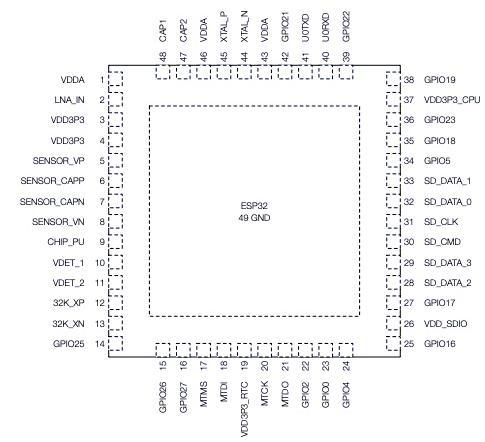
Hardware Description ESP-32
The ESP32 is a versatile and powerful embedded Wi-Fi and Bluetooth LE microcontroller unit (MCU) designed for a wide range of applications. Its uses span from low-power sensor networks to more complex tasks like voice encoding, music streaming,andMP3decoding.AttheheartofthismoduleistheESP32chip,whichisknownforitsscalabilityandadaptability. ThechipfeaturestwoCPUcores,whichcanbemanagedindependently,withaclockfrequencythatcanbeadjustedbetween 80 MHz and 240 MHz. Additionally, a low-power coprocessor allows for energy-efficient tasks like peripheral monitoring withoutusingthemainCPU.
The ESP32 comes with a rich array of peripherals, including capacitive touch sensors, an SD card interface, Ethernet, highspeedSPI,UART,I2S,andI2C.ItsintegrationofbothBluetoothandWi-Fimakesitsuitableforawidevarietyofapplications.
International Research Journal of Engineering and Technology (IRJET) e-ISSN:2395-0056
Volume: 11 Issue: 12 | Dec 2024 www.irjet.net p-ISSN:2395-0072
TheWi-Ficonnectivityprovidesalargephysicalrangeandinternetaccessthrougharouter,whiletheBluetoothfeatureallows convenientconnectionstosmartphonesorlow-energybroadcastingfordetection. Witha sleepcurrentoflessthan5µA,the ESP32 is ideal for battery-powered devices and wearable electronics. It supports data transfer rates of up to 150 Mbps and delivers20dBmoutputpowerattheantenna,ensuringstrongsignalcoverage.
TheESP32runsontheFreeRTOSoperatingsystemwithLwIPandincludesTLS1.2withhardwareaccelerationforsecurity.It alsosupportssecure,encryptedover-the-air(OTA)updates,enablinguserstoeasilyupgradetheirproductsevenpost-release withminimaleffortandcost.[6]
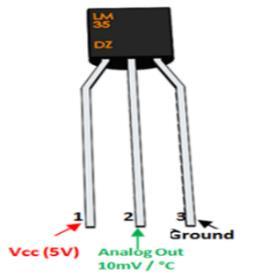
LM-35 sensor:
TheLM35sensorisaprecisiontemperaturesensorthatproducesanoutputvoltagedirectly proportionaltothetemperature inCelsius.UnlikesensorscalibratedinKelvin,theLM35offerstheadvantageofprovidingreadingsinCelsiuswithouttheneed foradditional calculations.Itdoesnotrequireexternal calibrationortrimming,offeringhighaccuracywitha typical errorof ±¼°Catroomtemperatureand±¾°Cacrossitsoperatingrangeof−55°Cto150°C.
The sensor is cost-effective due to its trimming and calibration done at the wafer level. Its low output impedance, linear voltage response, and built-in calibration make it easy to integrate with readout or control systems. It operates with either single or dual power supplies and consumes only 60 μA, resulting in minimal self-heating of less than 0.1°C in still air. The LM35isdesignedtoworkwithinatemperaturerangeof−55°Cto150°C,whiletheLM35Cmodelcoversarangefrom−40°Cto 110°Cwithimprovedaccuracyatlowertemperatures.
International Research Journal of Engineering and Technology (IRJET) e-ISSN:2395-0056
Volume: 11 Issue: 12 | Dec 2024 www.irjet.net p-ISSN:2395-0072
The AD8232 is an integrated signal conditioning module specifically designed for ECG and other biopotential measurement applications.Itextracts,amplifies,andfilterssmall biopotential signals,eveninnoisyenvironments,suchasthosecausedby motion or distant electrode placement. This makes it easier for an ultralow-power analog-to-digital converter (ADC) or embeddedmicrocontrollertocapturetheoutputsignal.
The AD8232 features a two-pole high-pass filter to eliminate motion artifacts and electrode half-cell potentials. This filter works seamlessly with the amplifier's architecture to provide both high gain and filtering in a single stage, optimizing space andcost.Additionally,itincludesanuncommittedoperationalamplifierthatcanbeusedtocreateathree-polelow-passfilter toreduceadditionalnoise,withcustomizablefrequencycut-offstofitdifferentapplications.
To improve noise rejection, particularly of line frequency interferences, the AD8232 includes an amplifier for driven lead applications, like the right leg drive (RLD). It also features a fast restore function, which shortens the recovery time after an abruptsignal change,suchaswhen electrodesare disconnected.Thisallowsthesystemtoreturntoaccurate measurements quicklyafterreconnection.
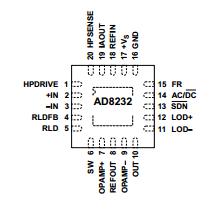
TechnicalSpecificationsofAD8232sensor
AnalogOutput:Providescontinuousanalogsignaloutput.
OperatingVoltage:3.3VDC,suitableforlow-powersystems.
LowPowerConsumption:Drawsonly170µA,idealforbattery-operateddevices.
NoiseRejection:Capableofrejecting60Hznoisewithahighratingof80dB.
HighGainAmplification:Featuresagainof100,alongwithDCblockingforaccuratesignalamplification.
RightLegDrive(RLD):Integratedrightlegamplifierforbetternoisereduction.
RFIFiltering:Built-infilteringtominimizeradiofrequencyinterference.
PowerManagement:Equippedwithashutdownpinforconservingpower.
ElectrodeConnection:Usesastandard3.5mmminiplugforelectrodeinput.
FlexibleElectrodeConfiguration:Canbeusedwith2or3electrodesbasedontheapplication.
International Research Journal of Engineering and Technology (IRJET) e-ISSN:2395-0056
Volume: 11 Issue: 12 | Dec 2024 www.irjet.net p-ISSN:2395-0072
How to Read an ECG:
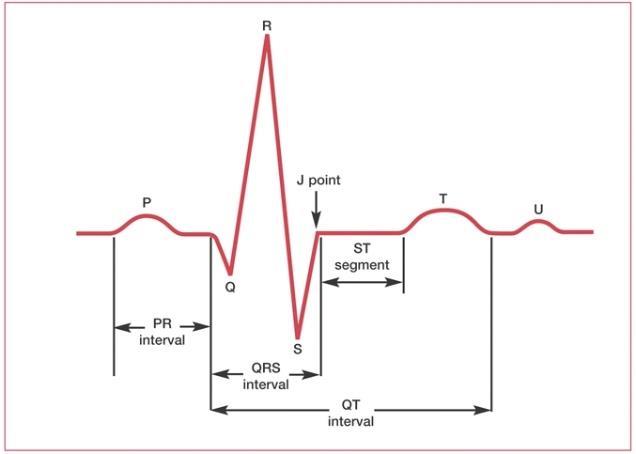
Figure.6Typicalexampleofheartbeat[8]
The normal rhythm of an electrocardiogram (ECG) is characterized by three key components: the P wave, the QRS complex, andtheTwave.TointerpretanECGeffectively,it'sessentialtoassessthepresence,shape,anddurationofthesewaves,along withtheSTsegment.TheSTsegmentrepresentsthetimebetweentheendofventriculardepolarizationandthebeginningof repolarization.AnormalSTsegmentmeasureslessthan1mm;ifitexceedsthis,itmayindicateconditionssuchasinfarction orischemia.
The P waves help determine the interval between heartbeats, appearing as a straight line connecting the lowest and highest pointsontheECGtrace.TheTwave,whichfollowstheQRScomplex,signifiestheconclusionoftheheartbeatandrepresents a subtle, detectable beat. Throughout the ECG recording, the intervals between the P waves and T waves should remain relatively consistent. If there is noticeable variability in these intervals during the test, it may suggest an irregular heartbeat.[8]
The MAX30100 is an integrated sensor solution for pulse oximetry and heart rate monitoring. It combines two LEDs, a photodetector,optimizedoptics,andlow-noiseanalogsignalprocessingtoaccuratelydetectpulseandheartratesignals.The sensorcanoperatewithpowersuppliesof1.8Vto3.3Vandfeaturesasoftware-controlledpower-downmodewithnegligible standbycurrent,allowingforconstantconnectiontothepowersupply.
FeaturesofMAX30100:
LowPowerConsumption:Operatesefficientlyfrom1.8Vto3.3V.
Ultra-LowShutdownCurrent:Typicallyconsumesonly0.7µAinshutdownmode.
FastDataOutputCapability:Enablesquickandefficientdatatransmission.
WorkingPrincipleoftheMAX30100PulseOximeterandHeartRateSensor:
The MAX30100 uses two LEDs: one emits red light, and the other emits infrared light. For measuring pulse rate, only the infrared light is required, while both light sources are utilized to assess oxygen levels in the blood. When the heart pumps, thereisanincreaseinoxygenatedblood,resultinginahighervolumeofblood.Astheheartrelaxes,thevolumeofoxygenated blood decreases. By analyzing the time interval between the increase and decrease in oxygenated blood, the device can determine the pulse rate. Oxygenated blood absorbs more infrared light and allows more red light to pass through, while deoxygenated blood absorbs red light and permits more infrared light. The MAX30100 reads the absorption levels of both lightsources,storingthedatainabufferthatcanbeaccessedviaI2Ccommunication.
International Research Journal of Engineering and Technology (IRJET) e-ISSN:2395-0056
Volume: 11 Issue: 12 | Dec 2024 www.irjet.net p-ISSN:2395-0072
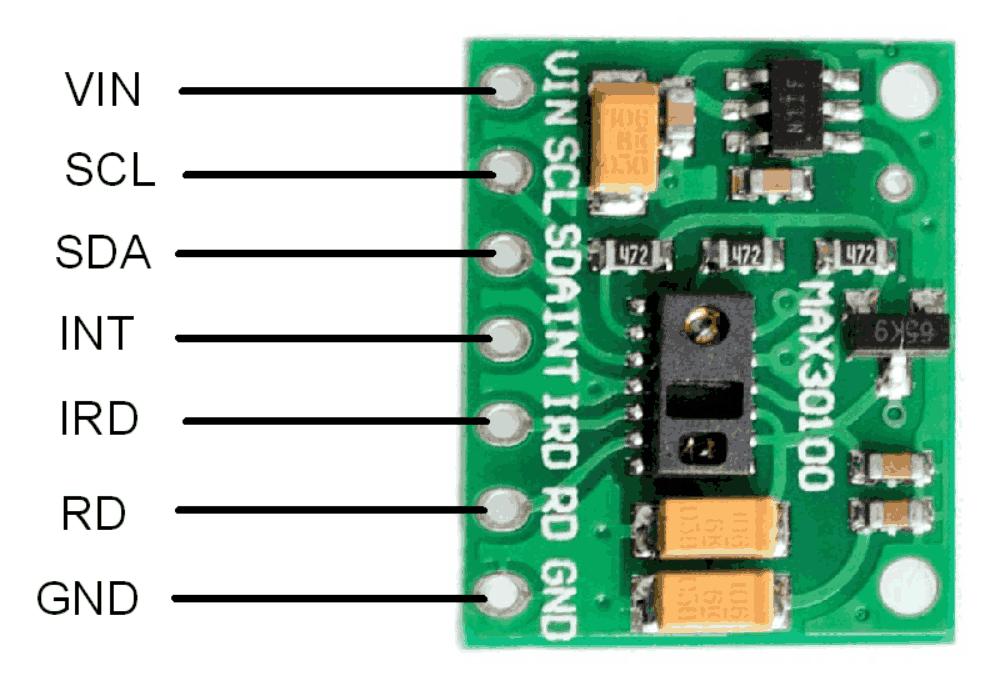
PinDescription
VIN:Powersupplypinconnectsintherangeof
GND:ConnecttoSupplyground.
SCL:SerialClockpinforI2CSerialCommunication.
SDL:SerialDatapinforI2CSerialCommunication.
INT:ActiveLowInterruptpin.
IRD:IRLEDCathodeandLEDDriverConnectionpin.
RD:RedLEDCathodeandLEDDriverConnectionpin.
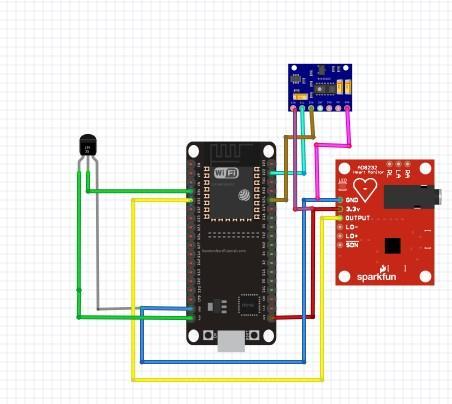
Total interfacing Diagram
International Research Journal of Engineering and Technology (IRJET) e-ISSN:2395-0056
Observations for LM35 sensor after interfacing with ESP32
The LM35 temperature sensor, AD8232 and MAX301000 sensers are individually interfaced with ESP32 and first individual resultsaretaken.
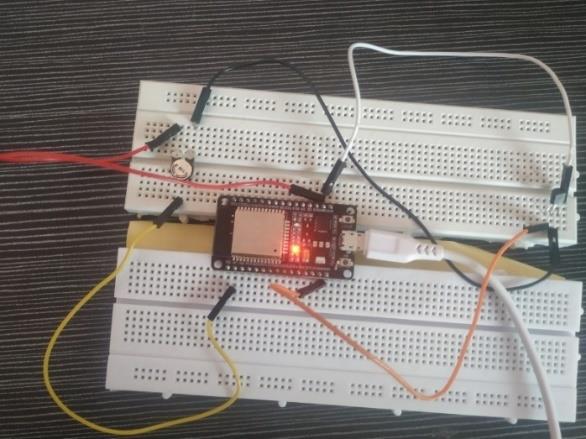
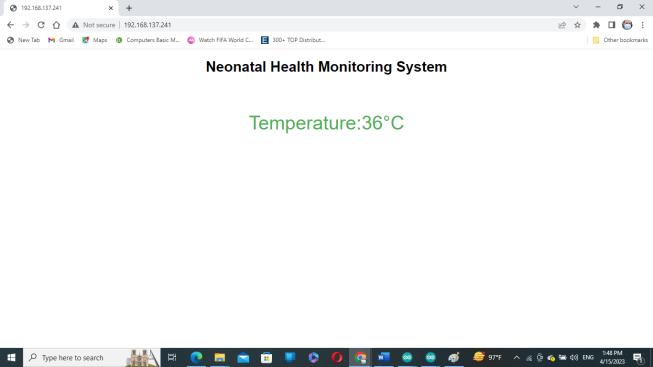
Thefigure12belowshowstheconnectionofLM35withESP32,thecodescreenshotandtheserialmonitoroutput.
Volume: 11 Issue: 12 | Dec 2024 www.irjet.net p-ISSN:2395-0072 © 2024, IRJET | Impact Factor value: 8.315 | ISO 9001:2008 Certified
Volume: 11 Issue: 12 | Dec 2024 www.irjet.net p-ISSN:2395-0072
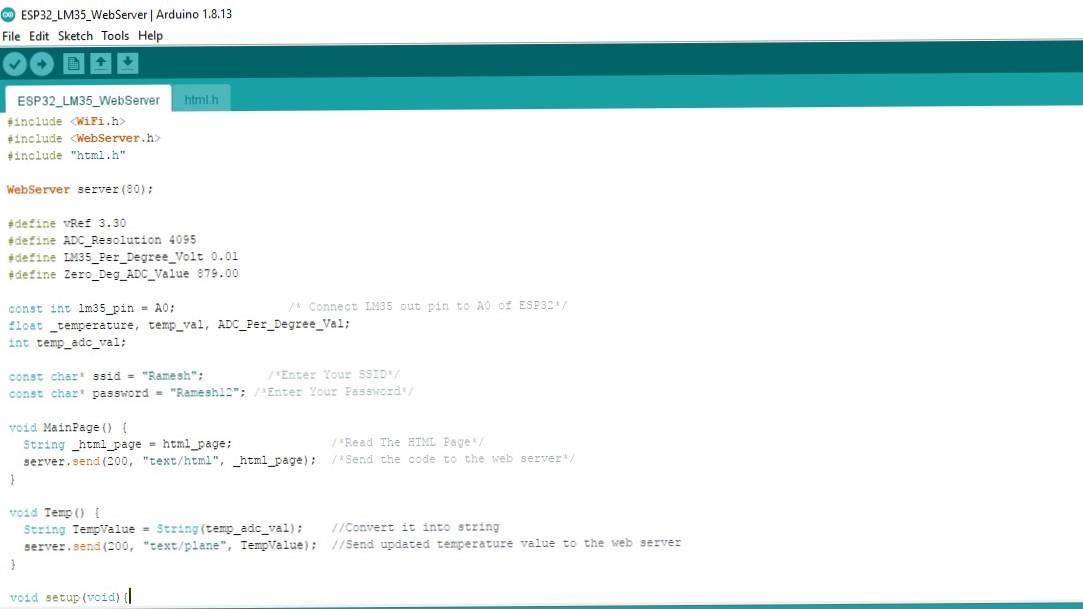
TheLM35temperaturesensoroperateswithinatemperaturerangeof-55°Cto150°Candoffersanaccuracyof±0.4°Catroom temperature. It outputs a voltage that is directly proportional to the temperature it measures. The proportional factor, also knownasthescalingfactororresolution,issetat0.01V/°C.ThismeansthatforeachdegreeCelsiusincreaseintemperature, theLM35providesanoutputof100mV.
When the LM35 sensor is interfaced with ESP32 and connected with Arduino IDE and the code is run, the output of LM35 sensorcan beviewedinserial monitor.ThecodewrittenherecanshowthetemperaturereadingintheCelsius.Atthesame timeiftheESP32isconnectedwiththeWi-Fi,wecanviewaReal-timeweb-portaldisplayingthesamedatathatisdisplayedin the serial monitor. The Real-time web-portal is accessible by anywhere if it is hosted in the internet. For this project we can accesstheweb-portalbyusinglocalIPaddress.TheLocalIPaddressisgeneratedanddisplayedintheserialmonitor.
ThevoltagedropofLM35isunstable,thusthetemperaturereadingisalsobeingdrasticallychange.Tosolvethisproblem,we canuseRCDamperCircuitandaDecouplingCapacitor.
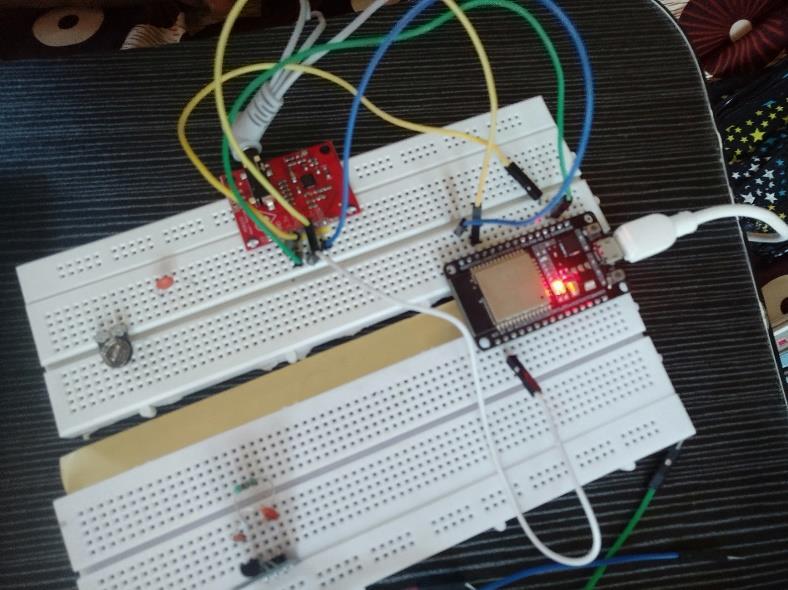
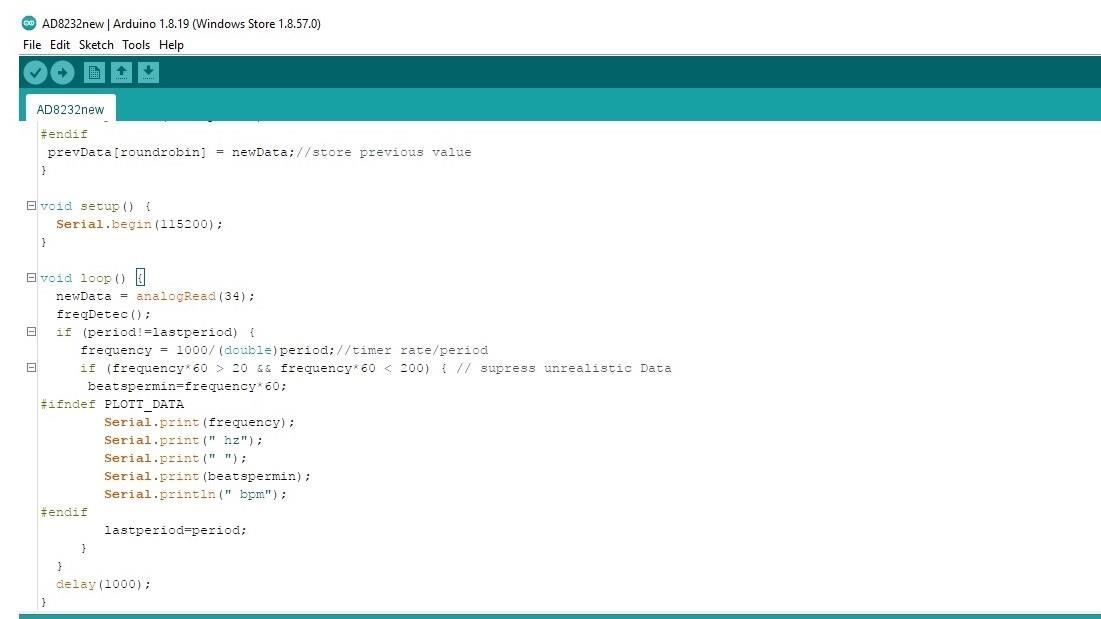
TheAD8232sensorenablestherecordingoftheheart'selectricalactivitybyobtaininganelectrocardiogram(ECG).Itdetects signalsgeneratedbyheartbeats,aselectrical signalstravel alongspecific pathways withinthehearttoinitiatetheheartbeat. Theseelectricalsignalscanbecapturedusingelectrodesplacedontheskin,typicallyonthechest,arms,andlegs.
The AD8232 module is equipped with specially calibrated signal amplifiers and noise filters tailored for ECG signals. It effectivelysuppresses60Hznoisecommonlygenerated byhouseholdelectrical sources.Sincethemoduleoutputsananalog signal,itisessentialtosolderheaderpinsandconnectittoamicrocontrollerwithanalog inputcapabilities,suchasArduino, ESP32,orESP8266.Intheaccompanyingprogram,analog-to-digitalconversionmustbeperformedtovisualizetheECGdata ontheArduinoIDEplotter.
International Research Journal of Engineering and Technology (IRJET) e-ISSN:2395-0056
Volume: 11 Issue: 12 | Dec 2024 www.irjet.net p-ISSN:2395-0072
ThefigurebelowshowsthecircuitconnectionandcodeonArduinoIDE.
Observations for MAX30100 sensor after interfacing with ESP32
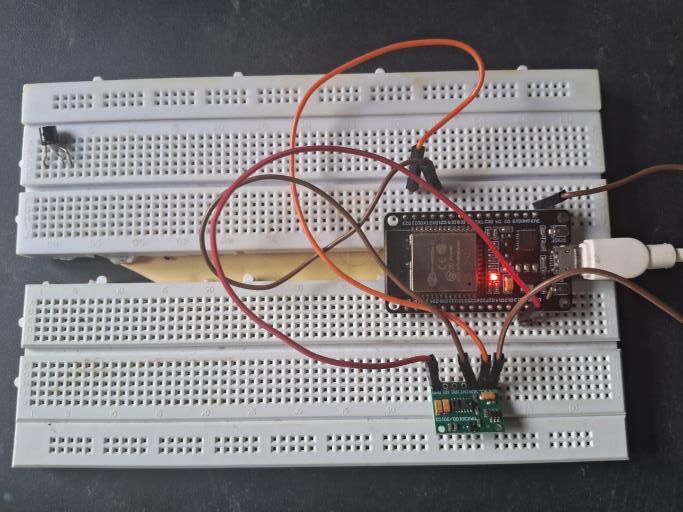
The MAX30100 Pulse Oximeter is a device that is used to measure blood oxygen saturation levels, heart rate, and pulse strengthformedicalpurpose.Itisusedtomeasureoxygensaturationlevelsinthebloodbyusinganon-invasivemethod.This modulehasapairofLEDsthatemitamonochromaticredlightatawavelengthof660nmandinfraredlightatawavelengthof 940nm. As the photodiode emits light, it touches the finger and gets absorbed by the oxygenated blood remaining light is reflectedthroughthefingerandfallsonthedetector.Thedetectordetectsandprocessesthesignalsandgivestheoutput.
© 2024, IRJET | Impact Factor value: 8.315 | ISO 9001:2008 Certified Journal | Page412
International Research Journal of Engineering and Technology (IRJET) e-ISSN:2395-0056
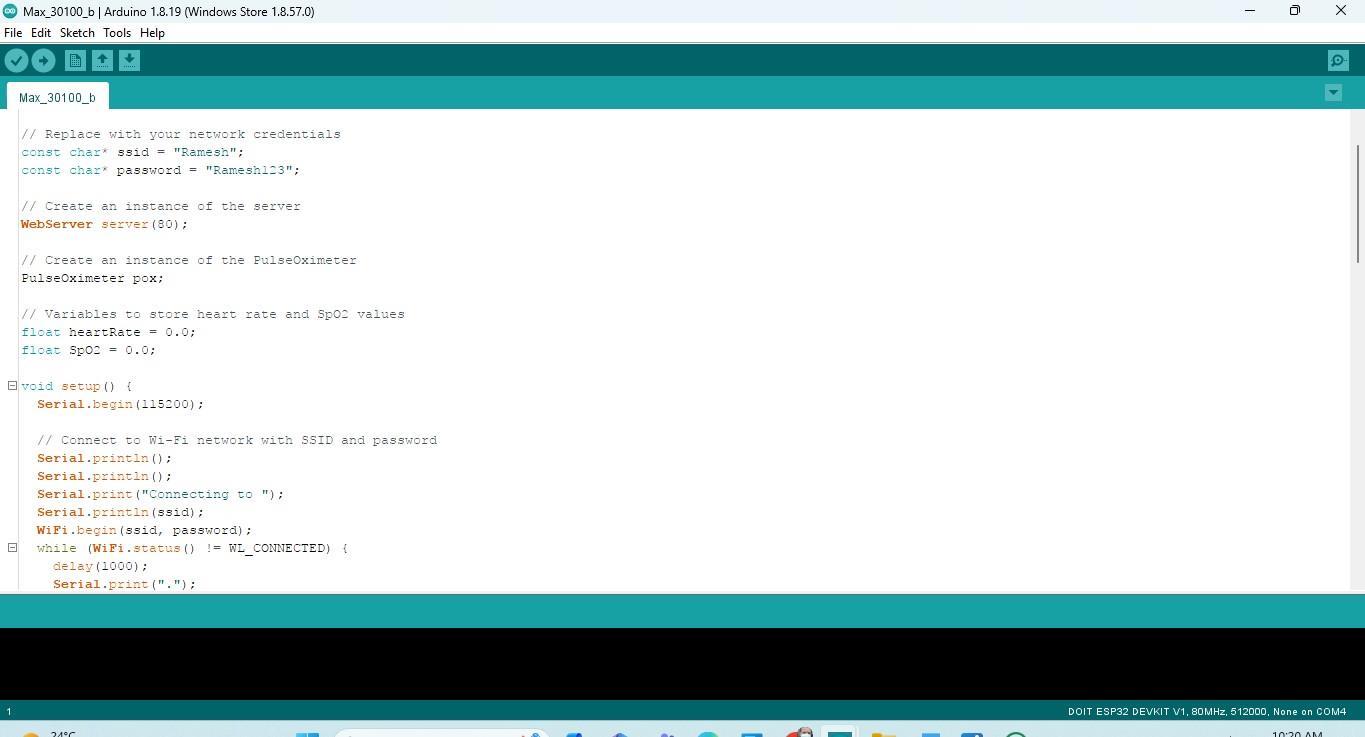
WhenMAX30100isinterfacedwiththeESP32,theconnectiondiagramandoutputwillbeasshownbelow
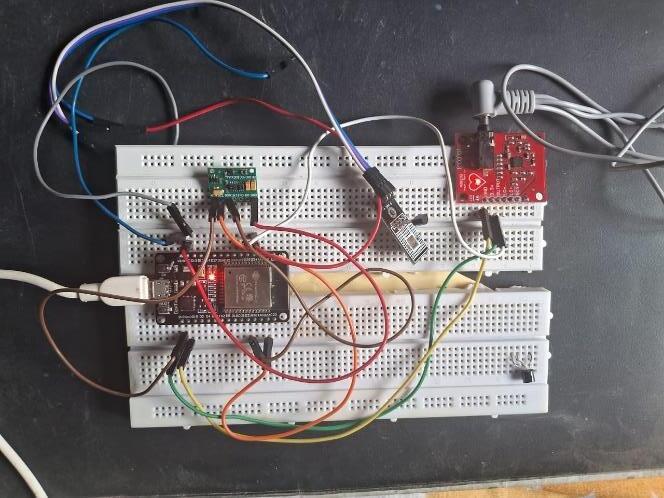
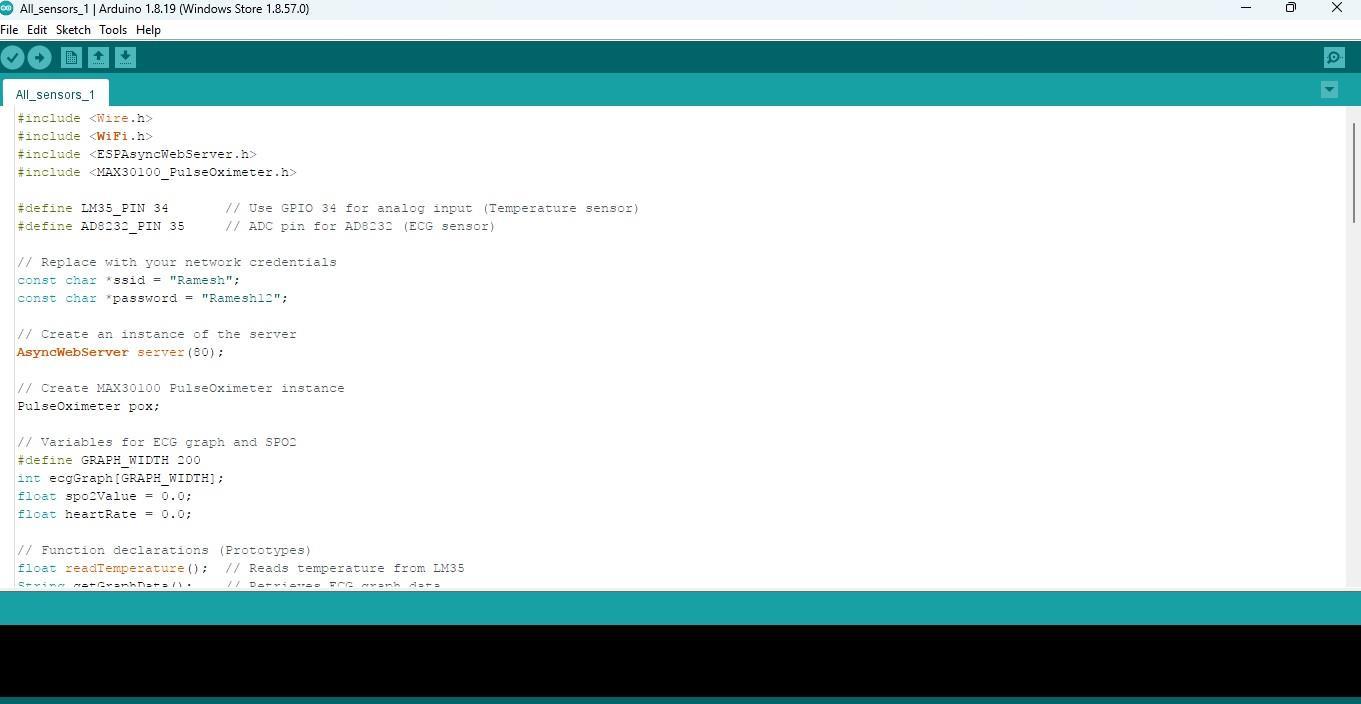
Observations for LM35, AD8232 and MAX 30100 sensor after interfacing with ESP32
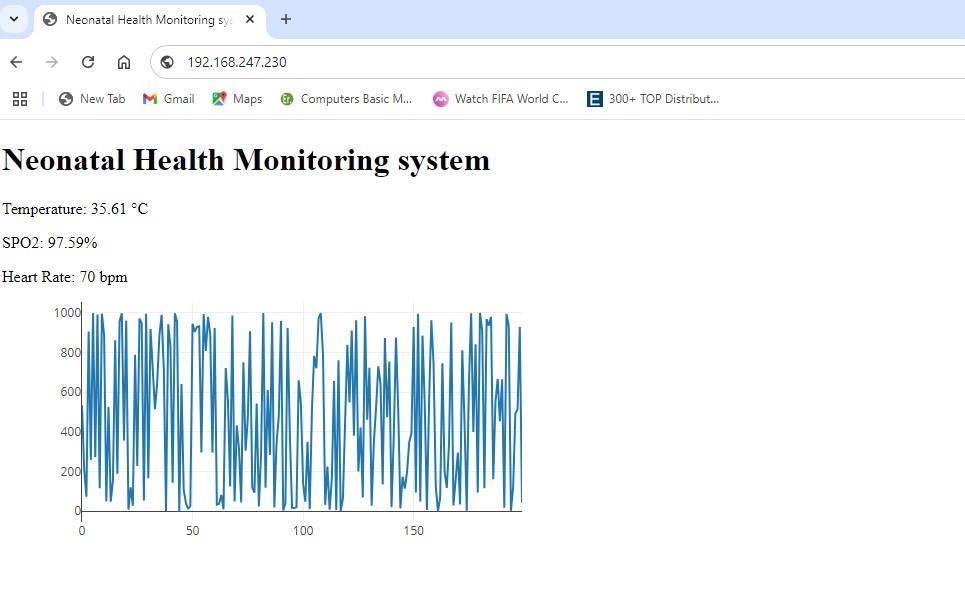
WhenallthesensorsLM35temperaturesensor,AD8232sensorandMAX30100sensorareinterfacedwithESP32andasper thisprojectthefinalwebportalisobservedsuccessfully.Thefinalconnectionandoutputisshowninthefigurebelow.
Volume: 11 Issue: 12 | Dec 2024 www.irjet.net p-ISSN:2395-0072 © 2024, IRJET | Impact Factor value: 8.315 | ISO 9001:2008 Certified Journal | Page413
International Research Journal of Engineering and Technology (IRJET) e-ISSN:2395-0056
Volume: 11 Issue: 12 | Dec 2024 www.irjet.net p-ISSN:2395-0072
International Research Journal of Engineering and Technology (IRJET) e-ISSN:2395-0056
6. Conclusion
Thisprojectaimstosolvetheproblemoftele-medicineforneonates.Hereinthisproject,mainlythreesensorsare supposed to be used to measure the body temperature, ECG, heart beat rate and SPO2. These sensor values obtained are directly uploaded in the Real-Time web-portal. The real- time web-portal can be accessed by pediatrician directly and he/she can observe the values obtained by these sensors and do the necessary examine. This project will be very helpful for the area in thedevelopingcountrieswherethereisunavailabilityofthepediatricianeasily.Generally,pediatriciansareavailablein urban areas and the neonates in the rural and suburban areas does not get the opportunity to get medical support from the pediatrician.
Inthisproject,TheLM35,AD8232andMAX30100sensorsarecompletelyinterfacedwithESP32andacompleterealtime web-portal is developed. The real time web-portal will give the information regarding the temperature, body oxygen level(SPO2),heartbeatandECGgraphofneonatesintherealtime.
References
[1] Gyselinckx et al., "Human++: Autonomous Wireless Sensors for Body Area Networks," IEEE 2005 Custom Integrated CircuitsConference
[2]A.Juric&A.Weaver,“RemoteMedicalMonitoring”,IEEEComputer,PP96-99April2008
[3] AkkayaK. &YounisM, “survey A onrouting protocols for wireless sensor networks” Elsevier Journal of AdHoc Networks. (2005)
[4]H.W.Kim,D.Kyue,“TechnologyandSecurityofIoT”,J.KoreaInstit.Informat.Secur.Cryptol.22(1)(2012)7–13.
[5]WorldHealthOrganization.(1998).AhealthtelematicspolicyinsupportofWHO’sHealth-For-Allstrategyforglobalhealth development: Report of the WHO group consultation on health telematics, 11–16 December 1997, Geneva. Geneva: World HealthOrganization.
[6]ESP32-WROOM-32Datasheetv3.4
Volume: 11 Issue: 12 | Dec 2024 www.irjet.net p-ISSN:2395-0072 © 2024, IRJET | Impact Factor value: 8.315 | ISO 9001:2008 Certified Journal | Page415 Figure18finaloutputonthewebportal
International Research Journal of Engineering and Technology (IRJET) e-ISSN:2395-0056
Volume: 11 Issue: 12 | Dec 2024 www.irjet.net p-ISSN:2395-0072
[7]AD8232DatasheetRev.D.
[8]EuanAAshleyandJosefNiebauer,“CardiologyExplained”,RemedicaPublishing;1stedition,2003.
[9]Chen,H.,Bao,S.,Lu,C., Wang,L.,Ma,J., Wang,P.,Lu,H.,Shu,F.,Oetomo,S.B., &Chen, W.(2020).Designofanintegrated wearablemulti-sensorplatformbasedonflexiblematerialsforneonatalmonitoring.IEEEAccess,8,1–10.
[10] Duncan, H. P., Fule, B., Rice, I., Sitch, A. J., & Lowe, D. (2020). Wireless monitoring and real time adaptive predictive indicatorofdeterioration.NatureScientificReports,10,Article11366.
[11] Amira, S., Asmira, N., Nadzlin, T., Helmy, M. A., Omar, A. H., Shukri, M. A., & Alabqari, M. R. (2020). Neonatal health monitoringsystemwithIoTapplication.JournalofPhysics:ConferenceSeries,1529,1–8.
[12] de Oliveira Filho, J. I., da Mota Almeida, O., Yousef, N., & Salama, K. N. (2019). Non-invasive IoT sensing and monitoring systemforneonatalcare.In2019IEEE31stInternationalConferenceonMicroelectronics(pp.1–6).
[13] Kumar, M. S., Ronali, R., Megha, K., & Shaikh, S. F. (2018). Design and development of infant monitoring using smart wearablesystem.InternationalJournalofEngineeringResearch&Technology(IJERT),7(6),1–10.
[14] De, D., Mukherjee, A., Sau, A., & Bhakta, I. (2016). Design of smart neonatal health monitoring system using SMCC. HealthcareTechnologyLetters,4(1),1–7.
[15]Lin,C.C.,Yang,C.Y.,Zhou,Z.,&Wu,S.(2018).Intelligenthealthmonitoringsystembasedonsmartclothing.International JournalofDistributedSensorNetworks,14(8),1–10.
2024, IRJET | Impact Factor value: 8.315 | ISO 9001:2008