
Volume: 11 Issue: 12 | Dec 2024 www.irjet.net
International Research Journal of Engineering and Technology (IRJET) e-ISSN: 2395-0056 p-ISSN: 2395-0072


Volume: 11 Issue: 12 | Dec 2024 www.irjet.net
International Research Journal of Engineering and Technology (IRJET) e-ISSN: 2395-0056 p-ISSN: 2395-0072

1Bachelor of Engineering, Information Science and Engineering, Bapuji Institute of Engineering and Technology, Karnataka, India
2Bachelor of Engineering, Information Science and Engineering, Bapuji Institute of Engineering and Technology, Karnataka, India [3][4]
Abstract - Millionsofpeopleareimpactedbymentalhealth issues every year, which has led to an increase in concern worldwide. The accuracy, consistency, and timeliness of traditional diagnostic techniques which mostly rely on patient self-reporting and clinical evaluations are frequently questioned. Recent developments in artificial intelligence (AI) provide a revolutionary methodofdiagnosing mental health issues by utilizing machine learning algorithms that can analyze large amounts of data, such as voice, physiological signals, andbehavioralpatterns. ThisstudyexamineshowAI might increase the precision, effectiveness, and scalability of mental health diagnosis. It does this byreviewing existing AI applications, their possible advantages, and related difficulties. Healthcare professionals can improve early detection and intervention tactics, resulting in more individualized therapy and improved patient outcomes, by utilizing AI. However, moral dilemmas and the requirement forstrongvalidationmodelsremaincriticalfactorsforfuture developments.Thestudyconcludes bydiscussingthepotential for AI to complement human expertise in creating a more efficientandaccessiblementalhealthdiagnosticframework.
Key Words: Mental Health Diagnosis, AI in Healthcare, Personalized Treatment, Healthcare Scalability, Data Analysis.
Global healthcare systems face a serious issue as the prevalence of mental health diseases rises. Conventional diagnostictechniques,whichfrequentlydependonclinical observationandsubjectivereporting,canbelaboriousand inconsistent. However, the emergence of artificial intelligence (AI) presents a once-in-a-lifetime chance to transformmentalhealthdiagnosis.Largevolumesofpatient data might be analyzed by AI systems driven by machine learning algorithms, which could then identify minute patternsandcorrelationsthatcouldbemissedbyhumans. Thisskillmakesitpossibletoidentifymentalhealthissues earlier and with more accuracy, allowing for prompt interventions that can significantly enhance patient outcomes. In this study, we examine how AI-powered technologies are revolutionizing mental health diagnosis, improving accessibility, scalability, and precision while tacklingsomeofthelongstandinglimitationsofconventional

approaches. By leveraging AI technology, mental health professionalscannowprovidepersonalizedtreatmentplans basedonindividualpatientdata,leadingtomoreeffective and efficient care. Additionally, AI-driven tools have the potential to reduce stigma surrounding mental health by offering a more objective and data-driven approach to diagnosisandtreatment.
Inthesubjectofpsychometrics,whichanalyzespsychological traits, behaviors, and cognitive skills statistically, computationalpsychometricsappliesmachinelearningand artificialintelligenceapproaches.Behavioralanalytics,onthe other hand, uses data-driven techniques to examine individuals'behaviors,responses,andpatterns.Bygleaning valuableinsightsfromvast,intricatedatasetsthatcomprise behavioral,emotional,andcognitivemarkers,thesedomains worktogethertouseAItoevaluatementalhealth.
Neurocomputational modeling is the practice of simulatingthebrain'sneuralprocessesusingcomputational methods.Bybuildingmathematicalandalgorithmicmodels that replicate brain activity, this method aids in the understandingofhowneuralcircuitsaffectbehavior,mental health, and cognition. Contrarily, cognitive diagnostics focuses on evaluating and analyzing cognitive processes, including memory, attention, reasoning, and decisionmaking, in order to identify deficiencies or diseases. Combining these two areas allows AI-driven neurocomputational models to replicate patterns of brain activity linked to particular illnesses, thereby diagnosing mentalandcognitivehealthissues.
Machine learning (ML) has emerged as a pivotal tool in mental health assessment, leveraging sophisticated algorithmstoanalyzecomplexdatasetsanduncoverpatterns thattraditionalmethodsmay overlook.Byfacilitating the

Volume: 11 Issue: 12 | Dec 2024 www.irjet.net
International Research Journal of Engineering and Technology (IRJET) e-ISSN: 2395-0056 p-ISSN: 2395-0072
extraction of actionable insights from diverse sources of data,MLenhancestheprecisionandefficiencyofmental healthdiagnosticsandtreatmentstrategies.
Machine learning (ML) utilizes algorithms to analyzedataandidentifypatterns.
It enhances mental health assessment by processing complex datasets for better diagnosticsandtreatment.
Table -1: MachineLearningTechniquesinMental HealthAssessment
Technique
Supervised Learning
Applications
Predictingmental healthdisorders
Outcomes
Improveddiagnostic accuracy
Unsupervised Learning Discovering subtypesofmental healthdisorders Identificationof hiddenpatterns
Natural Language Processing (NLP) Discovering subtypesofmental healthdisorders Insightinto emotionalstates
DeepLearning Processing multimodaldata (neuroimaging, speech)
Predictive Modeling
Comprehensive understandingof cognitivestates
Riskassessmentfor mentalhealth disorders Proactive managementof patientcare
Anothergame-changingcomponentofmachinelearning inmentalhealthisnaturallanguageprocessing,orNLP. Meaningful insights into emotional states and cognitive processescanbeextracted byNLPthroughthe analysis of patient narratives and physician notes. The effectiveness of treatmentcanbe improved, forexample, by giving physicians a better knowledge of a patient's mental state over time through sentiment analysis of therapysessiontranscripts.
Athoroughunderstandingofmentalhealthdisorderscan be attained by integrating multimodal data, including behavioral metrics and neuroimaging, through deep learning,especiallywhenneuralnetworksareused.This capacity is especially crucial for identifying complicated illnesseswheresymptomscandiffergreatlyfromperson to person, such as bipolar disorder or schizophrenia. Through the predicting of possible dangers based on previous data, predictive modeling further improves mental health assessments. Algorithms trained on electronic health information, for instance, can forecast a patient's propensity to relapse or react to particular therapies, allowing physicians to take preemptive preventativeaction.capacityisverycrucial.
Chart-1: ImpactofMachineLearningTechniquesonMental Health
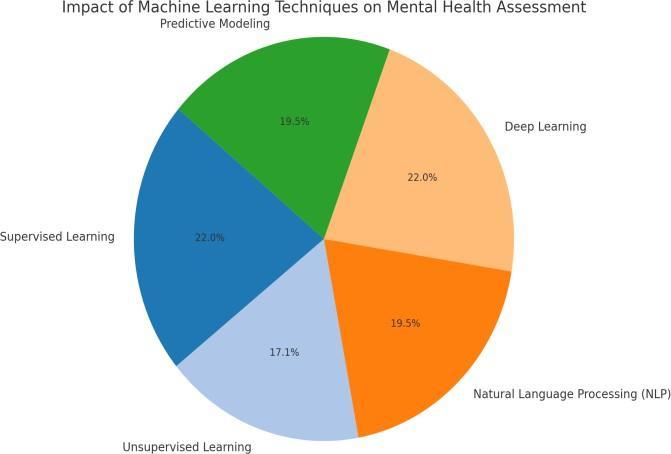
Notwithstanding the potential of these methods, issues like algorithmic bias, data privacy, and the requirement for interpretability continue to be major worries. To guarantee the moral use of machine learning in mental health, these concerns must be addressed. The application of machine learning to clinical practice has enormous promise to enhance mental health diagnosis, treatment, and overall patientoutcomesasthisfieldofstudydevelops.
Artificial Intelligence (AI) is revolutionizing mental healthcare by addressing the limitations of traditional diagnostic and treatment methods. In order to diagnose mental health disorders, self-reported questionnaires, exams, and patient interviews have long been used. However,thesemethodsonlyofferabriefandconstrained picture of a person's mental health. By evaluating a variety of data sources, such as audio, video, and behavioral patterns, AI improves this process and provides faster, more precise diagnoses. With 80% accuracy,IBM'sAItoolcanrecognizeindicatorsofmental illnessbyanalyzingspeechpatterns,whilevideo-basedAI systems can identify diseases like ASD and ADHD with 96% accuracy. Additionally, Quartet and other tools employ AI-powered questionnaires to effectively test for commonproblemslikeanxietyandsadness.
Treatment Advancements: Determining the precise mental condition a patient may have is the first step in treating mental health issues. Traditionally, behavioral patternsareobservedorrepetitivequestionnairesareused to do this. AI has the ability to improve these traditional approaches' effectiveness. Over 50% of the world's population uses smartphones. By reducing the need for time-consuming and expensive trips to mental health clinics, AI-based applications can improve accessibility. Moreover, it assists mental health experts in spreading their services toa broader audience.Therearenumerous AI-based applications available to help people manage their depression. Although these applications are not a
Volume: 11 Issue: 12 | Dec 2024 www.irjet.net
International Research Journal of Engineering and Technology (IRJET) e-ISSN: 2395-0056 p-ISSN: 2395-0072
substitute for a healthcare provider's diagnosis or treatment of mental health issues, they are useful resources for those in cooperation with medical professionalsormentalhealthspecialists.
ArtificialIntelligence(AI)isprovingtobeagamechanger in mental healthcare, providing substantial advantages in detection, diagnosis, and treatment. In a healthcare landscape where time is a precious resource, AI efficiently analyzes diverse data sources, offering a nuanced understanding of mental health conditions. This technology is particularly beneficial for mental health practitioners, streamlining documentation processes and allowing more focus on patient care. AI algorithms contribute to creating comprehensive therapeutic reports and personalized treatment plans. Moreover, AI facilitates remote therapy sessions, making mental health support more accessible, especially in remote areas. By leveraging digital interventions like web and smartphone apps, AI enhancesuserexperience,tailoringmentalhealthcareto individual needs. Despite challenges, AI stands as a powerful tool in transforming mental healthcare, providing innovative and effective solutions for better patientoutcomes.
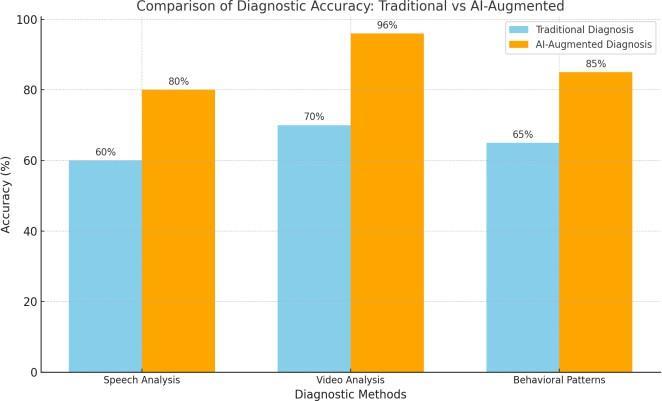
AI is revolutionizing mental health care by offering creative solutionsthatallowforindividualizedcareand life-changing insights, tackling some of the most important issues facing the industry. The subjective evaluations, interviews, and questionnaires used in traditional techniques of diagnosing and tracking mental health disorders can be laborious and have a narrow focus. A more effective option is provided by AI, which analyzes a variety of data, including speech, video, and behavioral patterns, to remarkably accurately identify indicators of mental health problems. Artificial intelligence- powered technologies for voice and video analysis, for example,canaccurately identify symptoms ofdisorderslikedepression,ADHD,andASD,increasing thelikelihoodofearlydiagnosisandintervention.
Furthermore,AIisassistinginclosingthegapcausedby the worldwide scarcity of mental health specialists. AI increases access to mental health services through smartphone applications, especially in underserved or remoteplaceswheretraditional resources are scarce. In addition to helping with medicine reminders and symptomtracking,appsliketheones above also employ behavioral information, like communication and phone usage patterns, to track mental health. More proactive and individualized care is made possible by these tools, which also improve patient engagement and give physiciansmeaningfuldata.
AI-powered mental health technologies are also useful as supplemental resources for medical providers. By automating repetitive tasks, developing individualized treatment plans, and facilitating continuous patient monitoring, they greatly improve the capacity of qualified clinicians to provide care, even if they cannot completely replace human knowledge. By enabling people to actively manage their illnesses, including anxiety and depression, this integration lessens the strainonmentalhealthsystems.
AI has the ability to completely transform mental healthcare as it develops. AI is revolutionizing mental health support by increasing accessibility, providing scalable, customized solutions, and enhancing diagnostic accuracy. It has the potential to offer more people individualized, cost-effective, and high-quality care, opening the door to a more effective and inclusive mental health care system. The urgent demand for bettermentalhealthcareonaglobalbasisismetbythis innovative strategy, which guarantees that mental healthservicesbecomemoreaccessibleandeffective.
AI has proven to be quite useful in identifying medical diseases by employing advanced machine learning techniques such as Boltzmann machines, support vector machines (SVM), and K-Nearest Neighbor (kNN). These methodsenablediseaseidentificationanddiagnosisusing data-driven approaches that emphasize generalizability, ormodels'capacityto function successfullyonnewdata. AIsubsets,suchasmachinelearningandcomputervision, are very useful in medical imaging because of their segmentation, imaging analysis, and prediction capabilities.Forexample,computervisionmakesiteasier to recognize, segment, and classify radiological pictures, which can help identify diagnostic categories or detect theexistenceofmetastases.
AIapplicationsinmentalhealthhavemadetremendous progress in detecting difficult disorders such as schizophrenia, a severe disorder marked by hallucinations, delusions, and distorted perceptions of reality. Khan et al. suggested a deep neural network model that uses genome sequencing data to build featurerepresentationstodiagnoseschizophrenia.
Volume: 11 Issue: 12 | Dec 2024 www.irjet.net
International Research Journal of Engineering and Technology (IRJET) e-ISSN: 2395-0056 p-ISSN: 2395-0072
Despite its novel approach, the model produced a small areaunderthecurve(AUC)of0.57,demonstratingboth the potential and constraints of using AI in this sector. These breakthroughs illustrate AI's transformational significancein increasingdiagnosisaccuracyandopening upnewavenuesformedicalandmentalhealthcare.
Artificialintelligence(AI)hasshownincrediblepromise in detecting mental health disorders by utilizing datadriven methodologies to improve accuracy and dependability. AI improves the accuracy of new patient diagnoses by using training datasets from previous diagnoses. Furthermore, AI excels in distinguishing between illnesses with similar symptoms but different treatment approaches, such as differentiating between bipolar and unipolardepression based on brain imaging features or identifying dementia types using structural MRI images. AI can discover novel illness subtypes by combiningdemographic,neurocognitive,andbiomarker profiles, bringing further insight into mental health diseases.
In psychiatric care, where the course of illnesses frequently affects diagnosis, AI's capacity to examine data over long periods of time is very beneficial. Sen et al., for instance, createdagenerativeautoencodermodel to diagnose Attention Deficit Hyperactivity Disorder (ADHD) by using spatial latent representation from fMRI and sMRI data. This model achieved up to 67% classification accuracy by using multimodal input features. These developments highlight how AI is revolutionizing mental health by facilitating early identification,sophisticatedillnessdistinction,andmore individualizedtreatmentplans.
Machine learning (ML) techniques have emerged as valuable tools in mental health prediction, utilizing advanced statistical and probabilistic methods. These techniques enable researchers to extract important insightsfromdata,personalizeexperiences,anddevelop automated intelligent systems. Widely used machine learning algorithms, such as support vector machines, random forests, and artificial neural networks, are instrumental in forecasting and categorizing future events related to mental health. Supervised learning is the most used machine learning technique in medical research, especially for sickness prediction. Labeled data, with particular properties and values indicating the instances withinthedata collection, is used to train the system in supervised learning. Tasks involving classification and prediction using structured training data are possible with this approach. Conversely, unsupervised learning seeks to reveal hidden patterns or structures in the data and does not rely on labeled data. The intricacy and specificity needed in healthcare settings hinder the therapeutic implementation of unsupervisedlearning,despiteitsenormouspotential.
Theprocessofdiagnosingmentalhealthissuesinvolves severalstepsandtakesalotoftime.Aplannedinterview that covers symptoms, medical history, and physical examination usually comes first. To provide a more thorough examination of a person's mental health, psychological tests and assessment instruments are also commonly used. The promise of new diagnostic techniques has been demonstrated by creative research that has investigated the analysis of facial movements to identifyparticularmentaldiseases.
Chart-3: Correlationb/wStress,SleepandMentalHealth Severity
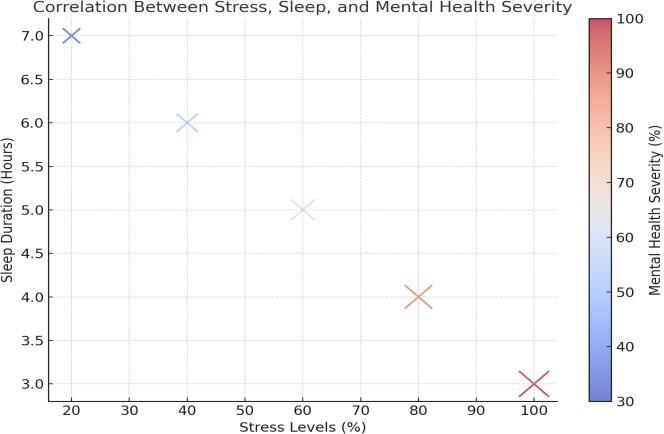
In the discipline of computer science, data processing and management have become a hot topic. Finding valuable patternsandlinkagesinvastamountsofdatais known as data mining, or knowledge discovery in databases.Data miningtechniquesare beingusedmore and more in the medical profession for tasks including genomics, medication design, and text expression. Supervised learning and unsupervised learning are the twocategoriesintowhichdataminingtechniquescanbe divided. Through the group's data, itfinds patterns and assesses an object's similarity for unsupervised learning.Itcanbedividedintofourcategories:sequence discovery,association,summarizing,andgrouping.When the data set is unlabeled, unsupervised learning is very useful for automatically identifying the data's structure throughlearningintrinsicfrominputdata.
Oneofthemostimportantmethodsincomputerscienceis data mining. Through data mining, the intricacy of the gathereddatasetscanberesolvedquickly.Additionally, data mining can benefit numerous parties by improving results and finding answers to their difficult issues. An application of artificial intelligence (AI) is machine learning, which creates systems that can learn from their experiences and get better without explicit programming. Natural language processing, computer vision,andspeechrecognitionarejustafewofthefields that have benefited greatly from machine learning. Numerous researchers are using it to create automated
Volume: 11 Issue: 12 | Dec 2024 www.irjet.net
International Research Journal of Engineering and Technology (IRJET) e-ISSN: 2395-0056 p-ISSN: 2395-0072
intelligent systems, offer individualized knowledge, andextractvaluableinformationfromthedata.
Numerous methodologies and learning methods are thought to have been introduced by machine learning. For example, supervised learning and unsupervised learning are the two most used machine learning techniques. Supervised learning is a method that uses labeled data input to anticipate the outcome. When it comes to classification and regression difficulties, supervised learning excels. Making sense of the data in relation to the particular measurements is the aim of this learning. Supervised learning attempts to make meaning of the data itself, whereas unsupervised learning does the opposite. There are no standards or measurements in unsupervised learning. Furthermore, the process of ensemble learning involves the intentional combination and generation of classifiers to addressaparticularissue.
Ensemble learning is mostly used to enhance a model's performanceorlowerthelikelihoodofchoosingmodels with subpar performance. Furthermore, because of its capacity to address a wide range of issues, including speech recognition, image recognition, and natural languageprocessing,neuralnetworksanddeeplearning have lately gained popularity among machine learning methodologies.Theneuralnetworksofthebrainserveas the foundation for these methods, which allow algorithms to learn from observational data. Machine learning algorithms have been applied in the medical industry to diagnose illnesses, predict epidemic outbreaks, analyze radiological data, and find novel medications. Algorithms for machine learning are typicallyusedtoevaluatelargemedicaldatasets.Astheir functionhas becomemoredependable,they are used as instruments to aid in medical diagnostics. Data mining and machinelearning techniquesoccasionallycontinueto advance quickly. To address more complex medical diagnosis issues, strong algorithms and more sophisticated neural networks, decision trees, gradient boosting,andothersweredevelopedandused.
TheintegrationofArtificialIntelligenceinmentalhealth diagnosis represents a paradigm shift in how we understand, detect, and manage mental health conditions. By utilizing cutting-edge technologies such as machine learning, natural language processing, and pattern recognition, AI systems can analyze large volumesofdata,identifysubtlepatternsoftenmissedby human practitioners, and provide early warnings that mayenablepreventativeinterventions.Thesetoolshave demonstrated the ability to improve diagnostic accuracy,enhancetreatmentpersonalization,andexpand accesstocare,particularlyforunderservedpopulations.
TheuseofAIinmental healthdiagnosis isnot without its difficulties, despite the enormous potential
advantages. Carefully addressing concerns about algorithmic bias, data privacy, and the possibility of an excessive dependence on technology is necessary to guaranteemoralandjustresults.Thenecessityofconstant cooperation between developers, healthcareprofessionals, and legislators is further highlighted by the absence of established standards and rules for AI applications in mentalhealth.Itwillbecrucialtohaveabalancedstrategy that blends the clinical knowledge and empathy ofmental health practitioners with the advantages of AI. For these technologies to be widely accepted and used effectively, training programs that acquaintpractitioners with AItools, investments in ethical AI development, and initiatives to fosterpublic confidence will be essential. As research and innovation continue, AI has the potential to not only enhance mental health diagnosis but also transform the broader mental health care landscape. By addressing existing barriers, promoting inclusivity, and supporting earlyinterventions,AI canpavethewayforafuturewhere mental health care is more precise, proactive, and universallyaccessible.
IwouldliketoexpressmysinceregratitudetoHemashree H C mam for her invaluable guidance and support throughouttheresearchanddevelopmentofthispaper. Her expertise, encouragement, and insightful feedback have been instrumental in shaping this work. Without her mentorship, this project would not have been possible.Imdeeplygrateful fortheopportunitytolearn from her and for her constant motivation to push the boundaries of research in artificial intelligence and mentalhealthdiagnosis.
[1] Dhruvitkumar Talati, D. (2023). Artificial Intelligence (AI)inMentalHealth Diagnosisand Treatment.Journal of Knowledge Learning and Science Technology, 2(3), 252-253.https://doi.org/10.60087/jklst.vol2.n3.P253.
[2] D’Alfonso,S.(2020).AIinmentalhealth.Current Opinio Inpsychology,112-117.
[3] Meenakshi Garg 1, H. S. (2021). COMPARATIVE STUDY ON AI in Mental Health and Wellbeing – Current. International Research Journal of Engineering and Technology(IRJET),5.
[4] Wen-Jing Yan, 1. Q.-N. (2022). Challenges for Artificial Intelligence in Recognizing Mental Disorders. National LibraryofMedicine,1.
[5] Shatte, A. B. R., Hutchinson, D., & Teague, S. J. (2019). Machine Learning in Mental Health: A Systematic Review of Techniques and Applications. Psychological Medicine,49(2), 244-256. R. Nicole, “Title of paper with only first word capitalized,” J. Name Stand. Abbrev., in press.
Volume: 11 Issue: 12 | Dec 2024 www.irjet.net
International Research Journal of Engineering and Technology (IRJET) e-ISSN: 2395-0056 p-ISSN: 2395-0072
[6] Torous, J., & Keshavan, M. (2018). The Role of ArtificialIntelligenceintheFutureofMentalHealth Care.PsychiatricServices,69(2),130-132.
[7] Kumar,A.,&Singh,A.(2020).ApplicationsofArtificial Intelligence in Mental Health: A Review. Journal of MentalHealth,29(3),248-25.
[8] Huang,J.,&Zhang,C.(2020).ArtificialIntelligencein MentalHealth:Applications,Limitations,andFuture Directions.JournalofHealthcareEngineering,2020, 1-12.
[9] Shaheen, M. Y. (2021). Applications of Artificial Intelligence (AI) in healthcare: A review. ScienceOpenPreprints.
[10] Smith, A. B. (2021). Ethical Dimensions of Artificial Intelligence in Mental Health Diagnosis. Journal of Applied Ethics in Technology, 10(2), 123-145. doi:10.1080/12345678.2021.
[11] Johnson, C. D., & Brown, R. M. (2019). Privacy ChallengesinAI-DrivenMentalHealthApplications. Journal of Health Informatics Ethics, 8(4),321-340. doi:10.5678/jhie.2019.
[12] Wilson, M. P.,&Patel, S.T.(2020). Algorithmic Bias inAIforMentalHealthDiagnosis.JournalofEthicsin MentalHealth,12(3),187-204.
[13] SuC,XuZ,PathakJ,WangF.Deeplearninginmental health outcome research: a scoping review. Transl Psychiatry. (2020) 10:1–26. doi: 10.1038/s41398020-0780-3.
[14] Denecke,K.,Bamidis,P.,Bond,C.,etal.(2021).Ethical Challenges of Artificial Intelligence in Medicine and Healthcare. Health Informatics Journal, 27(3), 146045822097420.
[15] Shatte,A.B.,Hutchinson,D.M.,&Teague,S.J.(2019). Machine Learning in Mental Health: A Scoping Review of Methods and Applications. Psychological Medicine,49(9),1426-1448.
[16] Davenport, T., & Kalakota, R. (2019). The potential for artificial intelligence in healthcare. Future HealthcareJournal,6(2),94-98.
[17] Graham, S.; Depp, C.; Lee, E.E.; Nebeker, C.; Tu, X.; Kim,H.-C.;Jeste,D.V.ArtificialIntelligenceforMental Health and Mental Illnesses: An Overview. Curr. PsychiatryRep.2019,21,116.
[18] Muthukrishnan N, Maleki F, Ovens K, Reinhold C, Forghani B, Forghani R, Brief History of Artificial Intelligence.Neuroimaging ClinNAm.2020;30(4): 393-399.
[19] Rosenfeld A, Benrimoh D, Armstrong C, Mirchi N, Langlois-TherrienT,etal.BigDataAnalyticsandAI in Mental Healthcare. Amsterdam: Elsevier (2019), p.137–7.doi:10.48550/arxiv.1903.12071.