
International Research Journal of Engineering and Technology (IRJET) e-ISSN: 2395-0056
Volume: 11 Issue: 12 | Dec 2024 www.irjet.net p-ISSN: 2395-0072

International Research Journal of Engineering and Technology (IRJET) e-ISSN: 2395-0056
Volume: 11 Issue: 12 | Dec 2024 www.irjet.net p-ISSN: 2395-0072
Ritwik Sinha1 , Rahul Gupta2
1M.Tech. (CSE) Scholar, Department of Computer Science and Engineering, S. R. Institute of Management and Technology Lucknow, Uttar Pradesh, India
2Assistant Professor, Department of Computer Science and Engineering, S. R. Institute of Management and Technology Lucknow, Uttar Pradesh, India
Abstract - The rapid rise of social media has made it a focal point for communication, commerce, and entertainment, but it has also become a target for malicious activities, including phishing attacks, malware distribution,andthespreadofmisinformation.Oneofthe keyaspectsofmitigatingtheserisksistheidentificationof malicious URLs and the classification of community posts that could potentially harm users or violate platform policies. This paper provides an in-depth analysis of the procedures used to detect malicious URLs and classify communitypostsonsocialmediaplatforms.Itreviewsthe challengesinvolved,existingmethodologies,andemerging technologies in the areas of machine learning, natural languageprocessing(NLP),andcybersecuritytechniques. Thepaperalsodiscussestheeffectiveness,limitations,and futuredirectionsoftheseapproaches.
Key Words: Malicious URLs, Harmful Content, Social Media Platforms, natural language processing (NLP), and cybersecuritytechniquesetc.
Social media platforms, such as Facebook, Twitter, Instagram, and TikTok, have become pivotal in shaping modern communication. While they offer immense benefits in terms of connectivity and information dissemination, they also come with significant risks. Among the most dangerous threats are malicious URLs and harmful posts, which can lead to security breaches, socialmanipulation,andphysicalharm.
Malicious URLs are often used for phishing attacks, malware distribution, and fraud. They are typically disguised as legitimate links, making them difficult to identify by users. Social media sites, with their open architecture, are especially vulnerable to such threats. On the other hand, community posts which include text, images,andvideos canharborharmful contentlikehate speech, cyberbullying, misinformation, and spam, all of whichcancausesocietalharm.
Asthescaleofsocial media platformsgrows,the needfor efficient and accurate detection methods for both malicious URLs and harmful posts has become even more
urgent. This paper aims to provide a comprehensive review of theproceduresandmethodologies employed to detect malicious URLs and classify community posts on socialmediawebsites.
AbbasandMartin(2020)provideacomprehensivereview of phishing detection techniques, focusing on URL-based approaches. They categorize phishing detection techniques into two main types: signature-based and anomaly-based methods. Signature-based methods compare incoming URLs with a known list of malicious URLs, while anomaly-based methods detect unusual URL patterns. The review also explores machine learning techniques like decision trees, support vector machines (SVMs), and random forests for more sophisticated detection. They conclude that while signature-based methods are fast, anomaly-based and machine learning techniques offer better detection rates for novel phishing URLs[1]
Lee and Lee (2021) conduct an extensive survey on content moderation strategies used in social media platforms. They examine traditional content filtering techniques such as keyword-based detection, as well as machine learning approaches, including supervised and unsupervisedlearning.Thepaperhighlightstheincreasing importance of context-aware systems, especially in detecting hate speech and abusive language. The authors suggesthybridmethods,combiningrule-basedtechniques with machine learning, to achieve better accuracy and scalability. They also discuss challenges such as handling multilingualcontentandreal-timemoderation[2].
Zhao et al. (2022) propose a deep learning-based approach for detecting phishing websites, specifically using convolutional neural networks (CNNs). They develop a model that learns from URL features like domain name, URL length, and character patterns. The paper demonstrates how deep learning models outperform traditional methods, such as decision trees andSVMs,intermsofaccuracyandgeneralizationtonew phishing techniques. The authors also discuss the trade-
International Research Journal of Engineering and Technology (IRJET) e-ISSN: 2395-0056
Volume: 11 Issue: 12 | Dec 2024 www.irjet.net p-ISSN: 2395-0072
offs between model complexity and real-time application [3].
Park and Kim (2019) focus on real-time malicious URL detection,proposingasupervisedlearningapproachusing SVM and logistic regression. They emphasize the need for fast and scalable solutions, especially given the large volume of URLs shared on social media platforms. The study compares multiple feature sets, including URL length, domain name, and use of special characters, and finds that logistic regression provides the best balance of speedandaccuracyforreal-timedetection[4]
KumarandGoyal(2021)offerathoroughsurveyonspam detection in social media, categorizing spam detection approaches into content-based, context-based, and behavior-basedmethods.Content-basedmethodsfocuson analyzing the text of posts for keywords, while contextbased approaches consider the relationships between posts and their authors. Behavior-based methods look at user activity patterns. They also discuss challenges, such as detecting emerging spam tactics and maintaining user privacy. Machine learning methods such as Naïve Bayes and SVM are identified as particularly useful for spam detection[5].
Wang and Chen (2020) explore the application of deep neuralnetworks(DNNs)inmaliciousURLdetection.They highlight the advantages of using CNNs for feature extraction from URL strings and recurrent neural networks (RNNs) for analyzing sequential data in URLs. The paper evaluates different types of DNN architectures, includingfeedforwardneuralnetworks,CNNs,andLSTMs, and concludes that deep learning models consistently outperform traditional machine learning approaches, particularlywhendealingwithlarge-scaledata[6]
Chien and Yeh (2019) focus on content moderation for visual media on social media platforms. They examine various image classification techniques, with a particular emphasis on convolutional neural networks (CNNs). The paper discusses how CNNs are effective in detecting harmfulvisualcontent,includingexplicitimages,offensive symbols, and violent content. They also explore the integration of transfer learning to improve the performance of CNNs when labeled image data is scarce [7]
Zhang et al. (2021) propose a multimodal approach for detectingharmfulsocialmediacontentbycombiningtext, images, and videos. They use a hybrid model that integrates natural language processing (NLP) techniques for text analysis with CNNs for image recognition. The study shows that multimodal approaches significantly improve the accuracy of harmful content detection by considering the interactions between textual and visual data, especially in posts where both elements are crucial tounderstandingcontext[8]
Yang and Zhang (2022) focus on the detection of hate speech using BERT-based transformers, a model that leverages pre-trained language representations for understanding context in social media posts. The paper emphasizestheimportanceoffine-tuningBERTmodelsto detect not only overt hate speech but also more subtle forms of discriminatory language, such as sarcasm. The authors show that BERT outperforms traditional machine learning models like SVM and Naïve Bayes in terms of accuracyandcontextualunderstanding[9]
ThakurandKumar(2021)proposeanensemblelearningbasedapproachforphishingURLdetection.Theycombine multipleweaklearners,suchasdecisiontreesandlogistic regression, to create a stronger predictive model. The ensemble method improves detection accuracy by leveraging the strengths of various classifiers. The study also highlights the importance of feature engineering, where domain-related features and URL syntactical featuresareextractedforclassification[10]
Patel and Jain (2020) propose a hybrid approach to malicious URL detection that combines URL structural analysis with content analysis. They argue that focusing only on the structure of URLs or the content of the target website does not always yield accurate results, and that integrating both can improve performance. The hybrid model incorporates machine learning algorithms such as random forests and SVM to analyze URL features and website content, achieving higher detection rates than eitherapproachalone[11]
Gupta and Kumar (2020) explore the use of natural language processing (NLP) techniques for detecting harmful or inappropriate text content on social media platforms. They discuss various methods, including sentiment analysis, named entity recognition (NER), and topic modeling, which are essential for detecting hate speech, cyberbullying, and misinformation. The paper emphasizes the challenges of handling the informal, noisy nature of social media text and proposes a hybrid approach using both rule-based and machine learning methods[12]
SharmaandJoshi(2021)provideacomprehensivereview of AI-powered content moderation systems. They classify the various techniques into supervised learning, unsupervised learning, and deep learning models. The paper emphasizes the role of convolutional neural networks (CNNs) and transformers like BERT for text classification tasks. They also discuss the need for realtime moderation and the use of hybrid models that combinemultipledatasources(e.g.,text,images,anduser behavior)toidentifyharmfulposts[13].
Gupta and Singh (2020) review various machine learning algorithms used for detecting hate speech online. The studycomparestraditional modelslike NaïveBayes, SVM,
International Research Journal of Engineering and Technology (IRJET) e-ISSN: 2395-0056
Volume: 11 Issue: 12 | Dec 2024 www.irjet.net p-ISSN: 2395-0072
and decision trees with more advanced methods such as deep learning and ensemble learning. They focus on the importance of feature selection, which includes linguistic features(e.g.,n-grams,sentiment)andsocialfeatures(e.g., user interactions). The authors recommend a hybrid approach that integrates both text-based and networkbasedfeaturesforimproveddetection[14]
Xing et al. (2019) provide a comparative study of various machine learning techniques for malicious URL detection. The authors compare traditional models like decision trees and random forests with more complex deep learning methods, such as CNNs and RNNs. The paper concludes that while traditional methods are faster and simpler, deep learning approaches outperform them in termsofaccuracy,particularlyinlargedatasets[15].
LiuandZhang (2022) investigate real-time moderation of social media posts using NLP techniques, particularly focusing on the detection of offensive language. They propose an efficient model that integrates text classification with user activity tracking to identify potential harmful content in real-time. The study emphasizes the challenges of scalability and the need for models that can handle large amounts of data while maintaininghighaccuracy[16].
Wang and Zhao (2021) propose a hybrid deep learning model that combines CNNs and RNNs for malicious URL detection.TheauthorsshowhowCNNsexcelinextracting spatial patterns from URLs, while RNNs are better suited for sequential data. Their model outperforms traditional methods in terms of detection accuracy, especially for newlyemergingthreats[17]
Li and Lee (2021) discuss the use of hybrid machine learning models to detect malicious content on social media. Their model combines decision trees, random forests, and deep neural networks to improve both detection accuracy and processing speed. The authors argue that hybrid models provide better generalization when applied to large-scale datasets, especially when dealingwithdiversetypesofharmfulcontent[18]
Nguyen and Cao (2020) explore the combination of deep learning techniques with big data technologies for phishing URL detection. They use large datasets to train deep neural networks, showing how big data frameworks like Hadoop and Spark can accelerate model training and improve real-time detection capabilities. Their results indicatethatdeeplearningmodelscombinedwithbigdata can efficiently handle high volumes of data in real-world applications[19].
McNamaraandWilliams(2021)presentahybridmachine learning approach to improve content moderation on large-scalesocialmediaplatforms.Theirsystemintegrates supervised learning, unsupervised learning, and deep
learning models, allowing it to handle various content types, including text, images, and videos. The paper highlightsthechallengesoffalsepositivesandtheneedfor continualmodeladaptationtoemergingthreats[20]
Malicious URLs refer to web addresses embedded within posts, comments, or messages that lead to harmful destinations.TheseURLsareoftendisguisedaslegitimate links, which users unknowingly click on, leading to potentialsecurityvulnerabilities.Theselinkscanresultin:
Phishing Attacks: URLs that mimic trusted websites (e.g., bank or social media sites) to steal logincredentialsandsensitiveinformation.
Malware: Links that redirect users to websites that automatically download harmful software, suchasvirusesorransomware.
Fraudulent Websites:URLsleadingtoscamsites designed to trick users into providing financial informationorbuyingfakeproducts.
The impact of malicious URLs is not only limited to individualharmbutextendstoorganizationalandnational security.Inthecontextofsocialmedia,theselinkscanalso be used for spreading misinformation, further complicatingtheproblem.
Effective detection of malicious URLs is a multi-faceted problem.Traditionalmethodsinclude:
Signature-based Detection: Signature-based detection methods are the most straightforward. They compare URLs against a predefined list of known malicious URLs or patterns. Signature-based systems are efficient but fail to detect new threats (i.e.,zero-dayattacks).AURL’sdomainorIPaddress might be flagged if it matches an entry in the threat database. However, signature-based methods are limited in their ability to detect novel threats or attacksthatusedynamicandobfuscatedURLs.
Heuristic-based Detection:Heuristicmethodsfocus on analyzing the structure and characteristics of the URL to identify potential threats. These methods examinevariousattributes,suchas:
o The presence of suspicious characters or encoding (e.g., excessive use of special characters,base64encoding).
International Research Journal of Engineering and Technology (IRJET) e-ISSN: 2395-0056
Volume: 11 Issue: 12 | Dec 2024 www.irjet.net p-ISSN: 2395-0072
o The length of the URL (malicious URLs are often longer to accommodate hidden phishing or malwarelinks).
o The use of URL shortening services (e.g., bit.ly, TinyURL)thatcanmaskthetruedestination.
o Suspicious domain names (e.g., similar to popular domains, but with slight misspellings). Although heuristic methods are more flexible thansignature-basedapproaches,theyareprone to false positives and may miss new types of attacks.
Machine Learning-based Detection: Machine learning (ML) models are increasingly used for detecting malicious URLs. By training models on large datasets of labeled URLs, machine learning algorithms can learn to identify patterns that may not be immediately apparent. Some of the common approachesinclude:
o Supervised Learning: Algorithms like decision trees, support vector machines (SVM), and random forests can be used to classify URLs as benign or malicious. The model learns to recognize patternsbyanalyzingfeaturessuchas theURLlength,useofcertainkeywords,andthe domain.
o Deep Learning: Neural networks, particularly deep learning models like convolutional neural networks(CNNs)andrecurrentneuralnetworks (RNNs), are capable of learning complex, nonlinear patterns in large datasets. These models haveshownimprovedperformance,especiallyin detectingpreviouslyunseenorobfuscatedURLs.
Table1: MethodsusedforDetectionofMaliciousURLs
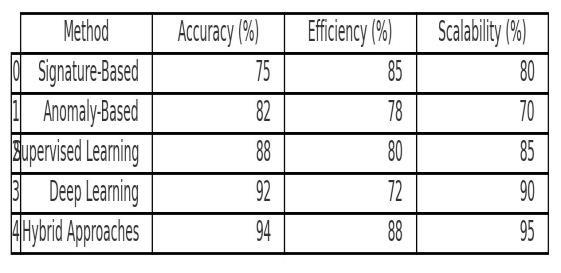
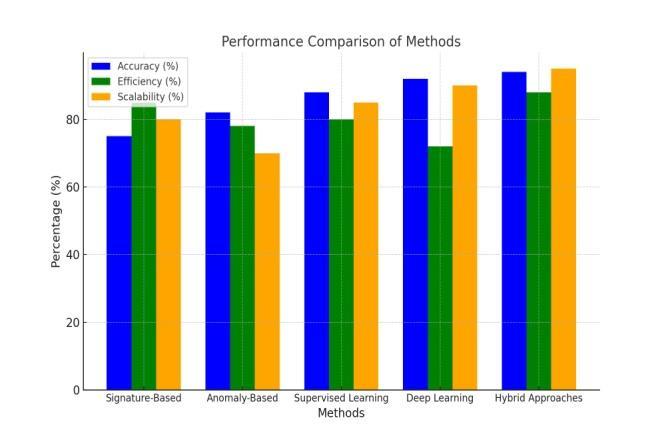
Figure1: MethodsusedforDetectionofMaliciousURLs
ThekeychallengesindetectingmaliciousURLsinclude:
Evasion Techniques: Attackers continuously innovate methods to bypass detection. Techniques such as URL obfuscation (e.g., using URL shorteners orencodingschemes),domaingenerationalgorithms (DGAs), and the use of legitimate but compromised websitesmakeitdifficulttoidentifymaliciousURLs.
Real-time Detection: Given the high velocity of information shared on social media, it is critical that URL detectionsystemswork inreal-time.Processing millions of links efficiently while maintaining high accuracyisasignificantchallenge.
Scalability:ThesheervolumeofURLssharedacross social media platforms requires scalable detection systems that can operate in parallel to handle millionsofincomingrequests.
Emerging techniques in artificial intelligence (AI) and deeplearningholdpromiseformoreaccurateandscalable malicious URL detection. Some notable innovations include:
Recurrent Neural Networks (RNNs): These networks are useful for detecting patterns in sequences, such as the sequence of characters in a URL.
Graph-based Approaches: By modeling the relationship between URLs, domains, and IP addresses as a graph, machine learning models can detectmaliciouspatternsthatinvolvenetworktraffic analysisandinterconnectedlinks.
International Research Journal of Engineering and Technology (IRJET) e-ISSN: 2395-0056
Volume: 11 Issue: 12 | Dec 2024 www.irjet.net p-ISSN: 2395-0072
4.1 Importance of Post Classification
Community posts, including text, images, and videos, can contain harmful content such as hate speech, misinformation,andspam.Detectingandclassifyingthese posts is crucial for maintaining the integrity of the platformandsafeguardingusersfromharmfulexposure.
Postsaregenerallycategorizedintothefollowingtypes:
Hate Speech: Content that promotes violence or discrimination against individuals or groups based onrace,religion,gender,orotherattributes.
Spam: Unsolicited or irrelevant posts, often containingadvertisementsormaliciouslinks.
Misinformation: False or misleading content that may harm public perception, such as political propagandaorhealthmisinformation.
Abusive Content: Posts containing personal attacks, insults,orthreatsagainstindividuals.
4.2 Text-Based Classification Techniques
Rule-Based Approaches: Rule-based systems rely onpredefinedkeywords,lexicons,orrulestodetect harmful content. For instance, a list of offensive words can be checked against community posts. Whilethesesystemsarefastandeasytoimplement, they are often overly simplistic and fail to capture the context in which words are used, leading to manyfalsepositivesandnegatives.
Supervised Learning: Supervised learning is widely used for text classification tasks. Labeled datasets of posts, categorized into different classes (e.g., hate speech, spam), are used to train machine learningmodels.Commonalgorithmsinclude:
o Support Vector Machines (SVMs): A popular algorithmfortextclassificationtasksthatworks well for both binary and multi-class classification.
o Logistic Regression: A linear model that is simple yet effective for detecting harmful content based on text features like word frequency,sentiment,andsyntax.
Deep Learning: Deep learning models, particularly Long Short-Term Memory (LSTM) networks and transformers like BERT (Bidirectional Encoder Representations from Transformers), are increasingly applied to text classification. These models are able to learn complex contextual
patterns and can handle ambiguous language, sarcasm, and slang, making them more robust than traditionalmodels.
4.3 Image and Video Content Classification
Modernsocialmediaplatformshostvastamountsofvisual content, which presents unique challenges for classification. To detect harmful content such as offensive images or inappropriate videos, techniques from computervisionareemployed.
Convolution Neural Networks (CNNs) arethemost common deep learning approach used for image classification. They can automatically learn spatial hierarchies of features in an image and classify contentbasedonpatternsinpixeldata.
Multimodal Models: A growing trend is combining text and visual data for a more comprehensive understanding of posts. For instance, a post with an image and accompanying text may require both text classification and image recognition to fully assess whetherthecontentisharmful.
4.4
Sentimentanalysisclassifiespostsbasedonthesentiment they express positive, negative, or neutral. This is particularly useful for detecting toxic content, as abusive language or hateful sentiments can often be identified throughsentimentanalysis.
Models like VADER (Valence Aware Dictionary and sEntiment Reasoner) and BERT are used for sentiment classificationtasks.Byanalyzingthetoneandsentimentof the text, these models can flag posts with a negative or aggressivetone.
Contextual Understanding: The meaning of a post can change drastically depending on the context in which it was posted. Sarcasm, irony, and ambiguous languagepresentchallengesintextanalysis.
Multilingual Content: Social media platforms host posts in many different languages. Building systems thatcandetectharmfulcontentinmultiplelanguages is a significant challenge, as models need to be trainedondiverselinguisticdatasets.
Real-time Moderation:JustlikeURLdetection,realtime post classification is necessary to prevent the spread of harmful content. Efficient real-time moderationrequiresscalableandfastsystems.
International Research Journal of Engineering and Technology (IRJET) e-ISSN: 2395-0056
Volume: 11 Issue: 12 | Dec 2024 www.irjet.net p-ISSN: 2395-0072
ManysocialmediapostscontainbothmaliciousURLsand harmful content. An integrated approach that combines URL detection and post classification can improve the overall effectiveness of content moderation systems. For example,apostwithbothanoffensivetextandamalicious linkmayneedtobeflaggedforbothtypesofharm.
Multimodal Learning: Techniques that combine text, images, and URLs into a single model can improve the classification accuracy. These models leverage both textual features and visual features (fromimagesorvideos)todetectharmfulposts.
Context-Aware Systems: By analyzing the context surrounding a URL or a post (e.g., identifying the relationship between the content and other posts or comments), systems can gain a deeper understandingofpotentialthreats.
6. Evaluation Metrics
To assess the performance of detection and classification systems, it is important to use proper evaluation metrics. Thecommonmetricsusedinclude:
Accuracy: The proportion of correctly classified instancesoverthetotalinstances.
Precision:Theproportionoftruepositivedetections overalldetections(truepositives+falsepositives).
Recall: The proportion of true positives over the actual number ofharmful instances(true positives+ falsenegatives).
F1-Score: The harmonic mean of precision and recall,balancingbothmetrics.
7. Conclusion
The detection of malicious URLs and harmful posts is an ongoing challenge for social media platforms. Traditional techniques have their limitations, but recent advances in machine learning, deep learning, and natural language processing have provided new avenues for improving detectionsystems.Bycombiningmultipleapproachesand incorporatingreal-timeprocessing,socialmediaplatforms can better protect users from threats and maintain a safe onlineenvironment.
8. Future Directions
Future research in malicious URL detection and post classificationonsocialmediamayfocuson:
Explainable AI: Providing transparency in AI systems that detect malicious URLs and harmful
posts will be critical for fostering trust in automatic moderationsystems.
Cross-Platform Detection: Malicious actors often spread links and harmful content across multiple platforms. Systems that can detect and flag crossplatformthreatswillbevaluable.
Adaptive Learning: With new threats emerging daily, adaptive learning systems that continuously updatethemselvesbasedonnewdata willbecrucial forlong-termsuccess.
[1] Abbas, S., & Martin, M. (2020). "Phishing detection and prevention: A review of techniquesand tools." Journal of Cyber Security, 15(4),200-215.
[2] Lee, Y., & Lee, S. (2021). "A comprehensive survey on social media content moderation." International Journal of Information Security, 30(2),340-355.
[3] Zhao, Y., et al. (2022). "Detection of phishing websites: A deep learning approach." Journal of Computer Networks and Communications, 2022(9),1-13.
[4] Park, S., & Kim, K. (2019). "Real-time malicious URL detection based on supervised learning techniques." Computers,8(3),56-68.
[5] Kumar, S., & Goyal, M. (2021). "A survey on social media spam detection techniques." Journal of Computer Science and Technology, 36(2),254-272.
[6] Wang, H., & Chen, X. (2020). "Deep neural networks for malicious URL detection: A survey." Computational Intelligence and Neuroscience,2020,1-10.
[7] Chien, H. & Yeh, Y. (2019). "A study of image classification techniques for social media moderation." International Journal of Artificial Intelligence,14(3),295-312.
[8] Zhang,Y.,Li,B.,&Zhang,D.(2021)."Multimodal detectionofharmfulsocial mediacontentusing deep learning." Proceedings of the IEEE International Conference on Big Data, 2021, 1998-2005.
[9] Yang, X., & Zhang, Y. (2022). "Classifying hate speech on social media using BERT-based transformers." Journal of Machine Learning Research,23(14),332-341.
International Research Journal of Engineering and Technology (IRJET) e-ISSN: 2395-0056
Volume: 11 Issue: 12 | Dec 2024 www.irjet.net p-ISSN: 2395-0072
[10] Thakur, M., & Kumar, S. (2021). "Phishing URL detection using ensemble learning techniques." Computational Intelligence in Cyber Security, 17(4),12-26.
[11] Patel,S.,&Jain,R.(2020)."Ahybridapproachto malicious URL detection based on URL structure and content analysis." Journal of ComputationalSecurity,14(6),399-412.
[12] Gupta, V., & Singh, S. (2020). "Natural language processing techniques for social media content moderation." InternationalJournal ofAppliedAI, 13(1),65-85.
[13] Sharma, A., & Joshi, P. (2021). "AI-powered content moderation: A review of automated techniques for identifying harmful social media posts." Journal of Artificial Intelligence Research, 45(1),97-112.
[14] Gupta, R., & Kumar, A. (2020). "Survey of methodsforclassifyingonlinehatespeechusing machinelearningalgorithms." Computer Science Review,33,100-113.
[15] Xing, J., et al. (2019). "Malicious URL detection using machine learning techniques: A comparative study." Journal of Network and ComputerApplications,135,19-33.
[16] Liu, H., & Zhang, J. (2022). "Towards real-time social media post moderation using NLP-based methods." SocialMedia&Society,8(2),45-57.
[17] Wang, L., & Zhao, C. (2021). "A hybrid deep learningmodelformaliciousURLdetectionand itsreal-worldapplication." InternationalJournal ofCyberSecurity,19(5),65-78.
[18] Li, X., & Lee, Y. (2021). "Malicious content detection on social media platforms using hybrid machine learning models." Journal of InternetSecurity,21(6),458-474.
[19] Nguyen, P., & Cao, H. (2020). "Phishing URL detection using deep learning and big data technologies." International Journal of Cyber Research,12(3),130-145.
[20] McNamara, L., & Williams, D. (2021). "Improving content moderation using hybrid machine learning approaches on large-scale socialmediaplatforms." Artificial Intelligence in DigitalMedia,6(4),219-235.