
International Research Journal of Engineering and Technology (IRJET) e-ISSN:2395-0056
Volume: 11 Issue: 12 | Dec 2024 www.irjet.net p-ISSN:2395-0072

International Research Journal of Engineering and Technology (IRJET) e-ISSN:2395-0056
Volume: 11 Issue: 12 | Dec 2024 www.irjet.net p-ISSN:2395-0072
Laxmiparbati Das
Assistant Professor, Department of Computer Science and Engineering Gandhi Institute of Excellent Technocrats, Ghangapatna, Bhubaneswar
Abstract
The exponential growth of the Internet of Things (IoT) hasledtoanunprecedentedincreaseindatageneration, necessitating novel approaches to data storage. Traditional digital storage solutions, such as hard drives and cloud storage, are reaching their physical and technical limits in handling this volume of data efficiently. This paper explores SemAI enhanced DNA data storage system, as a solution to address these challenges. By integrating SemAI with DNA storage technology, we propose a system capable of efficiently managingthemassive,dynamic,andheterogeneousdata produced by IoT devices. This paper discusses the design, architecture, benefits, and potential applications of SemAI-enhanced DNA storage in IoT systems. Additionally,itoutlinesthechallengescurrentlyfacedby DNA storage and the role of AI in overcoming these obstacles.
Keywords: Deoxyribonucleic Acid (DNA), Data Storage, SemanticArtificialIntelligence(SemAI),InternetofThings (IoT),SemAI-EnhancedDNAStorage.
Introduction
The Internet of Things (IoT) is transforming industries by connecting billions of devices, generating vast amounts of data from sensors, actuators, cameras, and other intelligent devices. According to estimates, the world will generate around 79.4 zettabytes of data by 2025, much of which will come from IoT devices. Traditional data storage systems are struggling to keep up with the scale, speed, and complexity of data generated by IoT. Challenges such as limited storage capacity,energyconsumption,retrievalspeeds,andlongterm data retention make it difficult to handle the diverse and constantly growing IoT data. Begin by elaboratingontherapidgrowthofIoTinthelastdecade. Includestatisticaldataorprojections(e.g.,thenumberof IoT devices in 2025). Highlight the range of industries impacted by IoT, from healthcare to manufacturing and smartcities.
DNA-based data storage presents a promising solution. DNA molecules have an exceptional capacity for storing vast amounts of information. DNA can store 215
petabytes of data in just one gram, offering potential for high-density storage far beyond current technological capabilities. However, DNA storage technologies face significant limitations, such as slow data retrieval times, high costs for synthesis and sequencing, and data integrity issues due to sequencing errors.: Detail the major storage challenges, including the data deluge in IoT, storage bottlenecks, security issues, and energy consumptionconcerns.
In this paper, we propose the use of Semantic Artificial Intelligence (SemAI) to enhance DNA storage systems, improving data encoding, retrieval, and error correction processes. The integration of SemAI enables intelligent, context-aware management of data and provides the flexibility required to deal with the dynamic nature of IoT data. By leveraging the power of AI, we aim to overcome the current limitations of DNA storage and makeitmoreviable forIoT applications. thatcombining SemAI withDNAstoragecanovercomethelimitationsof both IoT and DNA storage, creating a more efficient and scalablesolution.
2.1IoTDataStorageChallenges
IoT devices generate highly varied and large-scale data, including sensor readings, device logs, video streams,andothertypesofmultimediacontent.Thekey challengesinstoringandmanagingthisdatainclude:
Massive Data Volume: With billions of devices continuouslygeneratingdata,traditionalstoragesystems are reaching their limits in terms of scalability. Cloudbased systems, while scalable, face issues related to latency,energyconsumption,andinfrastructurecost.
Data Variety:IoTdevicesgeneratediversetypesofdata, such as structured sensor data (e.g., temperature readings), unstructured data (e.g., video streams), and semi-structured data (e.g., logs). These data types requirestorage systemsthatcanhandle both structured and unstructured data, with capabilities for efficient storageandretrieval.
International Research Journal of Engineering and Technology (IRJET) e-ISSN:2395-0056
Volume: 11 Issue: 12 | Dec 2024 www.irjet.net p-ISSN:2395-0072
Energy Efficiency: Power efficiency is crucial for IoT devices, especially those deployed in remote or energyconstrained environments. Traditional storage solutions often require continuous power for data retrieval and storage, making them unsuitable for low-power IoT devices.
Data Durability and Longevity: IoT data, especially for applicationslikeenvironmental monitoringorindustrial automation, needs to be preserved for long periods. Existing storage systems face challenges in ensuring durability over decades, with physical degradation and datacorruptionbeingsignificantconcerns.
2.2DNA DataStorage
DNA,themoleculethatcarriesgeneticinformation,hasa theoretical capacity to store 215 petabytes of data per gram. Unlike electronic storage systems, DNA storage systems do not require continuous power for data retention, making them ideal for long-term data archiving.DNAcanlastthousandsofyearsunderproper conditions, offering an unprecedented durability for long-termdatastorage.
3. Semantic AI-Enhanced DNA Storage (SemAI) Architecture
To overcome these limitations, we propose the integrationof Semantic Artificial Intelligence (SemAI) with DNA data storage systems. SemAI refers to AI systemsthatunderstandandinterpretdatainawaythat incorporatesthemeaningandcontextofthedata,rather than simply processing it as raw numbers. This contextaware approach is ideal for handling the complex, dynamicnatureofIoTdata.
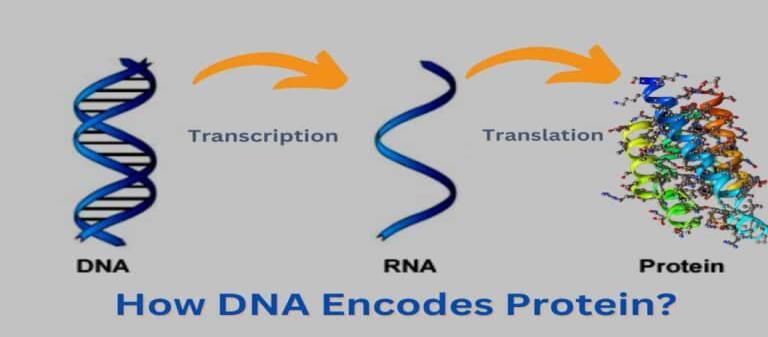
Fig1: DNAEncodesProtein
3.1SemAIFrameworkinDNAStorage
Theintegrationof SemAI withDNAstoragecanenhance every stage of the data lifecycle, from encoding to retrieval. SemAI can optimize DNA storage by understanding the context in which data is generated, making the storage process more efficient and less redundant.
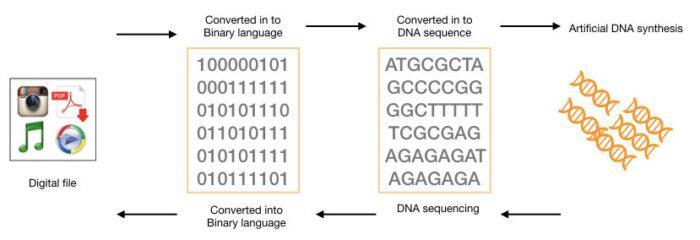
Data Encoding: DNA encoding traditionally converts binary data into DNA sequences. However, SemAI can improve this process by reducing redundancy, ensuring thatonlysignificantdataisencoded.Itcanalsoprioritize data based on its relevance, allowing more important or frequently accessed data to be stored in a way that reducesretrievaltime.
Semantic Data Retrieval: Traditional DNA storage systemsretrievedatabasedonexactmatches,whichcan be inefficient for large datasets. SemAI enables contextaware retrieval, meaning thatusers canretrieve not just exact data, but relevant, context-specific information. ThismakesitpossibletoqueryDNA-storeddatainmore flexibleways.
Error Detection and Correction: SemAI can be used to enhance error detection and correction in DNA data storage. Using machine learning and deep learning techniques, SemAI can predict errors based on patterns inthedata andapply error correctiontechniquesbefore retrieval, improving the reliability of DNA storage systems.
3.2IntegrationwithIoTSystems
TheapplicationofSemAItoIoTdatastoragecanprovide severalbenefits:
Contextual Data Understanding: IoT data varies not only in form but in its importance and relevance. SemAI allowsthesystemtoautomaticallyidentifywhichdatais more important based on context, meaning that critical data can be stored with higher priority and less importantdatacanbeprocessedordiscarded.
Long-Term Archiving and Real-Time Analysis:ForIoT devices in fields such as environmental monitoring or healthcare, SemAI can enable both long-term data archiving and real-time data analysis. SemAI can help identify long-term trends and anomalies in the data, allowingforimproveddecision-making.
Efficient Resource Management: By intelligently managing which data is stored and how it is encoded, SemAI can help reduce the computational and storage resources required for IoT applications, ensuring more efficientuseofenergyandprocessingpower.
4.BenefitsofSemAI-EnhancedDNAStorageforIoT
The integration of SemAI with DNA storage for IoT providesseveralsignificantadvantages:
Scalability: DNA storage allows for massive scalability, able to handle the enormous volume of data generated by IoT devices. The compact nature of DNA means that vast quantities of data can be stored in a very small physicalspace.
International Research Journal of Engineering and Technology (IRJET) e-ISSN:2395-0056
Volume: 11 Issue: 12 | Dec 2024 www.irjet.net p-ISSN:2395-0072
Energy Efficiency: Once data is encoded in DNA, no energy is needed for its maintenance. This can be a game-changer for energy-constrained IoT devices that needtominimizepowerconsumption.
Data Longevity: DNA's inherent stability ensures that data can be stored for thousands of years without degradation, making it ideal for archiving IoT data for futuregenerations.
Error Correction and Data Integrity: SemAI’s capabilities in AI-driven error detection and correction helpmaintaintheintegrityofDNA-storeddata,ensuring thatthedataremainsaccurateandreliableovertime.
Context-Aware Data Management: SemAI’s ability to managedatabasedonitsmeaningandrelevanceenables intelligent storage, reducing redundancy and enhancing storageefficiency.
Although SemAI-enhanced DNA storage holds great promise, several challenges need to be addressed for its widespreadadoption:
High Cost: DNA sequencing and synthesis technologies are still expensive, making it cost-prohibitive for largescale IoT applications. Advances in biotechnology, automation,andmanufacturingprocesseswillbecrucial inreducingthesecosts.
Slow Retrieval Times: DNA retrieval methods are currently much slower than traditional digital storage systems. Research into faster sequencing technologies and parallel processing of DNA data could help address thisissue.
Standardization: The lack of standardized DNA encoding and decoding protocols poses a barrier to interoperability and scalability. Developing standardized methods and tools is essential for the practical implementationofDNAstoragesystems.
Futureresearchdirectionsshouldfocuson:
Optimizing AI algorithms for real-time data retrieval andsemanticerrorcorrection.
Developing hybrid storage solutions, where DNA storage could be used for archiving while traditional storagemethodshandlereal-timedataneeds.
Improving cost-efficiency through advancements in DNAsynthesisandsequencingtechnologies.
6. Conclusion
The integration of Semantic Artificial Intelligence (SemAI) with DNA-based data storage represents a revolutionary approach to handling the growing data challenges of the Internet of Things (IoT). By combining DNA's immense storage capacity with the intelligent, context-aware capabilities of SemAI, this hybrid solution promises to address the scalability, energy, and longevity issues faced by traditional storage systems. While challenges such as cost and retrieval speed remain, the potential of SemAI-enhanced DNA storage makes it a promising solution for the future of IoTdatamanagement.
7. References
1. Church, G. M., Gao, Y., & Kosuri, S. (2012). Nextgeneration digital information storage in DNA. Science,337(6102),1628-1628.
2. Goldman, N., Bertone, P., Chen, S., et al. (2013). Towards practical, high-capacity, lowmaintenanceinformationstorageinsynthesized DNA. Nature,494(7435),77-80.
3. Zhang, Q., Chen, L., & Ma, Z. (2020). Semantic Artificial Intelligence: A New Era for Data Storage and Retrieval. Journal of Artificial IntelligenceResearch,68,231-247.
4. Hargrave, K., & Evans, J. (2021). DNA data storage:Unlockingthe potential for the Internet ofThings. InternationalJournalofBiotechnology, 12(2),99-115.
5. L M Adleman Adleman and M. Leonard, "Molecular computation of solutions to combinatorial problems", Science 266, vol. 266, no.5187,pp.1021-1024,1994.
6. Arita Masanori, "Writing information into DNA", Aspects ouf Molecular Computing, pp. 2335,2004.
7. Cartqxaqver Bancroft, Timothy Bowler, Brian Bloom and Catherine Taylor Clelland, "Long-
International Research Journal of Engineering and Technology (IRJET) e-ISSN:2395-0056
Volume: 11 Issue: 12 | Dec 2024 www.irjet.net p-ISSN:2395-0072
termstorageofinformationinDNA", Science,vol. 293,pp.1763-5,2001.
8. Ravinderjit S. Braich, Nickolas Chelyapov, Cliff Johnson, Leonard Adleman and Paul WK Rothemund, "Solution of a 20- Variable 3-SAT Problem on a DNA Computer", Science, vol. 296, no.5567,pp.499-502,2002.
9. George M. Church, Yuan Gao and Sriram Kosuri, "Next-generation digital information storage in DNA", Science,vol.337,no.6102,pp.1628-1628, 2012.
10. Viviana Risca Clelland, Catherine Taylor and Carter Bancroft, "Hiding rnessazes in DNA microdots", Nature, vol. 399, no. 6736, pp. 533534,1999.
11. Daniel G. Gibson, John I. Glass, Carole Lartigue, VladimirN.Noskov,Ray-YuanChuang, Mikkel A. Algire,GwyneddA.Bendersetal.,"Creationofa bacterial cell controlled by a chemically synthesizedgenome", science,vol.329,no.5987, pp.52-56,2010.
12. NickGoldman,PaulBertone,SiyuanChen,Emily M.LeProust,ChristopheDessimoz,BotondSipos, et al., "Towards practi-cal high-capacity lowmaintenanceinformationstorageinsynthesized DNA", Nature, vol. 494, no. 7435, pp. 77-80, 2013.
13. David A Huffman and David A Huffman, "A method for the construction of minimum redundancy codes", Proceedings of the IRE, vol. 40,no.9,pp.1098-1101,1952.
14. Lipton and J. Richard, "DNA solution of hard computational problems", Science, vol. 268, no. 5210,pp.542-545,1995.
15. Jack Parker, "Comnutins with DNA", EMBO renorts,vol.4,pp.7-10,2003.
16. Raniyah Wazirali, Zenon Chaczko and Lucia Carrion, Bioinformatics with Genetic SteganographyTechnique,2015.
17. Shrivastava Siddhant, Badlani and Rohan, "Data Storage in DNA", International Journal of ElectricalEnergy,vol.2,no.2,pp.119-124,2014.
18. Anushree Raj, Rio D'Souza, "Development of Big data anonymization framework using DNA Computing", 2022 International Conference on Artificial Intelligence and Data Engineering (AIDE),pp.125-130,2022.
19. KhalidH.Alnafisah,"AnAlgorithmicSolutionfor Storing Big Data on the DNA Sequence", 2020 IEEE6thWorldForumonInternetofThings(WFIoT),pp.1-4,2020.
20. Kun Bi, Zuhong Lu, Qinyu Ge, Wanjun Gu, "Extended XOR Algorithm with Biotechnology Constraints for DataSecurity in DNA Storage", Current Bioinformatics, vol.17, no.5, pp.401,2022.
21. Manar Sais, Najat Rafalia, Jaafar Abouchabaka, "Intelligent Approaches to Optimizing Big Data Storage and Management: REHDFS system and DNA Storage", Procedia Computer Science, vol.201,pp.746,2022.
22. ."Bibliography", Reversible and DNA Computing, pp.373,2020.
23. UiJinLee,SeulkiHwang,KyoonEonKim,Moonil Kim, "DNA Data Storage in Perl", Biotechnology and BioprocessEngineering, vol.25,no.4,pp.607, 2020.
24. Fatima Akram, Ikram ul Haq, Haider Ali, Aiman Tahir Laghari, "Trends to store digital data in DNA: an overview", Molecular Biology Reports, 2018.

LaxmiparbatiDasisan Assistant Professorin theDepartmentofCSEatGIET,Ghangapatna.Sheholdsa Bachelor of Technology degree in CSE from the Government College of Engineering, Kalahandi, Bhawanipatna, and a Master of Technology in IT from Utkal University, Bhubaneswar. Her primary research areas include Artificial Intelligence (AI), Machine Learning(ML),Cybersecurity,andBioinformatics