
International Research Journal of Engineering and Technology (IRJET) e-ISSN:2395-0056
Volume: 11 Issue: 12 | Dec 2024 www.irjet.net p-ISSN:2395-0072

International Research Journal of Engineering and Technology (IRJET) e-ISSN:2395-0056
Volume: 11 Issue: 12 | Dec 2024 www.irjet.net p-ISSN:2395-0072
Mohan H G1 , Abhishek S2, Aishwarya S G3, Arpitha V4, Bharath C5
1 Asst professor, Department of Computer Science and Engineering, Jawaharlal Nehru New College of Engineering, Shimoga 2, 3, 4, 5 BE students, Department of Computer Science and Engineering, Jawaharlal Nehru New College of Engineering, Shimoga
With advancements in computer vision, the potential for accessibility-focused human-computer interaction (HCI) has expanded.This paper presentsaninnovativesystem thatuseshandgesturesandfacial movementsfortouch-freedigital interaction, targeting users with physical limitations and specialized environments requiring hands-free interfaces. By combiningOpenCVforimageprocessing,MediaPipeforreal-timelandmarkdetection,andPyAutoGUIforactionexecution, thissystemoffersanaccessible,adaptive,andintuitivealternativetotraditional inputdevices.Thesystemachievesrealtime performance and demonstrates robust functionality under diverse conditions, making it an ideal solution for accessibility enhancement, professional multitasking, and interaction innovation. Future expansions include adaptive learningalgorithms,gesturelibraryenhancement,andprivacysafeguardstofurtherenhanceusabilityandsecurity.
Keywords: Gesture-based control system, Hands-free interaction, MediaPipe, OpenCV, PyAutoGUI, Real-time processing, Human-computer interaction (HCI).
The evolution of HCI technologies has been pivotal in improving accessibility and efficiency across various domains. Traditional input devices such as keyboards and mice, though widely used, pose limitations for individuals with motor disabilities and in environments where direct touch is impractical. The demand for intuitive, hands-free systems has consequentlysurged.
This paper explores a gesture and facial movement-based control system designed to enable seamless interaction with digital devices. The system uses OpenCV to process video frames, MediaPipe to detect hand and facial landmarks, and PyAutoGUItotranslategesturesintoactionablecomputercommands.Thismodulardesignsupportsreal-timeinteraction whilemaintainingadaptabilityacrossdifferentenvironmentsanduserneeds.
Applications of the system range from accessibility tools for individuals with disabilities to enhanced productivity in sterile or multitasking environments such as healthcare or manufacturing. By addressing existing limitations in gesturerecognitionsystemsandemphasizingusabilityandrobustness,thisprojectcontributessignificantlytothefieldofHCI.
The evolution of gesture-based control systems has seen significant advancements in recent years, with researchers exploring various methods to achieve touch-free human-computer interaction (HCI). Early systems, such as the "Virtual Mouse Controlled by Tracking Eye Movement," used webcams to detect and track pupil movements, allowing users with motor disabilities to control computer cursors. [1] have proposed the approach provided a low-cost solution for accessibilitybutfacedchallengessuchassensitivitytolightingandtheneedforprecisecalibration.
[2]Handgesturerecognitionsystems,ontheotherhand,haveleveragedtoolslikeOpenCVandPythonto enablereal-time trackingofhandmovements.Forexample,a"HandGestureControlledSystemUsingOpenCVandPython"mappedspecific gestures to predefined actions, showcasing the potential for gesture-based navigation. [3] have proposed promise, such systemsoftenstruggledwithenvironmentalvariabilityandwerelimitedtosimplegesturesduetohardwareconstraints.
[4]MediaPipe'son-device real-timehand-tracking framework introduceda significantleap in precisionandadaptability. [5]haveproposedthestudiesutilizingMediaPipeforgesturerecognitionhavedemonstratedhigh-qualitytrackingofhand landmarks, supporting applications in accessibility and AR/VR environments. [6] have proposed challenges such as performanceunderpoorlightingandlimitationsindetectingcomplexgesturespersisted.
International Research Journal of Engineering and Technology (IRJET) e-ISSN:2395-0056
Volume: 11 Issue: 12 | Dec 2024 www.irjet.net p-ISSN:2395-0072
RecenthybridmodelscombiningMediaPipe,convolutionalneuralnetworks(CNNs),andlongshort-termmemory(LSTM) architectures have further improved accuracy and real-time performance. [7] have proposed the systems successfully classifyingdynamicgesturesbycapturingtemporalrelationshipsbutoftenrequirehighcomputationalresources,making themlesspracticalforreal-worlddeployment.
[8] The literature highlights the potential of gesture-based systems for accessibility and hands-free interaction but underscores the need for a balance between computational efficiency, adaptability, and usability. The proposed system aims to address these challenges by combining robust tools like OpenCV, MediaPipe, and PyAutoGUI to create a costeffective,real-timesolutionsuitablefordiverseuserneeds.
Traditionalinputdevicessuchaskeyboardsandmice,whilewidelyadopted,arenotsuitableforallusers.Individualswith physical disabilities often face difficulties using these devices, and in specialized environments such as healthcare and manufacturing, hands-free interaction is a necessity. Existing gesture recognition systems, though innovative, lack the precision, flexibility, and accessibility required for widespread adoption. Challenges include sensitivity to environmental factors,limitedgesturelibraries,andcomputationalinefficienciesthathinderreal-timeperformance.
This project seeks to address these issues by developing a gesture and facial movement-based control interface. The system aims to improve accessibility, precision, and responsiveness in hands-free digital interactions. By leveraging computer vision and machine learning, it bridges the gap between human intent and technological capability, enabling naturalandintuitivecontrolmechanismsfordiverseapplications.
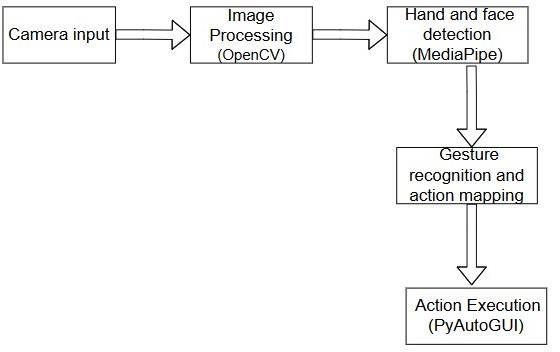
ThemethodologygiveninFig1,outlinesthesystematicapproachusedtodesignandimplementareal-timegesture-based controlsystem.Eachstepisstructuredtoensurefunctionality,precision,andadaptability.
i. InputCaptureandPreprocessing:
Thesystemcapturesreal-timevideoinputthroughastandardwebcam,providinganaccessibleandcost-effective solution without requiring specialized hardware. The captured frames are processed using OpenCV to ensure compatibility with the subsequent modules. This preprocessing includes converting frames from BGR to RGB format,asrequiredbyMediaPipe,andapplyingnoisereductiontechniquestoenhanceimagequality.Thesesteps ensurethesystemcanoperateaccuratelyundervaryingenvironmentalconditions.
ii. HandandFacialLandmarkDetection:
MediaPipe is employed to detect and track key landmarks on the user’s hands and face. For hand gestures, the system identifies 21 landmarks, including finger tips, joints, and the palm center. These points are crucial for detecting movements and forming the basis of gesturerecognition. Facial landmark detection focuses on the eye
International Research Journal of Engineering and Technology (IRJET) e-ISSN:2395-0056
Volume: 11 Issue: 12 | Dec 2024 www.irjet.net p-ISSN:2395-0072
region, enabling functionalities such as blink detection for simulating clicks. The combination of hand and facial detectionensuresaversatileandcomprehensiveinteractionframework.
iii. GestureRecognitionandMapping:
Once landmarks are detected, the system analyzes their spatial relationships to recognize predefined gestures. Handgestures,suchasindexfingermovements,aremappedtocursornavigation,whilepinchingmotionssimulate click actions. Eye blinks are detected by monitoring the distance between specific eye landmarks to differentiate intentional blinks from natural ones. Each gesture is mapped to a corresponding system action using predefined configurations,ensuringintuitiveinteractionforusers.
iv. ActionExecution:
PyAutoGUI is used to execute the mapped gestures as system actions, including cursor movement, scrolling, and clicking.Theexecutionpipelineisoptimizedtominimizelatency,enablingreal-timeresponsiveness.Thisensuresa seamlessexperiencewheregesturesareinstantlytranslatedintoon-screenactions.
v. Real-TimeFeedbackandErrorHandling:
Feedback mechanisms are integrated to dynamically adjust the system’s sensitivity to external factors such as lighting variations and background noise. The system employs error-handling protocols to recalibrate when landmarks are not detected or gestures are misinterpreted. These features enhance the system's robustness and adaptability,ensuringreliableoperationindiverseenvironments.
vi. SystemIntegrationandTesting:
The hand gesture and eye tracking functionalities are integrated into a unified framework, ensuring seamless interaction between modules. Comprehensive testing under various environmental conditions validates the system’sperformance,accuracy,andstability.
Inour research work, the proposed methodology weused gavethe resultsillustrated below. Wehaveachieved what we were supposed to get as the outcome. The combination of computer vision tools, including OpenCV and MediaPipe, accuratelyanalyzedhandandfacialgesturesinreal-time,enablingseamlesscontroloversystemactions.Theimplemented algorithmseffectivelymappedgesturestoactions,suchascursormovement,scrolling,andclicking,whiletheintegration of PyAutoGUI ensured smooth execution. The system was able to successfully recognize predefined gestures and facial movements,achievingpreciseandintuitiveinteractionasintended.
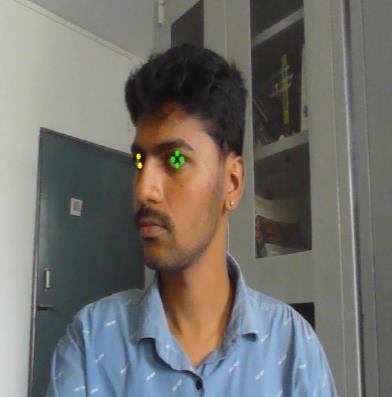
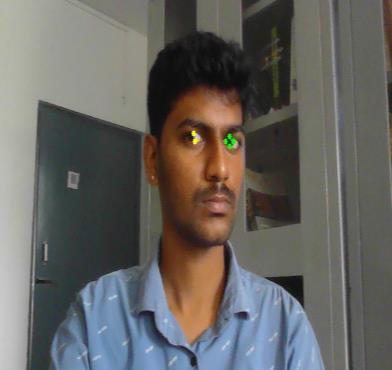
fig2andfig3ofbelowillustratesthecursormovementusingeyegesturewhereasfig4andfig5ofbelowillustratesthe scrollingactionusingthehandgesture.

International Research Journal of Engineering and Technology (IRJET) e-ISSN:2395-0056
Volume: 11 Issue: 12 | Dec 2024 www.irjet.net p-ISSN:2395-0072
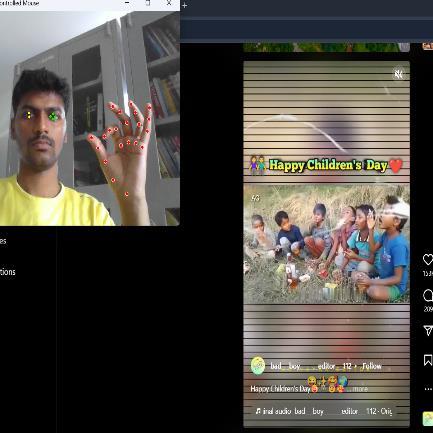
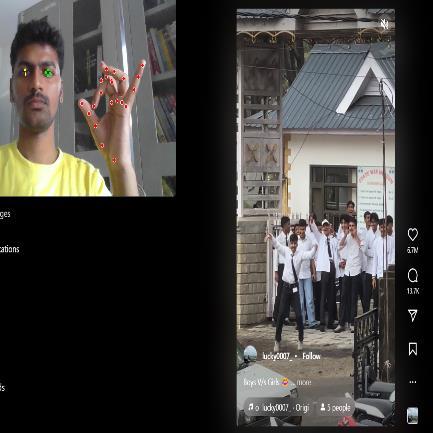
In conclusion, the Controlling Social Media Application using Computer Vision successfully showcases the power of computer vision to enable hands-free interaction with social media platforms. By integrating real-time gesture recognitionandeye-trackingtechnologies,thesystemoffersanintuitive,responsive,andaccessibleuserexperience.It caterstoindividualswithphysicallimitationsandprovidesatouch-freeinterface,enhancingusabilityacrossvarious environments. While performance can be improved under varying lighting conditions, the system lays a strong foundation for further development in human-computer interaction, emphasizing inclusivity, practicality, and innovation.
[1] C. D. Patil, A. Sonare, A. Husain, A. Jha, and A. Phirke, “Survey on: Hand Gesture Controlled using OpenCV and Python,”InternationalJournalofCreativeResearchThoughts(IJCRT),vol.10,no.11,pp.120–125,Nov.2022.
[2] R. Maheshwar, D. R. Kumar, M. A. Sami, and N. Akhil, “Eyeball Cursor Movement Using OpenCV,” Journal of EmergingTechnologiesandInnovativeResearch(JETIR),vol.11,no.3,pp.44–48,Mar.2024.
[3] Y. Yaseen, O.-J. Kwon, J. Kim, S. Jamil, J. Lee, and F. Ullah, “Next-Gen Dynamic Hand Gesture Recognition: MediaPipe,Inception-v3andLSTM-BasedEnhancedDeepLearningModel,”Electronics,vol.13,no.16,p.3233, 2024.[Online].
[4] S.S.Suganya,K.V.S.Suthir,M.R.S,andS.Selvamani,“HandGestureRecognitionforVirtualMouseControlUsing MediaPipeinArtificialIntelligence,”JournalofEmergingTechnologiesandInnovativeResearch(JETIR),vol.11, no.5,pp.50–55,May2024.
[5] K. Ijardar, P. Jaiswal, M. Dhakiter, M. Kakde, and T. Barai, “Human Eye Based Computer Mouse,” International Research Journal of Modernization in Engineering, Technology and Science, vol. 4, no. 12, pp. 224–228,Dec.2022.
[6] S. Gantyala, W. Godad, and N. Phadnis, “Controlling Mouse Events Using Eye Blink,” International Journal of Advanced Research in Computer and Communication Engineering, vol. 5, no. 3, pp. 754–757, Mar. 2016. doi: 10.17148/IJARCCE.2016.53182.
[7] F.Zhang,V.Bazarevsky,A. Vakunov,A.Tkachenka,G.Sung, C.-L.Chang,andM.Grundmann,“MediaPipeHands: On-deviceReal-timeHandTracking,”GoogleResearch,1600AmphitheatrePkwy,MountainView,CA,USA.
[8] M.B.Manikandan,A.S,M.S.C,S.Unnikrishnan,andA.R.B.Ummer,“VirtualMouseControlledbyTrackingEye Movement,”InternationalJournalofCreativeResearchThoughts(IJCRT),vol.11,no.11,pp.100–105,Nov.2023.