
International Research Journal of Engineering and Technology (IRJET) e-ISSN:2395-0056
Volume: 11 Issue: 12 | Dec 2024 www.irjet.net p-ISSN:2395-0072

International Research Journal of Engineering and Technology (IRJET) e-ISSN:2395-0056
Volume: 11 Issue: 12 | Dec 2024 www.irjet.net p-ISSN:2395-0072
1Sameer Kachare , 2Omkar Deokar , 3Vivek Jong , 4Atharva Shinde , 5Aryan Koli , 6S.A.Shegdar
1,2,3,4,5UG Students, Department of Computer Science and Engineering, SVERI’s College of Engineering Pandharpur, Maharashtra India
6Assistant Professor, Department of Computer Science and Engineering, SVERI’s College of Engineering Pandharpur, Maharashtra India
Agricultureservesastheprimarysourceoflivelihoodfor a significant portion of India’s population and is an integral part of the primary sector. The Harvesting System, a machine learning-driven solution, aims to enhance the efficiency of the harvesting process for farmers. Implementing an accurate vision system capable of real-time fruit classification and analysis is essential for ensuring the cost-effectiveness and productivityofharvestingrobots.
InmanyregionsofIndia,farmersfacechallengesincrop cultivation due to unfavorable climate conditions and poor soil quality. Additionally, the lack of readily accessible assistance to guide farmers in selecting the appropriate crops using modern technological advancements exacerbates the issue. Illiteracy further hampers farmers from leveraging advancements in agriculturalscience,oftenresultingincontinuedreliance on traditional farming methods. This can hinder achieving optimal yields. For example, crop failure may result from inadequate fertilization or unpredictable rainfallpatterns.
The increasing availability of agricultural data offers immense potential for improving crop management but also poses challenges in its effective utilization. This study introduces the HarvestifyClassifier, a machine learning-based framework designed to enhance agricultural decision-making. By accurately classifying crops and forecasting yields, the system leverages diverse datasets such as satellite images, soil health metrics, and climatic conditions. Advanced algorithms, including Random Forest and Support Vector Machines (SVM), are employed to ensure precise predictions and robustperformance.
KEYWORDS
Machine Learning, Processing, Training, Testing, PredictiveModel,TextProcessing
1.
Accordingtothe2011census, 118.6 million farmers in India rely on agriculture for their livelihood,
highlighting its critical role in the country. Farmers face several challenges, such as understanding soil conditions, determining the right time and location for compostapplication,accountingforrainfall,maintaining crop quality, and addressing the variability of factors even within different areas of the same field. These challenges, compounded during significant agricultural decision-making processes, often require consideration ofmultiplevariablesandmetrics.
Toaddressthesecomplexities,aprogramisproposedto assist farmers in enhancing their productivity by continuouslymonitoringagriculturalfields.Forinstance, online weather data, including rainfall trends and soil parameters,canguidedecisionsonwhichcropsarebest suited for specific locations. This system introduces a desktop application that leverages data analysis techniques to predict the most profitable crop yields basedoncurrentclimateandsoilconditions.
Key Features of the System:
1. Crop Recommendation
2. Fertilizer Recommendation
3. Plant Disease Prediction
Agriculture has been a cornerstone of Indian culture sinceancienttimes.Historically,farmerscultivatedcrops on their own land, adapting practices to meet their needs. However, the advent of modern technologies and techniques has led to a gradual shift in agricultural practices. This shift, while beneficial in some respects, has also resulted in a growing reliance on hybrid and artificial products, which may compromise health. Moreover, a lack of awareness about proper crop cultivation timing and location has contributed to changes in seasonal climatic conditions, negatively impacting essential resources like soil, water, and air, ultimatelyleadingtofoodinsecurity.
Machinelearningplaysapivotalroleinaddressingthese issues. It employs algorithms categorized into supervised, unsupervised, and reinforcement learning,eachwithitsuniquefeaturesandlimitations:
Volume: 11 Issue: 12 | Dec 2024 www.irjet.net
Supervised Learning: Creates mathematical models using labeled data, with inputs and corresponding desiredoutputs.
Unsupervised Learning: Builds models from datasets containingonlyinputs,withnolabeledoutputs.
Semi-Supervised Learning: Develops models from partially labeled data, where some input samples lack associatedlabels.
This paper focuses on improving crop yields through various techniques, including fertilizer recommendations tailored to specific crops. By integrating machine learning algorithms and leveraging data-driven insights, the program aims to revolutionize agricultural practices, ensuring sustainability and improvedproductivityforIndianfarmers.
1. OverviewofMachineLearninginAgriculture: Machinelearning(ML)hasfoundapplicationsinvarious agricultural processes, such as soil analysis, crop monitoring, yield prediction, and harvest classification. These innovations aim to enhance decision-making, resourcemanagement,andproductivity.
Importance of Harvest Prediction: Accurateharvestpredictionplaysavitalroleinensuring food security, efficient resource allocation, and waste reduction.Itallowsfarmerstomaketimelyandinformed decisions that optimize agricultural operations and outputs.
2.Supervised Learning Methods: Supervised learning algorithms are widely used in predicting harvest outcomes based on historical data. Examplesinclude:
SupportVectorMachines(SVM): Effective for binary classificationandregressiontasks.
RandomForests: Provides high accuracy through ensemble learning by constructing multiple decision trees.
3Agricultural Datasets: Machine learning applications in agriculture rely on diverseandhigh-qualitydatasets,suchas:
SatelliteImagery: Offers insights into crop health, growthpatterns,andlanduse.
SensorData: Monitors parameters like soil moisture, temperature,andhumidityinreal-time.
4. Crop-Specific Models: ML models have been developed for specific crops such
p-ISSN:2395-0072
aswheat,rice,maize,andsugarcane.Thesemodelsexcel atpredictingharvest times andyields,aiding in efficient farmmanagement.
5. Shinde and Khade (2021) survey machine learning techniquesinnetworkintrusiondetection,highlightinga noveldeeplearningmodelbasedonnon-symmetricdeep autoencoders for feature extraction and classification, testedeffectivelyonKDDCup'99andNSL-KDDdatasets forenhancednetworksecurity[11].
Advanced agricultural techniques offer transformative potential for improving crop management and productivity by integrating diverse data sources and technologies. By analyzing environmental factors, soil characteristics, and weather patterns, comprehensive crop type classification becomes possible, enabling precise recommendations for suitable crops in specific regions. This method promotes efficient land use while fosteringsustainableagriculturalpractices.
Predictive modeling serves as another critical tool, leveragingarangeofagronomicdatasuchassoilquality, climatic conditions, and environmental factors to forecast crop yields accurately. These models improve yield predictions, streamline resource allocation, and supportfarmersinmakingwell-informeddecisions.
In the area of crop health, automated systems for detectinganddiagnosing plantdiseasesutilizeadvanced image classification algorithms and sensor-based data collection. By identifying early signs like leaf discoloration or pest infestations, these systems enable timelyintervention,minimizingpotentialcroplosses.
A comprehensive assessment of soil quality, incorporating parameterssuchaschemical composition, texture, and moisture levels, further enhances agricultural practices. This data-driven analysis helps farmersmatchcrops tospecific soilconditions,boosting productivity and promoting sustainable farming techniques.
Together, these cutting-edge approaches represent a robust framework for improving agricultural efficiency, ensuring sustainability, and building resilience against environmentalchallenges.
Theagricultural sectorencounterssignificantchallenges inoptimizingharvesttiming,whichoftenleadstoissues such as inaccurate predictions, fragmented data, and diminished crop quality. Conventional harvesting practices frequently result in premature or delayed harvests,adverselyaffectingbothyieldandmarketvalue. International Research Journal of Engineering and Technology (IRJET) e-ISSN:2395-0056
International Research Journal of Engineering and Technology (IRJET) e-ISSN:2395-0056
Volume: 11 Issue: 12 | Dec 2024 www.irjet.net p-ISSN:2395-0072
Thelackofcentralizeddata,spreadacrossmultipletools, makes it difficult for farmers to make well-informed decisions.
Moreover, climate change exacerbates these difficulties by introducing greater unpredictability in weather patterns, complicating the timing of harvests. At the same time, rising consumer expectations for premiumquality produce demand advanced solutions to ensure crops are harvested at their peak maturity, meeting qualitystandardsandmarketrequirements.
1Machine learning (ML) is transforming agriculture by enhancing processes such as soil analysis, crop monitoring, yield prediction, and harvest classification. Through advanced algorithms, ML enables data-driven approaches that address key challenges in modern farming. Accurateharvestprediction playsa vital role in ensuring food security, optimizing resource allocation, and minimizing waste by helping farmers harvest crops at the right time for maximum yield and quality. However, the agricultural sector faces complexities in data analysis due to environmental variability, pest and disease outbreaks, and unpredictable weather patterns. Thesechallengesunderscoretheimportanceofadopting advanced ML techniques to interpret diverse datasets andsupportsustainablefarmingpractices.
2. In harvest prediction and classification, supervised learning methods are commonly used to predict harvest outcomes based on historical data. Popular supervised learning algorithms include Support Vector Machines (SVM), Random Forests, Decision Trees, and Neural Networks. SVM is known for its ability to classify data into distinct categories by finding the optimal hyperplane that separates different classes. Random Forests, an ensemble learning method, create multiple decision trees to enhance prediction accuracy and preventoverfitting
3. Data preprocessing techniques are essential for cleaning, normalizing, and augmenting agricultural data to ensure machine learning models can generate accurate predictions. Cleaning involves removing noise, handling missing values, and correcting errors in the data. Normalization adjusts the scale of data to ensure that features have a similar range, preventing any one variable from disproportionately influencing the model. Data augmentation techniques, such as generating synthetic data or using different data sources, help increase the volume and diversity of training data, improvingmodelrobustness.[1]
4. Machine learning models have been developed for specific crops like wheat, rice, maize, and sugarcane to predict harvest times and yield. These models utilize
data such as weather patterns, soil conditions, and crop growthstagestomakeaccuratepredictions.Forexample, wheat models forecast harvest timing based on temperature and moisture levels, while maize models predict yield by analyzing soil health and climate variables. These crop-specific models help optimize harvestplanningandimproveyieldforecasting.[4]
5. The detection model will aim to identify visual artifacts and inconsistencies in deepfake content, focusing on factors like head pose misalignments, unnatural lighting, and shadow anomalies. In particular, the model will detect spatial and temporal inconsistencies, including inconsistent head poses (Yang et al.) and lighting or shadow errors (Matern et al.). By incorporating these features, the model will be better equipped to detect subtle manipulations, ensuring that even minor visual inconsistencies are captured, which mightotherwisebeoverlooked.[9][7]
6. The application will feature a user-friendly interface for media content analysis, enabling users to upload images and videos and detect deepfakes in real-time. To ensure seamless functionality, the system will include secure storage for media files, robust payment processing features, and adherence to relevant data protection regulations. Regular security audits will be conducted to protect user information, ensuring the applicationremainssecureandtrustworthyforallusers. [12][9]
A Plant Disease Detection System flow diagram begins with users uploading plant images. The images undergo preprocessing (like resizing or noise removal) and are analyzed by a trained machine learning model, such as CNN.Themodelclassifiesthediseasebasedonpatterns, and the system outputs the disease name with possible solutionsortreatments.
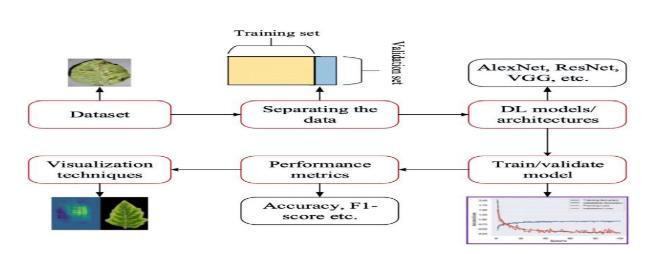
Fig1:SystemArchitecture
Volume: 11 Issue: 12 | Dec 2024 www.irjet.net
The CropRecommendationGraph provides a visual analysis of suitable crops based on various environmental factors like soil type, temperature, rainfall, and nutrient availability. It helps farmers make informed decisions by identifying optimal crops for specificregions,ensuringbetteryields..
The graph compares multiple crop options side-by-side tohighlightthebestchoicesundergivenconditions.This aids in sustainable agriculture by recommending crops that require fewer resources and are resilient to local conditions.Thegraphalsoemphasizestheimportanceof selecting crops that are both economically viable and environmentallyfriendly

Fig2:Homepage
The home page of the ”Harvestify” system offers a visually appealing and functional interface designed to assist farmers with smart agricultural decisions. It dis plays a vibrant background of seedlings, reinforcing the theme of sustainable agriculture. The platform’s tagline, “Get Informed Decisions About Your Farming Strat egy,” highlights its purpose. Below, it introduces two key questionsithelpsanswer:“Whatcroptoplanthere?”and “What fertilizer to use?” The navigation bar at the top provides easy access to different sections: Crop, Fertilizer, and Disease. This design ensures simplicity andaccessibility, guidingusersthroughcrucial decisionmakingprocessesefficiently
p-ISSN:2395-0072
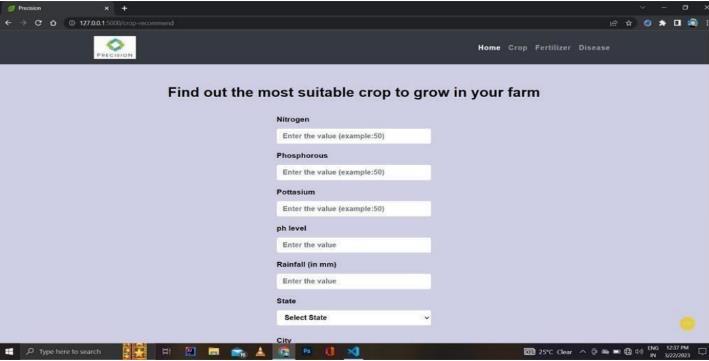
A Fertilizer Recommendation System flow diagram generally begins with the user entering soil parameters such as Nitrogen, Phosphorus, and Potassium (NPK levels), pH, and crop type. This input data is then processedbyamachinelearningmodelthatanalyzesthe soil's nutritional content and other environmental factorsusingpredefinedpatter.
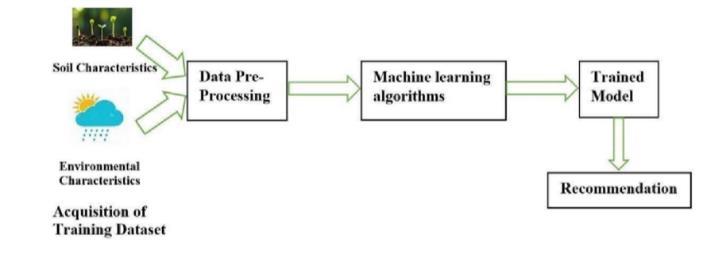
A model is proposed for recommending soil treatments, fertilizers, and predicting crop diseases, based on datasets sourced from Kaggle. Integrating machine learningwiththeagriculturalsectoraimstosignificantly enhance farming practices. Various algorithms will be employed and compared to predict the most effective outcomes for farmers, ultimately improving crop yield andminimizinglosses.Toensureaccuracy,thestudywill focus on understanding soil composition and its relationship with crops and fertilizers, as well as analyzing different plant diseases, their causes, and treatments. Analyzing the available datasets will help improve the model’s prediction accuracy. Future work will involve deploying this model in a user-friendly applicationforeasyaccessbyfarmers.
• AI models in predictive analytics can forecast supply and demand trends, optimizing inventory management and reducing waste. Machine learning algorithms can also detect anomalies in transactions or quality data, helping to identify potential fraud or product issues early,ensuringtimelyinterventionandminimizingrisks.
• IoT-basedMonitoringand AutomatedData EntryRealtime Sensor Integration: IoT devices can monitor conditions like temper ature, humidity, and soil quality, automatically feeding data into the blockchain for realtime updates. Automated QR CodeScanning: QRcodescanbescanned at every checkpoint to reduce manual data entry, ensuring higher data accuracy. IoTbased monitoring integrates real-time sensors to track conditions such as temperature, humidity, and soil quality,automaticallyfeedingthis data into a blockchain for real-time updates. Automated QR code scanning at International Research Journal of Engineering and Technology (IRJET) e-ISSN:2395-0056
International Research Journal of Engineering and Technology (IRJET) e-ISSN:2395-0056
Volume: 11 Issue: 12 | Dec 2024 www.irjet.net p-ISSN:2395-0072
each checkpoint reduces manual data entry, enhancing dataaccuracyandensuringefficienttrackingthroughout theprocess.
HybridBlockchainImplementation: By implementing a hybrid blockchain that combines both public and private chains, scalability, speed, and privacy are enhanced while ensuring transparency and maintaining data integrity. This approach offers the best of both worlds, allowing for secure transactions and efficient operations.
Multi-modal Detection Approaches: Cross-modal analysis integrates audio analysis with video data to detect inconsistencies between voice and facial movements, improving the overall accuracy of detection systems and making them more effective at identifying manipulations.
• Developing mobile applications for all stakeholders farmers, suppliers, and consumers will provide easy access to reports, updates, and product traceability. Through QR codes or RFID tags, users can track the journey of products, ensuring transparency and enhancing the user experience across the agricultural supplychain.
1. J. Joo, U. Lee, S. Jeong, J. Y. Yoon, H. Jin ,S. C. Kim, ” Periodontal Dis ease Detection Using Convolutional NeuralNetworks”,InternationalConfer018
2. J.Jitendra Kumar Jaiswal, Rita Samik Annu, Application of Random For Algorithm on FeatureSubset SelectionandClassificationandRegression||,IEEEpaper 2017.
3 S. Ding and X. Xu, “Extreme learning machine: algorithm, theory and appli cations”, Article in Artificial IntelligenceReview,June2013.Mehta,ChahatJain,Karan Kanchan, Prof. Vinaya Sawant A Machine Learning Approach to Foretell the Probability of a Crop Contracting a Disease||, 2018 Fourth Inter national Conference on Computing Communication Control and Automation(ICCUBEA).
4.Classification Using Machine Learning Techniques”, Issue8,Volume4,August2005
5.D.B.M.PAZZANI,“Learningandrevisinguserprofiles: The identification of interesting web sites,” Machine Learning, vol. 27, no. 3, pp. 313–331, 1997 ZOBEIDI, MARJAN NADERAN, SEYED ENAYATOLLAH ALAVI,” Effective Text Classification Using Multi-level Fuzzy NeuralNetwork”,March2017
6.M.Mohanty,D.P.Hughes,andM.Salath´e,“UsingDeep Learning for Image Based Plant Disease Detection,” FrontiersinPlantScience,vol.7,2016.
7.B.Ghosal,A.Sarkar,A.Das,R.Gangopadhyay,S.Sarkar, and B. N. Singh, “Rice Leaf Diseases Classification Using CNN with Transfer Learning,” Jour nal of Ambient IntelligenceandHumanizedComputing,2020.
8. S. Sladojevic, M. Arsenovic, A. Anderla, D. Culibrk, and D.Stefanovic,“DeepNeural NetworksBasedRecognition of Plant Diseases by Leaf Image Classifi cation,” Computational Intelligence and Neuroscience, vol. 2016, 2016.
9. N. S. Tewari, A. Gupta, and M. Mohanty, “A Machine Learning Approach to Soil Fertility Prediction Using Nutrient Content and Environmental Parame ters,” JournalofSoilScience,vol.12,no.2,pp.132–140,2019.
10. A. Kamilaris and F. X. Prenafeta-Bold´ u, ”Deep learning in agriculture: A sur vey,” Computers and ElectronicsinAgriculture,vol.147,pp.70-90,2018.doi: 10.1016/j.compag.2018.02.016.
11. Shinde S. M., & Khade N. B. (2021). A SURVEY ON INTRUSION DETECTION SYSTEM USING MACHINE LEARNING FRAMEWORK", International Journal of Emerging Technologies and Innovative Research (www.jetir.org | UGC and ISSN Approved), ISSN:23495162, Vol.7, Issue 3, page no. pp542-547, March-2020, Available at : http://www.jetir.org/papers/JETIR2003085.pdf