
International Research Journal of Engineering and Technology (IRJET) e-ISSN: 2395-0056
Volume: 11 Issue: 12 | Dec 2024 www.irjet.net p-ISSN: 2395-0072

International Research Journal of Engineering and Technology (IRJET) e-ISSN: 2395-0056
Volume: 11 Issue: 12 | Dec 2024 www.irjet.net p-ISSN: 2395-0072
Sandeep Kumar1, Mr. Ushendra Kumar2
1Master of Technology, Civil Engineering, Lucknow Institute of Technology, Lucknow, India
2Head of Department, Department of Civil Engineering, Lucknow Institute of Technology, Lucknow, India
Abstract - This review paper investigates the lateral response variations in reinforced concrete (RC) frame structures constructed using different types of concrete. Structural performance under lateral loads, such as those induced by seismic activity, is critical for ensuring the stability and safety of RC frames. The study explores how variations in concrete types,encompassing standard, highstrength, and lightweight concrete,impact parameters such as stiffness, ductility, energy dissipation, and overall resilience. Through a comprehensive analysis of recent experimental and computational studies, key trends and insights are synthesized, highlighting the role of concrete type in modulating the lateral load-bearing capacity and deformationcharacteristicsofRCframes.Findingsfromthis review underscore the potential for optimizing concrete selection to improve lateral response, thereby contributing to design recommendations for enhancing earthquake resilience. This review serves as a resource for civil engineers and researchers aiming to refine structural designs for improved safety and performance in diverse environmentalconditions.
Key Words: Lateralresponse,Reinforcedconcreteframes, Concretetypes,Seismicperformance,Structuralresilience, Structuraldesignoptimization.
The investigation of lateral response in reinforced concrete(RC)frameshasbeena crucial area ofstructural engineering research for decades, primarily due to the high vulnerability of RC structures to lateral forces induced by seismic activities, wind loads, and other dynamicforces.
Early research efforts in the mid-20th century focused on understanding the fundamental behavior of RC structures under lateral loads, but at that time, concrete was generallytreatedasa homogeneous material withlimited variation in concrete types or strengths. With advancements in material science during the 1980s and 1990s, the development of high-strength concrete (HSC) and ultra-high-performance concrete (UHPC) broadened the scope for investigating RC frames’ lateral response. Researchers began conducting comparative studies between conventional concrete and these new types, focusing on their distinct material properties. HSC, for
example, offered substantial improvements in terms of compressive strength but required careful design adjustments in reinforcement to prevent brittle failure modesunderseismicloading.
During this period, the adoption of advanced concrete types, such as fiber-reinforced concrete, marked a significant milestone in construction technology. This innovative material offered substantial improvements in tensile strength, effectively reducing the risk of cracking underload.
Its unique composition, incorporating fibers into the concrete matrix, enhanced its ductility and energy absorption capacity. Structural tests highlighted its superiorlateralperformance,makingitanidealchoicefor buildings and infrastructure in regions prone to high seismic activity, where durability and resilience are critical.
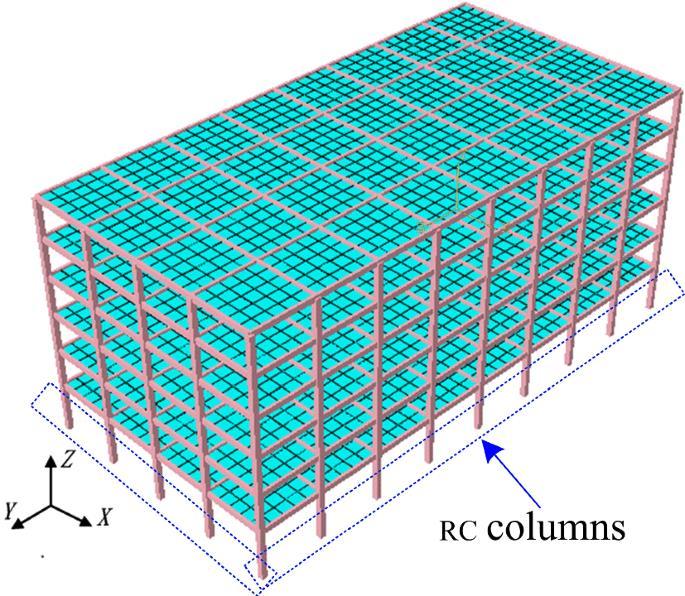
Reinforced Concrete (RC) frames are essential for structural stability in modern construction, as they combine concrete’s compressive strength with steel’s tensile strength to create a highly resilient and loadbearing system. These frames form a rigid skeleton by connecting beams and columns, which helps distribute forces evenly throughout a structure, resisting external forceslikewindandseismicactivity.
RC frames are also valued for their ductility, allowing structures to withstand deformation without sudden collapse, particularly during earthquakes. They offer design flexibility, cost-effectiveness, and long-term durability,makingthemidealforbuildingsofalltypesand sizes,fromresidentialcomplexestohigh-riseskyscrapers. Through effective soil-structure interaction, RC frames enhance the stability and safety of the structures they support, ensuring a solid foundation even in challenging environmentalconditions.
International Research Journal of Engineering and Technology (IRJET) e-ISSN: 2395-0056
Volume: 11 Issue: 12 | Dec 2024 www.irjet.net p-ISSN: 2395-0072
2.1.Importance of lateral response in RC frames for structural stability
ThelateralresponseofReinforcedConcrete(RC)framesis crucialforstructuralstability,asitdeterminestheframe’s ability to resist horizontal forces like wind and earthquakes. By effectively managing lateral loads, RC framespreventexcessiveswayordisplacement,whichcan lead to structural damage or collapse. This response enhances the frame's rigidity, allowing it to maintain balance and integrity under stress, thus safeguarding the building and its occupants in dynamic environmental conditions.
2.2.Purpose of investigating lateral variations with different concrete types
Investigating lateral variations with different concrete types in RC frames is essential to understand how each concretemixaffectstheframe’sabilitytoresisthorizontal forces like wind and seismic loads. Different concrete grades have unique strengths, stiffness, and deformation characteristics, impacting the overall lateral stability and flexibility of the structure. By analyzing these variations, engineers can identify the optimal concrete type that provides the best balance of strength and ductility for a given structure. This research ensures that the RC frame can achieve maximum stability and safety while optimizing material costs and performance under varying lateralforces.
3.TYPES OF CONCRETE IN RC FRAMES
In reinforced concrete (RC) frames, different types of concrete are used depending on structural requirements, performance characteristics, and specific project needs. Here's an overview of the main types of concrete commonlyusedinRCstructures:
Normal-Strength Concrete (NSC) is a commonly used construction material characterized by a compressive strength typically ranging from 20 to 40 MPa (2900 to 5800 psi). Composed of standard aggregates, cement, water, and sometimes admixtures, NSC is known for its cost-effectiveness and suitability for a variety of applications, including residential and light commercial buildings. While it provides adequate structural performanceformanytypicalloads,NSChaslimitationsin terms of durability and resistance to extreme conditions, making it less suitable for high-stress environments or structuresrequiringenhancedperformance.
High-Strength Concrete (HSC) is engineered to achieve compressivestrengthsexceeding40MPa(5800psi),often reachingupto100MPa(14,500psi)ormore.Thistypeof concreteisformulatedusingspecializedcements,reduced water-to-cement ratios, and carefully selected aggregates, which contribute to its superior performance characteristics. HSC offers enhanced load-bearing capacity,allowingformoreslenderandefficientstructural designs, making it ideal for high-rise buildings, bridges, and other applications subjected to significant loads. Additionally, HSC exhibits improved durability and resistance to environmental factors, which helps extend the lifespan of structures in challenging conditions. However, its higher material costs and specific mixing requirementscanbeconsiderationsinitsuse.
Self-ConsolidatingConcrete(SCC)isahighlyflowabletype of concrete that can fill formwork and encapsulate reinforcement without the need for mechanical vibration. Thischaracteristicisachievedthroughtheuseofahigher proportionoffineaggregatesandsuperplasticizers,which enhance its fluidity while maintaining stability and preventing segregation. SCC is particularly beneficial in complex formwork and congested reinforcement conditions, leading to increased construction efficiency and a superior surface finish with fewer defects like honeycombing. Its uniform consistency also improves performance in seismic regions, as it provides excellent lateral load response and overall structural integrity, making it a preferred choice for modern construction projects.
Fiber-Reinforced Concrete (FRC) incorporates fibrous materials such as steel, glass, synthetic, or natural fibers into the concrete mix to enhance its mechanical properties. This type of concrete significantly improves toughness, ductility, and crack resistance, making it
International Research Journal of Engineering and Technology (IRJET) e-ISSN: 2395-0056
Volume: 11 Issue: 12 | Dec 2024 www.irjet.net p-ISSN: 2395-0072
particularly effective in applications where enhanced durability is essential. FRC exhibits better post-crack behavior, which helps maintain structural integrity under load and can reduce the propagation of cracks, thereby extending the lifespan of structures. Its benefits are especially valuable in seismic applications, as FRC can absorb energy and provide greater stability during lateral loads.WhileFRCcanbemorecostlydueto theadditional materials, its performance advantages often justify the investmentindemandingconstructionscenarios.
Precastconcreteisaconstructionmaterialthatiscastand cured in a controlled environment before being transported to the construction site for assembly. This method allows for precise quality control, as the concrete is typically produced in a factory setting, ensuring uniformity and strength. Precast components, such as beams,columns,walls,andslabs,canbemanufacturedina varietyofshapesandsizes,enablingefficientconstruction and rapid installation. Additionally, precast concrete can enhance durability and reduce on-site construction time, minimizing labor costs and environmental impact. Its versatility and ability to be tailored for specific design requirements make precast concrete a popular choice in modern building projects, including commercial, residential,andinfrastructuralapplications.
The type of concrete used in reinforced concrete (RC) frames significantly influences their lateral response, which is crucial in resisting lateral loads such as seismic andwindforces.Normal-strengthconcrete(NSC)provides basic load-bearing capacity but may lack the ductility needed for high seismic performance. High-strength concrete (HSC), while offering enhanced stiffness and load-bearing capacity, can be brittle, which may limit its effectiveness under extreme lateral displacements. Selfconsolidating concrete (SCC) improves construction efficiency and structural homogeneity, which can positively impact lateral load distribution, though it may have limited ductility. Fiber-reinforced concrete (FRC) incorporates fibers that improve crack resistance and toughness, contributing to enhanced post-yield performance and energy dissipation during lateral loading.Overall,selectingtherightconcretetypeinvolves balancing strength, ductility, and stiffness to meet the specificlateralloadrequirementsofthestructure.
Inthissectionoftheliteraturereview,wehavestudiedthe previous research papers based on the different types of concrete on the Frame structure, and summary of previouspapershasbeengivenbelow:
Ahmed et al.(2023): The staged analysis (SA) yields higherbendingmomentsandshearingforcescomparedto ordinary analysis (OA). The rigid frame (RF) system provides the minimum difference in differential displacement between OA and SA. SA and OA compared for concrete buildings' lateral load resistance. RF system showed minimum differences in displacements and internalforces.
Ying et al.(2023): Improved planar frame models considering system-level interactions. Reduced errors in peakoverturningmomentswithupdatedmodels.Systemlevel shake-table test of two-story low-damage concrete wall building. Modified planar frame models improve accuracybyconsideringsystem-levelinteractions.
Khalil et al.(2023): Axial load affects dynamic response andcrackformation.ThickerCFRPlayersimproveimpact resistancesignificantly.Investigatedaxialload'simpacton RCmembers'dynamicresponse.Foundaxialcompression affectsinclinedcrackformationanddamageseverity.
Fajar et al.(2023): Infill walls significantly improve lateral strength of RC frames. Further research should consider infills as important components. Infill walls significantly improve lateral strength of RC frames. Furtherresearchneededoninfill'sroleinseismicdesign.
Airong et al.(2023): Impact mass and velocity influence dynamicstrainresponse.Longitudinalreinforcementratio reduces plastic deformation and impact damage. RCCs tested under lateral impact loading through experiments and simulations. Impact mass and velocity positively correlatedwithextremedynamicstrain.
Chunfeng (2023): ECC frames have higher energy absorbing capacity and ductility compared to SCC/UHPC frames. ECC/UHPC frames have higher load carrying capacity compared to SCC frames. Describes performance of HPC frames under lateral loading. ECC frames show higherenergyabsorptionandloadcapacity.
Xianhui et al.(2023): Composite columns have better impact resistance than RC columns. Outer steel tube is main energy dissipation component in columns. Study on impact responses of RC and composite columns. Compositecolumnsshow better overall impactresistance thanRCcolumns.
Algamati et al.(2023): 3Dsoftwareismoreaccuratethan 2Dsoftwareforseismicanalysis.Theappliedcasesdonot
International Research Journal of Engineering and Technology (IRJET) e-ISSN: 2395-0056
Volume: 11 Issue: 12 | Dec 2024 www.irjet.net p-ISSN: 2395-0072
exceed the limit of the NBCC 2015 Code. Investigating seismic behavior of concrete moment-resisting frame buildings. Analyzing seismic responses of 6- and 12-story reinforcedconcretebuildings.
Sila & Avgin (2022): Predictsbehaviorofpoorlydetailed RC columns under lateral loads. SAP2000 effectively models monotonic and hysteretic responses. Models monotonic and hysteretic behavior of RC columns under lateral loads. SAP2000 effectively predicts deformation comparedtoexperimentalresults.
Abdullah et al.(2022): Experimentalandnumericalstudy on CFST columns' impact behavior. Four concrete types tested: NC, RuC, SFC, hybrid RuC-SFC.Twelve specimens testedunderlateralimpactloadingconditions.High-speed camera measured mid-span deflection over time. Steel tubular showed plastic deformation and cracking under impact. Hybrid RuC-SFC had highest crack resistance; NC had lowest. Numerical results agreed with experimental findings.
Ion et al.(2022): Fragile global mechanism of failure by brittle rupture of RC columns in marginal end areas. "Strong Columns-Weak Beams" (SCWB) global ductile mechanism does not occur. Examines seismic response of MR RC frame structures. Proposes plastic hinge concentration in marginal beam areas.Reduces negative effects on beam-column joints. Observes participation of all lateral elements in energy dissipation.Validates innovativeimprovementsforseismicresponse.
Tunc et al.(2022): High ductile frame models showed better lateral load carrying performances. Existence of structuralsteelinacolumnimprovedlateralloadcarrying capacity. 12 frame models with reinforced concrete encased steel composite columns were analyzed. High ductilityframemodelsshowedbetterlateralloadcarrying performances.
Maidiawati & Jafril (2021): Masonry infills increase lateralstrengthandstiffnessofRCframes.Masonryinfills decrease ductility performance of RC frames. Seismic responses of masonry infilled RC frames tested under lateral load.Full and partial infills increase strength, decreaseductility.
Siva et al.(2021): RCframeswithstiffnessirregularityare more vulnerable than those with shear wall/bracings. RC frameswithshearwallhavereducedseismicimpactmore than bracings. Seismic performance of stiffness irregular structures studied using response spectrum method. RC frameswithshearwallhavereducedseismicimpactmore thanbracings.
Sae et al.(2020): The proposed frame model accurately captures the response of flexure-shear critical columns. The force-based formulation is computationally efficient
compared to displacement-based models. Proposes a frame model for nonlinear analysis of RC columns. Validatesefficiencythroughcorrelationwithexperimental responsesundercyclicloadings.
Rohit & Kolurkar (2020): The number of bays in SMRF buildings significantly affects their stability. SMRF buildingswithstronginfillhavehigherbaseshearcapacity than those with weak infill. Study compares performance of SMRF and OMRF buildings. Pushover analysis in SAP2000toanalyzestructuralbehavior.
Davda et al.(2019): The study assessed the effects of irregularities in an asymmetric RCC building. Different models were prepared and analyzed using ETABS software.StudyonirregularitiesinRCCbuildingsubjected toearthquakemotions.AssessmentusingETABSsoftware withtimehistorymethodanalysis.
Senthil et al.(2018): Maximum resistance with cement mortar at 10 mm thickness. Cork and foam effective at 6 mm thickness. Studied interface thickness effects on infilled frames under lateral loads. Maximum resistance foundwith10mmcementmortarinterface.
The review shows that advanced analysis and materials improve RC frames' lateral performance. Staged analysis (SA) predicts higher forces than ordinary analysis (OA), especially in rigid frames (Ahmed et al., 2023). Including system interactions reduces errors in overturning moments(Yingetal.,2023).ThickerCFRPlayersenhance impact resistance (Khalil et al., 2023), and infill walls significantly strengthen frames (Fajar et al., 2023). ECC materials improve energy absorption (Chunfeng, 2023), and composite columns with steel tubes increase impact resistance (Xianhui et al., 2023). Seismic studies validate 3D modeling for precision (Algamati et al., 2023) and highlight structural adjustments like "Strong ColumnsWeak Beams" for resilience (Ion et al., 2022). In short, refinedmethodsandmaterialsenhanceRCframestability underlateralandseismicloads.
1. A. A. Elansary, M. I. Metwally, and A. G. El-Attar, “Structural system yielding minimum differences between ordinary and staged analyses,” Journal of Engineering and Applied Science, vol. 70, no. 1, Jun. 2023,doi:10.1186/s44147-023-00243-3.
2. A. Gu, Y. Zhou, Y. Lu, Q. Yang, R. S. Henry, and G. W. Rodgers, “Planar frame models considering system‐level interactions of a two‐story low‐damage concrete wall building,” Earthquake Engineering & Structural Dynamics, vol. 52, no. 14, pp. 4325–4351, Jun.2023,doi:10.1002/eqe.3954.
International Research Journal of Engineering and Technology (IRJET) e-ISSN: 2395-0056
Volume: 11 Issue: 12 | Dec 2024 www.irjet.net p-ISSN: 2395-0072
3. K. Al-Bukhaiti et al., “Effect of the axial load on the dynamic response of the wrapped CFRP reinforced concrete column under the asymmetrical lateral impact load,” PLoS ONE, vol. 18, no. 6, p. e0284238, Jun.2023,doi:10.1371/journal.pone.0284238.
4. F. Nugroho, N. Zaidir, J. Tanjung, and N. Maidiawati, “Comparative Analysis on Lateral Strength of MultiSpan RC Frame with Different Types of Infill Walls,” IOP Conference Series Earth and Environmental Science, vol. 1173, no. 1, p. 012011, May 2023, doi: 10.1088/1755-1315/1173/1/012011.
5. A.Chen,Y.Liu,R.Ma,andX.Zhou,“Experimentaland Numerical Analysis of Reinforced Concrete Columns under Lateral Impact Loading,” Buildings, vol. 13, no. 3, p. 708, Mar. 2023, doi: 10.3390/buildings13030708.
6. A. E. Yeganeh, “Structural behaviour of reinforced high performance concrete frames subjected to monotonic lateral loading,” Ryerson University, Jun. 2021,doi:10.32920/ryerson.14653914.v1.
7. X. Li, Y. Yin, T. Li, X. Zhu, and R. Wang, “Analytical Study on Reinforced Concrete Columns and Composite Columns under Lateral Impact,” Coatings, vol. 13, no. 1, p. 152, Jan. 2023, doi: 10.3390/coatings13010152.
8. M. Algamati, A. Al-Sakkaf, E. M. Abdelkader, and A. Bagchi, “Studying and analyzing the seismic performance of concrete Moment-Resisting frame buildings,” CivilEng,vol.4,no.1,pp.34–54,Jan.2023, doi:10.3390/civileng4010003.
9. S. Avğin and M. M. Köse, “Simplified nonlinear analysis of RC columns exposed to lateral loads,” Çukurova Üniversitesi Mühendislik Fakültesi Dergisi, vol. 37, no. 4, pp. 1113–1126, Dec. 2022, doi: 10.21605/cukurovaumfd.1230959.
10. A.M.Merwad,A.A.El-Sisi,S.a.A.Mustafa,andH.E.D.M.Sallam,“LateralimpactresponseofRubberizedFibrous Concrete-Filled Steel tubular columns: Experiment and numerical study,” Buildings, vol. 12, no. 10, p. 1566, Sep. 2022, doi: 10.3390/buildings12101566.
11. I.Sococol,P.Mihai,T.-C.Petrescu,F.Nedeff,V.Nedeff, andM.Agop,“AnalyticalStudyRegardingtheSeismic Response of a Moment-Resisting (MR) Reinforced Concrete (RC) Frame System with Reduced Cross SectionsoftheRCBeams,” Buildings,vol.12,no.7,p. 983,Jul.2022,doi:10.3390/buildings12070983.
12. G. Tunc, M. M. Othman, and H. C. Mertol, “Finite ElementAnalysisofFrameswithReinforcedConcrete
EncasedSteelCompositeColumns,” Buildings,vol.12, no. 3, p. 375, Mar. 2022, doi: 10.3390/buildings12030375.
13. N.MaidiawatiandJ.Tanjung,“Theseismic responses of RC frames infilled with full and partial masonry walls under cyclic lateral load,” IOPConferenceSeries Earth and Environmental Science, vol. 708, no. 1, p. 012079, Apr. 2021, doi: 10.1088/17551315/708/1/012079.
14. S.S.B.S.KumarandG.V.R.Rao,“Seismicanalysisof Reinforced concrete frames with stiffness irregularity,” IOP Conference Series Materials Science and Engineering, vol. 1025, no. 1, p. 012031, Jan. 2021,doi:10.1088/1757-899x/1025/1/012031.
15. W. Sae-Long, S. Limkatanyu, C. Hansapinyo, T. Imjai, and Mi. Kwon, “Forced-based shear-flexureinteraction frame element for nonlinear analysis of non-ductile reinforced concrete columns,” Applied andComputational Mechanics, vol. 6, pp. 1151–1167, Dec.2020,doi:10.22055/jacm.2020.32731.2065.
16. N.R.R.Mahorkar,“TheEffectofLateralConnectionin Moment Carrying Capacity of Frame in RC High Rise Structure using Pushover Analysis,” International Journal of Engineering Research And, vol. V9, no. 08, Aug.2020,doi:10.17577/ijertv9is080158.
17. D. K. Kishorbhai, “Response of RCC Asymmetric building subjected to earthquake ground motions,” IJERT,Sep.2019,doi:10.17577/IJERTV8IS070355.
18. K. Senthil, S. Muthukumar, S. Rupali, and K. S. Satyanarayanan, “Effect of Various Interface Thicknesses on the Behaviour of Infilled frame Subjected to Lateral Load,” IOP Conference Series Materials Science and Engineering, vol. 330, p. 012113, Mar. 2018, doi: 10.1088/1757899x/330/1/012113.