
International Research Journal of Engineering and Technology (IRJET) e-ISSN: 2395-0056
Volume: 11 Issue: 12 | Dec 2024 www.irjet.net p-ISSN: 2395-0072

International Research Journal of Engineering and Technology (IRJET) e-ISSN: 2395-0056
Volume: 11 Issue: 12 | Dec 2024 www.irjet.net p-ISSN: 2395-0072
BIJANDRA GHIMIRAY, Er. SOHAN SINGH
1M.Tech Scholar, Deptt. Of Civil Engineering, Indo-Global Group of Colleges
2Assistant Professor, Deptt. Of Civil Engineering, Indo-Global Group of Colleges, Punjab, India ***
Abstract - Bamboo is also called as “Green Steel” for 21st century which is naturally available over the globe in tropical and non-tropical region like Asia, some part of America and Africa. Bamboo is contemplate as sustainable, adaptable, eco-friendly, rapid growing construction material Given the high energy demand of current construction material and the scarcity of other naturally available resources such as a favorable alternative for construction purposes. After observation of this we have perceive bamboo is one of the key asset of building material. It has greater compressive strength than concrete, brick, or wood and its tensile strength is similar to that of steel. Using bamboo instead of traditional materials like concrete or steel in construction can help to make our environment healthier. When we choose bamboo, we are making a smart decision for the planet. It means we’re using that grow quickly and doesn’t harm the environment as much as other materials. This switch to bamboo can make a big difference in reducing the amount of pollution created by the construction industry. Not only does bamboo help the environment, but it also helps the economy and makes society fairer. This paper suggests that we should keep studying bamboo and finding new ways to use it in construction. By doing this, we can unlock even more benefits for the environment, the economy, and society as a whole. In short, using bamboo in construction can help us build a better, more sustainable future.
Key Words: green steel, bamboo, favorable, traditionalmaterial,sustainablefuture,societyfairer.
Theconstructionindustryisamultifacetedsector involved in the planning, design, construction, and maintenance of infrastructure,includingroads,bridges, dams,buildings,and tunnels. Key materials used are steel, cement, sand, and aggregates, significantly contributing to construction. Annually,around1800-1900millionmetric tonsofsteelare used globally, with 2023 seeing approximately 1814.5 million metric tons. Global cement consumption reaches about4.4to4.5billionmetrictons annually,aspertheU.S. GeologicalSurveyandtheGlobal CementReport,with2023 estimates at 4.4 billion metric tons. Aggregate usage, including sand, gravel, and crushed stone, is around 50 billionmetrictonsannually.
Using these materials impacts the environment in various ways. Steel production, involving resource-intensive
processes like mining and smelting, contributes to deforestation, habitat destruction, soil erosion, and significantCO2emissions 1.91tonsofCO2pertonofcrude steelcastin2022,accordingtotheWorldSteel Association. Cement production, responsible for about 7- 8% of global CO2 emissions, also exacerbates climate change and air pollution. Sand and aggregate extraction disrupts ecosystems, leading to habitat loss, erosion, and water pollution, impacting aquatic biodiversity and ecosystem health.
Historically, civilizations used bamboo for construction beforesteel wasdiscovered.Bamboo's strength,flexibility, and abundance made it a versatile substitute. Ancient cultures in East Asia and South America used bamboo for beams, scaffolding, and even weaponry, showcasing its suitability for various climates and seismic activity. StructureslikethebamboobridgesofancientChinaand the frameworksofMayantempleshighlightits significance.
Bamboo, particularly Dendrocalamus Hamiltonii, is widely availableinIndia'sNorth-Eaststates.Thistallspecies,known locallyas“MolBas,”inmyareareaches15-18 meterswith culmdiametersof5-15cm.Bamboohasbeen usedfortools, paper, textiles, food, soil stabilization, reforestation, and handicraftsforcenturies.Recently,it hasgainedattentionas arenewable,low-impact alternativetoconcreteandsteelin construction. Its rapid growth rate ensures a sustainable supply,anditsstrength- to-weightratioandflexibilitymake it suitable for structural applications, especially in earthquake-prone regions. Bamboo also offers environmentalbenefitsby absorbinglargeamountsofCO2 andrequiringminimal chemicalinputs.
Studies on bamboo reinforcement focus on its performance under various loads, testing for its flexural strength. This tests evaluate how well bamboo can handle bending forces, which is essential for determining its suitabilityinapplicationswhereflexibilityandresilience are required. These tests helps us to understand bamboo's potentialasaconstructionmaterial,ensuringitcan support heavyloadswithoutbucklingorcollapsing.
Researchers have been engaged in studying the use of bambooinsustainableconstruction.Herearesomeoftheir accomplishments.
International Research Journal of Engineering and Technology (IRJET) e-ISSN: 2395-0056
Volume: 11 Issue: 12 | Dec 2024 www.irjet.net p-ISSN: 2395-0072
Sumeera Madhushan et al. (2023) “This review highlights the importance of understanding bamboo’s physical,mechanical,andchemicalpropertiesforits effective use in construction, particularly emphasizing the need to explore preservation techniques due to bamboo’s biodegradable nature. Previous studies on bamboo’s materialandmechanicalpropertiesacrossdifferent regions are synthesized, underlying the variability in strength parameters influenced by factors like species, moisture content, and growth conditions. Furthermore, the review stressesthenecessityofensuringconnection stabilityand long-termperformance,withadvancedhigh- performance bamboo connections showing promise in replacing traditionaljoints.Variouspreservativetechniques,including oil-heated treatment and borax treatment, are discussed, each with its advantages and disadvantages. In terms of durability, borax preservation emerges as a viable option, through further research is needed to quantify its effects accurately. The review suggests future research avenues could focus on enhancing bamboo’s durability through preservative techniques and exploring the potential of engineered bambooproductslikecross-laminatedbamboo, which offerimprovedmechanicalproperties.
Tanisha Rampal et al. (2023) “Thisliteraturereview emphasizesbamboo’spotentialasasustainableconstruction material,attributedtoitsrapidgrowthand environmental friendliness.Itsadaptabilityacross architecturalanddesign domains underscores its historical and contemporary relevance.Despiteitsmerits, challengeslikewaterdamage persist,althoughongoing technologicaladvancementsoffer remedies.Furthermore, thereviewidentifiesagapinspecific bamboo applications, suggesting an area ripe for further investigation. Ultimately, bamboo emerges as a crucial, versatile, and culturally significant resource for ecoconscious designinitiativesbothinIndiaandglobally.
Cleysson Marcio Guimaraes da Cunha el at. (2023) “ This literature review explores the economic impact of Brazil’s civil construction sector, noting its significant influence on the economy alongside concerns about resource depletion and waste generation. With a growing focusonsustainability,attentionturnstobambooas a promising alternative due to its durability and rapid growth. The review examines the feasibility of integrating bamboo into construction practices, emphasizing the importance of economic viability, sustainability, and regulatoryconsiderationsinachievingabalanced approach todevelopmentandenvironmentalstewardship.
Maria Fe V. Adier el at. (2023) “Thesignificanceof bambooasatraditionalconstructionmaterialpersists owing toitsadaptabilityandremarkablestrength-to- weightratio. However, ensuring its long-term durability necessitates meticulous treatment due to inherent variations in mechanical properties. Extensive research indicates that both natural and chemical treatments offer avenues for
enhancing bamboo’s properties, albeit challenges such as managing temperature and treatment duration persist. A comprehensiveliteraturereview encompassing57articles spanningtheperiodfrom2003 to2023,supplementedby additional scholarly references, underscores gaps in comprehending bamboo’s characteristics and treatment modalities.Toaddressthese gaps,thethesisrecommends the formulation of centralized protocols for bamboo preparation, exploration into alternative reinforcement materials,andthe refinementoftestingmethodologies.The standardization of treatment procedures and the critical evaluation of existing testing protocols emerges as imperativestepsto bolsterbamboo’sreliabilityandfacilitate itssustainable integrationintoconstructionpractices
Samjetsabam Chainey et al. (2022) “Thisliterature reviewexploresbamboo’sroleasasustainable construction material.Bamboo,abundantintropical regionsworldwide, boasts remarkable versatility and eco- friendliness. With strengths exceeding those of traditional materials like concreteandwood,bamboooffersa compellingsolutionto concerns about resource depletion. Amidst challenges in providing affordable housing due to population growth, bambooemergesasapromisingalternative.Furthermore,its potential to replace steel reinforcement in construction is examinedinthisstudy, whichinvestigatestheperformance of bamboo-reinforced concrete and housing systems featuringbambooasa primarycomponent.
Priyanka Shukla et al. (2020) “Theliteraturereview underscoresbamboo’sroleasahighlysustainable resource, showcasingitsdiverseapplicationsacross industriessuchas construction and fabric production, and its significant economic contributions worldwide. Extensive research highlightsbamboo’sremarkable tensilestrength,akintothat ofsteel,positioningitasa viablealternativetoconventional timber.Thisassertionis furthersupportedbyvariousLife Cycle Assessment tests. While certain Asian nations have embraced bamboo, emerging askey global producersand innovators,others, includingIndia,despitetheirsubstantial bamboo production, lack a robust bamboo industry infrastructure. Consequently,artisansandgrowersinthese regions encounter obstacles stemming from inadequate legislative backing, limited resources, and infrastructure, elucidating a notable gap in the bamboo resource development continuum.
Madhukar Ramchandra Wakchaure (2016) “The literature review highlights the pivotal role of reinforcing cementmatricesinmodernconstruction,withsteelbeingthe predominant material due to its adaptability. However, globalsteelshortagesandcostissuesindeveloping nations havepromptedaquestforeconomical alternatives,leading totheinvestigationofbambooasa reinforcementmaterial. This thesis delves into bamboo’s potential for concrete reinforcement, emphasizing its physical and mechanical attributes. Through experimental research and treatment
International Research Journal of Engineering and Technology (IRJET) e-ISSN: 2395-0056
Volume: 11 Issue: 12 | Dec 2024 www.irjet.net p-ISSN: 2395-0072
methods aimed at enhancing bamboo’s properties, an analytical and design framework for bamboo-reinforced concreteelementsisdeveloped. Validationisconductedvia testingofbeamandslab specimens,validatingthereliability oftheproposed framework.Additionally,thethesispresents design illustrationsandanextensivereferencelist
Sri Murni Dewi el at. (2016) “ Recent research at Brawijaya University in Indonesia has advanced bambooreinforcedconcretethroughthreekeyapproaches: attaching pegs to reinforcement for enhanced structural integrity, using lightweight bricks to reduce beam weight, and incorporating lightweight aggregate in bamboo concrete compositeframes.Thesemethodsaddress challengessuchas durabilityandcompatibility,making bambooamoreviable and sustainable construction material . The findings offer valuableinsightsandpavethe wayforfurtherdevelopments inbamboo-reinforced concrete.
This research explores the mechanical properties of Dendrocalamus Hemiltonii (locally known as Mol Bas) bamboospecimenunderflexuralstrength,andunderstand its application area. Despite its promising mechanical characteristics, and availability understanding the performanceofthisbambooiscrucialfortheir widespread adaptioninsustainableconstruction practices,speciallyin North-Eastregion.Closingthis researchgapcouldfacilitate theprocedureacceptanceand utilizationofMolBasbamboo as a viable alternative to conventional construction materials,contributingtomoveenvironmentallyfriendlyand resilientbuiltenvironment.
1.Performance ofdifferent Molbamboosections: This objective focuses on conducting flexural tests on different bamboo specimens to assess their load-bearing capacity. Byanalyzingthemechanicalpropertiesofhalved bamboo sections, the study aims to determine their suitabilityfor useinsustainableconstructionapplications, suchas modularorcompositestructures.
2. Investigate the influence of specimen configuration on flexural strength: Comparing the mechanical propertiesofdifferentspecimenconfigurations, including variationsinthenumberofhalvedandfullbamboo sectionsusedincompressionandtensionzoneforflexural strength. By systematically varying the specimen configurations, the study aims to identify how deflection varieswithdifferentspecimenarrangementsandto optimize specimen preparation protocols for future research and practicalapplications.
3. Comparing performance of Halved and full solid Mol bamboo specimens: Toconductcomparative analysis betweenhalvedbamboo,onethirdoforiginalhalf bamboo, and full solid bamboo specimen under two point loadingsystem.Byexaminingthedifferenceinload bearing capacity,deformationcharacteristics,andload failuremodes betweenhalved,onethirdoforiginalhalf bamboo,andfull solidbamboospecimens.Aimofstudyis toprovideinsights into the structural integrity and potential applications of halvedsectionbamboosections insustainableconstruction.
Beforeyoubegintoformatyourpaper,firstwriteandsave thecontentasaseparatetextfile.Keepyourtextandgraphic files separate until after the text has been formatted and styled.Donotusehardtabs,andlimituseofhardreturnsto onlyone returnatthe endof a paragraph. Donot addany kindofpagination
The bamboo specimen are collected from Pamphok, NamthangsouthSikkim,nearPamphokGovernment Junior High school, with specific coordinate (27.1427484, 88.4849345).ThebamboosamplewascarriedtotheCCCT collegelaboratory.
Mol bamboo specimens ofvaryingdimensions, ranging from4cmto6cmindiameter,wereselectedforthis study. These specimens were divided into three categories, and threesamplesforeachcategorywas prepared.
1. Specimen1(H2B):Twohalfbamboostrandinthe compressionandtensionzone.(Fig.1.)
2. Specimen2(H3B):Two1/3bamboostrandin the compressionzoneandthree1/3bamboo strandin thetensionzone.(Fig2.)
3. Specimen3(HB) :Two halfbamboostrand in the compressionzoneandtwofullsolidbambooin the tensionzone.(Fig.3.)
All specimens were standardized to the following dimensions:700mminlength,150mminwidth,and150 mminheight.ToachieveconcretegradeofM20materials suchascement,fineaggregate,andcoarseaggregatewere usedtoassembleandfixthebamboosections.Normal river sandwasused,andtheaggregatesizeforthe specimenswas 10 mm (approximately 60% of the totalcoarseaggregate) and 20 mm (approximately 40% of the total coarse aggregate).
International Research Journal of Engineering and Technology (IRJET) e-ISSN: 2395-0056
Volume: 11 Issue: 12 | Dec 2024 www.irjet.net p-ISSN: 2395-0072
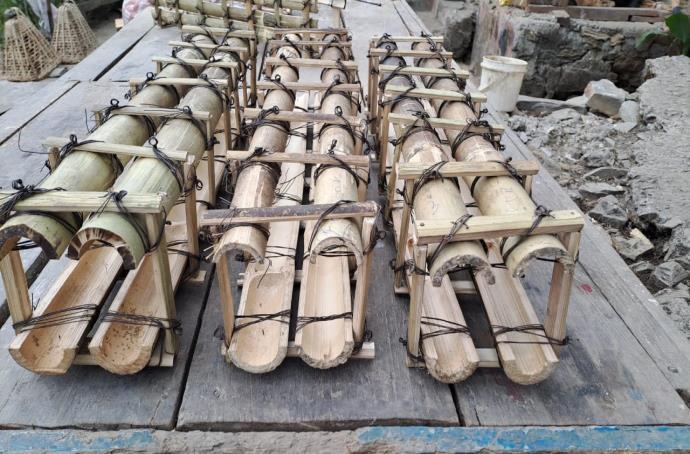
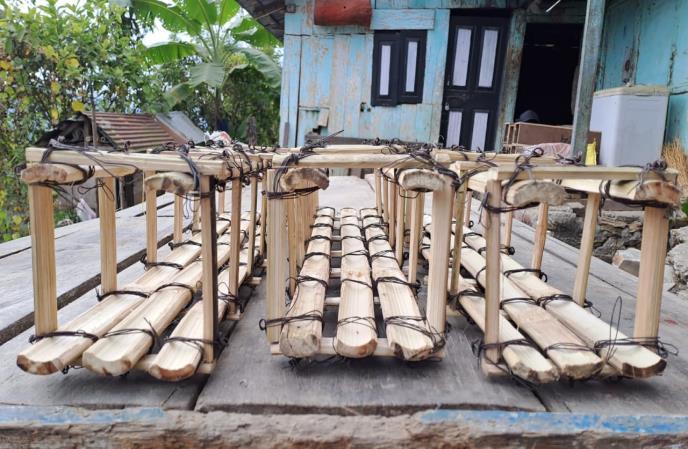
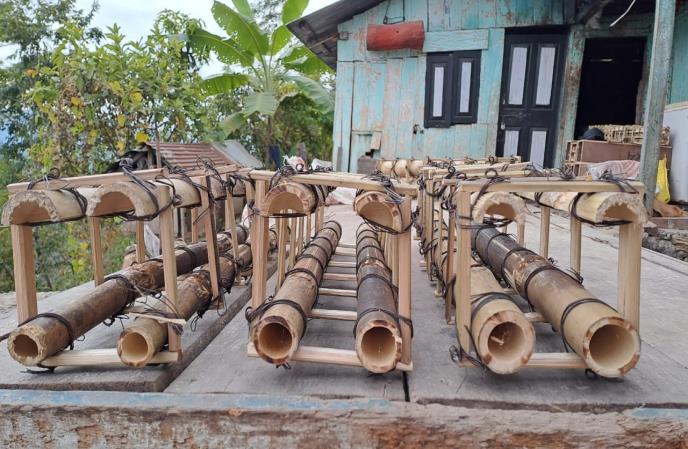
Twohalfbamboostrandinthecompressionzone andtwofullsolidbamboointhetensionzone
Thetestsetupinvolvedaflexuretestingmachineover which thebeamspecimenswereplaced,andtheloadwas applied simultaneouslyattwopointsequidistantfromthe supports. This configuration subjected the specimen to bending momentsandshearforces.Alsofindingsbasedon thefirst
crackloadandfailureloadwasrecorded,whichis provided inTable1.
6. RESULT AND DISCUSSION
Table -1: SampleTableformat
Sl. No
1. HalfBamboo Specimens 7 27
2. One-thirdofthe OriginalHalfBamboo Specimens 6 22
3. CombinedHalfand FullSolidBamboo Specimens 8.5 19
1. Thefindingsdemonstratethatthearrangementof bambooreinforcementconsiderablyinfluencesthe flexural strength and crack initiation load of the concrete sections. The Half Bamboo strand specimen exhibited the highest flexural strength, followed by the One-Third of the Original Half BambooSpecimens andtheCombinedHalfandFull SolidBamboo Specimens.
2. TheHalfBambooSpecimenshadalargereffective areaofreinforcementinboththecompressionand tension zones, leading to higher load-carrying capacity anddelayedcrackinitiation.
3. Thefirstcrackloadcanbeusedtoassesstheinitial stiffness of the bamboo-reinforced concrete. Specimen 1(H2B)demonstratedthehighestfirst crackloadof7 kN,indicatingbetterresistanceto initial cracking, while Specimen 2 (H3B) and Specimen3(HB) exhibitedfirstcrackloadsof6kN and8.5kN, respectively.Thevariationinfirstcrack loadsshows theimpactofbambooconfigurationon theearly-stage performanceofthecomposite.
4. Thehalvedbambooconfigurationprovidedbetter load-carryingcapacity,whichcouldbeattributedto the distribution of stresses and better bonding betweenthebambooandtheconcretematrix.
The study demonstrates that bamboo-reinforced concrete has significant potential as an alternative to conventional steelreinforcement,particularlyinregionswherebamboo is readily available and cost-effective. The results highlight thattheconfigurationofbamboostrands(halved,one- third, andfullsolid)playsacrucialroleindeterminingthe flexural strengthandoverallperformanceofthe composite.Halved
International Research Journal of Engineering and Technology (IRJET) e-ISSN: 2395-0056
Volume: 11 Issue: 12 | Dec 2024 www.irjet.net p-ISSN: 2395-0072
bamboo strands, in particular, exhibited superior loadcarrying capacity, better distribution of stresses, and enhanced bonding with concrete. This makes halved bamboo sections an attractive option for reinforcing concreteinstructuralapplications.
[1] D.GuptaandR.Ranjan,“RoleofBambooinSustainable Development,”AJSInternationalJournalofAdvancesin ScientificResearchandReviews(IJASRR),vol.2no.1pp 25-32,2016.
[2] GhavamiK,HombeeckRV,“ApplicationofBambooasa ConstructionMaterial.
[3] MritunjayKumarSingh,ShivPratapSingh,KaisarJamal, Piyush Verma, “Bamboo Reinforced Concrete: A Review,” Volume:07,Issue:06June,2020.
[4] K. Ghavani, “Bamboo as reinforcement in structural concrete elements, Cement and Concrete Composite” , 27,637-649(2005)
[5] Khesrow Ghavami, “Bamboo as reinforcement in StructuralConcreteElements”,04June,2004.
[6] Samjetsabam Chainey, Chitra Shijagurumayum, Thokchan, “Review on the use of Bamboo as A Constructionmaterial”,SAMRIDDHIVolume14,Special issue1,2022.
BIOGRAPHIES


5.
Bijandra Ghimiray M.Tech Scholar,Deptt.OfCivil Engineering,IndoGlobalGroup OfColleges.
Er. Sohan Singh Assistant Professor,Deptt.OfCivil Engineering,IndoGlobal Groupof Colleges,Punjab, India.