
International Research Journal of Engineering and Technology (IRJET) e-ISSN: 2395-0056
Volume: 11 Issue: 12 | Dec 2024 www.irjet.net p-ISSN: 2395-0072

International Research Journal of Engineering and Technology (IRJET) e-ISSN: 2395-0056
Volume: 11 Issue: 12 | Dec 2024 www.irjet.net p-ISSN: 2395-0072
Samarth Pujari1 , Nikhil R Dandige2 , Sunil L M3
1 Bachelor of Engineering, Information Science and Engineering, Bapuji Institute of Engineering and technology, Karnataka, India
2 Bachelor of Engineering, Information Science and Engineering, Bapuji Institute of Engineering and technology, Karnataka, India
3 Bachelor of Engineering, Information Science and Engineering, Bapuji Institute of Engineering and technology, Karnataka, India ***
Abstract - People, including those with impairments, can easily see, browse, and interact with digital content thanks to web accessibility. However, developers and organizations frequently face difficulties when adopting accessibility requirements across many platforms and applications. A framework for AI-powered tools that streamline and automate adherence to accessibility standards like the Web Content Accessibility Guidelines (WCAG) is presented in this research, which investigates the integration of AI in improving web accessibility. The report highlights several major obstacles to web accessibility, such as resource limitations, inexperience, and manual implementation. It suggests AI-powered solutions including real-time accessibility audits, automated semantic code analysis, and intelligent content adaption for those with cognitive, visual, or aural impairments. The possibilities of computer vision, machine learning, and natural language processing (NLP) technologies
Key Words: Web Accessibility, Artificial Intelligence, Inclusive Design, WCAG Compliance, Content Adaptation, Automated Accessibility Solutions.
The internet has become an integral part of modern life, enabling communication, education, commerce, and entertainment. However, for the approximately 1 billion people worldwide who live with some form of disability, accessing the web can often be a daunting task. Barriers suchasunstructuredcontent,inaccessibledesign,andlack ofassistivetoolshindertheirabilitytointeractwithdigital platforms effectively. Web accessibility, which focuses on designingdigitalexperiencesthatareinclusivetoallusers, isnot onlya fundamental humanright butalsoa growing legalrequirementglobally.
Despite efforts to implement accessibility standards like the Web Content Accessibility Guidelines (WCAG), many websites still fail to meet these benchmarks. Traditional manual accessibility testing is time-consuming and prone tohumanerror,makingitdifficulttoensurecomplianceat scale.ThisiswhereArtificialIntelligence(AI)stepsinasa game-changing solution. By automating and augmenting
the process of making websites accessible, AI has the potentialtocreateamoreinclusivedigitalecosystem.
AI-powered tools are revolutionizing web accessibility in severalways.Theycananalyzewebsitestoidentifyandfix accessibility issues, generate descriptive alt text for images, provide real-time captioning for audio content, and enhance assistive technologies like screen readers. Moreover, AI can predict and adapt to the needs of users with disabilities, offering personalized experiences that werepreviouslyunimaginable.
This introduction highlights the growing importance of leveragingAIto enhancewebaccessibility.It exploresthe transformativepotential ofAI-driventoolsinbridgingthe digitaldivideandcreatinga webthatistrulyinclusivefor allusers,regardlessoftheirabilities.Byunderstandingthe challenges and opportunities, this research aims to shed light on how AI can play a pivotal role in reshaping the futureofwebaccessibility.
Artificial Intelligence (AI) is revolutionizing web accessibility by addressing the barriers faced by individualswithdisabilitiesinaccessingdigitalcontent.As the internet becomes an essential part of modern life, ensuring inclusivity on digital platforms is critical. Traditional methods of implementing accessibility standards, such as the Web Content Accessibility Guidelines (WCAG), often require significant manual effort, technical expertise, and resources. AI technologies provide innovative solutions to these challenges by automating processes, adapting content dynamically, and personalizing user experiences, making the web more accessibletodiverseaudiences.
One of the most impactful features of AI is its ability to perform automated accessibility audits. AI tools can scan websites to identify common issues, such as missing alternativetextforimages,inadequatecolorcontrast,and improper heading structures. These tools not only detect problems but also offer actionable recommendations, significantly reducing the time and effort required for
International Research Journal of Engineering and Technology (IRJET) e-ISSN: 2395-0056
Volume: 11 Issue: 12 | Dec 2024 www.irjet.net p-ISSN: 2395-0072
compliance. Additionally, AI-powered content adaptation ensures that digital interfaces adjust to individual user needs. For instance, AI can modify font sizes, enhance contrast, or reorganize layouts to improve usability for peoplewithvisualimpairments.
Natural Language Processing (NLP) further enhances accessibility by powering virtual assistants and chatbots, which provide real-time support for users with cognitive disabilities or limited technical skills. Similarly, AI-driven computer vision technologies generate accurate image descriptions and alternative text, making visual content accessible to individuals who rely on screen readers. Speech recognition systems allow hands-free navigation, benefiting users with motor disabilities, while predictive textandautocorrectfeaturesassistthosewithdyslexiaor otherlearningchallenges.
AI’srole extendsto multimediaaccessibilityaswell.Realtimecaptioningandtranscriptionservicesconvertspoken contentintotext,enablinguserswithhearingimpairments to access audio and video materials. Furthermore, AI systems can analyze user behavior and preferences to offer personalized experiences, such as simplified navigation paths for users with cognitive disabilities or tailoredcontentpresentationtoimproveengagement.
These features collectively demonstrate the transformative potential of AI in creating an inclusive digital ecosystem. By automating routine tasks, reducing reliance on manual efforts, and providing intelligent adaptations, AI empowers developers to achieve accessibility standards efficiently. As AI technologies continue to evolve, they hold the promise of bridging accessibility gaps and ensuring that the web becomes a truly universal platform, where users of all abilities can engageequallyandeffectively.
Web accessibility standards are guidelines and best practicesdesignedtoensuredigitalplatformsareinclusive for all users, including those with disabilities. The most widely recognized framework is the Web Content Accessibility Guidelines (WCAG), developed by the World Wide Web Consortium (W3C). WCAG provides a comprehensiveset of principles, organized underfourkey pillars:Perceivable,Operable,Understandable,andRobust (POUR). These principles ensure content is accessible to userswithvariousimpairments,includingvisual,auditory, motor, and cognitive disabilities. The guidelines are divided into three compliance levels A, AA, and AAA rangingfrombasictoenhancedaccessibilityrequirements.
Other important standards include the Americans with DisabilitiesAct(ADA)intheUnitedStates,whichmandates that public-facing websites and applications be accessible to individuals with disabilities. Similarly, the Accessible
Canada Act (ACA) and the European Accessibility Act enforceaccessibilityregulationsintheirrespectiveregions. These standards emphasize creating accessible content, offering assistive technologies, and ensuring compatibility acrossdevices.
Despite the existence of robust guidelines, current practices often fall short of achieving full accessibility. Many developers lack awareness or expertise in implementing these standards. Common issues include missing alternative text for images, poorly designed navigation structures, and insufficient color contrast. Organizationsoftenrelyonmanual testingandstatic tools toaddresstheseissues,whichcanbetime-consumingand error-prone.
Emerging practices are increasingly leveraging technology to improve accessibility implementation. Automated accessibility testing tools like Axe, Wave, and Lighthouse help developers identify and fix issues efficiently. AI-powered solutions, such as real-time accessibility audits and dynamic content adaptation, are gaining traction. Collaborative approaches involving accessibility experts, user testing, and compliance audits also play a critical role in creating inclusive digital platforms.
While progress is being made, there is still a gap between theintentofaccessibilitystandardsandtheirapplicationin practice. Advancing web accessibility requires a combination of adherence to established guidelines, education for developers, and the adoption of innovative technologies like AI. This integration will help bridge the gap and ensure that digital experiences are universally accessible.
Artificial Intelligence (AI) has immense potential to revolutionize web accessibility by addressing the challenges faced by individuals with disabilities and ensuring inclusivity in digital spaces. Traditional methods of implementing accessibility often require significant manual effort and expertise. AI, with its ability to automateprocessesandadaptcontentdynamically,offers innovativesolutionstoovercomethesebarriers.
One of AI’s greatest strengths is its capacity for automated issue detection and correction. AI-powered tools can scan websites to identify accessibility problems, such as missing alternative text for images, inadequate color contrast, or non-semantic HTML structures. These tools provide developers with actionable insights, reducing time and effort while ensuring compliance with standards like the Web Content Accessibility Guidelines (WCAG).
International Research Journal of Engineering and Technology (IRJET) e-ISSN: 2395-0056
Volume: 11 Issue: 12 | Dec 2024 www.irjet.net p-ISSN: 2395-0072
AI’s dynamic content adaptation capabilities further enhance its potential. By analyzing user preferences, AI canmodifywebsiteelementsinreal-time,suchasresizing fonts, enhancing contrast, or reorganizing layouts. This is particularly beneficial for users with visual impairments or cognitive disabilities, offering a personalized browsing experience.
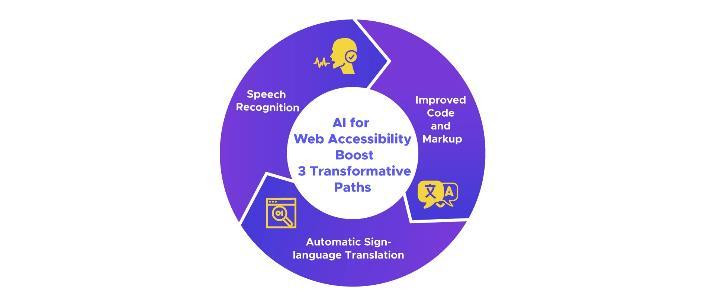
Fig -1:RoleofAlinImprovingWebAccessibility
Incorporating natural language processing (NLP) and computervisionintowebaccessibilitytoolshasalsobeen transformative.NLPpowersintelligentchatbotsandvoice assistantsthatsimplifynavigationforuserswithcognitive challenges. Computer vision generates descriptive alt text for images, making visual content accessible to screen readerusers.
Additionally, AI supports real-time captioning and transcription,enablinguserswithhearingimpairmentsto access audio and video content. Features like speech recognition and predictive text further assist individuals with motor disabilities or dyslexia, enabling them to interactwithwebsitesmoreeffectively.
AI’s ability to learn user behavior and preferences allows it to create highly tailored experiences, ensuring that interfaces are intuitive and easy to navigate. For instance, AI can prioritize specific content or simplify complexinterfacesforuserswithcognitivedisabilities.
As AI technologies evolve, their potential to bridge accessibility gaps continues to grow. By automating repetitive tasks, reducing reliance on manual interventions, and providing intelligent, adaptive solutions, AI can make digital platforms universally accessible. With continued innovation, AI holds the promise of transforming web accessibility, fostering inclusivity, and ensuring equal access to information and opportunitiesforallusers.
The future of artificial intelligence (AI) in web accessibility promises transformative changes that will furtherbridgethedigitaldivideandfosterinclusivity.AsAI technologies continue to advance, their ability to address complexaccessibilitychallengeswillgrow,makingtheweb moreaccessibleforindividualswithdisabilities.
One significant aspect of AI’s future is the evolution of intelligent user interfaces. AI will increasingly leverage machine learning to analyze user behavior, preferences, and needs, creating adaptive and personalized web experiences. These interfaces will automatically adjust elements like font sizes, layouts, and color schemes based on real-time feedback, ensuring seamless usability for diverseaudiences.
Another promising area is the advancement of multimodal interaction technologies. AI will enhance speech recognition, gesture-based controls, and braincomputer interface systems, enabling individuals with severe motor disabilities to navigate the web effortlessly. These innovations will redefine how users interact with digital platforms, making them accessible to a wider demographic.
The integration of AI in multimedia accessibility will also play a crucial role. Future AI systems will provide moreaccurateandcontext-awareimagedescriptions,realtime video captioning, and audio transcription. This will benefituserswithvisualorhearingimpairments,allowing themtoengagefullywithmultimediacontent.
Moreover, AI-powered accessibility auditing tools will become more sophisticated, offering real-time corrections andproactiveguidancefordevelopers.Thesetoolswillnot only identify potential issues but also suggest contextspecific solutions, ensuring compliance with evolving accessibilitystandardslikeWCAG.
Despite its potential, the future of AI in web accessibility will also need to address critical challenges. Ethical considerations, suchas avoiding bias in AI models, safeguardinguserdataprivacy,andensuringtransparency, will be paramount. Additionally, over-reliance on AI may inadvertently reduce the emphasis on human-centered design,whichremainsacornerstoneofaccessibility.
Looking ahead, collaboration between technologists, accessibility experts, and end-users will be crucial to harness AI’s full potential. By incorporating user feedback into AI-driven solutions, developers can ensure that these technologiesarebothpracticalandimpactful.
Inconclusion,thefutureofAIinwebaccessibilityissetto create a more inclusive digital landscape. By advancing intelligent, adaptive, and context-aware tools, AI will empower individuals with disabilities to access the web equitably,fosteringgreaterdigitalequityandparticipation.
ArtificialIntelligence(AI)hasemergedasatransformative force in enhancing web accessibility, offering solutions to long-standing challenges faced by individuals with disabilities. By automating processes, adapting content
International Research Journal of Engineering and Technology (IRJET) e-ISSN: 2395-0056
Volume: 11 Issue: 12 | Dec 2024 www.irjet.net p-ISSN: 2395-0072
dynamically,andpersonalizinguserexperiences,AI-driven tools are reshaping the digital landscape, making it more inclusive and equitable. This research has explored the various aspects of AI's role in web accessibility, highlighting its current capabilities, potential, and future impactonthedigitalecosystem.
The adoption of AI in web accessibility is not merely a technological advancement but a social imperative. Millions of users worldwide face barriers in accessing digital content due to disabilities. AI technologies, such as machine learning, natural language processing (NLP), and computer vision, provide innovative methods to address these barriers. From automated accessibility audits and real-time captioning to dynamic content adaptation and personalized user interfaces, AI is enabling developers to createwebsitesandapplicationsthatcatertodiverseuser needs.
However, the journey toward universal web accessibility is not without challenges. Ethical considerations, such as preventing bias in AI models and safeguarding user privacy,are critical to ensure thatthese technologiesaredeployedresponsibly.Furthermore,while AI can automate many aspects of accessibility, humancentered design remains indispensable. Accessibility is ultimatelyaboutunderstandingandaddressingtheunique needsofindividuals,whichrequiresempathy,usertesting, andcollaborationwithaccessibilityexperts.
The future of AI in web accessibility holds immense promise. Emerging technologies, such as multimodal interaction systems, advanced predictive analytics, and brain-computerinterfaces,will furtherredefinehowusers engage with digital platforms. These innovations will empower individuals with severe disabilities, enabling themtointeractwiththewebinwaysthatwerepreviously unimaginable. Additionally, as AI-powered accessibility tools become more sophisticated, they will enable developerstonotonlycomplywithexistingstandardslike WCAG but also proactively adapt to evolving user needs andtechnologicaladvancements.
To fully realize AI's potential in web accessibility, a collaborativeapproachisessential.Stakeholders,including technologists, policymakers, educators, and end-users, must work together to drive innovation while ensuring ethical implementation. Public awareness and training programs for developers will also play a crucial role in fostering widespread adoption of AI-driven accessibility solutions.
Inconclusion,AIisapowerfulenablerofwebaccessibility, but its success depends on its thoughtful integration into the broader framework of inclusive design. By leveraging AI responsibly and innovatively, we can create a digital ecosystem where all individuals, regardless of ability, can access, engage with,and benefit from the web. This vision
of an inclusive web is not just a technical goal but a commitmenttoequityandhumandignityinthedigitalage.
I extend my sincere gratitude to my faculty guide, Hemashree H C, of the Information Science and EngineeringDepartmentatBapuji InstituteofEngineering and Technology, for his invaluableguidance and support throughout the successfulcompletion of this project. I am alsogratefultoDrPoornima B, Head of the Department, for her timely assistance and encouragement. Their contributions have been instrumental in the achievement ofourobjectives.
[1] Bhutoria, A., 2022. Personalized education and artificial intelligence in the United States, China, and India: A systematic review using a human-in-the-loop model. Computers and Education: Artificial Intelligence,3,p.100068.
[2] Clarke, J.M., Mehrnezhad, M. and Toreini, E., 2024. Invisible, Unreadable, and Inaudible Cookie Notices: An Evaluation of Cookie Notices for Users with Visual Impairments. ACM Transactions on Accessible Computing,17(1),pp.1-39
[3] Clarke, J.M., Mehrnezhad, M., Toreini, E., Migovich, M., Adiani, D., Breen, M., Swanson, A., Vogus, T.J., Sarkar, N., Tang, C. and Shuva, I.K., 2024. Accessible Computing.ACMTransactionson,17(1)
[4] Eziamaka, N.V., Odonkor, T.N. and Akinsulire, A.A., 2024. AI-Driven accessibility: Transformative software solutions for empowering individuals with disabilities. International Journal of Applied Research inSocialSciences,6(8),pp.1612-1641.
[5] Foley, A. and Ferri, B.A., 2012. Technology for people, notdisabilities:Ensuringaccessandinclusion.Journal of Research in Special Educational Needs, 12(4), pp.192-200.
[6] .Henni, S.H., Maurud, S., Fuglerud, K.S. and Moen, A., 2022. The experiences, needs and barriers of people withimpairmentsrelatedtousabilityandaccessibility ofdigitalhealthsolutions,levelsofinvolvementinthe design process and strategies for participatory and universaldesign:ascopingreview.BMCpublichealth, 22(1),p.35
[7] Kuhn, K., Kersken, V., Reuter, B., Egger, N. and Zimmermann, G., 2024. Measuring the accuracy of automatic speech recognition solutions. ACM TransactionsonAccessibleComputing,16(4),pp.1-23.
International Research Journal of Engineering and Technology (IRJET) e-ISSN: 2395-0056
Volume: 11 Issue: 12 | Dec 2024 www.irjet.net p-ISSN: 2395-0072
[8] Aderibigbe, A.O., Ohenhen, P.E., Nwaobia, N.K., Gidiagba,J.O.andAni,E.C.,2023.Artificialintelligence in developing countries: bridging the gap between potential andimplementation.ComputerScience&IT ResearchJournal,4(3),pp.185-199.
[9] Herold, B., Waller, J., & Kushalnagar, R. (2022). Applying the Stereotype Content Model to assess disability bias in popular pre-trained NLP models underlying AI-based assistive technologies. In S. Ebling, E. Prud’hommeaux, & P. Vaidyanathan (Eds.), Ninth Workshop on Speech and Language Processing forAssistiveTechnologies (SLPAT-2022)(pp.58–65). Association for Computational Linguistics. DOI: 10.18653/v1/2022.slpat-1.8.
[10] Onyango, L., Jadini, P., Darwesh, R., & Abdullatif, U. (2023). Facilitating the implementation of AI-based assistive technologies for persons with disabilities in vocational rehabilitation: A practical design thinking approach. Proceedings of London International Conferences,48–53.DOI:10.31039/plic.2023.8.164
[11] Dange, P., Mistry, T., & Mann, S. (2023). AI and Assistive Technologies for Persons with Disabilities: Worldwide Trends in the Scientific Production Using BibliometrixRTool.24–43.DOI:10.1007/978-3-03147997-7_3.
[12] Kirongo, A., Huka, G., & Chege, D. (2022). Implementation of AI-based assistive technologies for learners with physical disabilities in Kenya: A practical design thinking approach. African Journal of Science, Technology and Social Sciences, 1(1). DOI: 10.58506/ajstss.v1i1.71.
[13] Adel, A., Goda, A., Sadek, M., & Salama, M. (2023). Enhancing Accessibility and Independence of Visually Impaired Individuals through AI, ML and IoT: The DevelopmentofaSmartRobotAssistant.International Uni-Scientific Research Journal, 4, 61–76. DOI: 10.59271/s45078.023.2301.11
[14] S. G. Bouschery, V. Blazevic, and F. T. Piller, “Augmenting human innovation teams with artificial intelligence: Exploring transformerbased language models,” Journal of Product Innovation Management, vol.40,pp.139-153,2023
[15] J. Fuller, K. Hutter, J. Wahl, V. Bilgram, and Z. Tekic, “How AI rev ¨ olutionizes innovation management Perceptions and implementation preferences of AIbased innovators,” Technological Forecasting and SocialChange,vol.178,2022.
[16] J. Fuller, K. Hutter, J. Wahl, V. Bilgram, and Z. Tekic, “How AI rev ¨ olutionizes innovation management Perceptions and implementation preferences of AI-
based innovators,” Technological Forecasting and SocialChange,vol.178,2022.
[17] J. Kim and M. L. Maher, “The effect of AI-based inspiration on human design ideation,” International Journal of Design Creativity and Innovation, vol. 11, no.2,pp.81–98,2023.
[18] X. Ferras-Hernandez, P. A. Nylund, and A. Brem, “Strategy follows the structure of artificial intelligence,” IEEE Engineering Management Review, vol.50,no.3,pp.17-19,Jul./Sep.2022.
[19] Hatzigeorgiou GD, Beskos DE. (2014) SINUS: Seismic inelasticanalysisofundergroundstructurescomputer program. Version 3.0. Hellenic Open University, Patras, Greece. Lysmer J. Kuhlemeyer RL. (1969) Finitedynamicmodelforinfinitemedia.Journalofthe Engineering Mechanics Division (ASCE); 95(4): 859877.Lysmer J,Kuhlemeyer RL.(1969)Finitedynamic model for infinite media. Journal of the Engineering MechanicsDivision(ASCE):95(4):859-877.
[20] Hatzivassiliou M, Hatzigeorgiou GD. (2015) Seismic sequence effects on three-dimensional reinforced concretebuildings.SoilDynEarthqEng:72:77-88.