
Object Detection and Localization for Visually Impaired People using CNN
Sony Tirkey1 , Anmol Ratan Tirkey2 , Cazal Tirkey3
1Student, CHRIST (Deemed-To-Be University), Bengaluru, Karnataka, India
2 Student, JAIN (Deemed-To-Be University), Bengaluru, Karnataka, India
3Researcher, Bengaluru, Karnataka, India
Abstract - Visually impairedpeople constitute a significant portion of the global population, with both permanent and temporary disabilities. WHO estimates around 390 lakh individuals are completelyblind,and2850lakhindividualsare purblind or visually impaired. To help them aid in daily navigation, numerous supportingsystemsarebeingdeveloped which had numerous disadvantages. Our main objective is to create anauto-assistance system for the visually impaired. By using CNNs (Convolution Neural Network), a widely-used approach in deep learning models, our system achieves over 95% accuracy in object detection based on camera images. Identified objects are conveyed through voice messages, making it a valuable prototype for assisting the visually impaired.
Key Words: VisuallyImpaired,ObjectDetection,CNN,Deep Learning,assistance.
1. INTRODUCTION
Visuallyimpairedpeopleconstituteasignificantportionof thepopulationcomponent,withtensofmillionspredictedto existglobally.Theirintegrationintosocietyisanessential and ongoing aim. A lot of work has gone into ensuring a health-caresystem,tohelpvisuallyimpairedpeoplelivea normal life, many guiding system approaches have been created. These systems are frequently created just for certainactivities.However,thesesolutionscansignificantly improvesuchpeople'sabilitytomoveandtheirsecurity.
Theadvancementofcutting-edgeguidingsystemstoassist visually impaired persons is tightly linked to advanced technologies in image processing and computer vision, as well as the speed of the devices and unit processors. Regardless of the technology used, the application must workinrealtimewithquickactionsanddecisions,asspeed iscrucialfortakingaction.
Choosingthebestpossibleoutcomeisessentiallyatrade-off between the performance of the software component and the hardware capabilities. It is necessary to adjust the parameters to optimum. One of the primary goals of the aided system during a visually impaired person's indoor movementistoautomaticallyidentifyandrecognizeobjects orobstacles,followedbyanauditoryalert.
Theimageprocessingvisionmoduledescribedinthissystem is an integrated aspect of the platform dedicated to assist visuallyimpairedpeople.Furthermore,theprovidedmodule canbeusedindependentlyoftheintegratedplatform.The proposedvision-basedguidancesystemiscreated,built,and tested throughout experiments and iteratively optimized. The module follows the principle of producing a highperformance devicethatis alsocost-effective for practical use.Themoduleemploysdisruptivetechnologyandpermits updatesandtheadditionofnewfunctionality.
WORKDONE
Downloadedtheproject'smodelfile.
2. EXISTING SYSTEMS
ConvolutionalNeuralNetworks(CNN),speechrecognition, smartphone camera, and object personalization were all used in existing systems. The purpose is to help visually impaired people navigate indoor surroundings, recognize items,andavoidobstacles.
By using facial recognition for authentication, the Facial IdentificationandAuthenticationSystemprovidesasecure andpersonalizeduserexperiencewhilealsoensuringthat only authorized users may access the system and its features. Nonetheless, it is dependent on the accuracy of facial recognition technology, which can be influenced by lighting,changesinlook,andotherfactors.
The Object Detection System (General Object DetectionModel 1) employs a pre-trained CNN model for general object detection, allowing the system to identify a wide rangeofitemsandprovidingreal-timeobject recognition, which improves the user's comprehension of their surroundings. However, it is restricted to the items and categoriesinthepre-trainedmodel.Objectsthatarenotpart ofthemodel'strainingdatamaynotbedetectedaccurately.
TheCustomizedObjectDetectionSystem(Model2)allows users to personalize the system by adding their own detection objects, increasing the system's versatility and usability for visually impaired users with special needs. However,usersmusttakeandlabelphotographs,whichcan betime-consuming.Accuracymayalsovarydependingon the quality of photographs captured by users. Distance
International Research Journal of Engineering and Technology (IRJET) e-ISSN: 2395-0056 Volume: 11 Issue: 01 | Jan 2024 www.irjet.net p-ISSN: 2395-0072 © 2024, IRJET | Impact Factor value: 8.226 | ISO 9001:2008 Certified Journal | Page127
***
measurementsmaycontainmistakesduetorelianceongood cameraandtheassumptionofafixedfocuslength.
Thedetectionofobstaclesandnavigationdirectionimproves theuser'ssafetywhentravellingthroughindoorspaces.It delivers real-time alerts and guidance to help you avoid obstacles and get to your destination. However, obstacle detection and navigation guidance may not be totally foolproof,andusersmuststillusecaution.Overrelianceon thesystemmayresultinunanticipatedoutcomes.
Text-to-Speech Interaction and Speech Recognition offer naturalandconvenientinteractionbetweentheuserandthe smartphone. It recognizes human commands and delivers navigation instructions, making the system more userfriendly. However, the accuracy of speech recognition can vary based on the user's speech patterns, accents, and background noise. It is possible that commands will be misinterpreted.
Supports personalized object detection, allowing users to addobjectstailoredtotheirindividualrequirements.Cloud training improves the precision of personalized models, ensuringaccurateobjectrecognition.However,itmaycreate latency and reliance on network connectivity. Concerns about privacy should be considered while uploading personaldatatothecloud.
Theexperimentalresultsandevaluationsshowpromising accuracy in object detection and distance measurement, confirmingtheproposedapproach.However,experimental resultscandifferdependingonthetestingenvironmentand thequalityofthedataacquired.Theaccuracypercentages statedmaynotbeachievableinallreal-worldconditions.
Whilethesuggestedsystemsprovideessentialfeaturesand benefits for visually impaired individuals, they also have limitationsandpossibleissuesthatmustbeaddressed.The careful examination of these benefits and drawbacks is critical forthesuccessful deployment andenhancementof theoverallsystem.
3. PROPOSED SYSTEMS
This research addresses at the difficulties that visually impairedpeoplehavewhentraversingindoorsurroundings. Thesystemattemptstoenablereal-timeobjectrecognition andlocalizationbyexploitingthecapabilitiesofCNNs,while also providing users with complete and intuitive audio or hapticfeedback.

Thefollowingaretheaimsofthepresentedresearchpaper:
Object Detection and Recognition: Use of CNN for precise object recognition, improving awareness of the indoor environment.
ObjectLocalization:Theuseofasystemtocalculateorpoint out the location of an object in the frame of any image or videoinput.
Speech Interaction and Communication: Allows users to interact with the system by using voice commands and hearinginstructions.
Personalized Object Detection: Entails developing customizedobjectdetectionmodelsandprovidingsupport foruser-specificitems.
AffordabilityandAccessibility:Developacheapsolutionby utilizingwidelyavailablecellphoneswithintegratedsensors andfunctionalities.
Improved freedom and Safety: Improve the freedom and safety of visually impaired people by making indoor navigationandobjectrecognitioneasier.
4. IMPLEMENTATION
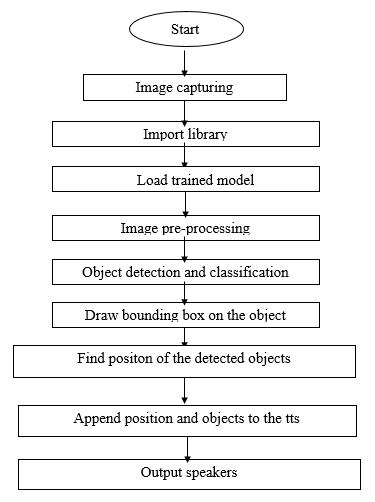
A camera is used to capture the footage, which is then separated into frames. CNN classifiers are used for object detection,andpyttsx3isusedfortext-to-speechconversion.
International Research Journal of Engineering and Technology (IRJET) e-ISSN: 2395-0056 Volume: 11 Issue: 01 | Jan 2024 www.irjet.net p-ISSN: 2395-0072 © 2024, IRJET | Impact Factor value: 8.226 | ISO 9001:2008 Certified Journal | Page128
Fig -1:DeepLearningSteps
Fig -2:Workflowoftheobjectdetectionalgorithm.
Foreveryperson'smovementintheindoorenvironment,the process image acquisition > image processing > acoustic notificationislooped.Thetotalprocessingtimeiscalculated byaddingthethreeprocessingperiods,whichdetermines theacquisitionratefortheinputimageframes.Theprocess mustbequick enoughsothatpossibleroadblocksmaybe avoidedontime.
The image processing method is used to detect a specific object,morespecificallytrafficsign recognition. We made useofthecv2integratedOpenCVfunction.
Image acquisition, pre-processing, CNN model, object detection and localization, feedback generation, and user interface are all components of the implemented system architecture.Imageacquisitionistheprocessofcapturing photographs of the indoor environment using a camera module (e.g., web camera, depth sensor). Image preprocessing techniques are used to improve image quality andeliminatenoise.Designandtrainingarerequiredforthe Convolutional Neural Network (CNN) model for object detection and localization. The input photos are then processed through the trained CNN to detect and localise objects,barriers,andlandmarks.
The user receives auditory or haptic input regarding the detectedobjectsandtheirpositions.Toconveyinformation totheuser,auser-friendlyinterfaceiscreated,whichmaybe amobileapplicationorwearabledevice.
CNNModelDevelopment:
ThefirststageisDatasetCollection,whichrequiresamassing abroadindoordatasetthatincludesvarioussettings,items, barriers, and landmarks. Precise annotations serve as the foundation for training and evaluation. In the Model Architecturephase,aConvolutionalNeuralNetwork(CNN) ispainstakinglydevelopedtosolvereal-timeitemdetection, harnessing spatial features for accurate indoor object identification and positioning. The model's efficiency is improved through rigorous training using the acquired dataset and accuracy optimization. The third step, Integration, incorporates the CNN model into the system architecture, which improves real-time object recognition and localization. This improves overall functionality, allowing for more informed decisions in interior environments.
HardwareIntegration:
Asuitablecameramodulewaschosenandintegratedinto the system to facilitate image acquisition. To effectively managethetasksofimageprocessing,ConvolutionalNeural Network (CNN) inference, and feedback generation, a microcontroller or processor was selected. To convey the outcomes of the analysis to the user, auditory and haptic outputdeviceswereincorporated.Theintegrationofthese
components resulted in development of functional and robustsystems.
UserTestingandValidation:
Tofacilitatepictureacquisition,a suitablecamera module wasselectedandputintothesystem.Amicrocontrolleror CPU was chosen to successfully manage the activities of image processing, Convolutional Neural Network (CNN) inference, and feedback production. Auditory and haptic outputdeviceswereusedtocommunicatetheresultsofthe analysistotheuser.Thecombinationoftheseelementsled inthecreationoffunctionalandrobustsystems.
5. RESULTS
The result indicates that the CNN (Convolutional Neural Network)programforobjectrecognitionwasimplemented effectively.Bydetectingandassistingthemwiththeobstacle orobjectfound,theaimistohelppersonswhoarepurblind improvetheirqualityoflife.Thisapplicationcanbeusedto differentiate between objects and assist those with disabilities,accordingtotheproposedparadigm.
6. CONCLUSIONS
Asystem-basedaidingnetworkhasbeenproposedtohelp purblindandfullyblindpeople.Thetemplatethatmatches theprocedurescompletedbyexperimentingwithOpenCV hasdevelopedasuccessfulmultiscaleandusefulmethodfor theapplicationsemployedwithintheenvironment.Finally, theidentifieditemsareoutputasanauditorymessagewith theobject'sname.Theclarityoftheimageobtainedbythe user will determine the accuracy. The real-time implementation of the technology is promising, providing real-worldbenefitsforvisuallyimpairedpersonstraversing indoorsettings.Ourtechnologyhasthepotentialtobecome an indispensable tool, enabling greater freedom and inclusivity for visually impaired individuals, with usercentric input and incremental enhancements. This project shows the positive impact of cutting-edge technology and opens the way for future advances in assistive systems, makingtheworldmoreaccessibletoall.
REFERENCES
[1] Samkit Shah, Jayraj Bandariya, Garima Jain, Mayur Ghevariya,SaroshDastoor,“CNNbasedAuto-Assistance System as a Boon for Directing Visually Impaired Person”,20193rdInternationalConferenceonTrends inElectronicsandInformatics(ICOEI)23-25April2019, DOI:10.1109/ICOEI.2019.8862699.
[2] Bin Jiang, Jiachen Yang, Zhihan Lv, Houbing Song, “WearableVisionAssistanceSystemBasedonBinocular SensorsforVisuallyImpairedUsers”,IEEEInternetof ThingsJournal(Volume:6,Issue:2,31May2018),DOI: 10.1109/JIOT.2018.2842229.
International Research Journal of Engineering and Technology (IRJET) e-ISSN: 2395-0056 Volume: 11 Issue: 01 | Jan 2024 www.irjet.net p-ISSN: 2395-0072 © 2024, IRJET | Impact Factor value: 8.226 | ISO 9001:2008 Certified Journal | Page129
[3] Md.MilonIslam,MuhammadSheikhSadi,andThomas Bräunl, “Automated Walking Guide to Enhance the MobilityofVisuallyImpairedPeople”,IEEETransactions on Medical Robotics and Bionics (Volume: 2, Issue: 3, August2020),DOI:10.1109/TMRB.2020.3011501.
[4] Devashish Pradeep Khairnar, Rushikesh Balasaheb Karad, Apurva Kapse, Geetanjali Kale, Prathamesh Jadhav, “PARTHA: A Visually Impaired Assistance System”, 2020 3rd International Conference on CommunicationSystem,ComputingandITApplications (CSCITA),DOI:10.1109/CSCITA47329.2020.9137791.
[5] AjinkyaBadave,RathinJagtap,RizinaKaovasia,Shivani Rahatwad, Saroja Kulkarni, “Android Based Object Detection System for Visually Impaired”, 2020 International Conference on Industry 4.0 Technology (I4Tech),DOI:10.1109/I4Tech48345.2020.9102694.
[6] Ruiqi Cheng, Kaiwei Wang, Longqing Lin and Kailun Yang,“VisualLocalizationofKeyPositionsforVisually ImpairedPeople”,201824thInternationalConference on Pattern Recognition (ICPR), DOI: 10.1109/ICPR.2018.8545141.
[7] Payal T. Mahida, Seyed Shahrestani, Hon Cheung, “LocalizationTechniquesinIndoorNavigationSystem forVisuallyImpairedpeople”,201717thInternational Symposium on Communications and Information Technologies (ISCIT), DOI: 10.1109/ISCIT.2017.8261229.
[8] VidulaV.Meshram,KailasPatil,VishalA.Meshramand FelixCheShu,“AnAstuteAssistiveDeviceforMobility and Object Recognition for Visually Impaired People”, IEEE Transactions on Human-Machine Systems (Volume: 49, Issue: 5, October 2019), DOI: 10.1109/THMS.2019.2931745.
[9] VidyaN.Murali,JamesM.Coughlan,“Smartphone-based crosswalk detection and localization for visually impaired pedestrians”, 2013 IEEE International Conference on Multimedia and Expo Workshops (ICMEW),DOI:10.1109/ICMEW.2013.6618432.
[10] Jawaid Nasreen, Warsi Arif, Asad Ali Shaikh, Yahya Muhammad,MonaishaAbdullah,“ObjectDetectionand NarratorforVisuallyImpairedPeople”,20196thIEEE InternationalConferenceonEngineeringTechnologies and Applied Sciences (ICETAS), DOI: 10.1109/ICETAS48360.2019.9117405.
[11] Cang Ye, Xiangfei Qian, “3D Object Recognition of a RoboticNavigationAidfortheVisuallyImpaired”,IEEE Transactions on Neural Systems and Rehabilitation Engineering(Volume:26,Issue:2,February2018),DOI: 10.1109/TNSRE.2017.2748419.
[12] Akshaya Kesarimangalam Srinivasan, Shwetha Sridharan,RajeswariSridhar,“ObjectLocalizationand NavigationAssistantfortheVisuallychallenged”,2020 Fourth International Conference on Computing Methodologies and Communication (ICCMC), DOI: 10.1109/ICCMC48092.2020.ICCMC-00061.
[13] Joel A. Hesch and Stergios I. Roumeliotis, “An Indoor LocalizationAidfortheVisuallyImpaired”,Proceedings 2007 IEEE International Conference on Robotics and Automation,DOI:10.1109/ROBOT.2007.364021.
[14] K. Matusiak, P. Skulimowski, P. Strurniłło, “Object recognition in a mobile phone application for visually impairedusers”,20136thInternationalConferenceon Human System Interactions (HSI), DOI: 10.1109/HSI.2013.6577868.
[15] NouranKhaled,ShehabMohsen,KareemEmadEl-Din, SherifAkram,HaythamMetawie,AmmarMohamed,“InDoor Assistant Mobile Application Using CNN and TensorFlow”, 2020 International Conference on Electrical,Communication,andComputerEngineering (ICECCE),DOI:10.1109/ICECCE49384.2020.9179386.
[16] Hsueh-Cheng Wang, Robert K. Katzschmann, Santani Teng, Brandon Araki, Laura Giarré, Daniela Rus, “EnablingIndependentNavigationforVisuallyImpaired People through a Wearable Vision-Based Feedback System”, 2017 IEEE International Conference on Robotics and Automation (ICRA), DOI: 10.1109/ICRA.2017.7989772.
International Research Journal of Engineering and Technology (IRJET) e-ISSN: 2395-0056 Volume: 11 Issue: 01 | Jan 2024 www.irjet.net p-ISSN: 2395-0072 © 2024, IRJET | Impact Factor value: 8.226 | ISO 9001:2008 Certified Journal | Page130