
International Research Journal of Engineering and Technology (IRJET) e-ISSN: 2395-0056
Volume: 11 Issue: 12 | DEC 2024 www.irjet.net p-ISSN: 2395-0072

International Research Journal of Engineering and Technology (IRJET) e-ISSN: 2395-0056
Volume: 11 Issue: 12 | DEC 2024 www.irjet.net p-ISSN: 2395-0072
Yadav Sonali1, Suryawanshi Priyanka2 , Prof. V.B Pansare3 Prof. G.P.Overikar4
1,2U.G. Student, 3,4Assistant Professor Department of mechanical engineering, Shree Tuljabhavani College of Engineering Tuljapur.
Abstract - This paper introduces an innovative solar technology inspired by the way trees convert sunlight into energy. The concept, known as the artificial oxygen Tree, is designed to benefit humanity and support environmental sustainability. This system combines several functions: it performs electrolysis on sewage water to produce hydrogen (for fuel) and oxygen (to release into the air), while simultaneously generatingelectricity usingphotovoltaic(PV) panels installed at the top of the structure. The model is intended to be installed above sewage tanks, where the electrolysis process takes place. Electrolysis involves connecting an electrical power source to two electrodes submerged in water, allowing anelectriccurrent to flow. This causes hydrogen to form at the cathode and oxygen at the anode. The hydrogen is then collected and stored in a tank for useas fuel, whiletheoxygenis releasedintotheatmosphereto improve air quality. The PV panels on the tree's top capture sunlight andconvert it intoelectricity. These panels aremade ofsemiconductormaterials, typicallycrystallinesilicon,which absorb solar energy. The electricity generated is stored and used to power LEDs on the tree, enabling it to function as a streetlight. This multifunctional design integrates renewable energy generation with environmental restoration.
Key Words: Solar Tree, Solar Panels, Electrolysis, Street Light, Oxygen ,etc
1.INTRODUCTION
Treesnaturallyplayavitalroleinconvertingcarbondioxide intooxygen,anessentialprocessformaintainingtheplanet's balance. However, due to human greed, forests are being replacedwithconcretejunglesastreesarecutdowntomake wayforurbanizationandprofit-drivenventures.Thishasled to a growing scarcity of clean air. As the population continues to rise, the number of trees dwindles, with deforestationpersistingatanalarmingrate.Carbondioxide, whichisharmfultohumans,iseffectivelyprocessedbytrees toproducetheoxygenwerelyontosurvive.Thecontinued destructionofforestscouldresultinsevereconsequences, includingintensifiedglobalwarming,acidrain,respiratory illnesses,andotherenvironmentalcrises.Inresponsetothis urgent issue, science and technology have introduced a revolutionarysolution:theArtificialOxygenTree,designed tomimicthelife-sustainingfunctionsofnaturaltrees.
Research laboratories worldwide are striving to develop innovative and environmentally friendly industrial design solutions.Amongtheseefforts,K.S.Lackner’sworkfocuses ondemonstratingandenhancingpassivemethodstoremove carbon dioxide from the atmosphere, addressing the challenges of climate change. This paper introduces the conceptofaSolarTreeasanalternativeenergysourcefor urbanareas.Anovelideainvolvingtheuseofnanowiresolar cellsinSolarTreedesignsisdiscussed.Nanowiresareknown fortheirexceptionallightabsorptioncapabilities,whichcan be significantly enhanced for improved performance. This makesSolarTreesagroundbreakingurbanlightingsolution, advancingthedevelopmentof high-efficiencytechnologies forsustainablecities.
Intheprocessofelectrolysis,anelectricalpowersourceis connectedtotwoelectrodesimmersedinwater.Hydrogen gasformsatthecathode(thenegativelychargedelectrode where electrons flow into the water), while oxygen gas is produced at the anode (the positively charged electrode). Under ideal conditions with perfect faradic efficiency, the amountofhydrogengeneratedistwicethenumberofmoles of oxygen, as their production is proportional to the total electrical charge passing through the solution. However, achieving this requires additional energy, known as overpotential,toovercomeactivationbarriers.Theefficiency of the electrolysis process can be improved by adding sulfuric acid, which reduces resistance and enhances the reaction.
A solar panel isa technology thattransformssunlight into electricitythrough thephotovoltaic effect.Itismade upof several solar cells, typically crafted from silicon, which generatesanelectriccurrentwhenexposedtosunlight.This electricity, initially in the form of direct current (DC), is converted into alternating current (AC) using an inverter, makingitsuitableforeverydayuse.Solarpanelsarebuiltto endure environmental conditions, with a protective glass layerandasturdyframeensuringdurabilityandefficiency. They come in various types, such as monocrystalline, polycrystalline,andthin-film,eachofferingdifferentlevelsof
International Research Journal of Engineering and Technology (IRJET) e-ISSN: 2395-0056
Volume: 11 Issue: 12 | DEC 2024 www.irjet.net p-ISSN: 2395-0072
efficiencyandaffordability.Solarpanelsareextensivelyused in homes, businesses, and remote areas to provide sustainable, renewable energy, offering an eco-friendly alternativewithlowmaintenancecosts.
Solar
Asolarpanelisadevicethatcapturessunlightandconvertsit intoelectricityusingthephotovoltaic(PV)effect.Thecoreof a solar panel is made up of multiple solar cells, usually composedofsemiconductormaterialssuchassilicon.When sunlight hits these cells, it excites the electrons in the material, generating an electric current. This current is initiallyintheformofdirectcurrent(DC),,itisconvertedinto alternatingcurrent(AC)usinganinverter.Asolarpanelisa devicethatcapturessunlightandconvertsitintoelectricity usingthephotovoltaic(PV)effect.Thecoreofasolarpanelis made up of multiple solar cells, usually composed of semiconductormaterialssuchassilicon.Whensunlighthits thesecells,itexcitestheelectronsinthematerial,generating an electric current. This current is initially in the form of directcurrent(DC),buttobeusableinhomesandbusinesses, itisconvertedintoalternatingcurrent(AC)usinganinverter.
Solar panels are designed to be durable and weatherresistant,typicallyprotectedbyalayeroftemperedglassthat allowssunlighttopassthroughwhileshieldingthecellsfrom environmentalelements.
Solar panels are an integral part of renewable energy systems, offering a clean and sustainable way to generate electricity.Theyworkbyharnessingtheenergyfromthesun through photovoltaic cells, which are usually made from
silicon. These cells capture sunlight and convert it into electricity through the photovoltaic effect. When sunlight strikesthesiliconmaterial,itexciteselectrons,creatingan electriccurrent.Thiscurrentisthencollectedanddirected into an electrical circuit. However, since the electricity generatedbysolarpanelsisindirectcurrent(DC),itmustbe converted into alternating current (AC) using an inverter, whichmakesitcompatiblewithstandardelectricalgridsand devices.
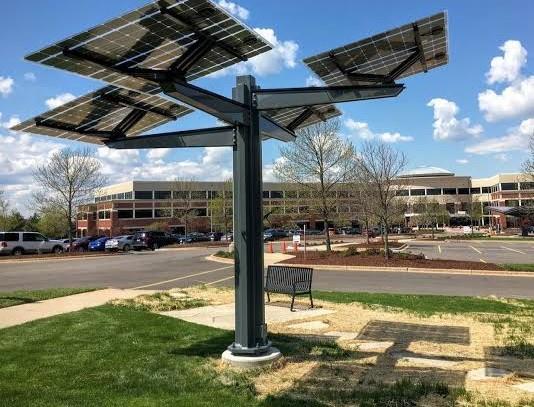
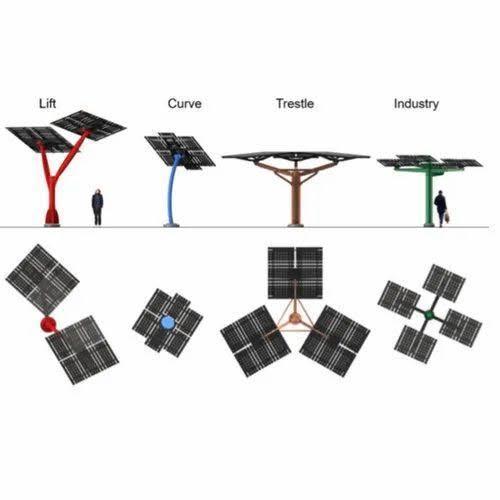
Asolartreeisaninnovativestructuredesignedtogenerate renewableenergyusingsolarpanelsarrangedinatree-like configuration. These structures mimic the shape of a tree, with a trunk and branches that hold solar panels, often at differentangles,tomaximizesunlightabsorptionthroughout theday.
We have developed an innovative "artificial tree" that producesoxygenwithoutrequiringsoil,water,ortraditional maintenance, making it an ideal solution for urban environments with limited greenery, high carbon dioxide levels, and low oxygen availability. In addition to oxygen production, the design also functions as a street lighting system, enhancing its utility in cityscapes. The system generates 25 ml of oxygen and 50 ml of hydrogen while producing2.4wattsofelectricitythroughsolarpanels.This energy is stored in a 12V rechargeable battery, which powers LEDs for lighting and facilitates electrolysis. Key components include an AVR microcontroller, which processessignalsfromlight-dependentresistors(LDRs)to control the system’s operation based on environmental conditions. An oxygen generator measures oxygen output and monitors surrounding temperatures, mimicking the naturalroleoftrees.ThesystemalsofeaturesanLCDdisplay for providing real-time updates. Environmentally friendly and cost-effective, this artificial tree can be installed in
International Research Journal of Engineering and Technology (IRJET) e-ISSN: 2395-0056
Volume: 11 Issue: 12 | DEC 2024 www.irjet.net p-ISSN: 2395-0072
various locations, requiring minimal maintenance after initial setup. By combining oxygen generation and street lighting, it addresses critical urban challenges while demonstratingefficientuseofrenewableenergytechnology.
[1] Lackner,KlausS.(September2009)."Captureofcarbon dioxidefromambientair".EuropeanPhysicalJournal: SpecialTopics176(1):93–106.
[2] Lackner, Klaus S. (June 2012). "The urgency of the development of CO2 capture from ambient air". ProceedingsoftheNationalAcademyofSciencesofthe United States of America: Current Issue 109 (33):13156–13162.
[3] International Journal of Scientific and Research Publications,Volume3,Issue12,December20131ISSN 2250-3153“IdeatoDesignaSolarTreeUsingNano-wire SolarCells”
[4] International Journal of Technical Research and Applications-ISSN:2320-8163,www.ijtra.comVolume3, Issue5(September- October,2015), PP.198-203“PicControlled Oxygen and Light Generation Using RenewableResources
[5] SSRGInternationalJournalofElectricalandElectronics Engineering(SSRG-IJEEE)–EFESApril2015ISSN:2348 –8379
[6] IOSRJournalofElectricalandElectronicsEngineering (IOSR-JEEE)e-ISSN:2278-1676,p-ISSN:2320-3331PP 26-29”VerticalWindOxygenTree”
2024, IRJET | Impact Factor value: 8.315 | ISO 9001:2008