
International Research Journal of Engineering and Technology (IRJET) e-ISSN:2395-0056
Volume: 11 Issue: 12 | Dec 2024 www.irjet.net p-ISSN:2395-0072

International Research Journal of Engineering and Technology (IRJET) e-ISSN:2395-0056
Volume: 11 Issue: 12 | Dec 2024 www.irjet.net p-ISSN:2395-0072
Shravani Kulkarni1
1 UG student, Department of Mechanical Engineering, Dr. Vishwanath Karad MIT World Peace University, Pune, India
Abstract
Internal combustion engines are a significant contributor to noise pollution in society, particularly in urban areas where trafficisdense.Tomitigatethisissue,mufflersarecommonlyinstalledattheendoftheexhaustsystemtoreducethenoise generatedbytheengine.Theeffectivenessofamufflerinreducingnoiselargelydependsonthedesignandmaterialsused in its construction. The way different components of the muffler interact with sound waves plays a crucial role in determininghowmuchnoiseissuppressed.Consequently,itisessentialtodesignmufflersthatareaseffectiveaspossible inminimizingnoisepollution.ThisstudyfocusesonevaluatingtheTransmissionLoss(TL)ofasingleexpandingchamber reactive muffler, which is a common type of muffler used in exhaust systems. To measure the TL, the study employs a combination of three different approaches: theoretical analysis, finite element analysis using COMSOL Multi-Physics, and experimental analysis through the two-load method. By employing these diverse methods, the research aims to gain a comprehensiveunderstandingofthemuffler’sperformanceandoptimizeitsdesignformaximumnoisereduction.
Keywords – Noise pollution, Muffler design, Transmission Loss, Reactive muffler, Transfer matrix Method, Finite ElementMethod(FEM),ExperimentalMethod.
Thenoiseproducedbyinternalcombustionengineshasbeenasignificantenvironmentalissuesincethelate19thcentury. Whilestructuralnoiseandothersourcescontributetoenginenoise,exhaustnoiseisthedominantfactor,producingabout 10 times the pressure of the other sources. As a result, reducing exhaust noise is the primary challenge in minimizing overall engine noise. Mufflers, or silencers, are acoustic devices installed in the exhaust systems of internal combustion engines to reduce this noise. They are also used in various other applications such as air conditioning units and compressors. Mufflers work by employing either absorptive or reactive principles to dampen noise. Absorptive mufflers absorbacousticenergyassoundwavespassthrough,therebyreducingnoisetransmission.Reactivemufflers,incontrast, rely on the impedance mismatch principle to reduce sound. An example of a reactive muffler is shown in Figure 1. To evaluatetheperformanceofmufflers,keymetricslikeinsertionloss(IL)andtransmissionloss(TL)areused.Specifically, transmission loss (TL) measures the muffler’s ability to prevent sound radiation, offering insight into its acoustic effectiveness.
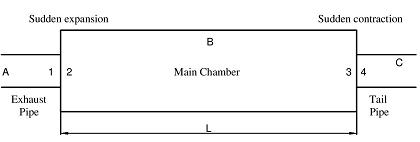
Thefigure1showssinglechamberreactivemuffler.Itincludesexhaustpipe,mainchamberandtailpipe.
Absorptive Mufflers: Utilizing absorption mechanisms, these mufflers reduce sound energy. Characterized by simpler designs and relatively lower back pressure, they excel in attenuating noise at higher frequencies but may exhibit limitationsinreducingnoisegeneratedbyexhaustgasesatspecificfrequencies.
Volume: 11 Issue: 12 | Dec 2024 www.irjet.net
ISSN:2395-0072
Reactive Mufflers: Comprising resonating and expansion chambers, reactive mufflers are engineered to decrease sound pressure levels at targeted frequencies, operating on the principle of impedance mismatch. Their construction aims to achieveoptimalnoisereduction.
Combination Muffler: Acombinationmufflerintegratesbothreactiveandabsorptiveelementstoeffectivelyreducenoise. This hybrid design leverages the strengths of both principles, combining sound absorption and reflection to optimize performance. Typically, a combination muffler consists of components such as chambers, baffles, and sound-absorbing materials,strategicallyarrangedtoenhancetheirnoise-dampeningcapabilities.Thesemufflersarewidelyusedinvarious applications, including automotive exhaust systems, motorcycles, generators, and industrial equipment, where comprehensive and efficient noise control is required. By blending the benefits of reactive and absorptive designs, combinationmufflersprovideaversatilesolutionforreducingexhaustnoise.
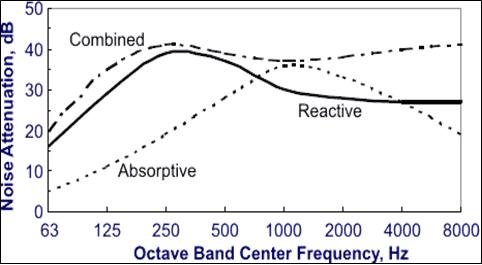
Figure2comparesthenoiseattenuationcapabilitiesofreactive,absorptive,andcombinationmufflers.Theresultsindicate that reactive mufflers are most effective at reducing higher frequency noise, while absorptive mufflers perform better at attenuatinglowerfrequencynoise.Combinationmufflers,whichcombinebothreactiveandabsorptiveelements,providea comprehensivesolutionbyefficientlyreducingnoiseacrossabroadrangeoffrequencies.
Inthepaper "Prediction of TransmissionLoss ona SimpleExpansion Chamber Muffler" byUjjal KalitaandDr. Manpreet Singh, the authors focus on optimizing the design of a single expansion chamber muffler, specifically by considering the chamber's length and diameter as critical design parameters. The design process begins with the creation of the muffler model using CAD software, allowing for precise control over the shape and dimensions. Following this, acoustic simulations are performed using ANSYS to analyze the muffler's performance in reducing noise. The primary aim of the studyistopredictthetransmissionloss(TL)basedonthemodifieddesignandvalidatetheresultsthroughcomparisons withpreviousstudies,includingthosebyMiladetal.andLeeetal.Theresearchhighlightstheimportanceofthesedesign parameters in determining the muffler's effectiveness in attenuating sound. By comparing their findings with earlier works, the authors seek to confirm the reliability of their optimized design approach. This study not only provides valuable insights into the role of chamber geometry in muffler performance but also contributes to the development of moreefficientmufflerdesignsthatcanbeappliedinreducingenginenoiseinvariousapplications.Ultimately,theresearch helps establish a clear relationship between theoretical modeling and practical muffler design, advancing strategies for noisecontrolininternalcombustionengines.[1][2][3][4].
Thearticle "Design and Analysis of Core Chamber of Muffler" byRameshwarCambowexploresthegeometricaloptimization ofasimpleexpansionchambermufflertoenhancetransmissionloss.Thestudybeginsbyselectingarangefortheratioof chamber diameter (D) to inlet tube diameter (d) based on a literature review. Simulations conducted in Ansys software reveal that the highest transmission loss occurs at a D/d ratio of 4.38. Further analysis examines the ratio of chamber length (L) to chamber diameter (D) within a range of 1.2 to 1.6, showing that an L/D ratio of 1.6 yields stable maximum transmission loss values. However, due to dimensional constraints, the study focuses on the L/D ratio of 1.3, which achieves a comparable maximum transmission loss of 22.055 dB. These findings provide a basis for designing and manufacturingoptimizedmufflersusingtheproposedgeometricdimensionsandratios.[5],[6].
Volume: 11 Issue: 12 | Dec 2024 www.irjet.net
The article "Investigation on Effect of Extended Inlet and Outlet Tubes on Single Expansion Chamber Muffler for Noise Reduction" by Mahesh V. Kulkarni and Dr. Ravindra B. Ingle examines the acoustic performance of a single expansion chamberreactivemufflerequippedwithextendedinletandoutlettubes.Thestudyaimstomaximizesoundtransmission loss,analyzingamufflerwithalengthof400mmandadiameterof110mm,withinletandoutletchambersmeasuring44 mm in diameter and 80 mm in length. Modeling and meshing are carried out using COMSOL Multiphysics for numerical simulations, while theoretical analysis is conducted using MATLAB code based on derived formulas for uniform and extended tubeconfigurations.Thestudyevaluatestransmissionloss forfourconfigurations:a standardsingle expansion chamber, and chambers with extended inlet, extended outlet, and both extended inlet and outlet. Results show that theoretical and numerical analyses produce closely matching transmission loss trends, validating the findings. The study concludesthatmufflerswithextendedinletandoutlettubesexhibitthelowesttransmissionlossamongtheconfigurations tested[7][8][9][10].
In the article "Design and Analysis of Reactive Muffler for Enhancement in Transmission Loss" by Tushar Sonkule, Suyash Dhadve, Akshay Shahane, Yash Malpani, and Mahesh Kulkarni, the authors explore various methods to evaluate the transmission loss of a single expansion chamber reactive muffler. The study includes both theoretical analysis and numerical simulations using COMSOL Multiphysics. For the theoretical analysis, the transmission loss was calculated based on fixed dimensions of the expansion chamber (540 mm in length and 120 mm in diameter) and the inlet/outlet pipes (44 mm in diameter). Numerical simulations were conducted with COMSOL, where the muffler was meshed using tetrahedral elements, and the Helmholtz equation was applied to determine sound pressure and transmission loss. The results from both methods showed strong agreement, confirming the reliability of both approaches. Additionally, experimental validation was carried out using the two-load method, where transmission loss was calculated using four microphonepositionsandpoleequations.Twodifferentloadswereappliedtoensurestableresults.Theexperimentaland numerical results showed good consistency, though a slight discrepancy was noted, likely due to factors such as sound leakage, white noise from the FFT, and surface finish variations in the impedance tube. The study concluded that the maximumtransmissionlosscorrespondedtothelowestradiatednoiseatagivenfrequency.[11][12]
Thestudy"AcousticAnalysisandModellingofReactiveMufflertoReduceNoiseoftheSystem"byDr.MaheshV.Kulkarni and Akshay Vijay Shinde investigates the effect of baffle plate configurations on the acoustic performance of reactive mufflers. The researchers used numerical simulations in COMSOL Multiphysics and experimental analysis through the two-load method to model three muffler designs: a single baffle plate muffler with extended inlet-outlet, a double baffle plate configuration, and a triple baffle plate setup with varying circumferential diameters. All designs had a chamber diameterof60mmandalengthof560mm.Theresultsindicatedthatthesinglebaffleplatedesignachievedthehighest transmission loss of 58 dB, while the triple baffle plate model, with equally spaced plates, showed the most balanced performance, witha maximumtransmissionloss of27dBandanaverageof16dB. Thesefindingsemphasizethecrucial roleofbaffleplateplacementinoptimizingmufflerperformancefornoisereduction.[13],[14][15][16].
Inthearticle "Validation of Setup for Experimental Analysis of Reactive Muffler for the Determination of Transmission Loss," Mahesh V. Kulkarni and Ravindra B. Ingle discuss the use of mufflers to mitigate noise and vibration, particularly in automotive exhaust systems. The paper focuses on accurately predicting the sound radiation characteristics of reactive mufflers using the transmission loss (TL) method, which measures the difference between the power entering a muffler andthepowertransmitteddownstream.Toassessthemuffler'sacousticperformance,theauthorscreateanexperimental setupbasedonthetwo-loadmethod,whichisvalidatedbycomparingitsresultstothoseobtainedusingthefiniteelement method (FEM). The study uses COMSOL Multiphysics to perform three-dimensional FEM analysis,assuming a zero Mach number and excluding fluid-structure interaction. The results from the experimental analysis are compared with those fromtheFEM,showingthattheexperimentalsetupisreliablefordeterminingthetransmissionlossofexhaustmufflersin thelowtomid-frequencyrange.[17][18][19].
Inthearticle "Acoustic Analysis of Single Expansion Chamber Reactive Muffler with Single Baffle for Maximum Transmission Loss," Mahesh Kulkarni explores the acoustic performance of a single expansion chamber muffler, focusing on achieving maximum transmission loss, particularly in generators where transmission loss can be a limiting factor. The research investigatestheimpactofbaffles,includinghowvaryingbafflepositionsrelativetotheinletandoutletaffectthemuffler’s performance. Bycomparing theoretical and numerical analysismethods,thestudy shows their consistency, streamlining themuffleranalysisprocess.Theresultsindicatethatusingbafflesincreasestransmissionloss,especiallywhenthebaffle holediameterisreduced,althoughthisalsoraisesbackpressure,whichlimitsthesmallestdiametertothesizeoftheinlet. Thepositioningofthebaffleisalsocrucial,withthestudyfindingthattransmissionlossishigherwhenthebaffleisplaced closertotheinletandoutlet[20][21].
Volume: 11 Issue: 12 | Dec 2024 www.irjet.net p-ISSN:2395-0072
Inthearticle "Design Development and Analysis of a Single Expansion Chamber for a Diesel Engine," ChinmayeevAskhedkar andSagarC. Atrefocus on designinga reactive mufflerfora single-cylinder diesel engine tomaximizetransmissionloss, which is crucial for muffler performance and efficiency. The study investigates how the muffler’s shape and dimensions, includinglength,expansionratio,andnumberofresonatingchambers,influenceitsacousticperformance.Theresearchers optimizethemuffler'slengthandexpansionratiowhileconsideringmanufacturing constraints.Transmissionlossforthe optimaldesignismathematicallymodeledusingtheTransferMatrixMethodandanalyzedwiththeFiniteElementMethod (FEM).Bothmodelsarecomparedforaccuracy.Thestudyfindsthattransmissionlossincreaseswith themuffler’slength andexpansionratio,achievingamaximumattenuationlossof20dB.Theresultsfrombothmodelsarevalidatedthrough comparison, demonstrating their reliability in predicting muffler performance across varying dimensions and firing frequencies[22][23].
In the paper "Optimization and Experimental Validation of Elliptical Reactive Muffler with Central Inlet Central Outlet," Anant W. Wankhade and Dr. A. P. Bhattu present a practical solution for reducing tailpipe noise levels. The study uses acoustic analysis to assess muffler performance, with optimization achieved through Finite Element Analysis (FEA). The muffler design is initially modeled using PRO E Wildfire 5.0, and the acoustic analysis is conducted using COMSOL Multiphysics.Theresearchfocusesontwomainfactors:theextrusionoftheinletandoutletpipeswithinthechamberand the positioning of a divided inlet tube inside the chamber, with the goal of reducing sound pressure levels (SPL) or increasing transmission loss (TL). Although the effects of SPL on muffler walls and material considerations are not addressed, the optimized elliptical muffler model is manufactured and experimentallytested. The results fromtheFinite Element Method (FEM) analysis are compared with experimental outcomes, showing good agreement and validating the muffler'sperformance.[24][25][26].
In the paper "Acoustic Analysis of Extended Inlet and Outlet Tube Parameters in Single Expansion Chamber Reactive MufflerforIncrementinTransmissionLoss,"Dr.MaheshKulkarni,TusharSonkule,SuyashDhadve,AkshayShahane,and YashMalpaniexaminethepotentialofextendedinletandoutlettubestoimprovetransmissionlossinmufflers.Thestudy addressesthegrowingconcernofnoisepollutionfrominternal combustion engines, whichcannegativelyimpacthuman health,particularlywhennoiselevelsexceed80dB.Theresearchusesthreemethods:theoreticalanalysis,finiteelement analysis with COMSOL Multiphysics, and experimental validation through the two-load method. The theoretical analysis calculatestransmissionloss (TL) basedonparameterssuchasexpansionratio(m), wavenumber(k),soundvelocity(c), andchamberlength(l),aimingtooptimizemufflerdesignsforenhancednoisereduction[27][28][29].
The researchpaper examinesa single expansionchamberreactive muffler using boththeoretical and numerical analysis. The theoretical approach utilizes a MATLAB program to calculate transmission loss, taking into account factors such as extendedinletandoutletpipes,aswellasbaffles.ThenumericalanalysisisperformedusingCOMSOLMultiphysics,which models, meshes, and analyzes the muffler's acoustic performance in the frequency domain. The findings indicate that modifications to the internal geometry, like extending the inlet and outlet, lead to an increase in transmission loss, highlighting that optimization can enhance acoustic performance. The study underscores the significance of both theoretical and numerical methodsinoptimizing mufflerdesignandincludes experimental validationusingthe two-load method,confirmingtheaccuracyandreliabilityofthenumericalresults.
Funding
Nofundingwasreceivedtoassistwiththepreparationofthismanuscript.
Competing interests
Theauthorhavenocompetingintereststodeclarethatarerelevanttothecontentofthisarticle.
References
1) Kalita, U. (2018). Prediction of transmission loss on a simple expansion chamber muffler. Journal of Emerging Technologies and Innovative Research, 5(8),1022–1031.
2) Kulkarni,M.V.,&Ingle,R.B.(2018).Effectofextendedinletandoutletplacementontransmissionlossofdouble expansionchamberreactivemuffler. International Journal of Research and Analytical Reviews, 5(4),552–558. International Research Journal of Engineering and Technology (IRJET) e-ISSN:2395-0056
International Research Journal of Engineering and Technology (IRJET) e-ISSN:2395-0056
Volume: 11 Issue: 12 | Dec 2024 www.irjet.net p-ISSN:2395-0072
3) Khanzode, P. S., & Kulkarni, M. V. (2019). Acoustic analysis and optimization of double expansion chamber reactivemufflerformaximumtransmission. International Journal of Scientific & Technology Research, 8(9),2351–2355.
4) Kulkarni, M. (2024). An in-depth study of the acoustics of a single expansion chamber reactive muffler. International Journal of Research and Analytical Reviews, 11(1),259–265.
5) Cambow, R. (2019). Design and analysis of core chamber of muffler. International Journal of Research and Analytical Reviews. Retrievedfromwww.ijrar.org
6) Kulkarni, M., & Jadhav, S. (2023). Acoustic analysis of single expansion chamber reactive muffler - A critical review. International Journal of Scientific Engineering and Research, 11(1),37–42.
7) Kulkarni,M.V.,&Ingle,R.B.(2017).Investigationoneffectofextendedinletandoutlettubesonsingleexpansion chamber muffler for noise reduction. American International Journal of Research in Science, Technology, Engineering & Mathematics, 18(1),10–15.Retrievedfromhttp://www.iasir.net
8) Kulkarni,M.(2023).Evaluationofextendedinletandoutlettubeparametersinsingleexpansionchamberreactive muffler. YMER, 22,1134–1142.
9) Kulkarni,M.,&Ingle,R.(2020).Effectofvariationsinextendedinletlengthsforconstantextendedoutletlengths ontransmissionlossofdoubleexpansionchamberreactivemuffler. Journal of Seybold Report, 15(3),2318–2324.
10) Kulkarni, M., & Ingle, R. (2022). Effect of extended inlet and outlet lengths on transmission loss of double expansion chamber reactive muffler. International Journal of Vehicle Structures and Systems, 14(2), 135–137. https://doi.org/10.4273/IJVSS.14.2.01
11) Sonkule, T., Dhadve, S., Shahane, A., Malpani, Y., & Kulkarni, M. (2021). Acoustic analysis of extended inlet and outlet tube parameters in single expansion chamber reactive muffler for increment in transmission loss. International Research Journal of Engineering and Technology, 8(6),2589–2595.
12) Ghodke,N.A.,&Kulkarni,M.V.(2018).Experimentalandnumericalevaluationofexhaustbackpressureofdouble expansion chamber reactive muffler. International Journal of Research and Analytical Reviews, 5(2), 351–354. Retrievedfromwww.ijrar.org
13) Shinde,A.V.,& Kulkarni,M. V.(2021).Acousticanalysisandmodellingofreactive mufflertoreduce noiseofthe system. International Journal of Scientific & Engineering Research, 12(6), 535–539. https://doi.org/10.17577/ijertv5is050386
14) Sonkule, T., Dhadve, S., Shahane, A., Malpani, Y., & Kulkarni, M. (2021). Acoustic analysis of extended inlet and outlet tube parameters in single expansion chamber reactive muffler for increment in transmission loss. International Research Journal of Engineering and Technology, 8(6),870–876.Retrievedfromwww.irjet.net
15) Kulkarni, M. (2023). A critical study of the acoustic evaluation of a double expansion chamber reactive muffler. International Journal of Research and Analytical Reviews, 10(1),528–533.
16) Jadhav,S.,&Kulkarni,M.(2023).Acriticalreviewofacousticinvestigationofdoubleexpansionchamberreactive muffler. International Journal of Research and Analytical Reviews, 10(2),713–718.
17) Kulkarni, M. V., & Ingle, R. B. (2018). Validation of set-up for experimental analysis of reactive muffler for the determination of transmission loss: Part 1. Noise and Vibration Worldwide, 49(6), 237–240. https://doi.org/10.1177/0957456518781857
18) Kulkarni, M. V., & Ingle, R. B. (2018). Attenuation analysis and acoustic pressure levels for double expansion chamber reactive muffler: Part 2. Noise and Vibration Worldwide, 49(6), 241–245. https://doi.org/10.1177/0957456518781859
19) Kulkarni, M., Kuhikar, P., Shaikh, B., Chitre, S., & Jamal, S. (2023). Effect of internal geometry change on transmission loss (TL) of double expansion chamber reactive muffler. AIP Conference Proceedings, 2821. https://doi.org/10.1063/5.0158561
International Research Journal of Engineering and Technology (IRJET) e-ISSN:2395-0056
Volume: 11 Issue: 12 | Dec 2024 www.irjet.net p-ISSN:2395-0072
20) Patil,A.,Kulkarni,C.,Bhujbal,O.,Shete,S.,&Kulkarni,M.(2021).Acousticsanalysisofsingleexpansionchamber reactive muffler with single baffle for maximum transmission loss. International Journal of Advances in Engineering and Management, 3(7),833–839.https://doi.org/10.35629/5252-0307833839
21) Shirode, P., Lokhande, A., Shete, A., Mohite, D., & Kulkarni, M. (2022). Effect of baffle placement on transmission loss of single expansion chamber reactive muffler. International Journal of Research and Analytical Reviews, 9(3), 24–34.
22) Askhedkar, C., & Atre, S. C. (2020). Design, development, and analysis of a single expansion chamber for a diesel engine. International Research Journal of Engineering and Technology, 5(8),1076–1080.
23) Shirode, P., Lokhande, A., Shete, A., Mohite, D., & Kulkarni, M. (2022). Review of acoustic analysis of single expansionchamberreactivemuffler. International Journal of Research and Analytical Reviews, 9(2),635–640.
24) Wankhade, A. W., & Bhattu, A. P. (2015). Optimization and experimental validation of elliptical reactive muffler with central inlet central outlet. International Journal of Engineering Research and Technology, 4(5), 1321–1328. https://doi.org/10.17577/ijertv4is051209
25) Kulkarni, M. V., & Ingle, D. B. (2018). Finite element analysis of double expansion chamber reactive muffler with side outlet. International Journal of Research and Analytical Reviews, 5(2), 758–764. Retrieved from http://ijrar.com/
26) Ingle,R.,&Kulkarni,M.(2020).Acousticanalysisandoptimizationofdoubleexpansionchamberreactivemuffler usingTaguchimethod. Journal of Seybold Report, 15(2),1844–1855.
27) Kuhikar,P.,Shaikh,B.,Chitre,S.,Jamal,S.,&Kulkarni,M.(2022).Reviewonacousticanalysisofdoubleexpansion chamberreactivemuffler.InternationalJournalofResearchandAnalyticalReviews,9(1),26–32.
28) Salunkhe, S., Dayne, S., & Kulkarni, M. (2022). Review paper on analysis of reactive muffler for enhancement in transmissionloss.ResearchJournalofScienceEngineeringandTechnology,12(1),34–39.
29) Salunkhe, S., & Kulkarni, M. (2023). Optimization of extended inlet length and extended inlet diameter of single expansionchamberreactivemufflerformaximumtransmissionlossinaspecificfrequencyrange.YMER,22,708–721.