
International Research Journal of Engineering and Technology (IRJET) e-ISSN: 2395-0056
Volume: 11 Issue: 12 | Dec 2024 www.irjet.net p-ISSN: 2395-0072

International Research Journal of Engineering and Technology (IRJET) e-ISSN: 2395-0056
Volume: 11 Issue: 12 | Dec 2024 www.irjet.net p-ISSN: 2395-0072
1
Bachelor of Engineering, Information Science and Engineering, Bapuji Institute of Engineering and Technology Davangere, affiliated to VTU Belagavi, Karnataka, India
Abstract - Canceristheleadingcauseofmortalityglobally,secondonlytocardiovasculardisorders.Earlycancerdisease detectiongreatlyincreasesthelikelihoodofrecovery.Artificialintelligenceisonesetoftechnologythatisbeingusedmore and more to identify cancer. Because it enables the early detection of carcinomas, artificial intelligence has significant promiseforhelpingphysiciansandotherhealthcareprofessionals.Artificialintelligenceresearchforcancerdiagnosishas expandedsignificantlyinrecentyears.Wecarriedoutabibliometricanalysisofthebodyofliteraturepertainingtotheuse ofAIincancerdiagnosisforthisarticle.6450articlespublishedbetween1986and2022onthatsubjectwereexaminedby us. We were able to provide an overview of this research field by doing this, covering its main subjects, pertinent publications, organizations, and articles. We created a study agenda for the future based on our findings, which may contributetotheadvancement of artificial intelligence researchforcancer diagnosis.Inconclusion,our researchaimsto provideaplatformandbasisforscientistswhoarecuriousinthepossibilitiesofartificialintelligenceincancerdetection.
Key Words: cancer detection; artificial intelligence; machine learning; deep learning; bibliometric study.
Thefundamentalbuildingblocksofallplantsandanimalsarelivingcells.Thesecellsproliferatecontinuouslytoallowfor growth or to replace damaged cells. Even though this process is typically balanced and under control, disruption to this genetic control may result in cancer [1]. Most cell-based life is susceptible to the condition known as cancer. It affects humanity for as long as it has existed, and the ancient Egyptians were the first to notice it [2]. Globally, cancer is the leadingcause of death, secondonlyto cardiovascularillnesses [3]. Globally,there were9.6millioncancer-relateddeaths and over 18 million new cases of cancer in 2018 [4]. Considering the danger that cancer poses, scientists have long attempted to determine ways to To improve the odds of recovery, it's critical to identify cancer as soon as possible in addition to receiving therapy once it manifests [5–8]. Lung cancer is the most deadly type of cancer in part because it is hard to find in its early stages and difficult to treat when it has progressed [9, 10]. New strategies are always being developed to support an early cancer diagnosis because of the significant advantages of early cancer detection.Since its introduction in 1960 [11], mammography has become one of the most widely used methods for detecting breast cancer [12].Computersarebeingutilizedmoreandmoretoassistclinicalpractitionersinmakingmedicaldiagnosesasaresultof digitization and increases in processing capacity. Computer programs that aid in cancer detection Artificial intelligence (AI) is one technology that has gained more attention recently. The term artificial intelligence (AI) encompasses a wide range of innovations and technology. AI has been used in medicine recently for a number of reasons, such as assisting medicalprofessionalsinmakingdecisions[15].AIisbeingstudiedandappliedmoreandmoreinthefieldofoncologyfor a variety of reasons [14]. The identification and diagnosis of cancer is one potential use. AI has the potential to revolutionize the early identification of cancer disorders and is the next development in CAD because of its ability to efficientlyscreenforordiagnosecancerorpolyps[14,16].
AIforcancerdetectionanddiagnosishasexpandedquicklyinrecentyears,bothinclinicalpracticeandasafieldofstudy. ResearchonAI-supportedcancerdiagnosishasbeengrowingyearlysincethe2010s.Thesedays,avarietyofdisciplines, including engineering, computer science, medicine, and mathematics, contribute to this research area. A thorough study thatattemptstoprovideanoverviewoftheresearchfieldofAIincancerdetection asawholedoesnotexist,despitethe factthatthereareseveralstudiesregardingAIoncancer[17–19].ThisissurprisingbecauseAIforcancerdiagnosisisnow avastandchallengingtopic tomonitorbecausetotheabundanceofresearchandpublications.Thismakesitchallenging forscholarswhoareinterested.
Thefirstartificialneuronnotionwasputforthby[28]in1943[27],markingthebeginningofartificialintelligence.The phrase "artificial intelligence" was first used at the Darthmouth Conference thirteen years later [29]. As a result, artificial
International Research Journal of Engineering and Technology (IRJET) e-ISSN: 2395-0056
Volume: 11 Issue: 12 | Dec 2024 www.irjet.net p-ISSN: 2395-0072
intelligence (AI) is one of the newest areas being studied in science and engineering [29]. It is currently a vibrant and complicateddisciplinewithawiderangeofstudytopicsaswellasvarioususecasesandapplicationsforbusinessesandin practice [30–32]. AI has grown significantly in recent years and is being considered with attention by both society and industry. The primary causes are increases in processing power and the amount of data accessible for AI system training [33]. It is crucial to remember that artificial intelligence is a multidisciplinary field that is being studied in a number of academic disciplines, such as computer science, psychology, neurology, and mathematics [34, 35]. The term artificial intelligence(AI)encompassesawiderangeofalgorithmsandtechnologies.
Artificial neural networks are among the most widely utilized AI technology. Deep learning is another term for artificial neuralnetworksthataremultilayeredandcomprisemultiplehiddenlayers[30,31].Thegoalofartificialneuralnetworksis tomimichowbiological beings,includinghumans,learn[36].Becauseofthis,artificial neuralnetworksaremodeledafter the brains of biological things and are made up of interconnected processing units called neurons [31]. After receiving inputs,theseneuronsprocesstheminaccordancewithpredeterminedguidelinestoproduceanoutput.Theseneuronsare frequently organized into many modules or layers. The phrase "deep learning" in this sense refers to AI encompasses a number of additional technologies, including support vector machines [39,40] and random forests [37,38]. However, an explanationofthesetechnologieswouldbeoutsidethepurviewofthispaperandisnotrequiredtocomprehendthestudy's subsequent findings. Modern AI systems are not intelligent in the strict sense, despite their many capabilities. The distinctionbetweenstrongandweakAIwasfirstmadeby[41]inordertocharacterizethecapabilitiesofAI.Weakartificial intelligence(AI)systemsaretypicallynotintelligentandaresolelydesignedforspecifictasks.Theyalsolackotheraspects ofhumanity,suchassentiments,emotions,andaconsciousmind[34,41].EventhoughweakAIsystemsfrequentlygivethe impression of being clever, they simply act that way [29, 42]. On the other hand, AI systems that possess human-like intelligence orcapacitiesarereferred toas strong AI,sometimesknownas artificial general intelligence(AGI) [43, 44].In additiontointelligence,thismayalsoimplythatthesesystemsareemotionalorsentimental[34].
Thissectionexplainsourbibliometricmethodology.Abibliometricstudycanbeconductedintwosteps,broadlyspeaking. The firststepisto gatherthedata that will be evaluated.Thefirstsubsection explainsthisstep. Theactual data analysis phasecomesafterthedatacollectionphase.Thesecondsubsectionprovidesanoutlineofthisprocedure.
Tobeginourinvestigation,thebibliometricdatahadtobegathered.Nowadays,thereareanumberofdatabasesavailable for gathering bibliometric data, with Web of Science and Scopus being two of the most often used [47, 48]. The functions andcharacteristics of thesedatabases vary[49]. We choose toadhere to[20]'sadvice and exclusivelygather bibliometric data froma singledatabase.Wedecidedtogatherourdata fromthescientific databaseScopus.Thewell-knowndatabase Scopushasbeenemployedinanumberofpreviousbibliometricresearch[21,47,48,5052].Furthermore,Scopushasalarger journalcoveragethanWebofScience,makingitagoodtoolforfindingasmuchresearchaspossible[26].Wechosenotto use other databases, such as PubMed and Google Scholar, despite their existence. In contrast to Google Scholar, Scopus offers the ability to immediately download all bibliometric metadata and create a comprehensive search string. Second, ScopusincludesfarmoreinterdisciplinaryresearchthanPubMed.BecauseAI-basedcancerdetectionisadiverseresearch field,wedeterminedthatthebestdatabasetoperformabibliometricanalysisonwasScopus.
Thetechnicalsectionincludesbroadtechnicalwordssuchas"machinelearning"and"artificialintelligence."Inaneffortto expand our search, we also looked for particular technologies, including "artificial neural network," "deep learn*," "fuzzy expertsystem,"or"evolutionarycomputation." Thephrasesusedfortheapplicationwere"cancerdiagnose*"and"cancer detect*." The*symbolisusedbecauseofScopus'syntax,whichenablessearchingforeverypotential wordendingforthe searchphrase.
Numerous toolsthataidintheanalysisofbibliometricdatahaveemergedinrecent years[20].We combinedtwotools Bibliometrix/Bilioshinyand VOSviewer inourinvestigation.BibliometrixisanopensourceR packagethatwascreated by[54].Itmakesitpossibletoanalyzebibliometricdatainawiderangeofways[49].Additionally,weaddedBiblioshiny to Bibliometrix. We have added VOSviewer to complement Biblioshiny and Bibliometrix. One tool for visualizing bibliometricdataisVOSviewer.ItwascreatedbytheCentreforScienceandTechnologyStudiesatLeidenUniversityinthe Netherlands[49,55].NumerousbibliometricstudieshaveusedVOSviewer,whichmakesitpossibletocreatebibliometric networks that display connections between publications, outlets, keywords, and researchers, among other things.
International Research Journal of Engineering and Technology (IRJET) e-ISSN: 2395-0056
Volume: 11 Issue: 12 | Dec 2024 www.irjet.net p-ISSN: 2395-0072
Furthermore, co-authorship analysis, bibliographic coupling, and co-citation creation are supported by VOSviewer [49,55].VOSviewerisagoodtoolforvisualizingkeywordco-occurrences,evenifBiblioshinyhasmorestatisticalfeatures.
We will give a summary of our sample and some broad data, like yearly production, document kinds, and contributing authordetails,inthisfirstsubsection.AnoverviewofthefundamentalmetricsofourfinalsampleisprovidedinTable1. Thesamplecomprises6450distinctpapersintotal.23,854distinctscholarshavewrittenandco-writtenthesedocuments, meaning that each author has contributed 0.270 documents.9321 author keywords and 247,762 references were cited overall. More than 21,192 keywords were also found. The 6450 papers, which came from various sources and were published in 2018, averaged 19.87 citations. About 25% of the 6232 articles with multiple authors were created by a global team. The topic of this study is timely because of the The average document age is only 3.72 years old, which supportsthetopic'stimeliness.Thissuggeststhatmostoftheresearchhasbeenreleasedduringthelastfouryears.
Table 1:Keydataandbroadmeasurements.
Main information
Sources(conferencesandjournals)
Numberofkeywordsplus
Documenttypes
Journalarticle
Conferencearticle
Review
Authorsandcollaboration
NumberofdifferentAI-cancerauthors
Authorsofmulti-authoreddocuments
Co-authors
Wecontrastedourbibliometricinformationwiththatofexistingbibliometric researchonseveral subjects(seetoTable2 forasummary).First,itisnotablethatonlyasmallpercentageofarticlesonAIforcancerdiagnosishavebeenwrittenbya single person. Of the 6450 documents, only 218 (3.38%) were single-authored articles. This might be an evidence of the veryhighintricacyofthistopicthatmakesitnecessarytoworktogetherinhugeauthorteams.Thehighcollaborationindex
© 2024, IRJET | Impact Factor value: 8.315 | ISO 9001:2008 Certified Journal | Page78
International Research Journal of Engineering and Technology (IRJET) e-ISSN: 2395-0056
Volume: 11 Issue: 12 | Dec 2024 www.irjet.net p-ISSN: 2395-0072
for our investigation supports this idea even further. The collaboration index, which is computed by dividing the total numberofauthorswhocontributedtomulti-authoredpapersbythetotalnumberofmulti-authoredarticles,isfrequently used to gauge researcher cooperation [56,57]. When compared to other bibliometric studies, this one has the fewest documentsperauthor.ThisdemonstratesthatthetopicofAIforcancerdiagnosisisnotdominatedbya small numberof researchersandthatmanydifferentresearcherscontributetoit.
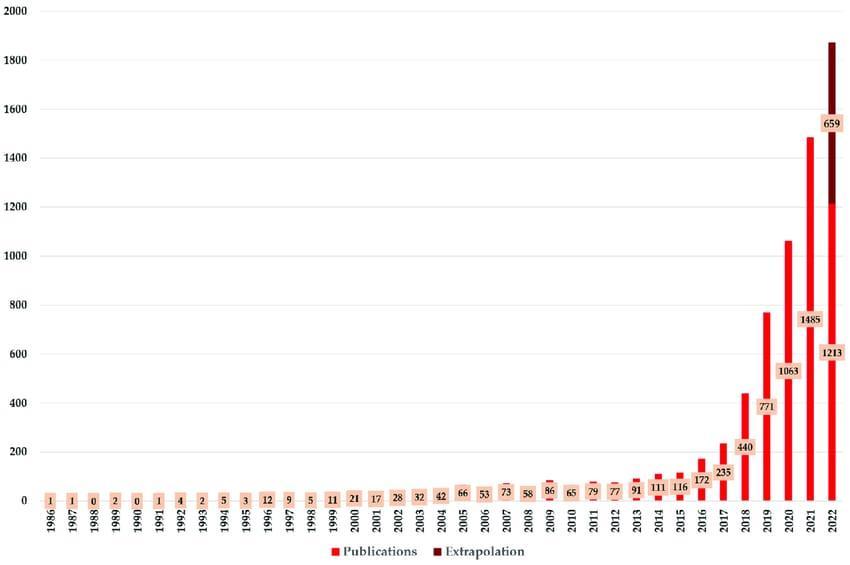
Fig-1.Overviewoftheannualproduction.
Fig-1showstheannual production of research dealingwithAIforcancer detection.The 1980ssawthe publication ofthe firststudyonthesubject.Theinitialarticlewaspublishedin1986.Anexpertsystemforcervicalcancerearlydetectionwas putforthinthisarticle[60].TheyearlyproductionofAIforcancerdiagnosisincreasedverylittleuntil1995.Therewereno publicationsonthissubjectin1988or1990.Thenumberofpublicationsonlyincreasedmodestlyintheensuingyears.In 2014,theannualproductionsreachedthe100-markforthefirsttimewith111publications.AIhasbecomemorerelevantin the realm of cancer diagnosis as its significance and possibilities have grown overall. Consequently, the majority of publicationshavebeenreleasedinthelastfewyears(2019–2021).PriortothedatacollectionforourstudyonSeptember 23,2022,1213publicationshadalreadybeenpublished.Weanticipatethatthetrendofrisingpublicationswillcontinuein 2022sinceitseemsstatisticallythatmorearticlesarereleasedinthefinalmonthsofayear[21].Anextrapolationleadsus tobelievethattherewillbe1872publicationsintotalin2022,withanestimated659piecesreleasedafterSeptember23.
International Research Journal of Engineering and Technology (IRJET) e-ISSN: 2395-0056
Volume: 11 Issue: 12 | Dec 2024 www.irjet.net p-ISSN: 2395-0072
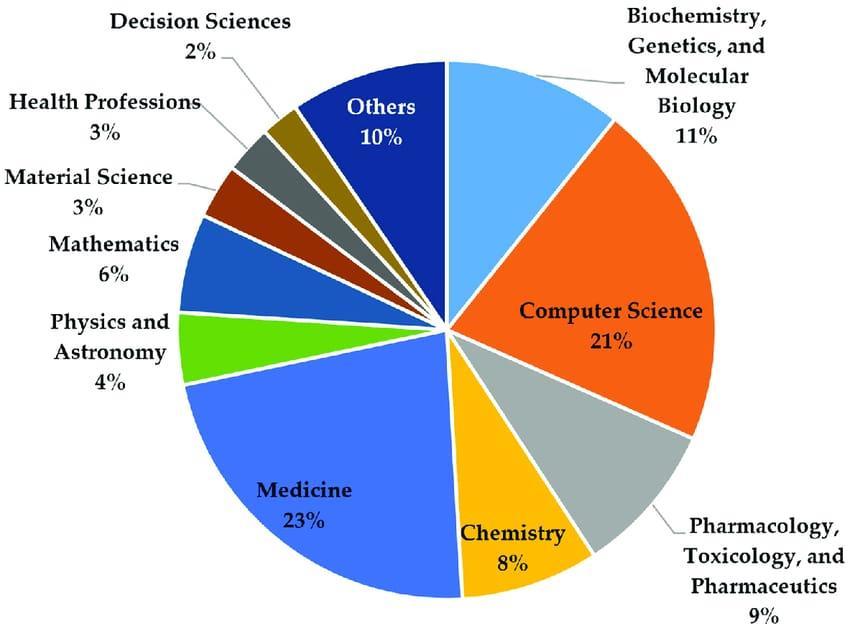
Fig-2.Overviewofthemostcontributingdisciplines.
ThedistributionofdisciplinesthroughoutthearticlesisseeninFigure3.Figure3'sdatacamefromScopus,whichassigns publications to disciplines according to the journal in which they were published. Nonetheless, some conferences or periodicalsmayfallundermorethanonefield.Notsurprisingly,themostwidelyusedAIapplicationsforcancerdiagnosis are in the fields of medicine andcomputer science. These disciplines'venueshave published23%and21%ofall articles, respectively. Chemistry (8%), pharmacology, toxicology, and pharmaceutics (9%), biochemistry, genetics, and molecular biology (11%), and medicine and computer science come next. It is not unexpected that computer science and medicine dominate,asoncologyandtheidentificationandmanagement.
Intheprecedingsections,wepresentedtheresultsofourbibliometricinvestigation.Basedonourresults,wewillsuggest intriguingavenuesforfuturestudyinthissection.Theseareintendedtoserveasaguideforinterestedscholars.Ascanbe seen by first examining the word cloud in Figure 5 and the most-cited papers, present research is mostly focused on the predictive performance of a limited number of applied AI algorithms. The topic of human–computer interaction, or the interactionbetweenthecomputersystemanditsusers,receivesalotlessattention.ItisessentialtoconsiderhowAIand humaninteractionmayorshouldseeminthecontextofcancerdiagnosis.Ingeneral,therearethreepotentialoutcomes: augmentation,substitution,andassemblage[95,96].
FutureresearchmustexaminehowAIandhumansmayworktogethermosteffectivelyinthecontextofcancerdiagnosis. Thismeansfiguringout whethera switchisdesirableatall and,morecrucially,whetheritispossible. Therearealready severalpromisingstudiesonhuman–computerinteractioninthehealthcareindustry[97,98].Theseresultscantherefore be used as a foundation for further investigation into the relationship between humans and AI. The degree of trust betweenthepublicandtheAIcancerdetectionsystemisanotherimportantfactor.
International Research Journal of Engineering and Technology (IRJET) e-ISSN: 2395-0056
Volume: 11 Issue: 12 | Dec 2024 www.irjet.net p-ISSN: 2395-0072
Focus
HumanComputerInteraction
Robustnessandsecurity
ExplainableAI
DataStorage
PossibleResearchQuestions
HowcantheinteractionbetweendoctorsandAI modelsbedesignedefficiently?Whatisthecurrent stateoftrusttowardsAIbasedmodelsinmedicine?
HowcantrustinAIbebuiltfordoctorsandpatients?
HowcanAIexpertsandclinicalpractitionerscooperate andworktogetherinthebestway?
WhatistheroleofexplainableAIforbuildingtrust?
HowreliablearetrainedAImodelsonothercancer datasets(e.g.,generatedbyothersensors)?
CanadversarialattacksoutsmartAImodelsin medicine?
HowshouldanAIsystemforcancerdetectionbe designedtomakeitrobustandsecureagainst adversarialattacksandactors?
Couldacancerdetectionalgorithmbeappliedtoother typesofcancer?
ShouldexplainableAImodelsbepreferredinsteadof themostaccurateone?
HowshouldexplainableAIbedesignedtoincreasethe trustintheAIsystemanditsdecisions?
WhatarethepromisingapproachesinXAIthathave notyetbeenappliedinthemedicalfield?
Whereshouldthedataofthescansbestoredtoensure dataprivacyrights?
Donewtechnologieslikeblockchainhaveapotential forthestorageandmanagementofmedicaldata?
Shouldpatientdatabeirreversiblyanonymizedoronly pseudonymized?
6. Conversation
Weperformedabibliometricanalysisof6450publicationsinthisstudythataddressedthepotentialanduseofAIincancer diagnosis and detection. To the best of our knowledge, this is the first study to examine AI research for cancer diagnosis usingabibliometricapproach.Bothscholarsandpractitionerscanprofitfromthisworkinanumberofways.Thepaperat handcanfirstbeusedbyinterestedresearcherstogeta preliminarysummaryoftheresearchonAIforcancerdiagnosis. Thisincludesdetailsaboutthestateofscience,themostimportantpapers,andthemainsubjectsandissuesthathavebeen studied.Therefore,thisstudycanhelpinterestedscholarsgainabasicunderstandingoftheresearchfieldpertainingtoAIbasedcancerdetection;ourresearchagendacanalsoserveasabasisforfutureresearchtobuilduponinordertofurther developthisexcitingfield;andclinicalandcommercialpractitionerscanuseourstudytogainapreliminaryunderstanding ofthepotentialofAIforsupportingcancerdiagnosis.However,webelievethatmostofourkeyfindings,especiallythemost importantsubjectsandthemes,wouldlikelynotalterevenifadditionaldatabaseswereused.Moreover,otherbibliometric toolsandanalytic methods,like bibliographic coupling [122,123] orcitationanalysis [121], may be used togetadditional datanotcoveredinthiswork.ThefieldofAIislikewiseonethatisexpandingquickly.NewresearchonAI-assistedcancer diagnosisispublishedeachmonth.Consequently,theresultsofthisinvestigationcanonlyillustratethecurrentstateofthe art.
International Research Journal of Engineering and Technology (IRJET) e-ISSN: 2395-0056
Volume: 11 Issue: 12 | Dec 2024 www.irjet.net p-ISSN: 2395-0072
Thefindingsofourbibliometricanalysisarepresentedinthenextthreeparts.Wewillstartbyprovidingabroadsummary ofthesamplewegatheredanddisplayingtheessentialcriticalmetrics.Theoutcomesofourperformanceanalysiswillthen be presented. An overview of the sources with the most papers on AI for cancer detection may be found in the first section.Second, we list the nations, funding sponsors, and affiliations that contribute the most.We provide a thematic analysisofthemostpertinentsubjectsandmajorthemesfollowingtheperformanceanalysis.
Artificial intelligence isa promising technology thatis increasinglybeingutilized to detect or diagnose cancer.Numerous studieshavebeenconductedonthetopicasaresultoftherapidexpansionofresearchonAIforcancerdiagnosisinrecent years.Itcouldbedifficultforinterestedacademicsormedicalprofessionalstoacquireabasiccomprehensionofthistopic because there is so much research available. Given this, our objective was to provide researchers with an overview and analysis of the field of study on AI for cancer diagnosis. To accomplish this, we conducted a bibliometric analysis of the literatureonthetopic..Ouranalysisconsistedofseveralparts.Westartedbygivingageneraloverviewofoursampleand describinghowscientific outputchangedoverthecourseoftheyearandthedisciplinesthatcontributedtoit.Afterthat, weconducteda performanceanalysis.Thecountriesandorganizationswiththehighestproductionwerelisted here.We foundthatthetwocancerkindsthatrecentstudieshavetreatedthemostBasedontheseresults,wedevelopedaresearch agendaforthefuturethatshouldaidscientistsinadvancingthefieldofAI-basedcancerdiagnosis.
[1] Kessler,M.M.Bibliographiccouplingbetweenscientificpapers.Am.Doc.1963,14,10–25.[CrossRef]
[2] Cruz,J.A.;Wishart,D.S.ApplicationsofMachineLearninginCancerPredictionandPrognosis.CancerInform.2006, 2,59–77.[CrossRef]
[3] Lu,G.;Fei,B.Medicalhyperspectralimaging:Areview.J.Biomed.Opt.2014,19,010901.[CrossRef]
[4] Donthu,N.;Kumar,S.;Pattnaik,D.Forty-fiveyearsofJournalofBusinessResearch:Abibliometricanalysis.J.Bus. Res.2019,109,1–14.[CrossRef]
[5] ora- u o errera-Viedma, E.; Santisteban-Espejo, A.; Cobo, M.J. Software tools for conducting bibliometricanalysisinscience:Anup-to-datereview.Prof.Inf.2020,29,e290103.[CrossRef]
[6] Adams,S.;Arel,I.;Bach,J.;Coop,R.;Furlan,R.;Goertzel,B.;Hall,J.S.;Samsonovich,A.;Scheutz,M.;Schlesinger,M.; etal.MappingtheLandscapeofHuman-LevelArtificialGeneralIntelligence.AIMag.2012,33,25–42.[CrossRef]
[7] Franklin,S.History,motivations,andcorethemes.InTheCambridgeHandbookofArtificialIntelligence;Frankish, K.,Ramsey,W.M.,Eds.;CambridgeUniversityPress:Cambridge,UK,2014;pp.15–33.
[8] Sweilam,N.;Tharwat,A.;Moniem,N.A.Supportvectormachinefordiagnosiscancerdisease:Acomparativestudy. Egypt.Inform.J.2010,11,81–92.[CrossRef]
[9] Nuklianggraita,T.N.;Adiwijaya,A.;Aditsania,A.OntheFeatureSelectionofMicroarrayDataforCancerDetection basedonRandomForestClassifier.J.INFOTEL2020,12,89–96.[CrossRef]
[10] Murugan, A.; Nair, S.H.; Kumar, K.P.S. Detection of Skin Cancer Using SVM, Random Forest and kNN Classifiers.J.MedSyst.2019,43,269.[CrossRef]
[11] Aggarwal, C.C. Neural Networks and Deep Learning; Springer International Publishing: Cham, Switzerland,2018.
[12] Haenlein, M.; Kaplan, A. A Brief History of Artificial Intelligence: On the Past, Present, and Future of ArtificialIntelligence.Calif.Manag.Rev.2019,61,5–14.[CrossRef]
International Research Journal of Engineering and Technology (IRJET) e-ISSN: 2395-0056
Volume: 11 Issue: 12 | Dec 2024 www.irjet.net p-ISSN: 2395-0072
[13] Goodfellow,I.;Bengio,Y.;Courville,A.DeepLearning;MITPress:Cambridge,MA,USA,2016.
[14] Russell,S.J.;Norvig,P.;Davis,E.;Edwards,D.ArtificialIntelligence:AModernApproach,3rded.;Pearson: London,UK,2016.
[15] Mcculloch, W.S.; Pitts, W.H. A logical calculus of the ideas immanent in nervous activity. Bull. Math. Biophys.1943,5,115–133.[CrossRef]
[16] Russell,S.J.;Norvig,P.ArtificialIntelligence:AModernApproach,4thed.;Pearson:London,UK,2020.
[17] Chiari,W.;Damayanti,R.;Harapan,H.;Puspita,K.;Saiful,S.;Rahmi,R.;Rizki,D.R.;Iqhrammullah,M.Trend ofPolymerResearchRelatedtoCOVID-19Pandemic:BibliometricAnalysis.Polymers2022,14,3297.[CrossRef]
[18] Patel,D.;Shah,Y.;Thakkar,N.ImplementationofArtificialIntelligenceTechniquesforCancerDetection.
2024, IRJET | Impact Factor value: 8.315 | ISO 9001:2008 Certified Journal | Page83