
International Research Journal of Engineering and Technology (IRJET) e-ISSN: 2395-0056
Volume: 11 Issue: 12 | Dec 2024 www.irjet.net p-ISSN: 2395-0072

International Research Journal of Engineering and Technology (IRJET) e-ISSN: 2395-0056
Volume: 11 Issue: 12 | Dec 2024 www.irjet.net p-ISSN: 2395-0072
Nitesh Waykar1 , Arti Vinkar2 , Dashrath Kshirsagar4, Prof. V M Mhalgi4
1,2,3U.G. Student, 4Assistant Professor Department of Computer Science and Engineering Shree Tuljabhavani College of Engineering Tuljapur.
Abstract- Trip-Share Connect is a modern online platform that transforms the trip-share experience, offeringindividuals and communities a seamless, sustainable way to share rides. The platform acts as a bridge, connecting drivers with available seats to passengerstravelingalongsimilarroutes.By facilitating cost-sharing, reducing traffic congestion, and lowering carbon emissions, Ride-Share Connect promotes a more eco-friendly and efficient transportation system. Designed with simplicity in mind, the platform allows users to easily plan and coordinate their trips. Drivers and passengers can set their travel schedules, select routes, and calculate fair contributions for their shared journeys. The user-friendly interface makes it simple for everyone to navigate the platform and find suitable trip-sharing options, making the process of organizing rides both convenient and accessible. Key features of Ride-Share Connect include live tracking of rides, which allows both drivers and passengers to stay updated on their journey in real-time, ensuring transparency and security. The automated payment system adds another layer of convenience by streamlining the financial aspect of trip-share, eliminating the need for manual transactions. To further enhance trust and safety, the platform employs a comprehensive user verification process, ensuring that all participants are trustworthy and verified before engaging in the ride-sharing process. Traditional trip-share systems typically rely on centralized models, which can be vulnerable to system failures or security breaches. Incontrast,Ride-Share Connect embraces a decentralized approach, whichaddresses these risks and strengthens the platform’s overall security and resilience. This decentralized framework ensures that user data and ride-sharing activities are stored in a more secure and distributed manner, reducing the likelihood of a single point of failure and offering a more robust and dependable trip-share experience.
Trip-sharing systems have become an essential solution for addressing urban transportation challenges, includingincreasingtrafficcongestion,risingpollutionlevels duetovehicleemissions,andtheshortageofparkingspaces resultingfromthegrowingnumberofprivatelyownedcars. Thesesystemsallowindividualstoaccessvehicleswithout the financial burden and responsibilities associated with owningone.Insteadofhavingtopurchaseandmaintainacar, peoplecansimplyuseasharedfleetofvehiclesonaflexible, as-needed basis. This shift away from personal vehicle
ownershiphelpstoalleviatecommonurbanissuesrelatedto car use and promotes a more sustainable approach to transportation. As urbanization continues to expand, fuel prices rise, and awareness of environmental impacts increases, the demand for more sustainable and efficient transportationoptionsgrows.Trip-shareplatformsserveasa modernsolutiontothesechallenges,connectingindividuals whosharesimilarroutes,enablingthemtocarpool,reduce travel expenses, and cut down on their carbon footprint. These platformsactas digital hubs where userscan easily create profiles, browse available trips, or post their own, making it easier than ever to find matching rides and coordinateschedules.
Oneofthekeyadvantagesoftrip-shareplatformsis theintegrationofadvancedfeaturessuchasreal-timeroute matching, which ensures that users find the most efficient shared rides, as well as payment systems that streamline financial transactions. Additionally, these platforms often includesafetyprotocols,likeverifiedprofilesandbackground checks, to build trust among users and ensure a secure experience.
The impact of these systems extends beyond cost savingsforindividuals.Bypromotingsharedrides,trip-share platformshelpreducetheoverallnumberofcarsontheroad, which leads to lower traffic congestion and decreased emissions,contributingtocleanerairandamoresustainable urban environment. These platformsalsofostera senseof community, as they enable individuals from diverse backgroundstocollaborateondailycommutes,strengthening social connections and building a more cooperative commutingculture.Ultimately,thisshifttowardsshared,ecofriendlytransportationplaysavitalroleincreatinggreener, morelivablecitiesthatprioritizesustainabilityandimproved qualityoflifefortheirresidents.
While trip-sharing systems offer solutions to transportation challenges, they are not without security concerns. In these systems, users typically lease a shared vehicle through an online application, often controlled via theirsmartphone.However,sinceinformationistransmitted over public networks, it is vulnerable to interception, alteration,ormisusebymaliciousattackers.Forinstance,ifa digitalkeyoraccesscodeisexposed,anattackercouldgain unauthorizedcontroloverthevehicle,potentiallyleadingto
International Research Journal of Engineering and Technology (IRJET) e-ISSN: 2395-0056
Volume: 11 Issue: 12 | Dec 2024 www.irjet.net p-ISSN: 2395-0072
theft.Toaddresstheserisks,secureauthenticationprotocols areessentialtoestablishaprotectedcommunicationchannel. Additionally,arobustuserauthenticationprocessiscritical toverifythatuserspossessthenecessarycredentials,suchas a valid identity and driving license, ensuring they are authorizedandqualifiedtooperatethevehicle.
Traditionaltrip-sharingsystemsoftenrelyoncentralized serverstostoreandmanageuserandservicedata.However, this centralized architecture introduces significant vulnerabilities,suchasasinglepointoffailure.Ifaservice server is compromised, essential records, such as vehicle usage history, could be erased or manipulated. This poses challengesinresolvingdisputesorholdingusersaccountable formisconductduringtrip-sharing.Moreover,theexposure ofstoreduserdatacouldresultinsevereprivacybreaches,as it may contain sensitive personal information. To mitigate theserisks,transitioningtoadecentralizedsystemiscrucial. Such a system would enhance data security, reduce the likelihood of single points of failure, and safeguard user privacy by distributing data storage and control across multiplenodes.
CancelingaBooking:-
1. CancellationOptions:
Userscanaccesstheir bookinghistoryor upcomingtripssectiononthewebsite.
From there, they can select the specific bookingtheywishtocancel.
2. ReasonsforCancellation:
Thewebsitemaypromptuserstochoose areasonforcancellation(optional),such asachangeinplans,incorrectbooking,or unforeseencircumstances.
3. CancellationPolicy:
The system may follow a cancellation policy where users are informed about potentialpenalties,suchaspartialcharges forlast-minutecancellations.
Forcancellationsmadewellinadvance,no chargesmightapply.
4. SeamlessProcess:
Once the user confirms the cancellation, the system updates the availability for other users who may want to book the sameride.
Users receive a confirmation of cancellationviaemailornotification,along with details about any refunds (if applicable).
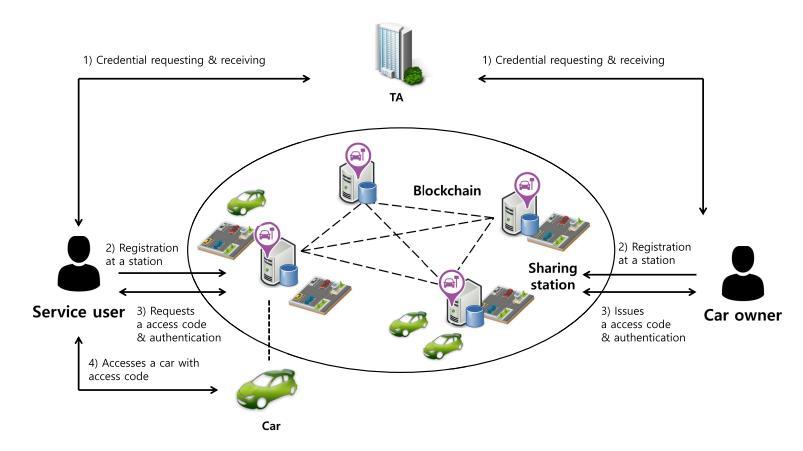
Theproposedauthenticationframeworkforatripsharingsystemisbuiltonablockchainstructureandinvolves five key entities: the Trust Authority, Stations, Vehicle Owners, Vehicles, and Users. The Trust Authority is responsibleforsettingupthesystemandissuingcredentials and pseudo-identities to both users and vehicle owners, actingasatrustedentitywithinthenetwork.
Stationsserveasdatastorageandcomputinghubs, facilitatingtheoperationoftheconsortiumblockchain.These stations play a critical role in managing the decentralized network,storingrelevantdata,andenablingcommunication betweenentities.Theyorganizetheblockchain'sconsensus mechanism, ensuring that all transactionsare verified and recordedinasecure,transparent,andimmutablemanner.
Userswhowishtouseasharedvehiclesubmitatrip-sharing requesttothevehicleownerthroughthestation.Therequest isprocessedthroughtheblockchain,allowingboththeuser and owner to securely exchange information, such as availability and terms of use, without the need for a centralizedintermediary.Blockchainensuresthatallactions taken during the trip-sharing process are authenticated, recorded,andauditable.
Thevehicleownerisalsoakeyplayerinthissystem, astheygrantaccesstotheirvehicletoverifiedusers.Vehicle data, such as location, condition, and usage history, is recordedontheblockchain,creatingatransparent,tamperproofrecordofeachcar'sactivity.
International Research Journal of Engineering and Technology (IRJET) e-ISSN: 2395-0056
Volume: 11 Issue: 12 | Dec 2024 www.irjet.net p-ISSN: 2395-0072
By leveraging blockchain technology, this authenticationschemeensuressecurity,trust,andprivacy.It addressesconcernsrelatedtodatamanipulation,fraud,and unauthorized access, while promoting a decentralized, efficient,anduser-centrictrip-sharingsystem.Additionally, the integration of blockchain allows for greater accountability,aseverytransactionandinteractionbetween users,owners,andvehiclesispermanentlyrecordedonthe distributedledger.
3.1 Rust authority: The Trust Authority is a pivotal component in the trip-sharing system, functioning as a trustedandsecureentitythatoverseestheoperationofthe platform. It is responsible for the initialization and continuousmaintenanceofthesystem’sintegrity.Oneofits key functions is to generate cryptographic keys for the stations,whicharerequiredforsecurecommunicationwithin thenetwork.Additionally,theTrustAuthorityassignsdigital credentials to both users and vehicle owners. These credentialsnotonlyauthenticateusersbutalsoverifytheir qualifications to drive, ensuring that only authorized individualscanparticipateinthesystem.
Inadditiontothesecredentials,theTrustAuthorityissues pseudo-identities to users and vehicle owners. The use of pseudo-identitiesiscrucialforprotectingusers'privacy,asit ensures that sensitive personal data (such as their real names) is not directly exposed within the system. This methodhelpstominimizetheriskofidentitytheftorprivacy breaches, while still allowing for secure verification and interactionswithintheplatform.
To further enhance its role, the Trust Authority is designedtobea highlysecureandresiliententity,builtto withstandpotentialattacksorcompromises.Itispositioned to be tamper-proof and resistant to unauthorized access, whichisvitalformaintainingtheintegrityofthesystemasa whole.
Incasesofdisputesorfraudulentactivities,suchaswhen thereisacaseofunauthorizedaccessormisuseofavehicle, theTrustAuthoritycanutilizeblockchain-storeddatatotrace anduncoverthetrueidentityofanymaliciousactor.Since blockchain technology is inherently immutable and transparent,itprovidesareliablesourceoftruth,ensuring that evidence is secure and tamper-proof. The Trust Authority uses this information to hold wrongdoers accountable,maintainingtheoveralltrustandsecurityofthe systemwhileprotectingtheprivacyoflegitimateusers.
Insummary,theTrustAuthorityplaysanessentialrolein ensuring the seamless, secure, and privacy-conscious operation of the trip-sharing system. Its combination of cryptographiccontrols,privacyprotectionthroughpseudoidentities, and its ability to resolve disputes through blockchain transparency makes it a cornerstone of the system'soveralltrustworthinessandsecurity.
3.2 Stations: Station serve as the operational hub for the trip-sharing system, providing a platform that facilitates interactionsbetweenusersandvehicleownerswhileacting asamediatorwhendisputesarise.
1. CredentialRegistrationandVerification:
The station collects and processes the credentials of both users and vehicle ownersduringregistration.
These credentials are verified for authenticityandsecurelyrecordedonthe blockchain,creatingareliableandtamperproofrepositoryofparticipantinformation.
2. UserAuthentication:
Uponreceivingatrip-sharingrequestfrom a user, the station validates the user’s credentials against the records stored on theblockchain.
This step ensures that only authorized userscanaccessthetrip-sharingservices, enhancingoverallsecurity.
3. ServiceCoordination:
After user authentication, the station communicates with the relevant vehicle ownertofacilitatetheservicerequest.
It handles the transfer of essential information, such as access details or vehicleavailability,betweentheownerand theuser.
4. BlockchainRecordManagement:
All transactions and service-related activities, including vehicle usage and serviceapproval,areloggedbythestation ontotheblockchain.
These records provide a transparent and immutable audit trail, which can be referencedincaseofdisputes.
5. DisputeResolutionSupport:
Intheeventofdisagreementsorissues,the stationprovidesthenecessaryblockchainstoreddatatoassistthetrustedauthorityin resolvingdisputes.
Thisensuresafairandefficientarbitration process,preservingtrustinthesystem.
3.3 User: Users are central to the trip-sharing system, utilizingmobiledevicessuchassmartphonestointeractwith theplatform.Theystartbycreatingaprofileandproviding necessary credentials, including identity verification and
Volume: 11 Issue: 12 | Dec 2024 www.irjet.net p-ISSN: 2395-0072
proofofdrivingeligibility.Onceregistered,userscanbrowse available vehicles and submit requests for trip-sharing services.
When a user decides to request a vehicle, they send a servicerequestaccompaniedbyauthenticationdetailstothe station.Thesedetailsverifytheiridentityandensuretheyare authorizedtodrive.Thestationvalidatesthisinformationby checkingtheblockchain,whichcontainssecurelystoreduser data.Thisprocessensuresthatonlyverifiedindividualscan proceed with the request, adding an essential layer of securitytothesystem.
After successfully passing the authentication, the user receivesauniquedigitalaccesscode,deliveredsecurelyto their mobile device. This access code enables the user to unlockandoperatethevehicleduringtheapprovedperiod. The user canthen begintheir journey, benefiting fromthe convenienceandflexibilityofthetrip-sharingplatform.
Inaddition,usershaveaccesstofeaturessuchasreal-time tracking of their journey, trip history, and automated paymentsystemsforahassle-freeexperience.Anyfeedback or issues during the trip can be logged through the app, ensuringcontinuousserviceimprovement.Byparticipating inthetrip-sharingsystem,usersnotonlyenjoycost-effective and eco-friendly transportation but also contribute to reducing traffic congestion and environmental impact in urbanareas.
3.4 Owner: Vehicleownersplayacrucialroleinthetripsharingsystembyofferingtheirvehiclesforshareduse.They beginbyregisteringtheirvehicleswiththestation,providing detailed information such as the vehicle’s make, model, condition,andnecessaryownershipdocuments.Thisdatais verified by the station and securely recorded on the blockchaintoensuretransparencyandpreventtampering.
Onceauserrequeststoshareavehicle,thestationnotifies the owner with the request details, including the user’s credentials and intended usage. The owner reviews the informationanddecideswhethertoapprovetherequest.If approved,theownergeneratesauniquedigitalaccesscode thatenablessecureentryandoperationofthevehicle.
Theaccesscodeistransmittedbacktothestation,which managesitssecuredistributiontotheauthorizeduserand thevehicle.Thisensuresthatonlytheverifiedusercanaccess thecarforthespecifiedperiod.Ownersalsohavetheability totracktheirvehicle’sstatusinrealtimethroughthesystem, ensuringpeaceofmindandaccountabilityduringitsuse.
Additionally, the blockchain maintains a complete, immutablerecordofalltransactionsandinteractionsrelated tothevehicle.Thisincludesthesharinghistory,accesslogs, and user feedback, providing owners with comprehensive documentation that can be used for dispute resolution or future reference. This system not only optimizes vehicle
utilizationbutalsoensuresthatownersretaincontrol and oversightoftheirassetswhilecontributingtoasustainable transportationmodel.
Trip-sharing systems have gained significant attentionasaneffectivesolutiontoaddresstransportation challengesinurbanareas.However,traditionaltrip-sharing modelsfacesecurityvulnerabilitiesduetotheircentralized architectureandrelianceonpubliccommunicationchannels. Thispaperintroducesa secure,decentralized trip-sharing system model, along with an authentication scheme designedtoprovideareliableanduser-friendlyservicefor authorized participants. The proposed system leverages blockchain technology to ensure the integrity of service informationandenableadecentralizedframeworkfortripsharing. To protect user privacy, a pseudonym system is employed,replacingrealidentitieswithpseudonyms.This ensuresthatevenifstoreddataiscompromised,anattacker cannotdiscernthetrueidentityofusers.
Theproposedauthenticationprotocolwasvalidated usingBANlogicanalysis,demonstratingitsabilitytoachieve secure mutual authentication among users, stations, and vehicle owners. The protocol effectively defends against various attacks, including impersonation, stolen device misuse,offlinepasswordguessing,replay,andman-in-themiddleattacks.Additionally,theprotocolensuresessential security properties such as user anonymity, data confidentiality, and mutual trust through an informal securityanalysis.
Performance comparisons with existing schemes showthattheproposedprotocolisbothefficientandwellsuited for integration into blockchain-based trip-sharing systems. Future work includes developing a simulation to further evaluate the protocol's effectiveness and implementing it in real-world trip-sharing platforms. This advancement promises a secure and privacy-preserving solutiontomodernurbantransportationneeds.
[1]J.JungandY.Koo,‘‘Analyzingtheeffectsofcarsharing services on the reduction of greenhouse gas (GHG) emissions,’’Sustainability,vol.10,no.2,p.539,Feb.2018.
[2] F. Ferrero, G. Perboli, M. Rosano, and A. Vesco, ‘‘Tripsharingservices:Anannotatedreview,’’Sustain.CitiesSoc., vol.37,pp.501–518,Feb.2018.
[3]D. Puthal,N.Malik,S.P. Mohanty,E. Kougianos,and C. Yang,‘‘Theblockchainasadecentralizedsecurityframework [futuredirections],’’IEEEConsum.Electron.Mag.,vol.7,no. 2,pp.18–21,Mar.2018.
International Research Journal of Engineering and Technology (IRJET) e-ISSN: 2395-0056
Volume: 11 Issue: 12 | Dec 2024 www.irjet.net p-ISSN: 2395-0072
[4] A. Dorri, M. Steger, S. S. Kanhere, and R. Jurdak, ‘‘Blockchain:Adistributedsolutiontoautomotivesecurity andprivacy,’’IEEECommun.Mag.,vol.55,no.12,pp.119–125,Dec.2017.
[5]B.VaidyaandH.T.Mouftah,‘‘Securityforsharedelectric and automated mobility services in smart cities,’’ IEEE Secure.Privacy,vol.19,no.1,pp.24–33,Feb.2021.
[6] D. Dolev and A. Yao, ‘‘On the security of public key protocols,’’IEEETrans.Inf.Theory,vol.IT-29,no.2,pp.198–208,Mar.1983.
[7]AVISPA.SPAN,ASecurityProtocolAnimatorforAVISPA. Accessed: Mar. 2021. [Online]. Available: http://www.avispa-project.org/
2024, IRJET | Impact Factor value: 8.315 | ISO 9001:2008