
International Research Journal of Engineering and Technology (IRJET) e-ISSN: 2395-0056
Volume: 11 Issue: 12 | Dec 2024 www.irjet.net p-ISSN: 2395-0072

International Research Journal of Engineering and Technology (IRJET) e-ISSN: 2395-0056
Volume: 11 Issue: 12 | Dec 2024 www.irjet.net p-ISSN: 2395-0072
Dija S, Avila Rose Fernandez
Center for Development of Advanced Computing, Thiruvanathapuram,
Abstract - In today's digital landscape, cybercrime continues to evolve, making RAM Forensics a critical tool for investigators. This paper focuses on RAM forensics across various versions of Windows operating systems, specifically Windows10,andWindows11.Ithighlightsthesignificanceof memory analysis in uncovering vital information such as running processes, dynamic link libraries (DLLs), and command usage. A key component of the research is examining the EPROCESS signature, with notable findings about its behavior in newer versions of Windows. The study presents insights into memory-related artifacts crucial for modern cybercrime investigations, emphasizing how these findings contribute to forensic practices in today's world.
Key Words: MemoryForensics,RAMForensics,EPROCESS Signature,MemoryArtifacts
1.INTRODUCTION
In a time of rising cybercrime, digital forensics is essential for uncovering vital evidence in investigations. Among the various branches of digital forensics, RAM Forensics has emerged as one of the most important techniques, particularly for identifying volatile data that traditionalstoragemediamaynotcapture.RandomAccess Memory(RAM)holdstransientinformationsuchasrunning processes, dynamic link libraries (DLLs), and executed commands, making it a key source for investigating maliciousactivitiesandsystembehavior.
Asoperatingsystemsevolve,sodothemethodsfor analyzing their memory structures. This paper focuses on RAM forensics across multiple versions of the Windows operating system, with an emphasis on Windows 10 and Windows11.Acoreaspectofthisresearchistheanalysisof theEPROCESSsignature,amemorystructureessentialfor identifying active processes within the system. By investigating the memory-related artifacts of these newer versions of Windows, this study aims to highlight critical differencesinforensicapproachesandtechniques.
ThispaperexaminestheevolutionofRAMForensics acrossdifferentWindowsversionstoprovideinsightsinto how memory structures have adapted to changing OS architectures.Understandingthesechangesisessentialfor forensic investigators, enabling them to adapt their techniques to analyze memory structures accurately and recover critical evidence. This research highlights the significance of keeping pace with operating system
India
advancements to ensure effective RAM Forensics across differentWindowsversions.
Intherealmofdigitalinvestigations,bothLiveand OfflineForensics[1]areintegraltechniquesusedtouncover andanalyzeevidence.LiveForensicsisemployedtocapture volatiledatafromarunningsystem,whichiscrucialwhen thesystemisfoundpoweredonatthesceneofacrime.This approach allows investigators to gather information that wouldotherwisebelostwhenthesystemisshutdown.By acquiring the contents of Random Access Memory (RAM), LiveForensicsprovidesinsightsintoactiveprocesses,open files, network connections, dynamic link libraries (DLLs), and command-line inputs. This volatile data offers a realtimesnapshotofthesystem’sactivities,revealingevidence relatedtoongoingoperations,suchasmalwareexecutionor encrypted data in its raw form, along with potential encryption keys. As modern-day cybercrimes often leave little trace on storage media, Live Forensics becomes indispensableforcapturing transient data thatcanlink to criminalactivities.
Incontrast,OfflineForensicsinvolvesthetraditional approachofcreatingabit-streamcopyofstoragemediafor later analysis. This method focuses on recovering files, including deleted and overwritten data, and analyzing unallocated space in storage. Through file system reconstruction and techniques such as keyword searches andtimelineanalysis,OfflineForensicshelpsinretrieving long-termstoreddata,whichmayprovidecrucialevidence. However,itislimitedinaccessingvolatileinformationthat onlyexistsinactivememory.Bycombiningthestrengthsof bothLiveandOfflineForensics,investigatorsareequipped to capture a more complete picture of a suspect’s digital footprint.WhileLiveForensicsexcelsinpreservingvolatile datafromactivesystems,OfflineForensicsensuresthorough analysis of persistent storage. Together, they form a complementaryapproach,offeringaholisticviewofdigital evidenceincybercrimeinvestigations.
RAM Forensics is a critical component of Live Forensics, focusing on the acquisition and analysis of RandomAccessMemory(RAM)togatheressentialforensic evidence. RAM contains volatile data such as running processes,networkconnections,encryptionkeys,openfiles,
International Research Journal of Engineering and Technology (IRJET) e-ISSN: 2395-0056
Volume: 11 Issue: 12 | Dec 2024 www.irjet.net p-ISSN: 2395-0072
andusercredentials,allofwhicharelostoncethesystemis powereddown.Thistransientinformationisoftencrucialto cybercrime investigations, as it provides a real-time snapshot of a system's activities that cannot be found on non-volatilemedialikeharddisks.
The process of RAM Forensics involves two key stages: Memory Acquisition [2] and Memory Analysis. Memory Acquisition captures the entire contents of a system'sRAMandstoresitinamemorydumpfile.Thisis performedwhilethesystemisstillrunningtoensurethat volatile data is preserved. Once the memory dump is obtained,MemoryAnalysisisconductedtoextractforensic artifactsfromthedumpfile.Thisanalysiscanrevealrunning processes, network activity, open files, and other volatile informationthatprovidesinsightsintothesuspect'ssystem behavior.
GiventhevolatilenatureofRAM,RAMForensicsis indispensableincybercrimeinvestigations.Itallowsforensic investigators to recover key evidence that would otherwise be lost when the system is powered off. As moderncyberattacksoftenleaveminimaltracesonstorage media, RAM Forensics ensures that essential evidence relatedtotheseattacksispreserved,makingitavitaltoolfor uncoveringmaliciousactivitiesinreal-time.
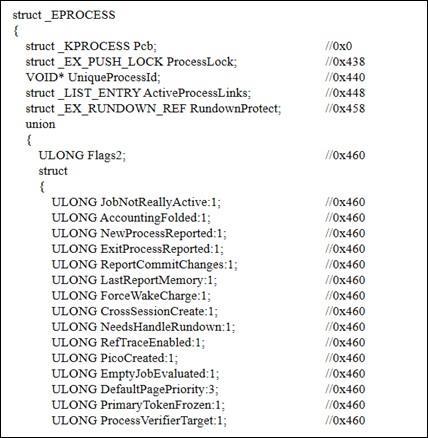
The _EPROCESS structure [3] is a cornerstone of RAM Forensics, residing within the kernel of the Windows operating system and containing critical components essentialforunderstandingprocessmanagement.Amongits key elements are the Directory Table Base (DTB), Process Environment Block (PEB), and Affinity structure. The _EPROCESSstructurehasover100members,manyofwhich are pointers to other structures that provide a comprehensiveviewofarunningprocess.TheDTBisvitalfor memory management as it aids in translating virtual addresses to physical addresses, crucial during memory analysis.Additionally,the_EPROCESSgivesustheProcessID (PID)andParentProcessID(PPID)ofagivenprocess,along with the creation and exit times, allowing forensic investigatorstoestablishtimelinesofsystemactivities.
ThePEB,nestedwithinthe_EPROCESSstructure,holds invaluableinformationabouttheloadedmodules,commandline parameters,and various attributes associated witha process.Specifically,thePEB_LDR_DATAstructureprovidesa list of Dynamic Link Libraries (DLLs) used by the process, while the RTL_USER_PROCESS_PARAMETERS structure contains command-line information. This data is instrumentalinidentifyingmaliciousbehaviors,asitreveals thelibrariesbeingutilizedandthecommandsexecutedby theprocess.Moreover,theHANDLE_TABLEstructurewithin the_EPROCESSgivesdetailsofallfilesopenedbytheprocess, furtherenrichingtheinvestigativecontext.
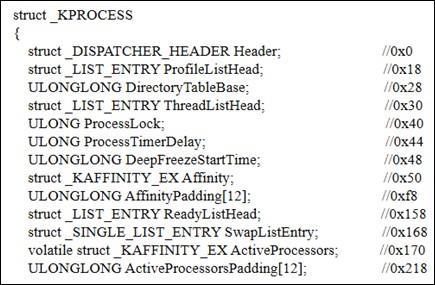
Animportantaspectofthe_EPROCESSstructureisthatit containsapointertothePEB,facilitatingadeeperanalysisof theprocess'scharacteristics.TheDTBvaluecanbelocatedat offset0x28inthe_KPROCESSstruct,whichisfoundatthe beginningofthe_EPROCESS;uptothelatestbuildversion, 0x28 is the position of the DTB. This value is crucial for addresstranslation,aidinginvestigatorsintransitioningfrom virtualtophysicaladdresses.Furthermore,thePEBstructure holdsanImageBaseAddressvaluethatpointstothefirstpage oftheprocess'scontent.Byanalyzingthesectiontableofthe Portable Executable (PE) structure on this first page, investigators can identify the locations of other pages, allowingforacomprehensivereconstructionoftheprogram bycombiningallthepagesspecifiedinthesectiontable.This comprehensiveanalysisofthe_EPROCESSstructurenotonly aidsin revealingthebehaviorsofactiveprocessesbutalso highlightspotentialvulnerabilitiesandattackvectorspresent inthesystem.
e-ISSN: 2395-0056
Volume: 11 Issue: 12 | Dec 2024 www.irjet.net p-ISSN: 2395-0072
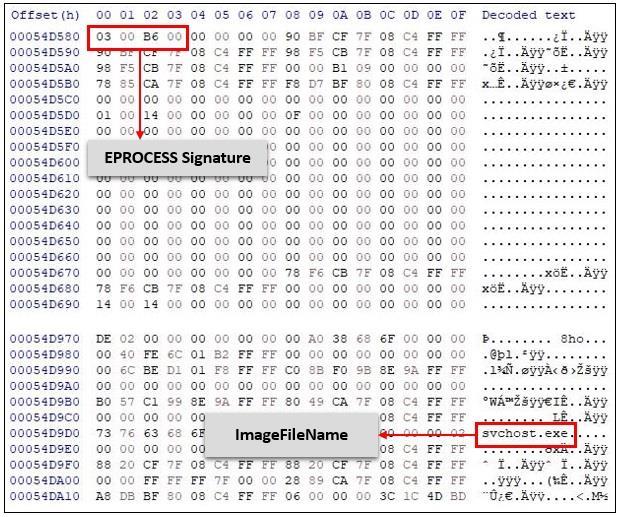
In the field of RAM Forensics, the ability to accurately identify critical structures within memory dumps is paramountforsuccessfulinvestigations.Onekeyfocusofthis paperisthe_EPROCESSsignature[4],whichvariesnotonly acrossdifferentoperatingsystemversionsbutalsoamong variousbuilds.Understandingtheuniquecharacteristicsof the _EPROCESS signature for each version and build of Windows 10 [5] is essential to ensure the precise identificationofvalid_EPROCESSinstanceswithinmemory dumps.
Table -1: EprocessSignatureofVariousVersionsof Computer
Windows10 10 0 17134 0x0300B600
Windows10 10 0 18362 0x0300B800
Windows10 10 0 18363 0x0300B800
Windows10 10 0 19041 0x03000000
Windows11 10 0 22621 0x03000000
Variationsinthelayoutandstructureof_EPROCESScan shiftbetweenversionsduetoupdatesintheWindowskernel. Therefore, forensic tools must be regularly updated to accommodate these changes and ensure that _EPROCESS instances are accurately identified across all relevant Windowsbuilds.Thisadaptabilityiskeytomaintainingthe integrity of investigations and ensuring the reliability of evidenceextractedfrommemorydumps.
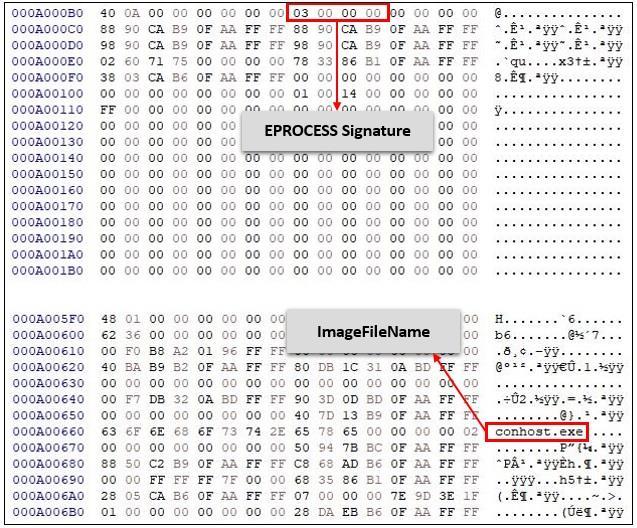
The proposed methodology begins by systematically scanningtheblocksofthememorydumpfiletolocateavalid _EPROCESS signature. Once this signature is identified, investigatorscanleverageittoefficientlycollectawealthof evidence, including information about running processes, loaded DLLs, and command-line arguments used by those processes. This signature-based approach not only allows forensic analysts to quickly pinpoint relevant processes within the memory dump but also streamlines the overall analysis process. By enabling a focused examination of pertinentdata,thismethodologyenhancestheaccuracyand effectivenessofRAMForensics,empoweringinvestigatorsto constructadetailedpictureofsystemactivitiesandidentify potentialsecuritythreats.Throughthisstructuredapproach, the methodology significantly contributes to the timely identificationandmitigationofcyberthreats.
IntherealmofRAMForensics,thejourneybeginswith thecrucialtaskoflocatingrelevantdatastructureswithinthe memory dump. This initial step is vital for unveiling the intricatewebofprocessesoperatingwithinasystem.Central tothisanalysisisthe_EPROCESSstructure,whichservesasa gatewaytoexamining criticalprocessinformation[6],such as the Process ID (PID), Parent Process ID (PPID), Thread Count, ImageName,andassociated DLLsfor each running process.Thisdetailedanalysisisinstrumental indetecting anomaliesandtracingtheoriginsofmalicioussoftware.
Oncethenecessarydatastructuresareidentified,analysts candelvedeeperintothe_EPROCESSstructuretoretrieve essential information about running processes, loaded dynamiclinklibraries(DLLs)andcommand-lineparameters usedbytherunningprocesses.ExaminingthelistofDLLsand command-line information allows forensic analysts to
International Research Journal of Engineering and Technology (IRJET) e-ISSN: 2395-0056
Volume: 11 Issue: 12 | Dec 2024 www.irjet.net p-ISSN: 2395-0072
identify potential malicious behaviors, as attackers often exploit specific DLLs or use unusual command-line argumentstoexecutetheiractivities.
Ascybercrime[7]continuestorise,therelevanceofRAM Forensics becomes increasingly significant. With the proliferationofmalwareandsophisticatedattacks,spotting suspicious activity in real time is crucial. After acquiring a memory dump, investigators can extract vital information, such as running processes and loaded DLLs, which aidsin identifying potential malware. This proactive approach to analyzingvolatilememoryallowsforensicprofessionalsto respondswiftlytoemergingthreats,makingitanessential practiceinmoderncybercrimeinvestigations.
By identifying the _EPROCESS signature in the latest Windows versions, forensic analysts can extract essential attributes that facilitate investigating suspicious activities and help establish timelines. This process enables investigatorstomapoutthebehaviorofmaliciousentities, identify their origins, and understand their impact on the system.
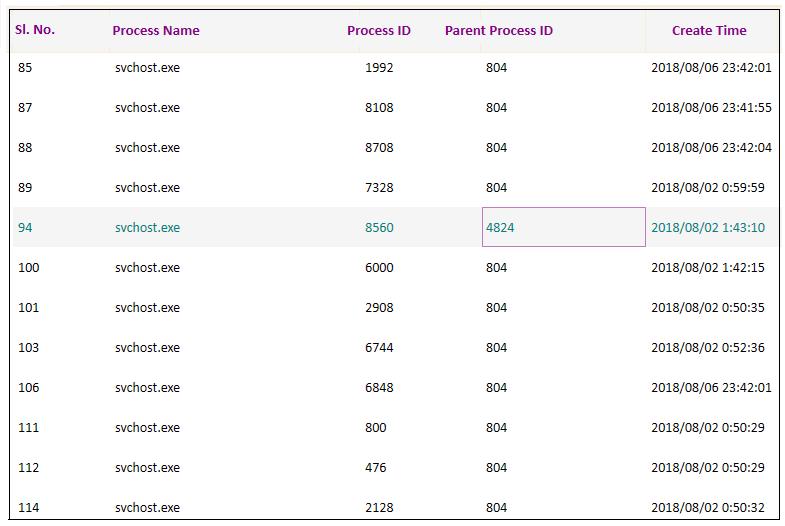
-5:Screenshotofprocesslistofmemorydumpof Windows10(17134OSbuild)
The provided Figure 5 depicts a list of svchost.exe processes running on a Windows system. As mentioned, svchost.exeisacommonsystemprocessthatcanbeusedby malwaretoevadedetection.Analyzingtheimage,weseethat mostsvchost.exeprocesseshaveaParentProcessID(PPID) of804,whichcorrespondstotheservices.exeprocess.Thisis expected behavior for legitimate svchost.exe instances. However,thereisoneprocesswithaPPIDof4824,whichis unusual. This discrepancy raises concerns about the legitimacyofthisparticularsvchost.exeprocess.
FromaWindows10memorydump,variouskeydetails can be extracted to assist in forensic analysis [8]. Investigatorscanretrieveinformationonrunningprocesses, DLLlists,andcommandlineusage.Specifically,attributeslike theImageFileName,ProcessID,andThreadCountprovidea snapshotofactiveprocesses,whiletheMemory_ProcessDlls tablecanrevealcriticalDLLdetails,includingsizeandbase address.Furthermore,theMemory_CommandUsedsection sheds light on the commands executed by processes. By leveraging the _EPROCESS signature, forensic analysts can reconstruct processes and establish a comprehensive understanding of the system’s state at the time of the memory capture, facilitating the identification of potential vulnerabilitiesandattackvectors.
ThevariabilityofEPROCESSsignaturesacrossdifferent operating system versions poses a significant challenge. Whenanewversionisintroduced,itiscrucialtoidentifythe corresponding EPROCESS signature by analyzing the memory dump. Additionally, if an update is made to an existingsystem,itsinternalstructuremaychange,resulting inalterationstotheEPROCESSsignature.Insomecases,the signaturevaluemaynotappearunique,necessitatingfurther examinationofadditionalEPROCESSdatatoensureaccurate identification.
Anotherchallengearisesfromthevariationsindumpfile extensionsandtheircorrespondingoffsetvalues,whichcan changebetweendifferentdumps.Somedumpsmaycontain extra data, leading to changes in offset and potentially producingdifferentresults.
Furthermore, the presence of terminated processes alongsiderunningprocessesaddscomplexitytotheanalysis. Thecurrentimplementationdisplaysbothtypesofprocesses andaimtodifferentiatebetweentheminfutureversionsto provideclearerinsightsintothesystem’sstate..
Cyber Forensics investigators must prioritize the acquisition and analysis of volatile data to secure critical evidence in cybercrime investigations. By focusing on the analysis of volatile data within Random Access Memory (RAM),investigatorscangainvaluableinsightsintoactive processes, network connections, and potential malicious activities.TheEPROCESSstructure,alongwithitssignature, serves as a vital component in this analysis, enabling the
Further investigation would involve examining the command line arguments, associated DLLs, and other attributesofthesuspectprocess.Ifitisfoundtohaveunusual or suspicious characteristics, it could be indicative of maliciousactivity.Forinstance,theprocessmightbeloading unusualDLLsorexecutingcommandsthatarenottypicalfor alegitimatesvchost.exeprocess.Bycarefullyanalyzingthese details, forensic investigators can determine whether the process is a genuine system process or a malicious actor attemptingtodisguiseitselfassuch.
International Research Journal of Engineering and Technology (IRJET) e-ISSN: 2395-0056
Volume: 11 Issue: 12 | Dec 2024 www.irjet.net p-ISSN: 2395-0072
identificationofrunningprocessesandfacilitatingadeeper understandingofsystembehavior.
However, the challenges posed by differing EPROCESS signatures across operating system versions, variationsinmemorydumpextensions,andthepresenceof bothrunningandterminatedprocessesnecessitateongoing researchandadaptationofforensicmethodologies.Asthe fieldofRAMForensicscontinuestoadvance,itisessential for investigators to refine their tools and techniques to ensureeffectiveanalysisandreliableresults.Byaddressing these challenges, forensic professionals can enhance their capabilitiesincombatingcybercrimeandprotectingdigital assetsinarapidlychangingtechnologicallandscape.
[1] S. Dija, J. Ajana, V. Indu, and M. Sabarinath, “Web browserforensicsforretrievingsearchedkeywordson theInternet,”in20213rdInternationalConferenceon Advances in Computing, Communication Control and Networking (ICAC3N), 2021, Greater Noida, India, pp. 1664–1668,2021. https://doi.org/10.1109/ICAC3N53548.2021.9725457.
[2] R. Shree, A. K. Shukla, R. P. Pandey, V. Shukla, and D. Bajpai, “Memory forensic: Acquisition and analysis mechanismforoperatingsystems,”inProceedingsofthe Conference on Materials Today: Proceedings, 2021, Springer, Heidelberg, pp. 1–13, 2021. https://doi.org/10.1016/j.matpr.2021.05.270.
[3] J.Jaina,G.S.Suma,S.Dija,andK.L.Thomas,“Extracting network connectionsfrom Windows764-bitphysical memory,” in 2015 IEEE International Conference on Computational Intelligence and Computing Research (ICCIC), 2015, Madurai, India, pp. 1–4, 2015. https://doi.org/10.1109/ICCIC.2015.7435745
[4] G. S. Suma, S. Dija, and K. L. Thomas, “A novel methodology for Windows 7 × 64 RAM Forensics,” in 2014IEEEInternationalConferenceonComputational IntelligenceandComputingResearch,2014,Coimbatore, India, pp. 1–6, 2014. https://doi.org/10.1109/ICCIC.2014.7238400.
[5] D.KimandT.Shon,“Futureofkernelobject-basedRAM Forensics,” in 2023 International Conference on Platform Technology and Service (PlatCon), 2023, Busan, Republic of Korea, pp. 64–66, IEEE, 2023. https://doi.org/10.1109/PlatCon60102.2023.10255186
[7] D. B. Oh, D. Kim, D. Kim, and H. K. Kim, “volGPT: Evaluation on triaging ransomware process in RAM Forensics with Large Language Model,” in Forensic ScienceInternational:DigitalInvestigation,2024,vol. 49, Supplement, pp. 301756, Elsevier, 2024. https://doi.org/10.1016/j.fsidi.2024.301756.
[8] N. Patil and B. B. Meshram, “Extraction of forensic evidences from Windows volatile memory,” in Proceedings of the 2nd International Conference for ConvergenceinTechnology(I2CT),2017,Mumbai,India, pp. 421–425, IEEE, 2017. https://doi.org/10.1109/I2CT.2017.8226164
[6] S. Dija, G. S. Suma, D. D. Gonsalvez, and A. T. Pillai, “ForensicreconstructionofexecutablesfromWindows 7 physical memory,” in 2016 IEEE International Conference on Computational Intelligence and ComputingResearch(ICCIC),2016,Chennai,India,pp. 1–5, IEEE, 2016. https://doi.org/10.1109/ICCIC.2016.7919641.