
International Research Journal of Engineering and Technology (IRJET) e-ISSN: 2395-0056
Volume: 11 Issue: 12 | Dec 2024 www.irjet.net p-ISSN: 2395-0072

International Research Journal of Engineering and Technology (IRJET) e-ISSN: 2395-0056
Volume: 11 Issue: 12 | Dec 2024 www.irjet.net p-ISSN: 2395-0072
Hafid Nanis1, Abdussalam Aziz2
1College of Engineering Technology, Zuwara, Libya
2Zallaf Libyan Oil & Gas, Tripoli, Libya ***
Abstract - Murzuq Basin is one of the major Libyan basins, and it occupies the southwestern part of the country and covering an area of about 350,000 km². It contains a sedimentary fill up to 4,000 m thick, containing mainly a marine Paleozoic unit and a continental Mesozoic unit. The Upper Ordovician Mamuniyat Formationcanbeconsideredas a primary reservoir target in the basin. In some places, where the Mamuniyat Formation is missing, the Middle Ordovician Hawaz Formation is considered the primary target. The Ordovician reservoirs are sourced and capped by Lower Silurian Tanezzuft Shale. The present study focuses on the sedimentological studyoftheHawazformation,whichisbased on the slabbed core, wireline log data, and thin sections from core samples for the Hawaz Formation within the exploration well O2 NC-115 in Murzuq Basin The core analysis and petrographic study show the sandstones are fine to mediumgrained, moderately to well-sorted, and sub-angular to subrounded grains. Facies analysis shows that the Hawaz Formation was deposited along a marine shoreline in shallow marine shoreface and distal shelf. The average porosity of the Hawaz Formation ranges between 7 - 17%. The reservoir quality of the Hawaz Formation varies from poor to good, represented by the middle part of the core section, to good quality, represented by the lower and the upper parts
Key Words: Hawaz, Sedimentology, Core, Tine section, Facies,ReservoirQuality.
MurzuqBasinisoneoftheseveralintracratonicbasinson the North African platform with a predominantly marine Palaeozoic clastic infill (Sola and Worsley, 2000). Murzuq Basin covers a massive area of about 350,000 km² in the southwestern part of Libya. The stratigraphic column of MurzuqBasinconsistsmainlyofclasticdeposits.Toassess its reservoir characteristic and petroleum potential, the Upper Ordovician Mamuniyat sandstone represents the primaryreservoirrockintheBasin.Incontrast,theHawaz Formationisrepresentsthesecondreservoirtarget,andthe main reservoirs sourced and capped by Lower Silurian Tanezzuft Shale. Potential younger traps, mainly in the Upper Silurian-Devonian, is considered in the basin (Aziz, 2000). The hydrocarbon exploration activities in Murzuq Basin have passed through three stages: (1) in the first explorationphasefrom1956to1980,17wellsweredrilled, withoildiscoveryinB2-1(Atshan)andhydrocarbonshows
in several other wells; (2) the second phase from 1980 to 1992with several companieshadsome discoveriesinthe basin, and the most attractive discovery was made by Rompetrolwithinthestudyarea,wheretheresultsofdrill ontwelvestructureswithsixnewcommercialdiscoveries; also LASMO and BOCO oil companies had Ambiguous discoveries;(3)thethirdphaseisDevelopmentExploration Repsol which was restricted to the central part of the originalblock,withinanareaabout5,000km²,whichstarted in1993,andhasbeencharacterizedbythedevelopmentof the three main fields discovered (A, B and H field) (Aziz, 2000).
The Hawaz formation, the focus of this paper, presents an exciting opportunity for hydrocarbon exploration. As a potential second reservoir rock in the petroleum system of Murzuq Basin, the Hawaz Formation MiddleOrdovicianage(Llanviru-Llandeilo)isasignificant interest. It is conformable with the underlying Achebyat Formation and unconformable with the overlying Melez ShuqranFormation(Hallett,2002).TheHawazFormationis thesecondmajorunitofBurollet'sQarqafGroupnamedby MassaandCollomb(1960)afterJabalHawazfromthetype section on the western part of the Qarqaf Arch. Collomb divided the formation into three subdivisions, an upper 'Tigillitessuperieurs',amiddle'Gresintermediaires'anda lower'Tigilliitesinferieurs'(MassaandCollomb,1960).The HawazFormationontheQarqafArch comprises120m of alternating siltstone and thinly bedded, cross-bedded sandstoneswithabundantTigillites.Vos1981interpreted thissequenceasacoarsening-upwardsdeltafront/deltatop high-standdeposit ThetypesectionoftheHawazFormation on the Qarqaf Arch consists of fine to medium-grained sandstone,withsubordinatesiltstoneandshale.Thissection hasbeendescribedbyVos(1981),whosuggestedthatthe sediments were deposited in a fan delta complex which progrededacrosstheQarqafUplifttowardsthenorth. The formationispresentintheDuralQussahTroughandaround theQarqafArchandinthesubsurfaceoftheGhadamisBasin and at least into the northwestern part of the Sirt Basin (Hallett,2002).
The uppermost Ordovician Mamuniyat Formation is usually considered to be the primary reservoir interval in NC-115. However, this formation is not preserved in the eastern part of the H-field, where the Hawaz Formation directly underlies the lowermost Silurian Tanezzuft shale
International Research Journal of Engineering and Technology (IRJET) e-ISSN: 2395-0056
Volume: 11 Issue: 12 | Dec 2024 www.irjet.net
and constitutes the main reservoir. The cross-section throughtheH-fieldshowstheHawazFormationintheeast, juxtaposedalonganescarpmentwiththewesternpartofthe field, where an infill of Mamuniyat deposits provides the reservoir.TheHawazFormationhasalsogivenpromising resultsintheF-structure,wheretheMamuniyatFormation isverythin.However,onlyalimitednumberofwellsinthe areahavebeendrilleddeepenoughtopenetratetheHawaz Formation(Aziz,2000.).TheconcessionNC-115islocatedin the north-western part of the basin and covers an area of about25000sqkm(Figure1).
6to900mD,respectively.Theporosityandpermeabilityin F1andF2generallyrangefrom3.6to14.6%and0.02to0.32 mD,respectively,withamaximumpermeabilityofabout50 mD in F1 NC-115. Acritarch assemblages within the formationindicatea Lower to Middle Ordovicianage. The depositional environment is transitional from fluvial to shallowmarine,withincreasingmarineinfluenceupwards. The Hawaz Formation varies in thickness in the NC-115 Concessionarea,rangingbetween0to280m(Aziz,2000).
Study Area
Petrographically,theHawazFormationconsistsof very fine to coarse-grained quartz arenite, which is moderately to well-sorted. Detrital components are dominatedbymonocrystallinequartz,butsomelithicgrains alsooccur.Thecommondiageneticcomponentsarequartz overgrowth, pore-filling recrystallized detrital clay, and crystallizedclay.Thequalityoftheformationasareservoir rock varies from poor to good. The upper parts of the formationwithintheH-Field,displaypoorreservoirquality with high shale content and sandstone porosity and permeability ranging from 6 to 12% and 0.2 to 2.5 mD, respectively. In contrast, the lower part of the formation exhibits betterqualityandformsthemainreservoirzone, withaverageporosityandpermeabilityfrom10to16%and
The main subject of this research is to perform a detailed petrography and sedimentological study of the Hawaz Formation on the slabbed core of the exploration well O2 NC-115,whichwasdrilledandcoredin2004byRepsolOil OperationswithinNC-115Concession Themainobjectives ofthisstudycouldbesummarizedasfollows:
To perform a detail sedimentological description of the slabbed core of the O2 NC-115 welloftheHawazFormation.
To study the vertical distribution and characteristic of the Hawaz Formation within the study well by provide additional evidence of the sedimentaryfacies.
International Research Journal of Engineering and Technology (IRJET) e-ISSN: 2395-0056
Volume: 11 Issue: 12 | Dec 2024 www.irjet.net p-ISSN: 2395-0072
Toexaminethepetrographiccharacteristicsto identifythetexture,mineralcomposition,diagenetic feature,andporositytoassessthereservoirquality andclassifysandstone
To integrate petrographic, sedimentological, and wireline log data to derive depositional environment, reservoir quality distribution, and hydrocarbonpotentiality.
Themainmethodologicalstepsinthisstudyare:
Collectthedata.
Qualitycontrolbyreviewingtherawdataandthe availablereports.
Correctthedepthcoreshiftusingthecoreandlog Gammaray.
Describe the slabbed core of the O2 NC-115 well andselectsamples.
Preparethethinsections.Thesethinsectionswere obtained from six scattered intervals of core hand specimensfromtheO2NC-115core,andthesethin sections have been prepared in the Petroleum ResearchCentre(PRC)inLibya.
Describe the thin sections to predict the mineral composition, type of sandstone, and diagenesis history.
Draw and plot the core description chart and combineitwiththelogs.
Breakdownthefacies.
Integrate and interpret the data and predict the depositionalmodeltohavethedistributionquality oftheHawazreservoir.
3.1. Core Description
RepsolOilOperationscoredthecoreoftheHawaz FormationintervalsfromO2NC-115onthenorthwestern flankoftheMurzuqbasin,SWLibya.Thecoreinventoryof O2NC-115isshowninTable1.Thecorehasbeenslabbed 1/3to2/3parts.Inthisstudy,weexaminedandinvestigated 172feetof theHawazreservoirinO2NC-115exploration well to perform detailed sedimentological description to definethesedimentologicalfeatures,thediagenesisandtry topredictthedepositionalenvironmentofthisformation.
Table1.CoreintervalsdrilledbyRepsolOilOperationsin O2NC-115.
Core No. Cored Interval(ft) Cored Length(ft) RecoveryFeet (%) Formation
1 5290'5317' 27 27.00(100%) Hawaz
2 5317'-5347 30 28.70 (95.7 %) Hawaz
3 5347'5375' 28 27.00 (96.4 %) Hawaz
4 5375'5405' 30 29.00 (96.7 %) Hawaz
5 5405'5465' 60 60.00(100%) Hawaz
Total 171.7ft
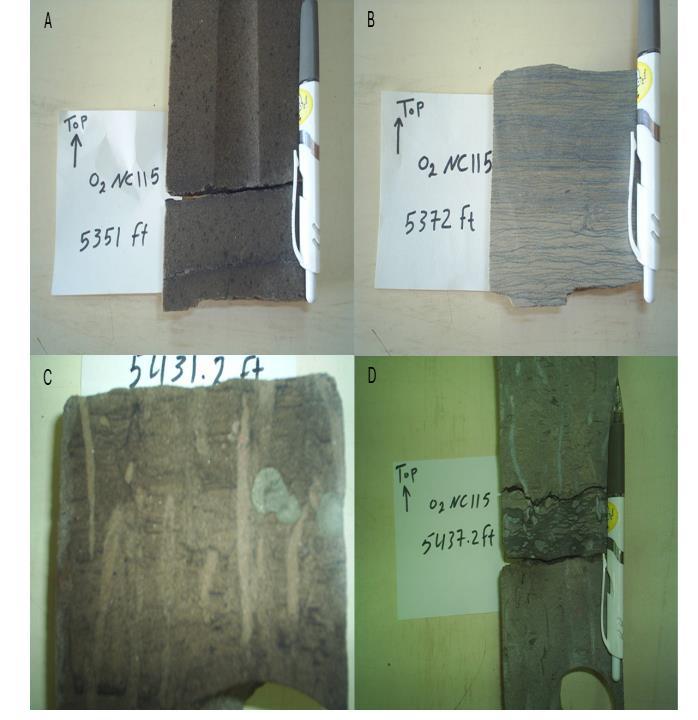
Inthissection,wecoveredthewholefifecoreswith investigationandrecordingallthefeaturesthatmighthelp in this sedimentological study. For example, core number one,whichrangesfrom5290ftto5317ft,withatotallength of27ft,andcorerecovered27feet(100%),threefacieshave beenobserved:BurrowedSandstoneFaciesisrepresented bythecoredinterval from5290ftto5298ft(Figure 2A), HeterolithicFaciesisrepresentedbythecoredintervalfrom 5298ftto5310(Figure2B),andMassiveSandstoneFacies isrepresentedbythecoredintervalfrom5310ftto5317ft. The vertical open fracture occurred in depth 5304 ft with smallfractureoccurredindepth5308ftandripoccurredin depth5312ft.Thestylolitefeaturesarepresentindifferent intervals of this core. The laminated feature occurred at depths5301ftand5307ft.Also,thecross-beddedfeature occurredindepthof5310ft(Figure2.C).Corenumberone haslithologicalvariation;onthetop,itischaracterized by sandstoneextendingfrom5290ftto5298ft,laydownbya foot of shale from 5299 ft to 5300 ft, another foot of sandstone from 5300 ft to 5301 ft, shale from 5301 ft to 5301.5ft,andinthelowerpartofthecoreappearsandstone from 5301.5 ft to 5317 ft with small streaks of shale. The lithologicaldescriptionsummaryofcoreoneissandstone, fine to medium grain size, pyritic, light brown to brown, translucent,whitishgrain,friabletomedium-hard,mottled may be by organic matter, the shale gray to dark gray, blackish,fissile.
Allothercoreshavebeenstudiedanddescribedin details,asshown.Thefeaturesthathavebeennoticedwere recordedasfollowing:onemassivesandstonefaciesincore two,whichwasrepresentedinthecoredintervalfrom5317 ft to 5344 ft as shown in (Figure 2.D). Core number three containsthreefacies,theseare:MassiveSandstoneFacies, Cross-beddedSandstoneFacies,andLaminatedFacies.Rip occurredanadepthof5312ftwithasmallfractureoccurred andepth5340ftandapartlyopenandpartlyclosedfracture occurredatadepthof5351ft(Figure3.A).LaminatedFacies isrepresentingthecoredintervalfrom5359ftto5374.5ft
International Research Journal of Engineering and Technology (IRJET) e-ISSN: 2395-0056
Volume: 11 Issue: 12 | Dec 2024 www.irjet.net p-ISSN: 2395-0072
(Figure 3.B). Core number four has many false changes representedbyfourfalsehoods,someofwhicharerepeated, such as Laminated Facies, Massive Sandstone Facies, Heterolithic Facies, and Cross-bedded Sandstone Facies. Corenumberfiverangesfrom5405ftto5465ft,withatotal length of 60 ft, and recovered 60 feet (100%). It contains four facies with repetition; these facies are: Heterolithic Laminated Facies, Laminated shale Facies, Cross-bedded Sandstone Facies, and Burrowed Sandstone Facies. The lithological description of core fife is sandstone, fine to mediumgrainsize,pyritic withroundedgrainof pyritein depth 5431 ft (Figure 3.C), light brown to brown, translucent, friable to medium-hard, mottled maybe by organicmatter,theshalegraytodarkgray,fissile,andshale deformationoccurredindifferentdepth5412.2ft,5415ft, 5437ft,and5452ft(Figure3.D).

3.2. Tine Section Preparation and Description
Thissectionofthisstudyisbasedonatotalofsix thinsections.Theyhavebeencutfromsixhandspecimens (cores) from O2 NC-115 and have been selected by the authors.Theywereselectedbasedonthefaciesdistribution of the core and in the interest facies for hydrocarbon accumulationandproduction.Thethinsectionshavebeen prepared in the PRC Laboratory by the authors to have a betterpetrographicunderstandingoftheHawazreservoirin O2NC-115well.Thethinsectionshavebeenimpregnated withblueresintofacilitatethemicroscopicexaminationof texture and quantitative analysis of composition and porosity.Becausethemineralogyofsandstoneisprimarily inherited from the source area, modified by sedimentary processes and diagenesis, a mineralogical examination provides one of the most valuable approaches to obtain information about the provenance, including tectonics, climate,theeffectsoftransportation,includingdistanceand direction, and the addition of mineral composition during sedimentation and diagenesis (Pettijohn et. al, 1987). The thinsectioninventoryandthepresentfaciesispresentedin Table2 Afterthat,detaildescriptionofthesixthinsections using the microscope under normal and polarized states with thin section photos are presented showing unique differentfeatures Table3illustratesthemodelcomposition ofthe thinsections ofsandstonesamplesfrom the Hawaz FormationinO2NC-115.
International Research Journal of Engineering and Technology (IRJET) e-ISSN: 2395-0056
Volume: 11 Issue: 12 | Dec 2024 www.irjet.net p-ISSN: 2395-0072
Table2.Thinsectionsselectedintervalsandfacies.
5 5431ft BurrowedS.S 5
6 5442ft BurrowedS.S 5
3.2.1. Thin Section No (1):
This sample can be represented as sandstone. It contains about 80 % of monocrystalline quartz grain, ranging from fine to medium in size, moderately to well sorted, containing subangular to subrounded grains, with straight to concave-convex grain contacts. Porosity is estimatedastotalporosityof15%.
3.2.2. Thin Section No (2):
Thissampleissandstone,anditcontainsabout66 %ofmonocrystallinequartzgrain.Thequartzgrainsrange from fine to medium in size, moderately to well sorted, containingsubangulartosubroundedgrains,withstraightto concave-convex grain contacts to point contact. The authigenic mineralogy predominantly caused by quartz overgrowthsofabout5%with7%claycement.Porosityis estimatedasatotalof15%.
3.2.3. Thin Section No (3):
This sample can be considered as sandstone and containsabout74%ofmonocrystallinequartz.Thequartz grainsrangefromfinetomediuminsize,moderatelytowell sorted, containing subangular to subrounded grains, with straight to concave-convex grain contacts. This sample comprises5%pyriteandincludes3%mica(muscovite)and 74%monocrystallinequartz.Theauthigenicmineralogyis about 15% clay cement. Porosity is estimated as total porosityof3%
3.2.4. Thin Section No (4):
This sample is characterized by micaceous shaly sandstone.Thesequartzgrainsrangefromfinetoveryfine insize,moderatelytowellsorted,containingsubangularto subrounded grains, with straight to concave-convex grain contacts. The detrital mineralogy comprises 30% monocrystalline quartz, 5 % pyrite, and 13 % mica (muscovite)with52%shale.Porositycouldbelessapparent anddifficulttoestimate.
3.2.5. Thin Section No (5):
Thissamplecanbecharacterizedbysandstone It containsabout75%ofmonocrystallinequartzgrain.These quartzgrainsrangefromfinetomediuminsize,moderately towellsorted,containingsubangulartosubroundedgrains, withstraighttoconcave-convexgraincontacts.Thedetrital mineralogy of these grains comprises 5 % pyrite beside monocrystalline quartz. The authigenic mineralogy is predominantlybyquartzovergrowths,representingabout3 % with 10 % clay cement. Porosity estimation is a total porosityof7%.
3.2.6. Thin Section No (6):
This sandstone sample contains about 76% of monocrystalline quartz grain, which ranges from fine to medium in size, moderately to well sorted, containing subangulartosubroundedgrains,withstraighttoconcaveconvexgraincontacts.Thedetritalmineralogycomprises5% pyrite, and 1% mica beside monocrystalline quartz. The authigenicmineralogyisabout2%claycementwithquartz overgrowth about 1%. Porosity can be estimated as total porosityof15%.
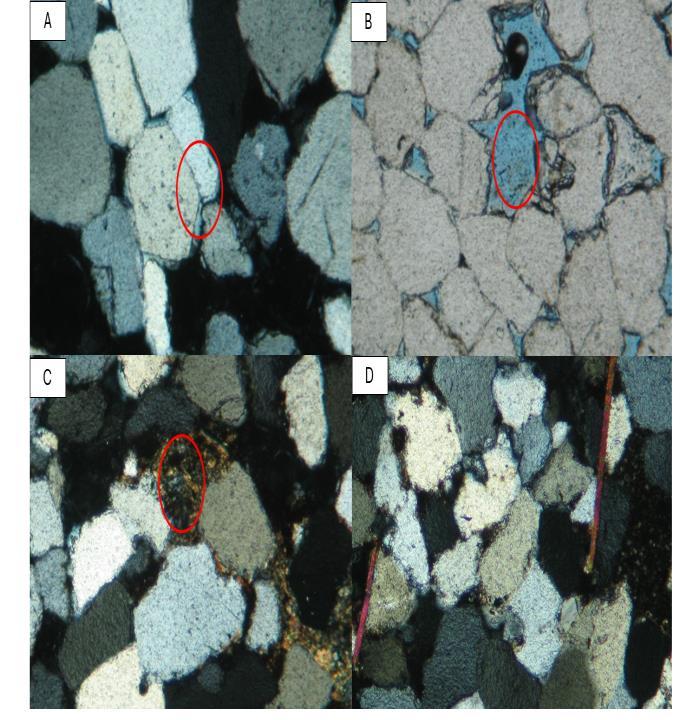
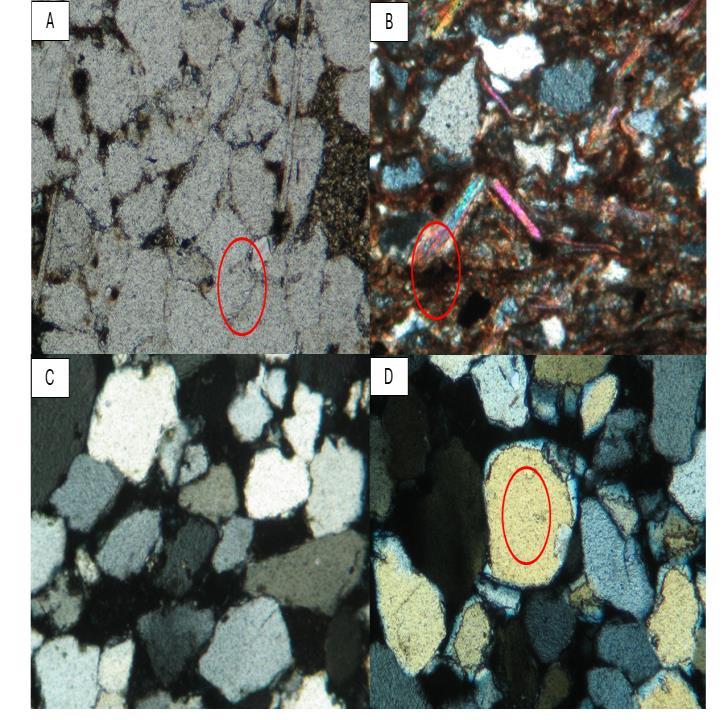
Figure5.A. Concave-convexquartzgrainscontact,B.Mica (muscovite),C.Showingthesubangulartosubrounded grains,andD.Monocrystallinequartzgrain.
the material itself and its deposition but also its genesis, transportation, diagenesis, geochemistry, physics, and statistics applicable to its existence (Alan, 1951). A fundamental tool in descripting and interpreting sedimentaryrocksistheconceptofsedimentaryfacies.The wordfaciesisdefinedinslightlydifferingwaysbydifferent authors,buttheconsensusisthatitreferstothesumofthe characteristics of a sedimentary unit (Middleton, 1976). Thesecharacteristicsincludethedimensions,sedimentary structures, grain sizes and types, colour, and biogenic content of the sedimentary rocks. The term facies was introduced into geology by Gressly in 1838. It meant the entireaspectofapartoftheearth'ssurfaceduringacertain intervalofgeologicaltime(Teichert,1958).Theworditself is derived from the Latin facia or facies, implying the externalappearanceorlookofsomething.Themodernusage wasintroducedbyJamiesonin1860,whousedthetermto imply a stratigraphic unit’s total lithological and palaeontological aspects. The definition of the term facies canbeextended.Forexample,whencharacteristicbiological materialispresent,thefaciesiscalledbiofacies.Whenfossils are not present, the term lithofacies is used. The facies concept does not just describe rocks and groups of sedimentaryrocksseeninthefieldandformsthebasisfor interpretating strata. The lithofacies characteristics result fromthephysicalandchemicalprocessesthatwereactiveat the time of deposition of the sediments, and the biofacies andichnofaciesprovideinformationaboutthepalaeoecology duringandafterdeposition.Knowingthephysical,chemical, and ecological conditions makes reconstructing the environment during deposition possible. The process of facies analysis, the interpretation of strata in terms of depositionalenvironments,andcanbeconsideredcentralto themainobjectiveofsedimentologyandstratigraphy,which isthereconstructionofthepast(Anderton,1976:Reading and Levell, 1996). Facies analysis has significantly been stimulated over the past few years by rapid conceptual advancesinsequencestratigraphy.Faciesanalysishasbeen and remains essential for many authors to describe, correlate,andinterpretthedepositionalenvironment.
Table3.Modelcompositionofthinsectionofsandstone samplesfromHawazFormationinO2-NC115.
4.1. Sedimentological Characteristics and Facies Analysis
Through the construction of its root and suffix, sedimentation is a noun of action or act of doing. Geologically, it means the act or process of depositing sediments.Thewordsedimentologyencompassesnotonly
The analysis of sedimentary facies of the Hawaz Formationwasbasedonlithology,grainsize,sedimentary structures,andbiogenicfeaturesseeninthecoresectionand gamma-raylog.Manyofthedescribedfaciesaresimilarand sometimesdifferentiatedbysubtledifferencesintextureand biogenicfeatures.The172feetcoredsectionoftheHawaz reservoir in O2 NC-115 hasbeen divided into three parts, where the following facies have been recognized and are described below based on detailed core description and analysisofboththecoresamplesandthegamma-raylog.
International Research Journal of Engineering and Technology (IRJET) e-ISSN: 2395-0056
Volume: 11 Issue: 12 | Dec 2024 www.irjet.net p-ISSN: 2395-0072
4.2.1. Upper Part of the Hawaz Formation
Itrepresentstheintervalfrom5290ftto5353.5ft, withatotallengthof63.5f.Thissectionischaracterizedby onlylowershorefacedeposits,anditconsistsofthreefacies, whichare:BurrowedSandstoneFacies,HeterolithicFacies, andMassiveSandstoneFacies.
4.2.1.1. Burrowed Sandstone Facies
This facies ranges from 5290 ft to 5298 ft with a totalintervallengthof8ft.Thisfaciesformstheupperpart of the core section and consists of vertical burrowed sandstoneindepth5291ft,5292ft,5294ft,5295ft,5296ft, 5297ft,and5298 ft,richburrowedatdepths 5296.5ft to 5297.5ft,mottledmaybeby organicmatter. The lithology can by described as sandstone, fine to medium grain size, pyritic, light brown to brown, translucent, whitish grain, friabletomedium-hard.Theaverageporosityinthissection is about 13.5%, while the average permeability is about 286.6mD.
4.2.1.2. Heterolithic Facies
Thisfacies extends from5298ftto5310ftwith a total interval length of 12ft. Stylolite feature appears in depth5299ftto5300ft,5301.5ft,5302.7ft,and5308ftto 5310 ft. Vertical open fracture occurred in depth 5304 ft withasmallfractureindepth5308ft.Laminatedoccurredin depth 5301 ft and 5307 ft, and cross-bedded occurred in depth 5310 ft. The lithology of this facies includes a shale withintheintervalfrom5299ftto5300ft,sandstonefrom 5300 ft to 5301 ft, shale from 5301 ft to 5301.5 ft, and sandstonefrom5301.5ftto5310ftwithasmallstreaksof shale.Lithologicaldescriptionissandstone,finetomedium grainsize,pyretic,lightbrowntobrown,translucent,whitish grain, friable to medium-hard, mottled maybe by organic matter,theshaleisgraytodarkgray,blackish,fissile.The average porosity in this facies is about 9.2%, while the averagepermeabilityinthisfaciesisabout166.4mD.
4.2.1.3. Massive Sandstone Facies
Thisfaciesrangesfrom5310ftto5353.5ftwitha totalintervallengthof43.5ft.Stylolitefeaturepresentsin depth 5310 ft to 5313.5 ft, 5315ft to 5316.5 ft, 5320 ft to 5326ft,5328.5ftand5350.7ft.Lithologicaldescription is sandstone,finetomediumgrainsize,pyritic,lightbrownto brown,yellowish,translucent,transparenttowhitishgrain, friabletomedium-hard,mottledmaybebyorganicmatter, cross-bedded occurred in depth 5328ft. The average porosity in this facies is about 14.8%, while the average permeabilityinthisfaciesisabout314.1mD.
4.2.2. Middle Part of the Hawaz Formation:
Thispartrepresentsthecoreintervalfrom5353.5ft to 5422.6 ft with a total length of 69.1ft. This section is
characterizedbytwofaciesrepresentedbyuppershoreface and distal shelf deposits. The upper shore face facies association occurs from 5353.5 ft to 5404 ft, with a total length of 50.5 ft including seven facies with repetition of someofthesefacies.Thedistalshelfdepositsrepresentthe intervalfrom5404ftto5422.6ftwithatotallengthof18.5ft thatconsistsoftwofacies.
4.2.2.1. Cross-bedded Sandstone Facies
Thisfaciesrangesfrom5353.5ftto5359ftwithinterval length 5.5 ft. Stylolite feature appears in depth 5354.5 ft, 5355.1ft5357.1ft,and5358ft,openfractureoccurredin depth 5356 ft, and 5358.2 ft, low angle cross-bedded occurred in different depth in this facies The lithological descriptionofthisfaciesissandstone,finegrain,lightbrown to gray, translucent, transparent, friable to medium-hard, andmottledmaybebyorganicmatter.Theaverageporosity inthisfaciesisabout13%,whiletheaveragepermeabilityis about281.1mD.
4.2.2.2. Laminated Facies
This facies extends from 5359 ft to 5378.5 ft with a totalintervallengthof19.5ft.Laminatedstructurecanbe seen in different depths in this facies. The Facies can be divided into three subfacies which are: Laminated Shale, Laminated Sandstone, and Laminated Shale/Sandstone subfacies Theaverageporosityinthisfaciesisabout8.9%, whiletheaveragepermeabilityisabout2.9mD.
4.2.2.3. Massive Sandstone Facies
Thisfaciesextendsfrom5378.5ftto5384ftwitha totalintervallengthof5.5ft.Thelithologicaldescriptionis sandstone, fine to medium grain size, brown to yellowish, translucent,friabletomedium-hard.Anopenfracturecanbe seen in depth 5379 ft, and 5382 ft, with closed fractures occurredindepth5380ft.Theaverageporosityinthisfacies isabout17%,whiletheaveragepermeabilityisabout566.1 mD.
4.2.2.4. Heterolithic Facies
Thisfaciesextendsfrom5384ftto5387ft,witha total interval length of 3ft. The lithology description is sandstonewithastrakeofshale.Closedfracturesappearin depthat5384.5ftand5385.5ft.Theaverageporosityinthis facies is about 11.4%, while the average permeability is about1mD.
4.2.2.5. Cross-bedded Sandstone Facies
This facies ranges from 5387 ft to 5390 ft with interval length of 3 ft. The lithological description is sandstone, fine to medium grain size, light gray to brown, translucent, and friable to medium-hard. Open fractures occurred in depth 5388 ft and 5388.8 ft. Cross-bedded appears in depth 5388.5 ft and 5389.3 ft. The average
International Research Journal of Engineering and Technology (IRJET) e-ISSN: 2395-0056
Volume: 11 Issue: 12 | Dec 2024 www.irjet.net p-ISSN: 2395-0072
porosity in this facies is about 19%, while the average permeabilityisabout920mD.
4 2.2.6. Massive Sandstone Facies
Thisfaciesextendsfrom5390ftto5401ftwithan interval length of 11 ft. The lithological description is sandstone, fine to medium grain size, light gray to brown, translucent, friable to medium-hard with shale streaks in depth5397ft.Stylolitestructuresappearindifferentdepths inthefacies.Mottledmaybebyorganicmatter.Theaverage porosity in this facies is about 14.4%, while the average permeabilityisabout407.9mD.
4.2.2.7. Cross-bedded Sandstone Facies
Thisfaciesextendsfrom5401ftto5404ftinterval withlengthof3ft.Thelithologicaldescriptionissandstone, finetomediumgrainsize,medium-hard,andlightbrownto yellowish. Stylolite structure occurred in depth 5401.2 ft, and 5403 ft. Cross-bedded occurres in depth 5401.3 ft, 5402.2ft,and5403.2ft.Theaverageporosityinthisfaciesis about14.4%,whiletheaveragepermeabilityisabout297.7 mD.
4.2.2.8. Laminated Facies
Thisfaciesextendsfrom5404ftto5420ftwithtotal interval length of 16 ft. The lithological description is sandstonewithstreaksofshale.Theaverageporosityinthis faciesisabout7.5%,whiletheaveragepermeabilityisabout 15.9mD
4.2.2.9. Cross-bedded Sandstone Facies
Thisfaciesextendsfrom5420ftto5422.6ft,witha totallengthof2.6ft.Thelithologydescriptionissandstone, finetomediumgrainsize,medium-hard,andlightbrownto yellowish.Stylolitestructurecanbeseenindepthat5420.2 ft,5420.8ft,5421.9ft,and5422.5ft.Cross-beddedappears indepth5420ftand5421.5ft.Theaverageporosityinthis facies is about11.4%, while the average permeability is about348.8mD.
4.2.3. Lower Part of the Hawaz Formation
Thispartrepresentstheintervalfrom5422.6ftto 5465ftwithatotallengthof42.4ft.Itcomprisesofonlyone lowershorefacefaciesassociation,withonlyoneBurrowed SandstoneFacies.
4.2.3.1. Burrowed Sandstone Facies
Thisfaciesrangesfrom5422.6ftto5465ftwitha totallengthof42.4ft.Thisfaciesformsthelowerpartofthe coresectionandcomprisesofverticalburrowedsandstone indepth5422.6ftto465ftwithhorizontalburrowsindepth 5449.5 ft, and some of large burrows extend to one feet lengthindepth5442ft,mottledmaybebyorganicmatter.
Thelithologyofthisfaciesissandstoneextendsfrom5422.6 ftto5465ftwithsmallstreaksofshaleindepthsof5436ft, 5437ft,5452ft,5459ft,andlargebedofshalefrom5463ft to 5464 ft. Lithological description is sandstone, fine to mediumgrainsize,pyritic withroundedgrainof pyritein depth 5431 ft, light brown to brown, translucent, whitish grain, friable to medium-hard, mottled maybe by organic matter, shale deformation occurred in depth 5437 ft and 5452ft.Theaverageporosityinthisfaciesisabout15.3%, whiletheaveragepermeabilityisabout130.7mD.However, intheupperpartofthisfacies,theaveragepermeabilityis about212.4mD,andtheaveragepermeabilityinthelower partofthisfaciesisdecreasingdownwardtoreach3.1Md.
Inthissection,weintegratedallthedataandresults obtainedfromthisstudytohaveaclearunderstandingofthe depositionalenvironmentandformationdistribution InO2NC115,theHawazFormationisabout175ftthickoffineto medium sandstones with streaks of shale. The grain-size analysisandbiologicalandprimarysedimentarystructures inthecoresectionoftheHawazFormationfromO2–NC115 thathasbeendescribedandinterpretedsuggestthatitwas depositedinashallowmarineenvironment.Therepetition of similar facies suggests a recurring pattern of similar depositionalprocessesandenvironments.Thisisattributed toadynamicinteractionbetweenthelowershorefaceand theuppershoreface,aswellastheinnerandoutershelf.The distal shelf overlies the lower shoreface that involves burrowedsandstonefaciesinthelowerpartofsuccession Thedistalshelffaciesmayhaveoccurredduetorisingsea level.Overlainthedistal shelfoccurstheuppershoreface; this reflects either non-deposition of lower shoreface sediments,possiblyduetoglacialerosionorerosionduring the post-glacial marine regression in this area, leading to depositionoftheTannezuftshalesourcerocks. Thelower shorefaceisdepositedovertheuppershoreface.Thesource of sediments can originate from the Ghat-Tikiumit Arch locatedsouthwestofthestudyarea.Toconclude,theHawaz Formationwasdepositedinashallowmarineenvironment dominatedbytidalcurrentsonashelfsubjectedtoperiodic storm-generatedwaveactivity.
The petrographic analysis provides a means of assessing the sandstone’s composition and relating to its provenance, tectonic setting, diagenetic evaluation, and economic potential (Pettijohn et. al, 1987). Based on core description and thin sections examination, it can be documented that the Hawaz Formation consists mostly of alternating fine to medium-grained, well-sorted to moderately well-sorted sandstone, subangular to subrounded grains. The detrital mineral components are monocrystalline quartz with subordinate polycrystalline quartz,rockfragments,mica,andpyrite.Thereareseveral classificationschemesavailable,andmostuseatriangular
International Research Journal of Engineering and Technology (IRJET) e-ISSN: 2395-0056
Volume: 11 Issue: 12 | Dec 2024 www.irjet.net p-ISSN: 2395-0072
diagramwithmembersofquartz(Q),feldspar(F)androck fragments(L).Thetriangleisdividedintovariousfields,and appropriate modal analysis is given a particular name of rocks.Inthisstudy,awidelyusedclassificationofsandstone presentedbyPettijhnetal.in1987basedontheoriginofthe sandstonewasusedtoclassifytheHawazsandstoneinO2 NC-115. The sandstone of the Hawaz Formation can be classifiedasmainlyarenites,quartz-richwithpoorfeldspar androckfragments
4.5. Reservoir Quality and Hydrocarbon Potential of the Hawaz Formation
Petrographic studies indicate that the Middle Ordovician Hawaz Formation sandstones cored in the O2 NC-115 well are mainly fine to medium-grained quartz arenites well-sorted to moderately sorted sandstone, subangulartosubroundedgrains,commonlyfiningupward. Based on microscope analysis, the detrital mineralogy is dominated by monocrystalline quartz grain, with minor amountsofpolycrystallinequartzgrains,mica,andpyrite. Theporosityreductionisduetomanyfactors,suchasquartz overgrowth It can also reduce the degree of compaction, preserving a well-connected pore system and good permeability. Some of the clay deposits will reduce permeability.Thequalityoftheformationasareservoirrock variesfrompoortogood.Theupperpart(from5290ftto 5360 ft) displays a suitable reservoir; the porosity and permeability range from 7 to 17% and 166 to 286 mD; respectively.Themiddlepart(from5390ftto5420ft)has poor to good reservoir quality with shale content and sandstone,porosityrangingfrom7to17%andpermeability ranging from 1 to 15 mD in the lamination facies and heterolithic facies and range from 297 to 920 mD in the massivesandstonefaciesandcross-beddedsandstonefacies
The lower part (from 5420 ft to 5465 ft) shows a good reservoir,andporosityandpermeabilityarefrom7to17% and130to348mD;respectively,butinthelowersectionis poorduetothelowpermeability.Fromthereservoirquality perspective, the cross-bedded sandstone facies, burrowed sandstonefacies,andmassivesandstonefaciesarethebest reservoirquality,whiletheheterolithicfaciesaretheworst reservoirquality.
TheHazwaFormationinO2NC-115,MurzuqBasinhasbeen studied comprehensively by core description, sedimentological and petrographic studies, and well log analysistoevaluatethereservoirqualityandhydrocarbon potentiality. The findings from the core description demonstrated that the Hawaz Formation in this location encompasses some facies that are reservoir and nonreservoir facies. Sedimentary facies in O2 NC-115 contain the upper part (lower shoreface facies association), the middle part (upper shorefacefacies associationand distal shelffaciesassociation),andthelowerpart(lowershoreface
facies association). The Hawaz Formation consists predominantlyofalternatingfinetomedium-grained,wellsortedtomoderatelywell-sortedsandstone,subangularto subrounded grains. The detrital mineral components are monocrystalline quartz with subordinate polycrystalline quartz,rockfragments,mica,andpyrite.Petrographicdata showsthattheHawazsandstonecanbeclassifiedmainlyas aquartzarenite.Diageneticcementismainlyintheformof quartz overgrowths, and local calcite, all of which have reduced the porosity. The average total porosity of the HawazFormationis7%to17%.Thereservoirqualityofthe HawazFormationvariesfrompoortogood,representedby the middle part of the core section, and good can be representedbythelowerpartandtheupperpartofthecore section, but in the lower part is poor because of low permeability. Facies analysis shows that the Hawaz Formation was deposited along the marine shoreline in shallowmarineshorefaceanddistalshelf,whichrepresenta quite deposition environment. The source of sediments expectedfromtheGhat-TikiumitArchthatislocatedSWofO well(studywell).Theresultsfromallthemethodsagreedto confirm that the Hawaz sandstone possesses fair to good reservoir quality and hydrocarbon potential that was depositedinashallowmarineenvironment.
Alane, E. 1951. Futher discussion of ''what is the sedimentology?''Journalofsedimentarypetrology,Vol.21, No2,p121.
Anderton, R., 1976. Tidal-ShelfSedimentation:anexample fromtheScottishDalradian.Sedimentology,Vol.23,p429458.
Aziz, A. 2000. Stratigraphyandhydrocarbonpotentialofthe Lower Palaeozoic succession of License NC-115, Murzuq Basin, SW Libya. In: M. A. Sola and D. Worsley (Eds), Geological Exploration in Murzuq Basin, Elsevier Science, Amsterdam,pp.349-368.
Glessly, A., 1838. observation geolgiques sur le Jura Soleurois.NeueDenkschr,allg.Schweiz,Ges.Nturw.Vol.2,p 1-112.
Hallett, D. 2002. Petroleum Geology of Libya. Elsevier Science,Amsterdam.
Jamieson, T. F., 1860. Onthedriftandrolledgravelofthe north of Scotland. Geological Society London, Quaternary Journal,Vol.16,p347-371.
Massa, D. and Collomb, G.R. 1960. Observationsnouvelles surlaregiond'AouinetetduDjebelFezzan(Libya).Proc.21st Int.Geol.Cong.Copenhagen,pt.12.p65-73.
Middlteon G. V., 1976. Hydraulic interpretation of sand sizedistribution. Journal of Geology,Vol.84,p405-426.
International Research Journal of Engineering and Technology (IRJET) e-ISSN: 2395-0056
Volume: 11 Issue: 12 | Dec 2024 www.irjet.net p-ISSN: 2395-0072
Pemberton, S. G., Maceachern, J. A. And Frey, R. W., 1992. Tracefossilfaciesmodel:environmentalandallostratgraphic significance. In: R. G. Walker and N. P. James (Eds.) Facies models:responsetosealevelchange:GeologicalAssociation ofCanada,St.Johns,Newfoundland,Canada,P.47-72.
Pettijohn, F. J., Potter, P. E. And Siever, R., 1987. Sandand sandstone,SpringerVerlag,secondedition.
Pierobon, E.S.T. 1991. Contributiontothestratigraphyof the Murzuq Basin, SW Libya. In: The Geology of Libya, M.J. SalemandM.N.Belaid(Eds).Elsevier,Amsterdam,V,17671783.
Reading, H. G., and Levell, B. K. 1996. Controls on the sedimentary record. In Reading H. G. (Ed), Sedimentary Environments:Processes,FaciesandStratigraphyBlackwell Science,Oxford.P3-36.
Sola, M. A. and Worsley, M., 2000. GeologicalExploration inMurzuqBasin,ElsevierScience,Amsterdam.
Teichert, C., 1958. ConceptofFacies.AmericanAssociation ofPetroleumGeologistBulletin,Vol.42,p2718-2744.
Vos, R. G. 1981.SedimentologyofanOrdovicianfandelta complex, Western Libya. Sedimentary. Geology, vol 29, P 153-170.
| Page10