
Impact of Electric Vehicle (EV) Adoption on Power Transmission System
Suman Mysore
Senior Transmission Engineer, Pittsburg, California, USA
Abstract - Governments across the globe are increasingly adopting policies to encourage the adoption of electric vehicles. While this move has numerous benefits for the climate, it raises new concerns about its ramifications on the grid. This piece of writing discusses the impact of EV charging on the grid and explores some of the upgrades that can be implemented on the grid to reinforce it for EV charging.
Key Words: Grid, Power supply, Electric vehicles, EV chargers, Voltage, Systems.
1. INTRODUCTION
Climatechangeisemergingasoneofthemajorproblemsin the21st century.Thedeterioratingweatherpatternsacross the globe are not only affecting food security and underminingthequalityofecosystemsbutalsodisplacing populationsandleadingtothelossofspecies.Accordingto the United Nations, weather conditions such as frequent severe storms, increased drought, floods, and heat waves, whichstemfromclimatechange,arenotonlyhinderingfood productionbutalsoimpedingothereconomicactivities[1] Extreme weather events combined with air pollution aggravate diseases and mental health. Although climate change can be attributed to a myriad of factors, evidence suggests that fossil fuels are the main drivers of climate change.
AccordingtoaUNreport,fossilfuelsarebyfarthelargest contributorstoglobalclimatechange,accountingforover75 percentofglobal greenhousegasemissionsand nearly 90 percentofallcarbondioxideemissions[1] Accordingtothe United States Department of Energy, highway vehicles releaseabout1.5billiontonsofgreenhousegasesintothe atmosphereeachyear[2].Thereportfurthernotesthateach gallon of gasoline produces 20 pounds of greenhouse gas, translatingto5to9tonseachyearforastandardvehicle.As the global economy and population continue to grow, the numberofhighwayvehicleswillalsocontinuetosurge.This impliesthatthequantityofgreenhousegasemissionswill worsen in the future, causing more implications for the climate.
Tocombattheimpactofautomobilesontheclimate,world governments have launched initiatives to promote the adoption of vehicles with low carbon footprints on the environment.Suchvehiclesareelectricvehicles,commonly abbreviated as EVs. With no exhaust pipe, pure electric
vehicles reduce carbon emissions considerably. In fact, accordingtotheUnitedStatesDepartmentofEnergy,electric vehicles produce zero direct emissions [3]. Unlike conventional vehicles, whose combustion engines require more parts to manufacture and assemble, electric vehicle engines are simple and hence do not require more parts, further reducing the carbon footprint of electric vehicle manufacturing.Overall,multiplestudiesagreethatelectric vehiclescanreducecarbonemissionsby50to70percent.
Althoughtheproliferationofelectricvehiclesisgoodforthe environment,thewidespreadadoptionofthetechnologyhas various impacts to the global power transmission infrastructure.Pureelectricvehiclesaresolelypoweredby electricity.Thisimpliesthatasmassesadoptthetechnology, the pressure on power transmission systems will significantly increase. Widespread adoption of the technologywillmandategridupgradesandthedevelopment of new infrastructure to support the new demand. These upgradesmayinvolveincreasingpowersupplytomeetthe surgingdemand,developingchargingpoints,andsecuring the grid from downtimes such as those caused by cyber threats. This piece of writing discusses the projected assimilation of electric vehicles and the impact of the adoption to power systems, and explores some of the strategies that can be exploited to enhance the efficacy of powersystemstomeettheincreaseddemand.
2. ELECTRIC VEHICLES ADOPTION
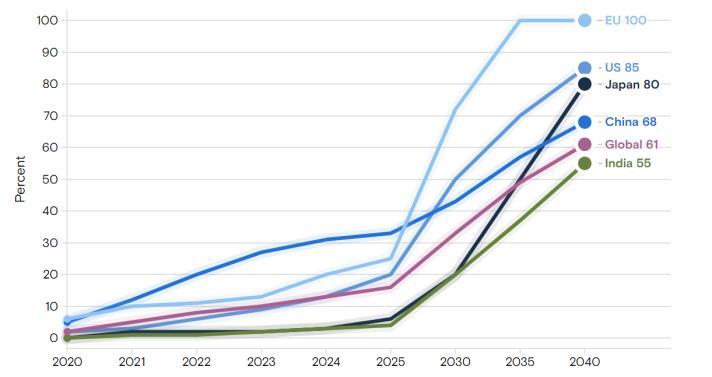
The presence of electric vehicles in the global market has significantly grown over the past decade. According to Gomez-Ramirez et al, only 120,000 electric vehicles were soldgloballyin2012[4].In2021,thisnumberhadsurgedto 6.6million,denotingagrowthofover5400percentinjust 10 years. They further note that by 2021, electric cars accountedfor10percentofglobalcarsales,andmorethan 16.5millionusersweredrivingelectriccars.In2022,electric carsaleswere75 percenthighercomparedto2021sales. TheInternationalEnergyAgency(IEA)assertsthatelectric carsaleshavebeengrowingatanannualrateof60percent andprojectsthatover130millionelectricvehicleswillbein useby2030.AccordingtoAutomotiveDive,electricvehicles willaccountfor62percentto86percentofglobalcarsales by 2030 [5]. Goldman Sachs report projects that by 2040, electricvehicles'annualsaleswillreach73million[6].The report further notes that developed markets, such as the EuropeanUnion,maycompletelygetridoftailpipecarsby
© 2024, IRJET | Impact Factor value: 8.226 | ISO 9001:2008 Certified Journal | Page111
***
International Research Journal of Engineering and Technology (IRJET) e-ISSN: 2395-0056 Volume: 11 Issue: 01 | Jan 2024 www.irjet.net p-ISSN: 2395-0072
2040.Thegraphbelowsummarizestheshifttoelectriccars intheworld'sleadingeconomies.
Increasedadoptionofelectricvehiclesisdrivenprimarilyby twofactors:environmentalconcernsandgovernmentpolicy. Asaforementioned,electricvehiclesarelargelyappreciated for their eco-friendly nature. They not only produce zero emissions,butalsoemissionsrelatedtotheirproductionand runningaresignificantlylow.Besides,thesevehiclesoffer othereco-friendlybenefitssuchaslownoisepollutionand recyclabilityoftheircomponents.Lithiumbatteriesusedin electricvehiclescanbeeasilyrecycled,hencereducingthe environmentalimpactofEVs.
Governmentpoliciestailoredtopromotetheacceptabilityof electric vehicles are also playing a key role in pushing EV saleshigher.Somecountriesareincentivizingtheproduction andpurchaseofelectricvehiclesbyofferingsubsidiesand taxbenefitsonkeyproductionmaterials.Forexample,China hasratifiedcarmakerexemptionsfromconsumptiontaxand vehicleandvesseltaxforproduction.Allelectricplug-incars with a range of over 400 km are eligible for subsidies of about $2000, and those with a range of 300-400 km are eligiblefor$1400subsidiespercar.TheUnitedStatesoffers creditsofupto$7,500percarforbuyers.Thesecreditsare claimablewhenfilingtaxreturns.Othercountries,suchas Canada, India, and the European Union, have similar arrangements. These mechanisms not only make the production of electric cars cheaper and profitable for manufacturers but also make the cars affordable on the buyer'sside.ChargerintensityandreductioninEVbattery costs are other factors that will push for the adoption of electricvehicles.
From the insights above, it is evident that the adoption of electricvehiclesisunstoppable.Inthecomingyears,fossil fuel cars will subtly phase out as electric cars become mainstream. While this shift is commendable, it raises questions about the ability of power supply systems to supporttheincreasedloadfromalargenumberofelectric vehicleschargingsimultaneously.
3. IMPACT OF ELECTRIC VEHICLES ON POWER
AccordingtoareportbytheUniversityofNavarra,in2020, electriccarsconsumedjust80TWhofglobalelectricity[7]. Thisfigureroseto110TWhandisforecastedtogrowtoa range of 525 TWh and 860 TWh by 2030. As people assimilate EV technology, the power demands will proportionally surge. The increased demand for electric power will have various impacts on the power supply systemsacrosstheglobe.Theseimpactswillinclude;
3.1 System overloads
Even though there are arguments that the power supply systems of some countries, such as the United States, are well equipped to handle the power demands of the widespreadadoptionofelectricvehicleswithoutsignificant system updates, simulations indicate that some countries' powersystemsarenotreadytomeettheneedsofelectric vehicles.Forexample,accordingtosimulationsbyGomezRamirez et al., Costa Rica's high-voltage power supply systems may support the short-term electricity demand induced by electric vehicles but may not be sufficient to guaranteemeetinglong-termneeds[4].TheynotethatCosta Rica'spowersupplysystemhasenoughcapacitytomeetthe power needs until 2040. However, beyond this time, the country'spowersystemswillexperienceoverloadproblems, and voltage profiles will become unstable. They further observethatthecountry’smediumvoltagesystemswillonly meetEVpowersupplydemanduntil2030.Beyond2030the systems will become vulnerable to overload issues, and voltageprofileswillbeunhealthy.
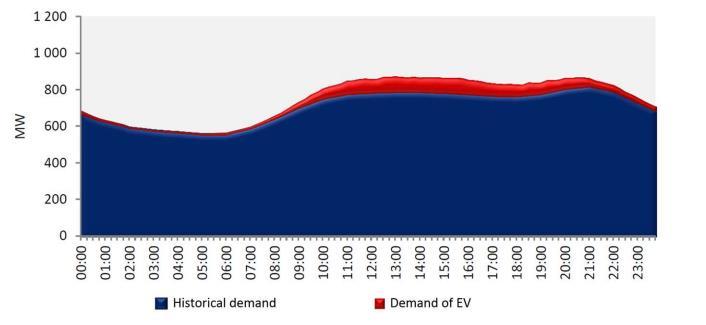
A similar simulation study by Szablowski & Bralewski on Polandyieldedalmostsimilarresults[8].Accordingtothe study,thedemandforpowerresultingfromelectricvehicles wasrelativelyhigh during weekdays ascompared tononworkingdays.Besidespowerdemandvaryingbetweendays, thestudyfoundthatthedemandfluctuatedduringthedayas well.Duringweekdays,thedemandpeakfellintheevening hours,coincidingwiththegreatestdailydemands.Morning hoursalsoregisteredsignificantpowerdemandascompared toafternoonhours.Duringnon-workingdays,thedemand forpowerfromelectriccarswashigherduringafternoons. Thesimulationalsofoundthatpowerdemandforsummer was significantly lower than winter demand. The report assertsthathighenergydemandsduringthewintermaybe aresultofmorepeopleusingcarstocommutetowork.The report estimated that on weekday evenings and weekend afternoons,thedemandwouldincreaseby11to12percent andwoulddropsharplyduringthenight.Inanutshell,the report concluded that widespread assimilation of electric cars in Poland would result in frequent power demand fluctuations.Irregularloaddistributiononthepowersupply wouldproveproblematicforthesystemtohandle.Highload unevenness would adversely affect the use of installed power in the system. Overdemand during peak periods
International Research Journal of Engineering and Technology (IRJET) e-ISSN: 2395-0056 Volume: 11 Issue: 01 | Jan 2024 www.irjet.net p-ISSN: 2395-0072 © 2024, IRJET | Impact Factor value: 8.226 | ISO 9001:2008 Certified Journal | Page112
Figure 1: Shift to EVs in leading markets
would risk issues such as load shedding, and power oversupply during off-peak would risk exploding transformers.Thefigurebelowdemonstratesthesimulated powerdemandfluctuationsinPoland.
AsimilarstudybySuskietalinMaldivesindicatesthatthe growingnumberofelectricvehicleswouldstressthepower supply systems at specific times of the day [9]. The projectionindicatesthatelectricpowerdemandinMaldives' capital,Malé,willgrowfrom71MWin2021to105MWin 2030,representingEVpowerdemandgrowthof4.4percent annually. The report notes that despite the increased pressure,thecapital’spowersystemswouldstillbeableto meetthedemandfortheperiodbefore2030.However,in 2030,theevening peak wouldincreasepowerdemand by over31percent.Theunprecedentedpowerdemandcould resultinloadshedding.ForMalétosustainablyassimilate electric vehicles, it must have plans to upgrade its power supplyinfrastructureinthefuture.
AsimulationdonebyFokuietal.tomeasuretheimpactof electricvehicleadoptiononKenya'spowersupplysystems showedthatthecountry'ssystemsweremoresuitablefor level1chargingsystemsasopposedtolevel2chargers.The simulation projects that while both level 1 and level 2 chargersincreasetheloadtothesupply,theloadimposedby level2chargersissignificantlyhigherthanlevel1chargers [10].Level2chargersarecapableofchargingbatteriesfaster (5hours),buttheyleadtoanincreaseinthenetwork'stotal powerlosses.Onthecontrary,level1chargersarerelatively slower(9hours),butpower lossesarerelativelylow.The simulation also found that level 2 chargers would be installedincommercialparkingareasandwouldbemainly activeduringtheday,coincidingwithnormalpowerdemand duringtheday.Thenormalpowerdemandcoupledwiththe high demand imposed by level 2 chargers on the system would destabilize power supply. In comparison, level 1 chargerswouldbeinstalledathomeandwouldbeprimarily usedduringthenightwhennormalpowerdemandislow. The study concluded that while Kenya's power supply system could support the widespread adoption of electric cars,thesystemwasonlysuitableforlevel1chargers.For thecountrytoinstallbothlevel1andlevel2chargers,the powersystemwouldrequireupgrades.
In summary, increased adoption of electric vehicles will resultinincreaseddemandforelectricpower.Whilemany countries' power supply will be able to cater to this increased demand in the short term, projections indicate that many will struggle in the future. Simulations indicate thatmanycountries'currentpowersupplysystemswillnot beabletosupportelectricvehiclepowerneedsfrom2030. Some studies indicate that power demand fluctuations throughout the day may be challenging for systems to handle.Duringpeak hours,typicallymorningand evening hours, power supply systems may experience unprecedented stress. This may risk systems responding withcautionarymeasuressuchasloadshedding.Duringoffpeak hours,powersupplysystemsmayexperience power surgesinthetransmission.Thiscantriggertransformersto explode.Somestudieshavealsofoundthatsomecountries' powersupplysystemsarenotwell-developedtohandleall types of electric vehicle chargers. Countries in developing regionsarenot well preparedtosupportfast-charging EV chargers.
3.2 Premature aging of components
Contemporarypowersupplytransformersandcomponents weredesignedtohandlenormalcommercialandhousehold demand.Thedesignersoftheinfrastructuredidnotenvisage the systems handling extra fluctuating loads similar to EV charging loads. Charging electric vehicles will cause excessiveandundesirablepeaksinenergydemandthatmay risk damaging transformers and other components of the system. Barros et al. assert that when transformers are exposedtohighambienttemperaturesandloadsabovewhat they were designed to handle transformer windings may overheat, reducing their performance and even rendering them dysfunctional [11]. The lifespan of transformers is affectedbyfactorssuchastemperature,moisturelevels,and oxygencontentincorecomponents.Electricvehiclecharging may not have a significant impact on factors such as moisturelevelandoxygencontent.However,overloadson transformerscansignificantlyraisetemperaturesincritical components.
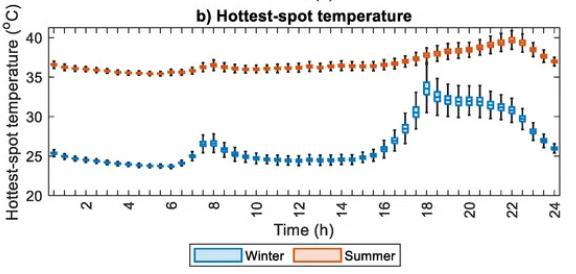
According to simulations by Barros et al., generally, high adoptionofelectricvehicleswillpushthetemperaturesin transformers high. However, the study found that some factors would accelerate the rise of temperatures beyond rated capacity. These factors are seasons and the battery capacitiesofelectricvehicles.Thesimulationsindicatethat despite the increased power demands during winter, transformertemperaturelevelswererelativelylow,hence less damage to components. In contrast, transformer temperatures remained relatively high even in off-peak hoursinsummer.Thisimpliesthatelectricvehiclecharging was more likely to accelerate damage to power supply systemsduringthesummer.Thefigurebelowdemonstrates transformer temperature changes throughout the day in summerandwinter.
International Research Journal of Engineering and Technology (IRJET) e-ISSN: 2395-0056 Volume: 11 Issue: 01 | Jan 2024 www.irjet.net p-ISSN: 2395-0072 © 2024, IRJET | Impact Factor value: 8.226 | ISO 9001:2008 Certified Journal | Page113
Figure 2: EV power demand throughout the day in Poland
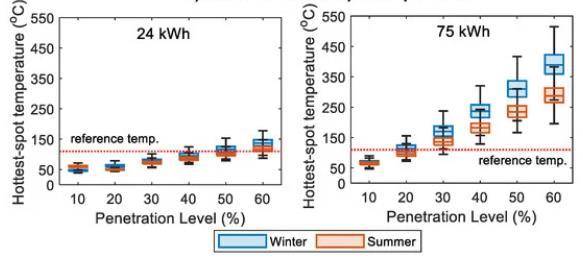
Electricvehicleswith75kWhbatterieschargeathighpower levels,increasingpeakdemand.Thesimulationsindicated thatwitha penetrationrate ofonly20 percent, peak time transformer temperatures would exceed the transformer ratecapacityforbothwinterandsummerseasons.Onthe contrary,forelectricvehicleswith24kWhbatteries,peak timetransformertemperaturesremainwithinmanageable ranges until the penetration rate reaches 50 percent. The figure below illustrates the impact of EV battery size on transformertemperature.
Transformers are one of the most critical and expensive componentsofapowersupplysystem.Forthepowersupply system to function optimally, transformers must be in perfectworkingconditions.Prematureagingoftransformers due to electric vehicle charging will necessitate frequent replacement of transformers and overall system maintenance. This implies that the increased adoption of electric vehicles will translate to additional power supply systemmaintenancecosts.
In a nutshell, the widespread adoption of electric vehicles will accelerate the aging of key power supply system components such as transformers, increasing the maintenance costs of the systems. The rate of aging will likely be more pronounced in summer due to high transformer temperatures during the season. Increased adoptionofelectricvehicleswith morepowerfulbatteries willalsohastentheagingofpowersupplycomponents.
3.3 Increased Vulnerability to cyberattacks
The grid is one of the critical infrastructures commonly targeted by cybercriminals, especially state-sponsored hackers. Typically, cyber attacks on the grid are meant to disruptthepowersupplyinaregionand,asaresult,hinder economicactivities,denyhouseholdsaccesstopower,and causedeathsinhealthcarefacilities.Thesetypesofattacks may also be intended to sabotage target governments by makingthemappear unable toprovidecritical services to their citizens. Increased reliance of vehicles on the grid makespowersupplysystemsevenmorecriticalthanbefore, making them more ideal targets for cyberattacks. For example, in case of a successful cyberattack on the grid, a country'stransportsectorislikelytosufferseverelyifitsEV adoption rate is 100 percent. As the importance of power supplysystemsincreases,theybecomefavoritetargetsfor state-sponsoredattacks[12]
Besides electric vehicles increasing the relevancy of grid attacks to state-sponsored hackers, charging ports act as new avenues for cybercriminals to launch attacks on the grid.Moderncarsareconnectedtotheinternetandarepart of the IoT. EV charging ports are computerized and communicatewithelectricvehicles'computerizedsystems. Consequently,EVchargingportsconnectthegridtotheIoT. Linking the grid to the IoT opens it up to conventional internet-based hackers. Sayed et al. note that electric vehiclesarecyber-physicalattackvectorsagainstthepower grid.Hackerstargetingpowersupplysystemscaneasilyuse electricvehiclesasagentstospreadattackstothegrid[12].
Itisnotjustelectricvehiclesthatposedangertothegrid;the gridalsoposesdangertoelectriccars.AccordingtoRoute Fifty, computerized EV charging systems can be used by attackers to spread attacks on electric vehicles [13] According to the agency, attacks spread through charging systemscanbeusedtolockcarownersoutoftheirvehicles, overcharge car batteries to destroy them, and steal car owners’ payment information. The reliance of electric vehicles on the grid gives cyber attackers a chance to leveragepowersupplysystemstoharmcarowners.
In a nutshell, electric vehicle charging impacts the cybersecuritysafetyofpowersupplysystemsinthreeways. First, it increases the role of power systems in society, making them ideal targets for politically motivated cyberattacks. Two, electric vehicles and charging stations provideanadditionalinterfaceforcyberattackerstoreach powersupplysystems.AccesstothesesystemsviaIoTgives almost every hacker a chance to harm the grid. Lastly, electricvehiclesandchargingsystemsholdvitalcustomer details such as financial information. This makes power supply systems a lucrative channel for trying to steal customerinformation.
Overall, the introduction of EV charging on the grid has various ramifications. One of the major concerns with the
International Research Journal of Engineering and Technology (IRJET) e-ISSN: 2395-0056 Volume: 11 Issue: 01 | Jan 2024 www.irjet.net p-ISSN: 2395-0072 © 2024, IRJET | Impact Factor value: 8.226 | ISO 9001:2008 Certified Journal | Page114
Figure 3: transformer temperature throughout the day in summer and winter
Figure 4: Impact of battery size on transformer size in relation to penetration rate
introduction of EV charging on the grid relates to system overloads, especially during peak hours. Fluctuations in powerdemandsthroughoutthedayinducedbyEVcharging can cause instability in the system. Also, while many countries'powersupplysystems cansupportEVcharging today, these systems may need upgrades in the future, particularly from 2030 and beyond. Failure to upgrade power supply systems risks exposing the systems to frequent blackouts due to load shedding or power oversupply.Prematureagingofsystemscomponentssuchas transformersisanothermajorEVchargingconcern.System overloads will raise transformer temperatures beyond acceptable levels, destroying them. Premature aging of componentswillincreasethemaintenancecostsofsystems. Lastly,EVchargingwilleasehackers'accesstopowersupply systemsandwillalsomakethemattractivetoattackers.Itis paramount relevant parties take necessary steps to proactivelysafeguardthegridfromtheseimpacts.
4. UPGRADING POWER SUPPLY SYSTEMS FOR EV CHARGING
The negative impacts of EV charging on the grid have the potentialtoslowdowntheassimilationofthetechnology. Consequently,thecapacityofpowersupplysystemsmustbe reinforcedinadvancetomitigatetheanticipatedchallenges. These upgrades should focus on managing loads on the system, increasing the power supply, enhancing the resilience of power supply systems, and protecting them from cyber threats. Some of the key upgrades to power supplysystemsare;
4.1 Active regulation of power supply
OneofthekeyimpactsofEVchargingonthegridisthehigh demand for power during peak hours and low demand duringoff-peakhours.Extremepowerdemandsduringpeak hourscancauseloadshedding,henceblackouts.Similarly, power oversupply during off-peak hours can cause transformerstoexplode,causingpowerfailure.Theimpact of fluctuating power demand can only be mitigated by actively regulating voltage levels in supply systems. The voltagelevelsshouldberampedupwhendemandgrowsand loweredwhendemanddiminishes.PowerCompanystates that the secret to effective regulation of power supply is knowingwhenpowerdemandincreasesanddecreases[14]
Regulationofpowersupplycanbeimplementedmanuallyor automated.Manualimplementationcanentailgridoperators increasingandreducingpowersupplymanuallythroughout the day based on the historical data of their grid. Using historical data,operatorscandevelop a model thatshows times of the day to increase power supply and when to reduceit.Forexample,accordingtoETAPsimulations,the EVchargingpowerdemandsurgesintheearlymorningand eveninganddropsfrom10PM.Basedonthesesimulations, voltagelevelsinthegridshouldbeloweredfrom10PMand
increasedfrom5AM.Automatedpowersupplycontrolcan leverage computerized systems that can track power demandinreal-timeandmakepowersupplyadjustments accordingly.Automatedsystemsarethemosteffectivebut can be complex to implement, especially for sophisticated grids.
4.2 Advanced transformer installation
Contemporarytransformersusedinpowersupplysystems werenotdesignedforelectricvehiclecharging.Barrosetal. asserts that while studies show that current transformers can support EV charging up to a certain electric vehicle penetration rate, these transformers are still exposed to overloads beyond their limit and will eventually fail [11] BecauseofthevulnerabilityofcurrenttransformerstoEV charging, experts recommend upgrading of power supply systemswithmoderntransformerscapableofwithstanding peaktimepowerdemands.AccordingtoHammondPower Solutionspublication,conventionaltransformersshouldbe replaced with k-factor rated transformers [15]. K-factor rated transformers are more resistant to heat that stems fromoverloadingandharmoniccurrents.Besides,k-factorrated transformers are designed to handle high neutral currentsproducedbymultiplelevel1and2EVchargers.The agencyfurthernotesthatthegridcanbedividedtohandle differenttypesofEVchargers.Transformerswithak-factor of 4 can be designated to support EV chargers with low loads,likelevel1chargers.Transformerswithk-factor9can bedesignatedforhigh-powerchargerslikelevel2chargers. Theagencyalsodirectstheinstallationoflow-temperature risetransformersinregionswithdailyaveragetemperatures above30°Cormaximumof above40°C.Low-temperature risetransformersusuallyhave220°Cinsulationsystemsand can handle temperatures up to 130°C. Upgrading power supply systems with advanced transformers will reduce long-termmaintenancecostsandstabilizetheperformance ofthegrid.
4.3 Incorporating energy storage
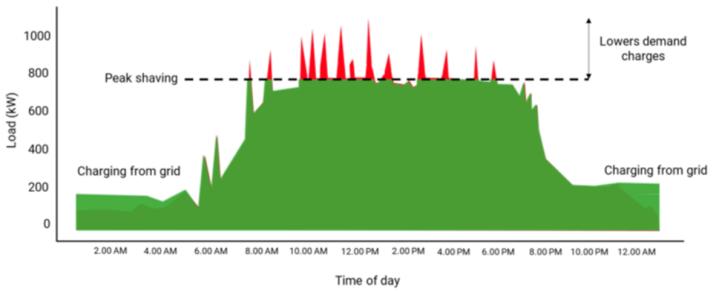
Theproblemofpowersupplysystemsoverloadcanalsobe mitigatedbyincorporatingenergystoragebatteriesinthe grid. Batteries can charge during off-peak hours and be deployedtosupplement the grid during peak hourswhen demand for EV charging exceeds the network's capacity. AccordingtoPower-SonicCorp,acompanythatspecializes inenergystoragesystems,theuseofenergystoragesystems can help reduce the extent of upgrades to power infrastructure[16].Forexample,incorporatingbatterieson thegridreducessystemoverload,henceminimaldamageto the transformers. Other benefits of incorporating energy storagebatteriesinthegridincludeimprovedreliabilityand resilienceofpowersupplynetworks,enhancedEVcharging capacity, and the use of renewable energy sources. The graph below demonstrates the impact of batteries on the grid.
International Research Journal of Engineering and Technology (IRJET) e-ISSN: 2395-0056 Volume: 11 Issue: 01 | Jan 2024 www.irjet.net p-ISSN: 2395-0072 © 2024, IRJET | Impact Factor value: 8.226 | ISO 9001:2008 Certified Journal | Page115
4.4 Incorporating renewable energy sources
According totheCenterfor ClimateandEnergy Solutions, renewables account for only 29 percent of electricity generation globally, with hydropower accounting for 16 percent of this figure [17]. This implies that other renewablessuchassolar,wind,andgeothermalcontribute 13percentonlytothegrid.Windandsolarenergyarethe mostunderexploitedsourcesofenergygloballydespitetheir potentialtopowerhalfoftheglobe by2050.Tocoverthe powerdeficitcreatedbyEVcharging,powersupplyentities canexploitthepotentialofrenewableenergy.Thenumber andsizeofwindfirmscanbeenhanced.Solarfarmscanalso bedevelopedtoharnesssolarenergy.AccordingtoUtilities One, photovoltaic cells can also be installed directly on vehiclesforsolarcharging[18].Thiswillnotonlyreducethe relianceofelectricvehiclesonthegridbutwillalsofacilitate vehicle-to-grid(V2G)technology,enablingvehiclestofeed extrapowerintothegrid,providingmorepowertothegrid. Nearlyall countriesacross theglobehavethepotential to enhancetheirpowerproductionbyinstallingsolarandwind energy.
4.5 Cybersecurity monitoring
Integrationof EVchargingtothe grid makesitamong the favoritetargetsforhackers.Besides,EVchargingactsasan easy interface for hackers to compromise the grid. The increasedsusceptibilityof powersupplysystems tocyber threats necessitates measures to protect the grid from maliciousactors.Oneofthecybersecuritymeasuresthatcan beadoptedintothegridisinstallinganartificialintelligent monitoring system. An AI monitoring system can detect suspicious activities in a network in real-time and block them instantly. This system can also raise alarms for administratorstoact.Otherstrategies,suchaspenetration testing, can be used to proactively detect cyber vulnerabilitiesandmitigatethembeforehackerscanexploit them.
4.6 Coordinated charging
These are methods that aim to manage grid load by controlling the number of electric vehicles charging at a particulartime.Thesemethodsarecontrolledchargingand
time of use (TOU) tariffs. Controlled charging refers to a smartgridapproachthatschedulesthechargingofelectric vehiclesinawaythatlowersaggregateimpactonthegrid. Controlled charging can be implemented by installing an algorithmthatcontrolsEVchargers[19].Time-of-usetariffs areincentivesthataredesignedtoencourageuserstocharge theirelectricvehiclesatoff-peakhours.Time-of-usetariffs includestrategiessuchasreducingchargingcostsduringoffpeakhours.Suskietal.notesthattime-of-usetariffsarean effectivestrategyforpeakshavingandreducingEV-related capacityinvestmentsindistribution[9]
5. CONCLUSION
Electricvehiclesaresubtlyreplacingfossilfuelautomobiles. Whilethisshiftisgoodfortheenvironment,ithasvarious ramifications for the power supply systems. Increased adoptionofelectricvehicleswilladdmoreloadtothegrid. Thismightrendersomesystemsunabletomeetthepower demands,especiallyduringpeakhours,causingblackouts. EV load also tends to fluctuate throughout the day. These extremefluctuationsaredangeroustothestabilityofpower supplysystems.IncreasedEVloadwillalsocausepremature ageing of critical components, increasing the system maintenancecosts.Thiswritinghasalsoindicatedthatthe relianceofvehiclesonthegridmakespowersupplysystems idealtargetsforcybercriminals.Thegridcanbecushioned fromtheadverseimpactsofEVchargingthroughupgrades such as the installation of power regulation systems, increased integration of renewables into the grid, assimilationofenergystoragebatteriesinthegrid,adoption ofmorepowerfultransformers,andintegrationofadvanced cybersecurity technologies in the grid. This writing also recommendstheuseofcoordinatedchargingstrategiesto manageEVloadsonthegrid.
References
[1] UnitedNations(2022),CausesandEffectsofClimateChange. Retrieved From: https://www.un.org/en/climatechange/science/causes-effectsclimatechange#:~:text=Changing%20weather%20patterns%20are%2 0expanding,care%20systems%20to%20keep%20up.&text=Cli mate%20change%20increases%20the%20factors,slums%2C% 20destroying%20homes%20and%20livelihoods
[2] US Department of Energy (2023), Reduce Climate Change. Retrieved From: https://www.fueleconomy.gov/feg/climate.shtml#:~:te xt=Highway%20vehicles%20release%20about%201.5,y ear%20for%20a%20typical%20vehicle.
[3] US Department of Energy (2023), Emissions from Electric Vehicles. Retrieved From: https://afdc.energy.gov/vehicles/electric_emissions.ht ml#wheel
International Research Journal of Engineering and Technology (IRJET) e-ISSN: 2395-0056 Volume: 11 Issue: 01 | Jan 2024 www.irjet.net p-ISSN: 2395-0072 © 2024, IRJET | Impact Factor value: 8.226 | ISO 9001:2008 Certified Journal | Page116
Figure 5: Batteries supplement the grid during peak, reducing stress on the network.
[4] Gómez-Ramírez,G.A.,Solis-Ortega,R.,&Ross-Lépiz,L. A.(2023).Impactofelectric vechicles on power transmissiongrids. Heliyon, 9(11).
[5] AutomotiveDive(2023),EVscouldreach86%ofglobal vehicle sales by 2030. Retrieved From: https://www.automotivedive.com/news/evs-reach-86percent-global-vehicle-sales-2030/695319/
[6] GoldmanSachs(2023),Electricvehiclesareforecastto behalfofglobalcarsalesby2035. Retrieved From: https://www.goldmansachs.com/intelligence/pages/ele ctric-vehicles-are- forecast-to-be-half-of-global-carsales-by-2035.html
[7] University of Navarra (2022), The impact of electric vehiclesinhouseholdelectricity consumption. Initial US figures as a guidance. Retrieved From: https://en.unav.edu/web/global-affairs/the-impact-ofelectric-vehicles-in-household-electricity-consumption.initial-us-figures-as-guidance
[8] Szabłowski, Ł., & Bralewski, P. (2019). Impact of development of infrastructure for charging electric vehicles on power demand in the national power system. Civil and Environmental Engineering Reports, 29(1),66-91.
[9] Suski, Adam, Tom Remy, Debabrata Chattopadhyay, ChongSukSong,IvanJaques,TarekKeskes,andYanchao Li. "Analyzing electric vehicle load impact on power systems: modeling analysis and a case study for Maldives." IEEE Access 9(2021):125640- 125657.
[10] Fokui,W.S.T.,Saulo,M.,&Ngoo,L.(2022,November). ImpactofElectricVehicleChargingontheNairobiAerial DistributionNetwork.In Proceedings of the Sustainable Research and Innovation Conference (pp.17-23).
[11] Barros, A. M., Angelim, J. H., & Affonso, C. M. (2023). ImpactonDistributionTransformerLife Using Electric Vehicles with Long-Range Battery Capacity. Energies, 16(12),4810.
[12] Sayed,M.A.,Atallah,R.,Assi,C.,&Debbabi,M.(2022). Electric vehicle attack impact on power grid operation. International Journal of Electrical Power & Energy Systems, 137,107784.
[13] RouteFifty(2022),EVinfrastructurevulnerabilitiesput cars, the grid at risk. Retrieved From: https://www.routefifty.com/cybersecurity/2022/05/ev-infrastructurevulnerabilities-put-cars-grid-risk/366694/
[14] Power(2020),DrivingChangeontheGrid TheImpact of EV Adoption. Retrieved From: https://www.powermag.com/driving-change-on-thegrid-the-impact-of-ev-adoption/
[15] Hammond Power Solutions (2020), Transformers for PoweringElectricVehicleChargingStations.Retrieved From: https://documents.hammondpowersolutions.com/docu ments/Product%20Info/Technical_Articles/HPSTA2EV-Transformers-for-Powering-EV-ChargingStations.pdf
[16] Power Sonic Corp (2023), The Benefits of Battery Energy Storage for EV Charging. Retrieved From: https://www.power-sonic.com/blog/the-benefits-ofbattery-energy-storage-for-ev-charging/
[17] Center for Climate and Energy Solutions (2023), Renewable Energy. Retrieved From: https://www.c2es.org/content/renewable-energy/
[18] Utilities One (2023), Integrating Solar Power with ElectricVehicleChargingInfrastructure. Retrieved From: https://utilitiesone.com/integrating-solarpower-with-electric-vehicle-charging-infrastructure
[19] Visakh, A., & Selvan, M. P. (2023). Analysis and mitigationoftheimpactofelectricvehiclechargingon service disruption of distribution transformers. Sustainable Energy, Grids and Networks, 101096.
BIOGRAPHIES
Suman Mysore is a seasoned Senior Transmission Engineer with an unwavering commitment to advancing sustainable practices and decarbonization withinthePowerIndustry.Withawealthofexperience spanningover14yearsasaCivilEngineer, hiscareer has been defined by a dedication to pushing the boundaries of innovation in transmission line design andcontributingtothebroadergoalsofenvironmental responsibility.HeisalsoaproudrecipientoftheGlobal Recognition Award, a testament to his contributions and impact in the field of power transmission engineering.
International Research Journal of Engineering and Technology (IRJET) e-ISSN: 2395-0056 Volume: 11 Issue: 01 | Jan 2024 www.irjet.net p-ISSN: 2395-0072 © 2024, IRJET | Impact Factor value: 8.226 | ISO 9001:2008 Certified Journal | Page117