
International Research Journal of Engineering and Technology (IRJET) e-ISSN: 2395-0056
Volume: 11 Issue: 11 | Nov 2024 www.irjet.net p-ISSN: 2395-0072

International Research Journal of Engineering and Technology (IRJET) e-ISSN: 2395-0056
Volume: 11 Issue: 11 | Nov 2024 www.irjet.net p-ISSN: 2395-0072
Suvarna Rajappa1, Lohith S Y2 Swetha J3
1Lecturer, Department of Computer Science & Engineering, Government Polytechnic Sorab, Karnataka, India
2Lecturer, Department of Computer Science & Engineering, Government Polytechnic Sorab, Karnataka, India
3Lecturer, Department of Electronics & Communication, S J (Government ) Evening Polytechnic Bangalore, Karnataka, India
Abstract - Social Internet of Things (SIoT) encompasses things in social network-like structures, thus incurring different security and trust concerns This research proposes the machine learning-based trust model for detecting trusted and untrusted devices in SIoT based on their evaluations of past interactions and reputation scores. Supplementary to manually trained classifiers andMLalgorithms, our suggested modelefficiently detectspossible threats whilegenerating a minimumof false alarms, thus improving SIoT network availability. Evaluation of the model shows positive results and we explain directionsforenhancingtrustinhighlydynamicIoTsettings.
Keywords: Social Internet of Things (SIoT), Trust detection, Machine learning, Device reputation, Anomaly detection, SIoT security, Network security
TheSocialInternetofThings(SIoT)isnotanewconceptintheoverallInternetofThings(IoT)perspective.Thus,devices in SIoT create connections and interact similarly to people interacting in social networks with other people. These connectionscan be basedonvarious factors,including sharedfunctionalities, commonownership,collaborativetasks,or physicalproximity.
TrustdetectioninSIoTiscriticalbecauseitinvolvesdeterminingthetrustworthinessoftheseinterconnecteddevicesand their interactions. Trust is central to ensuring security, reliability, and privacy within SIoT networks, where devices are expected to work together and share sensitive information. Machine Learning (ML) is increasingly utilized in trust detection because of its ability to analyze complex patterns, identify anomalies, and make predictions based on vast datasets.
This study explores how ML can be applied to trust detection in SIoT to enhance the security and reliability of these networks.Itaimstodevelopandvalidateatrustdetectionmodelthatcanevaluatethetrustinessofdevicesinadynamic andsocial-structuredIoTenvironment.
Key challenges and their real-world implications
1. Dynamic and Autonomous Interactions: IncontrasttoconventionalIoT,SIoTnodesactivelyconnectanddisconnect withreceivingnodesbasedonsociallikerelationships(e.g.,tasksthatarebeingworkedontogether,sharedownership). This gives variability to the device interactions, and therefore it becomes challenging to reliably determine the trustworthiness of devices. Real-world implication: The increase in possibilities for untrusted devices to enter critical systemorsensitivedatawithoutoutsidemonitoring.
2. Complexity of Relationship-Based Trust: Traditional social networks estimate the trust using other people’s interactionsandthisisrelativelystatic.TheSIoTtrustapproachmustincludedevicebehaviorpatternsaswellascontextbasedinteractionsamongthesedevices,whichconstantlychangeassomedevicesjoinorleavethenetworkortransform their roles in the network. Real-world implication: Trust assessments could become stale in a short order and therefore createsecuritybreachesincriticalareasthatincludehealthcaresmartcitiesamongothers.
3. High Scalability and Real-Time Requirements: Hence, trust models require scalability to accommodate a large numberofinteractionsgeneratedfromincreasingdensitiesofdevicesformingSIoTnetworksatinteractiverates.Itisfar fromstraightforward,especiallyinIoTwheredevicesaremostlyknowntoonlyexchangedatawitheachother.Real-world
International Research Journal of Engineering and Technology (IRJET) e-ISSN: 2395-0056
Volume: 11 Issue: 11 | Nov 2024 www.irjet.net p-ISSN: 2395-0072
implication:Ifscalabilityisnotproperlyaddressedanorganizationmayencounter somecongestionwithinthenetworks andhenceimpactonthesystem'sabilitytorespondappropriatelywithinaparticularcriticalmission.
4. Privacy and Data Integrity Concerns: Various devices within SIoT can exchange information across different networks,whichisdamagingforthedataprivacyanddataintegrity.Typically,IoTsystemsarereferredtoassystemsthat controlthedisseminationofproduceddataonlywithinaLocalAreaNetwork,whileSIoTallowsforinformationexchange. Real-world implication: In trust failures or breaches in SIoT, private data can be revealed or device integrity violated in areassuchasbankingorsmarthome.
5. Increased Susceptibility to Malicious Attacks: Since SIoT architecture is network-based and strongly connected, it calls into question social engineering-like attacks, in which a malicious device takes advantage of a trust connection and disseminates viruses or steals information. Real-world implication: Trust-based attacks in SIoT can spread from one networklayertoanother,escalatingtheeffectsandmightcausetheinabilityofsignificantstructuresornumeroussmart applications.
ThisconceptiscalledSocialInternetofThings(SIoT),whichmakesashiftfromIoTtosocialnetworkingparadigm,where devices interact based on the tasks, distance, and ownership factors. However, these dynamic relationships heighten securityrisks,especiallyconcerningtrustworthiness.
Marche et al. [1] explore SIoT device profilingand emphasizethe need for adaptive trust models that account for device behaviorsandinteractions.Theauthorsproposemethodsforunderstandinghowsocialrelationshipscaninfluencedevice trust, setting a foundation for trust-based SIoT models. Dhelim et al. [2] introduce artificial social intelligence, which applies social relationship metrics to enhance SIoT trust, addressing how social intelligence can manage device cooperationandmaliciousbehavior.
Several worksfocusontrustmanagement frameworks. Marcheand Nitti[3] presenta detectionsystem for trust-related attacks,employingmachinelearningtodifferentiatetrustedfromuntrustedinteractions.Thisapproachprovidesinsights intotrustbehaviorandpossiblevulnerabilitiesinSIoT.Atzorietal.[5]furtheradvancethisbyexaminingsociocastandthe formation of social links between smart devices, proposing algorithms to strengthen trust relationships among SIoT devices.
A significant body of work also highlights the potential of machine learning to enhance SIoT security. Khelloufi et al.[6] discuss service recommendation systems within SIoT that use social relationships as a basis for enhancing device cooperationandidentifyinganomalies,demonstratinghowmachinelearningcanfacilitatereliableinteractionsincomplex networks.
Together,thesestudiesunderscoretheneedforrobust,adaptivetrustmodelsinSIoTandillustratehowmachinelearning methods can address dynamic, socially driven trust requirements in IoT environments. This paper builds on these foundationsbyproposinganenhanced,hybridtrustdetectionmodeltailoredtoSIoT'suniquedemands.
In the Social Internet of Things (SIoT), trust detection is essential for ensuring reliable and secure interactions between devices. Existing systems use machine learning techniques to evaluate trust based on direct interactions (e.g., communicationhistory)andindirectinputslikerecommendationsfromotherdevices.Supervisedlearningmodelssuchas Decision Trees, SVMs, and Random Forests are commonly employed to classify interactions as trustworthy or untrustworthy.
MoreadvancedsystemsusedeeplearningtechniqueslikeRNNsorLSTMstocapturethetemporaldynamicsoftrustover time. Additionally, reputation-based models aggregate behavioral data to predict trust levels. In hybrid approaches, reinforcementlearningisusedtocontinuouslyadapttrustmodelsbasedonevolvingdevicebehavior,enhancingboththe accuracyandscalabilityoftrustdetectioninSIoTnetworks.
International Research Journal of Engineering and Technology (IRJET) e-ISSN: 2395-0056
Volume: 11 Issue: 11 | Nov 2024 www.irjet.net p-ISSN: 2395-0072
A. Data Pre-processioning
During this stage, the chaste data encounters sundry pre-processioning stages to ascertain its adequacy for prototype training.Stagesnormallyencompassmedianembellishmentordormantabsentvaluesmaybeimplemented.
B Feature Engineering
Effectivefeatureengineeringwascrucialtoenhancemodelperformanceintrustdetection.Keystepsincluded:
1. Feature Selection:Identifiedrelevantattributessuchasinteractionfrequency,dataexchangevolume,reputation scores,andanomalyindicators.
2. Correlation Analysis:Usedtoremoveredundantfeaturesandimproveefficiency.
3. Feature Importance Ranking:LeveragedtechniqueslikeRandomForesttoprioritizeimpactfulfeatures.
4. Normalization:Standardizednumericalfeaturestoensureuniformityacrossmodels.
5. Interaction Features: Engineered metrics like trust transition scores and contextual interaction measures to capturedynamicrelationships.
6. Dimensionality Reduction:AppliedPCAtoreducedatasetcomplexitywhileretainingkeyinformation.
C. Prototypic Selection
1.K-Nearest Neighbors (KNN):
KNNalsousesthemajorityclassofthenearestdatapointswhichmakesthealgorithmusefulinidentifyingtheviabilityof trust-basedrelations.Becauseoftheseproperties,itcanbeusedforabinarytaskofdifferentiatingbetweentrustlevelsof devicesbytheirproximityinthefeaturespacewhichisusefulforpracticalSIoTapplicationswithlimiteddatavolumein real-time
2. XGBoost (Extreme Gradient Boosting):
XGBoostisauniquekindofensemblelearningmodelthatboostsothermodelsgraduallydecreasingtheerrorrateofthe modelitself.Interpretabilityisalsoanadvantageduetoitsperformancewithstructureddataandcapabilityofidentifying diverse patterns which is significant for SIoT since trustworthiness could vary depending on the sophisticated or simple devicebehaviorsandinteractionsXGBoostperformswellwithsubtlesignalsthatsuggestuntrusteddevices.
3. Logistic Regression:
Alinearmodelforresponsethatisbinaryinnature,thelogisticregressioniseffectiveincomputingprobabilitiesofbinary outcomes of either trusted oruntrusted.Efficiencyand interpretability are advantagesinSIoTsincesimpleandaccurate predictionsaremoreeffectiveforguaranteeingsafedeviceinteractionwithminimalresourceconsumption.
4. Decision Tree:
Simpledecisionrulesareusedincreatingdivisionsinthefeaturespacemakingiteasiertounderstandandthusinterpret thelikelihoodsgivenfortrust.ThismakesitrelevanttoSIoTbecauseitcreatesanunderstanding,thatisrecognizableby thesmartusers,ofwhysomedevicesaretrusted,andothersarenot,whichis importantinbuildingthetrustnecessaryin highlyinterconnectedsystems.
5. Random Forest:
An extension of multiple decision trees with a random selection of features, Random Forest has a lesser chance of overfitting becauseitcomputesanaverageoftheresult.ThisiswellsuitedtoSIoT,where thetrustworthinessofdevices needstobeevaluatedintermsofarangeofdevicesandinteractions;themodelwouldofferstable,accuratepredictionof trustworthiness,despitepossiblyerraticdevicebehavior.
International Research Journal of Engineering and Technology (IRJET) e-ISSN: 2395-0056
Volume: 11 Issue: 11 | Nov 2024 www.irjet.net p-ISSN: 2395-0072
Everyselectedalgorithmistrainedonthereprocesseddatasetusingappropriateparametersandhyperparametersettings. Modeltraininginvolves:
Splittingthedatasetintotrainingandvalidationsetstoevaluatemodelperformance.
Adjustingworkingsparametersbyemployinggridorrandomsearchtofindthebestconfigurationofeachalgorithm.
Trainingthemodelsusingthetrainingdatasetandtestingtheperformanceofthemodelonthevalidatingsettoreduce theriskofovertraining.
Thetrainedmodelsareevaluatedusingvariousmetricstoassesstheirperformanceintrustdetection.Commonevaluation metricsinclude:
Accuracy:Theproportionofcorrectlyclassifiedinstances.
Precision:Theproportionoftruepositivepredictionsamongallpositivepredictions.
Recall:Theproportionoftruepositivepredictionsamongallactualpositiveinstances.
F1-score:Themeanaveragebetweenprecisionandrecall,thatgivesafairviewofthemodelperformance.
TheareaundertheReceiverOperatingCharacteristic(ROC)Curve(AUC-ROC):Tobeprecise,themeasurethatcompares thedistributionoftheautoencoderforthepositiveandthenegativeclasseswithrespecttodifferentthresholdvalues.
Cross-validationisusefulwhendealingwithtrustdetectionintheSIoTbecauseitincreasestheintegrityoftheMLmodels. Specifically, different folds of the dataset distinct from each other but collectively represent source data let crossvalidation guarantee that the model produced is generally great within distinct situations and not only overfits to the dataset.
Inthecontextoftrustdetection,thisprocessisparticularlycrucialbecause:
Variability in Device Behavior:SIoTenvironmentsaredynamic,withdevicesexhibitingdiversebehaviorsbasedon contextual factors. Cross-validation helps account for this variability, ensuring that the model can generalize well to unseeninteractions.
Imbalanced Datasets:Trustdetectionoftendealswithimbalanceddatasets,wheretrustedinteractionssignificantly outnumberuntrustedones.Cross-validationhelpsinevaluatingbothclassesofamodelandasaresultgivesabetter ideaabouttheidentificationofuntrusteddevices.
Avoiding Overfitting: Cross-validation splits the same data set in different ways for model validation and by doing this, validate if the model over fitting where the model achieves high accuracy on training data but low accuracy on test data. This is especially important in SIoT architectures where the ability to make almost real-time decisions on trustlevelsisofparamountimportance.
Confidence in Predictions:Cross-validationprovidesinsightsintothemodel'sstabilityandreliabilitybygenerating multiple performance metrics. This confidence is vital for deploying trust detection systems in real-world SIoT applications,wheresecurityisparamount.
Theresultsobtainedfrommodeltrainingandevaluationareinterpretedtodrawmeaningfulinsightsandconclusions:
Comparison of performance: In trust management, the performance of various algorithms is established by comparing evaluationmetricstoselectthepropertactic.
International Research Journal of Engineering and Technology (IRJET) e-ISSN: 2395-0056
Volume: 11 Issue: 11 | Nov 2024 www.irjet.net p-ISSN: 2395-0072
Analysis of strengths and weaknesses: The properties of each algorithm are presented along with its advantages and possibleproblems,includinginterpretability,scalability,andcomputationalresourcesneededtorunit.
Practicalimplications:Thefindingsdevelopedaresummarizedandthepossibleapplicationareasandsituationswheretrust detectionintheSocietyofIoTThings(SIT)canbevaluableareoutlined.
TheevaluationoftheproposedmachinelearningmodelsfortrustdetectioninSIoTrevealedsignificantinsightsintotheir performance:
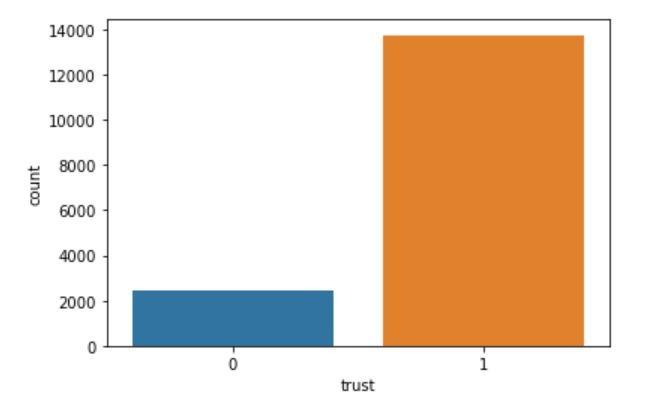
ThebarchartinFigure1representsthedistributionoftrustlabels,withtwocategories:"0"(representinguntrusted)and "1" (representing trusted). The count on the y-axis shows the number of instances for each label. The "1" (trusted) categoryhassignificantlymoreinstances(around14,000)comparedtothe"0"(untrusted)category,whichhasfewerthan 2,000instances.Thisindicatesanimbalanceddataset,wheretrustedinteractionsaremuchmorefrequentthanuntrusted ones.
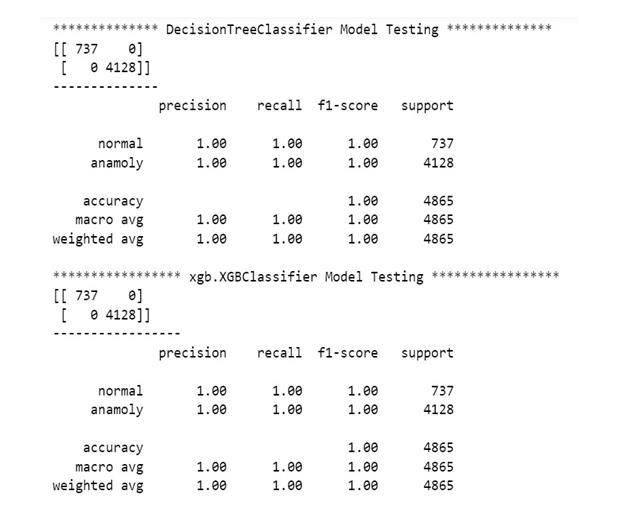
The models achieved high accuracy, precision, recall, and F1 scores, indicating the robust classification of trusted and untrusteddevices.Amongthemodels,XGBoostperformedbest,effectivelycapturingsubtlepatternsindeviceinteractions.
Figure 2 illustrates the precision and recall of the models, highlighting their ability to identify true positives accurately (precision) and detect all actual positives (recall). XGBoost demonstrated the highest values for both metrics, followed closelybyRandomForest,indicatingthesemodels'reliabilityintrustdetection.LogisticRegression,whileslightlylower, offered consistent performance with minimal computational complexity, making it suitable for resource-constrained environments.
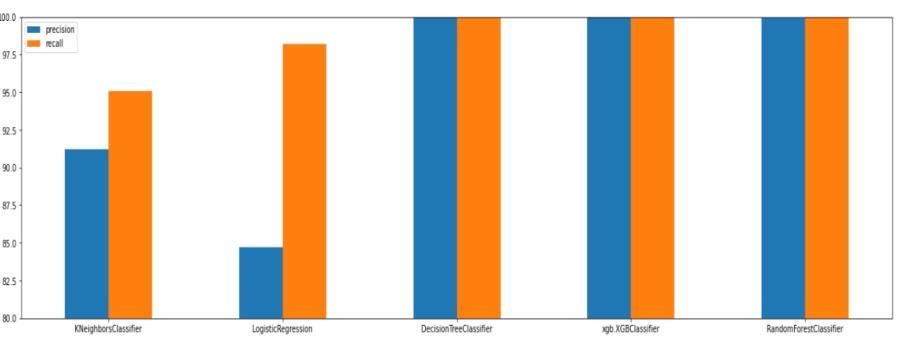
Fig2.precisionandRecallcomparision
International Research Journal of Engineering and Technology (IRJET) e-ISSN: 2395-0056
Volume: 11 Issue: 11 | Nov 2024 www.irjet.net p-ISSN: 2395-0072
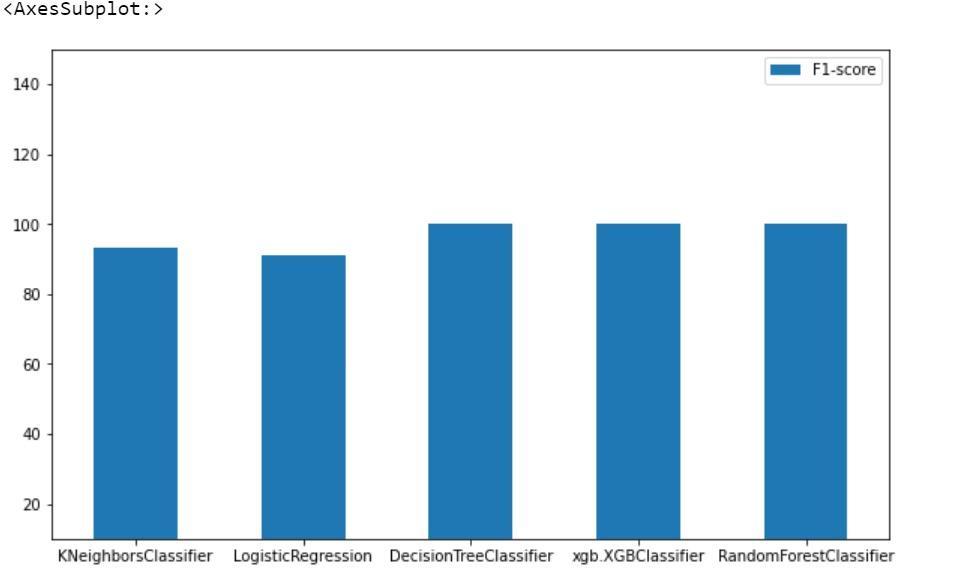
Figure 3 displays the F1 scores, which provide a balance between precision and recall. XGBoost led with the highest F1score,confirmingitssuperiorcapabilitytomaintainaccuracyevenwithimbalanceddatasets.RandomForestalsoshowed strongperformance,whereasLogisticRegressionmaintainedcompetitiveresultswithlowercomplexity.
Classification Report
International Research Journal of Engineering and Technology (IRJET) e-ISSN: 2395-0056
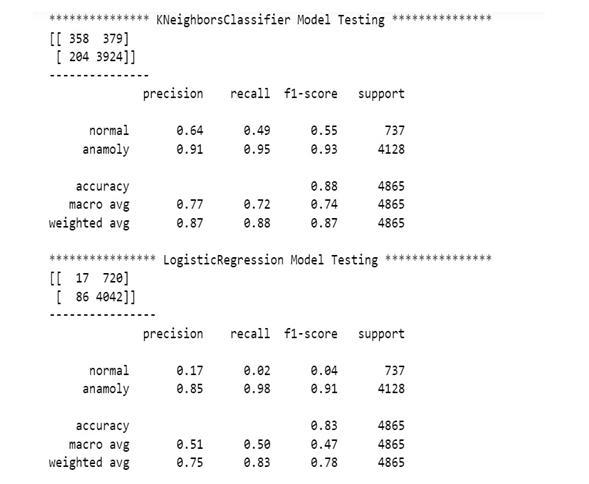
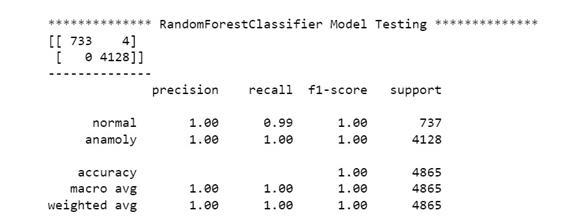
This research addresses the critical need for robust trust detection in the Social Internet of Things (SIoT), where traditional IoTandsocial network approachesfall short. Byleveragingmachinelearning, our model effectivelyidentifies trustedanduntrusteddevices,mitigatingsecurityrisksindynamicSIoTenvironments.Experimentalresultsconfirmhigh accuracywithminimalfalsepositives,demonstratingthemodel’spotentialtostrengthennetworkreliability.Futurework will focus on enhancing scalability and incorporating real-time adaptability, paving the way for secure, resilient SIoT frameworkscrucialfordiverseapplications,fromsmartcitiestohealthcare.
Volume: 11 Issue: 11 | Nov 2024 www.irjet.net p-ISSN: 2395-0072 © 2024, IRJET | Impact Factor value: 8.315 | ISO 9001:2008 Certified Journal | Page656
International Research Journal of Engineering and Technology (IRJET) e-ISSN: 2395-0056
Volume: 11 Issue: 11 | Nov 2024 www.irjet.net p-ISSN: 2395-0072
The future of trust detection in Social IoT (SIoT) using machine learning presents significant opportunities for enhancement and innovation. As IoT networks grow in size and complexity, there will be a greater demand for more scalable and accurate trust detection mechanisms. One promising direction is the integration of edge computing with machine learning for distributed trust evaluation. This would allow devices to perform trust analysis locally, reducing latency and dependency on centralized systems while ensuring that trust decisions are made in real-time. Edge-based trustdetectioncanalsoenhanceprivacybylimitingtheexposureofsensitivedatatoexternalservers.
Explainable AI (XAI) isanotherkeyareaoffuturedevelopment.Trustmodelsthatareinterpretableandtransparentwill become increasingly important in SIoT. Current machine learning models, particularly deep learning ones, are often viewed as black boxes, making it difficult to understand how trust decisions are made. By integrating explainability techniques into trust detection systems, we can provide users and devices with clear justifications for trust scores, enhancingtrustinthesystemitself.XAIcanhelpdetectbiasesintrustevaluationsandensurethatdecisionsaremorefair andreliable.
In addition, privacy-preserving trust detection methods will be critical for the future. With the increase in interconnected devices and sensitive data being shared across SIoT networks, ensuring secure trust evaluations while maintaining data privacy will be a priority. Techniques like federated learning and differential privacy can be incorporated to allow decentralized learning of trust models without sharing raw data. This can foster greater collaborationamongdeviceswhilemitigatingrisksassociatedwithdatabreachesandmisuse.
Lastly, future systems will likely involve adaptive trust models that can evolve dynamically in response to changing network conditions and behavior patterns. Trust is not static; it fluctuates based on context, new information, and interactions.Machinelearning modelsthatincorporate reinforcement learning oronlinelearning techniques willbeable to continuously update and refine trust evaluations in real time. This dynamic approach will enable more robust and resilient trust detection, especially in highly fluid environments where devices are constantly joining and leaving the network.
[1]Marche,C.,Atzori,L.,Pilloni,V.,&Nitti,M.(2020).HowtoexploittheSocialInternetofThings:QueryGenerationModel andDeviceProfiles’Dataset.ComputerNetworks,174,107248.https://doi.org/10.1016/j.comnet.2020.107248
[2] Dhelim,S.,Atzori,L.,Khelloufi,A.,&Ning,H.(2021).IoT-enabledsocialrelationshipsmeetartificialsocialintelligence. IEEEInternetofThingsJournal,8(24),17817-17828.https://doi.org/10.1109/JIOT.2021.3097400
[3]Marche,C.,&Nitti,M.(2020).Trust-relatedattacksandtheirdetection:AtrustmanagementmodelfortheSocialIoT. IEEETransactionsonNetworkandServiceManagement,18(3),3297-3308.https://doi.org/10.1109/TNSM.2020.3007033
[4] Atzori, L., Iera, A., &Morabito, G. (2017). Sociocast: A new network primitive for IoT. IEEECommunications Magazine, 55(11),51-57.https://doi.org/10.1109/MCOM.2017.1700203
[5]Atzori,L.,Campolo,C.,Da,B.,Girau,R.,Iera,A.,Morabito,G.,&Quattropani,S.(2019).Smartdevicesinthesocialloops: Criteria and algorithms for the creation of the social links. IEEE Access, 7, 153236-153252. https://doi.org/10.1109/ACCESS.2019.2951824
[6] Khelloufi, A., Ning, H., Dhelim, S., Qiu, T., Ma, J., Huang, R., & Atzori, L. (2020). A social relationships-based service recommendation system for SIoT devices. IEEE Internet of Things Journal, 8(10), 8118-8129. https://doi.org/10.1109/JIOT.2020.2972881