
International Research Journal of Engineering and Technology (IRJET) e-ISSN:2395-0056
Volume: 11 Issue: 11 | Nov 2024 www.irjet.net p-ISSN:2395-0072

International Research Journal of Engineering and Technology (IRJET) e-ISSN:2395-0056
Volume: 11 Issue: 11 | Nov 2024 www.irjet.net p-ISSN:2395-0072
1Nagesh Sarade, 2Abhijit Chorade, 3Prathamesh Patil, 4Laxman Alashetti , 5Digvijay Jadhav , 6P.A.Satarkar
1,2,3,4,5UG Students, Department of Computer Science and Engineering, SVERI’s College of Engineering Pandharpur, Maharashtra, India
6Assistant Professor, Department of Computer Science and Engineering, SVERI’s College of Engineering Pandharpur, Maharashtra, India
Abstract Social media platforms are widely used for sharing ideas and content globally. However, they face challenges such as the spread of misinformation, which poses a threat to democracy. One major issue is the presenceof fakeaccountsandinadequateregulation.To address these problems, it's proposed to verify social media accounts using real identities. Blockchain technology offers a solution by securely storing digital identities. When creating a social media account, users wouldneedtoverifytheiridentitywithadatabase.This database would then share a unique identifier with the social media platform, preventing the creation of multipleaccountsbyasingleperson.
Keywords Fake news, Social media, Blockchain, Digitalidentity.
In the realm of digital communication, social media standsasa transformative force, offeringinternet-based platforms for mass personal interaction and content generation, as defined by Carr and Rebecca [1]. Early precursors such as Usenet, crafted in 1979 by Tom Truscott and Jim Ellis, paved the way for online idea sharing.However,theseplatformsfacedlimitedadoption due to factors like restricted internet access and low literacyrates.
The advent of Web 2.0 in 2005 heralded a new era of internet innovation,usheringina diversearray ofsocial media platforms that empowered users to create and disseminate content [2]. Web 2.0 introduced groundbreaking technologies like Adobe Flash, RSS, and AJAX, fueling the development of more dynamic and engagingsocialmediaexperiences[5].
Today, social media has become an integral facet of contemporary life, particularly for younger generations raised in a digital milieu replete with electronic devices and online networking platforms [3]Despite a stabilization in growth rates observed since 2013, the globaltallyofsocialmediauserssurgedtoanestimated 3.81 billion in 2020, representing a 45% upsurge from 2015 and a remarkable 95% leap from 2008. This consistent growth trajectory, averaging an annual
increase of 9.8%, underscores the enduring relevance andimpactofsocialmediainmodernsociety.
The rapid evolution of social media platforms has transformed how individuals communicate and share information. However, this shift has introduced significant challenges, particularly regarding misinformation, identity theft, and the proliferation of fake accounts. Numerous studies have explored these issuesandproposedsolutions,emphasizingtheneedfor robustdigitalidentityverificationmechanisms.
1. Carr, Caleb T., and Rebecca [1] Social Media and Misinformation
The rise of social media has facilitated the spread of misinformation, which can undermine public trust and democraticprocesses.CarrandRebecca(2015)highlight that social media, while empowering users to share content, has become a breeding ground for false information ,particularly during significant events such as elections. The dissemination of fake news through social media can skew public perception and influence decision-making(Fieseler et al.,2010).The roleofsocial media bots in manipulating online discourse has been documented, with studies showing extensive bot intervention during the 2016 U.S. elections (Kwon et al., 2016).
2. Fieseler, C., Fleck, M., Meckel, M [2] Digital Identity Verification
To combat the challenges posed by fake accounts and misinformation, researchers have proposed various digital identity verification solutions. One prominent approach is the use of bio metric data, such as fingerprints, to authenticate users.Thismethod ensures that each account corresponds to a verified individual, thereby reducing the potential for fake accounts (Yu et al.,2018). The integration of blockchain technology into digital identity verification systems has garnered attention due to its decentralized nature and security features. Blockchain can store digital identities securely, making it difficult for unauthorized users to manipulate orcreatefalseidentities(CanKaya,2016).
International Research Journal of Engineering and Technology (IRJET) e-ISSN:2395-0056
Volume: 11 Issue: 11 | Nov 2024 www.irjet.net p-ISSN:2395-0072
3. Anderson, Monica, and Jingjing Jiang.[3] Blockchain Technology Blockchain technology offers a promising solution for digital identity verification. Its immutable nature ensures data integrity, while cryptographic hashing enhances security (Shabir etal., 2016). Various studies have explored the potential of blockchain in identity management ,arguing that it can provide a secure, decentralized framework for verifying users’ identities (Griffiths, 1999). By leveraging a blockchainbased system, social media platforms can enhance user trust and reduce the risks associated with identity theft andfraud.
4. Kwon, H.E., So, H., Han, S.P., Oh, W.[4] Social Media AddictionandUserBehavior
The addictive nature of social media is another critical area of research. Studies indicate that excessive use of socialmediaplatformscanleadtodetrimentaleffectson mental health, particularly among younger users (Kuss Griffiths, 2017). The design of social media platforms often exploits users’ psychological vulnerabilities, leadingtoincreasedscreentimeanddiminishedreal-life interactions. This phenomenon highlights the need for responsibledesign practices andregulatory oversight to protectusersfrompotentialharm.
The primary objective of implementing blockchain technologyforsocial media authenticationis to createa more secure, reliable, and user-centric authentication systemthatenhancesuserprivacywhileminimizingthe riskoffraudandidentitytheft.Thespecificobjectivesof thisprojectinclude:
1.ToEnhancingSecurityandPrivacy
2.ToEmpoweringUsers
3.ToReducingFraudandMisinformation
4.ToDecentralizingIdentityManagement
5.ToStreamliningUserExperience
6.ToPromotingInteroperability
IV. PROBLEMS IN SOCIAL MEDIA
While social media platforms offer avenues for sharing photos and videos, they also serve as conduits for disseminating content containing violence and negativity, which can significantly impact the behaviour of children growing up in a mobile phone-centric environment.Additionally,usersspendanaverageof2.5 hours per day on social media, diverting their attention from specific activities and potentially leading to addiction[8].
Griffiths (1999) distinguishes internet addictions as beingaboutaddictionsontheinternetratherthanbeing addictedtotheinternetitself[9].Individualscanbecome addicted to various internet activities such as gaming, content sharing, shopping, and social networking. While social media serves communication and educational purposesformostusers,a subset developsproblematic, uncontrollable,andaddictivebehaviour
B.Fakenews
While social media facilitatesinformation sharing, some users exploit it to disseminate fake news. Individuals create and spread fake news to boost views, likes, and shares, while others use fake accounts and groups to influence society. Many malicious accounts, including fakeaccounts,areoperatedbysocialmediabots,cyborg users, and trolls [4]. Social media bots, driven by computer algorithms, engage in negative activities like targeted digital bullying and spreading fake news. Studieshaveshown extensive bot interventioninonline debates, such as during the 2016 U.S. election, where millions of Twitter bots were used to manipulate polls and spread fake news, potentially impacting public sentimentanddecision-making[2]
C.EchoChamberEffect
The echo chamber effect occurs when individuals seek information that aligns with their existing beliefs, reinforcing their viewpoints without exposure to counterarguments[7]. Like-minded individuals form groups and are exposed to similar news feeds on social media, leading to homogeneous communities. Cyborgs and social bots exploit these groups to propagate fake news, leveraging psychological factors like social credibility and frequency heuristic to influence belief in fake news. Homogeneous communities contribute to social polarization and the widespread dissemination of fakenews[1].
D.SocialMediaCompanies
Social media companies profit by selling targeted advertisements based on user data and engagement metrics. To increase profits, tech companies employ machine learning models to optimize news feeds and increase user engagement. Recommendation systems play a significant role in social media addiction by tailoringcontenttousers'interests[1]
However, these systems can also facilitate the spread of fake news by targeting users with similar interests.[4] Whilevariousmethodsandtechnologiescandetectfake news, robust solutions to prevent its spread remain elusive. A blockchain-based digital identity verification
International Research Journal of Engineering and Technology (IRJET) e-ISSN:2395-0056
Volume: 11 Issue: 11 | Nov 2024 www.irjet.net p-ISSN:2395-0072
systemisproposedasapotentialsolutiontoaddressthis challenge[5]
Digital identity verification involves authenticating the identity of individuals registering for social media platforms[9]. The implementation of this system is contingent upon government policies regarding social media and identity verification. By verifying users' real identities stored in government databases, social media companiescanenhancesecurityandtrust[3].
A.ElementsofDigitalIdentity
Distinct elements are employed for digital identification to bolster system robustness. These elements include identifiers (e.g., passport numbers), attributes (e.g., height, weight), and personal identifiers (e.g., date of birth), which remain unchanged over time. Identifying elements may vary based on government policies. Examples of identifiers include fingerprint raw data, photos, and passport numbers, while attributes encompassdetailslikedateofbirth,height,andaddress Fingerprintdata,beinguniquetoindividuals,servesasa primaryidentifier.
B.DigitalIdentityDatabase
Databases play a crucial role in managing stored data anditspurpose.DatabaseManagementSystems(DBMS) haveevolvedtoaccommodatevastamountsofdata,with factors such as data model, consistency, security, and access influencing DBMS selection. While data models may vary, relational databases are commonly utilized, with SQL databases accounting for a significant portion ofglobaldatastorage[6].
C.LimitationsofSQLDatabase
Despite its advantages such as normalization and data integration, SQL databases are susceptible to vulnerabilities like SQL injection and administrative weaknesses. Data security is paramount for protecting records and resources from cyber threats. While encryption and administrative controls mitigate risks, SQL databases may not be suitable for digital identity verification systems due to centralized vulnerabilities andlimitationsinhandlingbigdata[10]
D.BlockchainforDigitalIdentityVerification
Blockchaintechnologyoffersadecentralizedsolutionfor storing digital identities, mitigating concerns associated with centralized databases. Its immutable nature ensures data integrity, while cryptographic hashing enhancessecurity.
Private blockchains, despite vulnerabilities, offer advantages such as reduced power consumption and enhanced security through cryptographic algorithms. The decentralized and encrypted nature of blockchain technologymakesitanidealsolutionforsecuringdigital identities, with its growing network size bolstering data immunityagainstsecuritybreaches[3].
1.UserCreationofSocialMediaID:
Theprocessbeginswhenauserdecidestocreateanew social media account. This could be on any platform suchasFacebook,Twitter,orInstagram.
1. VerificationRequestfromSocialMedia
Platform: Once the user initiates the account creation process, the social media platform requests verification from the government's digital verification system. This step ensures that the user's identity is authenticated usingreliablesources[6].
2. User Identification: The user is directed to the verificationsystemportal,wheretheyarerequiredto provide their identifier, which in this case is their fingerprint[2]
1 System Design
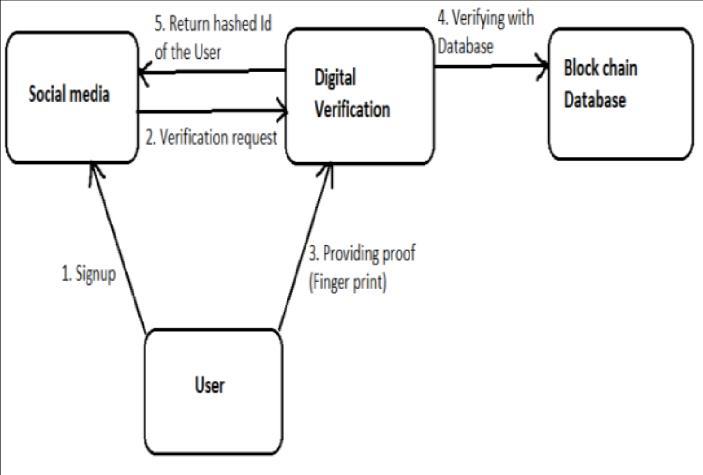
3. Fingerprint Verification with Blockchain Database: The system then verifies the provided fingerprint data with the blockchain database. The blockchain database containsencryptedrecordsofusers'identities,ensuring theirintegrityandsecurity[9]
4. Return of Encrypted ID: If the system finds a match betweentheprovidedfingerprintdataandtherecordsin the blockchain database, it generates a hashed (encrypted) ID for the user. This encrypted ID is then returnedtothesocialmediaplatform.[4]
International Research Journal of Engineering and Technology (IRJET) e-ISSN:2395-0056
Volume: 11 Issue: 11 | Nov 2024 www.irjet.net p-ISSN:2395-0072
Overall,thisworkingmodelensuresthatusers'identities aresecurelyverifiedusingbiometricdataandstoredina tamperproof blockchain database. This enhances security, reduces the risk of identity theft, and helps in maintaining the authenticity of user accounts on social mediaplatforms.[10].
Algorithms
1.Secure Shell (SSH) Algorithm
Steps:
1. KeyExchange:
Theclientandserverexchangeasessionkeyusingakey exchangeprotocollikeDiffie-HellmanorECDH.
2.DataEncryption:
All subsequent communication is encrypted using symmetricencryption(e.g.,AES)withthesessionkey.
3. IntegrityVerification:
Message integrity is ensured using HMAC (Hash-based MessageAuthenticationCode).
2.Digital Identity Verification with Zero-Knowledge Proofs (ZKP)
Steps:
1.GenerateIdentityParameters:
The user generates a private identity parameter (e.g., a secretSSS)thatwillnotbeshared.
Compute a public identity parameter PPP, derived using acryptographicfunctionP=f(S)P=f(S)P=f(S).
2.StorePublicIdentityonBlockchain:
The computed PPP is recorded securely on the blockchain.
A. PrivacyBreachesandLaw-breaking
Implementing digital identity verification to prevent digital frauds may lead digital companies to exploit personal data for their benefit. Current security laws may not adequatelyaddress suchpractices,posing risks ofprivacybreachesandpotentialviolationsoflaws[2].
B. IdentityTheft&FraudandReputationHarms
Digitalizing identity could inadvertently facilitate identity theft, resulting in issues like double identity
problems. Such occurrences can adversely affect ecommerce departments and companies reliant on ecommerceplatforms[4].
C. DigitalIdentityInvisibility&Inaccessibility
The quality of digital identity attributes is crucial. Typographical errors in digital identities, once recorded on the immutable blockchain, may persist indefinitely. This can lead to issues of inaccessibility and incorrect representationofindividuals'identities.[5]
D. MachineControlandOwnership
The proliferation of machine-generated information, as highlighted by researchers, may surpass other forms of data growth. In a decentralized blockchain-based digital identity verification system, machinegenerated information is controlled by machines without human intervention, potentially raising concerns regarding controlandownership. [2]
The rise of social media has transformed the way we interact and communicate, yet its future implications were initially unclear. Over the past 15 years, social media has left both positive and negative impacts on society. Despite the challenges faced by the blockchainbased digital verification system, such as privacy concerns and potential vulnerabilities, it presents a promisingsolution.
Considering the growing number of social media users and the proliferation of cyborg accounts, which pose significant threats to democracy, it becomes imperative to consider innovative solutions for social media regulation. The blockchain-based digital verification systemproposedinthispaperrepresentsacrucialinitial step towards addressing these challenges and ensuring theintegrityandsecurityofsocialmediaplatforms.
Collaborating with friends and a teacher can greatly enhancethequalityanddepthofyourconferencepaper. Working together allows for diverse perspectives, constructive feedback, and shared expertise, ultimately leading to a more comprehensive and polished final product.
[1]. Carr, Caleb T., and Rebecca. (2015). "Social Media: Defining, Developing, and Divining Atlantic Journal of Communication." 23:46–65. ISSN: 15456870. DOI: 10.1080/15456870.2015.972282.
International Research Journal of Engineering and Technology (IRJET) e-ISSN:2395-0056
Volume: 11 Issue: 11 | Nov 2024 www.irjet.net p-ISSN:2395-0072
[2]. Fieseler, C., Fleck, M., & Meckel, M. (2010). "Corporate social responsibility in the blogosphere." JournalofBusinessEthics,91,599–614.
[3].Anderson,Monica,andJingjingJiang.(2018)."Teens, SocialMedia&Technology."
[4]. Kwon, H.E., So, H., Han, S.P., & Oh, W. (2016). "Excessivedependence on mobilesocial apps: a rational addiction perspective." Social Science Electronic Publishing.27(4).919-939.
[5]. Yu, L., Cao, X., Liu, Z., & Wang, J. (2018). "Excessive social media use at work: exploring the effects of social mediaoverloadonjobperformance."31(6).1091-1112.
[6]. Shabir, Ghulam, Hameed Yousef, Safdar Ghulam, & Syed Mohammed Farooq Shah Gilani. (2016). "The impact of social media on Youth: A case study of Bahawalpur City." International Journal of Computer Applications Technology and Research. 5(2). 71 – 75. ISSN:-2319–8656.
[7]. Perrin, Andrew. (2016). "Social Networking Usage: 2005-2015."PewResearchCenter.
[8]. Can, L., & Kaya, N. (2016). "Social networking sites addiction and the effect of attitude towards social network advertising." Procedia-Social and Behavioural Sciences.235.484-492.
[9]. Griffiths, M. D. (1999). "Internet addiction: Fact or fiction?" The Psychologist: Bulletin of the British PsychologicalSociety,12,246–250.
[10]. Kuss, D. J., & Griffiths, M. D. (2017). "Social networking sites and addiction: Ten lessons learned." International Journal of Environmental Research and PublicHealth,14(3),311.doi:10.3390/ijerph14030311.
[11]Vernekar,A.G.,Phutane,M.,Godase,R.,Waghmode, V., & Shinde, S. M. (2020). Blockchain based E-Voting System. International Research Journal of Engineering and Technology (IRJET),7(12),1786.