
International Research Journal of Engineering and Technology (IRJET) e-ISSN: 2395-0056
Volume: 11 Issue: 11 | Nov 2024 www.irjet.net p-ISSN: 2395-0072

International Research Journal of Engineering and Technology (IRJET) e-ISSN: 2395-0056
Volume: 11 Issue: 11 | Nov 2024 www.irjet.net p-ISSN: 2395-0072
Aman Ujjwal1 , Prashant Sinha1 , Sourav Soni1, Bindhu Lal2
1Former Undergraduate student, Dept. of Civil and Environmental Engineering, Birla Institute of Technology Mesra, Ranchi, India
2Professor, Dept. of Civil and Environmental Engineering, Birla Institute of Technology Mesra, Ranchi, India
Abstract - During earthquakes medium to fine sands becomeunstableduetoliquefactionasaresultofapplication of cyclic loads during earthquakes (the resulting high porewater pressures reduce the effective stresses to zero) Severalmicrobiology-basedtechniqueshavebeenmanifested with time to counteract this and one amongst them is Microbially Induced Calcite Precipitation (MICP). Conventionally, MICP includes the bacteria with ureasic activity. The carbonate ions produced, by the metabolism of bacteria in presence of urea, react with externally added calcium ions to give calcium carbonate, a cementitious material called bio cement, thereby improving the shear strength of sand. In this work, an effort has been made to check the adequacy of certain unprecedented materials in MICP after a thorough study. For this, Sugarcane Bagasse (SCB) has been used in place of Urea and edible Yeast cells insteadofureabacteria.Sugarcanebagasse,beingapotential solidwaste,hasbeenfoundtohavesomesucrosecontentand moisture. Thus, by alcoholic fermentation of sucrose and/or plant glucose present in bagasse, through yeast, in an anaerobicsaturatedenvironment withinsandpores,CO2 can be produced, which get converted to carbonate ions to react with externally added calcium ions (from added lime) to producecalciumcarbonate(biocement).Additionally,Human Hair Fibers of requisite aspect ratio have been used as reinforcement, which would further increase the shear strength of sand. The aim has been to develop only the stabilized samples of sand for Unconfined Compressive Strength test in compliance with the IS code.
Key Words: Microbially Induced Calcite Precipitation, SugarcaneBagasse,Yeast,HumanHairFibers,Lime
1.INTRODUCTION
Sands too, are susceptible to damages under earthquakes due to liquefaction. Stabilization of sand is an effective technique for reducing the damages during liquefaction. Liquefactionisageotechnicalproblemwhicharisesdueto the application of dynamic loads during earthquakes (seismic activities), in which soils get loaded under undrained conditions as dissipation of pore water is not possibleinsuchasmalltime.Thisresultsinhighporewater pressures which reduce the effective stresses to absolute zero. Sands under such conditions become unsuitable to
supportanyoverlyingstructureastheshearstrengthofsand (cohesionless) is totally governed by the overburden effectivestresses.Increasingtheshearstrengthandstiffness ofsandwiththehelpofsomestabilizationmethodstotackle such situations, can avert great damages like building collapse,tiltingandtoppling.Anysoilstabilizationtechnique aims at increasing the shear strength of soil and subsequently its bearing capacity and decreasing its permeabilityandcompressibility.Severalworkshavebeen doneforimprovementofsoiltakingcostalsoasagoverning factor.Soilimprovementtechniquescanbebroadlydivided intofourmaincategories[11]:
(1)Soilimprovementwithoutadmixtures(fornon-cohesive soils: vibro-compaction, dynamic-compaction, explosive compaction, electric pulse compaction and surface compaction, and for cohesive soils: soil replacement/displacementmethod,preloadingusingfilland prefabricated using vertical drains, preloading using vacuum,dynamicconsolidationwithenhanceddrainageand vacuum, electro-osmosis or electro-kinetic consolidation, thermalstabilizationusingheatingorfreezingetc.).(2)Soil improvement with admixtures or inclusions (vibroreplacementorstonecolumns,dynamicreplacement,sand compaction piles, geotextile confined columns, controlled modulus columns, multiple stepped piles etc.). (3) Soil improvement using stabilization with grouting type admixtures (particulate grouting, jet grouting, chemical grouting, mixing methods etc.). (4) Earth Reinforcements (usingGeosynthetics,anchorsandbiologicalreinforcingwith vegetationroots).
Now a days, interests towards ‘Microbiological Geotechnology’arewideningwhichincludestheprocessesof bio clogging and bio cementation seeking to reduce the permeabilityandtoincreasetheshearstrengthofthesoil. These biological techniques have been successfully implementedinsandsforcontrollingtheirproperties.Soil bio-cementationcanbeachievedthroughaverycommonly adopted process that is; ‘Microbially Induced Calcite Precipitation(MICP)’.Inthistechnique,thebacteriasecrete certain metabolic products under favourable conditions, which react with the ions present in the external environment to develop a cementing compound, Calcium Carbonate(CaCO3)alsocalledbiocement.Thishasalsobeen categorizedasBiologicallyInducedMineralization(BIM)and
International Research Journal of Engineering and Technology (IRJET) e-ISSN: 2395-0056
Volume: 11 Issue: 11 | Nov 2024 www.irjet.net p-ISSN: 2395-0072
isamostimportantsustainabletechnique[1][17].Thiswork uses the same concepts of MICP (or bio cementation) but with certain new categories of bacteria and ions, clubbed withmechanicalstabilizationformediumtofinesands.
Biocloggingistheprocessofcloggingoftheporeswithinthe soilmassbythemetabolicsecretionsofthemicroorganisms orbytheirbodyclusters.Thisreducesthepermeabilityand compressibilityofthesoil.Similarly,biocementationisthe processofbindingofthesoilgrainstogetherbycementing material called bio cement formed by the combination of microbial secretions and externally supplied ions or compounds[30].Thisincreasestheshearingstrengthofthe soilanditsbearingcapacity.CalciumCarbonateisthemost commoncementitiousmaterialwhichprecipitatesnaturally inmarinewater,freshwateraswellasinsoilsandaccounts for4%oftheearth’scrustbyweight[9].MicrobiallyInduced CalcitePrecipitation(MICP),alsocalledMicrobiallyInduced CalciumCarbonatePrecipitation(MICCP),asstated,isanew soil improvement technique that has been developed in recentyearstosolvetheliquefactionrelatedproblemsand other geotechnical engineering problems in sands by the deposition of calcium carbonate in the pores [21]. Precipitationofcalciumcarbonatebymicrobialactionrefers to the formation of calcium carbonate within an oversaturated solution (calcium rich environment) in the presence of microorganisms through their biochemical metabolic activities [10]. During this process, microorganisms secrete one or more metabolic products (possessingCO32- ions)thatreactwithions(Ca2+)foundin thelocalenvironmentleadingtosubsequentbiocementor microbecement(CaCO3)precipitation[35].Theeffectiverole of microbes in inducing calcite precipitation makes bio cement a most important metabolic product of Biomineralization,whichhasbeenfoundtoremediateand restore the disturbances in structures as well, like minor cracks[30].
2.1 Conventional method of MICP using Urea, Ammonifying bacteria and Calcium source.
Variousstudiesconductedbymanyresearchprofessionalsin thisfieldovertimeshowthatMICPcanbesuitablyusedfor therepairofthebuildings,soilimprovements,preparationof self-healing concrete and bio grouting. There are many biologicalprocessesthatcanleadtoMICPlikecementation by urease producing bacteria (UPB), cementation by iron hydroxidesusingironreducingbacteria(IRB),hypothetical cementation by ferrous sulfide using sulphate reducing bacteria(SRB)andcementationbymicroorganismsinvolved inNitrogencycle[30].Buttheureaseproducingbacteriaalso called ammonifying bacteria are getting more attention becauseoftheirwidespreadavailability.Ureasesareagroup of enzymes that hydrolyze urea to promote bio mineralizationinnature.Although,thereisawideavailability
ofmicroorganismswiththeureasicactivity,buttheBacillus group is well renowned for its high levels of urease production[1].Especially, Sporosarcinapasteurii (with21mM hydrolyzed urea per minute) is found to be the most apt bacteria for MICP ([1][10]) as it can grow under harsh conditionsofpH9andisnonpathogenic[10][20].Thus,itcan bewellsaidthattheconventionalMICPprocessinvolvesthe ureabacteriaorammonifyingbacteriaforcalciumcarbonate precipitation. The set of reactions involved in this MICP processareasfollows[10]:
a. Urease catalyzes urea hydrolysis to produce ammoniumandcarbonate.Inthisreaction,onemole of urea is hydrolyzed which forms one mole of ammoniaandonemoleofcarbamicacid.
2)2 +H2O+Microbial urease NH2COOH+ NH3
b. Carbamic acid is hydrolyzed spontaneously to anotherammoniaandcarbonicacidmoleculewhich getbalancedinanaqueousmedium.
2COOH+H2O NH3 +H2CO3
c. Thecarbonicacidmoleculeformsbicarbonateand hydrogenion.Addedtothis,twomolesofammonia getconvertedintotwomolesofammoniumandtwo molesofhydroxylions.ThelatterincreasethepHof themediumto7.5– 8affecting theequilibriumof bicarbonate ions which leads to the subsequent formationofcarbonateions.
2CO3
3 - +H+
3+2H2O 2NH4+ +2OH-
3 - +H+ +2OH- CO32- +2H2O
d. This causes the metal ions to precipitate in conjunction with carbonate anions as calcite. The NH4+ ions, so produced, increase the pH of the mediumandthereactioncontinuesspontaneously towardscalciumcarbonate(biocement)formation [16], provided there is sufficient calcium and carbonate ion concentration in the solution. Here, thebacterialcellactsasaninterfaceforthisreaction tocomplete[44]. Ca2+ +BacterialCell Cell–Ca2+
–Ca2+ +CO32- CaCO3 +Cell
e. These compounds are generated in the nearby aqueousenvironment,totallydominatedbypHand suitable chemical conditions of the surrounding solution. The production of hydroxyl ions (associated with the conversion of ammonia to
International Research Journal of Engineering and Technology (IRJET) e-ISSN: 2395-0056
Volume: 11 Issue: 11 | Nov 2024 www.irjet.net p-ISSN: 2395-0072
ammonium)andtheproductionofbicarbonateions (by the conversion of carbonic acid) bring in the availabilityofcarbonateions,whichinthepresence of external calcium cause the calcium carbonate precipitation under supersaturated conditions in aqueous medium. Under such conditions, calcium carbonateprecipitates(MICP)onthemicrobialcell wallsnearsoilparticle-particlecontacts[13].Fig-1 ([10][44])illustratesthesereactions.Thus,themost popular and conventional method of MICP is this aforementioned way which involves ‘urea hydrolysis’[13][20].
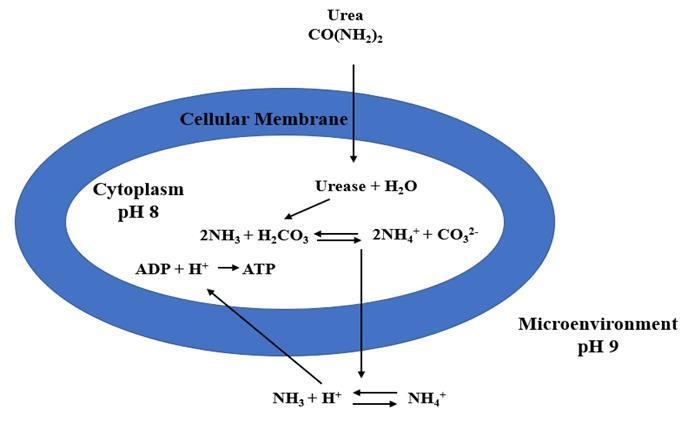
Fig-1: Ureasicactivitybybacteriainvolvedincalcite precipitation[10][44].
Interestingly, as per [41], with MICP treatment, the improvementratiosintheshearstrengthoftheresidualsoil specimens were found to be higher (1.41 to 2.64) when compared with those of sand specimens (1.14 to 1.25), whereasthereductioninthehydraulicconductivityvalues aremoreinsandspecimens(finaltoinitialratioas0.09to 0.15)contrarytoresidualsoilspecimens(0.26to0.45).Apart from this, bio cementation (MICP) using urea hydrolysis suffersfromseriouslimitations.Theproductionofammonia withinthisprocesscanbefataltohumans([21])andalsothis ammoniaproductionstepisquiteslow.Thisprocessisvery difficult to control and depends upon several factors including pH, temperature, concentrations of species, nutrients etc. [27]. Also, there are serious economic limitationsintheacquisitionofnutrientsduringfieldworks [10].Theextractionofpurestrainsofbacteriawitheffective ureasicactivitycouldalsobedifficult.Thus,itisimportantto look out for some other alternatives in the field of soil improvementusingbiocementation(MICP).
3.1 Possibility for a new MICP process using Sugarcane Bagasse and Yeast
Intheprevioussection,theconventionalmethodofMICPhas beenmentionedandstudied.But,inthisworkanefforthas been made to check the use Sugarcane bagasse (SCB) and
YeastcellsinsteadofUreaandUreabacteriaforMICP.The methodology of Urea Hydrolysis has been replaced by Alcoholic Fermentation for MICP with further addition of Human Hair Fibers as reinforcement and Lime for mechanicalstabilizationforsand.
SugarcaneBagasseisawasteavailablefromsugarcaneafter extracting available sucrose (sugar juice) from it. It is a potential solid waste and takes lots of time for bio degradationbecauseofhighcelluloseandlignincontentinit [18]. Bagasse has 1-2% sucrose in it and has a moisture contentof12.6%onanaverage[3].Althoughbeingawaste product of the sugar industry, it is also burned as fuel in sugar mill boilers [19][42]. The use of SCB ash is very renownednowinstabilizingclayeysoilsandinformationof compacted soil blocks [2]. SCB ash along with lime can effectively work as chemical stabilizers in compacted soil blockssuchthatafterpropercuringoftheseblocksfor7,14 and 28 days, an improved compressive strength and durabilitycouldbeachievedwhencomparedwithonlylime addition [2]. As per [8], approximately 270 to 280 kg of bagasseisgeneratedfromprocessingeachtonofsugarcane whichis25%byweightalongwith140kgofstraw.Around 200 million tons of Lignin (for polymer composites) are producedannuallyfromSCB[40].Also,thesteamexplosion pretreatmentofrawSCBat215˚Cfor5minutesresultsinan overallglucoseyieldof86.8%ofthetotalcontent [3].The amount of glucose in bagasse is 41.9 % by dry weight of unalteredbagasse[3].Asper[19],thelowcost,lowdensity, and acceptable mechanical properties of SCB fibers also makethemeligibletobeusedasreinforcementsinplastic composites.SCBwiththeaspectratioof80([12])canactas reinforcements in composites as it is composed of approximately50%cellulose,25%hemicelluloseand25% lignin ([19]) giving it a tensile strength in range of 170 to 290MPaandmodulusofelasticityof15to19GPa[45].
We also cannot neglect an important attribute associated with SCB, that is, alcoholic fermentation. Alcoholic fermentation is the process of converting sugar (glucose, C6H12O6)intoalcohol(ethanol,C2H5OH)andcarbondioxide (CO2) following anaerobic conditions [15]. As per [15], stoichiometryshowsthat180gofglucose/simplesugarcan produceapproximately92gofalcoholwith88gofcarbon dioxidegas(48.9%byweightofglucose)whichcanremain dissolved in the solution but a part of it can even escape. Sucha processtakesplaceintheabsenceofoxygenwhen certainspecieslikeyeastact onsimplesugars/glucosefor derivingenergy[46].Thealcoholproducedinthisprocessof fermentationisethanol(popularlycalledbioethanol)which hasmaximumconcentrationatapHof4.5andtemperature of 35˚C. These pH and temperature conditions are also optimal for yeast cells to grow [46]. The fermentation of sucrose(orglucose)presentinSCB withthehelpofyeast can take place in the same manner as the fermentation of sugarswithinananaerobicatmosphere.Akineticstudyfor theproductionof bioethanol fromSCB usingyeaststrains
International Research Journal of Engineering and Technology (IRJET) e-ISSN: 2395-0056
Volume: 11 Issue: 11 | Nov 2024 www.irjet.net p-ISSN: 2395-0072
has also been conducted to establish the success of the process [23]. From each mole of sucrose, four moles of ethanol (alcohol) and four moles of carbon dioxide are produced by this fermentation process compared to only twomolesofeachfromonemoleofglucoseorfructose[31].
Sucrose (being a disaccharide) undergoes hydrolysis to produceglucoseandfructoseasshown[31]:
Sucrose+H2O Glucose+Fructose
Thefermentationreactionsofsucrose,glucoseandfructose aregivenseparately[31]:
(Sucrose)C12H22O11 +H2O+yeast 4C2H5OH+4CO2
(Glucose)C6H12O6 +H2O+yeast 2C2H5OH+2CO2
(Fructose)C6H12O6+H2O+yeast 2C2H5OH+2CO2
ThroughtheaboveprocessesenoughCO2isproducedinthe aqueous anaerobic environment. The CO2 so released at acidicpHcanbeusedincarbonateionformationatbasicpH. Theseionscanreactwithexternallyaddedcalciumionsto produce calcium carbonate (Bio cement). It has also been found that the fermentation rates of sucrose, glucose and fructosearemoreorlessthesame(sucrosehavinghigher ratethanglucoseandfructose[31])
3.2 The use of Human Hair fibers and Lime
Furthermore,averywideapplicationpossibilityofHuman Hairfiberstobeusedasreinforcementsinsandsorsandy soils are available in literature. Human Hair, being nonbiodegradable[7]andapotentialsolidwaste[14],isdirectly dumped into the soil where it creates several health and environmental issues [29]. Sand has shown great improvement in its mechanical properties with several polymericreinforcements.Asper[38],poorlygradedsand reinforced with 51 mm long monofilament polypropylene showedhighvaluesofUnconfinedCompressiveStrengthat an optimum fiber content of 1% (1.5% when large deformationswereallowed)andsuchfiber-stabilizedsand subgradescanbebeneficiallyusedinairfields.Also,asper [28],whensuchpolypropylenefibersoflengths6mmand 12mmwereaddedtosand,itshowedaresistanceagainst liquefaction, the maximum resistance ata fiber content of 1%andrelativedensityof50%for12mmlongfibers.The CyclicStressRatiosincreasedwiththeincreaseinthefiber length.Apartfromthesepolymericfibers,HumanHairfibers arealsonowinuseforreinforcingsandshowever,theywere formerlyusedextensivelyforstabilizationofcohesivesoils. Asper[7],HumanHairfiberscanbeusedwithinclayeysoil toincreaseitsstrengthandCBRvalue.PresenceofHuman Hair fibers within soil can also reduce its cracking. Such reinforcements are incombustible and durable thereby, increasingtheservicelifeoftheconstructionsoil,reducing the lateral spreading and providing higher confinement. Accordingto[6],theinclusionofrandomlyorientedfibers
(Synthetic,CoirandHumanHair)inKaoliniteClayshowed an increase in the Liquid limit, Hydraulic conductivity, Unconfined Compressive Strength, Stiffness and Optimum moisture content and a subsequent reduction in CompressibilityandinMaximumDryDensityduetotheir light weight. Human Hair fiber reinforced Kaolinite clay showedthehighestvalueofMaximumDryDensityamongst allbut,themixingoffibersaboveacontentof2%couldbe difficult with no further improvement in engineering properties. Parallelly, the work of [33], shows that an additionof2%ofHumanHairfiberstoKaoliniteClaycauses a 200% increase in the Unconfined Compressive Strength valueoftheclay.TheMaximumDryDensityreducesslightly (Optimummoisturecontentincreasesmarginally)withthis addition and then remains same. Similarly, [29] showed a maximum increase of 163.2% in California Bearing Ratio value and 167.4% increase in Unconfined Compressive StrengthvalueofKancheepuramclayat1.2%ofHumanHair fiberinclusion.Asper[39],amaximumincrementof67.2% wasobtainedintheUnconfinedCompressiveStrengthofthe cohesivesoilwithaninclusionof1.2%ofHumanHairfibers. The same soil sample when treated with chloride compounds(SodiumChlorideandCalciumChloride)along withHumanHairfibersshowedanimprovementofnearly 180% in both Unconfined Compressive Strength and California Bearing Ratio. [4] showed that an addition of HumanHairfiberstothemarineclayalongwithjutefibers of length 2 cm, the Maximum Dry Density, Unconfined Compressive Strength and California Bearing Ratio values increased,andOptimummoisturecontentandLiquidlimit values decreased. The optimum amount of Human Hair fibers was 1.5% in context with compressive strength. Accordingto[14],anadditionof9%limeand1.5%Human HairfiberstoKuttanadclayledtoanincreaseof90.4%in the compressive strength with the rate of strength achievementhigherfor2-14daysoflimecuringthan14-28 days.However,limeandHumanHairfibersaloneshowed lesserstrengthimprovement.
Also, Human Hair fiber reinforcement has shown good resultsinsandysoilsorsandstoo.Asper[36],theYamuna sand showed a higher dilative behavior when reinforced with Human Hair fibers. The peak shear strength of sand specimensincreasedaftertheadditionofHumanHairfibers as per Direct Shear Test results along with an increase in angleofshearingresistance(maximumvalueof45.3˚at2% fiberaddition),butthecohesioninterceptdecreasedasfiber contentincreased.Similarly,[37]showed,throughaseriesof Cyclic Triaxial Tests conducted on Human Hair fiber reinforced sand at two different relative densities of 50% and80%,thattheShearmodulushadamaximumincrease undermediumshearstrainsandat0.5%fiberinclusionfor 80%relativedensity.
Forstabilizationoflocalsoils,Limehasbeenusedsincequite alongtimenow.Itisthegreatsuccessoflimeinimproving themechanicalpropertiesofsoilthatLimestabilizationisso
International Research Journal of Engineering and Technology (IRJET) e-ISSN: 2395-0056
Volume: 11 Issue: 11 | Nov 2024 www.irjet.net p-ISSN: 2395-0072
popularespeciallyinpavementconstruction[5][22].Asper [32], local soil mixed with lime showed an increase in strengthandinloadbearingcapacityrequiredfortheroad construction.Afteracuringperiodof28dayssuchamixture can work as a subbase material for flexible pavements. According to [43], dune sand can be stabilized with BentoniteandLimemixture.TheUnconfinedCompressive Strengthindunesandsampleswasfoundtobemaximum whentheBentonitecontentwas15%andLimecontentwas 3%wherethecuringenvironmenthadasignificantinfluence on the strength development. Thus, lime could be used beneficiallyinimprovingthepropertiesofsandsaswell.
Havingseenthatsandcouldundergobiocementationusing this new MICP process involving SCB and yeast cells with furtherimprovementusingHumanHairfiberreinforcement in the presence of lime, some experimentation was conducted to get the sand samples. Table-1 shows the propertiesofsandusedin this experiment. Sand wasfirst washedover75-micronsieveandthendriedbeforeitsuse. Fig-2showstheGrainSizeAnalysischartdevelopedusing thesieveanalysis(asperIS2720Part-4)forthesand.The sandchosenwaspoorlygraded(SP)withspecificgravityof 2.526 (as per IS 2720 Part-3) and with hydraulic conductivity of 0.009095 cm/s from constant head permeabilitytest.Thesandsochosenhadamaximumvoid’s ratioof0.81andminimumvoid’sratioof0.646.Sugarcane Bagasse(SCB)wascollectedfromlocaljuicecentres.Forthe easeofwork,theoutergreenportionswereremoved,and innerwhiteportionswereused(whichweresoftwithsome moisture/sucrose in them). Such portions were cut out in lengths of 10 to 20 mm so that they can be properly incorporatedwithinthesandsamples.Yeast(baker’syeast) was collected from a grocery shop. To do a comparative analysis on its performance in relation to pure laboratory strains,SaccharomycesCerevisiaeyeastwascollectedfrom the Biotechnological Department of Birla Institute of Technology, Mesra. Human Hair was collected from local barbershopsandparlours.TheseHumanHairfiberswere firstwashedandthenairdriedbeforetheiruse.QuickLime (CaO)wasusedinpowderedformforstrengthimprovement andintheformoflimewaterforcalciumionsourceinthe MICPprocess.Forlimewaterpreparation,powderedlime wasmixedwithwaterandfilteredoverafilterpaper.The filtratesoobtainedwasused.
Table-1 PropertiesoftheSandusedintheexperiment
Properties of
Coefficient of Uniformity (Cu) 3.70
Coefficient of Curvature (Cc) 0.751
Classification as per ISSCS Poorly Graded Sand (SP) (UniformlyGraded)
Specific Gravity of solids (Gs) 2.526
Coefficient of Permeability(k) 0.009095cm/s
Maximum Void’s Ratio (emax) 0.810
Minimum Void’s Ratio (emin) 0.646
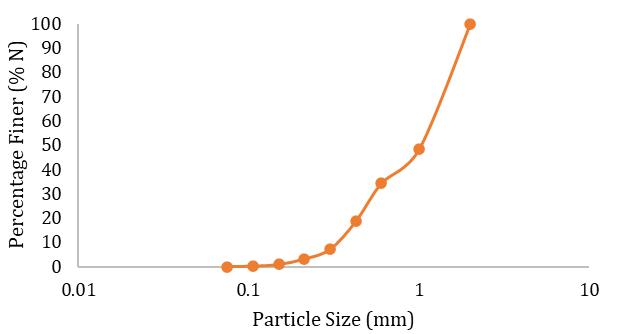
Fig-2: GrainSizeAnalysisChartoftheSandused.
Fig-3 shows a collage of the various materials used in the sand sample preparation. The aim was to obtain only the stabilizedsandsampleswithdimensionsconformingwith standardUnconfinedCompressiveStrengthtest(asperIS 2720 Part-10). This could ensure a success of this new stabilizationmethodforsand.
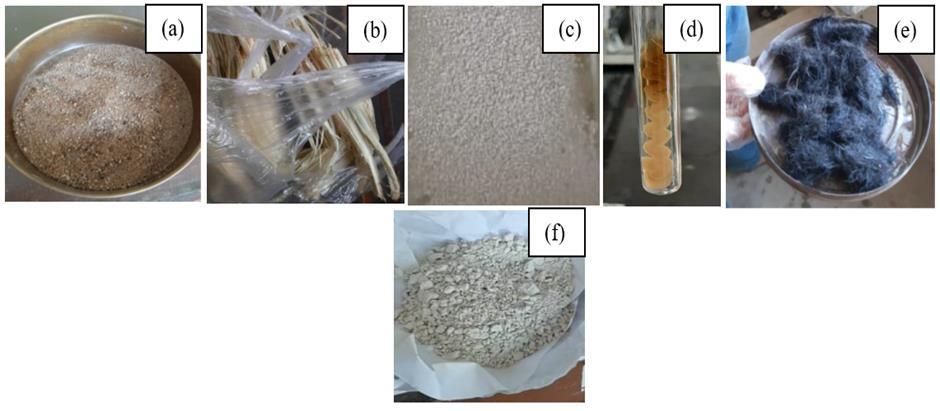
Fig-3: Thematerialsusedintheexperiment:(a)Sandtobe usedinsamplepreparation,(b)SugarcaneBagasse,(c)Yeast commerciallyavailable,(d)Yeast(SaccharomycesCerevisiae) obtainedfromBiotechnologicalLaboratory,(e)HumanHair fibersand(f)Limetobeusedinpowderedformandinlime water.
4.1 A Feasibility Experiment to check CO2 production
Tocheckthefeasibilityofproductionofcarbondioxide(CO2) from the Alcoholic fermentation of SCB using yeast, an experimentwasconducted.Thecarbondioxidesoproduced can be used in carbonate ion formation for calcium carbonate precipitation between sand particle-particle contacts. For such an experiment (where only escaping carbondioxidecanbeused),(1)50gofSugarcaneBagasse
International Research Journal of Engineering and Technology (IRJET) e-ISSN: 2395-0056
Volume: 11 Issue: 11 | Nov 2024 www.irjet.net p-ISSN: 2395-0072
(white portions) was taken in a beaker and 200 mL of distilled water was added to it. To this, a distilled water solution of yeast (obtained from Biotechnological Laboratory) wasadded,andthesetupwascoveredwitha paper to block the release of CO2 gas which would be produced by anaerobic fermentation. (2) Through a hole madeinthispapercover,apipewastakenintoacylindrical measure containing lime water which would turn milky if sufficient amount of CO2 gas produced moves to the lime waterfromthebeaker.Thiscouldprovethatfermentation for SCB is taking place due to the presence of yeast. The joints were sealed with clay. (3) The apparatus was left undisturbedforfermentationfor15daysandthereaction wasmonitoredeveryalternateday.(4)Afterconductingthis test,asimilarsetupwaspreparedusing5gofcommercially availableBaker’syeastandtheobservationswererecorded for 15 days. Fig-4 gives a representation of this feasibility experiment.
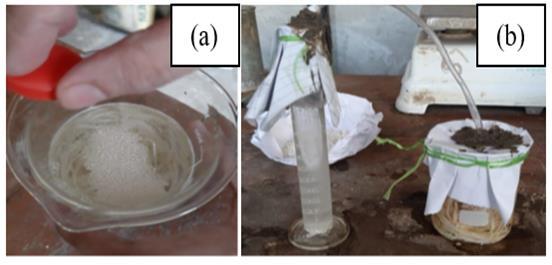
Fig-4: Thesetuppreparationforfeasibilityexperiment(a) addition of commercial yeast to SCB and water (b) final setupkeptforobservationwithfermentationtakingplacein beakerandlimewaterinthecylindricalmeasureconnected withapipe.
Thesandsampleswerepreparedusingtheadmixturesand molded in the size suitable for Unconfined Compressive Strengthtest(asperIS2720Part-10).Todothat(1)15gof HumanHairfibers(1.5%) wereaddedto1kgofdrysand and the mixture was mixed with sand till uniform consistency(Fig-5(b)).(2)50goffinelypowderedlime(5%) wasaddedatthisstageandthenmixedthoroughlyforinitial stiffness.(3)Now,thenextwastheadditionofYeastandSCB tothismixtureofsand,limeandHumanhair.Separatelya mixtureofYeastandSCBwasprepared.Asaninitialstep,15 g of SCB cut out in lengths of 10 to 20 mm (white inside portions)wastakenandyeastwasaddedtoitintworatios 1:6 and 1:10 by weight (Yeast to SCB). The smallest dimensionoftheSCBstripstaken,waskeptlesserthanoneeighth of the sand sample size (as per IS 2720 Part-10). These were properly kneaded with wet hands to provide goodcontactofyeastwithbagasse(Fig-5(c)).(4)However, forcomparison,thesetwoYeast-SCBmixtureswereaddedto the sand-lime-Human hair mixture in layers and by a thorough mixing. Thus, a total of four stabilized sand samples(twomixedsamplesandtwolayeredsamples)were
prepared (Fig-6). (5) The samples are required to be of cylindricalshapewith38mmdiameterand76mmheight (heighttodiameterratioof2)asperstandards.So,forthis, 38 mm diameter plastic pipe was taken which was cut in pieces of suitable lengths and the stabilized sand samples werepreparedwithinthesepipes.Also,itwastriedthatall thesamplesremainfullysaturated.(6)Toallowsaturation water and lime water to pass through them and for full drainage,afilterarrangementwasdevelopedwithinthese pipesusingscrubbersandgravels(8to10mmsize)placed suitably(Fig-6).(7)After,thesuitablepreparationofsand samples(layeredandmixed)withinthemoldpipes,these were made fully saturated by adding water from one side andcollectingtheeffluentfromtheother.Thiswasrepeated for several times from both the sides of the sample pipes. Furthermore, the effluent was again passed through the samplestoreducethechancesoflossofyeastcells.(8)The samples within the mold pipes were allowed to undergo decompositionandfermentationfor5dayssothatenough carbon dioxide (as per feasibility experiment) could be produced.From day6onwards,lime waterwasadded on each alternate day so that increasing pH can facilitate carbonate ion formation and subsequently calcium carbonate (bio cement) precipitation between particleparticlecontactsusingcalciumionsfromthelimewater.In this process also, the effluent so obtained was re-entered fromthetop(maintainingthesameflowdirection).Thiswas repeated several times to make the best use of carbon dioxidedissolvedintheeffluent.Thesampleswereremoved fromthemoldpipesonday15.Anaveragetemperatureof nearly30˚Cwasmaintainedduringthecompleteprocess.
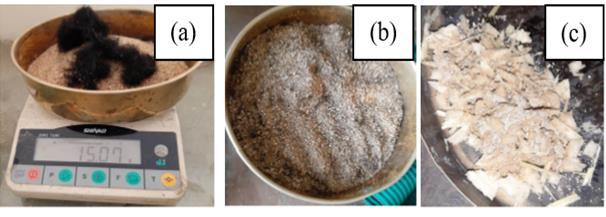
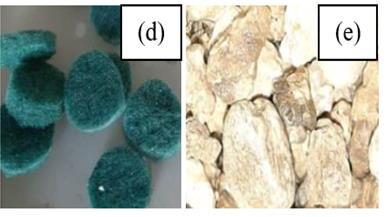
Fig-5: (a) 15 g of Human Hair fibers taken for 1 kg of dry sand,(b)thesandismixedproperlywithHumanHair,(c) theYeast-SCBmixtureprepared,(d)Scrubbersusedinthe mold pipes in filter arrangement and (e) Gravels used in filterarrangementwithinthemoldpipes.
International Research Journal of Engineering and Technology (IRJET) e-ISSN: 2395-0056
Volume: 11 Issue: 11 | Nov 2024 www.irjet.net p-ISSN: 2395-0072
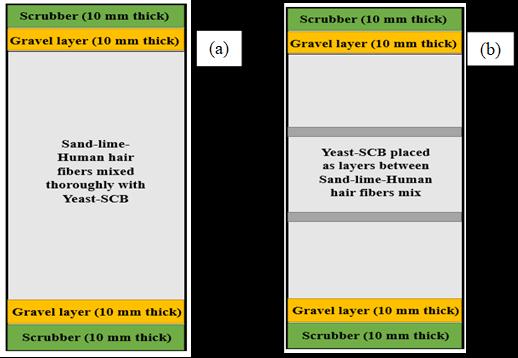

Fig-6: Proper arrangement of the sand-lime-Human Hair mixture and Yeast-SCB mixture for (a) mixed sample, (b) layeredsample,(c)mixwithinamixedsampleand(d)lime wateradditioninamixedsample.
Thefeasibilityexperimentshowedthatthereisapossibility ofthefermentationofsucrose/glucosepresentinSCBusing Yeastunderanaerobicconditions(Fig-7).Itwasobserved, after15days,thatthecompletelimesolutiondidnotfully turn milky but, a stretch of the pipe connecting the fermentationareawithlimewaterturnedwhiteandalsoa partofcylindricalvesselcontaininglimewaterturnedwhite ascalciumcarbonateprecipitatedtherein.Table-2givesthe daywiseobservationsofthesetup.Theresultsobtainedby using Yeast (Saccharomyces Cerevisiae) obtained from Biotechnological Laboratory and by using commercially available Yeast (Baker’s Yeast) were same. It was also observedthatthebubblingofcarbondioxideasaresultof fermentation wasmore concentrated atthe bottom of the beaker (due to anaerobic conditions) while the top of the beakershowedaerobicdecomposition(intheformofdark patches) whose rate increased after day 7. Although, the carbondioxidebubblingcouldbeseenbuttheintensityof productionwaslowprobablybecausetheidealtemperature of 35 ˚C could not be maintained. Also, the ethanol so producedduringfermentation,beingacidic,couldreducethe pHtosuitfurthercarbondioxideproduction.Thisexplains
the increase in the bubbling intensity with the passing of days.
Table-2: Daywiseobservationsinthesetupofthe feasibilityexperiment
Days Observations
Day 1 NoChange
Day 3 Somebubblingatthebottomofthevessel.
Day 5 Vigorousbubblingatthebottomofthevessel.
Day 7 More bubbling and aerobic degradation starts at thetopofthebeaker.
Day 9 Thebeakerstartsstinkingduetoaerobicactionbut stillCO2 bubblingatthebottomtakesplacedueto anaerobicyeastaction.
Day 11 The connecting pipe starts turning white but the bubblingstartsreducing.
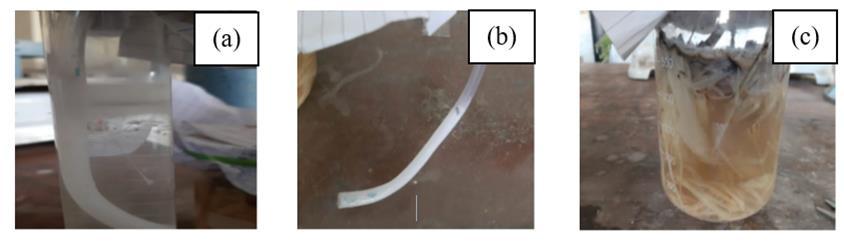
The results of the Feasibility Experiment (a) slight haziness in lime water, (b) the deposition of calcium carbonate in the connecting pipe and (c) the beaker containingSCB,Yeastandwaterafter15days.
The sand-lime-Human Hair mix along with Yeast-SCB mixtureinratiosof1:6and1:10(byweight)wereused in Layered and Mixed sample preparation within the mold pipes. When these sand samples were removed from the moldpipes,thesamplescouldretaintheirshapesof38mm diameter and height 76 mm successfully (Fig-8 and 9). Hence, it could be said that this MICP process based on ‘FermentationGeotechnology’alongwithHumanHairfibers reinforcement and lime can produce well stabilized sand samples.Thiscouldbeattributedtothefactthatwithinthe fully saturated sand pores anaerobic conditions exist supportingfermentationbyyeast.Thedaywiseobservations developedonthegeneralbehaviorofthelayeredandmixed samplesduringlimewateradditionaregiveninTable-3.The permeabilityofthelayeredsample(s)wasfoundlessthan thepermeabilityofthe mixedsample(s).Thismightbe so becauseinlayeredsamplesthefermentingYeast-SCBzones wereplacedinbetweenthesandlayerswhichbrokedown to simpler small pieces hindering the easy water passage. For both the layered and mixed samples, the ones having Yeast-SCB ratio of 1:6 (by weight) showed lesser permeabilitythanthosewith1:10YeasttoSCBratiobecause of more fermentation and stabilization of SCB due to high microbe(YeastoverSCB)content.Certaindarkpatchesof decomposition could be seen along with a consistent pungent smell. When sand was mixed with Human Hair fibers then it showed a quick response when shaken and
International Research Journal of Engineering and Technology (IRJET) e-ISSN: 2395-0056
Volume: 11 Issue: 11 | Nov 2024 www.irjet.net p-ISSN: 2395-0072
squeezed between the palms under saturated conditions. TheSCBparticlesleftwithinthesamplescouldalsoworkas reinforcements and improve the mechanical properties of sandfurthermore.
Table-3: DaywiseobservationsintheLayeredandMixed sandsamples
Days Layered Samples Mixed Samples
Day 1
The samples were set in both 1:6 and 1:10 YeastSCB ratio. They were madefullysaturatedwith water.
Day 6 Limewaterwasaddedfor the first time. Pungent smellwasnoticed.
Day 8 Lime water was again added.Theflowingspeed indicated lesser permeability.
Day 10 Lime water was again added.Pungentsmellgot strengthened.
Day 12
Day 14
Day 15
The sampleswere setin both1:6and1:10YeastSCBratio.Theywerealso madefullysaturated.The permeability was higher than the layered sample(s).
Lime water was added. Harder pungent smell was observed than layeredsample(s).
Lime water was again added.Theflowingspeed indicated lesser permeability.
Lime water was added. Pungentsmellwasmuch more than the layered ones.
Limewaterwasadded.No newobservation. Limewaterwasadded.
Last dose of lime water wasadded.Thesample(s) had much reduced permeabilitycomparedto the first day. Stretches of black decomposition patchescouldbeobserved neartheSCBlayers.
Thesample(s)wasgently removed from the mold pipe(s).
Last dose of lime water was given. More permeability was observed compared to the layered sample(s). The sample(s) had no dark patches of decompositionofSCB.
Thesample(s)wasgently removed from the mold pipe(s). It had very high pungent smell owing to more decomposition compared to layered sample(s).
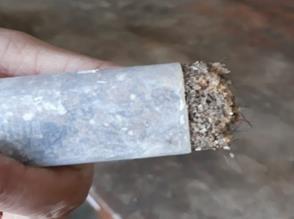
It was also found that the bio-cementation using this approach is not that widespread as that happens in the conventionalprocess.ThiswassobecausetheextendofCO2 productionwaslesserusingSCBinpresenceofyeast(when comparedtoanysugarsolution).Also,therecouldhavebeen fluctuationsinpHandtemperatureduringthefermentation phase. However, it was seen that, visually, there were not manydifferencesbetweenlayeredandmixedsamples(Fig9)andsampleswerestifferinbehavior.
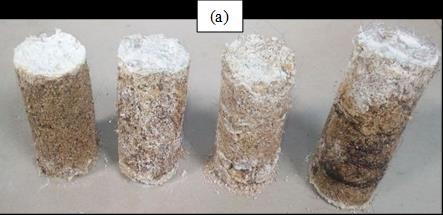
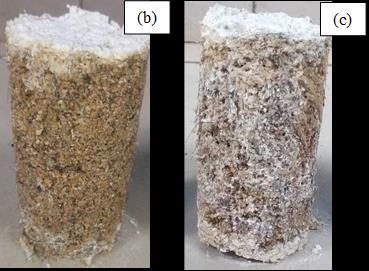
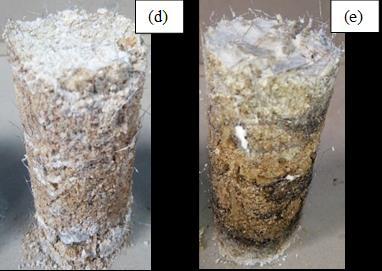
Fig-9: (a) All the samples after removing from the mold pipes (b) Mixed Sample with Yeast to SCB ratio of 1:6 (c) Mixed Sample with Yeast to SCB ratio of 1:10 (d)Layered SamplewithYeasttoSCBratioof1:6and(e)LayeredSample withYeasttoSCBratioof1:10.
The aim of this work was to develop the stabilized sand samples of standard sizes of 38 mm diameter and 76 mm height as per Indian Standards, based on ‘Fermentation Geotechnology’andreinforcingwithHumanHairfibersin presence of lime. Several works have been done to determinetheadequacyofeachoneofthesematerialsinthe stabilizationofsandhowever,aneffortforacollectivestudy hasbeenmadeherewitha specialemphasisontheuseof thefermentationprincipleinbiocementation(MICP)using
International Research Journal of Engineering and Technology (IRJET) e-ISSN: 2395-0056
Volume: 11 Issue: 11 | Nov 2024 www.irjet.net p-ISSN: 2395-0072
Yeast under anaerobic conditions prevalent within fully saturated sand pores. Instead of pure sugar or glucose source, Sugarcane Bagasse (SCB), a waste material was chosentoserveasasourceoffermentationandalsotoactas reinforcementwithinsand.Thegeneralconclusionsareas follows:
a. Medium to fine sand is prone to serious Liquefactioneffectsduringearthquakesandthiscan be reduced only by improving the engineering propertiesofsands.Therefore,sandismixedwith certainadmixturesforitsstabilizationinorderto tacklesuchconditions.Theaimhasbeentoimpart Unconfined Compressive Strength to sand so that the stabilized sand samples could retain their shapes. As natural sand lacks Unconfined CompressiveStrength(andsocohesion),therefore, theobjectiveofgettingfirmsampleswithstandard dimensions can only be fulfilled using bio cementation(MICP)process.Conventionally,urea bacteria are made to undergo urea hydrolysis for carbonate ion formation within the pores which reactwithcalciumions(availablefromanyexternal source)toformcalciumcarbonate(biocement)at sand particle-particle contacts. However, this suffers with certain limitations. Therefore, a new method of bio cementation (MICP) was targeted here with the same carbonate ion production mechanismbutbyfermentingSCBwiththehelpof yeast cells within the anaerobic environment present within the pores. The CO2 thus produced, havegotconvertedtocarbonateionswhichinthe presence of lime water, precipitated as Calcium Carbonate(biocement)atthecontactpoints.
b. With the inclusion of 1.5% Human Hair fibers in sand, it showed a quick response in shaking and squeezing behaviors under fully saturated conditions. 5% of finely powdered lime was also added to this for initial stiffness. An observative study was also carried out on different ‘Layered’ and ‘Mixed’ samples with different Yeast-SCB mixtures(i.e.,withYeast-SCBratiosof1:6and1:10 by weight). After 15 days of curing and fermentation, the stabilized sand samples were removedfromthemoldpipesandtheycouldretain their shapes indicating that the method of MICP developed in this work can effectively produce stabilized sand samples for Unconfined Compressive Strength test with standard dimensions.
Although the work demonstrates the conversion of sand with zero Unconfined Compressive Strength value to stabilizedsandwithsomeUnconfinedCompressiveStrength value,buttheworkisnotcompleteyet.Abetterstudyand experimentation on this newly adopted MICP process (Fermentation Geotechnology) using Scanning Electron
Microscopeimagesalongwithmeasuredimprovementsin Unconfined Compressive Strength value and Liquefaction resistanceusingCyclicTriaxialtestsforthisstabilizedsand wouldbepresentedinfuture.
[1] Achal V, Mukherjee A, Kumari D, Zhang Q (2015) “Biomineralization for sustainable construction – A review of processes and applications” Earth-science reviews 148: 1-17. https://doi.org/10.1016/j.earscirev.2015.05.008
[2] Alavez-Ramirez R, Montes-Garcia P, Martinez-Reyes J, Altamirano-JuarezDC,Gochi-PonceY(2012)“Theuseof sugarcanebagasseashandlimetoimprovethedurability and mechanical properties of compacted soil blocks” Construction and Building Materials 34: 296-305 https://doi.org/10.1016/j.conbuildmat.2012.02.072
[3] AmoresI,BallesterosI,ManzanaresP,SaezF,Michelena G, Ballesteros M (2013) “Ethanol Production from sugarcane bagasse pretreated by Steam Explosion” ElectronicJournalofEnergyandEnvironment1(1):2536.https://doi.org/10.7770/ejee-V1N1-art486
[4] AnjanadeviKA,RehmanA,MerineG,SaumyaM,Sruthi MG(2019)“SoilStabilizationusingJuteandHumanHair Fiber ” International Research Journal of Engineering andTechnology(IRJET)6(5):5117-5121.
[5] AroraMG,KhannaSK,VasanRM(1970)“Durabilityand strength characteristics of lime-flyash-soil mixture for road construction”. Indian Roads Congress Road ResearchBulletinNo.14.
[6] AyothiramanR,BhuyanP,JainR(2014)“Comparative studies on performance of human hair and coir fibers against synthetic fibers in soil reinforcement ” In: Proceedingsof2nd AnnualInternationalConferenceon Architecture and Civil Engineering (ACE 2014) Singapore,pp.222-227.
[7] Butt WA, Gupta K, Naik H, Bhat SM (2014) “Soil subgrade improvement using human hair fiber” . International Journal of Scientific and Engineering Research5(12):977-981.
[8] Canilha L, Chandel AK, Milessi TSDS, Antunes FAF, Freitas WLDC, Felipe MDGA, da Silva SS (2012) “Bioconversion of sugarcane biomass into ethanol: An overview about composition, pretreatment methods, detoxificationofhydrolysates,enzymaticsaccharification, and ethanol fermentation”.JournalofBiomedicineand Biotechnology 2012 hindawi.com Article ID 989572. https://doi.org/10.1155/2012/989572
International Research Journal of Engineering and Technology (IRJET) e-ISSN: 2395-0056
Volume: 11 Issue: 11 | Nov 2024 www.irjet.net p-ISSN: 2395-0072
[9] CastanierS,LeMetayer-LevrelG,PerthuisotJP(1999) “Ca-carbonates precipitation and limestone genesis-the microbiologist point of view.” Sedimentary Geology 126(1-4): 9-23. https://doi.org/10.1016/S00370738(99)00028-7
[10] Chaparro-Acuna SP, Becerra-Jimenez ML, MartinezZambranoJJ,Rojas-SarmientoHA(2017)“Soil bacteria that precipitate calcium carbonate: mechanism and applications of the process ” Acta Agronomica 67(2): 277-288.https://doi.org/10.15446/acag.v67n2.66109
[11] ChuJ,VaraskinS,KlotzU,MengéP(2009)“Construction processes. ” In: Proceedings of the 17th International Conference on Soil mechanics and Geotechnical Engineering Amsterdam (Volumes 1,2,3 and 4), pp. 3006-3135.
[12] da Luz SM, Gonclaves AR, Del’Arco Jr AP (2007) “Mechanical behavior and microstructural analysis of sugarcane bagasse fibers reinforced polypropylene composites ” Composites Part A: Applied Science and Manufacturing 38(6): 1455-1461. https://doi.org/10.1016/j.compositesa.2007.01.014
[13] DeJong JT, Mortensen BM, Martinez BC, Nelson DC (2010) “Bio-mediated soil improvement ” Ecological Engineering 36(2): 197–210. https://doi.org/10.1016/j.ecoleng.2008.12.029
[14] Elias T, George S, Zachariah A, Sulfi S, Sreedevi P S (2016) “Comparative study of soil stabilization using humanhairandlime ”InternationalJournalofScientific &EngineeringResearch(IJSER)7(2):1323-1326ISSN 2229-5518.
[15] Elshani A, Pehlivani K, Kelmendi B, Cacaj I (2018) “PossibilityandDeterminationoftheuseofCO2produced by the production of beers. ” Journal of Pharmaceutical SciencesandResearch10:1229-1230.
[16] FerrisFG,StehmeierLG,KantzasA,MouritsFM(1997) “Bacteriogenic mineral plugging ” Journal of Canadian Petroleum Technology 36(9). https://doi.org/10.2118/97-09-07
[17] FrankelRB,BazylinskiDA(2003)“Biologically induced mineralizationby bacteria. ”ReviewsinMineralogyand Geochemistry 54(1): 95-114. https://doi.org/10.2113/0540095
[18] Haghdan S, Renneckar S, Smith GD (2016) “Sources of Lignin(LignininPolymercomposites).” In:FrankO,Sain M(ed)Lignininpolymercomposites,WilliamAndrew Publications,Elsevier,pp.1-11.
[19] HajihaH,SainM(2015)“The use of sugarcane bagasse fibers as reinforcements in composites. ” Biofiber
Reinforcements in Composite Materials 525-549. https://doi.org/10.1533/9781782421276.4.525
[20] HammesF,BoonN,deVilliersJ,VerstraeteW,Siciliano SD (2003) “Strain-Specific ureolytic microbial calcium carbonate precipitation ” Applied and Environmental Microbiology 69(8): 4901–4909. https://doi.org/10.1128/AEM.69.8.4901-4909.2003
[21] HarkesMP,vanPaassenLA,BoosterJL,WhiffinVS,van Loosdrecht MCM (2010) “Fixation and distribution of bacterial activity in sand to induce carbonate precipitation for ground reinforcement.” Ecological Engineering 36(2):112–117. https://doi.org/10.1016/j.ecoleng.2009.01.004
[22] Herrin M, Mitchell H (1961) “Lime-soil mixtures ” In: Proceedings of 40th Annual Meeting of the Highway ResearchBoard,HighwayResearchBoardBulletin304. http://onlinepubs.trb.org/Onlinepubs/hrbbulletin/304 /304-008.pdf
[23] IramM,AsgharU,IrfanM,HumaZ,JamilS,NadeemM (2018) “Production of bioethanol from sugarcane bagasse using yeast strains: A kinetic study. ” Energy Sources, Part A: Recovery, Utilization and Environmental Effects 40(3): 364-372. https://doi.org/10.1080/15567036.2017.1422056
[24] IS2720Part10(1991)“IndianStandard,methodoftests for soils: determination of unconfined compressive strength ”SecondRevision.BureauofIndianStandards, NewDelhi
[25] IS2720Part3(1980)“IndianStandard, methodoftests forsoils:determinationofspecificgravity. ”FirstRevision. BureauofIndianStandards,NewDelhi
[26] IS2720Part4(1985)“IndianStandard, methodoftests for soils:grain size analysis. SecondRevision ”Bureauof IndianStandards,NewDelhi
[27] IvanovV,ChuJ(2008)“Applications of microorganisms to geotechnical engineering for bioclogging and biocementationofsoilinsitu.”ReviewsinEnvironmental Science and Biotechnology 7(2): 139–153. https://doi.org/10.1007/s11157-007-9126-3
[28] KarakanE,EskisarT,AltunS(2018) “The liquefaction behavior of poorly graded sands reinforced with fibers.” AdvancesinCivilEngineering20hindawi.comArticleID 4738628.https://doi.org/10.1155/2018/4738628
[29] Narayanan KS, Sharmila SMR (2017) “Stabilization of claywithhumanhairfiber.” InternationalJournalofCivil EngineeringandTechnology(IJCIET)8(4):662:667.
[30] Parmar S, Marjadi D (2017) “Biocementation: a novel technique and approach towards sustainable material. ”
International Research Journal of Engineering and Technology (IRJET) e-ISSN: 2395-0056
WorldJournalofResearchandReview(WJRR)4(3):3441262839.
[31] PepinC,MarzzaccoC(2015)“Thefermentationofsugars using yeast: A discovery experiment ” Melbourne FL, Chem13NewsMagazine.
[32] Pereira RS,EmmertF,Miguel EP,GattoA(2018) “Soil stabilization with lime for the construction of forest roads.” Floresta e Ambiente 25(2). https://doi.org/10.1590/2179-8087.007715
[33] PillaiRR,RamanathanA(2012)“Aninnovativetechnique of improving the soil using human hair fibers ” In: Proceedings of the 3rd International Conference on ConstructionindevelopingCountries(ICCIDC-3)pp.4-6.
[34] Qabany,AA,MortensenB,MartinezB,SogaK,DeJong,J (2011)“Microbialcarbonateprecipitation:correlationof S-wavevelocitywithcalciteprecipitation ”Geo-Frontiers 2011:AdvancesinGeotechnicalEngineering3993-4001. https://doi.org/10.1061/41165(397)408
[35] RongH,QianCX,LiL(2012) “Study on microstructure and properties of sandstone cemented by microbe cement. ”ConstructionBuildingMaterials36:687–694. https://doi.org/10.1016/j.conbuildmat.2012.06.063
[36] Sahu R, Ayothiraman R, Ramana GV (2018) “Shear behaviorofSandReinforcedwithHumanHairFibers ”In: Proceedings of 19th Southeast Asian Geotechnical Conferenceand2ndAGSSEAConference(19SEAGCand 2AGSSEA),pp.3-5.
[37] SahuR,RamaiahBJ,AyothiramanR,RamanaGV(2020) “Dynamic properties of human hair fiber- reinforced yamunasand. ”JournalofTestingandEvaluation48(6). https://doi.org/10.1520/JTE20180133
[38] Santoni RL, Webster SL (2001) “Airfields and road constructionusingfiberstabilizationofsands ”Journalof Transportation Engineering 127(2): 96-104. https://doi.org/10.1061/(ASCE)0733947X(2001)127:2(96)
[39] Sharmila SMR, Narayanan KS, Arun S (2019) “Experimentalinvestigationofsoilreinforcedwithhuman hair fibre and chloride compounds. ” Engineering ResearchExpress1(1)015017.
[40] SinghR,SinghS,TrimukheKD,PandareKV,Bastawade KB,GokhaleDV,VarmaAJ(2005)“Lignin-carbohydrates complexes from sugarcane bagasse: Preparation, purification, and characterization ” Carbohydrate polymers 62(1): 57-66. https://doi.org/10.1016/j.carbpol.2005.07.011
[41] Soon NW, Lee LM, Khun TC, Ling HS (2013) “Improvementsinengineeringpropertiesofsoilsthrough
microbial-inducedcalciteprecipitation. ”KSCEJournalof Civil Engineering 17(4): 718–728. https://doi.org/10.1007/s12205-013-0149-8
[42] Tyagi S, Lee KJ, Mulla SI, Garg N, Chae JC (2019) “Production of bioethanol from sugarcane bagasse: current approaches and perspectives ” Applied Microbiology and Bioengineering pp. 21-42. https://doi.org/10.1016/B978-0-12-815407-6.00002-2
[43] Wayal AS, Ameta NK, Purohit DG (2012) “Dune Sand Stabilization using Bentonite and Lime. ” Journal of EngineeringResearchandStudies3(1):58-60.
[44] Whiffin,VS(2004)“MicrobialCaCO3 precipitationforthe production of biocement ” Dissertation, Murdoch University,Perth,Australia.
[45] Wirawan R, Sapuan SM, Yunus R, Abdan K (2011) “Properties of sugarcane bagasse/poly (vinyl chloride) composites after various treatments ” Journal of Composite Materials 45(16): 1667-1674. https://doi.org/10.1177/0021998310385030
[46] WongYC,SanggariV(2014)“Bioethanolproductionfrom sugarcanebagasseusingfermentationprocess.”Oriental Journal of Chemistry 30(2): 507-513. http://dx.doi.org/10.13005/ojc/300214
Volume: 11 Issue: 11 | Nov 2024 www.irjet.net p-ISSN: 2395-0072 © 2024, IRJET | Impact Factor value: 8.315 | ISO 9001:2008
|