
International Research Journal of Engineering and Technology (IRJET) e-ISSN: 2395-0056
Volume: 11 Issue: 11 | Nov 2024 www.irjet.net p-ISSN: 2395-0072

International Research Journal of Engineering and Technology (IRJET) e-ISSN: 2395-0056
Volume: 11 Issue: 11 | Nov 2024 www.irjet.net p-ISSN: 2395-0072
Chaithra K1 , Dr. K N Rajanikanth2
1Post Graduate Student, Dept. of ECE, BMS College of Engineering, Bengaluru, India
2Associate Professor, Dept. of ECE, BMS College of Engineering, Bengaluru, India
Abstract - Modern electronic devices face challenges in managing power dissipation, making efficient design crucial. This paper presents a high-performance ALU that uses reversiblelogicgatesandVedicmultipliers,implementedwith Xilinx Vivado. Reversible logic gates help reduce power consumption and heat by allowing bidirectional data processing, while Vedic multipliers improve arithmetic speed using traditional techniques. The ALU also features clock gatingforenergysavingsandinput-basedpipeliningtoboost processing efficiency. ALU is capable of handling various operations,thisdesignoffersbetterpowerefficiencyandspeed than conventional ALUs, making it ideal for mobile and embedded applications.
Key Words: ALU(Arithmeticandlogicalunit),FPGA(Field programmable gate array), Reversible logic gates, Urdhva Tiryagbhyam,Vedicmultiplier.
In the rapidly evolving technology of today, numerous devices are created with incredibly tiny sizes, often measuredinnanometers,andtheArithmeticandLogicUnit (ALU)isessentialinthesesystems.TheALUisinchargeof carryingoutmathematicalandlogicaltasksonbinarydata, madeupofzeroesandones,thebasiccomputerlanguage. Functioning as the primary component of the central processingunit(CPU)tohandlecalculations,thearithmetic logic unit (ALU) decodes CPU commands and performs operations like addition, subtraction, multiplication, and comparisons to facilitate effective data processing. After gettingbinaryinputs,theALUperformstaskssuchasadding numbersand then transmitsthe outcomesto theCPU for additional purposes. The ALU also carries out logical operationssuchasAND,OR,XOR,andNOT,inadditionto arithmetic functions, which are essential for data comparisonanddecision-making.TheALU,asakeyelement incomputerdesign,playsacrucialroleinperformingawide rangeoffunctions,frombasicmathoperationstocomplex datahandling,andisvitalintoday'scomputersystems.
WhendesigninganALU,it’scrucialtoprioritizespeedand energy efficiency, making sure it operates quickly while consuming minimal power. Certain methods, such as employing reversible gates and Vedic multiplication techniques, can assist in attaining these objectives. Reversiblegatesareuniqueastheycanhandledatawhile
preserving information, enabling energy recovery that is typically wasted. The Vedic multiplier method, rooted in ancient Indian mathematics, enhances multiplication efficiencyandsimplifiescalculations.
Lately, engineers have been exploring novel methods to develop quicker and more energy-efficient ALUs utilizing reversible gates and Vedic multipliers techniques. These sophisticated techniques have considerable promise for enhancing both the efficiency and performance of ALU designs.Utilizingreversiblegatesthatreduceenergywaste andVedicmultipliersthatstreamlineintricatecalculations, these methods provide significant benefits for contemporary computing systems. This paper will extensively examine the design process utilizing these methods,alongwithsimulatedoutcomestoconfirmtheir efficacyandshowcasetheirimprovedperformance.
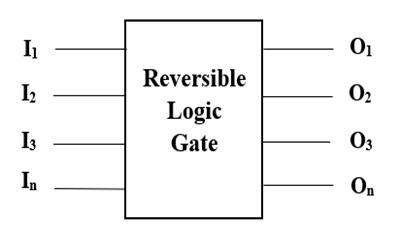
Reversiblegatesareessentialinmoderncircuitdesignsince they allow computations to move in both directions while maintainingallinformation.Thismakesthemauniqueand efficient tool for managing information. Unlike traditional logicgatesthatcanleadtoinformationloss,reversiblegates allowfortheretrievaloftheoriginalinputfromtheoutput, making them highly beneficial in various applications. In reversible computing, preserving information is a core concept.Eachcombinationofinputsinareversiblegatemust corresponduniquelyandreversiblytotheoutput,ensuring that no information is lost during processing. This trait distinguishesreversiblegatesfromirreversibleones,offering thepossibilityofreducedpoweruseandimprovedefficiency. In some cases, extra inputs or outputs are needed to guaranteethatacircuitcanbereversed.Thetotalnumberof inputs,includingfixedinputs,mustequaltheoverallnumber of outputs, even if certain outputs, known as "garbage" outputs,arenotessentialforthefunction.These"garbage" resultsarecrucialforpreservingaone-to-onelinkbetween inputsandoutputs.Figure1depictsareversiblelogicgateof sizen*nwithninputsandnoutputs,whereeveryinput(In) isconnectedtoitsmatchingoutput(On).
International Research Journal of Engineering and Technology (IRJET) e-ISSN: 2395-0056
Volume: 11 Issue: 11 | Nov 2024 www.irjet.net p-ISSN: 2395-0072
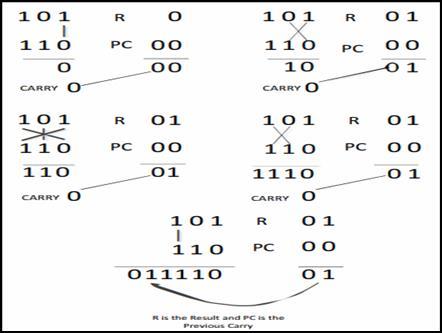
A Vedic multiplier is a digital multiplier rooted in ancient IndianVedicmathematics,utilizingformulasfromhistorical texts. It simplifies multiplication in digital circuits by breaking the task into smaller phases that use particular numerical sequences. The method called "Urdhva Tiryagbhyam"(VerticallyandCrosswise)isoftenemployed to reduce partial products, enhancing both speed and efficiency. This technique is employed in modern digital circuit design for quick multiplication in applications like digital signal processing and mathematical computations. The Urdhva Tiryagbhyam method involves generating partialproductsverticallyandmergingthemdiagonallyto achieve the final result. Figure 2 depicts the Urdhva Tiryagbhyam method for performing multiplication with binarynumbers.
AlgorithmforUrdhvaTiryagbhyamMultiplier
1. Divide the numbers: Begin by dividing the two numbers you wish to multiply into smaller components,usuallypairsofdigits.
2. Vertical multiplication: Multiply each pair of digits verticallyandrecordthepartialproductsonebelow theother.
3. Diagonalmultiplication:Performcrosswise(diagonal) multiplication of each pair of digits and place the resultsdiagonallybelowtheverticalpartialproducts.
4. Sum the partial products: Combine all the partial products obtained from the vertical and crosswise multiplications.
5. Handle carries and finalize: If any carries are generated during addition, carry them to the appropriate positions and calculate the final sum to obtaintheresult.
Articleinreference[1]introducesareversibleALUdesign specifically designed for DSP applications, leading to enhancements in power and area efficiency. By incorporatingreversiblegatessuchasFredkin,Toffoli,and Peres,theimplementationdecreasespowerconsumptionby 1.45% and reduces the area needed by 1.79% when comparedtoconventionalALUs.CreatedusingVerilogand processed with Xilinx ISE 14.7, it showcases improved efficiency and power utilization for systems with limited resources.
Articleinreference[2],acomparisonismadebetweena32bitALUconstructedusingreversibleandirreversiblelogic, with a focus on low-power uses. Reversible gates, which avoidinformationloss,greatlydecreasepowerconsumption. ThereversibleALUpropositiondemonstratesareductionin delayofupto48%andadecreaseinareaof34%compared to conventional CMOS designs, showcasing its aptness for systems with limited resources and a focus on energy efficiency.
Article in reference [3] investigates the VLSI design and testingofanALUwithXilinxISE14.7,withanemphasison gate and chip level simulations. The ALU is capable of performing nine different tasks, such as addition and multiplicationforarithmeticoperations,andAND,OR,and XORforlogicalfunctions.Showingadelayof125.711ns,the design highlights the importance of simulation tools in enhancing ALU performance for contemporary digital systemswitheffectivenessandcompetitiveness.
Articleinreference[4]describesthecreationofa16-bitALU utilizing reversible logic gates, programmed in Verilog on XilinxISE14.7,andtrialedonaSpartan6FPGA.Thestudy evaluateshowitperformsincomparisontoatypicalALU, emphasizingthebenefitsofreversiblegatesinminimizing powerconsumptionandavoidingdataloss.Acollectionof reversiblegateswascreatedtoperformdifferentarithmetic and logic functions, highlighting the benefits of reversible logicinenhancingefficiencyanddependabilityinlow-power digitalsystems.
International Research Journal of Engineering and Technology (IRJET) e-ISSN: 2395-0056
Volume: 11 Issue: 11 | Nov 2024 www.irjet.net p-ISSN: 2395-0072
Articleinreference[5]introducesadesignfora64-bitALU that integrates Vedic mathematics principles, employing Sutras such as Urdhva Tiryakbhyam and Nikhilam for arithmetic functions. The Vedic multiplier, running on a SpartanFPGAinVerilogHDL,achievesadelayofonly4.014 ns.Simulationfindingsexhibitedan85%decreaseindelay when compared to traditional methods, emphasizing the capability of Vedic practices to improve effectiveness in high-speeddigitalcircuits.
Articleinreference[6]investigatestheconstructionofa32bit ALU utilizing reversible logic, contrasting it with a conventional ALU constructed using regular gates. The reversible ALU was tested using ModelSim SE 6.4c and implementedinXilinxISE14.5,resultingina5.1%decrease inpowerusageandutilizingonly7%ofFPGAresources.It resultsinadecreaseindelayfrom2.266nsto1.907nsanda decreaseinpowerdissipationfrom0.312mWto0.261mW, demonstrating its effectiveness for contemporary digital uses.
Article in reference [7] presents a technique for encoding integersinModifiedBooth(MB)formforALUcreationwith Verilog HDL and Xilinx ISE 14.7, but it does not offer substantial enhancements in area, power, or delay. By integratingann-bitALUintoa32-bitframework,thedesign enhances flexibility and includes a power and areaoptimized multiplier, particularly beneficial for neural networks.ItalsorecommendsdistributingRTLmodelsand extendingtheALUcapabilitiestoaccommodatedifferentbit widths,puttingafocusonefficiencyandflexibilityindigital circuits.
Article in reference [8] presents a Vedic multiplier that is reversible and designed to reduce power consumption, making it ideal for low-power applications. It includes a compactsquarercircuitandaVedicALUController(VAC) that boosts data processing efficiency, providing better performance compared to conventional designs. The research improves ALU design to enhance resource utilizationandprocessingefficiency.
Articleinreference[9]utilizestheGateDiffusionInput(GDI) technique to decrease power usage and number of transistors, resulting in a smaller chip footprint. The ALU conductseightfunctionsandconsistsofa3TXORfulladder and a fresh 1-to-8 demultiplexer. Experiments conducted using Xilinx ISE 14.7 validate the efficiency of the GDI methodinenhancingpowerandareaforVLSIdesigns.
Articleinreference[10]investigatestechniquesforcreating reversiblelogiccircuitswiththegoalofdecreasingexpenses throughdecreasingthenumberofgatesandimplementation costs. It contrasts various algorithms, emphasizing their strengths, weaknesses, and uses in green computing and quantum computing. The research suggests the need for moreinvestigationtoenhancealgorithmsforreversiblelogic synthesisinadvanced,low-powersystems.
Articleinreference[11],anovelALUdesignisintroduced thatreliesonreversiblecomputingandincorporatesFredkin andCNOTgatestodecreasepowerusageandmaintaindata accuracy.Thedesignallowsforerrordetectionwithparity checks,surpassingtraditionalALUsingatecount,quantum cost, and fault detection capabilities. The research emphasizes the benefits of reversible computing for enhancing power efficiency and error detection in digital systems.
Articleinreference[12]introducesanoptimizeddesignofa single-precisionfloating-pointALU,prioritizingspeedand power efficiency, which are essential for AI, machine learning, and signal processing tasks. Significant enhancementsconsistofacarrylook-aheadadder,altered Booth encoder, and Goldschmidt algorithm to expedite operations.DevelopedwithVerilogHDLanddeployedona Spartan 7 FPGA, the project demonstrated a 36% enhancement in speed, decreased power usage, and improvedhardwareutilization.
Article in reference [13] explains how an ALU is designed usingan8-bitProgrammableRingCounter,whichincludes bothstraightandtwistedringcounters.TheArithmeticLogic Unit processes 4-bit binary inputs and executes different arithmeticandlogicaloperations,usingringcountersetups tomanagethecalculations.UtilizingXilinxISE14.2,thegoal of the design is to improve computational flexibility and efficiencywithindigitalsystems.
Article in reference [14] is focuses on minimizing power usage in digital circuits, specifically in microprocessors foundinportablegadgets.Theresearchintroducesa4-bit ALU built for high speed and low power, fine-tuned with 45nm technology and Verilog HDL. It emphasizes how energy-efficientALUsarecrucialforenhancingtheefficiency ofmobilecomputingdevices.
Article in reference [15], an ALU tailored for microcontrollersisdiscussed,withaparticularemphasison areaefficiencyandnecessaryfunctions.Thedesignincludes Booleanprinciples,DSP-basedmultiplieranddividerunits, andabarrelshiftertoenhanceperformance.UtilizingXilinx 9.1 ISE and confirmed with ModelSim, the ALU improves resource efficiency and sets the stage for additional microcontrollerenhancements.
TheALUisacrucialpartofacomputer'sCPUthathandles 32-bitdataandperformsdifferentarithmeticoperationslike addition,subtraction,andmultiplication,alongwithlogical functions such as AND, OR, and XOR. Its activities are controlledbysignalsfromtheCPUcommandsthatindicate thefunctionneeded.InreversibleALUs,everyoperationis basedontheprincipleofbijection,ensuringthateachunique input combination results in a distinct output that can be reversed to obtain the original inputs. This is achieved by
International Research Journal of Engineering and Technology (IRJET) e-ISSN: 2395-0056
Volume: 11 Issue: 11 | Nov 2024 www.irjet.net p-ISSN: 2395-0072
utilizing reversible gates, which maintain information, reduce power loss, and facilitate energy-efficient computation. The ALUs are equipped with a set of instructions that incorporate reversible arithmetic and logical operations, leveraging reversible gates to enhance performanceandenergyefficiencyindigitalsystems.
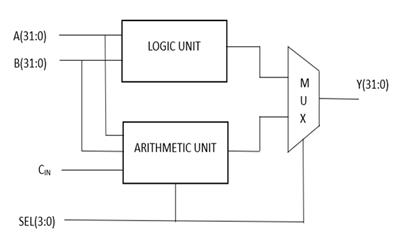
Fig-3: Blockdiagramof32-bitALU
4.1 REVERSIBLE GATES
i. NOT GATE
A reversible NOT gate, essential in reversible computing, differsfromatraditionalNOTgatebyallowingtheinputto be reconstructed from the output, ensuring the process is fullyreversible.
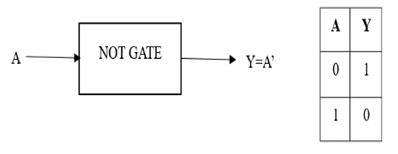
Fig-4: NOTGateanditstruthtable
ii. FEYNMAN GATE (FG)
TheFeynmangateisareversiblelogicgatewithtwoinputs, A and B, generating two outputs, X and Y. The output X equalsA,whereasYiscomputedasAXORB.Thetruthtable showstheoutputsforallpossibleinputcombinations.
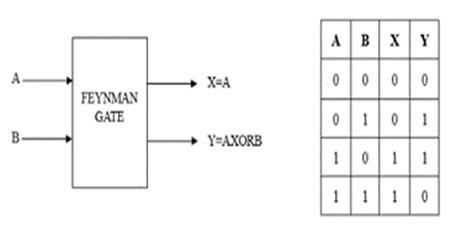
Fig-5: FGanditstruthtable
iii. PERES GATE (PG)
ThePeresgateisareversiblelogicgatewiththreeinputs:A, B, and C, and it generates three outputs: X, Y, and Z. The output X equals A, Y is determined by A XOR B, and Z is
produced by XORing the multiplication of A and B with C. Thetruthtableillustratestheoutputsforeverypossibleset ofinputcombinations.
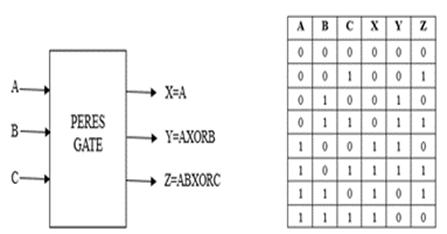
Fig-6: PGanditstruthtable
iv. FREDKIN GATE (FDG)
The Fredkin gate is a reversible logic gate that has three inputs:A,B,andC,alongwiththreeoutputs:X,Y,andZ.The output X is equal to A, whereas Y is calculated using the formula(Y=(A'B)XOR(AC)).Zisobtainedfromtheformula (Z = (A'C) XOR (AB)). The truth table displays the output valuesforeverypossiblecombinationofinputs.
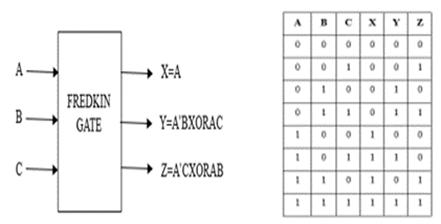
Fig-7: FDGanditstruthtable
v. TOFFOLI GATE(TG)
The Toffoli gate, often referred to as the CCNOT gate or controlled-controlled-NOTgate,isafundamentalreversible logicgateusedinclassicalcomputing.Itworkswiththree inputs: A, B, and C. The gate toggles the target bit A only when both control bits B and C are equal to 1; if not, A remainsunchanged.
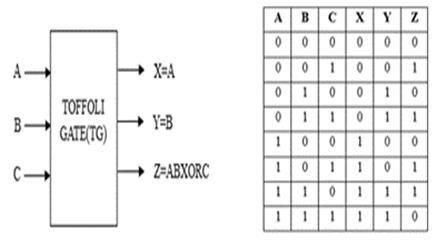
Fig-8: TGanditstruthtable
International Research Journal of Engineering and Technology (IRJET) e-ISSN: 2395-0056
Volume: 11 Issue: 11 | Nov 2024 www.irjet.net p-ISSN: 2395-0072
The ALU carries out various functions based on control signals.Itsfeaturescomprisea4-bitcontrolsignal,two32bit digital data inputs, and one 32-bit digital data output. According to the control signals, various arithmetic and logicalfunctionsareexecuted,asoutlinedinTable1.The32bit reversible ALU can perform 13 distinct operations, all directedbythesecontrolsignals.TheALU'scombinational circuitsareconstructedwithreversiblelogicgates.Figure8 illustratestheblockdiagramofa32-bitALU.
Table-1: FunctionalDescriptionof32-BitALU

4.2.1 Combinational and Basic gates
ArithmeticandlogicunitsofreversibleALUaredesignedby usingfollowingcombinationalandbasicgates.
1. Reversible Full Adder/Subtractor
Areversiblefulladder/subtractorcircuitcanbeconstructed using Feynman gates (FG) and Peres gates (PG), as illustratedinFigure8.Thiscircuitenablesbinaryaddition andsubtractionwhilemaintainingreversibility.Ithasthree inputs:A,B,andCin(carryin),withaControlLine(CL)that specifiestheoperationmode.Inadditionmode(CL=0),PG1 calculatestheSum(S)ofAandB,whilePG2generatesthe Carry(C)foranyoverflow.Insubtractionmode(CL=1),PG1 computestheDifference(D),andPG2providestheBorrow (B)whenAislessthanB.
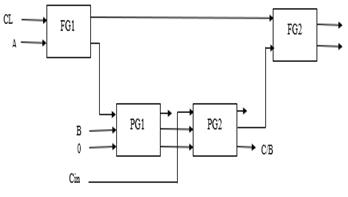
Fig-9: Fulladder/Subtractor
2. Reversible multiplier
A Vedic multiplier module implements efficient hardware multiplication using the Urdhva Tiryagbhyam sutra. It multipliestwo32-bitnumbersbybreakingtheminto16-bit halvesandusingfour16x16Vedicmultiplierstoproduce32bit partial products. 32-bit adders combine these partial products to yield a 64-bit result, divided into four 16-bit sections. This approach streamlines large-number multiplication by leveraging parallel processing and hierarchicalmoduledesign.
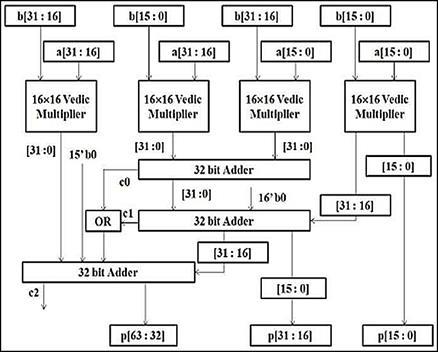
Fig-10:32-bitVedicmultiplier
3. Increment and Decrement
32-bitincrementanddecrementoperationsadjusta32-bit binary number by one. For incrementing, the operation startsfromtherightmostbit,flipping0to1andstopping,or flipping1to0andcontinuingleft.Anoverflowoccursifall bitsare1.Fordecrementing,theoperationstartssimilarly butflips1to0andstops,orflips0to1andcontinuesleft.An underflowoccursifallbitsare0.
International Research Journal of Engineering and Technology (IRJET) e-ISSN: 2395-0056
Volume: 11 Issue: 11 | Nov 2024 www.irjet.net p-ISSN: 2395-0072
4. Logical AND
AnANDgateconstructedwithFredkingates,alsoknownas controlled-SWAP gates, executes the AND operation by guaranteeing that both output bits are 1 only when both inputbitsare1.Ifeitherinputis0,theoutputwillalsobe0, mirroringthefunctionalityofastandardANDgate.
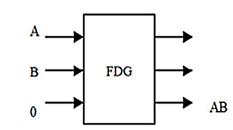
Fig-11: ANDGateusingFredkin
5. Logical OR
An OR gate constructed using Fredkin gates, a form of reversiblelogiccircuit,functionsbysettingtheoutputbitsto 1ifatleastoneinputbitis1.Ifbothinputsare0,theoutput will also be 0, which aligns with the behavior of a conventionalORgate.
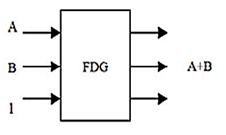
Fig-12: ORGateusingFredkin
6. Logical NOR
ANORgatebuiltwithFredkingatesandaNOTgateexecutes the NOR operation in reversible logic. The Fredkin gate managestheNORfunction,whiletheNOTgateinvertsthe outputtoyieldtheoppositeofanORoperation.
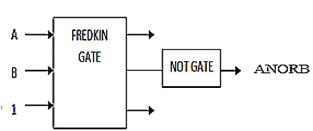
Fig-13: NORgateusingFredkinandNOTgate
7. Logical NAND
ANANDgateconstructedusingToffoligatesisareversible logiccircuitthatproducesatrueoutputunlessbothinputs aretrue.ItutilizestwoToffoligatestotoggleinputbitsand
managetheoutput.Theoutputisfalsewhenbothinputsare true;ifeitherinputisfalse,theoutputbecomestrue,which alignswiththefunctionofaNANDgate.
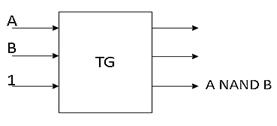
Fig-14: NANDgateusingToffoli
8. Logical XOR
AnXORgateconstructedwithFeynmangatesisareversible circuitthatcarriesouttheexclusiveORfunction.Feynman gates,whichperformcontrolled-NOToperations,generate anoutputof1whentheinputbitsaredifferentand0when theyarethesame,whichreflectsthebehaviorofastandard XORgate.
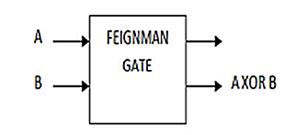
Fig-15: XORgateusingFeynman
9. Logical XNOR
AnXNORgateusingFeynmangatesandaNOTgateperforms the exclusive NOR operation. The Feynman gates manage controlled-NOT functions, while the NOT gate inverts the output, yielding 1 when the input bits match and 0 when theydiffer,consistentwithXNORlogic.
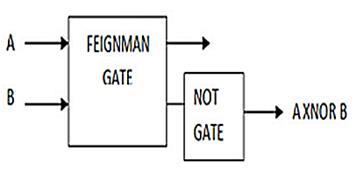
Fig-16: XNORgateusingFeynmanandNOTgate
10. Pipelining
Pipelining is a technique that improves instruction processing by breaking it into sequential stages within a pipeline, allowing overlapping execution of multiple instructions.Eachpipelinestageincludesaninputregister anda combinational circuit, with the register storing data andthecircuitperformingoperations.Thissetupincreases overallthroughputbyprocessinginstructionsconcurrently and reducing the critical path with strategically placed
International Research Journal of Engineering and Technology (IRJET) e-ISSN: 2395-0056
Volume: 11 Issue: 11 | Nov 2024 www.irjet.net p-ISSN: 2395-0072
latches,thusenablinghigherspeeds.However,italsoleads tomorelatchusageandincreasedsystemlatency.
InVLSIcircuitdesign,reducingpowerdissipationisnowa major focus. Previously, designers prioritized optimizing area,delay,andtestability,butadvancementsintechnology and shrinking chip sizes have brought power leakage and dissipation to the forefront. To tackle these challenges, techniques such as clock gating and voltage scaling are crucial.Thisworkemphasizesminimizingdynamicpower dissipationbyreducingsignalactivityinthedesign.
Flip-flop-Based Clock Gating
In numerous applications, designs that originally utilized latchesarenowtransitioningtoflip-flop-baseddesigns.By splitting a flip-flop, it effectively creates two latches, following the master-slave concept. This method involves usingaDflip-flopincombinationwithanANDgate.
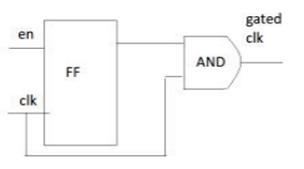
Fig-17: Flip-Flop-BasedClockGating
Asillustratedinthefigure,thegatedclocksignalactivates onlywhenboththeflip-flopoutputandtheclocksignalare high.Ifeitheroftheseislow,thegatedclockremainslow. Therefore,whentheclockisinsleepmode,thegatedclock alsostaysinthelowstate.
TheALUisdesignedandsimulatedusingXilinxVivado,and synthesized for parameter analysis. In Figure 18, inputs A[31:0]andB[31:0]performdifferentoperationsbasedon theselectionline,showingresultsforbothconventionaland reversibleALUs.
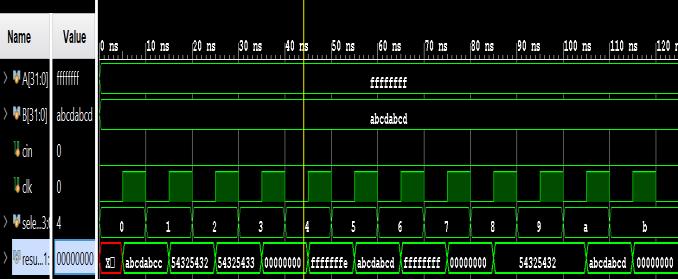
Fig-18: Simulationresultof32bitconventionaland reversibleALU
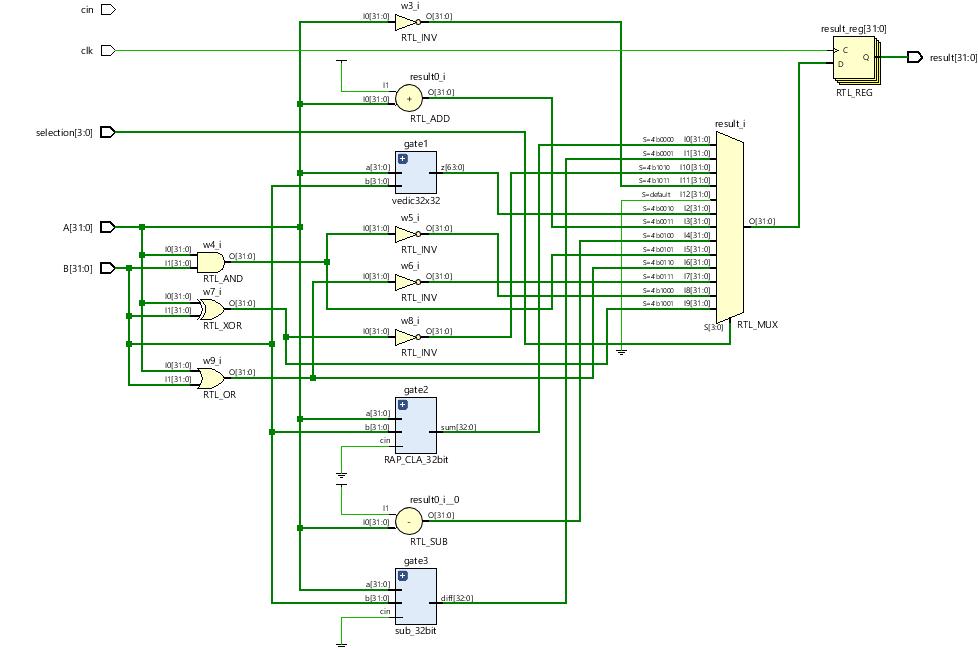
Fig-19: RTLschematicof32bitconventionalALU
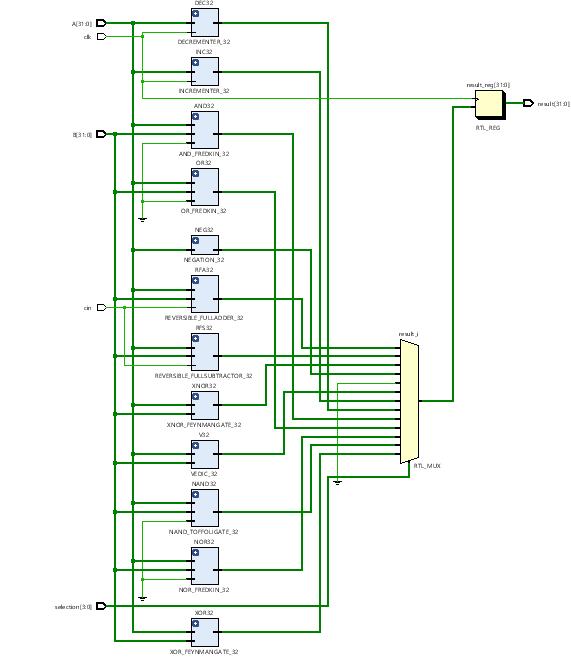
Fig-20: RTLschematicof32bitreversiblelogicALU
International Research Journal of Engineering and Technology (IRJET) e-ISSN: 2395-0056
Volume: 11 Issue: 11 | Nov 2024 www.irjet.net p-ISSN: 2395-0072
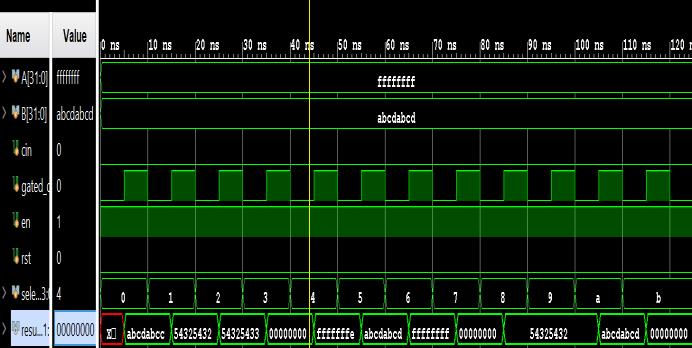
Fig-21: SimulationresultofreversibleALUwithadvanced techniques
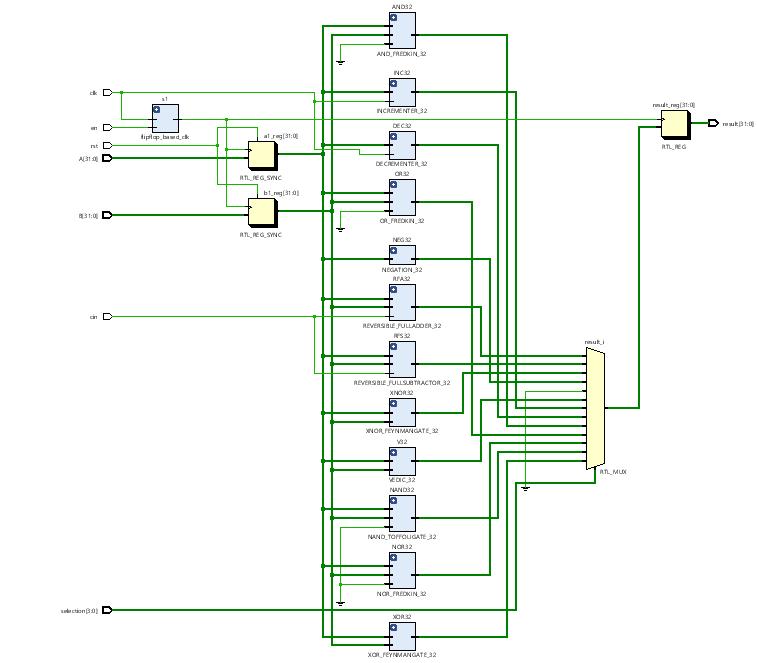
Fig-22: RTLschematicof32bitreversiblelogicALUwith advancedtechniques
powerconsumption,areautilization,anddelay.Theuseof clockgatingandpipeliningtechniquesfurtherboostedALU performance, resulting in a 90% reduction in power consumptionandaprocessingspeedof12.511ns.
In conclusion, this paper presents an effective design strategyfora32-bitreversibleArithmeticLogicUnit(ALU) that employs clock gating and pipelining techniques. The combination of these approaches leads to significant enhancementsintheALU'sperformance,achievinga90% reductioninpowerconsumptionanda 2.52%increase in processing speed. Additionally, the incorporation of reversible logic gates boosts the ALU's efficiency, showcasingtheirpotentialtocreateenergy-efficient,highperformance digital systems. This work emphasizes the promisingfutureofreversiblelogicinlow-powercomputing applications.
[1]Jose, Cissy, T. D. Subash, and Simi P. Thomas. "FPGA implementation of dynamic power, area optimized reversibleALUforvariousDSPapplications."Materials Today:Proceedings24(2020):2044-2053.
[2]S. Nagaraj, B. V. Krishna, B. Chakradhar and D. Sarkar, "Comparison of 32-bit ALU for Reversible Logic and Irreversible Logic," 2021 Innovations in Power and Advanced Computing Technologies (i-PACT), Kuala Lumpur, Malaysia, 2021, pp. 1-5, doi: 10.1109/iPACT52855.2021.9696935.
[3]G. Surekha, G. Madesh, M. P. Kumar and H. Sriramoju, "Design and Implementation of Arithmetic and Logic Unit (ALU)," 2023 2nd International Conference on AppliedArtificialIntelligenceandComputing(ICAAIC), Salem, India, 2023, pp. 1530-1536, doi: 10.1109/ICAAIC56838.2023.10140574.
[4]S. Sen, P. Saha and S. Saha, "FPGA-Supported HDL Approach to Implement Reversible Logic Gate-Based ALU,"202311thInternationalConferenceonInternetof Everything,MicrowaveEngineering,Communicationand Networks(IEMECON),Jaipur,India,2023,pp.1-5,doi: 10.1109/IEMECON56962.2023.10092307.
Table-2: Comparisontableofconventionalandreversible ALU
Table2comparestheresultsofConventionalandReversible ALUs.VerificationtestsconfirmedthattheALUaccurately performs all intended arithmetic and logical operations. Integrating reversible logic gates into the ALU provided significantbenefitsoverconventionaldesigns,particularlyin
[5]N.GaddaandU.Eranna,"64-bitALUDesignusingVedic Mathematics," 2020 International Conference on Emerging Trends in Information Technology and Engineering(ic-ETITE),Vellore,India,2020,pp.1-4,doi: 10.1109/ic-ETITE47903.2020.122.
[6]S. M. Swamynathan and V. Banumathi, "Design and analysis of FPGA based 32 bit ALU using reversible gates,"2017IEEEInternationalConferenceonElectrical,
International Research Journal of Engineering and Technology (IRJET) e-ISSN: 2395-0056
Volume: 11 Issue: 11 | Nov 2024 www.irjet.net p-ISSN: 2395-0072
Instrumentation and Communication Engineering (ICEICE), Karur, India, 2017, pp. 1-4, doi: 10.1109/ICEICE.2017.8191959.
[7]V.PriyankaBrahmaiah,V.KumarGurrala,S.TejaTuduru and K. Hari Kishore, "DESIGN OF AREA AND POWEROPTIMIZEDVLSIARCHITECTUREOFALUDESIGNUSING SIGNEDMULTIPLIER,"2022InternationalConferenceon Recent Trends in Microelectronics, Automation, Computing and Communications Systems (ICMACC), Hyderabad, India, 2022, pp. 276-280,doi: 10.1109/ICMACC54824.2022.10093559.
[8]Rayudu,K.V.B.V.,D.R.Jahagirdar,andP.SrihariRao. "Modern Design and Testing of High Speed Vedic ALU Controller using Vedic Algorithms." Journal of The Institution of Engineers (India): Series B 104, no. 1 (2023):221-230.
[9]S. Sarkar, H. Chatterjee, P. Saha and M. Biswas, "8-Bit ALU Design using m-GDI Technique," 2020 4th InternationalConferenceonTrendsinElectronicsand Informatics(ICOEI)(48184),Tirunelveli,India,2020,pp. 17-22,doi:10.1109/ICOEI48184.2020.9142881.
[10] B. Das, N. Vinutha, N. Zafar and M. Rajeshwar, "Synthesis of Reversible Logic Circuits-A Technical Review,"2023InternationalConferenceonAdvancesin Electronics,Communication,ComputingandIntelligent InformationSystems(ICAECIS),Bangalore,India,2023, pp. 309-313, doi:10.1109/ICAECIS58353.2023.10170496.
[11] M. Bhusal, R. Rohith and R. Sakthivel, "Single Bit Fault Detecting ALU Design using Reversible Gates," 2020International ConferenceonEmergingTrendsin Information Technology and Engineering (ic-ETITE), Vellore, India, 2020, pp. 1-6, doi: 10.1109/icETITE47903.2020.326.
[12] A. Y. N J and A. V R, "FPGA Implementation of a High-Speed Efficient Single Precision Floating Point ALU," 2023 International Conference on Control, Communication and Computing (ICCC), Thiruvananthapuram, India, 2023, pp. 1-5, doi: 10.1109/ICCC57789.2023.10165441.
[13] J.L.V.RamanaKumari,Y.Varshitha,C.GopiandM. Rakesh,"DesignandImplementationofALUUsingRing Counters," 2023 International Conference on Signal Processing, Computation, Electronics, Power and Telecommunication(IConSCEPT),Karaikal,India,2023, pp.1-5,doi:10.1109/IConSCEPT57958.2023.10170295.
[14] J.L.V.RamanaKumari,Y.Varshitha,C.GopiandM. Rakesh,"DesignandImplementationofALUUsingRing Counters," 2023 International Conference on Signal
© 2024, IRJET | Impact Factor value: 8.315 |
Processing, Computation, Electronics, Power and Telecommunication(IConSCEPT),Karaikal,India,2023, pp.1-5,doi:10.1109/IConSCEPT57958.2023.10170295.
[15] A. A. Purohit, M. R. Ahmed and R. V. S. Reddy, "DesignofAreaOptimizedArithmeticandLogicalUnit forMicrocontroller,"2020IEEEVLSIDEVICE CIRCUIT ANDSYSTEM(VLSIDCS),Kolkata,India,2020,pp.335339,doi:10.1109/VLSIDCS47293.2020.9179942.
|