
International Research Journal of Engineering and Technology (IRJET) e-ISSN:2395-0056
Volume:11Issue:11|Nov2024 www.irjet.net p-ISSN:2395-0072

International Research Journal of Engineering and Technology (IRJET) e-ISSN:2395-0056
Volume:11Issue:11|Nov2024 www.irjet.net p-ISSN:2395-0072
1Dhanashree Bagal, 2Sanika Patil, 3Gauri Chavan, 4Srushti Shete, 5Kajal Pawar, 6Dr. Swati Pawar
1,2,3,4,5 UG Students, Department of Computer Science And Engineering, SVERI’s College of Engineering, Pandharpur, Maharashtra, India
6Associate Professor, Department of Computer Science And Engineering, SVERI’s College of Engineering, Pandharpur, Maharashtra, India
Abstract:
The paper presents an innovative e-voting system that integrates facial recognition and blockchain technology to address security and authenticity issues in online voting. The system uses facial recognition to uniquely identify registered voters, ensuring that each individual is authorizedtovote.Thistechnologypreventsidentityfraud and enhances the security of the voting process. Blockchain technology is employed to record votes securely, ensuring transparency, immutability, and verificationofthevotingdata.Thesystemallowsvotersto casttheirvotesremotelywhilemaintainingconfidentiality and trust in the election process. The paper discusses the methodologybehindthedesignandimplementationofthe e-votingsystem,focusingonintegratingthesetechnologies for a secure, scalable, and efficient voting experience. Additionally,thechallengesfacedduringdevelopmentand thepotential improvementsforfutureimplementations of this system are also highlighted. This approach aims to modernize the voting process, making it more accessible, secure,andtransparentforelectionsinvarioussectors.
Keywords:
E-Voting, Face Recognition, Blockchain, Security, Reliability,transparency,Functionality,Estonia,Electronic Governance,DecentralizedSystem,userauthentication.
The significance of "electronic voting using facial recognition and blockchain" is that it can change the way of voting by solving important problems such as security, package transparency, and access. In many traditional voting systems, problems such as voting, double voting, electionfraud,andvoterfraudthreatentheintegrityofthe election[1][2][3].Thecombinationofblockchaincreatesa secureandreliableelection[4].Facialrecognitionreduces the risk of fraud and increases the accuracy of voter identification by ensuring that only registered people can vote[5][6].Thedistributedandimmutablestructureofthe
blockchaincanprotecttheintegrityofvotesbypreventing vote data from being tampered with or altered [7]. Together,thesetechnologiesincreasepublicconfidence in elections by ensuring that all votes are secure and accurate. It is especially effective in remote or large turnout situations [8]. The initiative highlights the importance of integrating new technologies into the democratic process to ensure a secure and transparent electoral process, safeguard fair elections, and enhance publicparticipation[9].
E-Voting System Using Blockchain and Face Recognition:
Electronic voting using facial recognition and blockchain addresses key issues in the electoral process, including voter identification, fair voting, transparency, and prevention of fraud. Current research and progress on evoting, facial recognition, and blockchain technology also identify gaps and challenges to overcome in the planning process[1][2][3].
1. N Prathyusha, P Pooja, A Vijay Vasanth. “Blockchain-BasedE-VotingSystemwithFacial Recognition.” This paper proposes a blockchainbased e-voting system with facial recognition for secure voter authentication. It ensures tamperproof voting and accurate voter identification, improving transparency, security, and privacy in elections
2. Rifa Hanifatunnisa, Budi Rahardjo. A review paperonBlockchainBasedE-VotingRecording System Design. This paper highlights the use of blockchain for secure and immutable e-voting systems, ensuring data integrity and reducing fraud risks. It emphasizes transparency and decentralizeddatastorage.
International Research Journal of Engineering and Technology (IRJET) e-ISSN:2395-0056
Volume:11Issue:11|Nov2024 www.irjet.net p-ISSN:2395-0072
3. Kanika Garg,PaviSaraswat,Sachin Bisht, Sahil Kr.Aggarwal,SaiKrishna Kothuri,SahilGupta. A Comparitive Analysis on E-Voting System Using Blockchain The authors analyze different blockchain-based e-voting systems, focusing on their benefits like security and transparency, while addressing challenges such as scalability andvoterauthentication.
4. Ali Mansour AI-madani, Ashok T. Gaikwad, Vivek Mahale, Zeyad A.T. Ahmed. Decentralized Evoting System based on Smart ContractbyusingBlockchainTechnology This study proposes a decentralized e-voting system using blockchain smart contracts to automate voting processes, ensuring transparency while reducingthird-partydependencies.
5. Friðrik Þ. Hjálmarsson, Gunnlaugur K. Hreiðarsson, Mohammad Hamdaqa, Gísli Hjálmtýsson. Blockchain-Based E-Voting System. Thepaperpresentsablockchain-basedevoting prototype, leveraging cryptographic techniquestoenhanceprivacyandsecurity,witha focus on permissioned blockchains for efficient performance.
6. Ayesha Shaikh, Bhavika Oswal, Divya Parekh and B. Y. Jani, "E-voting Using One Time Password and Face Detection and Recognition". This paper proposes an e-voting system combining OTP authentication and face recognition for enhanced security, preventing impersonation and ensuring reliable voter verification.
7. F. Schroff, D. Kalenichenko and J. Philbin, "FaceNet: A unified embedding for face recognition and clustering". The FaceNet algorithm introduces a deep learning model that mapsfacialimagestoaEuclideanspace,achieving high accuracy in face recognition and clustering, optimizedbytripletloss.
8. I. William, D. R. Ignatius Moses Setiadi, E. H. Rachmawanto, H. A. Santoso and C. A. Sari, "Face Recognition using FaceNet (Survey Performance Test and Comparison)". This study evaluates FaceNet's performance across various datasets, demonstrating its robustness and high accuracy in recognizing faces under different conditions like pose and lighting. Vernekar et al. (2020) presents an exploration of blockchain technology for developing a secure,
transparent, and cost-efficient e-voting system, addressingtechnical,legal,andsecuritychallenges initsimplementation[9].
Traditional voting systems face numerous challenges, including logistical difficulties, high costs, long counting times, voter fraud, and tampering risks. Electronic voting (e-voting)systemshaveemergedtoaddresssomeofthese issues but are vulnerable to security threats such as hacking and unauthorized access. Ensuring voter privacy and authentication remains critical, as current methods oftenrelyoninsecuretechniqueslikepasswords.
Publictrustinelectoralprocesseshasdiminishedduetoa lackoftransparencyandaccountability,withvotersunable to verify that their votes are accurately recorded and counted. To tackle these challenges, an innovative voting system that combines facial recognition technology with blockchaincouldbeeffective.
Facial recognition offers a reliable way to authenticate voter identity and prevent impersonation, while blockchain provides a decentralized, tamper-proof ledger for recording votes, ensuring they cannot be altered after casting while maintaining voter anonymity. This integrated approach aims to enhance voter security, ensure transparency, and restore public confidence in evoting systems, ultimately safeguarding the integrity of democraticprocesses.
1. To enhance Voter Authentication with Facial Recognition.
2. To ensure the Integrity of Votes through Blockchain.
3. ToeliminateVoterFraudandImpersonation.
4. TocreateaTransparentandVerifiableVoting Process.
5. To increase Election Efficiency and Accessibility.
International Research Journal of Engineering and Technology (IRJET) e-ISSN:2395-0056
Volume:11Issue:11|Nov2024 www.irjet.net p-ISSN:2395-0072
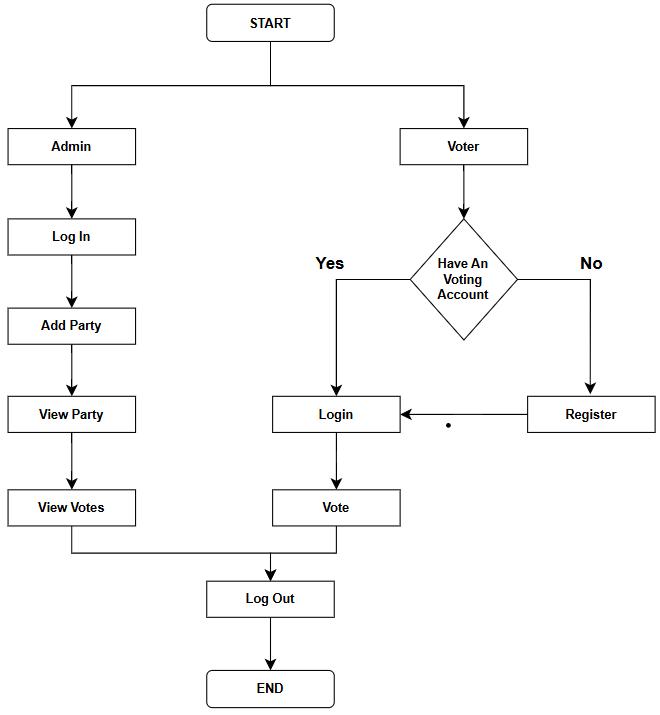
Fig1:BlockDiagram
This electronic voting system provides a secure and effective platform for digital voting and includes the ability to recognize faces to ensure the authenticity of voters. This method is divided into two main user roles:administratorsandvoters.
1. Administratorregistrationandlogin:
i. Themanagerisresponsiblefor managing the election, including adding and managing candidates.
ii. Manager must log in using their security credentials.
iii. Youcancheckthevotingresultsandmonitor the voting status of all political parties inreal-time.
2. Voterregistrationandloginviafacialrecognition:
i. VotersneedavotingID.Ifvotersdonothave anaccount,theywillgo through aregistrationprocess.
ii. The registration process includes recording their facial information. time. This image is securely stored in the system database for futurefacialrecognition.
iii. Steps to ensure unique information for each voter number and prevent double registration.
3. Whenloggedin,thesystem comparesthevoter's live image with the image in the database using the recorded image for facial recognition. Blockchain-integratedvotingprocess:
i. After identity verification, voters can choose their favorite candidate or candidates and vote.
ii. ThesystemgeneratesauniquehashIDusing blockchain technology. This hash ID acts as immutable data, ensuring that votes cannot bechanged,copiedortamperedwith.People voteirreversibly.
iii. Trust IDs are securely held, preserving the integrityandconfidentialityofallvotes.
4. SystemWorkflow:
i. Aftervoting,thevoterlogsout,protectingthe systemandpreventingunauthorizedaccess.
The approach uses blockchain technology and facial recognition to create a secure and tamperproofelectronicballot.Thesystempreventsvotemani pulationbygeneratingauniqueblockchain-basehash IDforeachvote,ensuringthateveryvoteisunaltered, traceableandsecure
Algorithms Used in the E-voting System Using Face RecognitionandBlockchain:
1. HaarCascadeClassifier(OpenCV):
The Haar Cascade Classifier is an algorithm used for object detection, specifically for identifying faces in images and videos. It employs machine learning techniques to create a cascade function using both positive and negative image samples. The algorithm analyzes images at multiple scales to detect features such as the edges of the face, eyes, and nose. If it identifies a sufficient number of matches, it verifies
International Research Journal of Engineering and Technology (IRJET) e-ISSN:2395-0056
Volume:11Issue:11|Nov2024 www.irjet.net p-ISSN:2395-0072
the presence of a face. Its high efficiency makes it well-suitedforreal-timeapplications.
2. FaceEncodingsandComparisons(dlib):
The dlib face encoding algorithm generates a 128dimensional vector that represents an individual's face. This allows for effective comparisons of images using Euclidean distance; shorter distances signify closer matches and achieve high accuracy regardless of lighting or variations in expression. On the other hand, the Haar Cascade Classifier detects faces in images and videos by employing machine learning to develop a cascade function from both positive and negative samples, scanning for facial features at differentscales.Itsefficiencymakesitappropriatefor real-timeapplications.
3. Dlib’s ResNet-basedModel:
Dlib employs a modified ResNet-34 architecture for extractingfacialfeatures.It utilizesresidual blocksto address the vanishing gradient issue, facilitating the effective training of deeper networks. This design allows for the learning of intricate facial characteristics through sequential convolutional layers, producing a vector representation for face recognition. ResNet models are effective at feature extraction and are particularly adept at handling complex visual patterns, which makes them wellsuitedforfacerecognitionapplications.
4. EuclideanDistance:
Euclidean distance quantifies the direct distance betweentwopointsinmulti-dimensionalspaceandis utilized here for comparing face encodings. In facial recognition, the algorithm determines the distance between two encoding vectors, identifying them as representing the same individual if the distance is belowa specifiedthreshold. Itssimplicity,speed,and efficiency make Euclidean distance particularly appropriate for face verification tasks, especially in small-scale,low-dimensionalenvironments.
5. ShapePredictor(dlib):
Dlib’s shape predictor detects 68 facial landmarks, including the eyes, nose, and mouth, to pinpoint distinct features on a face. It employs a regressionbased model to examine their relative positions, creatingastructurethatcorrespondstoahumanface. This alignment is crucial for improving the accuracy
of face recognition algorithms by ensuring proper positioning,nomattertheindividual’sangleorpose.
6. SHA256(HashingAlgorithmforBlockchain):
SHA256 is a cryptographic hash function that produces a fixed-length output of 256 bits (32 bytes) from any input. It is widely used in blockchain technology to ensure data integrity and security. In a blockchain, each block contains a hash of the preceding block, a timestamp, and transaction data, with SHA256 generating a unique hash for every block. Any modification to the block results in a significant change to the hash, facilitating tamper detection. Its strong security features, computational efficiency, and resistance to collisions make SHA256 an excellent choice for securing blockchain transactionsandelectronicvotingsystems.
7. ProofofWork(PoW)(Blockchain):
Proof of Work (PoW) is a consensus mechanism utilized in blockchain networks to validate transactions and incorporate new blocks. Miners engageincompetitiontosolveintricatecryptographic puzzles, and when a valid solution is discovered, the new block isintegratedinto the blockchain,providing arewardtotheminer.Thisprocessentailssubstantial computational resources, which serves as a deterrent against manipulation by malicious entities. PoW strengthens blockchain security by requiring considerable effort for transaction validation, thereby makingitexpensiveforattackerstomodifythechain.
8. RSA(ForEncryptionofVotes):
RSAisanasymmetriccryptographicalgorithmutilized for data encryption and decryption, making it appropriateforencryptingvotesinane-votingsystem prior to their submission to the blockchain. It uses a keypair:apublickeyforencryptionandaprivatekey for decryption. When a vote is cast, it is encrypted withthepublickey, ensuringthatonlythedesignated recipient with the private key can decrypt it. RSA provides a high level of security for sensitive information, guaranteeing that only authorized individualscanaccesstheencrypteddata.
VII. Results
TableNumber1:
This table has columns like Candidate ID, Candidate Name, Area, and Number of Votes which show which
International Research Journal of Engineering and Technology (IRJET) e-ISSN:2395-0056
Volume:11Issue:11|Nov2024 www.irjet.net p-ISSN:2395-0072
candidate has how many votes and that candidate is fromwhicharea.
Table1:TableofVectorIdentificationAccuracy.
Figure number 3 is the figure that shows which voters have voted to whom, what is the hash ID of that vote and whatistimeofvote.
1. System Security: The integration of blockchain ensures the tamper-proof nature of the voting records, providing high-level security and transparencythroughoutthevotingprocess
2. Scalability: The system demonstrated the ability to handle multiple users and large datasets, making it a scalable solution for elections with highvoterturnout.
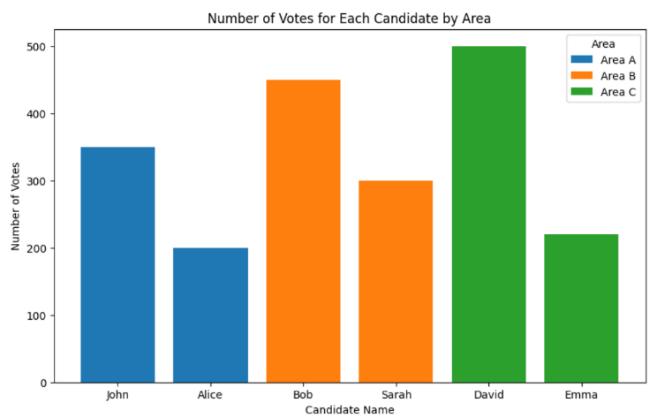
Fig2: GraphofcandidatesandNumberofvotes
Figurenumber2istheimageofgraphthatdescribesthe abovetablei.e.,tablenumber1

Fig3:Showvotesandtheirinformation
3. Voter Identification: Facial recognition proved to beaneffectiveandreliablemethodforidentifying voters, significantly reducing the chances of fraudulentvoting.
4. Performance: The system operates with minimal latency for voter identification and blockchain verification, providing real-time results without noticeabledelays.
5. Fraud Prevention: The combined use of blockchain and facial recognition reduces the possibility of identity theft, vote duplication, and othertypesofelectionfraud.
The proposed e-voting system integrates blockchain and facial recognition, ensuring a secure and transparent voting process. The system effectively addresses the challenges of fraud and identity verification, making it a scalable solution for secure online voting. Blockchain technology enhances the security and transparency of the voting process, reducing the risk of tampering and fraud. Facial recognition ensures accurate voter identification and eliminates the need for traditional authentication methods.
1. Improve Blockchain Performance: Enhance the scalability and speed of blockchain for handling large-scale elections efficiently, ensuring faster transactionprocessing.
2. AI Integration: Integrate AI for real-time fraud detection during voting, enabling the system to identify and mitigate suspicious activities immediately.
International Research Journal of Engineering and Technology (IRJET) e-ISSN:2395-0056
Volume:11Issue:11|Nov2024 www.irjet.net p-ISSN:2395-0072
3. Facial Recognition Enhancement: Improve the accuracy and reliability of facial recognition in low-light conditions and varying environments to ensureconsistentperformance.
4. Multi-Factor Authentication: Incorporate multifactor authentication (e.g., OTP, biometrics) to strengthen voter security further and prevent unauthorizedaccess.
5. Biometric Authentication: Explore the possibility of integrating additional biometric systems (e.g., fingerprint, iris scan) for a more robust voter identificationprocess.
References
ResearchPapers:
1. N Prathyusha, P Pooja, A Vijay Vasanth. “Blockchain-Based E-Voting System with Facial Recognition.” International Conference on Inventive Computation Technologies (ICICT), 2023.
2. RifaHanifatunnisa,BudiRahardjo.Areviewpaper on Blockchain Based E-Voting Recording System Design, 11th International Conference on Telecommunication Systems Services and Applications(TSSA),2017.
3. Kanika Garg,PaviSaraswat,Sachin Bisht, Sahil Kr. Aggarwal, Sai Krishna Kothuri, Sahil Gupta. A Comparitive Analysis on E-Voting System Using Blockchain, 4th International Conference on Internet of Things: Smart Innovation and Usages, 2019.
4. Ali Mansour AI-madani, Ashok T. Gaikwad, Vivek Mahale, Zeyad A.T. Ahmed. Decentralized Evoting System based on Smart Contract by using Blockchain Technology, International Confrernce on Smart Innovations in Design, Environment, Management, Planning and Computing (ICSIDEMPC),2020.
5. Friðrik Þ. Hjálmarsson, Gunnlaugur K. Hreiðarsson, Mohammad Hamdaqa, Gísli Hjálmtýsson. Blockchain-Based E-Voting System. IEEE International Conference on Cloud Computing,CLOUD2018.
6. Ayesha Shaikh, Bhavika Oswal, Divya Parekh and B.Y.Jani,"E-votingUsingOneTimePasswordand FaceDetectionandRecognition", INTERNATIONAL
JOURNAL OF ENGINEERING RESEARCH & TECHNOLOGY (IJERT), vol. 03, no. 02, February 2014.
7. F. Schroff, D. Kalenichenko and J. Philbin, "FaceNet: A unified embedding for face recognition and clustering", 2015IEEEConference on Computer Vision and Pattern Recognition (CVPR),pp.815-823,2015.
8. I. William, D. R. Ignatius Moses Setiadi, E. H. Rachmawanto, H. A. Santoso and C. A. Sari, "Face Recognition using FaceNet (Survey Performance Test and Comparison)", 2019FourthInternational Conference on Informatics and Computing (ICIC), pp.1-6,2019.
9. Vernekar, A. G., Phutane, M., Godase, R., Waghmode, V., & Shinde, S. M. (2020). Blockchain based E-Voting System. International Research Journal of Engineering and Technology (IRJET), 7(12),1786.