
International Research Journal of Engineering and Technology (IRJET) e-ISSN:2395-0056
Volume:11Issue:11|Nov2024 www.irjet.net p-ISSN:2395-0072
Shubham

International Research Journal of Engineering and Technology (IRJET) e-ISSN:2395-0056
Volume:11Issue:11|Nov2024 www.irjet.net p-ISSN:2395-0072
Shubham
Maurya1 , Ranjeet Yadav2 , Rishabh Gautam3 , Indra Kumar4 , Nilaksh Tripathi5 , Shubhendu Mishra6
1 ,2,3,4 Students , Department Of Civil Engineering GITM , Lucknow
6 Associate Professor , Department Of Civil Engineering GITM , Lucknow
Abstract-The Hyperloop is a revolutionary high-speed transportation concept designed to address the challenges of modern travel, including efficiency, sustainability, and speed. Proposed as a system of low-pressure tubes through which pressurized capsules travel on air bearings or magnetic levitation, the Hyperloop aims to achieve unprecedented travel speeds exceeding 1,000 km/h (620 mph). Powered by renewable energy sources like solar and wind, it promises a greener alternative to traditional The Hyperloop system operates in a near-vacuum transportation. Environment tominimizeairresistanceand friction, enabling ultra-fast and energy-efficient travel. Its lightweightpodsarepropelledbylinearelectricmotorsand advanced magnetic levitation technology, ensuring smooth, low-maintenance operations. Designed for inter-city connectivity, the system has the potential to drastically reduce travel times, revolutionizing logistics and daily commutes.
While the Hyperloop remains largely in the development and testing phases, it has garnered global interest from companies and governments due to its transformative potential. Challenges such as high construction costs, safety regulations, and public acceptance remain significant barriers to widespread adoption. However, with continued innovation and collaboration, the Hyperloop could redefine transportation, providing an efficient, sustainable, and futuristic solution to the growing demands of global mobility.
Key word: sustainability, efficiency, magnetic levitation , vaccum,transformative,widespread.
The Hyperloop is an innovative and disruptive transportation concept that seeks to revolutionize longdistance travel by combining speed, efficiency, and sustainability.ProposedbyElonMuskin2013,itenvisions high-speed capsules or "pods" traveling through lowpressure tubes at speeds exceeding 700 miles per hour, potentially reducing travel times between major cities from hours to minutes. Unlike traditional forms of transport, such as trains and airplanes, the Hyperloop promises to address key challenges, including congestion, high energy consumption, and environmental impact, offeringacleaner,moreefficientalternative.
This study aims to analyze the feasibility of Hyperloop technology, focusing on its technical, economic, and environmental implications. The paper explores the current state of research and development, including the challenges faced in terms of infrastructure, safety, and regulatory approval. Additionally, it evaluates the potential economic benefits of Hyperloop systems, including cost reduction in transportation and job creation, while assessing the environmental impact, such as energy consumption and carbon emissions. By examiningcasestudiesofongoingHyperloopprojectsand advancements in related technologies, this research provides a comprehensive understanding of the transformative potential of Hyperloop, as well as the obstaclesthatmustbeovercomeforitto becomea viable modeoftransportationinthefuture.
The Hyperloop is based on the principle of reducing resistance to enable ultra-high-speed transportation. Its core concept involves a low-pressure tube or tunnel in whichcapsulesorpodstravel,significantlyminimizingair resistance and friction. By eliminating two primary forces that slow down conventional vehicles air drag and friction with the ground the Hyperloop achieves efficiencyandspeedsexceedingthoseofairplanes.
In this near-vacuum environment, capsules are either levitated using magnetic levitation (maglev) or ride on a cushion of air created by air bearings. The propulsion system employs linear electric motors to accelerate and decelerate the pods smoothly. Renewable energy sources, such as solar panels mounted along the tube, are envisioned to power the system, making it environmentallysustainable.
The Hyperloop's design ensures safety, speed, and efficiency. The enclosed system shields it from weather conditions and external interferences, enhancing reliability and reducing maintenance. Moreover, its highspeed operations and low energy consumption offer a transformativesolutiontomoderntransportationneeds.
1. Low-PressureTube:
The backbone of the Hyperloop system is a long, sealed tube maintained at near-vacuum pressure.
International Research Journal of Engineering and Technology (IRJET) e-ISSN:2395-0056
Volume:11Issue:11|Nov2024 www.irjet.net p-ISSN:2395-0072
Thisenvironmentreducesairresistancetoalmost negligible levels, enabling pods to travel at extremely high speeds. Advanced vacuum pumps are used to maintain the low-pressure conditions withinthetube.
2. Pods/Capsules:
Thepassengerorcargopodsareaerodynamically designed to minimize drag. They are lightweight and constructed using materials like carbon fiber or aluminum to ensure strength without compromisingspeed.Thepodshouse propulsion, braking systems, and safety mechanisms, ensuringasecureandcomfortableride.
3. LevitationSystem:
Two main levitation technologies are used in Hyperloopdesigns:
Magnetic Levitation (Maglev): Strong magnets lift the pod above the track, eliminating friction. Variants include electromagnetic suspension (EMS) and electrodynamicsuspension(EDS).
Air Bearings: Some designs use pressurized air beneath the pods to create a cushion, furtherreducingfriction.
4. Propulsion System:
Linear electric motors (LEM) are the primary propulsion mechanism. These motors use electromagnetic fields to accelerate the pod to high speeds. The system can also decelerate the pods by reversing the magnetic forces, enabling precisecontrol.
5. EnergySource:
Solar panels integrated along the length of the tube provide sustainable energy to power the system. Additional renewable sources, such as wind or geothermal energy, can supplement the energy supply, aiming for a net-zero carbon footprint.
6. SupportStructures:
Elevated pylons or underground tunnels support the tubes. Elevated designs reduce land-use impact, while tunnels are used in urban or environmentallysensitiveareas.
7. ControlandSafetySystems:
Advanced computer systems monitor and control pod movement, maintaining optimal speeds and ensuring collision avoidance. Emergency braking systems and redundant safety measures are includedtohandleanymalfunctions.
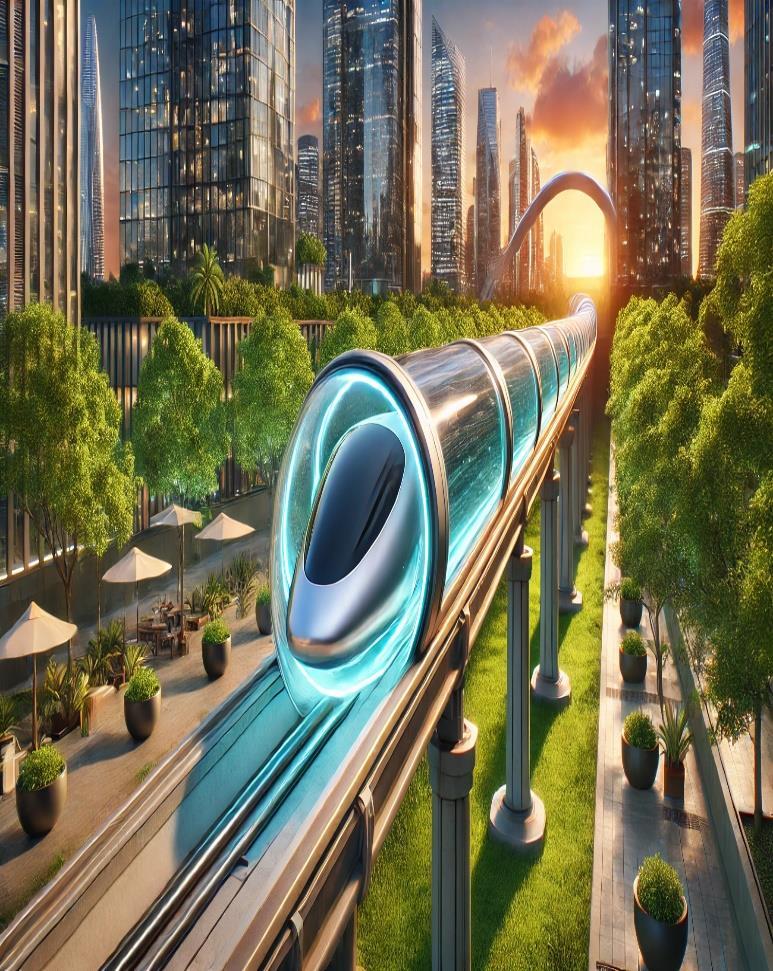
3. FUTURE WORK SCOPE
The Hyperloop represents a transformative shift in transportation technology, with significant potential for globalimpactacrosspassengertravel,freightlogistics,and infrastructure development. While still in the experimental and testing phase, its future scope is vast and promising, driven by the need for sustainable, efficient,andhigh-speedtransitsolutions.
3.1RevolutionizingInter-CityTravel
The Hyperloop offers the potential to connect cities at unprecedented speeds, rivaling or even surpassing air travel. For example, a journey that typically takes several hours by car or train could be reduced to mere minutes. This would foster regional integration by making commuting between cities more practical and convenient, reshapingurbanandsuburbandevelopment. Futurework couldfocusonintegratingHyperloopsystemsintoexisting transport networks to create seamless multimodal transit hubs.
3.2TransformingFreightTransportation
TheHyperloop’sabilitytotransportcargoathighspeeds and with low energy consumption could revolutionize supply chains. Goods could move between cities or even
International Research Journal of Engineering and Technology (IRJET) e-ISSN:2395-0056
Volume:11Issue:11|Nov2024 www.irjet.net p-ISSN:2395-0072
continents faster than ever before, reducing delays and storage costs. With a lower environmental impact compared to trucking or air freight, Hyperloop systems could play a significant role in building sustainable logistics networks. The future scope includes specialized designs for cargo pods, automated handling systems, and dedicatedHyperloopfreightcorridors.
3.3PromotingSustainability
With the Hyperloop’s reliance on renewable energy sources like solar panels and its minimal carbon emissions, it aligns with global goals to combat climate change. Future work could focus on maximizing energy efficiency through advanced materials, energy storage systems, and integration with other renewable technologies. Research could also explore methods to reduce the environmental footprint of constructing and operating Hyperloop systems, such as using recycled materialsandoptimizinglanduse.
3.4TechnologicalAdvancements
The development of Hyperloop technologies such as magnetic levitation, vacuum pumps, and advanced materials opens avenues for innovation across industries.Forinstance,breakthroughsinmaglevsystems or low-friction materials could benefit not only transportation but also energy, robotics, and manufacturing sectors. Future work includes enhancing levitationefficiency,improvingtubevacuummaintenance, anddevelopingmorecost-effectivematerialsforpodsand infrastructure.
3.5EconomicandEmploymentOpportunities
The large-scale deployment of Hyperloop systems would generate significant economic activity, including construction, maintenance, and operation of the infrastructure. It would create jobs in engineering, manufacturing, and technology development while stimulating local economies around Hyperloop stations. Future studies could explore models for public-private partnerships and financing to make Hyperloop projects economicallyviable.
3.6OvercomingChallenges
Several challenges, such as high upfront costs, regulatory approvals,landacquisition,andpublicacceptance,needto be addressed for widespread adoption. Future work should focus on cost reduction through technological innovations, efficient construction methods, and policy frameworks that support Hyperloop projects. Pilot programs and small-scale implementations could demonstratefeasibilityandbuildpublictrust.
As Hyperloop technology matures, it could be tailored to different geographical and socio-economic conditions. Future work may explore adapting the system for longdistance international travel, underwater routes, and regions with extreme climates. Scalability will be key, ensuring that the Hyperloop is accessible and affordable forawiderangeofusersworldwide.
In conclusion, the Hyperloop’s future scope extends beyond transportation to reshaping economies, fostering sustainability, and driving technological innovation. With continued research, collaboration, and investment, the Hyperloop could become a cornerstone of 21st-century infrastructure.
MeritsandDemeritsofHyperloop Merits
UnprecedentSpeed:
The Hyperloop can achieve speeds of over 1,000 km/h (620 mph), significantly reducing travel times compared to conventional trains, cars, and even airplanes. This makesitidealforlong-distancetravel.
1. Energy-Efficiency:
Powered by renewable energy sources such as solar panels, the Hyperloop offers a sustainable alternative to fossil-fuel-based transportation, with lower carbon emissions and energy consumption.
2. Cost-Effective-Operation:
Once constructed, the Hyperloop has relatively low operating costs due to its reliance on renewable energy and minimal wear-and-tear fromreducedfriction.
3. Weather-Independent:
Theenclosedtubesystemshieldsoperationsfrom adverseweatherconditions,ensuringreliableand consistentperformance.
4. Reduced-Traffic-Congestion:
By providing an alternative to road-based transportation,theHyperloopcanalleviatetraffic inurbanareasandreducetravel-relateddelays.
5. Eco-Friendly:
With a small land-use footprint and reliance on green energy, the Hyperloop is a sustainable solutionforgrowingglobaltransportationneeds.
1. High-Initial-Costs:
The construction of Hyperloop infrastructure,
International Research Journal of Engineering and Technology (IRJET) e-ISSN:2395-0056
Volume:11Issue:11|Nov2024 www.irjet.net p-ISSN:2395-0072
including tubes, pylons, and stations, requires significant upfront investment, making it a financiallyriskyventure.
2. Technological-Challenges:
Maintaining a near-vacuum environment over longdistances,ensuringsafetyathighspeeds,and addressingissueslikethermalexpansionintubes posesignificantengineeringchallenges.
3. Safety-Concerns:
Operatingatextremelyhighspeedsinanenclosed tuberaisesconcernsabouttheimpactofaccidents or system failures, such as leaks or mechanical breakdowns.
4. Regulatory-and-Legal-Hurdles:
Hyperloop systems must navigate complex regulatory frameworks and secure land rights, whichcandelayprojectsandincreasecosts.
5. Limited-Capacity:
Compared to conventional trains or airplanes, Hyperloop pods may carry fewer passengers or cargopertrip,potentiallylimitingitsscalability.
6. Public-Acceptance:
Theideaoftravelinginahigh-speedvacuumtube may face resistance from potential passengers duetofearsofsafetyordiscomfort.
TheHyperloopisa transformativetransportationconcept poisedtoaddresssomeofthemostpressingchallengesof modern travel: speed, sustainability, and efficiency. By combiningcutting-edgetechnologiessuchaslow-pressure tubes,magneticlevitation, andrenewableenergy,itoffers the potential to revolutionize both passenger and freight transit.Itspromiseofreducingtraveltimestoafractionof current durations, coupled with a focus on sustainability, positions it as a forward-thinking solution to the growing demandsforglobalconnectivity.
Oneof theHyperloop’s most significant advantages is its reliance on renewable energy sources, such as solar and wind,whichmakesitagreeneralternativetoconventional transportation. By operating in a near-vacuum environment, it minimizes air resistance and friction, leadingtogreaterenergyefficiency.Ifwidelyadopted,the Hyperloop could play a vital role in reducing carbon emissionsandcombatingclimatechange.
However, the path to realizing the Hyperloop's full potential is fraught with challenges. High initial costs, technological hurdles, safety concerns, and regulatory obstacles remain significant barriers. Maintaining a vacuum over long distances, ensuring passenger safety at
extreme speeds, and addressing public acceptance are some of the key areas requiring further research and innovation. The economic viability of large-scale implementation also depends on reducing construction costs and integrating the Hyperloop into existing transportationnetworks.
The Hyperloop’s impact could extend beyond transportation, fostering economic growth, regional development, and job creation. It could connect cities and regions more efficiently, enabling smoother commutes, reducing traffic congestion, and transforming urban and suburban planning. In logistics, it has the potential to revolutionize supply chains by offering faster and more efficientfreighttransport.
In conclusion, while the Hyperloop is still in the experimental phase, its potential to redefine transportationisundeniable.Tomakethisvisionareality, collaboration between governments, private companies, andresearchersisessential.Pilotprojectsandsmall-scale implementations will serve as critical stepping stones in overcoming technical and financial challenges. If successful,theHyperloopcouldusherinaneweraofhighspeed,sustainabletransportation,shapingthewaypeople and goods move across the globe and creating a more connected, efficient, and environmentally responsible future.
1. Simon,Joanna."APrimeronHyperloopTravel:Howfar offistheFuture?" RudinCenterforTransportationPolicy &Management,NewYorkUniversity
2. "Hyperloop Alpha" from the original on 13 August 2013.
3. "ACriticalReviewofHyperloop(Ultra-HighSpeedRail) Technology: Urban and Transport Planning, Technical, Environmental, Economic, and Human Considerations" FrontiersinSustainableCities
4. Opgenoord, Max M. J."How does the aerodynamic design implement in hyperloop concept?" Mechanical Engineering. MIT - Massachusetts Institute of Technology. Archived from the original on 3 October 2019. Retrieved16September2019.
5. Lang, Alex J.; Connolly, David P.; de Boer, Gregory; Shahpar, Shahrokh; Hinchliffe, Benjamin; Gilkeson, Carl A. "A review of Hyperloop aerodynamics".Computers & Fluids.