
International Research Journal of Engineering and Technology (IRJET) e-ISSN:2395-0056
Volume: 11 Issue: 11 | Nov 2024 www.irjet.net p-ISSN:2395-0072

International Research Journal of Engineering and Technology (IRJET) e-ISSN:2395-0056
Volume: 11 Issue: 11 | Nov 2024 www.irjet.net p-ISSN:2395-0072
Kshitij Rai, Aman Tripathi, Vijesh Chaudhari, Dr. Sujata Bhairnallykar
1Consultant at MindCraft Software Pvt. ltd, Mumbai, India
2Java Developer at Tata Consultancy Services Ltd, Thane, India
3Software Engineer at Code B solutions Pvt. ltd, Mumbai, India
4Head Of Department at Saraswati College of Engineering, Kharghar
Abstract - Data Leakage Prevention (DLP) is a crucial technique used by organizations to safeguard sensitive or confidential data. A core component of DLP is the deidentification of Personally Identifiable Information (PII) before sharing it with third parties or stakeholders. Techniques such as masking and replacement are employed to conceal or anonymize PII. Masking involves substituting specific elements, like names or addresses, with generic placeholders such as "<PERSON>" or "*". Replacement substitutes sensitive data with similar but fictitious values, for instance, replacing the name "Aman" with "Rishi". Beyond de-identification, DLP systems incorporate access control mechanisms for uploading and reviewing files, ensuring that only authorized personnel can access the data. Additionally, DLP systems encrypt stored data to prevent breaches, rendering the data inaccessible without the appropriate decryption key, even in the event of theft. As organizations increasingly need to share information with multiple parties, the adoption of DLP technology is essential for maintaining the privacy and security of sensitive information while enabling secure data sharing with relevant stakeholders.
Keywords: De-identification, Extraction, Encryption, Pseudonymization, anonymization
Data breaches are frequently attributed to human error, suchasmisconfigurationsorinadequatedata governance, rather than external hacking attempts. Misconfigured applicationsandsoftwarebugsposeaconstantrisktothe confidentialityofsensitiveinformation.Commonexamples of data leakage include log files that inadvertently store sensitivedetailslikeusernamesandpasswords,aswell as stacktracesorcoredumpsfromcrashedapplicationsthat exposeprivatedata.
Traditional data protection strategies, such as access controlandencryption,areofteninsufficienttoaddressall potential data leakage scenarios. Data leakage can occur when data is shared among multiple users or systems, or when it must be accessible for purposes like auditing or debugging. The widely practiced approach of creating multiple versions of datasets for different purposes is
costly and impractical, especially for large-scale data handling.
The Data Leakage Prevention File System (DLPFS) introduces an innovative approach to secure data sharing across applications and systems. By leveraging advanced datatypeidentificationandde-identificationtechnologies, DLPFS provides robust data protection. It integrates seamlessly into existing infrastructures by exposing a POSIX file system API, enabling applications to access protecteddatasubtreeswithoutsignificantmodifications.
DLPFS enables users to share data securely and maintain privacy across multiple systems without the need to generate custom copies of data for different applications. Additionally, it supports legacy applications by allowing them to operate on de-identified data in real-time, eliminating the need for modifications to the applications themselves.
While the original DLPFS was designed to secure data within POSIX-compliant file systems, its architecture is inherently tied to file-based operations, limiting its applicability in modern, web-based environments. In response to the growing need for privacy-preserving data handling in distributed and dynamic web systems, this project reimagines DLPFS as a web-based application, addressing the challenges of real-time data sharing over HTTPprotocols.
The adapted system retains the core principles of DLPFS, such as sensitive data detection, de-identification, and robust access control, while extending its functionality to meet the demands of web-based workflows. By replacing thePOSIXfilesystemAPIwithascalablewebarchitecture, this project integrates state-of-the-art data masking, redaction, and anonymization techniques into a middleware solution that operates seamlessly across distributedsystems.
International Research Journal of Engineering and Technology (IRJET) e-ISSN:2395-0056
Volume: 11 Issue: 11 | Nov 2024 www.irjet.net p-ISSN:2395-0072
Keyinnovationsinthisadaptationinclude:
Real-Time Data Protection: Implementation of automated workflows forsensitivedatadetection and de-identification during data uploads and retrievals.
● Role-Based Access Control (RBAC): Design of a web-native access control mechanism, ensuring secure, role-specific access to sensitive information.
● Scalability and Usability: Optimization for dynamic, high-volume environments, enabling secure data sharing across diverse stakeholders withoutduplicatingdatasets.
This transition not only modernizes the original DLPFS architecture but also addresses key limitations of POSIXbased systems, such as stateless data handling, interoperability with web protocols, and real-time scalability.Bybridgingthegapbetweenfile-basedsystems and web applications, the project demonstrates how DLP principles can be effectively extended to secure sensitive dataintoday’sweb-drivenecosystems.
Transitioning DLPFS from a POSIX file system to a webbasedarchitecturepresentedseveraluniquechallenges:
● Data Accessibility vs. Privacy: Balancing the need for seamless data accessibility with strong privacymeasuresforsensitiveinformation.
● Real-Time Processing: Ensuring that sensitive data detection andde-identificationoccurinrealtimewithoutintroducingsignificantlatency.
● System Interoperability: Designing a solution compatible with existing web protocols and RESTful API standards to support widespread adoption.
By addressing these challenges, this project demonstrates howtraditionalfile-system-basedDLPmechanismscanbe effectivelyreimaginedforwebenvironments.
1.4 Practical Applications of the Web-Based DLPFS
The web-based adaptation of DLPFS has significant implications across various industries and real-world applications:
● Healthcare Systems: Protecting patient records by de-identifying sensitive information such as names, addresses, and medical history before sharing for research, analytics, or regulatory purposes, ensuring compliance with HIPAA and similarstandards.
● Financial Institutions: Securing sensitive financial data, including transaction logs and customer information, to mitigate risks of data leakage during audits, fraud detection, or thirdpartycollaboration.
● E-Commerce Platforms: Enabling secure handling of user data and transaction logs while ensuring privacy during real-time analysis and reportingindistributedsystems.
Data Leakage Prevention (DLP) and data de-identification techniques are critical for securing sensitive information, especiallyinweb-basedenvironmentswheredatasharing isprevalent.Thissurveyreviewsfoundationalresearchon DLP techniques, with a focus on their application in file systems and their relevance to web-based implementations. It highlights the shift from POSIX-based DLP systems, like the original DLPFS, to web-based architectures.
The original DLPFS, introduced by Braghin et al. (2020), was developed as a middleware for POSIX file systems to secure sensitive data during read/write operations. It implementedde-identificationtechniquessuchasmasking and redaction while maintaining compatibility with existingfilesystems.AlthoughDLPFSeffectivelyprevented data leakageinlocal anddistributedPOSIX environments, it lacked adaptability for web-based applications where data handlingoccursover HTTP protocolsratherthan file system interfaces. This case study addresses that gap by reimagining DLPFS for web-based systems, ensuring robustsecurityinamoredynamicenvironment.
Shapira et al. (2019) proposed a content-based data leakage detection system for cloud-based applications, emphasizing the need for real-time detection and secure data sharing. Their approach, while effective for cloud environments, did not address the challenges of adapting file-system-based solutions like DLPFS to web architectures.Ourstudybridgesthisgapbydemonstrating how DLP techniques can be integrated into web applicationsforsecuredatahandling.
While POSIX file systems offer reliable methods for handling sensitive data, web applications present unique challenges,includingstatelessprotocolsandmulti-layered architectures. Studies like those by Chellaprabha and Archana(2013)highlightedanomalydetectionindynamic environments, but their techniques were limited to largescale data flows and did not explore file-system-level
International Research Journal of Engineering and Technology (IRJET) e-ISSN:2395-0056
Volume: 11 Issue: 11 | Nov 2024 www.irjet.net p-ISSN:2395-0072
integrations in web contexts. This casestudy explores the technical adaptations required to transitionDLPFS from a file-based system to a web application, ensuring it retains its core functionality while addressing web-specific challenges.
Masking,redaction,andanonymizationarewidelyusedin securingsensitivedata.M. Young(2019)and Kumar et al. (2020)exploredthesetechniquesinvariousdomains,such asfinancialandhealthcare data.However,theirfocuswas largely on data stored in structured databases or processed in cloud environments. Our work adapts these de-identification techniques for web-based file systems, ensuring real-time protection without compromising usability.
Li and Lin (2018) demonstrated the utility of differential privacyinhealthcaredata,introducingnoiseforstatistical protection. While their techniques were effective in ensuring privacy, they were not optimized for integration into middleware solutions like DLPFS. This case study evaluates the scalability of differential privacy techniques for web-basedsystems, addressingchallengeslike latency andperformance.
Grobaueretal.(2011)focusedonredactionforsecuredata sharing in cloud-based systems but lacked automation for real-timeimplementations.Thislimitationiscriticalwhen adapting file-system-based solutions like DLPFS to web applications, where real-time data flow is common. Our work introduces automated redaction mechanisms suitableforweb-basedenvironments.
Venkata Kumar et al. (2020) explored encryption and deidentification in cloud storage, emphasizing the importance of securing data at rest and in transit. However,theirmethodswereprimarilydesignedforcloud storage services and did not address the transition from file-based to web-based architectures. This case study demonstrates how DLP techniques can be seamlessly integrated into web applications, ensuring robust security andscalability.
While significant research has been conducted on DLP techniques and POSIX-based file systems, there is limited exploration of transitioning such systems to web-based architectures. Existing studies focus on either file systems or cloud environments but rarely address the unique
challenges of web applications. This case study addresses thesegapsbyadaptingDLPFSforaweb-basedapplication, ensuring secure data storage and retrieval in dynamic, statelessenvironments.
The implementation of our case study builds upon the Data Leakage Prevention FileSystem (DLPFS) framework, extending its concept to a web-based application for secure file handling and privacy-preserving transformations. It is designed to mitigate data leakage risks by intercepting file I/O operations, identifying sensitivedata,andapplyingprivacytransformations.
Thesystemcomprisesthefollowingkeycomponents:
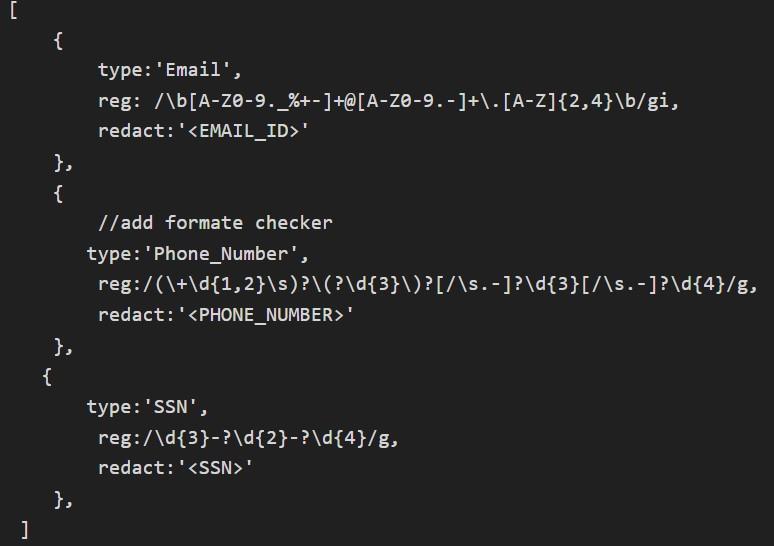
● DataIdentificationModule:Detectssensitivedata patternsusingregex-basedmatching.
● Transformation Engine: Applies privacy-preserving transformations(redaction,masking,anonymizatio n)
● Knowledge Base: Stores patterns and transformationrulesinJSONformatforflexibility.
● WebInterface:Facilitatesfileuploadsand configurationmanagementforprivacypolicies.
● SecureFileManagement:Ensuresprocesseddata isstoredsecurelywithaccesscontrols.
The architecture integrates seamlessly with web-based infrastructuresandsupportsreal-timedataprocessing
For Data Identification - sensitive data patterns are defined using regex rules stored in the Knowledge Base. Keypatternsinclude
International Research Journal of Engineering and Technology (IRJET) e-ISSN:2395-0056
Volume: 11 Issue: 11 | Nov 2024 www.irjet.net p-ISSN:2395-0072
For Data Transformation - Detected sensitive data undergoestransformationbasedonconfigurablerules:
● Redaction: Replaces sensitive data with asterisks (e.g.,john.doe@example.com → ********).
● Masking: Substitutes sensitive data with syntacticallysimilarbutfictionalvalues.
● Anonymization: Applies differential privacy techniquestonumericaldata.
These transformations are applied in compliance with user-definedconfigurations.
ForfileReadandWrite-Thesysteminterceptsfileuploads andprocessestheminthefollowingsteps:
● Upload: The user uploads a file through theweb interface.
● Inspection: The backend scans the file for sensitivedatapatterns.
● Transformation: Detected patterns are transformedbasedonKnowledgeBaserules.
● Storage: Transformed files aresecurelystored, andtheoriginalfilesarediscarded.
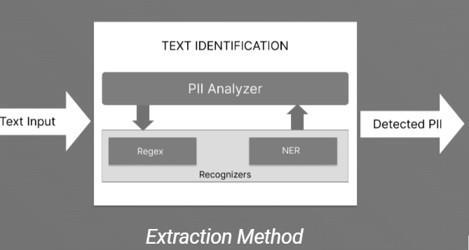
The above diagram illustrates the process of PII (Personally Identifiable Information) Detection and Extraction. It begins with the input of text, which is thenprocessed by a PII Analyzer. This analyzer employs two primary methods: Regex (Regular Expressions) and NER(NamedEntityRecognition).RegexidentifiesPII based on predefined patterns, while NER leverages machine learning models to recognize entities like names, addresses, and social security numbers. The detectedPIIisthenoutputtedasthefinalresult.
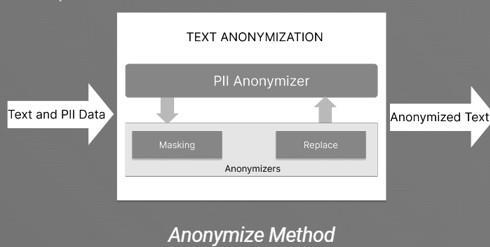
The above diagram illustrates the process of Text Anonymization.Itbeginswiththeinputoftextcontaining PII (Personally Identifiable Information). This text is fed into the PII Anonymizer, which employs two anonymization methods: Masking and Replace. The Masking method obscures PII by replacing sensitive characters with special characters, while the Replace method substitutes PII with generic or placeholder values. The anonymized text, devoid of sensitive information,isthenoutputtedasthefinalresult.
DataLeakagePreventionFileSystemextractsthePIIdata efficiently and Masks or Replace PII data based on users choice to store or share with 3rd parties and stakeholders. Extraction of Address is still one of the issues which we need to work on. In conclusion, a data leakage file system is a critical element in ensuring the security of sensitive organizational information. Itallows organizations to regulate access to information and control who has access to specific data. A well-designed data leakage file system should allow for easy administration, real-time monitoring, and a robust audit trail system. This will help in identifying any unauthorizedaccesstosensitivedataandrespondtosuch incidents promptly. Overall, organizations should invest inarobustdataleakagefilesystemaspartoftheiroverall securitystrategytopreventdatabreachesanddataloss.
[1] Braghin, S., Sinn, M., Simioni, M., "Data Leakage Prevention File System (DLPFS)," IEEE Security & Privacy,2020.
[2] Shapira, Y., Shabtai, A., "Content-Based Data Leakage Detection using Extended Fingerprinting," Journal of NetworkandComputerApplications,2019.
International Research Journal of Engineering and Technology (IRJET) e-ISSN:2395-0056
Volume: 11 Issue: 11 | Nov 2024 www.irjet.net p-ISSN:2395-0072
[3] Chellaprabha, B., Archana, "Anomaly Data Leakage Detection," International Journal of Engineering and InnovativeTechnology(IJEIT),2013.
[4] Young, M., "Data Masking for Financial Information Security,"JournalofInformationSecurity,2019.
[5] Li, T., Lin, J., "Differential Privacy for Healthcare Data Anonymization,"JournalofDataPrivacy,2018.
[6] Venkata Kumar, D., et al., "Data De-Identification and Encryption for Cloud Systems," International Journal ofComputerScience,2020
[7] A.YuriShapira,BrachaShapira,AsafShabtai,“ContentBased Data Leakage Detection using extfingerprinting”
[8] Dilip Venkata Kumar Vengala1, D. Kavitha, A.P.Siva Kumar, “Three factor authentication system with modified ECC based secured data transfer: untrusted cloudenvironment
[9] Subramanian, Helen Nissenbaum, Prateek Mittal, “VACCINE: Using Contextual Integrity for Data Leakage Detection”, 2019 World Wide Web Conference(WWW’19)
[10]Somorovsky, J., Heiderich, M., Jensen, M., Schwenk, J., Gruschka, N. and Lo Iacono, L. (2011).All your clouds belong to us. Proceedings of the 3rd ACM workshop onCloudcomputingsecurityworkshop-CCSW'11
[11] Narayanan, A., Shmatikov, V., "Robust Deanonymization of Large Sparse Datasets," IEEE SymposiumonSecurityandPrivacy,2008.
[12]Abadi,M.,Chu,A.,Goodfellow,I.,etal., "Deep Learning with Differential Privacy," Proceedings of the 2016 ACM SIGSAC Conference on Computer and CommunicationsSecurity.
[13] Ristenpart, T., Tromer, E., Shacham, H., Savage, S., "Hey, You, Get Off of My Cloud: Exploring Information Leakagein Shared Cloud Computing," ACM Conference onComputerandCommunicationsSecurity,2009.
BIOGRAPHIES

Software Developer at Mindcraft SoftwarePvtLtd.


Java Developer at Tata ConsultancyServicesLtd.
Software Developer at Code B SolutionsPvtLtd.
Head of Department at Saraswati CollegeofEngineering,Kharghar