
International Research Journal of Engineering and Technology (IRJET) e-ISSN: 2395-0056
Volume: 11 Issue: 11 | Nov 2024 www.irjet.net p-ISSN: 2395-0072

International Research Journal of Engineering and Technology (IRJET) e-ISSN: 2395-0056
Volume: 11 Issue: 11 | Nov 2024 www.irjet.net p-ISSN: 2395-0072
Bibek Bhandari
Undergraduate Student, Civil Engineering Department Oxford College of Engineering and Management, Nepal ***
Abstract - This study embarked on a comprehensive exploration of the influence of rice husk ash as a replacement for fine aggregates in concrete samples. Beginning with anindepth literature review, the research delved into the mix design process, understanding the pivotal components for concrete preparation. Various tests, including compressive strength, slump, andsieve analyses, were conducted,adhering to the Indian Standard approach. The study's focal point was the replacement of fine aggregates with rice husk ash in proportions ranging from 0% to 2%. The results showcased a notable enhancement in both compressive and flexural strengths with a 1.5% rice husk ash replacement, making it the optimal choice. After 28 days of curing, this mix exhibited the highest compressive strength of 47.06 N/mm2 and a flexural strength of 6.63 N/mm2. The research concludes that concrete mixed with 1.5% rice husk ash offers superior mechanical properties, marking its potential for sustainable construction applications.
Key Words: RiceHuskAsh,CompressiveStrength,Flexural Strength,ConcreteMixDesign,FineAggregates,SlumpTest, SieveAnalysis.
1.INTRODUCTION
Concreteiseverywherearoundus,frombridgestobuildings toroads.Thisversatilematerialismadeupofcement,water, sand, and aggregates that are mixed in specific ratios to producefreshconcrete.Asitundergoesthecuringprocess,it hardensintoasolidstructure.Addingadditivestoconcrete hasbecomeincreasinglypopulartoday.Avarietyofadditivesareavailableinthemarket,suchasflyash,brickdust,and ricehuskash.Amongthem,ricehuskashishighlysoughtafter for its affordability and accessibility. In construction projects,it'scommontopartiallysubstitutesandwithrice huskashsinceitenhancesconcretepropertieslikestrength andductility.Thisresultsinmoreresilientstructuresthat canwithstandtimeandexternalforces.
Theutilizationofflyashinconcretemixdesignshasbeena topicofinterestforresearchersovertheyears.Abrams,in 1918,proposedthewater-cementratiolaw,whichdidnot considertheeffectsofflyashandsilicafumeastheywere virtuallyunknownduringthattime[1].However,Oluokun's
study in 1994 found that Abrams' law is not directly applicable to mixes with fly ash, suggesting an alternative augmentedwater-cementitiousmaterialsratiolawforsuch mixes[1].
In2003,Siddhiqueconductedanexperimentalinvestigation toevaluatethemechanicalpropertiesofconcretemixtures where fine aggregate (sand) was partially replaced with Class F fly ash [2]. The study revealed significant improvement in the strength properties of plain concrete withtheinclusionofflyashasapartialreplacementoffine aggregate[2].
Limbachiya et al., in 2012, discussed the environmental benefits of using recycled concrete aggregate in fly-ash concrete [3]. Their study showed that while embedding a highamountofrecycledconcreteaggregatecouldlowerthe resistance to chloride penetration and carbonation of concrete, it still achieved a comparable design strength to thatofthecontrolmix[3].
Sarker and Nath, in 2011, investigated the durability properties ofhighstrength concreteutilizinghighvolume ClassFflyash[4].Theirresultsindicatedthattheinclusion of fly ash reduced sorptivity and chloride ion permeation significantly,therebyimprovingthedurabilitypropertiesof concrete[4].
Lastly,KayaliandHaque,in1998,usedaClassFfineflyash toproduceworkablehigh-strengthconcrete[5].Theirstudy foundthattheoptimumcementreplacementforboth400 and500kgtotalcementitiousmaterialmixtureswas10%, with the 28-day maximum strength for the two optimum mixturesbeing94and111MPa,respectively[5].
The endeavor's principal intention was to conduct an indepth investigation of evaluating and investigation of the concretebytheadditionofrichhuskash,
Touplifttheworkabilityoftheconcretebyfinding theappropriateratiooftheadditives,
To surge up the physical as well as mechanical characteristics of the concrete by considering the bestmaterialavailable,
International Research Journal of Engineering and Technology (IRJET) e-ISSN: 2395-0056
Volume: 11 Issue: 11 | Nov 2024 www.irjet.net p-ISSN: 2395-0072
4. Methodology
a) Preliminary Research:
Reviewedhardcopiesincludingbooksand academicnotes.
Studiedsoftcopiessuchasonlinejournals anddissertations.
Gained understanding about concrete, its components, and its use in civil engineering.
Familiarized with the mix design process andvariouschemicalsusedinconcrete.
b) Material Collection:
GatheredOPCcementofgrade43.
Sourcedflyashtoenhanceworkabilityand durability.
Collected aggregates of varied sizes and shapes.
Reviewed IS codes for experiment guidelines.
ConductedsieveanalysisasperIS2386-1 (1963).
Calculated mix design for M30 concrete basedonIS10262-1982.
c) Aggregate Impact Value Test:
Used1kgof10mmaggregatesfromsieve analysis.
Measuredweightoftheemptymold(W1).
Compacted aggregates in a measuring cylinderinthreelayers.
Calculated combined weight of mold and sample(W2).
Conductedimpacttestandsievedmaterial through a 2.36 mm sieve to get weight (W3).
Calculated impact value using the given formula.
d) Concrete Mixing and Slump Test:
Mixedconcretewithvaryingproportionsof ricehuskash(0,0.5,1,1.5,and2%).
Conductedslumptestusinga30.48cm-tall slumpconemold.
e) Material Preparation and Curing:
Poured concrete into cubical molds of specifiedsizes.
Vibratedsamplestoremovevoids.
Allowedsamplestocurein thelabfor24 hours.
Demolded samples and cured in water tanksfor7and28days.
f) Strength Tests:
Conducted compressive strength test on curedsamples.
Performed flexural strength test on rectangularmoldasperIndianstandard.
g) Data Analysis:
Calculatedandrecordedaggregateimpact value, flakiness index, elongation index, compressive strengths, and flexural strengths.
Identified the concrete mix with 1.5% fly ashasexhibitingthebestcompressiveand flexuralstrengths.
4. Material Required
Table -1: Propertiesofconstituents
6. MIX DESIGN
Table-1:MixdesignforM30concrete
7. EXPERIMENTAL INVESTIGATION AND MATERIAL PREPARATION
7.1 AGGREGATES TESTING
In this study, I embarked on an in-depth examination of aggregates emphasizing their impact value and shape characteristics. For the Aggregate Impact Value Test, I utilizeda 1kgsample of10 mmaggregatesretainedafter sieveanalysis.The weightofthe empty moldwasinitially recorded as W1. The specimen was systematically compressed within a mould, consisting of three separate layers, with each layer subjected to 25 impacts with a tamperingrod.Oncethesamplewasset,itwastransferred toasteelcuponanimpacttestingdeviceandthecombined weight of the mold and sample was noted as W2. The aggregatethenunderwenttheforceofahammerdropped fromaheightof380mmaprocessrepeatedfivetimes.After theimpacts,theaggregatesweresievedthrougha2.36mm mesh with the resultant weightdocumentedas W3.Using the weights W1, W2, and W3 in conjunction with a designatedformula,weascertainedtheeffectivevalueofthe aggregates.
International Research Journal of Engineering and Technology (IRJET) e-ISSN: 2395-0056
Volume: 11 Issue: 11 | Nov 2024 www.irjet.net p-ISSN: 2395-0072
Additionally,IconductedtheFlakinessandElongationIndex Testtoevaluatetheshapeattributesoftheaggregates.These assessments are crucial for gauging the aggregates' appropriatenessfordiverse construction endeavours.Our findings present invaluable insights into the quality and potential applications of aggregates in the realm of construction. findings offer valuable insights into the quality and applicabilityofaggregatesintheconstructionindustry.

7.2
Inthesubsequentphaseofourstudy,Iinitiatedtheconcrete mixingprocessutilizingaconcretemixer.Theconcretewas uniquelypreparedbysubstitutingfineaggregateswithrice huskashinvaryingproportions:0%,0.5%,1%,1.5%,and 2%. Once the mix was ready, it was poured into a cubical moldwithdimensionsof59.0551incheson eachsideand anothermoldmeasuring5.9x5.9x29.52inches.Toensurea void-freesample,theconcretewasvibratedusingavibrator. Thesampleswerethenleftundisturbedinthelaboratoryfor 24hours,postwhichtheyweredemoulded.Forcuring,the specimensweresubmergedinwatertanks,withtwodistinct durationssetforcuring:sevendaysandtwenty-eightdays.
7.3 SLUMP TEST
In order to evaluate the feasibility of the recently made concrete,aslumptestwasperformed.Aslumpconemould, withaheightof30.48cm,atopdiameterof9.906cm,anda bottomdiameterof20.66cm,wasutilised.Themouldwas filledinatri-layeredmanner,wherebyeachindividuallayer underwent compaction with twenty-five repetitions of tamping using a rod. After ensuring the top was level by removing excess concrete with a trowel, the cone was verticallylifted.Theresultingslumpwasobservedtobea trueslump,indicatingtheconcrete'sworkablenature.
Followingthepost-curingprocess,thespecimensunderwent acompressivestrengthtest.Thesubjectsweresituatedon the foundation plate of the experimental apparatus, guaranteeingthattheloadingplungerwasindirectcontact withthesurfaceofthespecimen.Themovablecomponentof themachinewasthenactivated,subjectingthespecimensto auniformloadof0.2MPa.Observationsweremade,andthe peak load at which the specimens exhibited complete fracture was recorded. In addition to the compressive strengthtest,aflexuralstrengthtestwasconductedonthe rectangular mold, adhering to the Indian standard guidelines.Thisprovidedacomprehensiveunderstandingof boththecompressiveandflexuralstrengthsoftheprepared samples.
8.1
In the study on aggregates, the following measurements wererecordedduringtheAggregateImpactValueTest:
Weight of Empty Cylinder (W1):Theinitialweight of the empty cylinder was measured to be 702 grams.
Weight of Cylinder Cup with Sample (W2):Upon addingtheaggregatesampletothecylindercup,the combined weight was determined to be 1025 grams.
Weight of Aggregate Passing Through 2.36mm Sieve (W3): After subjecting the impacted aggregatetosieving,theweightofthematerialthat passedthroughthe2.36mmsievewas47grams. Basedon theabovemeasurements, thecalculated Impact Value oftheaggregatewasfoundtobe14.55%.Thisvalue providesinsightsintotheaggregate'sresistancetosudden impacts, which is crucial for its application in various constructionscenarios.
Table 3-: Elongationandflakinessindex
Is sieve (passin g) Is sieve (retained ) Sample weight Weight of aggregat e passthrough thicknes s gauge (gm) Weig ht of nonflaky agg (gm) Weight of aggregate retainedon elongation gauge
Elongatio n index (%) 14.5800 9
Combine s 29.7236 1
8.3 COMPRESSIVE AND FLEXURAL
Based on an examination of the compressive and flexural strengthdata,itcanbededucedthattheconcretespecimen integrating a 1.5% substitution of rice husk ash has improved mechanical properties compared to the other
International Research Journal of Engineering and Technology (IRJET) e-ISSN: 2395-0056
Volume: 11 Issue: 11 | Nov 2024 www.irjet.net p-ISSN: 2395-0072
samples.Theinclusionofanoptimalratioofricehuskash not only enhances the material's strength, but also offers potentialsustainabilitybenefits,thereforeestablishingitasa promising option for utilisation in construction-related contexts
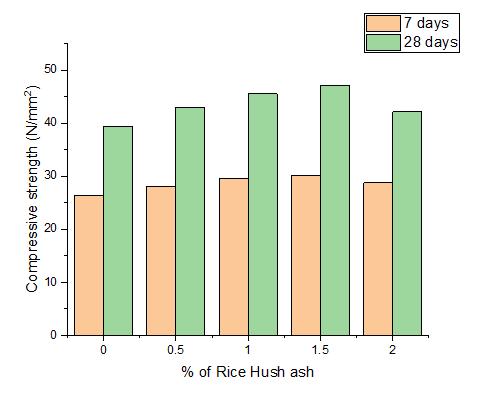
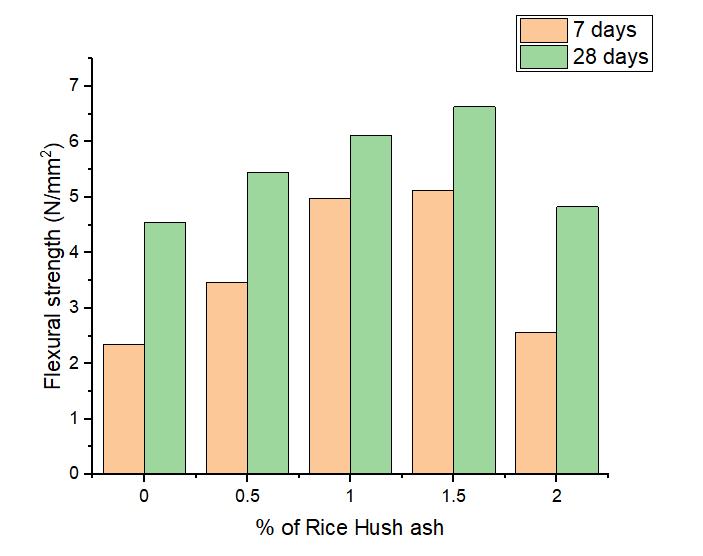
Table- 2: Tabulated details of compressive strength for different days
Table- 3: Tabulated details of flexural strength for different days
The presented table provides an overview of the flexural strengthexhibitedbyconcretespecimensafterundergoinga curing period of 7 and 28 days. In a manner akin to compressive strength, flexural strength similarly demonstrates a positive correlation with the duration of curing and showcases fluctuations contingent upon the proportionofricehuskashpresent.
The results of this study give a detailed analysis of the impactofricehuskashonthemechanicalcharacteristicsof concrete, hence providing significant insights that can be usedtomanybuildingscenarios.
The extensive examination into the impact of substituting RHA for fine particles in concrete samples has produced informativefindings.Compressiveandflexuralstrengthtests conductedattwodistinctcuringdurations,namely7and28 days, have allowed for a thorough understanding of the mechanicalpropertiesoftheconcretesamples
Fromthedatapresented:
1. Compressive Strength:Adistinctpatternofrising strengthcanbeseenintherelationshipbetweenthe concrete samples' compressive strength and the length of curing. It is worth mentioning that the specimenwitha1.5%replacementofRHAhadthe maximum compressive strength after 28 days, achievingavalueof47.05MPa
2. Flexural Strength:Thedatapertainingtoflexural strengthlikewiseshownapositivecorrelationwith thedurationofthecuringprocess.Thesamplewith asubstitutionof1.5%ricehuskashdemonstrated notableperformance,exhibitingaflexuralstrength of6.63MPaafter28days.
International Research Journal of Engineering and Technology (IRJET) e-ISSN: 2395-0056
Volume: 11 Issue: 11 | Nov 2024 www.irjet.net p-ISSN: 2395-0072
The results of the study of the compressive and flexural strengthdataindicatethattheconcretespecimenthathas 1.5% more rice husk ash replaced by it has better mechanicalpropertiesthantheothersamples.WhenRHAis addedintherightamount,thematerialbecomesstronger and may have sustainability benefits as well, making it a viableoptionforuseinconstruction.
Inconclusion,thestudyunderscoresthepotentialofRHAas a viable replacement for fine aggregates in concrete mixtures.Amongthesamplestested,the1.5%ricehuskash replacementsampleisidentifiedasthebestintermsofits mechanicalproperties,markingitasaprimecandidatefor further exploration and application in the construction industry.
[1] F. A. Oluokun, “Fly Ash Concrete Mix Design and the Water-CementRatioLaw,”MaterialsJournal,vol.91,no.4, Jul.1994,pp.362-371,doi:10.14359/4050.
[2]R.Siddhique,“Effectoffineaggregatereplacementwith Class F fly ash on the mechanical properties of concrete,” CementandConcreteResearch,vol.33,no.4,Apr.2003,pp. 539-547.
[3]M.Limbachiya,M.S.Meddah,andY.Ouchagour,“Useof recycled concrete aggregate in fly-ash concrete,” ConstructionandBuildingMaterials,vol.27,no.1,Feb.2012, pp.439-449.
[4] P. K. Sarker and P. Nath, “Effect of Fly Ash on the DurabilityPropertiesofHighStrengthConcrete,”Procedia Engineering,vol.14,2011,pp.1149-1156.
[5]O.KayaliandM.N.Haque,“Propertiesofhigh-strength concreteusingafineflyash,”CementandConcreteResearch, vol.28,no.10,Oct.1998,pp.1445-1452