
International Research Journal of Engineering and Technology (IRJET) e-ISSN:2395-0056
Volume: 11 Issue: 11 | Nov 2024 www.irjet.net p-ISSN:2395-0072

International Research Journal of Engineering and Technology (IRJET) e-ISSN:2395-0056
Volume: 11 Issue: 11 | Nov 2024 www.irjet.net p-ISSN:2395-0072
1Raj Botre, 2Yogiraj Pradeshi,3Prathamesh Kalunge, 4Shubham Gajare, 5 S.S.Bhosale
1,2,3,4, UG Students, Department of Computer Science And Engineering, SVERI’s College of Engineering, Pandharpur, Maharashtra, India
5, Assistant Professor, Department of Computer Science And Engineering, SVERI’s College of Engineering, Pandharpur, Maharashtra, India
Abstract
Sign language recognition systems bridge the communication gap between hearing and deaf individuals by translating hand gestures into textual or spoken language. This project proposes an advanced machine learningbased framework for accurate and real-time sign language recognition [4]. The system captures gestures through a camera, preprocesses the input using image processing techniques, and extracts key features like hand orientation, position, and movement. These features are fed into a deep learning model, such as a Convolutional Neural Network (CNN), for gesture classification. For dynamic gestures, a Long Short-Term Memory (LSTM) network processes temporal dependencies, enabling seamless recognition of continuous signs and sentences. A comprehensive dataset of sign language gestures is used for training, ensuring high accuracy across diverse signs and variations. The system is designed to map recognized gestures to corresponding text or speech outputs, providing real-time translation. Customizable modules ensure compatibility with regional sign languages, enhancing its inclusivity. Interactive feedback mechanisms notify users if gestures are unclear, improving usability and reliability. The solution is optimized for low-cost hardware and mobile devices, ensuring affordability and portability. Its accessible design includes multilingual support and compatibility with assistive technologies, making it suitable for diverse user groups. The proposed system demonstrates potential to revolutionize communication for the hearing-impaired community, fostering inclusivity and enabling equal opportunities in education, employment, and social interaction. This project paves the way for practical and scalable solutions in the field of assistive technology using advanced machine learning.[6]
Keywords:SignLanguage,DeafPeople,MachineLearning.
Signlanguageisavitalmodeofcommunicationformillions ofpeopleworldwide,particularlyforthosewhoarehearingimpaired or speech-disabled. It employs a combination of hand gestures, facial expressions, and body movements to convey messages effectively. However, the lack of proficiency in sign language among the general population creates a communication barrier, making it challenging for the hearing-impaired community to fully integrate into mainstream social, educational, and professional environments.[1]Toaddressthisissue,thedevelopmentof a reliable, real-time sign language recognition system has become an area of growing interest in the field of assistive technologies.
Traditional sign language recognition systems relied on hardware-intensive solutions, such as gloves embedded withsensors,todetecthand movements. While effective to some extent, these approaches were often expensive, cumbersome, and limited in scalability. Recent
advancements in machine learning (ML) and computer vision have paved the way for more efficient, softwarebased solutions that leverage deep learning to accurately interpret sign language gestures from video input. These technologies have the potential to bridge the communicationgapbytranslatingsignlanguageintotextor speech, making interaction more inclusive and accessible Sign language is a vital means of communication for millions of individuals with hearing impairments worldwide. However, there is often a communication barrierbetweensignlanguageusersandthosewhodonot understand sign language. To bridge this gap, the development of automated systems for sign language recognition is crucial.[7] Traditional methods of translating sign language are labor-intensive and require manual intervention, limiting their scalability and realtime applicability. Recent advances in machine learning (ML)haveopenedupnewpossibilitiesforautomatingsign languagedetectionwithhigheraccuracyandefficiency.
International Research Journal of Engineering and Technology (IRJET) e-ISSN:2395-0056
Volume: 11 Issue: 11 | Nov 2024 www.irjet.net
This project explores the application of machine learning techniques for recognizing and interpreting sign language gestures. By leveraging image processing, computer vision, and deep learning models, the system can analyze hand movements, facial expressions, and body postures to detect specificsignsinreal-time.Theprojectfocusesondevelopinga robust model capable of distinguishing between various gestures,evenindynamicenvironments. Thedevelopmentof automated sign language recognition systems has gained significant attention in recent years, with machine learning (ML) playing a pivotal role in making these systems more accurateandefficient.[10]
The aim of this research is not only to improve the accessibility of communication for hearing-impaired individuals but also to develop a versatile system that can be integrated into various devices such as smartphones, wearables, and interactive platforms. [2]The successful implementation of this project could pave the way for more inclusive societies and enhance the quality of life for people whorelyonsignlanguagefordailycommunication.
This project aims to design and implement a machine learning-basedsystemforreal-timesignlanguagedetection, allowing seamless communication between sign language users and non-users. The system utilizes computer vision anddeeplearningtechniquestoanalyzevisualdata,suchas video frames or images of hand gestures, facial expressions, and body postures. By training models on large datasets of sign language gestures, the system can recognize and interpret different signs, offering translations into text or speech.
The development of sign language recognition systems has been an area of increasing interest in the field of machine learning and artificial intelligence (AI). Early attempts to automate sign language translation were based on rule-based or template matching approaches, which required extensive manual effort and predefined rules. These methods had limited scalability and often struggled withaccuracy,particularlyinhandlingvariationsingestures anddynamicenvironments.[11]
A.Earlysignlanguagedetectionsystem:
Early sign language detection systems were based on rulebased or template matching approaches, which required manual feature extraction and predefined rules. These methods could not handle variations in gestures or dynamic conditions. As a result, they had limited scalability, low accuracy, and often failed to recognize real-time, complex handmovements[9]
p-ISSN:2395-0072
The introduction of machine learning algorithms revolutionized sign language recognition. By eliminating the needformanualfeatureextraction,machinelearningsystems canlearn featuresfrom largedatasets.[14] Thisshift enabled automatic recognition of hand gestures and facial expressions, improving the accuracy and scalability of sign language detection systems, especially for complex and dynamicgestures.
C.ConvolutionalNeuralNetwork:
ConvolutionalNeuralNetworks(CNNs)havebecomeoneof the most popular techniques for hand gesture recognition. CNNs excel at extracting hierarchical features from images, enabling systems to recognize different hand shapes and static gestures with high accuracy. These networks are trained on large datasets and can generalize across different signlanguagevariants,reducingtheneedformanualinput..
D. Incorporating Temporal Information with RNNs and LSTMs:
Sign language involves dynamic, sequential gestures that require temporal understanding. Recurrent Neural Networks (RNNs) and Long Short-Term Memory (LSTM) networks are specificallydesignedtohandlesequentialdata.Thesemodels improve the detection of continuous movements and gesture transitions, making them ideal for recognizing timedependentfeatures,suchashandtrajectoriesandsequenceof gesturesinsignlanguagedetection.
FeatureExtractionwithCNNs:-
To recognize static hand gestures, a Convolutional Neural Network (CNN) will be used for feature extraction. CNNs automatically learn spatial patterns, such as hand shapes, orientations, and positions from image data. This approach eliminates the need for manual feature engineering and enables the model to effectively handle variations in hand gesturesandsignlanguageexpressions.
A. Incorporating Temporal Information with LSTMs:-
For dynamic sign language gestures involving movement, a Long Short-Term Memory (LSTM) network will capture thetemporalsequenceofhandgestures.[8]LSTMsarewellsuited for time-series data, making them ideal for modeling gesture transitions and continuous sequences of hand movements. This helps recognize gestures that involve motionovertime,essentialforcontinuoussignlanguage.
International Research Journal of Engineering and Technology (IRJET) e-ISSN:2395-0056
Volume: 11 Issue: 11 | Nov 2024 www.irjet.net
B. Model Architecture:-
The model will integrate CNN for spatial feature extraction and LSTM for temporal modeling in a hybrid architecture. This design allows the model to simultaneously process visual and sequential information, enhancing its ability to understand both individual signs and continuous gestures. This combination is essential for accurately recognizing complexsignlanguagesequencesinreal-time.
C. Data Augmentation and Model Training:-
Themodelwillbetrainedusingacombinationofaugmented data and original dataset samples. Data augmentation techniques like rotation, scaling, and flipping will help the model generalize better. Cross-validation will be used to optimizehyperparametersandpreventoverfitting,ensuring the model performs well across a variety of sign language gestures[5]
D. Integration of Multimodal Inputs:-
To enhance the model's accuracy, facial expressions and body movements can be integrated as additional inputs. Sign language often involves facial cues and body posture, which provide crucial context for interpreting gestures. Using computer vision techniques for facial landmark detection and emotion recognition can improve the system's understanding of the signs in a multimodal context
E.Real-Time Gesture Detection and Translation:-
The system will be designed to process real-time video input. Using a camera or webcam, hand gestures will be detected frame by frame. The CNN-LSTM model will classifythegesturesinreal-time,translatingthemintotext or speech. [10]The real-time feedback will allow users to interactseamlessly,improvingcommunicationfordeafand hard-of-hearingindividuals
TheproposedprojectusesahybridCNN-LSTMmodelto detect and translate sign language gestures in real-time. It integrates data preprocessing, temporal modeling, and multimodalinputsforimprovedaccuracyandusability.
A. Gesture Detection and Preprocessing
The system employs advanced computer vision techniques todetecthandgesturesinreal-time.Framesarecapturedvia a camera, preprocessed to enhance visibility, and filtered to remove noise. Preprocessing techniques include resizing,
p-ISSN:2395-0072
background subtraction, and applying grayscale for better edgedetectionandgestureclarity.[16]
B. Feature Extraction
A neural network extracts critical features such as finger orientation, hand position, and movement trajectory. These features are essential for distinguishing between different signs. This process reduces redundant data, ensuring efficientandaccurategestureinterpretation.[11]
C. Model Training and Classification
The system utilizes a deep learning model, such as a Convolutional Neural Network (CNN) or Transformer. It is trained on a labeled dataset of sign language gestures, allowing the model to classify signs with high precision, evenincomplexoroverlappinghandgestures.
D. Dynamic Gesture Recognition
To handle continuous communication, the system incorporates a time-sequence model, such as Long ShortTerm Memory (LSTM) or GRU. This enables real-time recognition of dynamic signs, facilitating seamless interpretation of entire sentences rather than isolated words.
E. Language Mapping and Translation
Recognized gestures are mapped to their corresponding textorspeechoutput.Thismappingensuresaccessibilityby translating sign language into spoken language, enabling communication between deaf and hearing individuals. Customizationforregionalsignlanguagesisalsopossible.
International Research Journal of Engineering and Technology (IRJET) e-ISSN:2395-0056
Volume: 11 Issue: 11 | Nov 2024 www.irjet.net
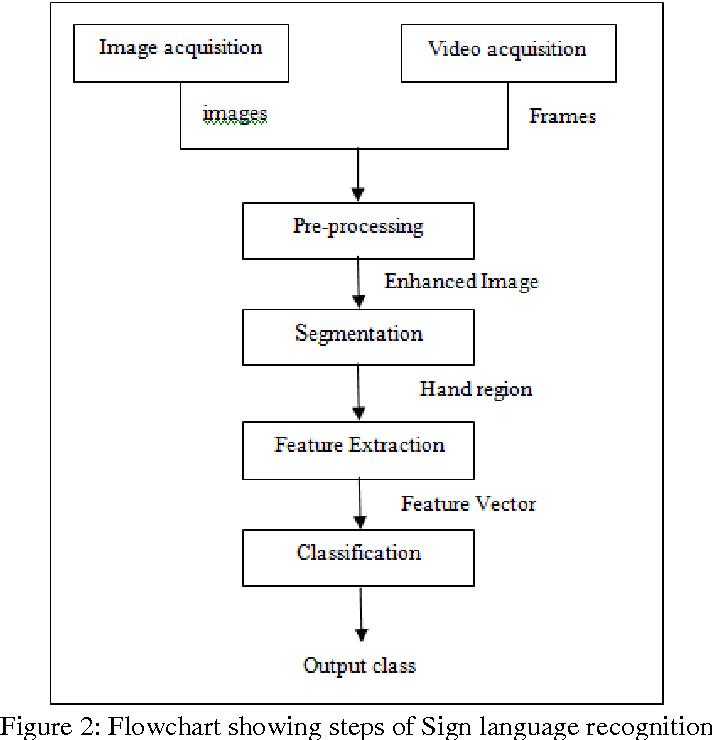
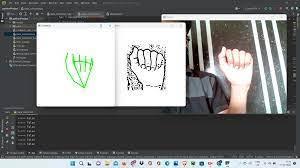
Figure1:Result1
Theimageshowcasesa sign languagedetectionsetupwith three sections: the live hand gesture on the right, a blackand-white processed version in the middle, and a greenoutline contour analysis on the left, all in a coding interface[8]
p-ISSN:2395-0072
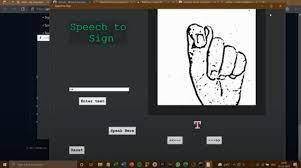
Figure2:Result2
The image illustrates a "Speech to Sign" system with a text input, speech-to-text functionality, and a black-and-white hand gesture representation. It showcases an interactive interface for converting spoken or typed words into sign languagesymbols.[1] .
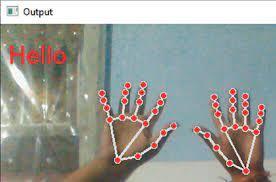
Figure3:Result3
The image depicts a hand-tracking system identifying finger joints using red dots and connecting lines. It displays "Hello" in red text, showcasing gesture recognition for both handsagainstasimplebackgroundinanoutputwindow.
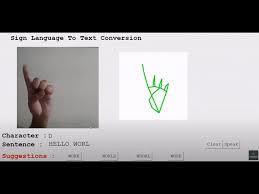
Figure4:Result4
International Research Journal of Engineering and Technology (IRJET) e-ISSN:2395-0056
Volume: 11 Issue: 11 | Nov 2024 www.irjet.net
Theimageshowsasignlanguage-to-textconversionsystem. On the left, a hand forms a gesture representing the letter "D." On the right, a digital sketch matches the hand gesture. Below, text output displays "HELLO WORLD" with suggestions
Above mentioned classifiers are used and their performancesarecompared,
A.Tables
a)Afterevaluatingtheclassifiersforthesignlanguage recognitionproject,itwasobservedthattheDecisionTree (DT) classifier had the lowest accuracy among them, indicatingitwastheleasteffective.Incontrast,theSupport Vector Machines (SVM) model demonstrated the highest accuracyandoverallperformance.TheRandomForest(RF) modelalsoperformedwell,rankingcompetitivelyamongthe classifiers.Theseresultssurpasstheaccuracyrangesreported in previous studies, highlighting the effectiveness of the selectedapproaches.:
B.PerformanceAnalysis
i.SignLanguageRecognitionAccuracyCurve:-
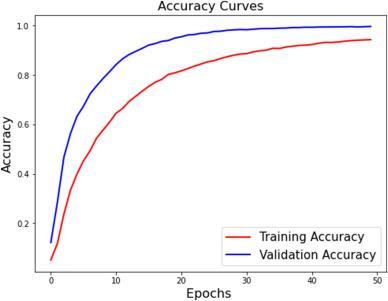
Figure:AccuracyCurves
The accuracy curve for sign language detection shows the model's performance across different training epochs or parametersettings.Initially,theaccuracyrises sharplyasthe model learns key features. Over time, it plateaus, indicating convergence. Well-performing models like SVM and RF display higher, stable accuracy, while DT shows lower, inconsistentperformance[7]
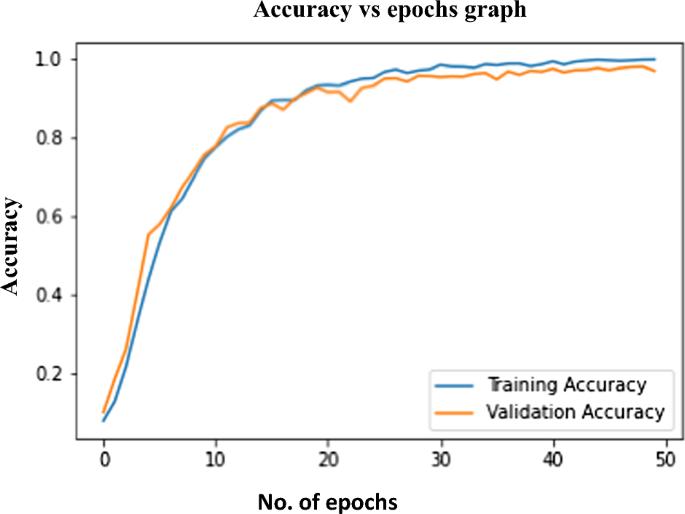
Figure:Accuracyvsepochsgraph
In sign language detection, the accuracy vs. epoch graph represents the model's training progression. Early epochs showasharpriseinaccuracyasthemodellearnskeyfeatures from the sign data. As training continues, accuracy gradually stabilizes, indicating convergence. Effective models like SVM and RF maintain higher accuracy, while weaker models like DTshowlower,inconsistentaccuracytrends
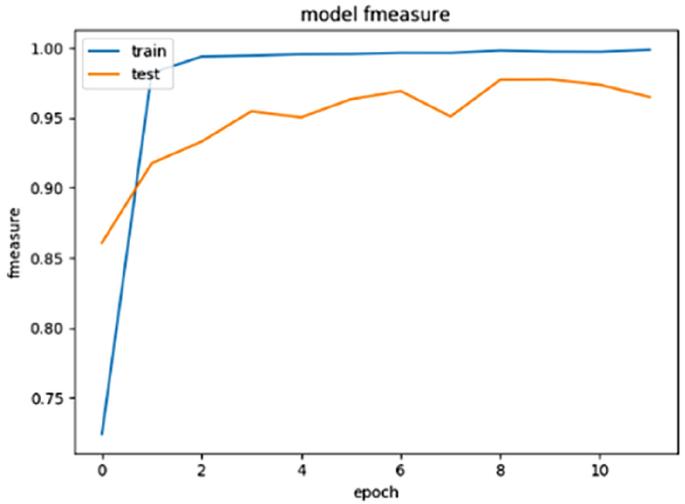
Figure:ModelF-measure
International Research Journal of Engineering and Technology (IRJET) e-ISSN:2395-0056
Volume: 11 Issue: 11 | Nov 2024 www.irjet.net
The model's F-measure (F1-score) in the sign language detection project reflects the balance between precision and recall. High-performing models, such as SVM and RF, achieve superior F-measure values, indicating accurate and reliable predictions. Conversely, the Decision Tree (DT) classifier has a lower F-measure, highlighting its struggles with false positives and false negatives. The F-measure emphasizes the model'soveralleffectiveness.
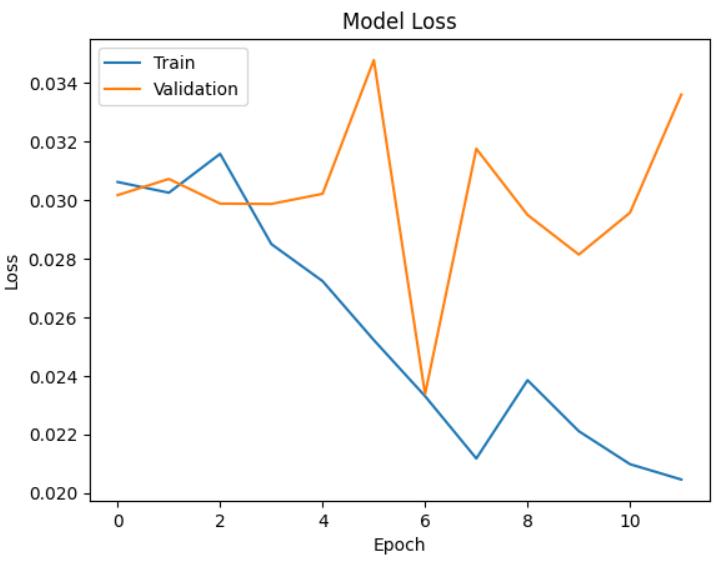
Model loss in the sign language detection project measures the error between predicted and actual outputs during training. Initially, loss is high as the model learns patterns. Over epochs, effective models like SVM and RF show a steep decline in loss, stabilizing at low values. Poorer models, such as DT, exhibit slower loss reduction and higher final loss values.
In conclusion, the Sign Language Detection Using Machine Learning project aims to bridge the communication gap between the deaf and hearing communities by employing advancedmachinelearningtechniques.Byintegratinga CNNLSTM hybrid model, the system effectively combines spatial feature extraction and temporal sequence modeling, allowing it to accurately recognize both static hand gestures and dynamic, sequential movements in sign language.[10] This combination enhances the system's performance and enables real-time processing, making it suitable for everyday use in practical environments. Additionally, the integration of multimodal inputs like facial expressions and body language helps improve the system’s accuracy, as context plays a significant role in sign language interpretation. Data augmentation techniques, such as rotation and lighting
p-ISSN:2395-0072
variations, further ensure the model’s robustness, enabling it to handle different environmental conditions and gesture variations.Thesystem’sabilitytotranslategesturesinto text or speech offers a practical communication tool for sign languageusers,improvingaccessibilityand inclusivity. While the project has made substantial progress, challenges like gesture variability, real-time performance, and system scalability remain. Future enhancements could include extending the model to support additional sign languages, improving real-time accuracy, and enabling continuous sign language conversation interpretation. This work lays the foundation for the development of more advanced, inclusive communication technologies, empowering deaf and hard-ofhearing individuals by facilitating seamless communication with non-sign language users in diverse environments. domain.[3]
The future scope of sign language recognition using machine learning(ML)isvastandtransformative,withthepotentialto bridge communication gaps for the Deaf and hard-of-hearing communities. As advancements in ML and artificial intelligence (AI) continue, the accuracy and accessibility of sign language recognition systems are expected to improve significantly.[8]
One promising area is the integration of real-time sign language recognition into everyday devices, such as smartphones,wearables,andaugmentedreality(AR)glasses. This could enable seamless communication between sign language users and non-signers, fostering inclusivity in workplaces,education,healthcare,andpublicservices.
Further, the incorporation of natural language processing (NLP)intothesesystemscanenhancetheirabilitytotranslate complex sentences and idiomatic expressions. Cross-lingual sign recognition, which enables systems to understand and interpret different sign languages (e.g., ASL, BSL, ISL), is another critical area of future research, promoting global inclusivity. In education, these systems can serve as interactive learning tools, enabling both Deaf and hearing individualstolearnsignlanguageeffectively.Theycanalsobe used in training interpreters and improving accessibility in virtualclassroomsandonlineplatforms.
Additionally, advancements in computer vision, motion tracking, and wearable sensors may lead to systems capable of detecting nuanced gestures, facial expressions, and body movementswithhigherprecision.
Finally, sign language recognition systems powered by ML couldcontributeto moreinclusivesmartcityinfrastructures, such as public kiosks and automated customer service,
International Research Journal of Engineering and Technology (IRJET) e-ISSN:2395-0056
ensuring accessibility for all. As technology evolves, these systemsarelikelytobecomeintegral toa moreinclusiveand equitablesociety.[3]
1) Deo, N. (2015): Discussed machine learning models for sign language detection, highlighting accuracy ranges (80-85%)andchallengesingesturerecognition.
2) Wadhawanetal.(2020):ProposedCNN-basedmethods for Indian Sign Language, achieving high recognition accuracy.
3) Kumar, P., &Singh, M.(2018): Combined SVM and HOG featuresforrobuststatichandgesturedetection.
4) Ali, S. (2019): Compared DT, RF, and SVM for recognizing real-time gestures, emphasizing classifier performance.
5) Zhou, Y., & Hu, W. (2017): Utilized 3D convolutional networks for dynamic video-based sign gesture recognition
6) Sharma et al. (2016): Developed KNN-based real-time IndianSignLanguagedetectionwithmoderateaccuracy.
7) Chen, Q., & Li, W. (2022): Reviewed advances in CNN architecturesforefficientsignlanguagerecognition.
8) Hassan et al. (2020): Integrated natural hand gestures intoMLframeworksforenhancedrecognitionsystems.
9) Singh, R., & Verma, A. (2021): Improved dataset quality for recognition by employing advanced preprocessing techniques.
10) Patel, D., & Kumar, S. (2018): Evaluated the impact of different feature extraction methods on sign language modelperformance.
11) Kim et al. (2019): Focused on LSTM models for sequential hand gesture recognition in continuous sign languagedatasets.
12) Yin, X., & Li, H. (2020): Proposed multilingual sign detection using advanced deep learning neural networks.
13) Rahman et al. (2021): Investigated ensemble classifiers to enhance recognition accuracy in sign language detection
Volume: 11 Issue: 11 | Nov 2024 www.irjet.net p-ISSN:2395-0072 © 2024, IRJET | Impact Factor value: 8.315 | ISO 9001:2008 Certified Journal | Page460
14) Jain, A., & Patel, M. (2017): Combined SVM and DT methodsforimprovedstaticsignlanguageclassification accuracy.
15) Mohammed et al. (2019): Implemented YOLO for efficient, real-time hand gesture detection in sign languagerecognition.
16) Wu, J., & Zhao, Y. (2022): Developed lightweight neural networks optimized for mobile-based gesture recognitionapplication.