
International Research Journal of Engineering and Technology (IRJET) e-ISSN:2395-0056
Volume:11Issue:11|Nov2024 www.irjet.net p-ISSN:2395-0072

International Research Journal of Engineering and Technology (IRJET) e-ISSN:2395-0056
Volume:11Issue:11|Nov2024 www.irjet.net p-ISSN:2395-0072
1Madhura Kulkarni, 2Sanjeevani Anuse, 3Pooja Vasekar, 4Prajkta Gaikwad, 5Kalyani Kumbhar, 6S.A. Shegdar
1 ,2,3,4,5 UG Students, Department of Computer Science and Engineering, SVERI’s College of Engineering, Pandharpur, Maharashtra, India
1madhurarkulkarni@coep.sveri.ac.in
6 Assistant Professor, Department of Computer Science and Engineering, SVERI’s College of Engineering, Pandharpur, Maharashtra, India
ABSTRACT: The IoT-enhanced fitness tracker with machine learning (ML) recommendations is an innovative solution designed to optimize fitness and health management. By integrating advanced IoT sensors, such as heart rate monitors (HW827) and accelerometers (MPU6050), with sophisticated ML algorithms, the system provides personalized fitness recommendations based on real-time data. The tracker continuously monitors key health metrics, including heart rate, step count, and activity levels, to deliver tailored workout plans and detailed progress tracking. The ML component analyzes historical and current user data to refine recommendations, ensuring fitness plans are customized,adaptive,andeffective.
This approach enhances user engagement through interactive features, empowers users to make datadriven health decisions, and supports habit formation. The system's scalability and remote access capabilities further extend itsutility, allowing forseamlessintegrationwith web-based dashboards and future expansions. Overall, this project represents a significant advancement in personalized fitness technology, combining IoT and ML to promote healthier, more with sensors like the MPU6050 accelerometer and the hw827 heart rate sensor to capture real-time data on user movements and vital signs. This data is transmitted to the web platform via the ESP32 module, allowing users to access their fitness metrics remotely through a userfriendly interface. What sets this project apart is the integration of machine learning algorithms recommendations. By analyzing the collected data, theMLcomponent.
Keywords: Data Analytics., Health Monitoring, IoT, FitnessTracker,MachineLearning,WearableTechnology.
The rapid advancement of Internet of Things (IoT) technologieshasrevolutionizedthewaywemonitorand manage personal health and fitness. The integration of
IoT sensors to continuously monitor various health metrics,suchasheartrate,stepcount,andactivitylevels. The data collected is processed through machine learning algorithms that analyze user patterns and generate tailored fitness advice to enhance user engagement and outcomes [3]. These devices utilize varioussensorstotrackmetricssuchasheartrate,steps, sleep patterns, and calories burned, offering a comprehensiveviewofauser’sfitnessjourney.
In this project, we present an IoT-enhanced fitness tracker website integrated with machine learning (ML)based recommendation systems. The system employs the ESP32 microcontroller paired with sensors like the MPU6050 accelerometer and the hw827 heart rate sensortocapturereal-timedataonusermovementsand vital signs. This data is transmitted to the web platform via the ESP32 module, allowing users to access their fitness metrics remotely through a user-friendly interface. What sets this project apart is the integration of machine learning algorithms to deliver personalized fitness recommendations. By analyzing the collected data,theMLcomponentidentifiespatternsandtrendsin user behavior, enabling the system to provide tailored suggestions on exercise routines, activity adjustments, and health tips. The goal is to provide personalized fitnessrecommendationsbyprocessingandinterpreting sensordatasuchasheartrateandstepcountinrealtime [8].
MachinelearningtechniquestodevelopanIoT-enhanced fitnesstrackercapableofrecognizingandanalyzinguser activity patterns from sensor data. By implementing robust pattern recognition algorithms, the tracker can accurately interpret heart rate, step count, and other fitness metrics, enabling it to provide personalized and data-drivenfitnessrecommendations[11].
Inthecurrentorganicfoodsupplychain,variousmodels andsystemsareemployedtoensureproductqualityand
International Research Journal of Engineering and Technology (IRJET) e-ISSN:2395-0056
Volume:11Issue:11|Nov2024 www.irjet.net p-ISSN:2395-0072
authenticity, but they often fall short in addressing critical challenges. Traditional traceability methods rely on:
1. Wearable Fitness Device: Wearable devices such as smartwatches(e.g.,AppleWatch,Fitbit,andGarmin)are popularforfitnesstracking.
2. Mobile Fitness Applications: Fitness apps like Google Fit,SamsungHealth,systems thatrespond dynamically to real-time user data and MyFitnessPal enable users to track their health metrics throughasmartphone.
3. Online Fitness Platforms: Platforms such as Strava offer cloud-based services that integrate with wearable devices and fitness apps to provide detailed analytics andsocialsharingoptions.Userscanlogtheirworkouts, track progress over time, and receive fitness insights throughwebormobileinterfaces.
4.BasicRecommendationSystems:Manyexistingfitness trackingsystemsincludebasicrecommendationfeatures basedongeneraluserdatasuchasage,weight&gender.
5.Insufficientutilizationof IoT-based data collection for creating adaptive fitness recommendation and activity levels. These recommendations may involve exercise suggestions,calorieintakeguidelines,orsleeptips.
2.2ProblemDefinition
Theprimaryproblemsinthefitnesstrackinginclude:
1. Existing fitness tracking systems primarily offer basic health metric monitoring (e.g., heart rate, steps, calories burned)withoutpersonalizedrecommendations.
2. Current solutions often rely on generic algorithms or predefined fitness plans that do not adapt to individual users’evolvingfitnesslevelsandpreferences.
3. Most wearable devices focus on standalone functionality, leading to limitations in data integration andprocessingacrossmultipledevices.
4. Limited use of machine learning algorithms for realtime data analysis and personalized recommendations, withexistingsystemsoftenbasedonstaticdatasets.
2.3Technologies
1. Internet of Things (IoT): IoT technology enables realtime data collection and processing through connected devices, enhancing health monitoring. Wearable IoT devices integrate sensors like heart rate monitors and accelerometers with microcontrollers for accurate, timely data transmission [5]. This framework supports
proactive healthcare by providing actionable insights andpromotingwellness.
2. Microcontroller & Sensors: Microcontrollers like the ESP32-WROOM-32 play a crucial role in fitness tracking by integrating sensors and enabling real-time data transmission. Sensors like the HW827 for heart rate monitoring and MPU6050 for motion tracking provide essentialphysiologicalandactivitydata [5].
3. Web Development Technologies: Web technologies like HTML, CSS enable the development of interactive interfaces for visualizing fitness data, complemented by Arduino cloud for efficient database management [2] The importance of structuring and retrieving data effectively for user-centric applications. This integration supports dynamic visualization and personalized fitness insightsbasedoncollecteddata.
4. Machine Learning Libraries: Machine learning librarieslikeNumPy,Scikit-learn,andPandasstreamline the analysis of fitness data, enabling personalized recommendations [7]. These tools support the creation of models that utilize health metrics, activity levels, and historical data for tailored insights. This enhances user experience with precise, real-time feedback on fitness progress.
2.4Algorithms
1. K-Nearest Neighbors: The KNN algorithm analyzes user data such as steps taken, heart rate trends, sleep quality, and past fitness activities to identify the nearest neighbors in the dataset. These neighbors represent users with similar fitness levels and goals. Based on the insights derived from these comparisons, the system provides recommendations that are both relevant and achievable.Forexample,itcansuggestoptimaldailystep targets or workout plans that align with the user's capabilitiesandfitnessjourney
The simplicity and effectiveness of KNN make it a suitablechoiceforfitnesstrackers,asitrequiresminimal computationandcanadapttochanginguserdatainreal time. By leveraging KNN, the fitness tracker transforms generic feedback into actionable, personalized recommendations, enhancing user engagement and helpingindividualsachievetheirhealthandfitnessgoals more effectively. This integration marks a significant step toward bridging the personalization gap in fitness trackingsystems.
2.5AdvantagesofProposedSystem
1. Real-Time Monitoring and Feedback: The system continuously collects data from IOT sensors, such as the ESP32, HW827 (heart rate sensor), and MPU6050
International Research Journal of Engineering and Technology (IRJET) e-ISSN:2395-0056
Volume:11Issue:11|Nov2024 www.irjet.net p-ISSN:2395-0072
(accelerometer), enabling real-time tracking of trackers often deliver generic recommendations that fail to accountforindividualuserprofiles,real-timechangesin size- support the creation of models that utilize health metrics, activity levels, and historical data for tailored insights. This enhances user experience with precise, real-timefeedbackonfitnessprogress.
2. Personalized Recommendations: Interfaced using I2C communication, where it continuously tracks accelerationandgyroscopedatatoestimatestepcounts. The HW827 sensor is connected via an analog input pin ontheESP32tomonitortheuser'sheartrate.
3. Comprehensive Fitness Insights: Integrating multiple sensors allows the system to offer a detailed view of a user’s physical activity and health metrics. Combining heartratemonitoringwithstepcountdatahelpscreatea holistic understanding of the user’s fitness profile.
4. User-Friendly Interface: The system features a webbased interface built with HTML, CSS, enabling users to visualize their data, track progress, and interact with personalized recommendations. The responsive design ensures accessibility across various devices.
5. Enhanced Data Accuracy: Advanced algorithms like Support Vector Machines (SVM), Random Forest and Deep Learning models (e.g., LSTM) are incorporated for data analysis, improving the accuracy of activity classificationandhealthpredictions.
6. Seamless Data Transmission: Using the ESP32 microcontroller for wireless communication ensures smooth data transmission between the sensors and the server,makingiteasiertomaintainup-to-daterecordsof health metrics. for heart rate monitoring, the HW827 sensor is employed. This sensor measures the user's pulse and provides heart rate data, which is crucial for assessing fitness levels and overall health. The ESP32 connects with these sensors and communicates the collecteddatatothecloudforfurtheranalysis.
In the evolving landscape of health and fitness, fitness trackershavebecomeindispensabletoolsformonitoring metrics such as steps taken, heart rate, calories burned, and sleep patterns. These devices empower individuals to take charge of their health by providing real-time feedbackandtrackingprogress.However,theirimpactis often undermined by a lack of personalization. Many fitness trackers operate on a generic model, offering feedback and recommendations that fail to consider the unique physiological and behavioral traits of individual users.
Asignificantlimitationofcurrentfitnesstrackersistheir inability to provide actionable, personalized insights. Genericnotifications,suchasreminderstoincreasedaily steps, often overlook key factors like the user’s fitness level, existing health conditions, and personal preferences. This can result in overwhelming or impractical recommendations, leading to user frustrationandinconsistentdeviceusage.Theabsenceof adaptive feedback mechanisms further restricts users from making sustained lifestyle improvements, ultimately diminishing the long-term value of these devicesinfosteringhealthierhabits.
Additionally, while advanced technologies such as the InternetofThings(IoT)andmachinelearning(ML)offer immense potential, their application in fitness trackers remains in its infancy. IoT-enabled sensors can collect vast amounts of real-time data, but the analysis of this dataisoftenrudimentary.
Machine learning techniques, which could analyze patterns in activity levels, heart rate trends, and sleep quality to offer predictive and personalized recommendations, are not widely utilized. The lack of sophisticated recommendationsystemsthat evolve with the user’s fitness journey highlights a critical gap. Addressing these challenges requires the integration of adaptive ML algorithms and IoT capabilities to deliver tailored fitness plans, predictive insights, and dynamic feedback, ultimately transforming fitness trackers into trulypersonalizedhealthcompanions.
1.ToutilizeIoTsensors
2.Toimplementcloudintegration
3.Todevelopmachinelearningmodels
4.Toprovideagoal-settingfeature
5.Toutilizecontent-basedfiltering
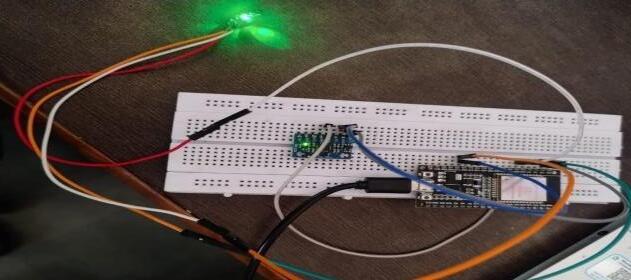
1. Hardware Components: The system utilizes various hardwarecomponentstocollectfitness-relateddata.The primarycomponentistheESP32microcontroller,which serves as the central processing unit for integrating the sensorsandmanagingdatatransmission.
International Research Journal of Engineering and Technology (IRJET) e-ISSN:2395-0056
Volume:11Issue:11|Nov2024 www.irjet.net p-ISSN:2395-0072
2. Integration Process: Thesetupinvolvesconnectingthe MPU6050 and HW827 sensors to the ESP32. The MPU6050 is deep sleep modes, and cross-validation. These enhancements improve system performance, supportingtheeffectiveuseofIoTandmachinelearning for real-time fitness monitoring & personalized recommendations.
3.Software Setup: The software setup involves programming the ESP32 using the Arduino IDE and integrating it with the Arduino IoT Cloud. The Arduino IoTCloudfacilitatesseamlessdatacollection,processing, andvisualizationthroughdashboards.Itprovidesauserfriendly interface for setting up data variables, monitoring sensor readings, and sending data to the cloud.
Machinelearningalgorithmsareimplementedfordata analysisandprovidingrecommendations.Popular librariessuchasscikit-learnorTensorFlowcanbeused fortrainingmodelsthatpredictuserbehaviororsuggest fitnessactivitiesbasedonhistoricaldata. utilizinglowenergywereimplemented,suchasfilteringtechniques andpoweroptimization,toenhancethesystem's reliability.
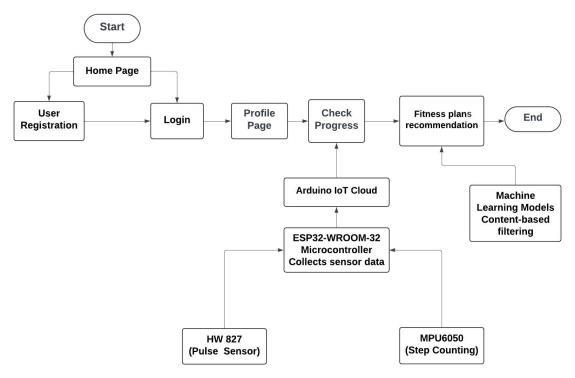
Fig2:FlowChart
VI. RESULTS AND DISCUSSION
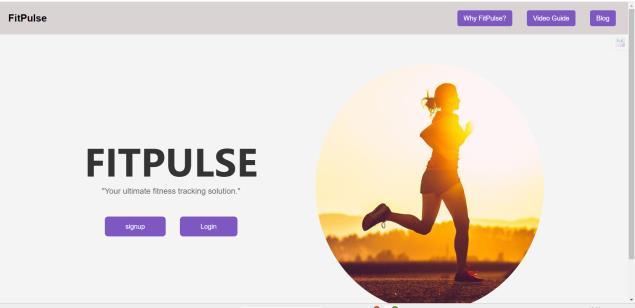
Fig3:HomePage
The page provides two main call-to-action buttons ”Signup”and”Login,”enablingnewuserstoregisterand existinguserstoaccesstheiraccounts.
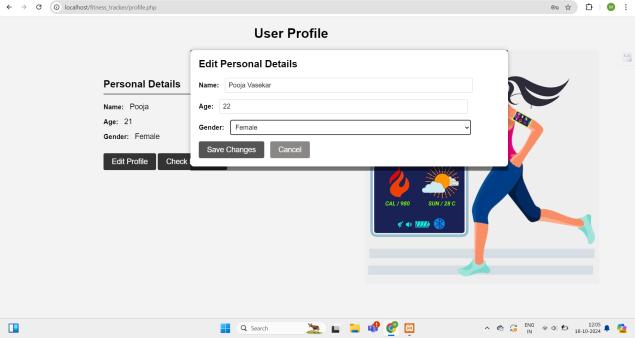
Fig3:ProfilePage
Profilepagewhereusercanenterthedetailslikename, ageandgender.Alsocaneditandcheckprogress

Fig4:VideoWorkoutPage
VideoWorkoutspageonthewebsite,featuringavariety of fitness and wellness videos. The videos displayed include topics such as yoga for beginners, warm-up routines,meditation,andstretchingexercises.
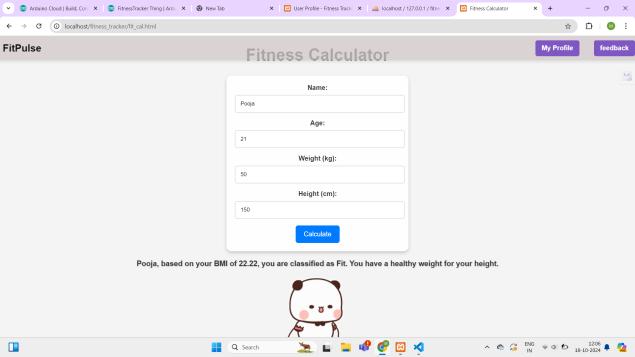
Fig5:FitnessCalculatorpage
Fitness Calculator page allows users to input personal detailssuchasname,age,weight(kg),andheight(cm)to calculatefitness-relatedmetrics.
International Research Journal of Engineering and Technology (IRJET) e-ISSN:2395-0056
Volume:11Issue:11|Nov2024 www.irjet.net p-ISSN:2395-0072
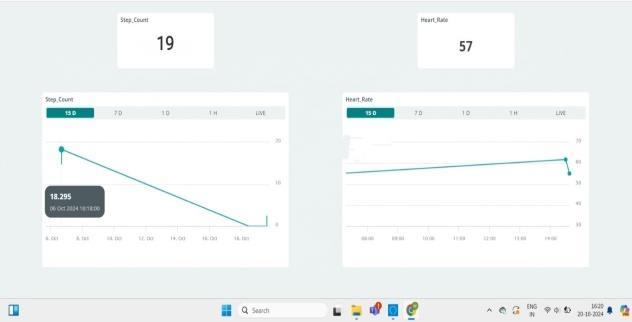
The fitness tracker continuously collects data from the MPU6050 & HW827 sensors, capturing step counts through motion analysis and heart rate by monitoring pulse signals. This data, displayed as daily step counts, average and peak heart rates during activity, reveals trends like increased heart rate during exercise or reduced steps on sedentary latency, and power management, also promote days, visualized in the ArduinoIoTClouddashboards.
Machine learning models process this data in real time, identifying fitness patterns to significant value by analyzing data patterns and providing personalized health and activity recommendations. These recommendations not only help users set achievable fitness goals but healthier lifestyle choices by various solutions
1. CONCLUSION
The IoT-enhanced fitness tracker project presents a comprehensive approach to modern fitness tracking by integrating Internet of Things (IoT) technologies, machine learning algorithms, and user-friendly web interfaces. The system employs sensors such as the ESP32 microcontroller, HW827 for heart rate monitoring, and MPU6050 for tracking physical movements to collect real-time data on vital health metrics,includingheartrateandstepcount.Thisdatais wirelessly transmitted to a central server, where it is securelystoredandprocessedforanalysis.
Machine learning algorithms such asKNNis utilized to analyze the data, classify activities, and generate customized fitness recommendations. These algorithms ensure that the recommendations are personalized, based on the user’s activity levels, health metrics, and historical trends. The system’s capacity for continuous learning allows it to adapt recommendations over time tofitchanginguserneeds.
The web UI is built with HTML, CSS, and JavaScript, enables users to visualize their health data in real-time,
track progress, and interact with fitness recommendations. The responsive design ensures seamlessaccessacrossdifferentdevices,providingusers with flexibility in monitoring their health metrics anytime and anywhere. Moreover, the architecture supports scalability, allowing additional sensors or functionalitiestobeintegratedeasilyinthefuture.
Thefitnesstrackersystemcanbesignificantlyenhanced by focusing on improving data accuracy and device functionality. Integrating advanced sensors, such as high-precision heart rate and motion sensors, will help reducemotionartifactsduringworkouts,ensuringmore reliable health metrics. Additionally, incorporating offline mode functionality will allow users to store and collect data locally when internet connectivity is unavailable, ensuring uninterrupted usage and convenienceinremoteareas.
Another critical area for improvement is extending battery life through efficient power management strategies and adopting low-energy communication protocols like Bluetooth Low Energy (BLE). Exploring sustainable energy solutions, such as solar-powered wearable components, can further enhance device longevity while promoting environmental sustainability. Moreover, advanced activity recognition powered by machine learning, including deep learning algorithms, can provide better accuracy in identifying diverse physical activities, enabling more personalized and actionable recommendations for users. These advancements will make the system more robust, reliable,anduser-centric.
[1] Lops, P., de Gemise, M., & Semeraro, G. (2007). A survey of content-based recommender systems. The AdaptiveWeb,4321,73-105.Accessed:2024-09-09.
[2] Hu, Y., Koren, Y., & Volinsky, C. (2008). Collaborative filtering for implicit feedback datasets. Proceedings of the 8th IEEE International Conference on Data Mining (ICDM),263-272.Accessed:2024-09-09.
[3] Yang, G., Mucchi, L., Smitha, M., Anand, K., Railkar, P. N., & Mahalle, P. N. (2024). IoT-based wearable fitness trackerwithmachinelearningrecommendationsystem.
4.Rashid,A.M.,Albert,I.,Cosley,D.,Lam,S.K.,McNee,S. M., Konstan, J. A., Riedl, J. (2002). Getting to Know You: Learning New User Preferences in Recommender Systems. Proceedings of the 7th International Conference on Intelligent User Interfaces (IUI ’02), 127134.Accessed:2024-09-09.
International Research Journal of Engineering and Technology (IRJET) e-ISSN:2395-0056
Volume:11Issue:11|Nov2024 www.irjet.net p-ISSN:2395-0072
[5] Chiang, M. C., Kuan, Y. C., Lee, T. C., & Chen, C. W. (2019). A wearable IoT-based device for real-time heart rate monitoring. Computers and Electrical Engineering, 72,194-203.Accessed:2024-09-09.
[6]VanEssen,B.,Macaraeg,C.,&Donker,H.(2019).Edge computing vs. cloud computing: IoT application performance and cost considerations. A triaxial accelerometer and portable data processing unit for the assessment of daily physical activity. IEEE Transactions on Biomedical Engineering, 44(3), 136-147. Accessed: 2024-09-09.IEEEInternetofThingsJournal,6(4),75957605.Accessed:2024-09-09.
[7] Raschka, S., & Mir Jalili, V. (2019). "Python Machine Learning: Machine Learning and Deep Learning with Python,Scikit-Learn,andTensorFlow2" (3rded.).Packt Publishing.Accessed:2024-09-09.
[8] Paul, A. K., & Anjana, A. P. P. (2024). "Practical Machine Learning for Data Analysis Using Python." Accessed:2024-09-09.
[9] Bishop, C. M. (2006). "Pattern Recognition and MachineLearning."Springer.Accessed:2024-09-09.
[10]Bouten,C. V., Koekkoek,K.T.,Verduin, M., Kode,R., &Janssen,J.D.(1997).
[11] Ravi, N., Dandekar, N., Mysore, P., & Littman, M. L. (2005). Activity recognition from accelerometer data. Proceedings of the 17th Conference on Innovative Applications of Artificial Intelligence, Volume 3. Accessed:2024-09-09.
[12]Laplante,P. A., &Neill, C. J.(2017).The IoT:A brief discussion of the challenges and opportunities. IEEE Consumer Electronics Magazine, 6(1), 50-54. Accessed: 2024-09-09.