
International Research Journal of Engineering and Technology (IRJET) e-ISSN: 2395-0056
Volume: 11 Issue: 11 | Nov 2024 www.irjet.net p-ISSN: 2395-0072

International Research Journal of Engineering and Technology (IRJET) e-ISSN: 2395-0056
Volume: 11 Issue: 11 | Nov 2024 www.irjet.net p-ISSN: 2395-0072
G. Jithin1 , B. Jothsna Sai Sri2 , R. Akshaya3, Dr. G Ganapathi Rao4
123Computer Science and Engineering (Data Science) Institute of Aeronautical Engineering Hyderabad, India
4Assistant Professor Computer Science and Engineering (Data Science) Institute of Aeronautical Engineering Hyderabad, India ***
Abstract –Road accidents are a common issue, with India recording the highest rate of fatalities, often due to driver drowsiness. Fatigue and sleepiness are significant factors contributing to these accidents. This paper outlines a system to detect driver drowsiness by analyzing eye aspect ratio (EAR) and mouth aspect ratio (MAR). If these values exceed set thresholds, an alert is triggered, notifying both the driver and passengers, thereby enhancing road safety and reducing accident risks. Based on EAR, drowsiness for the eye is detected and based on MAR , yawning is detected. Both yawning and sleepiness cause fatigue in drivers. So, to overcome this in this location of nearby hotels is displayed when a driver is under drowsiness
Key Words: Drowsiness Detection, Hybrid Features, TransferLearning,EAR,MAR,Hotellocations.
1.INTRODUCTION
Driverdrowsinessdetectionsystemsaredesigned to monitor and analyze a driver's physical or behavioural signalstoassessalertnesslevelsandidentifysignsoffatigue. Bydetectingcueslikeslowblinking,yawning,orerratichead movementsusingcamerasorsensors,thesystemcanalert the driver to take action before an accident occurs. Some advancedsystemsalsomonitorphysiologicalsignals,suchas heartrate,orusemachinelearningalgorithmstoimprove detectionaccuracy.
Intoday'sfast-pacedworld,peopleoftenoverlook theimportanceofpropersleepduetotheirbusyschedules, whichcanhaveasignificantimpactonroadsafety.Driving while drowsy is one of the leading causes of accidents, alongside drunk driving and general negligence. The consequencesoftheseaccidentsarefar-reaching,affecting notonlythedriversbutalsoothersontheroad.
Thegrowingnumberofvehicleshasheightenedthe need for effective measures to ensure safety, with driver fatiguebeingamajorfactorintrafficaccidents.
To address this, driver drowsiness detection systemshaveemergedascrucialtechnologiesthatmonitor the driver's behavior in real-time. These systems rely on visual analysis, focusing on cues such as eye closures, yawning,andheadmovementstodetectsignsoffatigue.By using advanced computer vision and machine learning
techniques, these systems can alert drivers promptly, helpingtopreventaccidents.
It monitors the driver's behavior for signs of drowsinessandprovidestimelyalerts,encouragingthemto takeabreakbeforelosingfocusorfallingasleep.Thissystem reducestheriskofaccidents,especiallyonlongdrivesorfor commercialdrivers,ensuringsaferjourneysandminimizing financial and legal impacts related to collisions. Road accidentsfrequentlyresultfromdriverdrowsiness,reduced focus, and fatigue, leading to slower reaction times and impaired control. Detecting drowsiness is critical for preventingtheseaccidentsbycontinuouslymonitoringthe driver'salertnessandissuingtimelywarnings.Thissystem helpsreducecrashes,protectlives,andensuresaferdriving, particularlyonlongtripsorduringnighttimedriving.
Haar Cascade Classifier is a popular machine learning-basedapproachforfacedetection.ItusesHaar-like features,whicharepatternsofpixelintensities,toidentify objects like faces in images. The classifier is trained on numerouspositiveimages(faces)andnegativeimages(nonfaces) to distinguish between them. During detection, it scanstheimageatmultiplescalesandpositions,lookingfor areaswherethefeaturesmatchthoseofaface.Themethod is efficient and works well for real-time face detection, commonly used in applications like security systems and camera-basedfacerecognition.
Eye Aspect Ratio (EAR) and Mouth Aspect Ratio (MAR) are key indicators used in driver drowsiness detection. EAR measures the ratio of distances between verticaleyelandmarksandthehorizontaldistancesbetween the eyecorners. When a driver becomesdrowsy, the eyes tend to blink more frequently or remain partially closed, causing a significant drop in EAR values. By continuously monitoringthisratio,thesystemcandetectprolongedeye closures,signallingpotentialdrowsiness.
Also,MARtrackstheratioofmouthopeningbased on facial landmarks. As drivers get drowsy, they tend to yawn frequently, which increases the MAR value. By analysingtheseyawningpatternsincombinationwitheye closuredetection,thesystemcanmoreaccuratelyidentify signsoffatigue,providinganearlywarningtohelpprevent accidents. Combining EAR and MAR enhances the overall accuracyofdrowsinessdetectionsystems.
International Research Journal of Engineering and Technology (IRJET) e-ISSN: 2395-0056
Volume: 11 Issue: 11 | Nov 2024 www.irjet.net p-ISSN: 2395-0072
Thispaperproposesahybriddrowsinessdetection system combining visual features (PERCLOS) with nonvisual ECG sensors, achieving a 94.5% detection rate and addressingnight-timedrivingchallenges.[1]
Thispaperusesdeeplearningtechniquestodetect driverdrowsinessbyanalyzingfacialfeatureslikeyawning, eyeblinking,andheadmovements.[2]
Thispaperproposesadrowsinessdetectionsystem using Haar classifiers to detect eye and mouth regions, focusingoneyelidmovementsandyawning.Byprocessing onlyoneeyetoimprovespeedandreducefalsedetections, the system achieves an 80% performance rate, proving effectiveundervaryinglightingconditions.[3]
Thispaperpresentsadriverdrowsinessdetection systemthatusesanIRcameratotrackpupilmovementand determineiftheeyesareopenorclosed.Iftheeyesremain closed for several frames, the system detects fatigue and triggers an alarm, helping to prevent accidents caused by drowsiness.[4]
This paper investigates a driver drowsiness detection system using three methods: EEG, EOG signal processing,andimage-basedeyestateanalysis.Byfocusing oneyestates(open,half-open,closed),thestudyutilizestwo neuralnetworks singlehiddenlayerandautoencoder to assess the feasibility of accurately detecting drowsiness throughimage-basedanalysis.[5]
This paper introduces a module within the AdvancedDriverAssistanceSystem(ADAS)thatenhances roadsafetybydetectingdriverfatigueusingAIandvisual informationkeyindicatorofdrowsiness,allowingthesystem toalertthedriverinreal-timeandpreventaccidents.[6]
ThepaperintroducesDriCare,asystemdesignedto detectdriverfatiguethroughfacialexpressionslikeblinking, yawning, and eye closure duration using video images. Unlikeearlierapproachesthatrequiredphysicalsensorson thedriver,DriCareusesanon-invasivemethodbyanalyzing facialfeaturescapturedinreal-time.Itemploysanewfacetrackingalgorithmforhigheraccuracyanduses68keyfacial pointstoevaluatethedriver’scondition.[7]
3.SURVEY STUDY REPORT
A) Primary Reason for Road Accidents: Driverfatigueis oneoftheleadingcausesofroadaccidents,contributingtoa significantpercentageofcrashesworldwide.Fatigueimpairs adriver'sreactiontime,concentration,anddecision-making abilities,oftenleadingtodelayedresponsesorfallingasleep at the wheel. Visual analysis of eye closure, yawning, and headmovementshelpsmonitorfatigueinreal-time,aiming
toreducetherisksassociatedwithlongdrivinghoursand monotonousconditions.
B) High Death Rate: TheFatigueisacommoncauseofhigh roadaccidentdeathrates,particularlyonhighwaysandat nightwhendriving,whichimpairsvehiclecontrolandcauses adelayedreactiontodangers.
TheStepsinvolvedinimplementingDrowsinessDetection are:
Startwebcam
HaarcascadeFaceDetection
landmarking
CalculateEARandMAR
Basedonthresholdshowdrowsiness
Ifdriverdrowsy,shownearesthotelsforrest
Stopthewebcam
Web camera monitor driver facial details continuously to take an action. When driver is in normal conditionmeanseyesarefullyopenedandmouthisclosed, thereisnowarningshowntodriver.Whendriverisclosing eyes then drowsy warning will be displayed and nearby hotelstotakerestfordriverwillbeshownbytakinglocation details of driver. Even same case happens with yawning. Whenyawningisdetecteddrivershouldtakerestsoweare displayingthenearbyhotels.
Start Webcam
HaarcascadeFacedectection
Landmarking
CalculateEARandMAR
Comparewiththresholdvalues
Ifdriverdrowsy,shownearest hotelsforrest
Stopthewebcam
International Research Journal of Engineering and Technology (IRJET) e-ISSN: 2395-0056
Volume: 11 Issue: 11 | Nov 2024 www.irjet.net p-ISSN: 2395-0072
Flow chart is explained in detail below,
The webcam is first turned on to continually record the driver'sfaceinrealtimeaspartofthesleepinessdetection system.Thebasisforfindingfatiguesignsthatcannotifythe driver before drowsiness hampers driving is provided by thisreal-timedata.ThesystemfirstemploysHaarCascade,a machine learning-based method for face detection that rapidly recognizes the driver's face in every frame. By concentrating on important facial regions, Haar Cascade isolatespertinentfacialfeaturesforadditionalexamination, facilitatingeffectiveprocessing.
Following face detection, the algorithm marks important facial features using facial landmarking. The dlib library, whichusestheiBUG300-Wdataset adatasetintendedto identify68differentfaciallandmarks isusedtoaccomplish this. Important regions surrounding the mouth, nose, jawline,andeyesareincludedintheselandmarks.Theareas surroundingthemouthand eyesare especiallycrucial for detecting drowsiness because they aid in tracking certain signsofexhaustion,likeyawnsandeyeblinks.Calculating certainmetricsliketheEyeAspectRatio(EAR)andMouth AspectRatio(MAR)requiresaccuratecoordinates,whichare providedbythe68-pointfaciallandmarkmodelindlib.
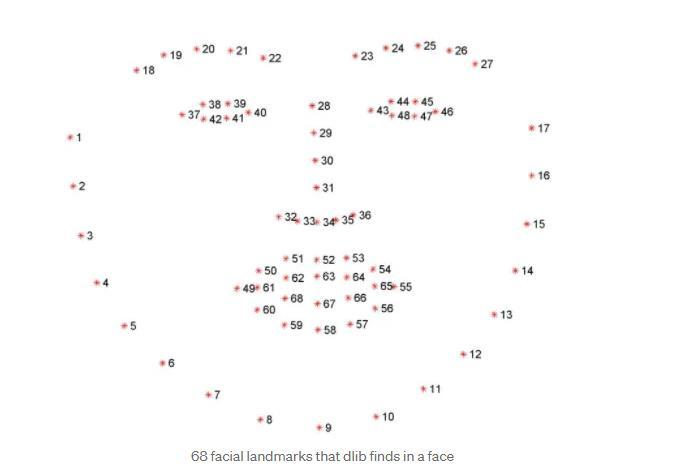
Using the 68 facial landmark coordinates, the system computes the Eye Aspect Ratio (EAR) and Mouth Aspect Ratio (MAR) to track sleepiness indicators, including eye blinksandyawns.Sixdistincteyelandmarks P1,P2,P3,P4, P5,andP6 areusedtodetermineEAR.
However,inordertoidentifyyawning,anotherindicationof tiredness,MARevaluatesmouthopenness.TheMARformula dividestheaverageverticaldistancebetweenthreepairsof pointsbythehorizontaldistanceacrossthemouthusingthe mouth landmarks P1, P3, P4, P5, P6, P7, and P8. A rise in MAR, a measure of tiredness, is brought on by yawning.measureofeyeblinksorextendedclosurebrought onbywearinessbecauseitdropsastheeyesclose.
This formula calculates eye openness by dividing the horizontal distanceacross theeyebythevertical distance betweentheeyelids,whichisaveragedovertwolocations. TheEARisagoodmeasureofeyeblinksorextendedclosure broughtonbywearinessbecauseitdropsastheeyesclose.
ThesystemcomputesEARandMAR,thencomparesthese ratios to predetermined cutoff points. The system will displayawarningifeitherratioishigherthanitsthreshold, whichindicatesthatthedrivermightbesleepy.Thesystem mayuseGoogleMapstosuggesthotelsorrestareasinthe area when tiredness is detected, which encourages the motoristtotakeabreakandpromotessafedriving.
When no more indications of exhaustion are found or the drivertakestherequiredsteptorest,thesystemendsthe webcam'sdrowsinessdetectionprocedure.Improvedroad safetyforthedriverandothersisensuredbythiscycleof ongoingobservationandpromptaction.
Hereresultsareanalysedfortotalthreedifferentpersonand observed that our proposed system is working more efficient.
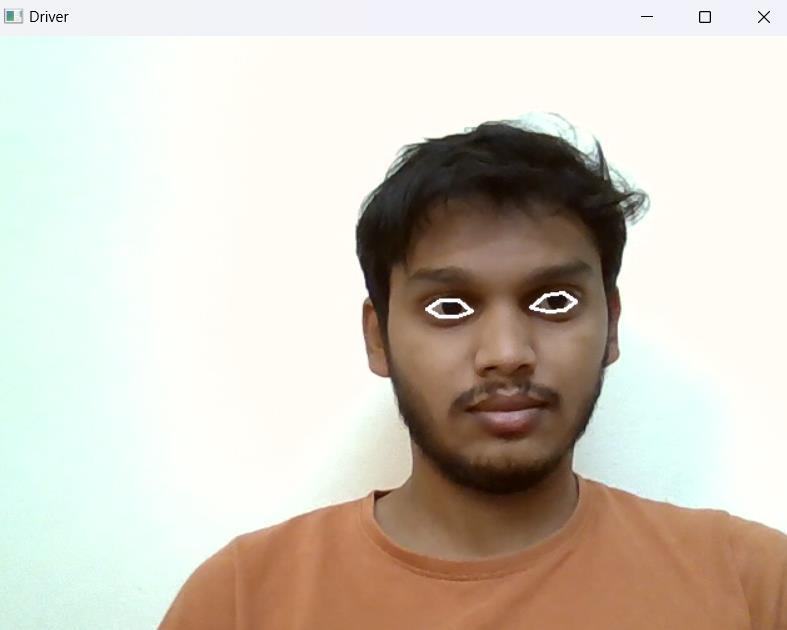
Figure5.1illustratesthatnowarningsaregivenwhenthe driverisinanormal,alertconditionsincetheEARandMAR values remain within safe bounds. In order to prevent
International Research Journal of Engineering and Technology (IRJET) e-ISSN: 2395-0056
Volume: 11 Issue: 11 | Nov 2024 www.irjet.net p-ISSN: 2395-0072
needless distractions, the system passively observes the driver'sfacedatawithoutgettinginvolved.Thisguarantees constant,discretemonitoringthatonlytriggersnotifications whensignsofdrowsinessappear.Asaresult,thetechnology offers a driving experience that is encouraging but unobtrusive.
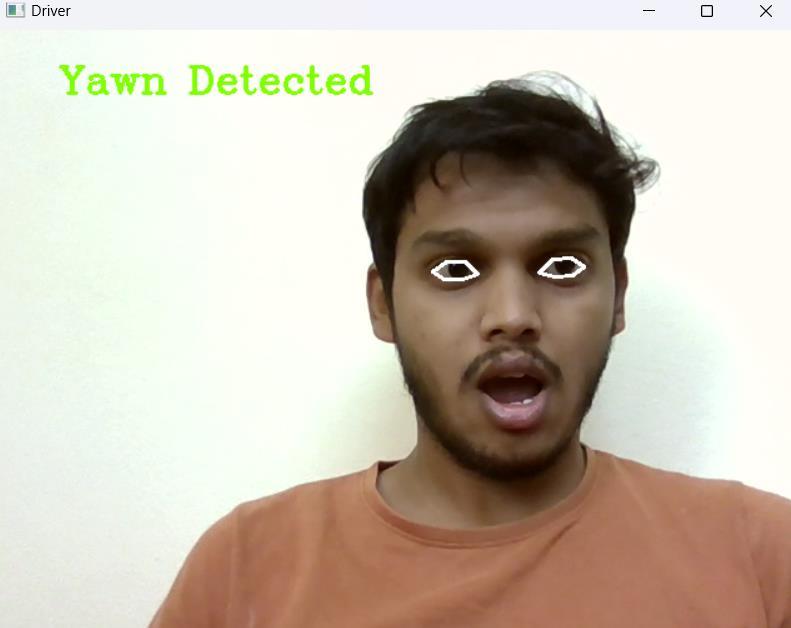
: Yawn detected as mouth is open
Figure5.2illustrateshowthesystemindicatesayawnand recommends motels in the area for the driver to stay at when their MAR surpasses the predetermined level. By addressing early indicators of fatigue, this alert seeks to persuadethedrivertotakearest.Thedetectionguarantees promptactiontopromotesafedriving.
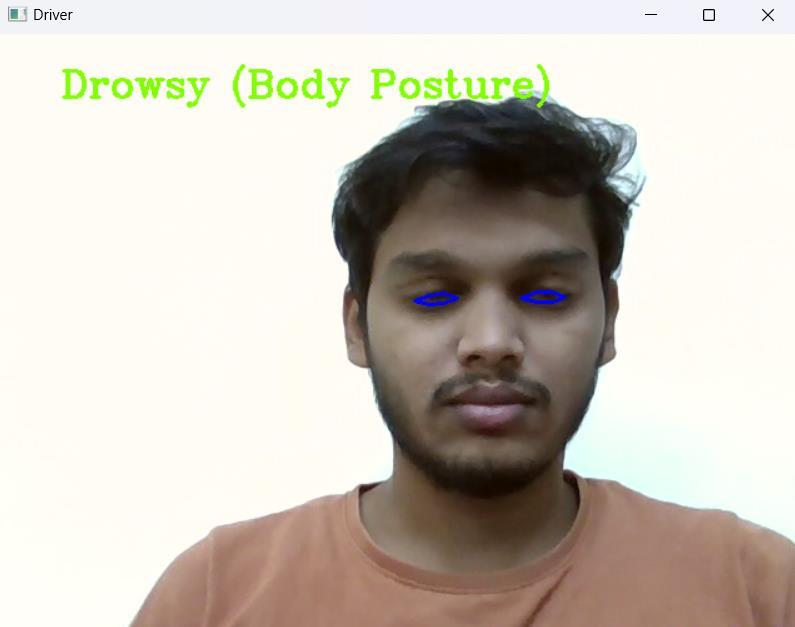
warning and recommends motels in the area for rest. By encouragingthemotoristtostopandtakeabreak,thisalarm systemimprovesroadsafety.
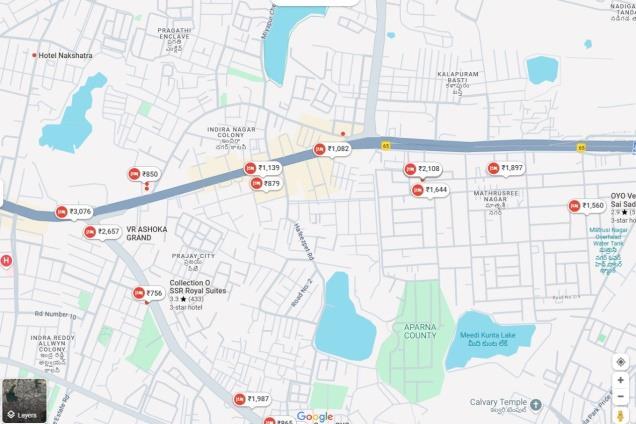
-5.4: Hotels near driver
Thesystemusesreal-timelocationdatatorecommendrest stopsandshowsthedriverhotelsinthearea(Figure 5.4). Whensleepinesssymptomsareidentified,thisfeaturekicks in, giving the driver easy ways to take a break and guaranteeing safer driving by encouraging rest when necessary
Driver drowsiness is a major cause of road accidents, particularly in countries like India, where the fatalityrateisalarminglyhigh.Byutilizingeyeaspectratio (EAR) and mouth aspect ratio (MAR) to monitor driver fatigue,thissystemoffersareliablemethodtodetectearly signs of drowsiness. When these indicators exceed the threshold values, timely alerts are sent to both the driver and passengers, significantly reducing the likelihood of accidents.Thisapproachcanplayacrucialroleinimproving road safety and preventing fatalities caused by drowsy driving.Whendriverdrowsinesssoourapplicationsuggests drivertotakerestinnearbyhotelsandevenhoteldetailsare diaplyedonthescreenofdriversohecanchoosehotelbased onprice,locationandotherdetails.
[1] Abbas, Qaisar. "HybridFatigue: A real-time driver drowsinessdetectionusinghybridfeaturesandtransfer learning."InternationalJournalofAdvancedComputer ScienceandApplications11,no.1(2020).
Thesystemdetectstirednesswhenthedriver'sEARdrops below the threshold, which indicates close eye closing, as shown in Figure 5.3. It immediately shows a sleepiness
[2] PriyankaS,ShanthiS.ANovelApproachtoDetectDriver Drowsiness Using Transfer Learning and Hybrid Features, 04 February 2024, PREPRINT (Version 1) available at Research Square [https://doi.org/10.21203/rs.3.rs-3914347/v1]
International Research Journal of Engineering and Technology (IRJET) e-ISSN: 2395-0056
Volume: 11 Issue: 11 | Nov 2024 www.irjet.net p-ISSN: 2395-0072
[3] VidyagouriB.Hemadri,UmakantP.Kulkarni,Detection of Drowsiness Using Fusion of Yawning and Eyelid Movements, Advances in Computing, Communication, and Control Co1mnunications in Computer and InformationScienceVolume361,pp583-594(2017).
[4] K. S. Chidanand Kumar, Brojeshwar Bhowmick, An ApplicationforDriverDrowsinessIdentificationbased onPupilDetectionusingIRCamera,IntelligentHumanComputerInteraction,pp73-82(2019).
[5] T.Vesselenyi,SMoca ,A.Rus,T.MitranandB.Tiitaru, Driver drowsiness detection using ANN image processing,(2017)
[6] BelalAlshaqaqi;AbdullahSalemBaquhaizel;Mohamed ElOuisDriverdrowsinessdetectionsystem,2017
[7] Wanghua Deng; Ruoxue Wu, Real Time DriverDrowsiness Detection System Using Facial Features,2019
[8] Drowsiness Using Fusion of Yawning and Eyelid Movements Advances in Computing, Communication, and Control Communications in Computer and InformationScienceVolume361,pp583-594(2017).
[9] Bela!Alshaqaqi;AbdullahSalemBaquhaizel;Mohamed El OuisDriverdrowsinessdetection,20178. K.Satish; A.Lalitesh;KBhargavi;driverdrowsinessdetection2020
[10] Fouzia;RoopaLakshmi,JayantKumar,A.Rathod;Aswita ,S,Shetty,K.Supriya,Driverdrowsinessdetectionsystem basedonvisualfeatures.2018
[11] ChallaYashwanth;JyotiSinghKirar,Driver'sDrowsiness Detection,2019
[12] KarlikDwivedi;KumarBiswaranjan;AmitSethi,Drowsy driverdetectionusingrepresentationlearning,2014
[13] Ioana-Raluca Adochiei; Oana-Tsabela tirbu; NarcisTulianAdochiei;MateiPericleGabriel;Ciprian-Marius Larco; Stefan-M ircea M ustata; Diana Costin, Drivers' DrowsinessDetectionandWarningSystemsforCritical Infrastructures,202044
[14] OraanKhunpisuth;TaweechaiChotchinasri;Varakorn Koschakosai; Narit Hnoohom, Driver Drowsiness DetectionUsingEye-ClosenessDetection,2017
[15] SukritMehta;ParimalMishra;ArpitaJadhavBhatt;Parul Agarwal,AD3S:AdvancedDriverDrowsinessDetection SystemusingMachineLearning,2020
[16] Maninder Kahlon; Subramaniam Ganesan, Driver Drowsiness Detection System Based on Binary Eyes ImageData,2018
[17] MelissaYauri-Machaca;BrianMeneses-Claudio;Natalia Vargas-Cuentas; Avid Roman-Gonzalez, Design ofa Vehicle Driver Drowsiness Detection System Through ImageProcessingusingMatlab,2018
[18] S. S, N. Banupriya, S. M and S. N. H, "Drowsiness Detection with OpenCV," 2021 Second International Conference on Electronics and Sustainable Communication Systems (ICESC), Coimbatore, India, 2021,
[19] AnshulPinto;MohitBhasi;DurveshBhalekar;Pradyoth Hegde; Shashidhar G. Koolagudi, A Deep Learning ApproachtoDetectDrowsyDriversinReal-Time,2020
[20] Zuzana Kepesiova; Jan Cig; inek; Stefan Kozak, Driver Drowsiness Detection Using Convolutional Neural Networks,2020
[21] Alak Das; Dibyendu Ghoshal, Human eye detection of color images based on morphological segmentation usingmodifiedHarriscornerdetector,20I3