
International Research Journal of Engineering and Technology (IRJET) e-ISSN:2395-0056
Volume: 11 Issue: 11 | Nov 2024 www.irjet.net p-ISSN:2395-0072

International Research Journal of Engineering and Technology (IRJET) e-ISSN:2395-0056
Volume: 11 Issue: 11 | Nov 2024 www.irjet.net p-ISSN:2395-0072
Manjula KalmathAsst.Prof
JSS Shri Manjunatheshwara MCA Institute, Vidyagiri, Dharwad 04
Affiliated with Karnataka University Dharwad City: Dharwad, State: Karnataka, Country: India
Abstract - Accuratelypredictingstudentperformanceis crucial for effective educational interventions and resource allocation. This study compares prominent supervised machine learning algorithms for forecasting student achievement, addressing the lack of comprehensiveevaluations inexistingresearch.Analyzing a dataset of 60 students from JSS SMI UG and PG Studies, Dharwad, India, the research incorporates student demographic information, academic performance indicators, engagement metrics, and final performance results to identify factors influencing academic success. The study evaluates several models, including logistic regression, decision trees, random forest, support vector machine (SVM), k-nearest neighbors (KNN), and Naive Bayes algorithms. A 5-fold cross-validation technique assesses model performance more reliably than a simple train_test_split, enhancing the evaluation of the model's generalizability and mitigating overfitting risks. Results indicate that the decision tree classifier achieves a mean accuracy of approximately 0.967, with most folds demonstrating perfect accuracy, although it may be susceptible to overfitting. The random forest classifier exhibits a mean accuracy of around 0.883, showing slightly more variability but greater robustness. KNN attains a mean accuracy of approximately 0.7667, while Gaussian Naive Bayes (NB) demonstrates consistent accuracywithameanofaround0.817.Logisticregression displays lower and less consistent accuracy at approximately 0.583. SVC exhibits the lowest accuracy at 0.45, suggesting that it might not be well-suited for the dataset. This study provides valuable insights into selecting and applying appropriate machine learning techniquesforpredictingstudentperformance,potentially benefitingeducatorsandresearchersinthefield.
Key Words: Supervised machine learning algorithms, Academic performance, 5-Fold crossvalidation, Confusion matrix, Accuracy, Prediction, ClassificationReport.
1.INTRODUCTION :
In education, predicting student academic performance is essential for identifying at-risk students and enhancing educational outcomes. This study
investigates the relationship between various factors, such as internal assessments, seminar engagement, assignment completion, attendance, and extracurricular activities,andtheirinfluenceonstudents'finalacademic results. By employing historical data and machine learning techniques, this research aims to develop a predictive model that accurately estimates final student grades based on these internal academic indicators. The abilitytopreciselyforecaststudentperformanceenables educators and institutions to implement timely interventions and tailor learning strategies to individual needs.
Theprimaryobjectiveofthisresearchistoassessthe efficacy of various supervised learning algorithms in predicting student performance. A real-world dataset will be utilized, incorporating features such as gender, assignment scores, seminar participation, internal marks, attendance, and overall average, with the student's grade as the target variable. While numerous supervised learning methods offer potential solutions, there is a lack of comprehensive understanding regarding the comparative advantages and disadvantages of different approaches in this field. Selecting the most appropriate algorithm for a specific educational context remains challenging. This study addresses this gap by conducting a comprehensive comparative analysis of several algorithms, including logistic regression, decision trees, random forest, SVM, KNN, and Naive Bayes. To evaluate the performance of these algorithms, 5-fold cross-validation will be utilized, ensuring robust assessment and minimizing the risk of overfitting. The algorithms will be compared using performance metrics such as accuracy, precision, recall, and F1 score, which will be calculated using a confusion_matrix.
Additionally, the study will evaluate the models by predicting grades for new, unseen data, visualizing the predictions with various output plots such as confusion_matrixandheatmap.Thesevisualizationswill aidininterpretingtheeffectivenessofeachalgorithmin predicting student performance. By elucidating the strengths and limitations of different machine learning models in educational settings, this research aims to
International Research Journal of Engineering and Technology (IRJET) e-ISSN:2395-0056
Volume: 11 Issue: 11 | Nov 2024 www.irjet.net p-ISSN:2395-0072
provideinsightsintowhichalgorithmsaremosteffective for student performance prediction and the practical implications of their use in real-world scenarios. Furthermore, the study seeks to address the challenges faced by educational institutions in managing diverse and complex data sources, ultimately contributing to moreinformeddecision-makingprocesses.
Recent studies have expanded beyond final exams to consider continuous assessments and extracurricular participation as key factors influencing student outcomes. The success of predictive models heavily depends on the choice of algorithm and dataset. For graduate-level predictions, factors such as GRE scores, GPA, motivation, and supervisor performance are commonly used [1]; [2]; [3]. Incorporating demographic, academic, and behavioural factors enhances prediction accuracy, emphasizing the importance of selecting relevant features and robust algorithms [4]. Predicting postgraduate performance involves considering multiple aspects, such as past academic records, demographics, and classroom behaviour [5]; [6]. Educational data mining (EDM) and machine learning techniquesarewidelyappliedto analyze student data, uncover patterns, and generate insights for decision-making [7]; [8]; [9] Supervised machine learning is particularly effective for classification and regression problems in predicting academic outcomes [10]. This study evaluated various supervised machine learning algorithms, with logistic regression showing the best performance in predicting studentsuccess.
Machine learning algorithms have demonstrated strong capabilities in predicting student academic performancebasedonvariousfactors.randomforestisa topperformer,withstudiesreportingaccuraciesof78% [11] and 77.3% [12] logistic regression and ensemble methodslikebagging andvotingalsoperformwell [13]; [14];[15] Key predictive factors include prior academic performance, study duration, gender, and engagement with online learning systems [12]. Other algorithms, such as Naïve Bayes and SMNaive Bayes, have shown significant predictive accuracy [16]. In one study, artificial neural networks (ANN) achieved the highest performance,explaining89%ofGPAvariation[17].
Machinelearningapproaches,particularlysupervised learning, have become integral to data analysis, with algorithms learning to categorize examples in classification tasks or predict numeric values in regression tasks [18]. Researchers are increasingly utilizing supervised, unsupervised, and semi-supervised learningtechniquestohandlethegrowingdata volumes in education and other fields learning [19]; [20]. Supervised learning involves labelled data, focusing on
classification and regression, while unsupervised learningseekspatternsinunlabelleddatausingmethods like clustering and dimensionality reduction [21]. Semisupervised learning combines both labelled and unlabelled data for enhanced predictions. Popular supervised techniques such as decision tree, Naïve Bayes, logistic regression, support vector machine, and Neural Networks yield accurate results in various fields [22]
3.
Figure 1 illustrates the overall working process of this study, evaluating six machine learning models for predictingstudentperformance.
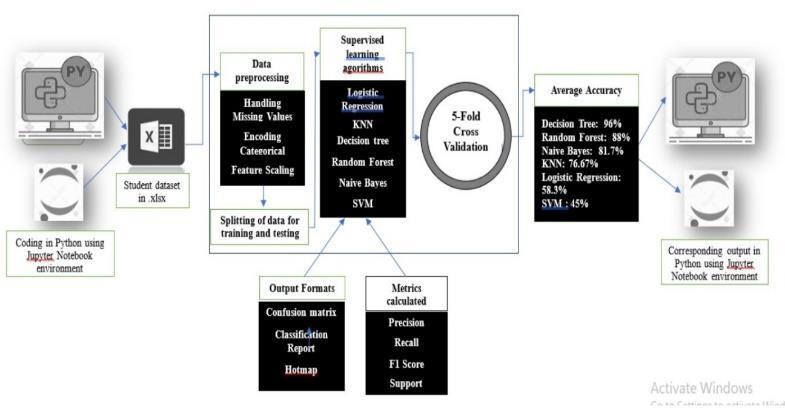
Figure1:MachineLearning-BasedPredictionofStudent AcademicPerformance.
This study employs a comparative analysis of supervised learning algorithms to predict student academic performance. We utilize a dataset maintained in an excel file, comprising records of student performance. The dataset includes the following features:
Roll_no:Uniqueidentifierforeachstudent.
Gender:Student'sgender(Male/Female).
Assignment:Marksobtainedinassignments.
Seminar:Marksobtainedinseminarpresentations.
Internal:Marksobtainedininternalassessments.
Attendance:Percentageattendanceofthestudent.
Average:Finalaveragemarks.
Grade: Final grade obtained by the student (A, B, C, etc.).
The dataset consists of records for 60 students, with the grade received by each student treated as the target variableforthepredictiontaskasshowninTable2
3.2
Evaluation metrics:
The performance of six supervised machine learning algorithms logistic regression, decision trees, random
International Research Journal of Engineering and Technology (IRJET) e-ISSN:2395-0056
Volume: 11 Issue: 11 | Nov 2024 www.irjet.net p-ISSN:2395-0072
forest, SVM, KNN, and Naive Bayes was evaluated using severalmetrics:
Accuracy: Percentage of correctly classified instancesoutofthetotalinstances.
Precision: Proportion of true positives among all positivepredictions.
Recall: Proportion of true positives among actual positives.
F1Score:Harmonicmeanofprecisionandrecall.
Confusion Matrix: Visual representation of the model'sperformance,displayingtruepositives,false positives,truenegatives,andfalsenegatives.
3.3 Software and tools:
The analysis and model implementation were performed using python (version 3.11.5) in jupyter notebook (version 7.2.2) environment The following librarieswereutilized:
pandas:Fordatamanipulationandpre-processing.
scikit learn: For implementing machine learning models,crossvalidation,andevaluationmetrics.
matplotlib and seaborn: For visualizing data and modelperformance.
numpy:Forefficientnumericalcomputations.
openpyxl:ToreadExcelfilesinpython.
3.4 Methods:
Mathematical background:
To understand the metrics used in the classification report, let's break down the precision, recall, F1 score, and support using mathematical formulas, and explain them in the context of our dataset. These metrics are basedonthemodel'sconfusion_matrixforeachclass.
Confusion Matrix for a Single Class:
The confusion_matrix for a binary classifier can be generalizedtomultipleclasses.
Table 1 : General form of confusion_matrix
Actual Predicted Positive (class 1) Predicted Negative (not class 1) Actual Positive (class1) TruePositive(TP) FalseNegative(FN) Actual Negative (not class1) FalsePositive (FP) TrueNegative(TN)
Table 1 shows confusion_matrix for the generalisationofagivenclass(e.g.,"Grade=1"):
True Positive (TP): The number of correctly predictedinstancesofclass1.
False Positive (FP): The number of instances incorrectlypredictedasclass1(buttheyarenotclass1).
FalseNegative(FN):Thenumberofinstancesofclass 1 that were not predicted correctly (i.e., predicted as anotherclass).
True Negative (TN): The number of correctly predictedinstancesthatdonotbelongtoclass1.
Calculation of precision, recall and F1 score:
Precision: measures the proportion of instances predictedasacertainclass(e.g.,class1)thatareactually thatclass,andisdefinedas:
Precision= True Positives (TP)/ (True Positives (TP)+FalsePositives(FP))
In this context, if class 1 represents a certain Grade (e.g., "Grade = A"), precision indicates the proportion of students predicted to have this grade who actually achieved it. A high precision suggests that when the modelpredicts"Grade=A",itistypicallyaccurate.
Recall (Sensitivity or True Positive Rate): measures theproportionofactualinstancesofaclass(e.g.,class1) themodelcorrectlypredicted,andisdefinedas:
Recall= True Positives (TP)/ (True Positives (TP)+FalseNegatives(FN))
In this dataset, recall for "Grade = A" indicates the proportionofstudentswhoactuallyhaveanAandwere correctly predicted as such by the model. A high recall suggeststhatthemodeleffectivelyidentifiesmostofthe trueinstancesof"Grade=A."
F1 Score: The F1 score is the harmonic mean of precision and recall. It provides a single metric that balances both precision and recall. It is particularly usefulwhenbalancingthetwoisnecessary,especiallyin cases of imbalanced datasets (i.e., when some grades occurmorefrequentlythanothers).
F1Score=2⋅(Precision⋅Recall)/Precision+Recall
In this context, the F1 score provides a combined measure of the model's performance in predicting a specific grade, balancing both precision (accuracy when predictingagrade)andrecall(identifyingallinstancesof that grade). A high F1 score indicates an effective balancebetweenprecisionandrecall.
Support: Support represents the quantity of actual instances for each class within the dataset. It is not a measure of model performance; rather, it indicates the numberofexamplespresentinthetestsetforeachclass (grade).
Forinstance,intheclassificationreport:
Class1:Support=6
Class2:Support=6
Class4:Support=0
International Research Journal of Engineering and Technology (IRJET) e-ISSN:2395-0056
Volume: 11 Issue: 11 | Nov 2024 www.irjet.net p-ISSN:2395-0072
Thisindicates:
Thereare6instancesofclass1(Grade1). Thereare6instancesofclass2(Grade2). Therearenoinstancesofclass4inthetestset.
Practical implementation:
In order to comprehend the entire operational procedureofeachalgorithm,thefollowingstepsneedto be executed. The initial step involves pre-processing, which includes addressing missing values, encoding categorical variables, performing feature scaling, and dividing the dataset into testing and training sets. This particularphaseisuniversalforallalgorithmssinceeach algorithm's effectiveness is assessed using the same dataset.Subsequently,eachmodelisformulated,trained, tested, used for predicting test values, utilized for creating a confusion_matrix, generating a classification report, and producing visualisations. Finally, 5-fold cross-validation is performed it offers a reliable performance estimate by reducing variance, making efficient use of data, providing balanced evaluation. It trainsand testsondifferent data portions,resultingin a more generalized and robust estimate of a model’s realworldperformance.
Pre-processing:
Before feeding the data into machine learning algorithmspre-processingstepsareapplied:
Handling missing values:
Missing data entries, if any, were handled using imputationtechniquessuchasfillingwithmean/median for numerical columns and mode for categorical columns. The data is collected and pre-processed in a spreadsheet format (Excel) for ease of analysis. It consists of both categorical (Gender, Grade) and numerical variables (Assignment, Seminar, Internal, Attendance,Average).
Implementation:
Codetoimportanddisplaythedatafromexcelfile
df=pd.readexcel("studentdata.xlsx") df
Table 2 : shows the dataset used for studentdata
Note:Completedatasetisgiven inthe endnotei
Filtering and assigning fields to dependent and independentarrayvariables:
ExtractingtwoarraysXandyfromaDataFramedf X=df.iloc[:,1:-1].values
1 means it starts from the second column (python uses zero based indexing, so 1 means the second column), -1meansitstopsjustbeforethelastcolumn.In ourdatasetRoll_noand Gradecolumnsarenotincluded inX
y=df.iloc[:, -1].values
Thisselectsallrowsandonlythelastcolumn(since1 refers to the last index in python). In our dataset only Gradecolumnisassignedtoy
Encoding categorical variables:
The categorical variable Gender was encoded utilizing label encoding (0 for Male, 1 for Female), and the Grade target variable was converted to numerical labels (e.g., A: 0, B: 1, C: 2, etc.). Python employs LabelEncoderfromthesklearn.pre-processingmoduleto convertcategoricaldataintonumericalform.
fromsklearn.pre-processingimportLabelEncoder le_gender=LabelEncoder()
le_grade=LabelEncoder()
ThiscodecreatesinstancesoftheLabelEncoderclass, designated as le_gender and le_grade, which are utilized to transform the values in the 'Gender' and 'Grade' columnsofthedataframe,respectively.
df['Gender']=le_gender.fit_transform(df['Gender'])
df['Grade']=le_grade.fit_transform(df['Grade'])
Thefit_transformmethodperformstwofunctions:
fit:It identifies the uniquevaluesinthe'Gender'and 'Grade'columns.
transform: It subsequently converts these categories intotheircorrespondingintegervalues.
Categoricalvariablessuchas'Gender'and'Grade'are transformed into numerical values because the models typically cannot interpret non-numeric data directly. By employing LabelEncoder, categorical values are converted to integers, enabling the machine learning modeltoutilizetheminitscalculations.
X = df[['Gender', 'Assignment', 'Seminar', 'Internal', 'Attendance','Average']]
y=df['Grade']
X comprises the features (independent variables) thatwillbeutilizedtomakepredictions.Inthisinstance, the features are 'Gender', 'Assignment', 'Seminar', 'Internal','Attendance',and'Average'
y contains the target (dependent variable) that we areattemptingtopredict,whichisthe'Grade'column.
Volume: 11 Issue: 11 | Nov 2024 www.irjet.net
In the context of a machine learning task, X would representtheinputdatafedintothemodel,andywould represent the output data (the actual grades) that the modelisattemptingtolearnhowtopredict.
Feature scaling:
Features with large ranges (such as Internal and Attendance) were standardized utilizing z-score normalization to ensure all features contribute equally during model training. To implement feature scaling to our dataset, we can employ either the StandardScaler (for standardization) or MinMaxScaler (for min-max scaling).
Applying Feature Scaling using Scikit-learn with StandardScalarandInitializingtheStandardScaler fromsklearn.preprocessingimportStandardScaler scaler=StandardScaler() Fitthescalertothedataandtransformit X_scaled=scaler.fit_transform(X)
Splitting of data for training and testing:
The dataset waspartitioned into trainingand testing sets, with 80% of the data utilized for training and 20% reservedfortesting. fromsklearn.model_selectionimporttrain_test_split
X_train, X_test, y_train, y_test = train_test_split(X, y, test_size=0.2,random_state=0)
This function is employed to divide the dataset into twodistinctsubsets:atrainingsetandatestingset.This step is crucial in the machine learning workflow to evaluatethemodel'sabilitytogeneralizetounseendata.
The train_test_split(X, y) function partitions the feature setXandthetargetvariableyinto:
X_train: The features for the training data (80% of the originaldataset).
X_test: The features for the testing data (20% of the originaldataset).
y_train:ThetargetvaluescorrespondingtoX_train. y_test:ThetargetvaluescorrespondingtoX_test.
Parameters:
test_size=0.2: this parameter specifies that 20% of the dataset will be allocated for testing, while 80% will beusedfortraining.
random_state=0: this parameter ensures the reproducibility of the dataset split. The random seed (0 in this instance) controls the shuffling of data prior to partitioning.
p-ISSN:2395-0072
3.5 Supervised machine learning algorithms:
3.5.1. Logistic regression:
The logistic regression model is an uncomplicated and easy to understand model utilized for both binary and multiclass classification. By employing a logistic function, it predicts the likelihood of a class (such as student grades) based on the association between the input features and the result. It performs effectively in situations where the connection between features and the result is roughly linear and the dataset does not contain intricate nonlinear patterns. The model estimates the relationship between the independent variablesandthedependentvariableandismostlyused for analysing and explaining the relationship between a binary variable and a series of predicted variables. Logistic regression is developed together with Linear Regression, but they differ in binary variable and continuous variable response. In our dataset, in the context of student performance prediction our target variable(y_train)iscategorical,predictingspecificGrade categories(A,B,C,etc.).
Model fitting and prediction:
fromsklearn.linear_modelimportLogisticRegression importsthelogistic regressionalgorithmfromScikitlearn.
Model=LogisticRegression() initializesthelogisticregressionmodel. Model.fit(X_train,y_train) trains the model on the training data (X_train for input features, y_train fortargetlabels), establishing the relationshipbetweenfeaturesandthetargetoutcome.
Y_pred=model.predict(X_Test)
The predict() method is employed to make predictions on the test data (X_Test), which represents the unseen data, comprising 20% of the original dataset not used for training. The model applies the learned relationshipstopredictthetargetvalues(y_pred)forthe testdata.Y_predwillbeanarrayofpredictedclasslabels correspondingtotheinputfeaturesinX_Test.
Evaluation of accuracy: from sklearn.metrics import classification_report, accuracy_score
This imports two important functions from Scikit learn’s metrics module to evaluate the performance of themodel print(“Accuracy:”,accuracy_score(y_Test,y_pred)) accuracy score: computes the accuracy of the model, whichistheratioofcorrectly_predictedinstancestothe totalnumberofinstances.
Volume: 11 Issue: 11 | Nov 2024 www.irjet.net p-ISSN:2395-0072
Classification report:
print (“\nClassification Report:\n” , classification_report(y_Test,y_pred))
classification_report: Provides a detailed breakdown of the model’s performance, including precision, recall, F1score,andsupportforeachclass.
Accuracy score (y_Test, y_pred) compares the true targetvalues(y_Test)withthepredictedvalues(y_pred) andcalculatestheproportionofcorrectpredictions.
In this instance, the accuracy of the model is 0.5833 (or approximately 58.33%), indicating that the model correctlypredictedabout58%ofthetestdata.
Print (“\nClassification Report:\n” , classification_report(y_Test,y_pred))
Table 3 : classification report of logistic regression
Table 3 illustrates that 1,2,4 are encoded numbers for Grades ‘B’,’C’,’Pass’ each Grade considered as an individual class for which the metrics are calculated, supportcolumnillustratesthatin theselectedfoldthere are no records of class 4, 6 records of class 1 and 6 recordsofclass2.
ForClass1(Grade1):
Precision = 0.67: students predicted to have Grade 1, 67%actuallyhadthisgrade.
Recall = 0.33: students who actually had Grade 1, the modelcorrectlypredicted33%.
F1 score = 0.44: this metric balances the precision and recallintoasinglescore.
Support=6:thereare6instancesofstudentswithGrade 1inthetestset.
Similarly
ForClass2(Grade2):
Precision0.62,Recall0.83,F1score0.71andsupport6
ForClass4(Grade4):
Precision, Recall, and F1 score = 0: There were no instances of Grade 4 in the test set; consequently, the modeldidnotpredictany.
Overall Metrics:
Accuracy: 0.58 The overall accuracy is 58%, indicating that the model correctly predicted the target for7outof12instances.
Macro average:
Precision:0.43Theunweightedmeanofprecisionacross allclasses.
Recall: 0.39 The unweighted mean of recall across all classes.
F1 score: 0.39 The unweighted mean of F1 score across allclasses.
Weightedaverage:
Precision: 0.65 The weighted mean of precision, accounting for the support (number of instances) for eachclass.
Recall:0.58Theweightedmeanofrecall.
F1score:0.58TheweightedmeanofF1score.
Observations:
The model demonstrates satisfactory precision and recall for classes 1 and 2; however, class 4 is not predicted,whichmaybeattributedtoalackofexamples inthetestsetorsuboptimalmodelperformanceforthis class. The overall accuracy of 58.33% is moderate but mayrequireimprovement,dependingonthecomplexity of the problem. In conclusion, this evaluation step facilitates the measurement of the trained model’ s performance on unseen data, both in terms of overall accuracyandmoredetailedclass-specificmetrics.
Prediction of new data:
new_data=[[1,8,7,75,90,80]] for example: Male, 8 Assignment, 7 Seminar, 75 Internal,90Attendance,80Average new_pred=model.predict(new_data)
print(“PredictedGrade(encoded):”,new_pred) print (“Predicted Grade (decoded):”, le Grade.inverse transform(new_pred)) outputoftheabovecode
PredictedGrade(encoded):[2]
PredictedGrade(decoded):[‘C’] y_predicted=model.predict(X_Test)
this line uses the trained machine learning model (model)topredictthetargetvalues(y_predicted)forthe test data (X_Test). The test data is a portion of the dataset that the model has not seen during training and isusedtoevaluateitsperformance.
International Research Journal of Engineering and Technology (IRJET) e-ISSN:2395-0056
Volume: 11 Issue: 11 | Nov 2024 www.irjet.net p-ISSN:2395-0072
Confusion matrix:
fromsklearn.metricsimportconfusion_matrix
this imports the confusion_matrix function from the sklearn.metrics module. A confusion_matrix is a useful tool to evaluate the performance of classification algorithms,especiallyformulticlassproblems.
Cm=confusion_matrix(y_Test,y_predicted)
here, a confusion_matrix (cm) is generated. It compares the true labels (y_Test) with the predicted labels (y_predicted). The resulting matrix shows how well the model is classifying data into different categories.
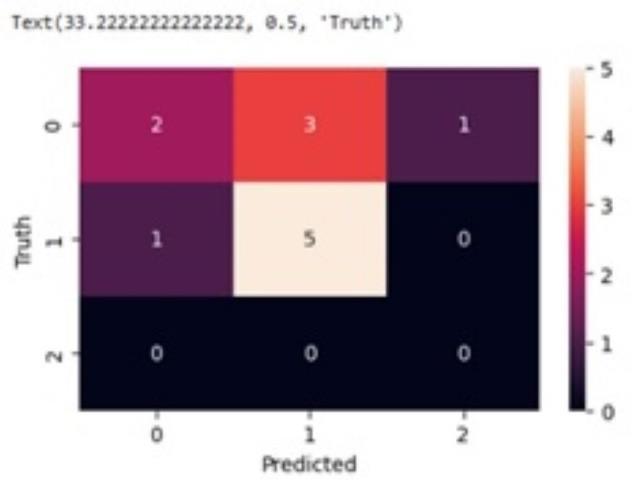
Confusion matrix:
array([[2,3,1], [1,5,0], [0,0,0]])
This is a 3x3 confusion_matrix, indicating that our classificationtaskhasthreeclasses.
The rows represent the actual classes and the columnsrepresentthepredictedclasses.
Row 1: Class 0 : -The model correctly predicted 2 instancesofclass0.Itmisclassified3instancesasclass1 and1instanceasclass2.
Row 2: Class 1:- The model correctly_predicted 5 instancesofclass1.Itmisclassified1instanceasclass0.
Row 3: Class2:-Themodeldidnotcorrectly_predict any instances of class 2. No instances were predicted as class2.
The observation shows that the confusion_matrix provides correct predictions along the diagonal (top left to bottom right). Misclassifications in the off diagonal cells. It can be particularly helpful for diagnosing issues inclassificationmodels.
Visualisation (Heatmap):
This code visualizes the confusion_matrix using a heatmap from the seaborn library, making it easier to interpretthemodel’sperformance.
Importseabornassn
this imports the seaborn library, which is a python data visualization library based on matplotlib. It provides high level functions to create informative and attractivestatisticalgraphics.
Plt.figure(figsize=(5,3))
thiscreatesanewfigure(ablankcanvasforplotting) with the specified size, where figsize= (5, 3) means the figurewill be5units wideand3unitstall.Thiscontrols howlargetheresultingplotwillappear.
Sn.heatmap(cm,annot=True):
this uses seaborn’s heatmap function to create a heatmap for the confusion_matrix (cm), the confusion_matrixispassedasthedatatobevisualized.
Annot=True: it ensures that the actual values inside theconfusion_matrixcellsaredisplayedontheheatmap, so we can see the number of correct and incorrect predictionsdirectly.
Plt.xlabel(“Predicted”)
thissetsthelabel forthexaxisoftheplot,indicating predictedclasslabels.
Plt.ylabel(‘Truth’)
thissetsthelabelfortheyaxisoftheplot,indicating true(actual)classlabels.
Figure2providesamorevisualrepresentationofthe confusion_matrix.Thecellsareshadedincolorsbasedon their values. Darker colors typically indicate higher values, and lighter colors indicate lower values (depending on the color map). The numbers in the cells represent how many instances were classified correctly or incorrectly. Accurate predictions are noticed in diagonal.
3.5.2.
KNN is a straightforward algorithm that makes predictions by considering the majority class of the k nearest data points in the feature space. It is simple to implement and performs well with small datasets. KNN is a non-parametric model, which means it does not assumeanythingaboutthe underlying data distribution. By comparing a student's scores with those of students who have similar assignment and attendance records, KNN can classify a student's grade. This algorithm classifiesbasedontheclosestktrainingexamplesinthe featurespaceandassignsunlabelledobservationstothe class of the most similar labelled examples. Characteristics of observations are collected for both trainingandtestdataset
Volume: 11 Issue: 11 | Nov 2024 www.irjet.net p-ISSN:2395-0072
Model fitting and prediction: fromsklearn.neighborsimportKNeighborsClassifier knn_model=KNeighborsClassifier(nneighbors=3) knn_model.fit(X_train,y_train) y_pred=knn_model.predict(X_Test)
Evaluation of accuracy:
accuracy=accuracyscore(y_Test,y_pred) print("Accuracy:",accuracy)
Accuracy:0.8333333333333334
Classification report: print("\nClassificationReport:\n", classification_report(y_Test,y_pred))
Table 4 : classification report of KNN
Class
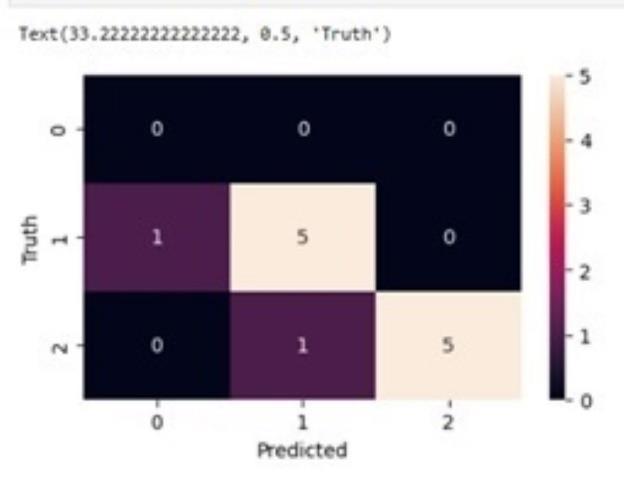
Table 4Table4 illustrates that 0,1,2 are encoded numbers for grades ‘A’, ‘B’ ,’C’ each grade considered as an individual class for which the metrics are calculated, supportcolumnillustratesthatintheselectedfoldthere are no records of class 0, 6 records of class 1 and 6 recordsofclass2.
Confusion matrix:
array([[0,0,0], [1,5,0], [0,1,5]])
Plotting the confusion_matrix:
Figure3providesamorevisualrepresentationofthe confusion_matrix,fordetailedinformationreferFigure2
3.5.3. Decision tree:
decisiontreesdividethedatasetintobranchesbased on feature values, creating a tree like structure. Each node represents a decision, and the leaves indicate the final prediction. It captures nonlinear relationships and is straightforward to interpret. It is capable of handling bothcategoricalandcontinuousvariables,makingitwell suited for this dataset, which contains a mix of numeric scores and categorical variables like gender. decision trees can identify intricate patterns, such as how the combination of internal scores and attendance affects a student’s grade. It is a supervised machine learning algorithm that employs branching methodology to display all potential outcomes of a decision based on specific parameters. Each tree branch represents one or moreoutcomesfromtheoriginaldataset
Implementation as follows:
Model fitting and prediction: fromsklearn.treeimportDecisionTreeClassifier clf=DecisionTreeClassifier(randomstate=42) clf.fit(X_train,y_train) y_pred=clf.predict(X_Test)
Evaluation of accuracy:
accuracy=accuracyscore(y_Test,y_pred) print("Accuracy:",accuracy) print ("\nClassification Report:\n", classification_report (y_Test,y_pred))
Accuracy:1.0
Classification report:
Table 5 : Classification Report for decision tree.
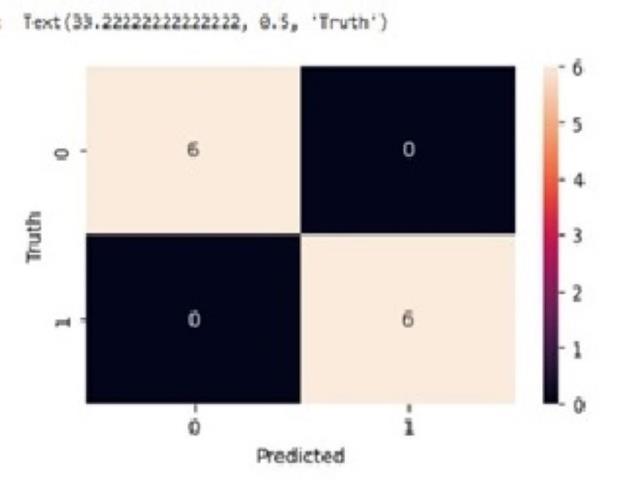
Table 5 illustrates that 1,2 are encoded numbers for grades ‘B’, ‘C’ each grade considered as an individual class for which the metrics are calculated, support column illustrates that in the selected fold there are 6 recordsofclass1and6recordsofclass2.
Confusion matrix: array([[6,0], [0,6]])
Plotting the confusion_matrix:
Figure4providesamorevisualrepresentationofthe confusion_matrix,fordetailedinformationreferFigure2
International Research Journal of Engineering and Technology (IRJET) e-ISSN:2395-0056
Volume: 11 Issue: 11 | Nov 2024 www.irjet.net p-ISSN:2395-0072
3.5.4. Random forest:
The ensemble method called random forest constructs multiple decision trees and then averages their results to enhance accuracy and mitigate overfitting.Itisresilientagainstoverfittingandgenerally yields superior accuracy compared to a single decision tree. random forests are adept at handling intricate datasets with noisy features and can account for interaction effects between variables, such as Seminar participation and Internal scores. Introduced by L. Breiman in 2001, the random forest algorithm excels in both classification and regression by averaging predictions from multiple randomized decision trees. It performs effectivelyinhigh dimensional data,adjuststo large-scale scale problems, and provides insights into variable importance. This review focuses on recent advancements in its theory, parameter selection, resampling methods, and variable importance, with the aim of making these concepts more accessible to nonexperts
Implementation as follows:
Model fitting and prediction: from sklearn.ensemble import
RandomForestClassifier
rfmodel=RandomForestClassifier()
rfmodel.fit(X_train,y_train)
y_pred=rfmodel.predict(X_Test)
accuracy, confusion_matrix, classification report and plotting the confusion_matrix(heatmap) are same as a decision tree algorithm, for classification report refer Table5,forheatmapreferFigure4
3.5.5. Naive Bayes:
BayestheoremformsthebasisofNaiveBayes,which assumes that features are independent. This model is probabilisticandworkseffectivelywithcategoricaldata, providing quick predictions. It is computationally
efficientandperformswellonsmalldatasets.Despiteits simplifying assumptions, it can surprisingly perform well, especially when the features are mostly independent.NaiveBayescanmakegradepredictionsby assuming that features like attendance and internal scorescontributeindependentlytothefinalgrade,which is a reasonable approximation in some educational datasets. All input features are considered to be independentofeachother.Iftheconditionalassumption of independence holds true, then an NB classifier can converge faster than other models, such as logistic regression.
Implementation as follows:
Model fitting and prediction:
fromsklearn.naivebayesimportGaussianNB
nbmodel=GaussianNB()
nbmodel.fit(X_train,y_train) y_pred=nbmodel.predict(X_Test)
accuracy, confusion_matrix, classification report and plotting the confusion_matrix(heatmap) are same as a decision tree algorithm, for classification report refer Table5,forheatmapreferFigure4
3.5.6. Support vector machines (SVM):
SVM determines the optimal hyperplane to separate distinct classes, like various grades, by maximizing the margin between them. It has the ability to utilize kernel functions to capture nonlinear associations. SVM performswellinhighdimensionalspacesandiseffective for datasets of small to medium sizes. It is particularly valuable when the data points cannot be separated linearly. In our dataset, SVM can effectively depict the intricate relationships between features, such as Assignment and Internal scores, to forecast whether a studentwillachieveahighorlowgrade.Aclassifierthat finds the hyperplane which maximizes the margin between different classes. SVM embodies the concept of systemic risk minimisation. SVMs have been applied to many regression, classification and outlier detection fields.
Implementation as follows:
Model fitting and prediction: fromsklearn.svmimportSVC svmmodel=SVC(kernel='linear',randomstate=42) #'linear'kernelisusedforsimplicity svmmodel.fit(X_train,y_train) y_pred=svmmodel.predict(X_Test)
accuracy, confusion matrix, classification report and plotting the confusion_matrix(heatmap) are same as a decision tree algorithm, for classification report refer Table5,forheatmapreferFigure4
Volume: 11 Issue: 11 | Nov 2024 www.irjet.net
Crossvalidationisappliedtoeachofthesemodelsto evaluate performance reliably. By splitting the data into 5 folds, each model is trained and tested on different subsets of the data, ensuring that the model's performance is not biased by any particular train test split. This process helps assess the generalisability of each model to unseen student data, reducing the risk of overfitting. These models are being compared in the study to assess their strengths and weaknesses in predicting student performance, allowing us to recommend the most suitable algorithm for educational predictions.
To ensure robustness and avoid overfitting 5-fold cross-validation was applied. In this technique, the datasetissplitinto5equallysized"folds"orsubsets.The model is trained on 4 of these folds and tested on the remaining fold. This process is repeated 5 times, with each fold being used as the test set once. The overall performance is the average of the 5 test results. This method helps assess how the model generalizes to unseendata by reducingthevariancecaused bya single train test split. It is recommended to use 5-fold cross validation with a large number of folds and a small numberof repetitions for evaluatingthe performanceof classificationalgorithms.
5-Fold cross-validation process for splitting data for training and testing:
This code illustrates how 5-fold cross-validation works using the KFold class from the sklearn.model_selectionmodule,andhowtoevaluatethe performanceofamachinelearningmodelusingacustom function,getscore.
fromsklearn.model_selectionimportKFold
kf=KFold(n_splits=5)
KFold(n_splits=5,random_state=None,shuffle=False)
this creates a K-Fold cross-validator object with n_splits=5, meaning the dataset will be split into 5 parts (folds).
shuffle=False: The data will not be shuffled before splitting,soitretainsitsoriginalorder.
random_state=None:Norandomseedisused defget_score(model,X_train,X_test,y_train,y_test):
model.fit(X_train, y_train) # Fit the model on the trainingdata
return model.score(X_test, y_test) # Evaluate the model onthetestdata
fortrain_index,test_indexinkf.split(range(60)): print(train_index,test_index)
kf.split(range(60)): This splits a dataset of size 60 (indexed from 0 to 59) into 5 parts dividing into two
p-ISSN:2395-0072
sets,onesetwith48records(fourfolds)usedfortraining purpose and set with 12 records(one fold) used for testing.
Foreachiteration,theloopgives: train_index: The indices used for training (48 records).
test_index:Theindicesusedfortesting(12records).
Evaluating model accuracy:
The function get_score is used to train a model and calculateitsaccuracyscoreforeachfold:
defget_score(midel,X_train,X_test,y_train,y_test): model.fit(X_train,y_train) returnmodel.score(X_test,y_test)
Thus, the KFold splits the data into 5 folds and outputstheindicesofthetrainandtestsetsforeachfold. The get_score function fits a model on the training set andreturnsitsaccuracyonthetestset.Thissetupallows formodel evaluationusing cross-validation,whichhelps ensurethatthemodelgeneralizeswelltounseendata.
Implementation of algorithms:
The code uses the cross_val_score function from sklearn.model selection to perform 5-fold crossvalidation for different machine learning models on the dataset by importing cross_val_score model and evaluates the accuracy scores for each fold and average accuracy fromsklearn.model_selectionimportcross_val_score
Logistic regression:
cross_val_score(LogisticRegression(),X,y) array ([0.75, 0.58333333, 0.66666667, 0.5, 0.41666667])
AverageAccuracy:0.583
Decision tree:
cross_val_score(DecisionTreeClassifier(),X,y) array([1.,1.,0.91666667,1.,0.91666667])
AverageAccuracy:0.967
Random forest:
cross_val_score(RandomForestClassifier(),X,y) array([0.83333333,1.,0.91666667,0.91666667,0.75])
AverageAccuracy:0.883
Support vector classifier (SVC):
cross_val_score(SVC(),X,y) array([0.41666667,0.5,0.5,0.41666667,0.41666667])
AverageAccuracy:0.45
K-nearest neighbors (KNN) classifier:
cross_val_score(KNeighborsClassifier(),X,y) array ([0.75 , 0.83333333, 0.66666667, 0.83333333, 0.75 ])
AverageAccuracy:0.767
International Research Journal of Engineering and Technology (IRJET) e-ISSN:2395-0056
Volume: 11 Issue: 11 | Nov 2024 www.irjet.net p-ISSN:2395-0072
Gaussian Naive Bayes (GaussianNB) : cross_val_score(GaussianNB(),X,y)
array ([0.91666667,0.75,0.83333333, 0.75, 0.83333333])
AverageAccuracy:0.817
In conclusion tree based methods (decision tree and random forest) perform the best, followed by GaussianNB and KNN. Linear methods like logistic regression and SVC perform poorly, likely because the relationshipsinthedataarenonlinear.
3.7. Results and Discussions:
Inthisstudy,acomparativeanalysisofsixsupervised learning algorithms logistic regression, decision tree classifier, random forest classifier, SVC, KNN, and Gaussian Naive Bayes was conducted to predict student performance based on a dataset of 60 students with features such as gender, assignment scores, seminar participation, internal marks, attendance, average score, and grade. The 5-fold cross-validation technique was employed to evaluate model performance, and the followingkeyresultswereobtained:
Table 6 : Prediction of an accuracy of each algorithm.
Algorithm
Logisticregression
Table 6 lists all algorithms with their average accuracy after conducting an 5-fold cross-validation technique.
Decision tree has the highest accuracy at 96%, followedcloselyby random forestat88%.Thisindicates that tree-based models are better at handling the dataset, likely due to their ability to capture complex decisionboundaries.
Gaussian Naive Bayes performsquitewellwith an accuracy of 81.7%, suggesting that despite its simplicity,itcanbeeffectiveinthiscase.
K-nearest neighbors have a reasonable accuracy of 76.7%, which may indicate that the dataset hassomelocalclustersthatKNNisabletoexploit.
Logistic regression performs moderately at 58.3%. It may struggle with nonlinear relationships in thedata,asit'salinearmodel.
SVC has the lowest accuracy at 45%, implying that it might not be well suited for the dataset, potentially due to its sensitivity to the data distribution orlackoftuningforhyperparameters.
Figure 5 shows the graphical representation of an average accuracy of each algorithm after 5-fold crossvalidationprocess.
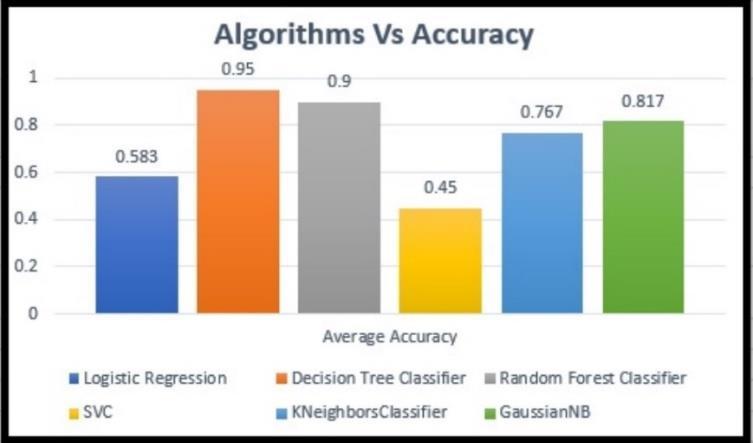
Figure 5 : Accuracy comparison of different supervised algorithms
This study demonstrates that tree-based models (decision tree and random forest) outperform other classifiers in predicting student performance, likely due to their ability to capture complex feature interactions. GaussianNB and KNN also performed reasonably well, while logistic regression and SVC were less effective, indicating that nonlinear classifiers are better suited for thistask.
Future work could focus on:
HyperparametertuningformodelslikeSVCand KNNtoimproveaccuracy.
Incorporating feature importance analysis to better understand the impact of different student characteristicsonperformance.
Testing with larger datasets to validate model scalability and generalization across different student populations.
The study presents a comprehensive comparison of various supervised learning algorithms for predicting student performance based on a range of academic and behavioural indicators, including gender, assignment scores, seminar participation, internal marks, attendance, average score, and final grade. The primary finding from the analysis indicates that tree-based models, specifically the decision tree classifier and the random forest classifier, significantly outperform other models,achievinghighpredictionaccuraciesof96%and 88% respectively. This suggests that models capable of handling nonlinear relationships and complex interactions between features are most effective for predicting student performance. While Gaussian Naive Bayes and KNN also demonstrated satisfactory
International Research Journal of Engineering and Technology (IRJET) e-ISSN:2395-0056
Volume: 11 Issue: 11 | Nov 2024 www.irjet.net p-ISSN:2395-0072
performance, indicating that even simpler models can produce acceptable results when the dataset is sufficiently informative, logistic regression and SVC performed poorly, with accuracies of 58.3% and 45% respectively, highlighting their limitations in handling this particular dataset due to its complexity and nonlinearity.Foreducationalinstitutionsseekingtoforecast student performance for interventions or targeted support, tree-based models such as decision trees and randomforestsprovidethe mostreliableresults.Future research could focus on fine tuning hyperparameters, assessing feature importance, and testing on larger datasets to corroborate these findings and enhance practicalimplementation.
:
Iwouldliketoextendmysincereappreciationtoseveral individuals and organizations for their significant contribution to the successful completion of this research study. Foremost, I am grateful to Dr. Ajith Prasad,thePrincipalandSecretaryofJSSSMIUGandPG Studies Dharwad, for providing the inspiration and support necessary for the completion of this research paper.
I also extend my heartfelt thanks to Dr. Suraj Jain, directorofJSSSMMCAInstituteandtheVicePrincipalof SMI UG and PG Studies, Dharwad, for their inspiration andsupport.
Lastly,Iexpressmydeepgratitudetomyfamilyfortheir unwaveringloveandsupport.
:
[1] M. D. &. D. C. Reisig, "Using GRE scores and prior GPA to predict academic performance among criminal justice graduate students," Journal of Criminal Justice Education,p.37–59.,2005.
[2] A.A.S.&.S.R.Amida,"Testingtherelationshipsof motivation,timemanagementandcareeraspirationson graduatestudents’academicsuccess,"JournalofApplied ResearchinHigherEducation,p.1305–1322,2020.
[3] L.C.G.C.A.&.G.Coromina,"EffectofBackground, Attitudinal and Social Network Variables on PhD Students’ Academic Performance. A Multimethod Approach1," Estudios Sobre Educación., p. 233–253, 2010.
[4] M.N.N.H.M.Y.N.Z.K.S.D.S.S.S.M.S.M.&.H.L. M. Asiah, "A Review on Predictive Modeling Technique for Student Academic Performance Monitoring," in MATECWebofConferences,2019.
[5] S.S.P.B.V.P.G.G.S.A.D.S.B.N.&.S.R.M.Gadde, "Performance Prediction of Students Using Machine Learning Algorithms," springer nature singapore., pp. 405-411,2022.
[6] M. &. K. K. L. Koutina, "Predicting Postgraduate Students’ Performance Using Machine Learning Techniques,"p.159–168,2011.
[7] R. Z. G. X. C. S. a. L. Y. B. Guo, "Predicting students performance in educational data mining," in 2015 International Symposium on Educational Technology (ISET,pp.125-128,2015,pp.
[8] A. K. H. J. L. a. I. B. I. A. Najm, "Machine Learning Prediction Approach to Enhance Congestion Control in 5GIoTEnvironment,"Electronics,vol.8,p.607,2019.
[9] G. MeeraGandhi, "Machine learning approach for attack prediction and classification using supervised learningalgorithms,"Int.J.Comput.Sci.Commun,vol.1, pp.11465-11484,2010.
[10] J. P. a. M. K. J. Han, "Data mining: concepts and techniques,"Elsevier,2011.
[11] S.Gaftandz, "Exploring OnlineActivitiesto Predict theFinalGradeofStudent,"Mathematics,vol.10,no.20,, p.3758,Oct2022.
[12] H. Alharthi, "Machine Learning Techniques to Predict Academic Performance of Health Sciences Students,"IEEE,Dec2021.
[13] A. K. H. A. &. A. A. W. Salah Hashim, "Student Performance Prediction Model based on Supervised Machine Learning Algorithms," Materials Science and Engineering,2020.
[14] L. Al-Alawi, "Using Machine Learning to Predict Factors Affecting Academic Performance: The Case of College Students on Academic Probation," Education andInformationTechnologies,vol.28,no.10,p.12407–32,Mar2023.
[15] J. a. P. C. Gajwani, "Students’ Performance Prediction Using Feature Selection and Supervised Machine Learning Algorithms," springer singapore, pp. 347-54,2020.
[16] B. P. X. L. N. J. R. H. X. G. P.&. N. K. Jia, "Prediction for Student Academic Performance Using SMNaive BayesModel,"springer,p.712–725,2019.
[17] Y.H.Y.A.G.F.C.L.A.H.A.A.&.A.-A.R.Baashar," Evaluationofpostgraduateacademicperformanceusing artificial intelligence models," Alexandria Engineering Journal,2022.
International Research Journal of Engineering and Technology (IRJET) e-ISSN:2395-0056
Volume: 11 Issue: 11 | Nov 2024 www.irjet.net p-ISSN:2395-0072
[18] M. Gopal, "Applied Machine Learning," McGrawHillEducation,2018.
[19] S. K. a. P. P. G. Kostopoulos, "Predicting student performance in distance higher education using semisupervisedtechniques,","inModelanddataengineering, ed:Springer,pp.259-270,2015.
[20] K. P. Murphy, "Machine learning," a probabilistic perspective:MITpress,2012.
[21] A. K. H. a. A. M. Humadi, "Student’s Success Prediction Model Based on Artificial Neural Networks (ANN) and A Combination of Feature Selection Methods," Journal of Southwest Jiaotong University, p. 54,2019.
[22] N. T. a. M. S. P. Guleria, Predicting student performance using decision tree classifiers and information gain in 2014 International Conference on Parallel, Distributed and Grid Computing, pp. 126-129., 2014.
i Completedatasetusedinthepaper