
International Research Journal of Engineering and Technology (IRJET) e-ISSN:2395-0056
Volume:11Issue: 11| Nov2024 www.irjet.net p-ISSN:2395-0072

International Research Journal of Engineering and Technology (IRJET) e-ISSN:2395-0056
Volume:11Issue: 11| Nov2024 www.irjet.net p-ISSN:2395-0072
Atharva Suhas Kulkarni1 ,
1Student, Dept of E&TC Engineering, Pimpri Chinchwad College Of Engineering, Maharashtra, India
Abstract - This study presents the development and implementation of an Arduino-based weather station leveraging Internet of Things (IoT) technology for real-time environmental monitoring. The system is designed to measure and log critical weather parameters, including temperature, humidity, atmospheric pressure, and rainfall detection, using sensors such as the DHT22, FC37, and BMP180. The data collected is transmitted via an ESP-01 (ESP8266) Wi-Fi module to the ThingSpeak IoT platform, enabling remote access to real-time weather information from anywhere in the world. The weather station is particularly suited for applications in agriculture, disaster management, and controlled environments such as industrial and residential areas, where continuous monitoring of climatic conditions is essential. The recorded data not only supports real-time decision-making but also aids in analysing weather patterns and studying climate changes. This implementation highlights the potential of integratingIoTwithmicrocontroller-basedsystemstocreate cost-effective, accessible, and reliable weather monitoring solutions.
Key Words: Arduino Weather Station, IoT-based Environmental Monitoring, Real-time Data Logging, ThingSpeak Cloud Integration, Sensor Data Visualization.
Weather monitoring is an essential aspect of various domains, including agriculture, disaster management, and environmental studies, where timely and accurate data is critical. Traditional satellite-based weather systems, while effective on a broad scale, often fail to deliver precise, localized, and real-time data needed for specific applications. This gap becomes particularly challenging in scenariosthatdemandimmediateaction,suchasmanaging agricultural resources during extreme weather or maintaining controlled environments like indoor facilities. To address this issue, the Arduino-based Weather Station presented in this study provides a cost-effective and efficient solution for real-time weather monitoring.[1][2] The system integrates multiple sensors, including the DHT22 for temperature and humidity, BMP180 for atmospheric pressure, and FC37 for rainfall detection. These sensors collect environmental data, which is transmitted using an ESP8266 Wi-Fi module to the
ThingSpeak IoT platform. The ThingSpeak interface enables users to access live data and graphical visualizations from anywhere in the world using smartphones or laptops. This system's ability to post data online in real time enhances accessibility and usability, making it a practical tool for individuals and industries alike.[2][3]
With applications ranging from agricultural monitoring to maintaining optimal conditions in controlled environments,theproposedWeatherStationhighlightsthe transformative potential of IoT in modern weather monitoring systems. By addressing the limitations of traditional offline systems and manual monitoring, this projectnotonlysimplifiesweatherdatacollectionbutalso empowers users with actionable insights for better decision-makinginreal-timescenarios.[4][5]
This section presents the key components of the system, detailing their specifications and roles in the overall design.
The Arduino UNO R3 serves as the central microcontroller for this project. It is an open-source prototyping board featuring an ATmega328P microcontroller, offering both 5V and 3.3V output voltage options. It supports input power through USB or a coaxial cableconnectedtoanexternalpowersource.
• OperatingVoltage:5V
• RecommendedInputVoltage:7–12V
• InputVoltageRange(limits):6–20V
• DigitalI/OPins:14(6PWMoutputs)
• AnalogInputPins:6
The DHT22 is a low-cost, high-accuracy sensor used for measuring temperature and humidity. It includes a polymer humidity capacitor and a DS18B20 temperature sensor.
International Research Journal of Engineering and Technology (IRJET) e-ISSN:2395-0056
Volume:11Issue: 11| Nov2024 www.irjet.net p-ISSN:2395-0072
• PowerSupply:3.3V–6VDC • Measuring Range:
o Humidity:0–100%RH o Temperature:40°C–125°C
• Accuracy:
o Humidity:±2% o Temperature: ±0.2°C
• SensingPeriod:~2seconds
TheBMP180sensormeasuresbarometricpressureand temperatureandcanalsobeusedasanaltimeterdueto thecorrelationbetweenpressureandaltitude.
• InputVoltage:3–5VDC
• Pressure Range: 300–1100 hPa (9000m to -500m altitude)
• Resolution:Upto0.03hPa/0.25m
• OperationalRange:-40°Cto+85°C
• TemperatureAccuracy:±2°C
The FC-37 is used for rain detection. It consists of a nickelplated rain board and a sensitivity-adjustable potentiometer.
• Dimensions:5cmx4cm
• WorkingVoltage:5V
• Output:Digital(0and1)andAnalogVoltage(AO)
• Features:Anti-oxidationandlongoperationallife
The ESP-01 module adds Wi-Fi capability to the system, enabling data transmission to the ThingSpeak platform. It can operate as a serial-to-Wi-Fi bridge or as a standalone processor.
• BaudRate:115200bps
• PeakCurrentDraw:~300mA
• FlashMemory:1MB
• Wi-FiSecurityModes:WPA,WPA2
• Dimensions:24.75mmx14.5mm
Weather stations are systems equipped with various sensorstomeasurekeyenvironmentalparameterssuchas temperature, humidity, atmospheric pressure, and rainfall. Theseparametersarecriticalformonitoringandanalyzing weather conditions in real time. The proposed weather stationcollectsdatathroughitssensorsandtransmitsitto the ThingSpeak IoT platform, where the information is storedandvisualized.
This setup enables users to access live data and insights from anywhere in the world, making it a versatile and accessiblesolutionforreal-timeweathermonitoring.
The block diagram below represents the overall architecture of the weather monitoring system. It outlines the relationships between the key components: the sensors, microcontroller, Wi-Fi module, and the cloud platform(ThingSpeak)fordatavisualization.
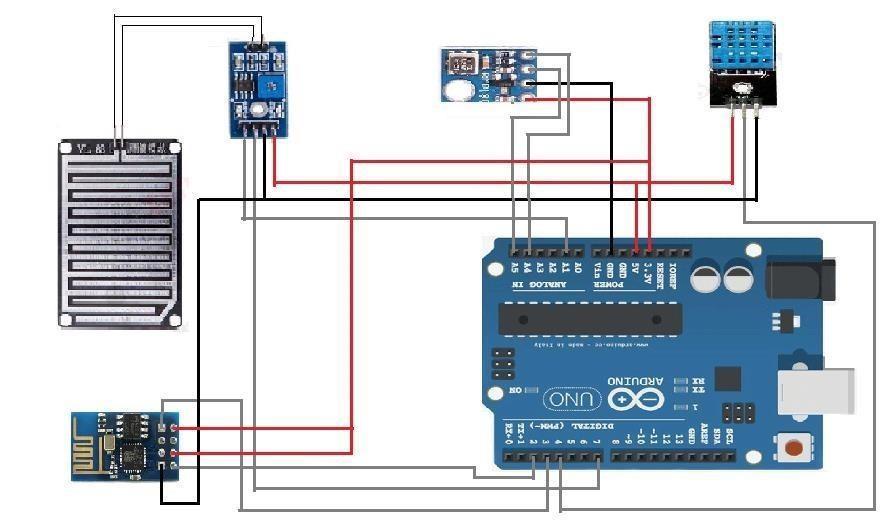
The block diagram illustrates the integration of three differentsensorsusedtomonitorkeyweatherparameters: temperature, humidity, rain, and atmospheric pressure. These sensors collect real-time environmental data, which is then processed and analyzed to provide an accurate representation of the current weather conditions. The system is controlled by the Arduino UNO microcontroller, which processes the sensor data, while the ESP-01 (ESP8266) Wi-Fi module enables the transmission of this data to the ThingSpeak IoT platform. Through this setup, weather information is displayed and made accessible remotelyviatheThingSpeakplatform.
In this project, the main circuit design and simulation were done using Proteus software. The code for the Arduinowaswritten,verified,anduploadedusingArduino IDE.
2395-0056
Volume:11Issue: 11| Nov2024 www.irjet.net p-ISSN:2395-0072
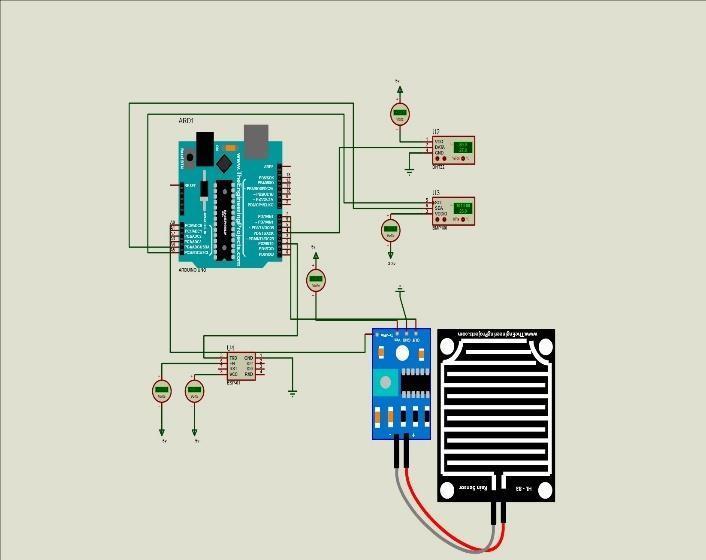
Fig-2: ProteusSimulationCircuitDesign
TheProteussoftwarewasusednotonlyforcircuitdesign butalsoforsimulatingthecompletesystem,ensuringthat allcomponentsfunctionasexpectedbeforeimplementing theminhardware.
Thefollowingflowchartdepictsthestep-by-stepprocess of the weather monitoring system, showcasing how the data flows from the sensors to the cloud platform. It demonstrates the sequence of operations, starting from data collection by the sensors to the transmission of that data via the Wi-Fi module to ThingSpeak for real-time visualization.
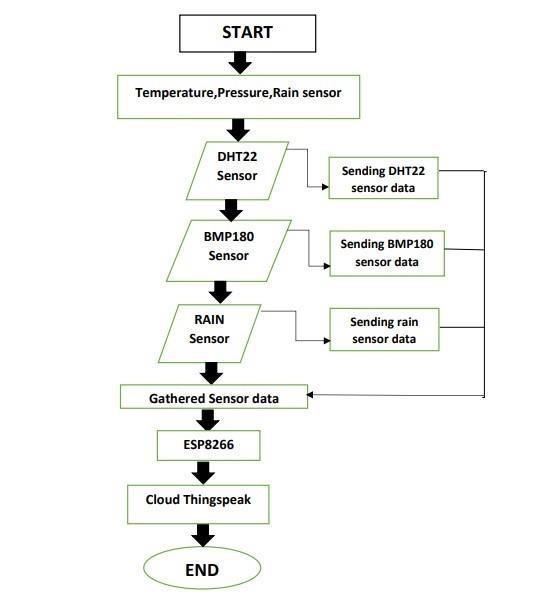
Fig -3: SystemWorkflowforDataCollectionand Transmission
The flowchart below illustrates the operational sequence of the weather monitoring system. The temperature, pressure, and rain sensors are connected to the Arduino UNO, which collects data from each sensor. TheArduinoprocessesthissensordataandsendsittothe ESP8266ESP-01Wi-Fimodule.TheESP8266modulethen transmits the data to the ThingSpeak cloud platform, where it is visualized in real-time through dynamically updated graphs. This setup allows users to monitor weather conditions remotely and track environmental parameterscontinuously.
The weather monitoring system was successfully implemented using a combination of Arduino-based hardware and a suite of sensors to measure key environmental parameters, including temperature, humidity, atmospheric pressure, and rainfall. These sensors,connectedtoanArduinoUnomicrocontroller,sent real-time data to the ThingSpeak IoT platform via the ESP01(ESP8266)Wi-Fimodule.Thisallowedforseamless visualization of the data through interactive, real-time graphs, enabling remote monitoring and analysis of the weatherconditions.
The data presented in the following section were collected in real-time through the weather monitoring system, leveraging the ThingSpeak IoT platform for visualization. The results highlight key environmental parameters, including temperature, humidity, atmospheric pressure, and rainfall, as measured by the sensors connected to the Arduino Uno and transmitted via the ESP8266Wi-Fimodule.
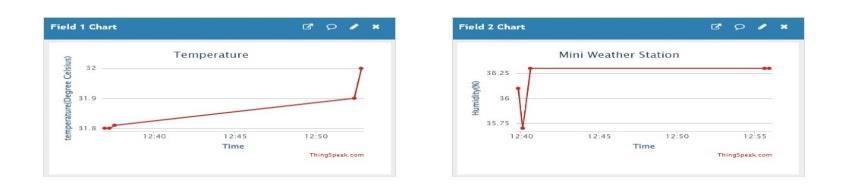
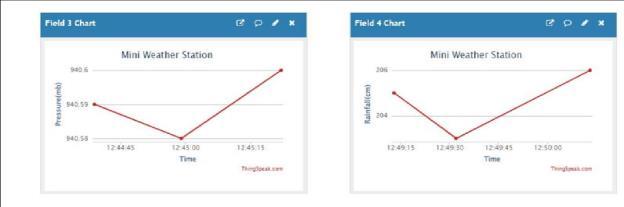
Fig -4: VisualizationofTemperature,Humidity,Pressure, andRainfallDatafromThingSpeak
International Research Journal of Engineering and Technology (IRJET) e-ISSN:2395-0056
Volume:11Issue: 11| Nov2024 www.irjet.net p-ISSN:2395-0072
• Temperature: The graph displays temperature fluctuationsover time,asmeasured bytheDHT22 sensor. The X-axis represents the time intervals, whiletheY-axisshowsthetemperatureindegrees Celsius. The graph demonstrates the real-time fluctuationsin temperature, with noticeable peaks and dips corresponding to varying environmental conditions throughout the day. These temperature changes are essential for understanding local weather patterns and can be used to make informed decisions in fields such as agriculture anddisastermanagement.
• Humidity: The second graph presents the relative humidity levels, also recorded by the DHT22 sensor. The Y-axis in this graph shows the relative humidity percentage, while the X-axis represents thetimeintervals.
• The graph reveals a dynamic change in humidity levels, reflecting the interaction between temperature and moisture in the air. Sudden increases or decreases in humidity often correlate with changes in temperature, highlighting the interdependenceofthesetwoparameters.
• Atmospheric Pressure: The BMP180 sensor recorded atmospheric pressure data, which is essential for understanding weather trends. The graphindicatesfluctuationsinpressure,whichcan be attributed to various environmental factors suchasweathersystemsandaltitude.Atmospheric pressureplaysacriticalroleinpredictingweather changes, and this data can help forecast storm systems and other weather phenomena, making it valuable for meteorological and agricultural applications.
• Rainfall:TheFC-37rainsensoroutputsbinarydata indicating the presence or absence of rainfall. the Y-axis shows the rainfall intensity and the X-axis represents time. This graph demonstrates the presence or absence of rainfall at different times, with clear spikes indicating periods of rain. The rain sensor used in the system is highly sensitive and provides accurate data, crucial for weather forecasting and applications in agriculture, where wateravailabilityiscritical.
This project successfully developed an Arduino-based Weather Station to monitor temperature, humidity, atmospheric pressure, and rainfall in real-time. Using sensors like the DHT22, BMP180, and FC-37, along with the ESP8266 Wi-Fi module, the system collected data and
sent it to the ThingSpeak IoT platform for visualization.
The dynamic graphs demonstrate the system’s capability for continuous monitoring and remote access to weather data. The integration of IoT with weather monitoring provides a cost-effective solution with applications in agriculture, disaster management, and environmental research. This project illustrates the potential of opensourcetechnologiestoofferscalablesolutionsforreal-time data collection and analysis. Future work could focus on improving sensor accuracy and expanding the system's capabilitiesforbroaderenvironmentalapplications.
[1] Kutubuddin Kazi ,“Arduino-Based Weather Monitoring System”, December 2023, https://www.researchgate.net/publication/3766489
32_Arduino-Based_Weather_Monitoring_System
[2] Temilola M. Adepoju, 1Matthias O. Oladele, 2Abdulwakil A. Kasali, and 1Gbenga J. Fabiyi, “DevelopmentofaLow-CostArduino-BasedWeather Station”, 21-AUG-2020, http://dx.doi.org/10.46792/fuoyejet.v5i2.508
[3] Hakan Uçgun, Zeynep Kubra Kaplan “Arduino based weather forecasting station”, November 2017, DOI: 10.1109/UBMK.2017.8093397
[4] Hardeep Saini, Abhishek Thakur, Satinderpar Ahuja, Nitant Sabharwal, Naveen Kumar, “Arduino based automatic wireless weather station with remote graphical application and alerts”, 15 September 2016, DOI: 10.1109/SPIN.2016.7566768
[5] Suvinraj S, Rajesh Kumar G , Manish, Venkatesh S , Dr. C. Lakshmi, “WEATHER MONITORING SYSTEM USING ARDUINO”,September2023,IJPREMSVol.03,Issue09, pp:540-545.