
International Research Journal of Engineering and Technology (IRJET) e-ISSN: 2395-0056
Volume: 11 Issue: 11 | Nov 2024 www.irjet.net p-ISSN: 2395-0072

International Research Journal of Engineering and Technology (IRJET) e-ISSN: 2395-0056
Volume: 11 Issue: 11 | Nov 2024 www.irjet.net p-ISSN: 2395-0072
Samir Sarkar1 ,
1M-Tech Student, Department of Civil Engineering, Maharishi University of Information Technology (MUIT), Lucknow, Uttar Pradesh, India
Abstract - In the dynamic field of construction materials, the integration of supplementary cementitious materials (SCMs) aimed at improving the mechanical and durability propertiesof concretehasattractedincreasing interest. Among these SCMs, micro silica, also known as silica fume (SF), stands out as a promising candidate. This work presents the function of micro-silica in enhancing concrete performance through a thorough reviewofthe literature and experimentalanalysis.In-depthresearchisdoneonimportant characteristicslikewaterpermeability,chloridepermeability, tensile strength, and compressive strength to determine how microsilica affects the mechanical and durability qualities of concrete.
Key Words: SupplementaryCementitiousMaterials,Silica Fume, Compressive strength, Tensile strength, Water permeability,Chloridepermeability
1. INTRODUCTION:
Asthedemandforhigh-performanceconcreteescalatesin tandem with the burgeoning infrastructural needs of contemporarysociety,understandingthenuancedeffectsof microsilica (MS) becomes imperative for advancing the frontiersofconstructiontechnology.Chemicalcomposition ofMSwhileinfusewithconcretenoticedsignificantchanges, more porous of SF has a better ability to broaden the pozzolanic reaction’s range [1]. Cheng Ding [2] demonstrated that adding of SF, improved the microstructureofconcretebybridginggapsandpromotinga subsequent hydration reaction. Osma [3] established that adding 45% coconut shell, 1.5% glass fiber and 15% SF increasesthecompressivestrengthby20%,tensilestrength by22%.Inclusionof20%SFintoSCCasacementsubstitute didnotimpactonconcreteproperties,rather,combinethis with steel fiber led to produce a more economical and durable SCC [4]. Adding 5% SF to the OPC-NP (Ordinary Portlandcement-NormalPozzolona)mixdidnotimprove itscompressivestrengthcomparedtonormalOPCconcrete for 28 days. OPC-NP-SF concrete has greater compressive strength than OPC concrete after 28 days. Moreover, both OPC-NPandOPC-NP-SFblendsdecreaseddryingshrinkage contrastedwithOPCconcrete,showingthegainfulimpacts ofNPandSFintheprogressofshrinkage[5] PromiseD[6] demonstrated that inclusion of SF into Lytag Silica Fume Concrete(LSFC)ledtoachieveultimatecompressivestrain of 2.18% while normal concrete exhibited 3.5%.
Furthermore,94.15%ofcompressivestrengthwasattained within 7 days. Tao Lou [7] investigated the workability of concreteandfoundthatinclusionofSFby0%-10%,slumpof concrete decreased by 27% and air content reduced by 13.7%.Theresearchalsoconcludedthatinfusingof10%SF, resultedinanincrementofcompressiveandsplittingtensile strengthby26.7%&40.7%respectively.ReniSuryanita[8] recommended to use SF dose at 0.15%-0.5% in the productionofcellularlightweightconcrete(CLWC) toget better result. Vikash Kumar [9], demonstrated that replacementofSFasasubstituteofcementisenhancedthe concretepropertiesandfoundoptimumdoseofSFas8%to getmaximumresultforcompressivestrength7%forSplit tensilestrengthand8%forFlexuralstrengthrespectively. AkshaySuryabanshi[10],Conductedtrialsonconcretewith silica fumes of variable doses and reported that the workabilityofconcretedecreasesastheproportionofsilica fumes increases, besides, increments of compressive strength,tensilestrength,andflexuralstrengthareobserved whensilicafumereplacementisabout10%.
Itwasevidentthat,eventhoughthestrengthproperties are improved, further study on higher grade concrete has been conductedand oversaw not only the strength propertiesbut also various durability characteristics, likechloride permeabilityas well aswater permeability for furtheradvancementsintheirreliability.Inthispaper,SFis replacedwithcementitiousmaterialsbyarangefrom2.5%10%andcomparethemechanicalanddurablepropertiesof concretewithcontrolmix.
In the present study, Ordinary Portland Cement (OPC) of Ultratechbrandof53gradeconfirmingtoIS:269-2015was used.ThepropertiesofcementfoundareshowninTableI:
Table 1: Properties of Cement: Properties Unit Value observed FinenessIndex (M2 /Kg) 263
International Research Journal of Engineering and Technology (IRJET) e-ISSN: 2395-0056
Volume: 11 Issue: 11 | Nov 2024 www.irjet.net p-ISSN: 2395-0072
Initial
NaturalRiversandfromSoneRiverasFineAggregate(FA) andCrushedstoneobtainedfromChatterpur,Jharkhand.of differentsizesi.e.20mmand10mmwereusedasCoarse Aggregate (CA) for carrying out the experimental study. TestingofaggregateasperthespecificationgivenbyIS:383 –1970.ThepropertiesdetailsforFineAggregateandCoarse AggregatearementionedinTable2&Table3respectively:
Table 2: Properties of Fine Aggregate:
Table 3: Properties of Coarse Aggregate:
MicroSilica(MS)purchasedfromElkem.Thedetailsofthe physical andchemical propertiesofmicro-silica havebeen provided by the manufacturer itself and are depicted in Tables4&5:
Table 4: Physical Properties of Micro Silica:
Table 5: Chemical Properties of Micro Silica:
Asuperplasticizer(SP)withspecificationCrysoDeltaG-8236 was used to maintain the slump value in the acceptable range of 75 - 100 mm. The SP grade compiles with the recommendationsofIS:9103-1999(2007)andASTMC494 was adopted at a constant dose of 0.7% (by weight of cement). Thedetailsofthephysicalandchemicalproperties ofSPhavebeenprovidedbythemanufactureritselfandare depictedinTables-6&7:
Table 6: Physical Properties of SP:
InitialSettingTimeof controlledsample
SettingTimeof controlledsample
CompressiveStrengthof controlledsample
ThreeDays
SevenDays
Twenty-eightDays
International Research Journal of Engineering and Technology (IRJET) e-ISSN: 2395-0056
Volume: 11 Issue: 11 | Nov 2024 www.irjet.net p-ISSN: 2395-0072
Table 7: Chemical Properties of SP:
In the present study, Concrete mix proportioning was calculated for the unit volume of concrete as per the recommendationsgivenbyIS10262:2009forM50gradeof concrete.Thequantitiesforunitvolumeweretakenasgiven inTable8:
Table 8: Quantities per unit volume of concrete:
3)
The water-cement ratio remained at 0.32 throughout the test.After curing, the cast samples were examined for mechanical capabilities (compressive and split tensile strength) and durability properties (permeability and chloride penetration). A number of samples were cast for differenttypesoftestingandeachtrialmixisasunder:
For testing of Compressive strength- 12 cubes (150mm×150mm×150mm),
FortestingofSplittensilestrength-3cylinders(150mm× 300mm),
FortestingofWaterPermeability-3cylinders(150mmx 160mm),
For testing of Chloride Permeability- 3 cylinders (50mmx100mm)
Consideringthe18%wastageofmaterial,thefinalvolumeof eachtrialmixbatchwascalculatedas0.037m3.Qualitative details of each trial mix are illustrated in Table9 and designated as TM-1(control mix, SF-0%), TM-2(SF-2.5%), TM-3(SF- 5%), TM-4(SF-7.5%), and TM-5(SF10%)respectively in order to avoid any experimental mishap.
Table 9: Trial Mix with variable dosage of Silica Fumes:
Themethods usedtodeterminethepurposeof the experimentalstudyandcarryouttheworkstepbystepare asfollows:
3.1 Weighing: Usingalaboratoryscale,theamountsofall theingredients,i.e.cement,silicafume,fineandcoarse aggregate,andwater,etc.ineachbatchofconcretewere measuredinaccordancewiththeintendedmixratio.
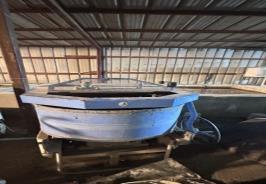
3.2 Mixing-All the materials mentioned above, were combinedinaccordancewithIS:456-2000,andmixing was done by using a mechanical mixer till they were mixeduniformly.
3.3 Mold preparation: All cylindrical and cubical molds were thoroughly cleaned, snugly screwed, and coated withoilonallsurfacesbeforecastingsothatde-molding ofthesamecanbedoneeasily.
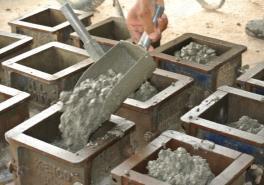
3.4 Compaction: Threelayersofconcretewerepouredinto oiledmolds,byusingatampingrodof16mmdiameter &600mmlengthtotampeachlayer25times.Following the tamping process, the top surface of the mold is
International Research Journal of Engineering and Technology (IRJET) e-ISSN: 2395-0056
Volume: 11 Issue: 11 | Nov 2024 www.irjet.net p-ISSN: 2395-0072
finished,andidentificationdetailslikethebatchnumber andcastingdatearemarked.
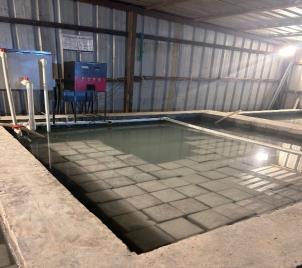
3.5 Curing: All ofthecastspecimenswereremoved from the molds after 24hrs., labeled to identify the casting batch,and then promptlyplacedin thecuring tank to cure for seven, fourteen, and twenty-eight days, respectively. Moldswere kept in submerged condition throughoutthecuringperiod.
3.6 Testing-After7,14&28days,Thetanksampleswere used for the following experiments, following the specifiedtechnique.
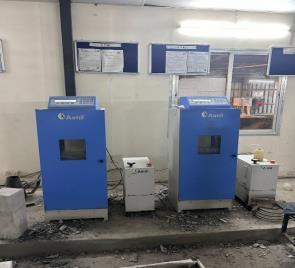
105specimenscomprising60cubesand45cylinderswere castandtastingswereperformedasperthespecifications. Resultsattainedbytestingspecimensareelaboratedinthis section.
4.1 TESTING OF CONCRETE FOR COMPRESSIVE STRENGTH:
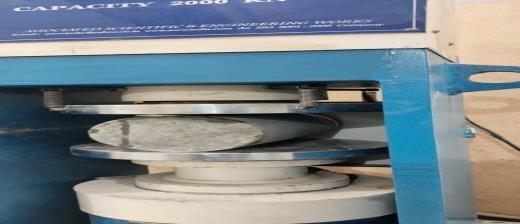
CompressivestrengthtestsweredoneintermsofIS4562000andIS516-2021,respectively.A2000kNcapacity CompressionTestingMachine(CTM)isemployedtotest thecubes(Fig.4).
After wet curing for 7, 14, and 28 days, respectively, concrete cubes (150 mm150 mm x 150mm) were subjectedtoacompressivestrengthtest.
Table 10 represents the variations in compressive strengthoffiveconcretemixesdisplayedinGraph1over seven,fourteen,andtwenty-eightdays,respectively.
FromGraph-1,itwasnotedthatthecompressivestrength of concreteincreases with an increase in silica fumedosage by2.5% andcontinues to increaseas the replacementlevelincreasesupto10%.
Approximately 28% of the increase in strength (71.20 N/mm2)hasbeen noted in thereplacementofcement with10%MicroSilicaincomparisontothecontrolmix (55.63N/mm2).
Theusageofmicrosilicahasbeenfoundtosignificantly enhanceconcrete'scompressivestrengthduetoitshigh pozzolanicactivityaswellasitscapacitytofillvoids.
Table 10: Result of compressive Strength of concrete:
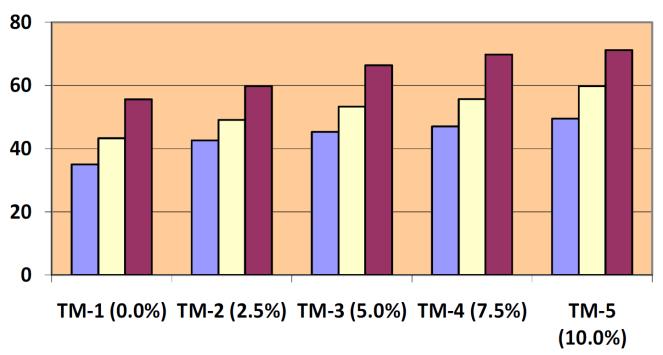
Graph-1: Variation of compressive strength on different dosages of SF
TESTING OF CONCRETE FOR TENSILE STRENGTH:
Splittensilestrengthwastestedforconcreteaccordingto IS456-2000andIS5816-1999(Fig.7).
After twenty-eight days of wet curing, split tensile strength wasperformed on concrete cylinder size (150mm x 300mm) by employingCTM of capacity 1000KN,andtherateofloadingwassustainedbetween 1.2N/(mm2/min)-2.4N/(mm2/min).
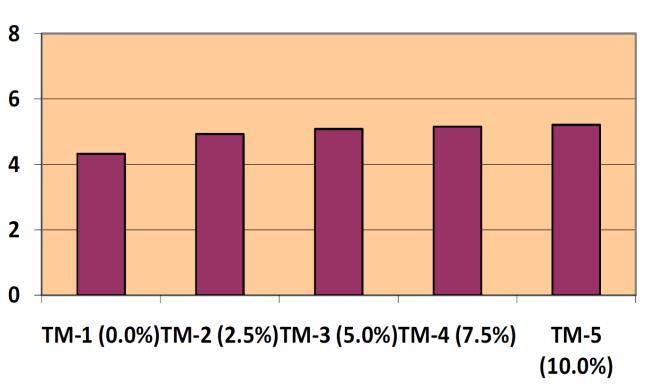
FromGraph2,itwasshownthatwhenthedoseofsilica fume is increased to 2.5%, the tensile strength of concrete increases and continues to rise until the replacementlevelisincreasedto10.0%.
Almost a 20% increase in tensile strength (i.e. 5.21 N/mm2) is observed when replacing cement with ten percentmicrosilicaincomparisontothetensilestrength ofthecontrolmix(i.e.4.32N/mm2).
Volume: 11 Issue: 11 | Nov 2024 www.irjet.net
1
5
4.2 TESTING OF CONCRETE FOR PERMEABILITY:
Thepermeabilityofconcretewasdeterminedbyawater penetrationtest.
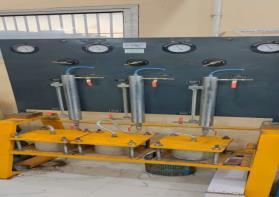
WaterPenetrationTest(WPT)ofconcreteisdoneasper the procedure laid down in clause 1717.7.5 of MoRTH specificationsandDIN:1048-1991(Part-V).
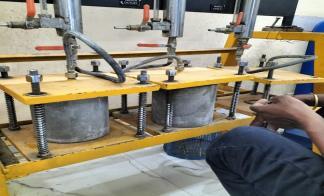
Cast150mmx160mmcylindricalsamplescuredfor28 days.Subsequently,thetestwasperformedbyfixingthe samplesinsucha mannerthattheyweresubjected toa waterpressureof7bars(Fig.6&7).
At first, for three days, the concrete specimens were subjectedtoacontinuouswaterpressureof0.5N/mm2 (5 bar) from the top. The test may be stopped and the
specimendismissedas“failed”ifthewaterseepsthrough totheundersideoftheobject.
After 3 days, the pressure was released and the samplesweretakenout.Thencompressionwasapplied bymeansoftworoundbarsaboveandbelowofsample, causingittosplitinthemiddle.
The maximum depth of penetration in the direction of height should be measured using the measuring scale whenthesplitfacesbegintoshowsymptomsofdrying (variedfrom5to10minutes).
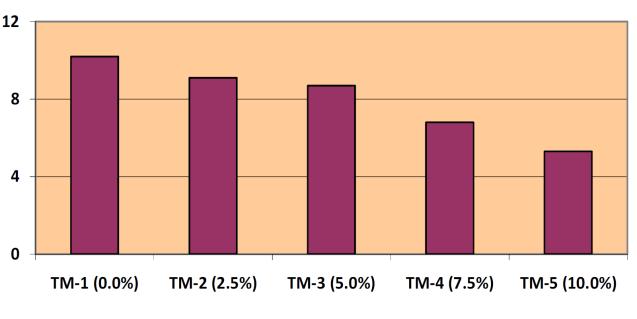
The average maximum penetration depth measured across three specimens will be used to determine the concrete's water penetration test result; this depth shouldnotexceed25mm.
International Research Journal of Engineering and Technology (IRJET) e-ISSN: 2395-0056
Volume: 11 Issue: 11 | Nov 2024 www.irjet.net p-ISSN: 2395-0072
Chlorideingress-inducedcorrosionofreinforcingsteelis a prevalent environmental attack that results in the degradationofconcretestructures.
ASTMC1202guidelinesareusedtoperformtheRapid ChloridePermeabilityTest(RCPT)toassesschlorideion resistance.BecauseRCPTisaquickandeasymethod,itis frequentlyusedtoassesshowresistantconcreteistothe intrusionofchlorideions.
Following twenty-eight days of wet curing, RCPT was carriedoutonacylindricalspecimenmeasuring50mmin thickness & 100mm in dia. Before starting the testing, specimenswereremovedfromthewaterandkeptinside thedesiccatortothemainhumiditylevelabove95%.
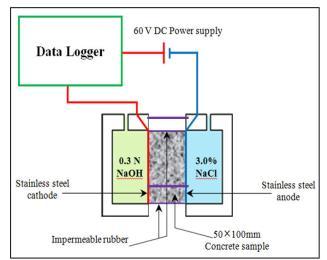
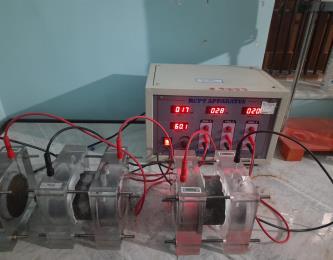
Two nos. of gasket-fitted cells were used to mount eachspecimen (Fig.10). Then one cell was filled with 3.0% NaCl and the other with 0.3N NaOH. The power supplyisthenturnedonandthevoltageis 60.0±0.1V andrecordinitialreadingofpassingcurrent(amperes).
Apartfrommaintainingthepropersolutionfilllevelin half of the test cell until the end of the test, the specimen'ssurroundingairtemperaturewasmaintained between20°and25°Cthroughoutthetest.
Reading of passing current at every 30-minuteinterval wasrecordedforaperiodofsixhours.Aftercompletion, all specimenswere removed from the cell and the residualsealant.
Theformulabelowisemployedinordertodeterminethe totalchargepassed:
Q=900(Io+2I30+2I60+………….+2I300+2I330+ I360),Where:
Q=chargepassed(coulombs)
Io = current (amperes) immediately after voltage is applied
It=current(amperes)attminafterthevoltageisapplied
TheschematicdiagramandtestingofRCPTisreferredto asFig.8&9
Qualitativeindicationsofthechlorideionpermeability
with respect to the measured value of total charge passing through the sample are illustrated in ASTM C 1202andmentionedinTable13:
Table 13: Qualitative indications of the chloride ion permeabilityw.r.t Total Charge Passing:
Chloride Permeability Charge passed in Coulombs
High >4000
Moderate 2000to4000 Low 1000to2000
VeryLow 100to1000 Negligible <100
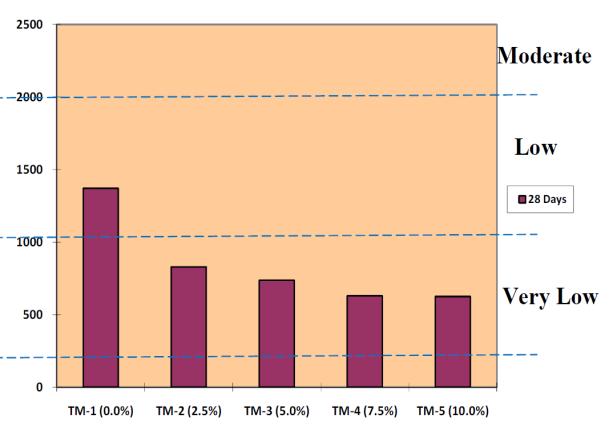
The total charge passing through each sampleis computedandtabulatedbelowinTable14toconclude the quality of concrete regarding chloride ion permeabilityisplottedinGraph-4.
Table 14: Result of chloride penetration of concrete:
No.
International Research Journal of Engineering and Technology (IRJET) e-ISSN: 2395-0056
Volume: 11 Issue: 11 | Nov 2024 www.irjet.net p-ISSN: 2395-0072
Graph-4: Variation of chloride permeability on different dosages of SF
In conclusion, the research conducted on the impact of microsilicaonthecharacteristicsofhardenedconcretehas shedsignificantlightonthetransformativepotentialofthis admixtureinenhancingconcreteperformance.Throughan extensivereviewofliteratureandempiricalinvestigations,it isevidentthatmicrosilica,withits pozzolanicproperties, contributestotheimprovementofvariouskeyattributesof hardenedconcrete,comprisingtensilestrength,resistanceto corrosionattacks,permeability,alongcompressivestrength.
Thecurrentstudy’sfindingsunderscoretheimportance ofconsideringmicrosilicaasaviableoptionforoptimizing concretemixdesigns,especiallyinapplicationswherehighperformanceconcreteisrequired.Byleveragingthebenefits ofmicrosilica,engineersandconstructionprofessionalscan achieve structures that not only meet but exceed performance expectations, leading to enhanced longevity andsustainabilityofconcreteinfrastructure.
In accordance with the limitations imposed by test results,experimentalfindingsleadtotheseconclusions:
SFisconsideredahighlyreactivepozzolanthatincreases the cohesion ofconcrete due to its high finenessfactor resulting inhigh watercontentto sustain the desired workability.However,theuseofasuperplasticizerinour researchreducedtheamountofwaterneeded.
When silica fume replacement levels were raised to 2.5%–10%, the compressive strength of concrete increasedby7.5%–28%. Compactstrengthisatitspeak when10%ofthesilicafumeisreplaced.
Concrete has a tendency to progressively increase its split tensile strength, with a maximum increase of 14–21%. Concrete's tensile strength rose as silica fume replacementincreased.Theoptimumresultwasfoundat 10%replacementofmicrosilica.
Water permeability of concrete demonstrates a decreasingtrenduptoalimitof11-48%.Permeabilityof concretemixdecreaseswithelevationofSFreplacement. 10%replacementofmicrosilicaisrequiredtoachieve themaximumreductioninpermeability.
Chloride penetration of concrete demonstrates a decreasing trend up to a limit of 40-54%. Chloride penetrationofconcretemixdecreaseswiththeincrease ofsilicafumesreplacementandvariesfromverylowto low. The optimum reduction in chloride penetration is obtainedwhenmicrosilicaisreplacedwitha10%value.
WhencomparedtoregularOPCconcrete,thedurability criteria of blended SF concrete include better water absorption,permeability,resistancetosulfateattack,and resistancetochloridepenetration.
TheAuthorwouldextendhisgratitudetotheAdministrative, Technical, and Academic staff of the Department of Civil Engineering,SchoolofEngineering,MaharishiUniversityof InformationTechnology(MUIT),Lucknowfortheirvaluable support.
[1]AlesFrýbort,JanaStulirova,MiroslavaGregreova,Giri Grosek “Changesin thechemical composition ofsilica fumeintheconcretecompositesystem”,2023.
[2] Cheng Ding, Kaixi Xue, Hongzhi Cui, Ziqing Xu, Haibin Yang, Xiaohua Bao ,Guangsheng Yi “Research on fire resistanceofsilicafumeinsulationmortar”,Journalof MaterialResearchTechnology,2023.
[3] Osama zaid, jawadahmad “A step towards sustainable glassfiberreinforcedconcreteutilizingsilicafumeand wastecoconutshellaggregate”,2021.
[4]AbdallaM.Saba,AfzalHusainkhan,MohammadNadeem Akhtar“Strengthandflexuralbehaviorofsteelfiberand silica and silica fume incorporated self-compacting concrete”,2021.
[5]ShamsadAhmad,OmarS.BaghabraAl-Amoudi,SaadM.S. Khan, Mohammed Malehuddin “Effect of silica fume inclusion on the strength, shrinkage and durability characteristics of natural pozzolan-based cement concrete”,2022.
[6] Promise D. Nukah, Samuel J. Abbey, Colin A. Booth, Ghassan Nounu “Development of a lytag-silica fume based lightweight concrete and corresponding design equationforpurebending”,2023.
International Research Journal of Engineering and Technology (IRJET) e-ISSN: 2395-0056
Volume: 11 Issue: 11 | Nov 2024 www.irjet.net p-ISSN: 2395-0072
[7]TaoLou,ChengHua,FangLiu,QiangSun,YuYI,Xiaofeng Pan“Effectofaddingsolidwastesilicafumeasacement paste replacement on the properties of fresh and hardenedconcrete”,2022.
[8]ReniSuryanita,HarnediMaizir,RizkiZulapriansyah,Yon Subagiono,MohdFadzilArshad“Theeffectofsilicafume admixtureonthecompressivestrengthofthecellular lightweightconcrete”,2022.
[9] Vikash Kumar, Ashhad Imam, Vikas Srivastava, Atul, Y Kushwaha “Effect of Micro Silica on the properties of hardenedconcrete”,2017
[10]AkshaySuryavanshi,SiddharthaNigam,Dr.S.K.Mittal, andDr.RamBharosh,“AnExperimentalStudyonPartial Replacement of Cement in Concrete by Using Silica Fume”,(2018).