
International Research Journal of Engineering and Technology (IRJET) e-ISSN: 2395-0056
Volume: 11 Issue: 11 | Nov 2024 www.irjet.net p-ISSN: 2395-0072

International Research Journal of Engineering and Technology (IRJET) e-ISSN: 2395-0056
Volume: 11 Issue: 11 | Nov 2024 www.irjet.net p-ISSN: 2395-0072
Zarina Begum1 , Anand Deshmukh2 , Aneesh Deshmukh3, Ayush Gude4, Gautam Warvatkar5 , Shreyas Dhomane6
1Professor, Dept. of Artificial Intelligence and Data Science, BRACT’s Vishwakarma Institute of Technology, Pune, India
2Student, Dept. of Artificial Intelligence and Data Science, BRACT’s Vishwakarma Institute of Technology, Pune, India
3Student, Dept. of Artificial Intelligence and Data Science, BRACT’s Vishwakarma Institute of Technology, Pune, India
4Student, Dept. of Artificial Intelligence and Data Science, BRACT’s Vishwakarma Institute of Technology, Pune, India
5Student, Dept. of Artificial Intelligence and Data Science, BRACT’s Vishwakarma Institute of Technology, Pune, India
6Student, Dept. of Artificial Intelligence and Data Science, BRACT’s Vishwakarma Institute of Technology, Pune, India
Abstract - The conventional traffic management system, whichreliesheavilyonfixedsignaltimersandmanualcontrol by traffic police, often results in significant inefficiencies, prolonged waiting times, and increased fuel consumption. As urban areas continue to grow and vehicle numbers rise, these issues become more pronounced, leading to heightened congestion and reduced transportation efficiency. This research paper proposes a novel approach to traffic managementthatdynamicallyadjustssignaltimingsbasedon real-time vehicle counts at intersections. By accurately measuring the number of vehicles and using this data to determine the optimal duration of green and red lights, the system aims to streamline traffic flow, minimize delays, and decrease overall congestion. This method not only enhances the efficiency of traffic movement but also contributes to environmental sustainability by reducing idle times and subsequent emissions. Our study includes a comprehensive analysisofcurrenttrafficproblems,thedesignoftheproposed system, and a discussion on the potential benefits and challenges of implementation. The proposed solution offers a practicalandimmediateimprovementovertraditionaltraffic control methods, presenting a viable path towards smarter and more efficient urban mobility.
Key Words: Intelligent Traffic Control, Real-time Vehicle Counting, Signal Timer Optimization, Traffic Congestion, UrbanMobility,TrafficManagementSystem,Transportation Efficiency,EnvironmentalSustainability.
1.INTRODUCTION
Urbanization and the exponential growth of vehicle ownership have led to significant challenges in managing traffic flow efficiently. Traditional traffic management systems, which rely on fixed signal timings and manual oversightbytrafficpolice,oftenfallshortinaddressingthe
dynamicnatureofmodernurbantraffic.Theseconventional systemsareinherentlyrigid,unabletoadapttofluctuating traffic volumes throughout the day. Consequently, this rigidity leads to several inefficiencies: prolonged waiting times for drivers, increased fuel consumption, heightened levelsofair pollution due to idlingvehicles,anda general decreaseinthequalityofurbanlife.
Trafficcongestionisnotmerelyaninconvenience;ithasfarreaching economic, environmental, and social impacts. Economically,itresultsinsubstantiallossesduetowasted time and reduced productivity. Environmentally, the continuous idling of vehicles at congested intersections contributes significantly to greenhouse gas emissions, exacerbating climate change and deteriorating urban air quality.Socially,thefrustrationandstressassociatedwith daily commuting in congested areas can lead to adverse healtheffectsanddecreasedoverallwell-being
Recognizing these issues, there is a pressing need to innovatebeyondtraditionaltrafficmanagementapproaches. This paper explores an intelligent traffic control system designedtoaddressthelimitationsofcurrentmethodsby dynamically adjusting signal timings based on real-time vehiclecounts.Theproposedsystemaimstooptimizetraffic flowthroughintersectionsbyaccuratelycountingvehicles and adjusting signal timings accordingly. This real-time adjustment allows for more efficient traffic movement, reducingwaittimesandminimizingcongestion.
Thecoreofthisintelligentsystemisitsabilitytocollectand processreal-timedataonvehiclenumbersatintersections. By employing straightforward counting mechanisms, the systemcandeterminetheoptimaldurationforgreenandred lights,ensuringthattrafficismanagedmoreeffectively.This methodstandsincontrasttotraditionalfixed-timersystems, whichoftenoperateonoutdatedassumptionsabouttraffic
International Research Journal of Engineering and Technology (IRJET) e-ISSN: 2395-0056
Volume: 11 Issue: 11 | Nov 2024 www.irjet.net p-ISSN: 2395-0072
volumesandpatterns.Thedynamicnatureoftheproposed system allows it to respond swiftly to changes in traffic density,leadingtosmoothertrafficflowandreducedoverall delays.
Furthermore, the implementation of an intelligent traffic controlsystemcansignificantlycontributetoenvironmental sustainability.Byminimizingidletimesatintersections,the systemreducesfuelconsumptionandlowersemissionsof pollutants,contributingtocleanerairandareductioninthe urban carbon footprint. This environmental benefit is a critical consideration in the context of global efforts to combat climate change and promote sustainable urban development.
In this paper, we will provide a detailed analysis of the current problems associated with traditional traffic management systems, outline the design and operational principlesoftheproposedintelligenttrafficcontrolsystem, anddiscussthepotentialbenefitsandchallengesassociated withitsimplementation.Ourresearchaimstodemonstrate thatwiththeintegrationofreal-timevehiclecountingand adaptive signal timing, cities can achieve a more efficient, sustainable,anddriver-friendlytrafficmanagementsystem. Throughthisinnovation,weenvisionafuturewhereurban mobilityissignificantlyenhanced,makingdailycommutes faster,safer,andmoreenvironmentallyfriendly.
Theevaluationpresentedin[1]examinestheSCATSMaster Isolated (SMI) control for non-coordinated signalized intersections, comparing its performance to traditional vehicle-actuated (VA) control methods through both simulations and field surveys. To assess effectiveness, various SCATS-like adaptive control algorithms were developed and tested. Results indicate that SMI control typicallyachievedlowerdelaysandreducedqueuelengths comparedtoVAcontrol.Whilefieldsurveysrevealedonly slightimprovementsduetowell-optimizedVAsettings,SMI control demonstrated a marked advantage in scenarios involving detector malfunctions. The findings underscore SMIcontrol'spotentialformoreefficienttrafficmanagement atisolatedintersections.
The study in [2] analyzes the SCOOT traffic network optimizationsystem,whichhasbeenimplementedglobally andwasspecificallyevaluatedinNijmegen,Netherlands,to compareitseffectivenesswiththeexistingsystem.Initiated inJuly1991,theprojectfaceddelays,completingcalibration bySeptember1993,withdataanalysisfinalizedinJanuary 1995.Keymetrics,includingjourneytimes,stops,andqueue lengths across various transport modes, were assessed. SCOOT delivered mixed results, showing improvements during morning periods but poorer performance in the evenings compared to the previous system, with no significant overall difference. The study also delves into implementationchallenges,suchascalibrationcomplexities
andspecificintersectionissues,providinginsightsintothe intricatedynamicsofurbantrafficmanagement.
The paper in [3] discusses Intelligent Transportation Systems(ITS)designedtoalleviateurbancongestionfrom rising travel demand and limited roadway capacity. It highlights adaptive traffic control systems like SCATS (Sydney Coordinated Adaptive Traffic System), which optimizesignaltimingsinrealtimetoenhancetrafficflow and minimize delays. Although certain studies report benefits in travel time, fuel consumption, and emissions reduction, evaluations like the one conducted in Troy, Michigan,find nosignificant differencescomparedto pretimed control systems. These mixed findings suggest the necessity for further research to optimize adaptive traffic control systems and ensure their efficacy across diverse urbansettings.
Thestudyin[4]utilizesdatafromLosAngeles'Automated TrafficSurveillanceandControl(ATSAC)system,covering 75 detectors across nine intersections on Olympic Boulevard, for simulating the Santa Monica Freeway Corridor using the INTEGRATION model. The research focusesonefficientdataextractionandintegrityverification. Three data processing programs were developed: ATSAC.CPP for data formatting, SLICE.CPP for half-hourly aggregation,andCOMBINE.CPPfordetectordatamerging. Theanalysisconfirmedhighdatareliability,withonlyone detectormalfunctioningamong45assessed,validatingthe data for use in traffic simulation models and future performanceevaluations.
In [5], adaptive traffic control systems (ATCS), such as SCOOT (Split Cycle Offset Optimization Technique) and SCATS (Sydney Coordinated Adaptive Traffic System), are examined for their ability to reduce delays, stops, and journey times. Comparative studies indicate that both systems generally outperform traditional methods, with SCATSoftenachievingfewerstops.SCOOTemploysonline optimization, while SCATS relies on heuristic adjustments using feedback. Recent evaluations via VISSIM simulation highlight SCATS' efficient implementation of offsets and splitsunderheavytrafficloads.Theresearchidentifiesthe needforimprovedcalibrationandperformanceassessment inoversaturatedconditionstoenhancethesystems’overall efficiency.
The paper in [6] introduces SURTRAC (Scalable Urban Traffic Control), a decentralized, real-time adaptive traffic signalcontrolsystemaimedatreducingurbancongestion. SURTRACintegratestrafficcontroltheorywithmulti-agent planning, allowing intersections to allocate green time independentlybasedonreal-timetraffic,communicatewith neighboring signals, and adjust dynamically every few seconds. A pilot deployment in Pittsburgh, Pennsylvania, demonstrated significant reductions in travel times and emissions compared to traditional control systems. The system’s architecture, featuring a decentralized model,
International Research Journal of Engineering and Technology (IRJET) e-ISSN: 2395-0056
Volume: 11 Issue: 11 | Nov 2024 www.irjet.net p-ISSN: 2395-0072
schedule-driven adjustments, and robust communication, showspromiseforscalableurbantrafficmanagement.
The study in [7] presents an adaptive traffic management system designed for rapidly urbanizing cities in India. It proposesanIoT-basedapproachemployingcamerasensors and machine learning algorithms, such as TensorFlow, to optimize signal timings dynamically based on traffic conditions.Thesystemprioritizeslaneswithhighervehicle densities, aiming to minimize wait times and congestion. TechniqueslikeMinMaxFairness,AIMD(AdditiveIncrease Multiplicative Decrease), and PCA (Principal Component Analysis) are integrated to enhance traffic efficiency and pollutioncontrol.Theapproachaddressesurbanchallenges byimprovingemergencyresponseandleveragingadvanced dataanalysisfordynamictrafficmanagement
Paper[8]outlinesanIntelligentTrafficManagementSystem (ITMS) using a Deep-Neuro-Fuzzy model to tackle urban trafficcongestion.ItincorporatestheDijkstraalgorithmfor optimal route planning based on road segment weights calculated by the model. The research uses SUMO (Simulation of Urban Mobility) for simulation and demonstrates the system's effectiveness in real-world scenarios.TheframeworkintegratesIoTsensorsandoffersa user-friendlyGUIforreal-timedataanalysisanddecisionmaking.Performancecomparisonsofroutingalgorithmsin SUMOshowtheDeep-Neuro-Fuzzymodel'sadaptabilityand accuracy,suggestingpotentialenhancementsforfutureITMS iterations.
The paper in [9] introduces an Intelligent Traffic ManagementSystemleveragingtheInternetofVehicles(IoV) and Vehicle Ad-hoc Networks(VANETs) to improve signal efficiency. The system adjusts signal timings dynamically basedonreal-timevehicledensity,offeringacost-effective andscalablesolution by utilizingexistinginfrastructure.It discusses the role of IoV and VANETs in future Intelligent Transportation Systems (ITS), emphasizing GNSS-based vehicle positioning. The proposed system enhances traffic flow,safety,andefficiency,usingIoVtechnologyforreal-time urbantrafficmanagement.
Torealisticallysimulatevehiclebehaviorandinteractions, weemploytheIntelligentDriverModel(IDM).TheIDMisa car-following model that simulates the acceleration and decelerationofindividualvehiclesbasedonthedistanceto thevehicleinfront,therelativespeed,andthedesiredspeed of the driver. This model is essential for creating realistic trafficflowinthesimulationasitcapturesthedynamicsof real-worlddrivingbehavior.TheIDMadjustseachvehicle's speed to ensure safe following distances, smooth acceleration and deceleration, and efficient lane changes, contributing to a more accurate representation of traffic
patterns.Theequationshavebeenshowninthefollowing figure[Figure1].
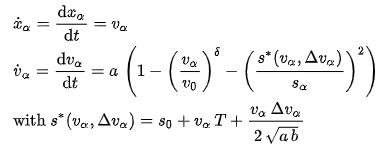
Figure1.EquationsinIDM
The roads in our adaptive traffic signal control system simulatethephysicalandbehavioralcharacteristicsofroad segments,managingvehicledynamicsandinteractionswith trafficsignals.Itinitializeswithstartandendcoordinatesto definetheroad'sstructure,andutilizesadequeforefficient vehicle management. Geometric properties such as road length and orientation are calculated to support vehicle movementsimulations.Trafficsignalintegrationallowsthe classtocontrolvehiclebehaviorinresponsetosignalstates, managingtransitionsbetweenmoving,slowingdown,and stopping. By continuously updating vehicle positions and responses to traffic signals, the Road class provides a realistic simulation of traffic flow, enabling the evaluation andoptimizationofadaptivesignalcontrolstrategies.Figure 2demonstratesthestartofthesimulation.
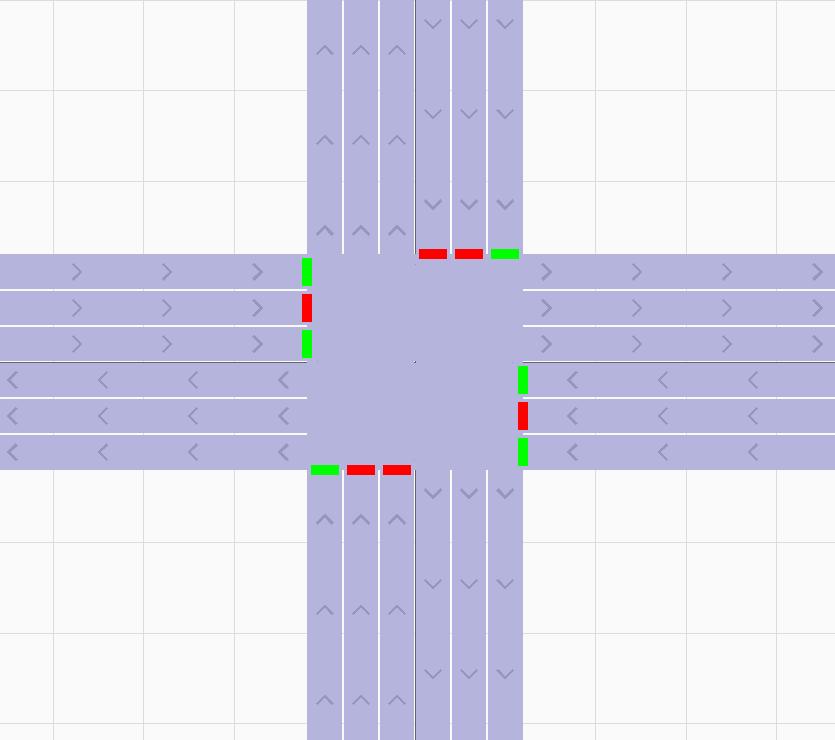
The intersection features four primary directions: East, West,North,andSouth.Eachdirectionincludesthreelanes forincomingtrafficandthreelanesforoutgoingtraffic.The lanes are designated as direction_in1, direction_in2,
Volume: 11 Issue: 11 | Nov 2024 www.irjet.net p-ISSN: 2395-0072
direction_in3 for incoming traffic, and similarly, direction_out1,direction_out2,direction_out3foroutgoing traffic. This configuration allows for a structured flow of vehiclesthroughtheintersection.Vehiclesinthefirstlane (designatedas_in1)arerestrictedtoturningright.Vehicles in the second lane (_in2) proceed straight through the intersection, while vehicles in the third lane (_in3) are designatedforleftturns.Thisspecificlanedesignationhelps toorganizetrafficflowandreducepotentialconflictswithin theintersection.
The traffic lights at the intersection regulate vehicle flow. The control system uses a matrix to decide which lanes should receive green lights, based on current traffic densities. This matrix is an 8x8 grid where each row and columncorrespondtospecificlanes.Thevalueswithinthe matrix indicate whether a particular pair of lanes (designated by the respective row and column) can have greenlightssimultaneously.Thematrixvaluesarebinary, whereavalueof1indicatesthatthecorrespondinglanescan be green at the same time. For example, if matrix[0][2] equals 1, this means that westin1 and eastin1 lanes can simultaneously have green lights. Multiple 1s in a row suggestseveralpotentialgreenlightcombinations,butthe systemwillselectthepairoflaneswiththehighesttraffic density. The system continuously calculates the traffic densityforeachlane.Basedonthesedensities,itdetermines which two lanes, having the highest traffic, should be granted green signals to optimize flow and minimize congestion.
The simulation flow begins by setting up the Pygame environmentandcreatingthedisplaywindow,whichforms the foundation for the graphical simulation. A function is thendefinedtodrawthelanesandintersectionlayoutonthe screen, using lines or rectangles. Each direction includes threelanesforbothincomingandoutgoingtraffic,accurately depictingthetrafficsetup.Vehicleclassesandtheirbehavior aredefinedaccordingtolanedirections(rightturn,straight, left turn), and vehicle positions are updated based on the statusoftrafficlights,ensuringrealisticvehiclemovement within the simulation. Traffic signal logic utilizes the provided matrix to determine possible green light pairs, calculates the number of vehicles in each lane to assess trafficdensity,andthendeterminesthetwolaneswiththe maximumtraffictograntgreensignals,effectivelymanaging congestion.
The 8x8 matrix represents allowable green light combinations for the lanes, with rows and columns corresponding to specific lanes: Row 0 = Col 0 = westin1 lane,Row1=Col1=southin1lane,Row2=Col2=eastin1 lane,Row3=Col3=northin1lane,Row4=Col4=westin2 lane,Row5=Col5=southin2lane,Row6=Col6=eastin2 lane,andRow7=Col7=northin2lane.Thematrixindicates which pairs of lanes can be green simultaneously. For example,matrix[0][2]=1signifiesthatwestin1andeastin1 can both have green lights at the same time. Although
multiple 1s in a row suggest several potential green light combinations,thesystemprioritizesthepairwiththemost traffic. The next steps involve implementing the Pygame setup,initializingPygame,andcreatingthedisplaywindow tobeginthesimulation.Afunctionisdefinedtoaccurately draw the lanes and intersection layout on the screen. A vehicle class is created to manage the properties and movementofvehicles,implementing movement logicthat adheres to lane directions. The traffic light control is implementedusingthematrix,calculatingtrafficdensities anddeterminingwhichlanesreceivegreenlights.Finally,a main loop is created that continuously updates vehicle positions, adjusts traffic lights based on real-time traffic densities,andrenderstheupdatedintersectionandvehicles onthescreen.Thisloopensuresthedynamicandadaptive natureofthetrafficsignalcontrolsystem.
3.3 Flowchart
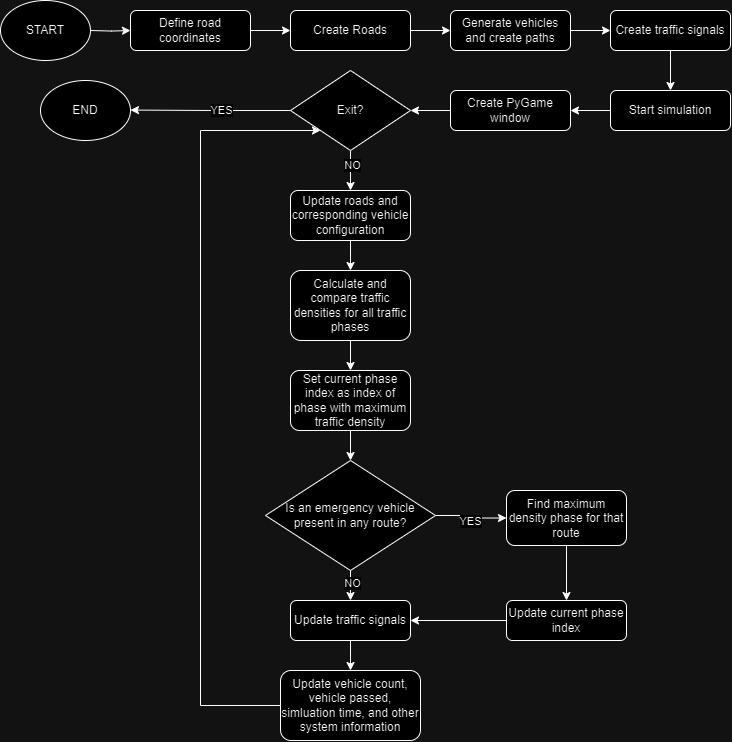
Inthissection,wepresenttheoutcomesofoursimulation experiments. The results highlight congestion levels, responsetimes,andtheefficiencyofourtrafficmanagement
International Research Journal of Engineering and Technology (IRJET) e-ISSN: 2395-0056
Volume: 11 Issue: 11 | Nov 2024 www.irjet.net p-ISSN: 2395-0072
system. Each figure and table corresponds to specific observations made during the simulations, providing insightsintotheimpactofvariousfactorsontrafficflowand emergencyvehicleprioritization.
Figure 4 illustrates the scenario at the beginning of the simulation,with74secondshavingelapsed.Atthispoint,the congestion is low, and an emergency vehicle has been grantedpassagethroughthetraffic.
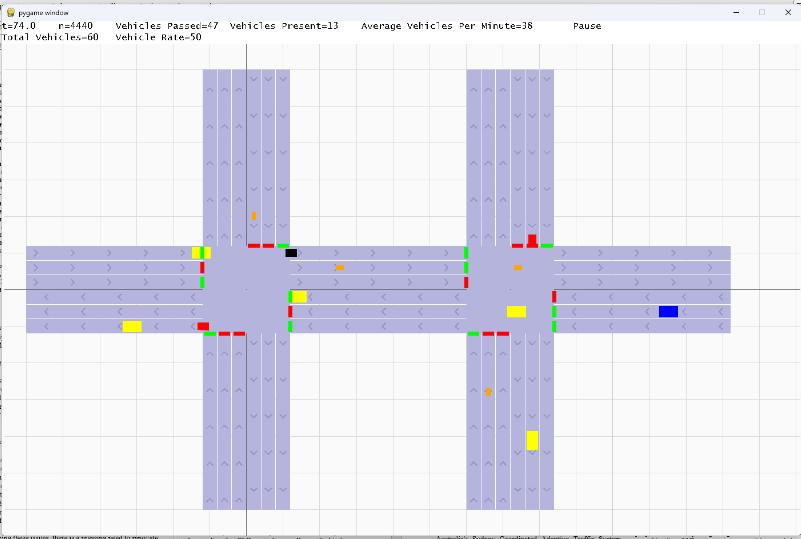
Figure5depictsthescenarioat167seconds,wheretraffic congestion remains low, and no significant queues have formed.
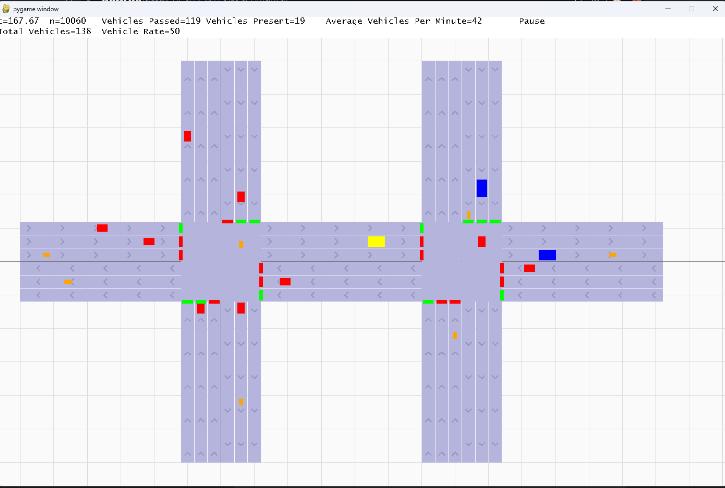
Figure 6 shows the scenario at 441 seconds into the simulation,wheretrafficcongestionhasrisen.Despitethe increased congestion, vehicles continue to flow at regular intervals,andtheemergencyvehicleisgivenpriority.
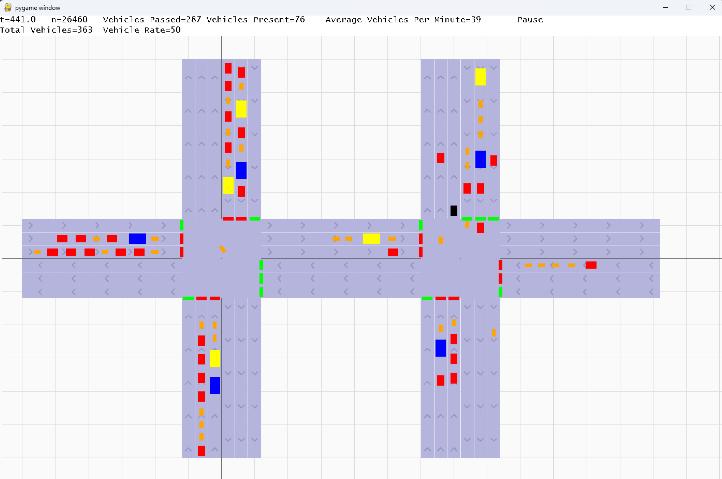
ThevehiclecountsatIntersection1arepresentedinTable1, showing the number of vehicles waiting at each incoming road at different time intervals. At 74 seconds, traffic remainslightwithminimalcongestion,asonlyonevehicleis waitingateachoftheNorth,West,andEastroads,whilethe South road has no waiting vehicles. By 167 seconds, the vehicle count has slightly increased, with small queues forming at the South and East roads. At 441 seconds, congestionrisesnotably,especiallyontheNorthandSouth roads,with15and13vehicleswaiting,respectively,while the West road sees no vehicles waiting. As the simulation progresses, the traffic volume continues to grow, with significant queues forming at all roads by 600 and 750 seconds,reflectinganincreaseinoverallcongestionatthe intersection.
Elapsed
Table1.ReadingsatIntersection1
ThevehiclecountsatIntersection2arepresentedinTable2, showing the number of vehicles waiting at each incoming roadatdifferenttimeintervals.At74seconds,trafficislight withonevehiclewaitingateachoftheNorth,West,South, and East roads. By 167 seconds, the vehicle count has increased slightly, with two vehicles waiting at the North roadwhiletheotherroadsremainrelativelyunaffected.At 441seconds,congestionrises,particularlyattheNorthand East roads, where 10 and 14 vehicles are waiting, respectively,whiletheSouthandWestroadsseemoderate queues.Asthesimulationcontinues,thenumberofwaiting vehiclesincreasesfurther,withmoresignificantcongestion
International Research Journal of Engineering and Technology (IRJET) e-ISSN: 2395-0056
Volume: 11 Issue: 11 | Nov 2024 www.irjet.net p-ISSN: 2395-0072
at all roads by 600 and 750 seconds, indicating higher overalltrafficvolumeattheintersection.
Table2.ReadingsatIntersection2
4. CONCLUSION
Inconclusion,theresultsofthesimulationdemonstratethe impactofvaryingtrafficconditionsoncongestionlevelsand theefficiencyoftrafficflowatthetwointersections.Thedata presented reveals that while initial traffic volumes are manageable, congestion increases significantly over time, particularly during peak periods. The ability to prioritize emergency vehicles, even under high congestion, was effectively maintained throughout the simulation. The findings highlight the importance of dynamic traffic managementsystemsthatcanadapttochangingconditions andensureboththesmoothflowofvehiclesandthetimely passage of emergency vehicles. Further studies and simulations could refine these models and incorporate additional factors to enhance the performance and scalability of traffic management systems in real-world scenarios.
[1] TomTom.com, 'Tom Tom World Traffic Index', 2019. [Online]. Available: https://www.tomtom.com/en_gb/traffic-index/ranking/
[2] Khushi, "Smart Control of Traffic Light System using Image Processing," 2017 International Conference on Current Trends in Computer, Electrical, Electronics and Communication (CTCEEC), Mysore, 2017, pp. 99-103, doi: 10.1109/CTCEEC.2017.8454966.
[3]A.Vogel,I.Oremović,R.ŠimićandE.Ivanjko,"Improving Traffic Light Control by Means of Fuzzy Logic," 2018 International Symposium ELMAR, Zadar, 2018, pp. 51-56, doi:10.23919/ELMAR.2018.8534692.
[4]A.A.Zaid,Y.SuhweilandM.A.Yaman,"Smartcontrolling for traffic light time," 2017 IEEE Jordan Conference on AppliedElectricalEngineeringandComputingTechnologies (AEECT), Aqaba, 2017, pp. 1-5, doi: 10.1109/AEECT.2017.8257768.
[5] Renjith Soman "Traffic Light Control and Violation Detection Using Image Processing”.” IOSR Journal of Engineering(IOSRJEN),vol.08,no.4,2018,pp.23-27
[6]A.Kanungo,A.SharmaandC.Singla,"Smarttrafficlights switching and traffic density calculation using video processing," 2014 Recent Advances in Engineering and ComputationalSciences(RAECS),Chandigarh,2014,pp.1-6, doi:10.1109/RAECS.2014.6799542.
[7] Sabeen Javaid, Ali Sufian, Saima Pervaiz and Mehak Tanveer,"SmartTrafficManagementSystemUsingInternet ofThings",IEEE2018.
[8] F. Tang, Y. Kawamoto, N. Kato, and J. Liu, “Future intelligent and secure vehicular network toward 6G: machine-learningapproaches,”ProceedingsoftheIEEE,vol. 108,no.2,pp.292–307,2020.
[9] Y.Ni,L.Cai,J.Heetal.,“Towardreliableandscalable internet of vehicles: performance analysis and resource management,”ProceedingsoftheIEEE,vol.108,no.2,pp. 324–340,2020.
[10] H. Zhou, W. Xu, J. Chen, and W. Wang, “Evolutionary V2Xtechnologiestowardtheinternetofvehicles:challenges andopportunities,”ProceedingsoftheIEEE,vol.108,no.2, pp.308–323,202
2024, IRJET | Impact Factor value: 8.315 | ISO 9001:2008