
International Research Journal of Engineering and Technology (IRJET) e-ISSN: 2395-0056
Volume: 11 Issue: 11 | Nov 2024 www.irjet.net p-ISSN: 2395-0072

International Research Journal of Engineering and Technology (IRJET) e-ISSN: 2395-0056
Volume: 11 Issue: 11 | Nov 2024 www.irjet.net p-ISSN: 2395-0072
Devendra
chouhan1, Upendra Sharan Gupta2 ,
[1] PG Scholar, Shri Vaishnav Vidyapeeth Vishwavidyalaya Indore (M.P.)
[2] Assistant Professor, Shri Vaishnav Vidyapeeth Vishwavidyalaya Indore (M.P.)
Abstract - In the contemporary setting of a fast-rising global population, the issue of resource depletion is a major concern for humanity. The creation of alternative materials has become more significant in recent years due to the environmental harm that some material extraction methods cause. As a result, composite materials particularly those made of natural fibers have developed. Due to their strength, stability, and inertness, synthetic fibres make up the majority of today's fibre technology. However, these fibres harm the natural order of things since they are polluting and nonbiodegradable. These composites improve the performance of artificial composites. One such ingredient is fibre from Bananas. The banana tree, a native plant of Southeast Asia, is used to make banana fibre. The tribological performance of a banana fiber reinforced epoxy composite was examined inthe current work. Wear and frictional characteristics of BFREC were investigated under dry contact condition at different operating parameters such as slidingdistance,slidingvelocity, applied load. The experimental results indicates that incorporation of banana fiber into epoxy matrix significantly improves the adhesive wear behaviour of BFREC. There was reduction in coefficient of friction, specific wear rate (S.W.R) and % mass loss of developed composites.
Key Words: banana-fiber; natural fiber; adhesive wear ; S.W.R; CoF
1.INTRODUCTION
Thereare manyresources suitedforvarious purposes all aroundthenearbypopulation.Oneofthepillarsofhuman society is the use of fibres. The foundation of human existence and flourishing are fibres. There are essentially two sorts of fibres. They are both synthetic and natural fibres.Naturalfibreslikecotton,jute,andsisalareexamples. Syntheticfibreslikeglass,nylon,andcarbonareexamples. Due to their durability, stability, and inertness, artificial fibres now make up the majority of fibre technology. However,becausetheyarenon-biodegradableandpolluting, thesefibresupsetthenaturalorder.Theuseofnaturalfiberbased composites has increased as they demonstrate a superior alternative to synthetic fiber. Composites are frequentlyusedinourdailylivestopromotethesustainable growth of human society. These composites increase the artificialcomposites'productivity.Bananafibreisonetype of natural fibre that is used in reinforced composites
nowadaysandisawasteproductfromthebananaindustry. Theyhavegainedagreatdealofnotorietyinperformance applications, aerospace, automotive, and many other industries thanks to their advantageous qualities of low weightandabilitytobecustomisedforparticularuses.The many advantages of banana fibre, including its low cost, availability,andstrength,makeitoneofmanynaturalfibres thatcouldbeusedasreinforcementinpolymercomposites. In turn, banana (Musaceae) fibre reinforced composites allow the creation of tribological components with exceptionalwear,friction,andlubricationqualitiesthathave a widerangeofindustrial uses.Anotableadvancementin the creation of bio composites has lately been made as a resultofthefurtheradditionofallfeatures.High-strength bananareinforcedcompositescanthusbeusedinarangeof applications.Thenutritionalbreakdownofabanana(100g pulp)isasfollows:18.8gofcarbohydrates,1.15gofprotein, 0.18goffat,73.9gofwater,0.83gofotherminerals,and81 kcal [1]. Banana plants often yield 30 large leaves, each measuringover2metreslongand30centimetreswide[2]. Tables1,and2byVenkateshwaranetal.[3]listthephysical Propertiesandchemicalcompositionofbananafibre.
Table 1: Physical properties of the banana fibers [3]
Diameter(μm) 80-250
Length(mm) 1000-5000
AspectRatio(l/d) 150
Moisturecontent(%) 60
Table 2: Chemical composition of banana fibers [3]
Cellulose (%) 60-65
Hemi cellulose (%) 5-19
lignin(%) 6-10
Pectin(%) 3-5
Ash(%) 1-3
Extractives(%) 3-6
The study of friction, wear and lubrication of interacting surfaces in relative motion is known as tribology [4]. The importanceoftribologyatpresenttimeiscrucialsincemost
International Research Journal of Engineering and Technology (IRJET) e-ISSN: 2395-0056
Volume: 11 Issue: 11 | Nov 2024 www.irjet.net p-ISSN: 2395-0072
design applications involve ‘wear and tear’ process when subjected to relative motion. Using thechosen parameters (slidevelocities,slidingdistances,appliedweights,contact conditions,andorientationsofthetestspecimenwithrespect to thesliding directionofthe counterface),a tribo-testing machine is constructed that can replicate the wear and frictionaltest.Thereareseveralsortsoftribo-testingdevices basedonthepublishedstudiesthatarecurrentlyavailable. Theydifferfromoneanotheraccordingtohowwellthetest fits a certain application. the many tribo-testing methodologies shown in table 6 employed in carrying out varioustests
Tribologicalloadingsareoneofthemostcrucialaspectsto takeintoaccountwhendevelopingaTribologicalcomponent becauseeverymaterialhassomewearandfrictionqualities that deteriorate over time [5]. Since the changes occur in tribologicalloadingconditionapprox.90%failurehappens, which modify their wear and friction properties [6]. Tribological properties are varied (either positively or negatively) by using reinforcement method with fibers or polymers [7]. The addition of natural fibres improved the wear performance of polylactic acid, and the wear rate of compositeswasnoticeablylowerthanthewearrateofclean polylacticacidathigherloads[6].Intheirstudy,forakindof bearing application Chin and Yousif [8] used Kenaf fibers reinforcedwithepoxycomposite,inwhichtheyconcluded thatwearperformanceandnormalorientationincomposites is85%enhancement.
El-Tayeb [9] investigated the wear and friction characteristicsofglassfiber/polyester(GRP)andsugarcane fiber/polyester(SCRP).Variousparameters,suchasspeed, the length of the test, and load, were used in the study. Accordingtothestudy'sfindings,SCRPandGRPcomposite arerivalproducts.Thesamefeaturesforsisalfibrereinforced resinbrakecompositeswerestudiedbyXinetal.[7],who found that sisal fibre may be used in place of asbestos in brakepads[10,11].
Yousif [12] investigated on the frictional and wear performance of polyester composites based on coir fibres. Coirfibrecompositesweredevelopedinamulti-layerfoam, mainly in three and four layers. Author carried out the experiment using a block-on-disc machine under sliding contact condition against smooth stainless steel. Author concluded that the interfacial adhesion between the coir fibresandpolyestermatrixisstrongenoughtoovercomethe pull-outoffibresattheinterface
Bajpai et al. [6] has studied and estimated three different naturalfibersclassasGrewia,nettle,optiva,andsisalwith PLA polymer and developed composites in which a hot compression procedure was used. The friction and wear characteristicsofcompositeswereexaminedundervarious conditions, such as dry contact conditions with the availabilityofvaryingoperatingparameters.Theappliedload
wasvariedbetweenarangeof10to30Nwithaspeedrange of 1 to 3 m/s and a sliding distance of 1 km to 3 km. The study'sfindingsdemonstratedthataddingnaturalfibremats to a polylactic acid matrix can improve the way that neat polymerswearandfriction.IncomparedtoneatPolylactic acid, there is a roughly 10–44% drop in the coefficient of friction,withahigherreductionof70%seenindeveloped compositesforspecificwearrates.
The coir fibre reinforced polyester composite exhibits a betterwearperformancethanneatpolyester.Eduardoetal. [13] performed wear experiments on thermoset matrix reinforced with Musaceae fibre bundles to study the wear resistance of the material. The fibre bundles used by the author were extracted from rachis Colombia Musaceae plants. After the completion of the experiment, the author concluded that the resins hold main role in the friction behaviour. The main wear mechanisms identified in the tested samples were adhesion and surface fatigue. Many studies are still going to improve the wear behaviour of naturalfibre-basedpolymercomposites.
T.P.Mohanetal.[14]Aimofthisresearchworkwastostudy thetribologicalpropertiesofnaturalfiber-basedcomposites usingnanotechnology.Thenaturallyavailablebananaplant fibersweretreatedwithnanoclayparticlesandthesetreated fibers were then reinforced in an epoxy polymer to form composites. The friction and wear properties of nanoclay treated banana fiber (NC BF) reinforced composites were compared with untreated banana fiber (UT BF) reinforced composites.ShortNCBFandUTBFreinforcedcomposites withfiberconcentrationrangingfrom20wt.%to60wt.% waspreparedbyvacuumresininfusionprocessingmethod. TheresultindicatesthattheNCBFreinforcedcompositeshas shown improved frictionand wear properties.Microscopy examinationrevealedthatNCBFreinforcedcompositeswere able to form transfer layer between wear test specimens, resultinginimprovedwearproperties.
S Vigneshkumar et. al [15] has carried out an Experiment with fiber reinforced polymer composite on Pin on disc equipment.Andinvestigatedthechangesofwearandfriction performanceofthesisalandricehuskcompositeweight.The carbon, sisal fiber and rice husk composite wear and frictional performance were improved with the increased load an orthogonal array method. with the increase in the load and sliding velocity the sisal, banana and kenaf fiber composite weight loss was more and Sisal and rice husk compositewearandfrictionalforcewasmorewithrespectto increasingthespeedandtime.
A.Alavudeenal[16]showedintheirinvestigationthatahigh wearresistantmaterialusingbananafibrehasbeenusedto developahybridclutchplatecompositematrixwithstrength andrigidity.Thecompositematerialalsoimprovesthelifecycleofthecomposite
International Research Journal of Engineering and Technology (IRJET) e-ISSN: 2395-0056
Volume: 11 Issue: 11 | Nov 2024 www.irjet.net p-ISSN: 2395-0072
Subramanianetal.[17]performedweartestoneco-friendly mono-layeredPTFEblendedpolymercomposites.Thetribotestwasperformedfortheconstantpressureandvelocityin a flat-on-flat configuration. A stable friction characteristic was clearly achieved in the steady state which implies the developedmaterialsuitablefortribologicalcomponentssuch as plain bearings, sliders, hinges etc. To understand the failuremechanismofslidingwear,themorphologyofwornoutcompositesurfaceandcounterpartwasanalysedusing ScanningElectronmicroscope(SEM).
2.1 Materials
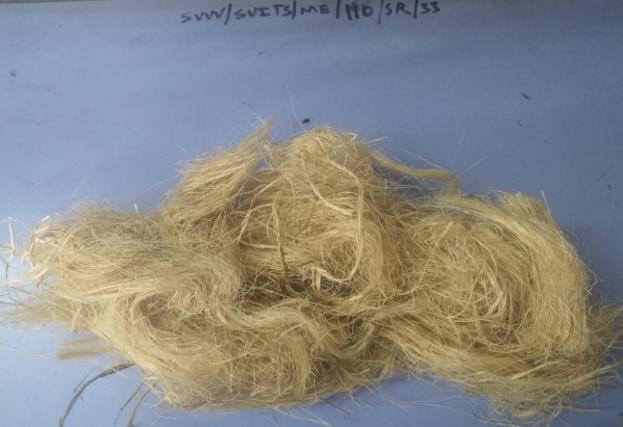
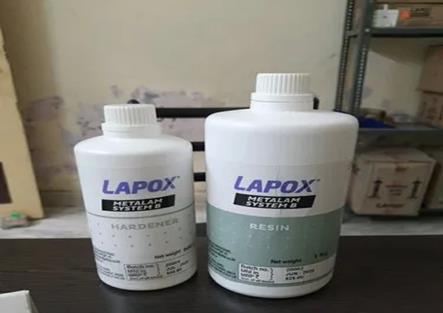
ShroffIndustries,Dist.BurhanpurMadhyaPradeshprovided unidirectionalcombedgoodgradelongbananafibre(shown infig.1).TheepoxyresinLY556andhardenerHY951(shown infig.2)chosenforthematrixareboughtfromalocalmarket inIndore,MadhyaPradesh.Oneofthemostwidelyutilised matrix materials is epoxy. The matrix's density was determined to be 1200 kg/mm3. According to the calculations, the amount of hardener and epoxy was measured. The composite is made using LY556, an epoxy withadensityof1.15-1.20g/cm3,combinedwithHY951,a hardener with a density of 0.97-0.99 g/cm3. Epoxy and hardenerarecombinedataweightratioof10:1.At250oC, this has a viscosity of 10–20 poise. In the mechanical department lab of Shri Vaishnav Institute of Technology, composite preparation is done. The tribological test have beenperformedatDucom,Bangalore
2.2 Fabrication of Composites:
Forpreparingtheweartestspecimensweused10 mmdiameterhotwaterpipeformakingthemold,pipesof the length 40 mm were cut. Weight of epoxy and Fiber is takenaccordingtopercentagei.e.,10%,20%,30%and40% ofbananafiberandremainingportionofmatrix(epoxyand hardener)intheratio10:1ispouredfromthesidesfollowed by inserting the fibers and then again pouring the epoxy throughoutthecavity.Afterremovingthespecimenfromthe pipe,itwascutaccordingtoASTMstandard.
2.3 Adhesive wear test Characterization
Thereareseveralsetupswhichcanbeusedforconducting weartestssomeofthemaredrysandrubberwheel,pinon drum,lineartribomachine,blockonring,blockondiscand pinondisc(Basicschematicdiagramforwearandfriction tribometerfig3)asdiscussedabove.wehaveusedthepin ondiscsetup.
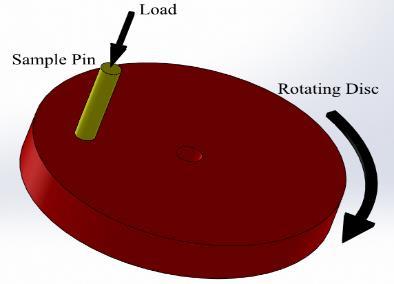
Figure 3: Basicschematicdiagram for wear andfrictiontribometer
International Research Journal of Engineering and Technology (IRJET) e-ISSN: 2395-0056
Volume: 11 Issue: 11 | Nov 2024 www.irjet.net p-ISSN: 2395-0072
A wear and friction tribometer as per ASTM G99 (TR-20M61,Ducom,Bangalore)wasusedtoassessco-efficientof friction adhesive wear and specific wear rate of polymer compositesASTMG99isthestandardforpinondisctesting asshowninfig4.Thesampleis10mmindiameterand30 mm in length. The sample is subjected in a perpendicular directionagainstarotatingcounterfaceEN31disc(165mm diameter, 8 mm thick). The contact with the counter face continuously erodes the material and the wear and the frictional force acting is continuously measured with the help of sensors fitted on the set up. Care should be taken whileapplyingandremovingtheloadsandfluctuationsin theloadwillbringalotoferrorinthetest
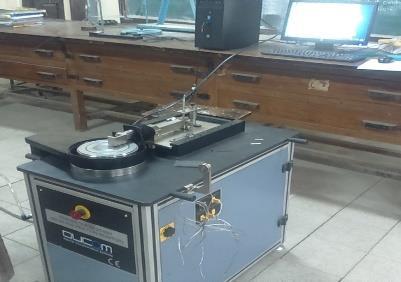
Figure4:Experimentalsetupforwearandfrictiontester
Table 3: Tribological test characterization. Method
Pin on disk ASTM G99 10mm×10mm ×20mm sliding distance, sliding velocity, appliedload,wet or dry sliding, abrasive or adhesive contact condition [18][20]
Where, Ks is specific wear rate in m3/N-m; ∆V is wear volume loss in m3; L is Load in Newton and D is sliding distanceinmeter.
In all the experiments, below mentioned (in fig 5) test procedureswerefollowed
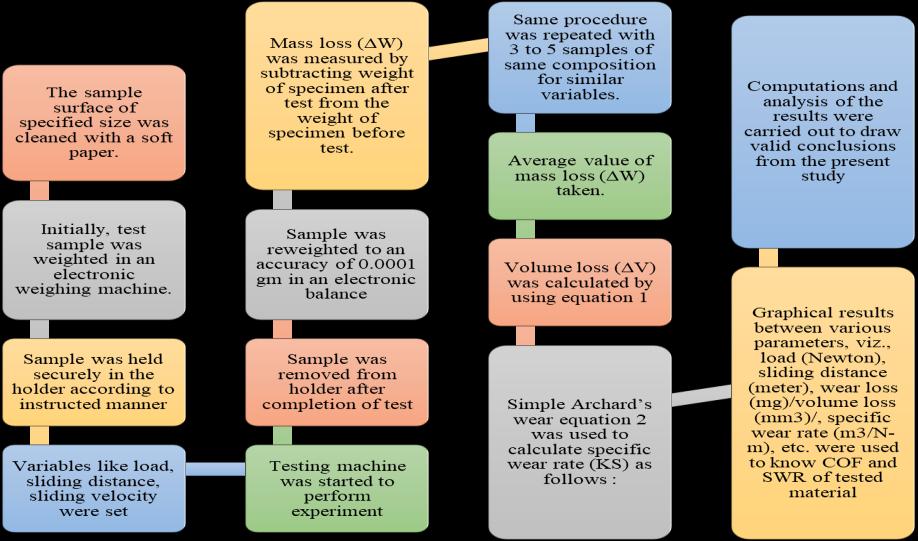
Figure5:Testprocedureforweartest
3.0 Results and Discussions
3.1 Tribological tests
3.1.1 Adhesive wear test
For the wear test we have taken readings against threedifferentrpms(300,400,500)rpmagainst30Nloadand testeditagainstdifferentslidingdistances,weargraphswere plottedand alongside graphs forcoefficient offrictionand specificwearrateisalsoprovided.Slidingdistancefor1000 m1500mand2000mwerecalculatedusingtheformula
ɷ=2*ᴨ*N/60 (3)
ForV=1.57m/s.timetakentocover1000m,1500mand 2000mdistanceare10.6mins,16minsand22mins.Hence fortheslidingdistancethemachinewasadjustedtoatime limit of 22 mins and the specific wear rate was calculated usingtheformula:

Equationforvolumeloss (1)
Where,∆Visvolumelossinmm3;∆Wismasslossingram andρisdensityinMg/m3
Specificwearrate=(Δm)/ρFL (4)
WhereΔmstandsforchangeinmassandρforthedensity, FforthenormalforceactingortheloadactingandListhe distancetravelledorslides.

Archard’swearequation (2)
International Research Journal of Engineering and Technology (IRJET) e-ISSN: 2395-0056
Volume: 11 Issue: 11 | Nov 2024 www.irjet.net
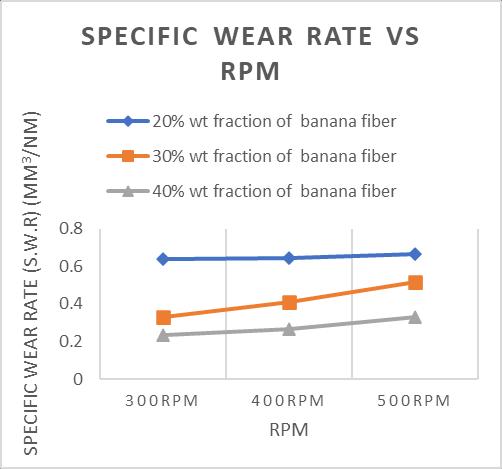
Figure6:SpecificwearrateofBananafiberreinforced epoxycompositeatdifferentrpm
Table 4: Values of specific wear rate for 1000 m 1500 m and 2000 m distance on 400 rpm and 30N load
Forthewearratethecoefficientoffrictionand %masslossduringthetestfor1000mdistanceand400rpm at30Nloadisappliedfordifferentvolumefractionbanana fiber.Theaveragevaluesof5samplesinfigure22and23is foundtobemaximumfor40%ofvolumefractionofbanana fiber. For a constant load, sliding distance and rpm the % mass loss of Banana fiber reinforced epoxy composite is droppedfrom2.14%to1.43%of20%and40%bananafiber respectively.
Table 5: Values of Coefficient of friction (CoF) and % mass loss for 1000 m distance on 400 rpm and 30N load
Bananafiber20% 0432 214
Bananafiber30% 0456 174
Bananafiber40% 0474 143
0632 0412 0298
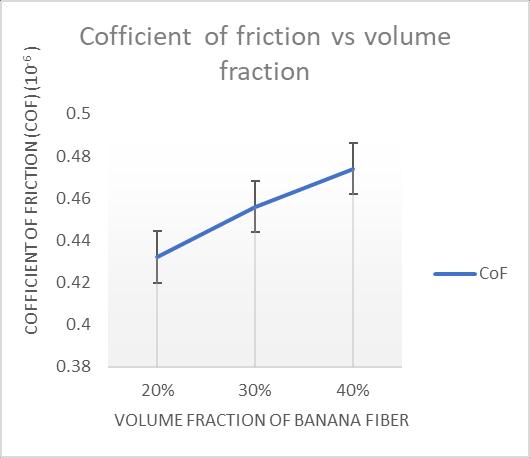
Figure22:Coefficientoffrictionfordifferentvolume fractionofBananafiberreinforcedepoxycomposite.
Figure7:SpecificwearrateofBananafiberreinforced epoxycompositeatdifferentslidingdistance.
International Research Journal of Engineering and Technology (IRJET) e-ISSN: 2395-0056
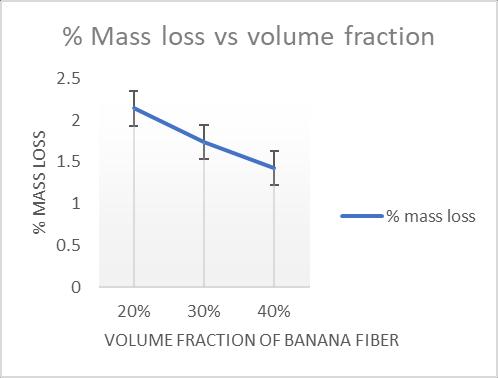
Figure23:%masslossfordifferentvolumefractionof Bananafiberreinforcedepoxycomposite.
4.0 Conclusions
Tribological characterization were assessed by determiningthevariousvolumefraction(10%to40%Vf)of bananafiberonBananaFiberReinforcedEpoxyComposite (BFREC). Tribological behavior of BFREC investigations leadstothefollowingassertions.
TribologicalcharacterizationforSpecificwearrate vsspeeditisclearlyevidentthatthespecificwear ratewillincreasebecauseforsameloadandsliding distance with increase in speed the composite wearsmore
Specific wear rate vs sliding distance the value decreaseswiththeincreaseinslidingdistance.
Withincreasingthefibrecontentfrom20%to40% thewearrateofthematerialdecreases.
Withincreasingthefibrecontentfrom20%to40% the%masslossofthematerialdecreases.
Withincreasingthespeedwearrateincreasesfor the same fiber content. Coefficient of friction(µs) increasesthevolumefractionofthecompositesand resultsinlowerwear.
Bananafiberhasthelowestspecificwearrateand would be better if considered for tribological applicationsinrotatingandslidingparts.
5.0 Reference
[1] Kai Bin Liew et al. (2021) Overview of Mechanical and Physicochemical Properties of Polymer Matrix Composites,EncyclopediaofMaterials:Composites, Elsevier, Pages 565-576, https://doi.org/10.1016/B978-0-12-8197240.00049-5
[2] Kumar, R.. (2014). Polymer-matrix composites: Types,applicationsandperformance.
[3] Narayanan, Venkateshwaran & Elayaperumal, Ayyasamy.(2010).BananaFiberReinforcedPolymer Composites - A Review. August 2010 Journal of Reinforced Plastics and Composites29(15):23872396DOI:10.1177/0731684409360578
[4] FriedrichK,LuZ,HagerAM(1995)Recentadvancesin polymercomposites’tribology.Wear190:139–144
[5] A. Shalwan and B. F. Yousif, “In state of art: mechanicalandtribological behaviourof polymeric composites based on natural fibres,” Materials & Design,vol.48,pp.14–24,2013
[6] P. K. Bajpai, I. Singh, and J. Madaan, “Tribological behavior of natural fiber reinforced PLA composites,” Wear,vol.297,no.1-2,pp.829–840,2013.
[7]N.S.M.El-Tayeb,B.F.Yousif,andT.C.Yap,“Tribological studiesofpolyesterreinforcedwithCSM450-R-glass fiber sliding against smooth stainless steel counterface,” Wear, vol.261, no. 3-4, pp. 443–452, 2006.
[8] C.W.ChinandB.F.Yousif,“Potentialofkenaffibresas reinforcementfortribologicalapplications,”Wear,vol. 267,no.9-10,pp.1550–1557,2009.
[9] N. S. M. El-Tayeb, “A study on the potential of sugarcanefibers/polyestercompositefortribological applications,” Wear,vol. 265, no. 1-2, pp. 223–235, 2008.
[10] M. M. Davoodi, S. M. Sapuan, D. Ahmad, A. Aidy, A. Khalina, and M. Jonoobi, “Concept selection of car bumper beam with developed hybrid bio-composite material,” Materials & Design,vol.32,no.10,pp.4857–4865,2011.
[11] N.BanthiaandR.Gupta,“Influenceofpolypropylene fiber geometry on plastic shrinkage cracking in concrete,” Cement andConcrete Research,vol.36,no.7, pp.1263–1267,2006.
[12] B F Yousif, Frictional and wear performance of polyestercompositesbasedoncoirfibres,Proc.Inst. Mech.Eng.PartJ:J.Eng.Tribol.223(1)(2009)51–59,https://doi.org/10.1243/13506501JET455
[13] Carlos Eduardo et al., Wear resistance and friction behaviour of thermoset matrix reinforced with Musaceae fibre bundles, Tribol. Int. (2015), https://doi.org/10.1016/j.triboint.2015.02.015.
Volume: 11 Issue: 11 | Nov 2024 www.irjet.net p-ISSN: 2395-0072 © 2024, IRJET | Impact Factor value: 8.315 | ISO 9001:2008 Certified Journal | Page300
International Research Journal of Engineering and Technology (IRJET) e-ISSN: 2395-0056
Volume: 11 Issue: 11 | Nov 2024 www.irjet.net p-ISSN: 2395-0072
[14] Mohan, T. P., and Kanny, K. (March 11, 2019). "TribologicalPropertiesofNanoclay-InfusedBanana FiberReinforcedEpoxyComposites."ASME.J.Tribol. May 2019; 141(5): 052003.https://doi.org/10.1115/1.4042873
[15] sn,Vigneshkumar&Thangaraju,Rajasekaran.(2018). Experimental analysis on tribological behavior of fiberreinforcedcomposites.IOPConferenceSeries: Materials Science and Engineering. 402. 012198. 10.1088/1757-899X/402/1/012198.
[16] A. Alavudeen, M. Thiruchitrambalam and A. Athijayamani.;Clutch plate using woven hybrid compositematerials,MaterialsResearchInnovations 2011,Vol15no4,229,30November2010,.
[17] KarthikeyanSubramanian,RajiniNagarajan,Patrick De Baets, Sukumaran, Eco-friendly mono-layered PTFE blended polymer composites for dry sliding tribo – systems, Tribol. Int. 102 (2016) 569–579, https://doi.org/10.1007/s40430-017-0839-0
[18] Mergler YJ, Schaake RP, Huis VAJ (2004) Material transfer of POM in sliding contact. Wear 256:294–301
[19] BijweJ,IndumathiJ,GhoshAK(2002)Ontheabrasive wearbehaviouroffabric-reinforcedpolyetherimide composites.Wear253:768–777
[20] Bijwe J, Indumathi J, John Rajesh J, Fahim M (2001) Friction and wear behavior of polyetherimide compositesinvariouswearmodes.Wear249:715–726
© 2024, IRJET | Impact Factor value: 8.315 | ISO 9001:2008 Certified Journal | Page301