
International Research Journal of Engineering and Technology (IRJET) e-ISSN: 2395-0056
Volume: 11 Issue: 11 | Nov 2024 www.irjet.net p-ISSN: 2395-0072

International Research Journal of Engineering and Technology (IRJET) e-ISSN: 2395-0056
Volume: 11 Issue: 11 | Nov 2024 www.irjet.net p-ISSN: 2395-0072
Deepak Aggarwal1 , Rahul Kumar
2
1Assistant Professor, Department of Civil Engineering, SCET Ghaziabad, UP, India
2Assistant Professor, Department of Civil Engineering, SCET Ghaziabad, UP, India
Abstract - Plastic waste is a significantresource,commonly found in solid waste and often discarded without proper treatment. Municipal plastic waste disposal, particularly in urban areas, has grown tremendously,impactingtheaesthetic of landscapes. Plastic has proven to be a useful binder in bitumen mixes used for flexible pavements. This innovative approach enables pavements to withstand higher temperatures by reducing crack formation and rainwater infiltration, which typically leads to pothole development. These roads demonstrate enhancedresistancetocrushingand abrasion and experience less water seepage. In India’s hot and highly humid climate, where temperatures often exceed 50°C and heavy rains wreak havoc on infrastructure, plastic roads could be a game-changer by reducing the occurrence of large potholes.
Bituminous Concrete(BC),acompositematerialwidelyusedin road surfaces, airports, and parking areas, is composed of asphalt or bitumen (acting as a binder) and mineral aggregates. These components are mixed, layered, and compacted to form durable surfaces. Today, the steady rise in high traffic volumes, especiallycommercialvehicles,combined with daily and seasonal temperature variations, prompts a need for alternatives that can improve pavement durability and quality while remaining cost-effective.
From an environmental standpoint, the excessive use of polythene in everyday activitieshasledtosignificantpollution. Since polythene is non-biodegradable, there is a pressingneed to find beneficial applications for this waste, and using it in road construction presents a promising solution
Key Words: Recycled Plastics, Bituminous Binders, Construction Aggregates, Sustainable Plastic Roads, Plastic Bituminous Aggregate mix.
1.INTRODUCTION
Most paved roads in our country are constructed with a granularsub-baseandbase,aswellasbituminousbaseand surface layers. Plastic, known for its versatility, became widely used due to the industrial revolution and mass production, making it a cheap and effective raw material. Plasticsnowplayacrucialroleacrossnearlyeveryeconomic sector from agriculture to packaging, automotive, electronics, construction, and communication. However, plasticisnon-biodegradable,withresearchshowingthatit canpersistintheenvironmentforupto4,500yearswithout
breaking down. Numerous studies have highlighted the environmentalandhealthrisksposedbyimproperplastic wastedisposal.Whileplasticisbeneficialtosociety,itposes significant environmental challenges after use. The ecofriendly disposal of various plastic and rubber wastes has becomeakeyfocusincurrentresearchefforts.Giventoday’s lifestyle,completelybanningplasticuseischallenging,even thoughithasbecomeamajorpollutionproblemforpresent andfuturegenerations.
Nevertheless, using waste plastics in road construction is gaining popularity, as plastic roads have shown better performance compared to traditional roads, repurposing what would otherwise contribute to pollution. Applying wasteplastictocoattheaggregatesinbituminousmixeshas beenfoundtoenhanceperformance.Recycledpolyethylene bags, shredded into small pieces, are coated onto the aggregateataspecifictemperature.Bituminousmixesare then prepared using 60/70-grade bitumen, either with plastic-coatedorconventionalaggregates,andcementasa filler material. The inclusion of plastic waste significantly improves the abrasion resistance and slip resistance of flexiblepavements,andenhancesthemix’stensilestrength values.
1. In1942,FransisHveem,aprojectengineerwiththe California Department of Highways, sought to determinetheoptimalamountofbitumenforroad construction.Withoutpriorexperienceinassessing mixqualitybyappearance, hedevisedtheHveem stabilometer in 1927 to measure specific mixture parameters, enabling accurate bitumen quantity estimationsbasedonsurfaceareacalculations a methodadaptedfromcementconcretemixdesign atthetime(VallergaandLovering,1985).
2. Sabina (2001) examined the properties of bituminous mixes containing plastic or polymer (PP)at8%and15%bybitumenweight,comparing themwithconventionalbituminousconcretemade with 60/70 penetration-grade bitumen. Her researchshowedthatplastic-modifiedbituminous concrete mixes had increased Marshall Stability, retained stability, indirect tensile strength, and reducedrutting.
International Research Journal of Engineering and Technology (IRJET) e-ISSN: 2395-0056
Volume: 11 Issue: 11 | Nov 2024 www.irjet.net p-ISSN: 2395-0072
3. Justoandhisteam(2002)atBangaloreUniversity’s Centre for Transportation Engineering experimented with processed plastic bags as additivesinasphaltmixes.Theyobservedthatwith higher proportions of plastic additives, the penetration and ductility values of bitumen declined, enhancing the mix's performance under specificconditions.
4. In2007,Dr.R.Vasudevandiscoveredthatcoating aggregateswithplasticreducesporosity,decreases moisture absorption, and enhances durability. He concludedthatapolymer-bitumenblendservesasa superior binder compared to plain bitumen, with improved softening points, reduced penetration values,andsuitableductility.Whenappliedinroad construction, this blend tolerates higher temperaturesandheavierloads.Theplastic-coated aggregate-bitumen mix exhibits higher Marshall StabilityandasuitableMarshallCoefficient,making it ideal for flexible pavement construction. This methodoffersaneffectivesolutionforwasteplastic disposal,enhancingroadqualitywhileaddressing pollutionissues.
5. Finally, S. Rajasekaran et al. (2009) conducted Marshall’s mix design experiments with modified bitumenandconstantoptimumrubbercontent.The studyrevealedsignificantimprovementsinvarious characteristics of the bitumen mix compared to conventional (60/70) bitumen, demonstrating enhanceddurabilityandperformanceattributes.
6. In 2013, Amit P. Gawande assessed the economic feasibilityofplastic-modifiedroads.Hisanalysisof asphaltconcretewith3%crumbrubbershoweda substantialimprovementinflexuralfatiguelifeand creeppropertiescomparedtounmodifiedasphalt mixes.
7. In 2013, S. Rajasekaran highlighted that coating aggregates with polymers not only enhances pavement quality but also improves aggregate durability. This techniquehelpsdispose of plastic wastefromhouseholdandindustrialpackaging,and thedryprocesseffectivelyrepurposesupto80%of waste polymers in an eco-friendly manner. Additionally,usingpolymersreducestheamountof bitumen needed, thereby lowering road constructioncosts.
8. Vatsal Patel and colleagues (2014) examined the impact of additives such as EVA (Ethyl Vinyl Acetate),aromaticresin,andSBSonwaxybitumen. They found that adding 4% EVA, 6% SBS, or 8% resin effectively decreased susceptibility to high
temperatures, minimized bleeding, and reduced brittlenessinlow-temperatureconditions.
9. In2015,AnzarHamidMirstudiedtheviscoelastic properties of binders for road pavement construction. He discovered that the complex modulus and phase angles of binders should be evaluatedunderconditionsthatmimicreal-world temperatures and loading rates to improve the accuracyofperformancepredictions.
10. Sasane Neha B. et al. (2015) explored the use of polyethylene, specifically HDPE and LDPE, to improve asphalt mix properties. The study found that HDPE as a 12% modifier by bitumen weight improvedstability,slightlyincreasedairvoids,and reduced density, yielding better engineering propertiesforthemix.
11. Kurmadasu Chandramouli et al. (2016) reported that polyethylene-modified binders in asphalt concrete exhibited improved resistance to permanentdeformationathightemperaturesand better stripping resistance in crumb rubbermodifiedmixesthaninstandardasphaltmixtures.
12. Wayal and Wagle investigated the use of waste plastic and rubber in bituminous mixes for road construction.Theirstudyusedpolymerandcrumb rubber as binders with aggregates and bitumen. Tests were conducted for parameters such as crushing value, impact value, abrasion resistance, specificgravity,penetration,ductility,andsoftening point.Theyconcludedthatusingwasteplasticand rubber as a powdered additive for flexible pavements is an excellent method for managing waste disposal while improving road material properties.
1.TocreateMarshallStabilitysamplesincorporatingplastic wasteandwithoutplasticwaste.
2. To conduct the Marshall Stability test on prepared samples.
3. To compare the characteristics of conventional bituminousroadswiththoseenhancedbyrecycledplastic additives.
4. To determine the ideal proportion of waste plastic for achievingoptimalstrengthinthebitumenmix.
5. To mitigate the environmental issue of plastic waste disposal.
International Research Journal of Engineering and Technology (IRJET) e-ISSN: 2395-0056
Volume: 11 Issue: 11 | Nov 2024 www.irjet.net p-ISSN: 2395-0072
The following steps have been incorporate detailed methodology.
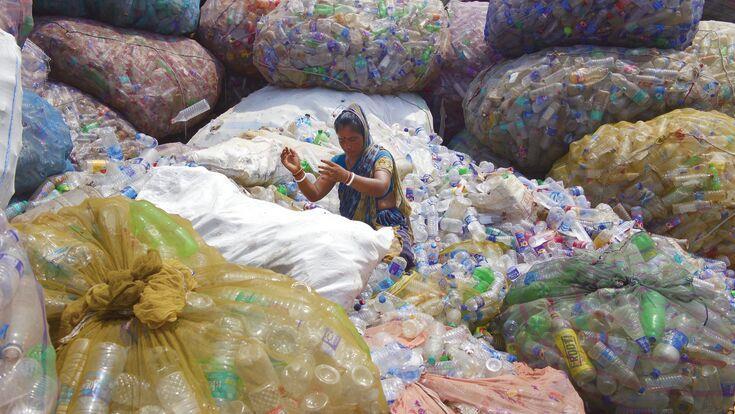
Segregation -Plasticwastecollectedfromvarioussourcesis carefully sorted to separate it from other materials. This thoroughsortingprocessensurestheplasticwasteisfreeof contaminants, facilitating efficient processing and smooth integrationintobituminousmixtures.
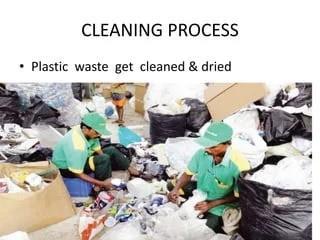
Cleaning Process -Thesortedplasticwasteissubjectedto thoroughcleaninganddryingtoeliminateanycontaminants, debris,ormoisture.Thisessentialstepensurestheplastic wastemeetsqualitystandardsforuseinroadconstruction. Clean, dry plastic waste improves particle adhesion and uniformdistributionwithinthebituminousmix,contributing toenhancedpavementdurabilityandperformance.
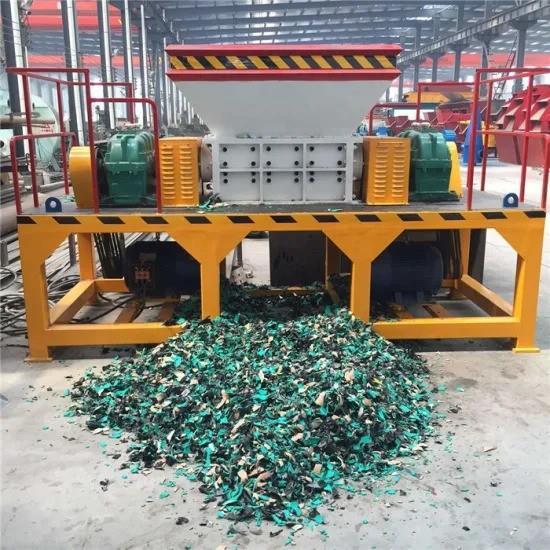
Shredding Process:- The cleaned plastic waste is finely shreddedorchoppedintosmall,consistentpiecestoensure uniform distribution within the bituminous mix. This process allows plastic particles to be evenly dispersed throughoutthemixture,enhancingthestability,durability, andperformanceoftheresultingpavement.
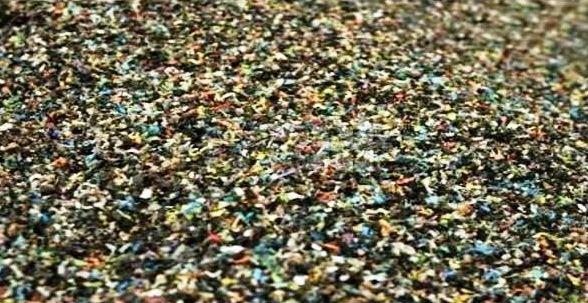
Collection Process - Plasticwaste particles retained on a 2.36 mm IS sieve are carefully gathered for further processing and integration into the bituminous mix. By selecting the ideal particle size, this step ensures optimal compatibilityandbondingbetweentheplasticparticlesand other components, thereby enhancing the overall performanceofthepavement.
5.RESULT AND DISCUSSION
Resultanddiscussion:MaterialTesting-Arangeoftestsare performedonbothaggregatesand bitumento thoroughly assesstheirproperties.Theseevaluationsinclude:
Teststobeperformedonaggregate:
Aggregate Impact Value Test: Measures the ability of aggregatestowithstandsuddenimpactsorshocks.
Los Angeles Abrasion Test:Determinestheresistanceof aggregatestowearandabrasion.
International Research Journal of Engineering and Technology (IRJET) e-ISSN: 2395-0056
Volume: 11 Issue: 11 | Nov 2024 www.irjet.net p-ISSN: 2395-0072
Water Absorption Test: Evaluates the water absorption capacity of aggregates, which reflects their porosity and potentialformoisturedamage.
Specific Gravity Test:Measuresthedensityofaggregatesin comparisontowater.
Stripping Value Test:Examinesthebondstrengthbetween aggregate and bitumen, indicating the mix’s resistance to moisture-inducedseparation.
Aggregate Crushing Test: It is used to assess the compressive strength of aggregates, which is crucial for understandingtheirabilitytoresistcrushingunderapplied loads.Aggregateswithalowcrushingvaluearepreferredfor high-strength,durablepavements,astheyarelesslikelyto breakdownunderheavyuse.
Tests to be performed on bitumen:
Penetration Value Test: Assesses the hardness or consistencyofbitumen.
Ductility Test:Measurestheabilityofbitumentostretch, showingitsflexibilityandelongationproperties.
Flash & Fire Point Test: Determinesthetemperatures at whichbitumenbecomesflammableandcombustible.
Softening Point Test: Identifiesthetemperatureatwhich bitumenbeginstosoften.
Sample Preparation:
MarshallStabilitysamplesarecreatedwithvaryingamounts of plastic waste (such as 5%, 10%, and 15%) alongside control samples without plastic. This addition of plastic wasteinthebituminousmixispreciselyadjustedtoexamine itseffectsonpavementqualitieslikestability,durability,and resiliencetotemperatureandmoisture.
Marshall Stability Testing: Marshall Stability tests are performed on all samples to assess their behavior under simulated load conditions. This test evaluates the pavement's resistance to deformation and failure under compressive forces, providing key insights into the structural performance of plastic-modified pavements versustraditionalbituminousmixes.
By following this detailed methodology, the study aims to systematically evaluate the advantages of adding plastic wastetobituminousmixesforroadconstruction.Through thorough testing and analysis, it explores how plastic modification influences pavement properties and overall performance,offeringvaluablecontributionstosustainable infrastructure practices and environmental conservation efforts.
Table-1: Resultsoftestsonaggregate
Table-2: ResultsoftestsonBitumen
Test
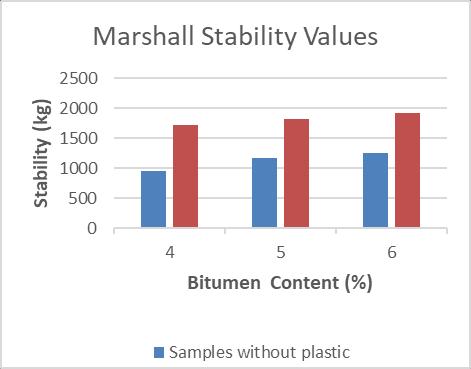
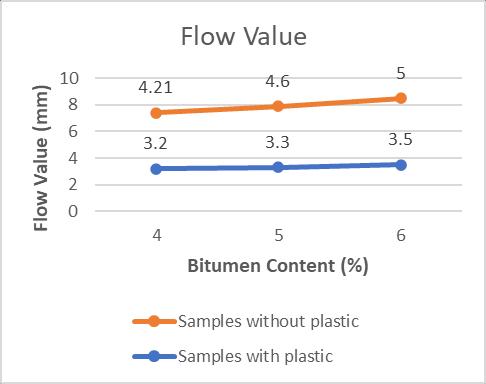
Table-3: MarshallStabilityandflowvalue
International Research Journal of Engineering and Technology (IRJET) e-ISSN: 2395-0056
Volume: 11 Issue: 11 | Nov 2024 www.irjet.net p-ISSN: 2395-0072
1 : - Stability(kg)andBitumenContent(%)
2 : - FlowValue(mm)andBitumenContent(%)
This study demonstrates that incorporating waste plastic intobituminousmixesofferssignificantpotentialtoimprove pavement performance while addressing environmental challengesassociatedwithplasticwaste.Byidentifyingthe ideal amount of plastic to incorporate and promoting sustainable road construction practices, a pathway to stronger, more eco-friendly infrastructure becomes clear. Plastic-modified pavements show improved durability, temperature stability, and resistance to moisture, making themespeciallysuitedforareaswithharshclimates,suchas thoseinIndia.
This research makes a valuable contribution to both infrastructureadvancementandenvironmentalprotection byadvocatingthereuseofplasticwasteinroadconstruction, reducingplasticpollutionwhileenhancingpavementquality.
In essence, utilizing plastic waste in road development providesaneffectivesolutiontoenvironmentalissuesand elevatesinfrastructurestandards.Withcontinuedresearch, innovativeapproaches,and well-plannedimplementation, plastic-modifiedpavementsofferasustainablepathtoward a resilient transportation system, benefiting communities andecosystemsalike.Thisapproachencouragesacircular economy, repurposing waste materials to build durable assets,andsupportingagreener,moresustainablefuturefor generationsahead.
1.AmitGawande,G.SZamre,V.CRengeG.RBharsakaleaand SaurabhTayde, utilization of waste plastic in asphalt of roads,scientificreviewsandchemicalcommunication.
2.Dr.SatishChandra,ShivKumar&RajeshKumarAnand, “SoilStabilizationwithRiceHuskAshandlineSludge”,India Highways, Indian Roads Congress, vol33 No. 5, May 2005, pp.87-98
3. Dr. S.S.Verma, “Road from Plastic state.”,ScienceTech Entrepreneur, March 2008 Gianni A.K. Modi, A.J., “Bio EnzymaticSoilStabilizersforConstructionofRuralRoads”, InternationalSeminaronSustainableDevelopmentinRoad Transport,NewDelhi-India8-10November2001
4. IRC: SP: 20-2002. “Rural Roads Manual”, Indian Roads Congress
5.Mroueh,U.M.,andWahlstrom,M.(2002).“By-Products andRecycledMaterialsinEarthConstructioninFinlandM an Assessment of Applicability.” Resources, Conservation andRecycling,No.35,2002,pp.117M129
6.MissAproova,useofplasticwasteinflexiblepavements, internationaljournalofinnovativeresearchinengineering andmanagement
7. Sherwood, P. T. (1995). “Alternative materials in road construction.“ThomasTelfordPublications,London,1995
8. Tara Sen, Umesh Mishra, “Usage of Industrial Waste ProductsinVillageRoadConstruction,”InternationalJournal of Environmental Science and Development, Vol. 1, No. 2, June2010
9. Vasudevan .R, utilization of waste plastics for flexible pavement,IndianHighWays(IndianRoadCongress),Vol.34, No.7.(July2006).
10. Sabina (2001) examined the properties of bituminous mixescontainingplasticorpolymer(PP)at8%and15%by bitumen weight, comparing them with conventional bituminous concrete made with 60/70 penetration-grade bitumen
International Research Journal of Engineering and Technology (IRJET) e-ISSN: 2395-0056
11. Wes Heidenreich, “Recycled plastic in highway construction and maintenance.” State Research report #525,July1997.


Volume: 11 Issue: 11 | Nov 2024 www.irjet.net p-ISSN: 2395-0072 © 2024, IRJET | Impact Factor value: 8.315 | ISO 9001:2008
Mr.DeepakAggarwalispresently workingasanAssistantProfessor in the Department of Civil Engineeringat SanskarCollege of Engineering and Technology, Ghaziabad,UP,India.
Mr. Rahul Kumar is presently workingasanAssistantProfessor &HeadintheDepartmentofCivil Engineeringat SanskarCollege of Engineering and Technology, Ghaziabad, UP, India. He has published so many research papers in national and internationaljournals