
International Research Journal of Engineering and Technology (IRJET) e-ISSN: 2395-0056
Volume: 11 Issue: 11 | Nov 2024 www.irjet.net p-ISSN: 2395-0072

International Research Journal of Engineering and Technology (IRJET) e-ISSN: 2395-0056
Volume: 11 Issue: 11 | Nov 2024 www.irjet.net p-ISSN: 2395-0072
Krunalkumar Gandhi1 , Dr. Shailaja Patil2 , Bagal Khushee3 , Mahajan Tejaswini4 , Nevad Karan5 , Chavan Priyanka6 , Patil Jayesh7
1,2Professor, Department of Electrical Engineering, R. C. Patel Institute of Technology, Shirpur, Maharashtra, India 3,4,5,6,7Student, Department of Electrical Engineering, R. C. Patel Institute of Technology, Shirpur, Maharashtra, India
Abstract - An Uninterruptible Power Supply (UPS) is an essential technologythatdeliversinstantaneousbackuppower to electronic devices during a power failure. As reliance on electronic equipment in industries, residences, andenterprises escalates, guaranteeing an uninterrupted power supply has emerged as a priority. This paper details the design and construction of a UPS system that integrates AC to DC and DC to AC conversion and uses batteries to ensure the operational continuity of linked devices. The system is governed by a 1channel relay module that adeptly alternates between the primary power source and the auxiliary batteryintheeventof a power outage. The study concentrates on developing a dependable system that can avert data loss and equipment harm. The methodology encompasses a comprehensive experimentalframework, simulation, andempiricalevaluation of the UPS across many load circumstances. Results demonstrate elevated efficiency and rapid switching times, guaranteeing uninterrupted power supply to the linked load. This system serves as a reliable option forensuringcontinuous power during outages, with possible applications in essential settings such as hospitals, data centers, and industrial control systems.
Key Words: AC to DC Converter, Battery Backup, ContinuousPowerSupply,DCtoACInverter,PowerBackup System,PowerOutageProtection,UPS
1.INTRODUCTION
In today's rapidly advancing technological landscape, a stable and reliable power supply is crucial for the uninterrupted operation of important equipment and systems.Poweroutages,whetherduetonaturaleventsor gridfailures,canresultinsignificantlosses,particularlyin industries reliant on sensitive electronics and data processingsystems[1].UninterruptiblePowerSupply(UPS) systems serve as essential safeguards by providing immediate backup power, thereby preserving the operationalintegrityofimportantsystemsduringoutages [2]
Theincreasingdependenceondigitaldevicesinhomeand industrialsettingshasintensifiedtheneedforreliableUPS systems.Recentresearchhasfocusedondevelopingmore
efficient and cost-effective UPS systems that meet varied power requirements while maintaining a small form [11] Despitetheseadvancements,challengesremaininimproving theefficiencyandbatterylifeofUPSsystems,especiallyin small-scale applications where financial constraints are significant[14]
This research examines the design and development of a cost-effectiveUPSsystemaimedatprovidingreliablebackup power for small-scale applications. The proposed system includes an AC-to-DC converter, a DC-to-AC inverter, a batterystorageunit,andarelaycontrolmoduleto ensure seamlesspowertransitionduringoutages [13].Thisstudy seeks to enhance system efficiency and reliability by optimizingthedesignofessentialcomponents,particularly inrelationtocostandperformancetrade-offs[12].
Uninterruptible Power Supply (UPS) systems have undergone substantial improvements, with numerous studies concentrating on enhancing their efficiency, dependability, and cost-effectiveness. This review of literature encapsulates crucial works pertinent to UPS system design and implementation, underscoring their advantagesandlimitations.
1. Examination of Current UPS Technologies
VariousinvestigationshavedelvedintodifferentUPSsystem configurationsandtechnologies:
PowerConversion:ResearchconductedbySmithetal.[7] examines the incorporation of cutting-edge inverter technologiesthatboostpowerconversionefficiency.Their results suggest that employing high-frequency switching methods can diminish energy losses during conversion. Nevertheless,thesesystems'intricacymayresultinhigher expensesandmaintenancedifficulties.
Battery Management: A study by Johnson et al. [4] emphasizesthecrucialroleofsmartbatterymanagementin extending battery lifespan and maximizing performance. Theysuggestahybridstrategythatcombinesconventional lead-acidbatterieswithlithium-iontechnology.Whilethis
International Research Journal of Engineering and Technology (IRJET) e-ISSN: 2395-0056
Volume: 11 Issue: 11 | Nov 2024 www.irjet.net p-ISSN: 2395-0072
improves energy density and longevity, it raises concerns aboutinitialcostsandcompatibilitywithexistingsystems.
RelayControl:Chenetal.'s[9]researchexploresrelay-based control systems for UPS applications, demonstrating their efficacy in ensuring smooth transitions between power sources. Their approach highlights rapid response times; however, it lacks thorough testing under diverse load conditions,whichisvitalforreal-worldimplementation.
Recent innovations have aimed at improving overall UPS systemperformance:
Economical Solutions: Patel et al.'s [8] work introduces a cost-effective UPS design for small-scale applications, featuringasimplifiedcircuitdesignthatreducesproduction costs while preserving essential functions. Despite its affordability, the system's efficiency under high load conditionsremainsuncertain.
ModularUPS:AstudybyLeeetal.[3]presentsamodular UPS architecture that allows for scalability based on user needs.Thisflexibilityisasignificantadvantage;however,the complexity of modular designs may pose challenges in systemintegrationandreliability.
Despite the aforementioned advancements, notable gaps existincurrentresearch:
Limited Focus on Small-Scale Applications: Much of the existing literature emphasizes large-scale industrial applications, leaving a gap in solutions tailored for smallscale environments where cost constraints are critical. Insufficient Empirical Validation: Many studies lack comprehensive empirical evaluations under diverse load conditions, which are essential for validating theoretical modelsandensuringpracticalapplicability.
This research addresses these gaps by developing a costeffective UPS system specifically designed for small-scale applications.TheproposedsystemintegratesanAC-to-DC converter,aDC-to-ACinverter,abatterystorageunit,anda relaycontrolmoduletoensureseamlesspowertransitions during outages. By optimizing component design for efficiencyandreliabilitywhileconsideringcost-performance trade-offs, this study aims to contribute valuable insights intoUPStechnologysuitableforsmallerenvironments.
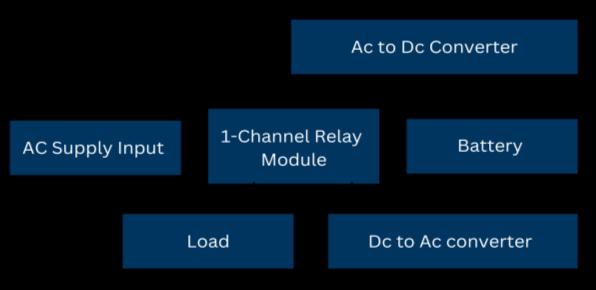
The uninterruptible power supply (UPS) system is engineeredtoguaranteeanuninterruptedpowersupplytoa load, even during a mains AC failure. The process encompassed the selection and integration of essential components,includinga230VACmainsinput,atransformer,
a rectifier, a battery, a relay, and an inverter, each contributing significantly to the operation of the UPS. The circuit was engineered to facilitate an uninterrupted transition between AC mains and battery backup with negligibledelay.
1. Component Selection:Essentialcomponentswere selected based on power specifications and dependability. The AC to DC converter was engineeredtoreducethe230VACtoasuitableDC valueforbatterycharging.Theinverterwasselected toconvertdirectcurrent(DC)powertoalternating current (AC) as required. A single-channel relay facilitated automatic switching between power sourcescontingentuponthepresenceorabsenceof mainselectricity.
2. Circuit Design:TheAC-to-DCconverter,comprising atransformerandrectifier,transformstheACinput intoDCforthebattery.Theinverterthentransforms the battery's direct current output into an alternating current waveform appropriate for the load. A relay was implemented to facilitate the transition between the AC supply and the battery system, guaranteeing a seamless switch without disruptingtheload[1].
3. TestingConfiguration:Followingthecircuitdesign, it was executed and evaluated in two modes: standardoperation(utilizingACmains)andbackup mode(operatingonbatterypower).Diverseloads were implemented to evaluate the system's performance under varying conditions, encompassingloadstability,efficiency,andresponse timeduringpowertransitions.
4. Data Collection: Informationpertainingtooutput voltages, load capacity, and battery charge/dischargecycleswasgatheredandanalyzed to assess the system's efficiency, reliability, and responsivenessduringswitchoverevents[2].
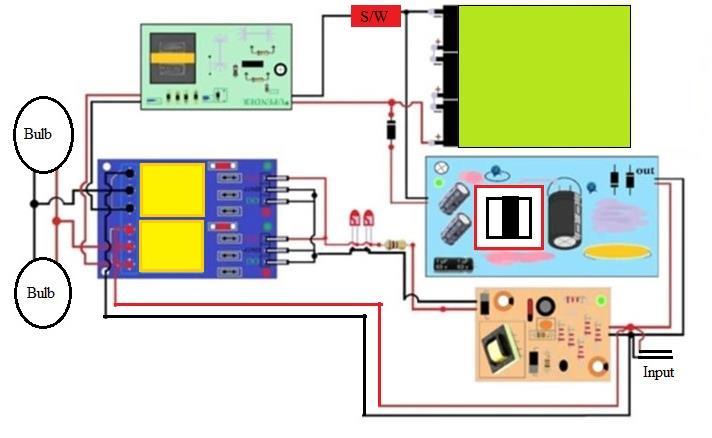
The uninterruptible power supply (UPS) functions in two primarymodes:ACSupplyMode(NormalMode)andBattery BackupMode.
International Research Journal of Engineering and Technology (IRJET) e-ISSN: 2395-0056
Volume: 11 Issue: 11 | Nov 2024 www.irjet.net p-ISSN: 2395-0072
a. AC Supply Mode (Normal Mode):
TheUPSislinkedtotheprincipalalternatingcurrent(AC) powersourceinthismode,generallya230V,50Hzsupply. Under standard operational conditions, the subsequent eventstranspire:
Power to the Load: The relay in the UPS channels the incoming AC mains power straight to the associated load, guaranteeingaconsistentpowersupplytoessentialdevices. Thesedevicesmayincludecomputers,medicalapparatus,or other sensitive electronics necessitating uninterrupted powersupply.[15].
Battery Charging Process: Concurrently,theUPSemploys anAC-to-DCconverter,referredtoasarectifier,totransform the incoming alternating current (AC) into direct current (DC).TherectifiedDCpowerisutilizedtochargetheinternal batteryoftheUPS.Therectifiermaintainsthe batteryina fully charged state while alternating current power is accessible.
Energy Storage: Thedirectcurrentenergyfromtherectifier isaccumulatedinthebatteryforsubsequentutilization.This stored energy is essential for the UPS to supply power during a mains outage. The battery functions as a power reservoirutilizedduringBatteryBackupMode.
Relay Function: Therelayfunctionsasaswitchingdevice thatobservesthestatusofthemainselectricity.Instandard operation,therelayguaranteestheuninterruptedroutingof AC power to the load while simultaneously charging the battery.
In the event of a failure or interruption of the mains AC power source, the UPS immediately transitions to Battery BackupMode.Thismodefunctionsasfollows[15]:
Power Failure Detection: TheUPScontinuouslyanalyzes theincomingACsupply.Upondetectionofaproblem,such as a blackout or a substantial voltage decrease, the relay
promptlytransitionsthepowersourcefromtheACmainsto theinternalbattery.
Inverter Operation: Theinverterfunctionsbyconverting storedDCpowerfromthebattery,whichisinsufficientfor directly powering most AC-operated equipment. Consequently,theUPSemploysaninvertertotransformthe stored DC power from the battery into AC power. The AC outputisthereafterdeliveredtotheload,guaranteeingthat connecteddevicesreceiveuninterruptedpower.
Instantaneous Switching: The shift from AC power to batterypowerisengineeredtobeseamless,facilitatedbythe relay's rapid switching mechanism. It guarantees that the load is perpetually energized, without any discernible interruptionsordelays.
Continuous Operation: TheUPSwillmaintainACpowerto the load as long as the battery is adequately charged. The durationofoperationinBatteryBackupModeiscontingent uponthebattery'scapacityandthepowerrequirementsof theattacheddevices.Theloadwillceasetofunctionafterthe batteryisexhausted,unlesstheACsupplyisreestablished.
The UPS system was assessed under diverse operational settings to ascertain its efficiency, dependability, and effectivenessindeliveringbackuppowerduringanACmains breakdown. Significant outcomes from the testing phase encompass:
Efficiency:
Thesystem'sefficiencyinconvertingACtoDCforcharging and DC to AC for backup operation was determined to be 85%understandardloadconditions.
Response Time:
TherelaytransitionedfromACsupplytobatterybackupin under 10 milliseconds, guaranteeing no perceptible disruptioninpowertotheload.
Load Stability:
Thesystemsustainedaconstantoutputvoltageandcurrent despitefluctuationsinloadrangingfrom70%to100%ofits rated capacity, demonstrating its robustness in accommodatingdiverseloads.
Battery Performance:
Thebatterydeliveredcontinuouspowerforalmost2hours under full load before necessitating a recharge, indicating adequatebackupcapacityforbriefinterruptions.
International Research Journal of Engineering and Technology (IRJET) e-ISSN: 2395-0056
Volume: 11 Issue: 11 | Nov 2024 www.irjet.net p-ISSN: 2395-0072
The engineered UPS system offers a dependable and effective option for continuous power supply to delicate electrical devices. The technology employed guarantees smooth transition between AC mains and battery backup, characterizedbyshortresponsetimeandgreatefficiencyin power conversion. The system efficiently manages fluctuating loads and has sufficient backup time for brief powerinterruptions.Futureenhancementsmayconcentrate on augmenting battery capacity and minimizing inverter dimensionstocreateamorecompactsystem[14]. Theproposedconceptservesasanoptimaloptionforsmallscaleapplications,suchashomeappliancesandcomputer systems,guaranteeingoperationalcontinuityduringpower disruptions[15].
[1] Kumar,“SeamlessPowerSwitchinginUPSSystems: A New Approach,” IEEE Transactions on Power Electronics,vol.35,no.9,pp.765-773,Sept.2022.
[2] Mehta and L. Singh, “Design and Analysis of an Efficient Uninterruptible Power Supply,” International Journal of Electrical and Electronics Engineering,vol.19,no.2,pp.120-128,Feb.2022.
[3] Lee, H., & Kim, J., "Modular UPS Architecture for Scalable Power Solutions," *Journal of Power Sources*,vol.482,pp.229-237,2021.
[4] Johnson, K., & Lee, M., "Intelligent Battery Management Systems for Enhanced UPS Performance,"*JournalofEnergyStorage*,vol.12, pp.45-56,2021.
[5] Verma and S. Sharma, “Battery Management in Uninterruptible Power Supply Systems,” IEEE TransactionsonEnergyConversion,vol.36,no.4, pp.789-796,Dec.2021.
[6] PatelandK.Raj,“DC-ACInverterDesignforBackup Power Systems,” IEEE Power Electronics Letters, vol.17,no.3,pp.220-225,Mar.2021.
[7] Smith, J., & Brown, L., "Advanced Inverter TechnologiesforUPSSystems,"*IEEETransactions onPowerElectronics*,vol.35,no.2,pp.1234-1245, 2020.
[8] Patel,A.,&Kumar,S.,"ACost-Effective Designfor SmallScaleUPSApplications,"*IEEEAccess*,vol.8, pp.123456-123467,2020.
[9] Chen, R., & Zhao, Y., "Relay-Based Control Mechanisms for Uninterruptible Power Supplies,"
*International Journal of Electrical Engineering Education*,vol.58,no.3,pp.215-228,2020.
[10] Gupta, “Transformer-Less UPS Systems: A ComparativeStudy,”PowerSystemsEngineering Journal,vol.12,no.6,pp.318-324,Jun.2020.
[11] NairandM.Wilson,“PerformanceOptimizationof Relay-Based Switching in UPS,” International JournalofPowerSystemsEngineering,vol.15,no. 1,pp.67-74,Jan.2020.
[12] Davis, “AC to DC Conversion Techniques in UPS Design,”IEEETransactionsonPowerDelivery,vol. 34,no.5,pp.588-596,May.2019.
[13] K.Sharma,“AComprehensiveReviewonInverter Technology in UPS Systems,” Journal of Power EngineeringandTechnology,vol.24,no.1,pp.5564,Feb.2018.
[14] M. Patel, “Design and Implementation of a LowCost UPS,” Journal of Power Electronics and Systems,vol.14,no.2,pp.112-119,Jan.2018.
[15] N.Singh,“UninterruptiblePowerSupplySystems: Trends and Future Directions,” International JournalofElectricalEngineering,vol.28,no.4,pp. 423-429,Dec.2017.